
| REPORT ATTRIBUTE | DETAILS |
|---|---|
| Historical Period | 2019-2022 |
| Base Year | 2023 |
| Forecast Period | 2024-2032 |
| Smart Grid Data Analytics Market Size 2023 | USD 4845.9 million |
| Smart Grid Data Analytics Market, CAGR | 13.20% |
| Smart Grid Data Analytics Market Size 2032 | USD 14790.8 million |
Market Insights
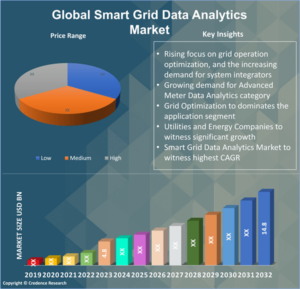
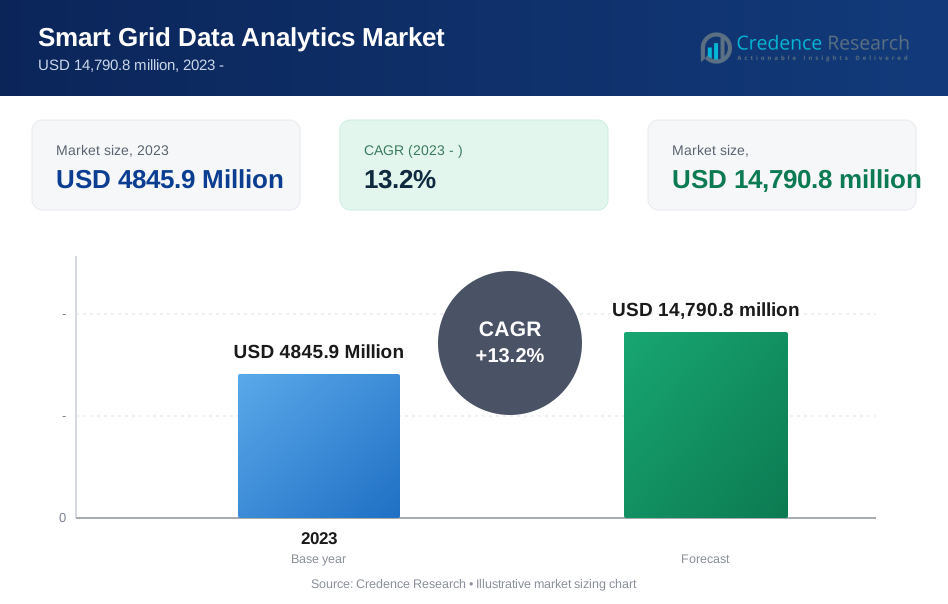
- The Smart Grid Data Analytics Market showcased remarkable growth, reaching a valuation of USD 4845.9 million in 2023 and is projected to soar to USD 14790.8 million by 2032, indicating a robust CAGR of 13.20% between 2024 and 2032.
- Among its primary segments, Meter Data Analytics held the largest market share, accounting for approximately 45-50% in 2023, attributed to the widespread deployment of Advanced Metering Infrastructure (AMI) and its multifaceted applications in load forecasting, outage detection, and billing optimization. Meanwhile, the Sensor and IoT Data segment is anticipated to experience rapid growth due to increased integration of IoT devices in the grid for real-time monitoring and control purposes.
- Grid Optimization dominates the application segment, comprising around 35% of the market in 2023, playing a pivotal role in maximizing grid efficiency and managing peak demand. Cybersecurity Analytics, with its real-time threat detection capabilities, is projected to have the fastest CAGR during the forecast period, given the increased vulnerability of smart grids to cyber threats.
- Descriptive Analytics constitutes the largest share in the analytics type segment, approximately 40% in 2023, owing to its diverse applications and ease of implementation. However, Predictive Analytics is expected to witness the fastest CAGR, leveraging historical data and weather patterns to forecast energy demand accurately.
- On-Premises deployment model maintains dominance with a market share of approximately 60% in 2023 due to data security concerns and customization benefits. Nonetheless, Cloud-Based deployment is projected to witness the highest growth rate, offering flexible pay-as-you-go models.
- Data Integration Platforms (DIPs) lead the data integration and management segment, holding approximately 55% of the market share in 2023, essential for ingesting and harmonizing vast volumes of data generated by smart grids. Data Management and Storage Solutions are gaining prominence owing to increased adoption of AI and machine learning in smart grid analytics.
- The transmission grid segment commands a predicted 65% market share in 2023, emphasizing its criticality and the need for advanced analytics for stability and clean energy goals. Distribution Grid, on the other hand, is poised for the fastest CAGR due to increased penetration of distributed energy resources and advancements in edge computing and IoT.
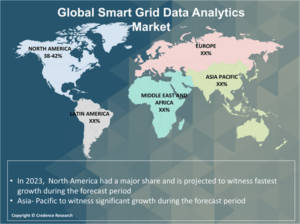
- North America holds the largest market share of around 35% in 2023, driven by advancements in energy technology, robust infrastructure, and significant investments in smart grid initiatives. Asia Pacific and Europe together account for nearly 55% of the market share, showcasing substantial growth potential driven by infrastructural developments in energy and a surge in adoption of smart grid data analytics systems.
- The rising demand for energy efficiency is a significant opportunity for the market, aligning with global concerns about climate change. Smart grid data analytics plays a crucial role in ensuring efficient energy use, minimizing wastage, and optimizing the overall system.
This market's growth is primarily propelled by the increasing need for sophisticated data analytics solutions to manage the complexities within smart grid infrastructure, fostering innovations and collaborations among industry players to address evolving energy demands efficiently.
Executive Summary
Market Definition
The smart grid is an advanced electrical grid that utilizes two-way communication and distributed intelligent devices to enhance the efficiency and reliability of electricity generation, transmission, and distribution. It enables real-time monitoring and response to changing electricity demand, leading to a more resilient and secure energy infrastructure. The smart grid also empowers consumers by providing them with information and tools to make informed choices about their energy use. Major focus areas for the smart grid include demand-side management, integration of renewable energy sources, and improved network flexibility.
Market Overview
The Smart Grid Data Analytics Market has exhibited consistent growth in recent years, projecting a robust CAGR of 13.20% between 2024 and 2032. In 2023, the market size was valued at USD 4,845.9 million, with estimations pointing towards a substantial rise to USD 14,790.8 million by 2032.
The driving force behind the growth of the Smart Grid Data Analytics Market lies in the increasing demand for sophisticated data analytics systems. This surge is primarily catalyzed by the evolving landscape of energy consumption and grid management, where existing methods face challenges in optimizing efficiency and responding to dynamic demands effectively. The need for precise and data-driven analytics platforms is crucial to navigate complexities within smart grid infrastructure.
For instance, in June 2023, according to IEA, global renewable power capacity additions are expected to increase by 107 GW in 2023 in Europe, the largest absolute increase ever, driven by policy momentum, higher fossil fuel prices, and energy security concerns. Solar PV additions will account for two-thirds of the increase, and wind power additions will rebound sharply. Europe's renewable capacity additions have been revised upwards by 40% due to high electricity prices and increased policy support. Newly installed solar PV and wind capacity has saved EU electricity consumers EUR 109.2 billion. Government policies need to adapt to changing market conditions and focus on timely planning and investment in grids to integrate high shares of variable renewables in power systems. The news about the expected increase in global renewable power capacity additions and the revision upwards of Europe's renewable capacity additions is likely to have a positive impact on the Smart Grid Data Analytics Market. As the share of renewable energy sources in the power grid increases, the need for advanced data analytics solutions to manage and optimize the integration of these intermittent sources becomes more pressing.
Segmentation by Data Source
- Meter Data Analytic segment held the largest share in 2023, comprising around 45-50% of the overall market. Factors contributing to its dominance include Widespread deployment of Advanced Metering Infrastructure (AMI) generating vast amounts of granular data. Use of meter data for various applications like load forecasting, outage detection, and billing optimization.
- Sensor and IoT Data segment is expected to have the fastest CAGR during the forecasted period. Drivers of its rapid growth include increasing integration of IoT sensors and devices in the grid, generating diverse data for real-time monitoring and control. Emerging applications like asset health monitoring, fault prediction, and distributed energy resource management.
Segmentation by Application
- Grid Optimization hold largest market share of around 35% in 2023, grid optimization currently reigns supreme. This dominance primarily stems from its vital role in maximizing grid efficiency, managing peak demand, and minimizing energy losses.
- Cybersecurity Analytics segment is anticipated to have the fastest CAGR during the forecast period. The smart grid's increased dependence on digital infrastructure makes it highly vulnerable to cyberattacks. Cybersecurity analytics solutions provide real-time threat detection, anomaly identification, and mitigation strategies, safeguarding critical grid infrastructure.
Segmentation by Analytics Type
- Descriptive Analytics segment is expected to hold the largest market share of approximately 40% in 2023. Its dominance stems from its wide-ranging applications and ease of implementation.
- Predictive Analytics segment is projected to have the fastest CAGR during the forecast period owing to Predicting future energy demand with accuracy enables utilities to optimize generation, minimize energy waste, and prepare for peak loads. Predictive analytics algorithms lever historical data and weather patterns to create accurate demand forecasts.
Segmentation by Deployment Model
- On-Premises segment is expected to hold the largest market share of approximately 60% in 2023. Several factors contribute to its dominance such as Data security concerns, Customization and control, and Limited internet connectivity.
- Cloud-Based segment is projected to have the fastest CAGR owing to this solutions offer flexible pay-as-you-go models, eliminating upfront hardware and software investments. This scalability makes them more attractive for smaller utilities or those with limited budgets.
Segmentation by Data Integration and Management
- Data Integration Platforms (DIPs) segment is expected to hold the largest market share of approximately 55% in 2023. Several factors contribute to its dominance such as high volume and variety of data: Smart grids generate vast amounts of data from diverse sources like smart meters, sensors, and legacy systems. DIPs provide the crucial first step of ingesting, cleansing, and harmonizing this data into a usable format for analytics.
- Data Management and Storage Solutions segment is projected to have the prominent market share in 2023 owing to the increasing adoption of AI and machine learning in smart grid analytics demands robust data storage and management solutions. These solutions ensure efficient data retrieval, archiving, and retrieval for advanced analytics models.
Segmentation by Cybersecurity Solutions
- Security Information and Event Management (SIEM) Systems segment is expected to hold the largest market share of approximately 60% in 2023. Several factors contribute to its dominance such as Centralized log aggregation and analysis, Correlation and threat detection, and others.
- Intrusion Detection Systems (IDS) segment is projected to have the fastest CAGR during the forecast period owing to the Real-time network traffic monitoring, and other factors.
Segmentation by Grid Scale
- The transmission grid boasting a predicted 65% market share in 2023. This dominance owing to its vast footprint, high-voltage flows, and critical nature; disruptions here have ripple effects. Governments and regulators prioritize its modernization, including data analytics for enhanced stability and clean energy goals.
- Distribution Grid segment is projected to have the fastest CAGR during the forecast period owing to several factors such as Increased penetration of distributed energy resources, Advancements in edge computing and IoT, and others.
Segmentation by Region
- North America holds largest market share in 2023 with approx 35% of the Smart Grid Data Analytics Market. This dominance is fueled by significant advancements in energy technology, robust infrastructure in the utilities sector, increased investment in smart grid initiatives, and a strong focus on innovation and R&D within the energy domain.For instance, in Nopvember 2023, the US Department of Energy awarded $3.5 billion in grants to 58 projects across 44 states to modernize the power grid and integrate more renewable energy sources. The funding, provided by the bipartisan infrastructure law signed in 2021, is the largest-ever direct investment in the grid and aims to improve its resilience against extreme weather and fires.
- Asia Pacific and Europe together accounting for nearly 55% of the market share in 2023, where Europe secures over 20% share within the same year. Asia Pacific showcases remarkable growth propelled with significant CAGR growth in future by rapid infrastructural developments in energy, expanding utilities industries, and a surging adoption of advanced smart grid data analytics systems For instance, October 2023, Amazon has reached a milestone of 50 renewable energy projects in India, with a new 198 MW wind farm in Osmanabad, Maharashtra. The company has now surpassed 1.1 GW of renewable energy capacity in India and is the largest corporate buyer of renewable energy globally. Amazon's renewable energy projects have generated over $12 billion in additional investment in local communities worldwide, including $349 million in India, and have supported over 20,600 local jobs in 2022. Europe, renowned for its emphasis on sustainable energy initiatives and technological innovation, remains a pivotal contributor to the market's expansion.
- Rest of the World (Latin America, Middle East, and Africa) Contributing to the remaining demand for Smart Grid Data Analytics, these regions are displaying an increasing interest in adopting cutting-edge solutions for energy management. The growth is underpinned by a rising need to address energy challenges, improve grid resilience, and enhance energy accessibility, especially in the face of evolving energy landscapes.
The Smart Grid Data Analytics Market is witnessing heightened collaborations and partnerships among key industry players. This trend is anticipated to further propel market growth, fostering increased adoption of advanced smart grid data analytics solutions globally, across various regions, and promoting innovations in energy management strategies.
In 2023, North America is poised to lead the global Smart Grid Data Analytics Market. The region's dominance is attributed to its well-established energy infrastructure, substantial growth in renewable energy adoption, and the presence of key industry players like Siemens AG, Itron Inc., and General Electric Company. Additionally, the increasing prevalence of energy challenges such as grid optimization needs, cybersecurity concerns, and the demand for enhanced data analytics tools to address these issues further accelerates market growth in North America. For instance, in November 2022, Siemens Smart Infrastructure partnered with SEW, a cloud platform provider, to enhance customer and workforce experiences for utility smart meter users. SEW's solutions, powered by AI, ML, and IoT analytics, will be integrated with Siemens' open, modular, and interoperable grid software suite, which supports utilities in planning, operating, maintaining, and optimizing grids. This partnership is part of Siemens' strategy to create an ecosystem of partners with complementary portfolios to accelerate digital transformation and value creation across industries.
The Asia Pacific region is forecasted significant CAGR of the Smart Grid Data Analytics Market, primarily due to an upsurge in energy consumption, technological innovations, and significant contributions from industry leaders in expanding their presence. Collaborations and expansions, such as joint ventures between major energy solution providers, have bolstered the market's growth. For instance, in July 2022, Idemitsu Kosan Co. and Skye Renewables Holdings Pte. Ltd. partnered to promote renewable energy development in Southeast Asia, focusing on C&I solar projects in Singapore, Malaysia, Philippines, and Vietnam. They will jointly develop projects, install advanced solar power systems, and provide high-quality renewable energy and differentiated solutions in energy efficiency and ESG management. The partnership aims to become a prominent solar solution provider in the region and contribute to a more sustainable society.
Moreover, the growing awareness and adoption of smart grid technologies in emerging economies like India, Japan, and China are main factors driving market growth. These regions are witnessing an increasing demand for advanced energy management solutions, emphasizing the need for more sophisticated smart grid data analytics systems to address evolving energy demands efficiently.
Key Highlights of the Report
The Smart Grid Data Analytics market is segmented based on Data Source, Application, Analytics Type, Deployment Model, Data Integration and Management, Cybersecurity Solutions, Grid Scale, and Region. The increasing complexity in energy consumption and grid management has propelled the demand for sophisticated data analytics solutions across multiple sectors, including energy, utilities, and infrastructure. This demand surge is a response to the challenges faced by traditional methods in optimizing efficiency and responding to dynamic energy demands effectively.
Meter Data Analytics holds a significant position in the Smart Grid Data Analytics Market, contributing substantially, primarily through the deployment of Advanced Metering Infrastructure (AMI) and its diverse applications in load forecasting, outage detection, and billing optimization. Concurrently, the growth of the Sensor and IoT Data segment is notable, driven by the integration of IoT sensors in grid infrastructure for real-time monitoring and control purposes.
Major user segments encompass grid optimization, cybersecurity analytics, and predictive analytics, reflecting a diverse application of data analytics solutions in maximizing grid efficiency, mitigating cyber threats, and forecasting energy demands accurately.
North America leads the market growth, housing prominent players such as Siemens AG, Itron Inc., and General Electric Company. This dominance is attributed to a well-established energy infrastructure and significant investments in smart grid initiatives, reflecting the region's strong focus on technological advancements and security across the energy sector.
The market's trajectory indicates a growing reliance on sophisticated data analytics solutions to address the evolving challenges within smart grid infrastructure, fostering innovation and technological collaborations among key industry players across different sectors, including energy, utilities, and technology providers.
What Are The Main Drivers Of The Global Smart Grid Data Analytics Market?
The main drivers of the market include the increasing adoption of smart grid solutions, the growing need for data-driven decision-making, government initiatives, cloud-based deployment, and the increasing focus on semiconductor R&D and smart vehicle development.
What Are The Major Challenges Faced By The Global Smart Grid Data Analytics Market?
The high cost of smart grid systems is anticipated to be a significant challenge, leading utility providers to rely on traditional grid systems due to uncertainties. While the integration of modern technologies such as IoT and smart sensors drives the demand for smart grid data analytics, it also presents challenges in terms of system integration, interoperability, and data management.
What Are The Growth Opportunities In The Global Smart Grid Data Analytics Market?
Government efforts worldwide are driving market growth, with North America expected to hold the largest share in the global smart grid data analytics market. The introduction of modern technologies such as IoT is expected to fuel the smart grid data analytics market.
Market Drivers
Increasing Demand For Energy Efficiency
As concern about climate change grows, people want ways to use less energy and reduce their carbon footprint. Smart grid data analytics helps utilities make sure energy gets used efficiently, cutting down on wasted energy and making the whole system run better. For instance, by using data analytics, a utility might find that a particular neighborhood uses way more energy than others during peak hours, and then work with residents to install smart thermostats that automatically lower temperatures when no one's home.
Market Restraints
Data Privacy and Security Concerns
Data privacy and security concerns are a major challenge in smart grid data analytics. The use of smart grid technologies involves collecting and analyzing large amounts of sensitive data, such as energy consumption patterns, demographic information, and personal behavior. This data can be vulnerable to cyber attacks and data breaches, which could compromise the privacy of consumers and put their personal information at risk. For instance, a hacker could gain access to a consumer's smart meter data and learn details about their daily routine, including when they are home and away, potentially putting them at risk of burglary or other crimes. To address these concerns, utilities must implement robust security measures and comply with strict regulations, such as the General Data Protection Regulation (GDPR) in the European Union, to protect consumer data and maintain their trust.
Opportunities
Market Players Contribution Drives the Market Growth by the Adoption of Various Strategies
The major companies serving the global smart grid market include ABB Ltd., Siemens AG, IBM Corp., General Electric Corp., and Landis+Gyr AG, among others. The market players are considerably contributing to the market growth by the adoption of various strategies including mergers & acquisitions, partnerships, geographical expansion, and collaborations to stay competitive in the market. For instance, in January 2021, Schneider Electric acquired DC Systems BV, which is a major supplier of smart systems. This has helped the company in advancing innovations in electrical distribution.
Competitive Landscape
Key Players
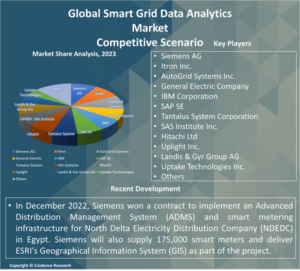
The global Smart Grid Data Analytics market is highly competitive, with several key players. Some of the major players in the market and their market share are as follows:
- Siemens AG
- Itron Inc.
- AutoGrid Systems Inc.
- General Electric Company
- IBM Corporation
- SAP SE
- Tantalus System Corporation
- SAS Institute Inc.
- Hitachi Ltd
- Uplight Inc.
- Landis & Gyr Group AG
- Uptake Technologies Inc.
- Others
These organizations prioritize product innovation, distribution channel expansion, and mergers and acquisitions to stay competitive.
The global Smart Grid Data Analytics market's key players continually seek to stay ahead by offering new products and developments.
In December 2022, Siemens announced plans to provide 175,000 smart meters and an advanced distribution management system in the Damietta area of the Nile Delta. The order, valued at over EUR 40 million (USD 42 million), was given to the North Delta Electricity Distribution Company (NDEDC) as part of the grid modernization and improvement initiative.
In September 2022, Itron combined its Industrial Internet of Things (IIoT) network solution with Samsung's SmartThings services to give utilities access to a system that improves distributed energy resource management (DERMS), cuts carbon emissions, and engages customers. The partnership will use the SmartThings Energy service to give real-time energy readings and usage trends using Itron's distributed intelligence (DI) network, which the business claims has millions of linked endpoints.
Summary of Key Findings
- The escalating demand for sophisticated data analytics solutions across energy, utilities, and infrastructure sectors propels the growth of the Smart Grid Data Analytics Market. This surge is a direct response to the inefficiencies of conventional grid management systems, driving the market's expansion.
- Market segmentation is based on data source, application, analytics type, deployment model, data integration, cybersecurity solutions, grid scale, and region, illustrating the diverse applications and specialized approaches within the Smart Grid Data Analytics sector.
- Meter Data Analytics emerges as a pivotal segment, offering comprehensive applications through Advanced Metering Infrastructure (AMI) and its utilization in load forecasting, outage detection, and billing optimization. Concurrently, the rapid growth of Sensor and IoT Data segment signifies its importance in real-time monitoring and control of grid infrastructure.
- Major user segments encompass grid optimization, cybersecurity analytics, predictive analytics, showcasing the widespread adoption of data analytics solutions across the energy and utilities domain. The growing integration of these solutions in smart grid infrastructure indicates a shift toward more efficient and reliable energy management.
Future Outlook
- The Smart Grid Data Analytics Market displays a promising outlook, particularly in North America, propelled by the increasing reliance on advanced analytics systems across the energy and utilities sectors.
- An anticipated challenge in the forecast period involves the preference for wireless data analytics solutions among consumers, influencing market dynamics and technological shifts.
- Key industry players should prioritize product innovation, market expansion, and competitive pricing strategies to remain relevant amidst evolving consumer preferences and the dynamic landscape of the data analytics market within the energy sector.
How CXOs Can Benefit from the Credence Research Smart Grid Data Analytics Market Report
The Credence Research Smart Grid Data Analytics Market Report provides CXOs with a comprehensive overview of the market, including:
- Market size and growth forecast:The report provides detailed estimates of the global Smart Grid Data Analytics market size, segmented by fiber type, network type, application, and region. It also includes forecasts for the market through 2032, based on key trends and drivers.
- Market segmentation:The report segments the Smart Grid Data Analytics market by fiber type, network type, application, and region. This segmentation provides CXOs with a granular understanding of the market and the opportunities in each segment.
- Competitive landscape:The report profiles the key players in the Smart Grid Data Analytics market and provides insights into their strategies, product offerings, and financial performance. This information can help CXOs to identify and assess their competition.
- Key trends and drivers:The report identifies and analyzes the key trends and drivers that are shaping the Smart Grid Data Analytics market. This information can help CXOs to make informed decisions about their investments and strategies.
CXOs can use the insights from the Credence Research Smart Grid Data Analytics Market Report to:
- Identify growth opportunities:The report can help CXOs to identify new growth opportunities in the Smart Grid Data Analytics market. For example, the report identifies the growing demand for Smart Grid Data Analytics from cloud computing providers and telecom companies as a key opportunity.
- Make informed investment decisions:The report can help CXOs to make informed investment decisions about Smart Grid Data Analytics. For example, the report provides insights into the key factors to consider when evaluating dark fiber providers and selecting dark fiber solutions.
- Develop competitive strategies:The report can help CXOs to develop competitive strategies for their Smart Grid Data Analytics businesses. For example, the report identifies the key strategies that dark fiber providers are using to differentiate themselves from their competitors.
- Track market developments:The report can help CXOs to track market developments and stay ahead of the curve. For example, the report provides insights into the latest trends and innovations in the Smart Grid Data Analytics market.
Overall, the Credence Research Smart Grid Data Analytics Market Report is a valuable resource for CXOs who are looking to gain a deeper understanding of the market and identify opportunities for growth.
Segmentation
- By Data Source:
- Meter Data Analytics
- Sensor and IoT Data
- SCADA (Supervisory Control and Data Acquisition) Systems
- Weather Data Integration
- Social Media and Customer Data
- By Application:
- Grid Optimization
- Demand Response
- Asset Management
- Fault Detection and Diagnostics
- Cybersecurity Analytics
- Customer Engagement
- By Analytics Type:
- Descriptive Analytics
- Predictive Analytics
- Prescriptive Analytics
- Diagnostic Analytics
- By Deployment Model:
- On-Premises
- Cloud-Based
- By End-User:
- Utilities and Energy Companies
- Grid Operators and Managers
- Government and Regulatory Bodies
- Smart Grid Solution Providers
- By Data Integration and Management:
- Data Integration Platforms
- Data Management and Storage Solutions
- By Cybersecurity Solutions:
- Intrusion Detection Systems
- Security Information and Event Management (SIEM) Systems
- By Grid Scale:
- Transmission Grid
- Distribution Grid
- By Region
- North America
- US
- Canada
- Mexico
- Europe
- Germany
- France
- UK.
- Italy
- Spain
- Rest of Europe
- Asia Pacific
- China
- Japan
- India
- South Korea
- South-east Asia
- Rest of Asia Pacific
- Latin America
- Brazil
- Argentina
- Rest of Latin America
- Middle East & Africa
- GCC Countries
- South Africa
- Rest of Middle East and Africa
- North America
Adjacent Markets
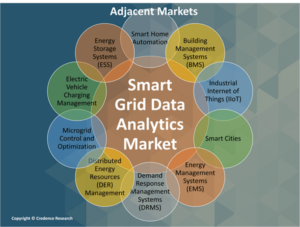
In the Smart Grid Data Analytics market, there are several adjacent markets which has high revenue growth opportunities. The key adjacent markets for Smart Grid Data Analytics market -
Request a Free Sample
Fill in your details and we'll send you a free sample report.
- Sample data tables & charts
- Research methodology
Need a Custom Version of This Report?
Tailor the scope, geography, or segments to your exact requirements.
- Custom geography or segment scope
- Direct access to our analyst team
Frequently Asked Questions
What is the size of Smart Grid Data Analytics Market?
What is the expected growth rate of the Smart Grid Data Analytics market between2024 and 2032?
Which segment is leading the market share in terms of Data Source?
Which Deployment Model segment is expected to post the highest CAGR during theforecast period?
Which region is fueling the growth of the Smart Grid Data Analytics industry?
Who are the major players in the global Smart Grid Data Analytics market?
What are the major market drivers of the Smart Grid Data Analytics industry?
What are the major market restraints of the Smart Grid Data Analytics industry?
Table of Content
Chapter 1. Report Introduction
- 1.1 Report Description & Purpose
- 1.1.1 Report Title & Market Definition
- 1.1.2 Unique Selling Propositions (USP) & Key Differentiators
- 1.1.3 Value Proposition for Stakeholders
- 1.2 Research Objectives
- 1.2.1 Market Sizing Objectives (Volume & Revenue)
- 1.2.2 Segmentation Objectives
- 1.2.3 Competitive Intelligence Objectives
- 1.2.4 Forecast & Scenario Objectives
- 1.3 Report Scope
- 1.3.1 Smart Grid Data Analytics Scope – Types & Subtypes Covered
- 1.3.2 Geographic Scope – Regions & Countries Covered
- 1.3.3 Historical Period, Base Year & Forecast Period (2023; forecast to the forecast period)
- 1.3.4 Inclusions & Exclusions
- 1.4 HS Code & Classification Framework
- 1.5 Currency, Units & Pricing Basis
- 1.6 Target Stakeholders
- 1.7 Limitations & Assumptions
Chapter 2. Executive Summary
- 2.1 Global Smart Grid Data Analytics Market Snapshot
- 2.1.1 Market Size – Historical (2023) & Forecast (the forecast period) (2023: USD 4845.9 Million → forecast year: USD 14,790.8 million)
- 2.1.2 Volume & Revenue – Global Totals
- 2.1.3 Key Market Highlights – Top Five Facts
- 2.2 Smart Grid Data Analytics Market Segmentation Snapshot
- 2.2.1 Market Split by Region – 2023 vs.
- 2.3 Competitive Snapshot
- 2.3.1 Top 10 Players by Revenue Share – 2023
- 2.3.2 Top 10 Players by Volume Share – 2023
- 2.3.3 Recent Strategic Developments (18-Month Summary)
- 2.4 Key Investment Highlights & Strategic Conclusions
Chapter 3. Smart Grid Data Analytics Market Dynamics & Industry Analysis
- 3.1 Market Overview & Context
- 3.1.1 Smart Grid Data Analytics Market Position in the Broader Automotive Value Chain
- 3.1.2 OEM vs. Replacement Market Dynamics
- 3.1.3 Market Maturity & Development Stage by Region
- 3.2 Smart Grid Data Analytics Market Drivers
- 3.3 Smart Grid Data Analytics Market Restraints & Challenges
- 3.4 Smart Grid Data Analytics Market Opportunities
- 3.5 Porter's Five Forces Analysis
- 3.5.1 Threat of New Entrants
- 3.5.2 Bargaining Power of Suppliers
- 3.5.3 Bargaining Power of Buyers
- 3.5.4 Threat of Substitutes
- 3.5.5 Competitive Rivalry – Intensity Assessment
- 3.6 Smart Grid Data Analytics Value Chain Analysis
- 3.6.1 Upstream – Raw Material/Input Suppliers
- 3.6.1.1 Raw Material/Input 1
- 3.6.1.2 Raw Material/Input 2
- 3.6.1.3 Raw Material/Input 3
- 3.6.2 Midstream – Production/Manufacturing/Service Delivery
- 3.6.2.1 Production/Process Overview
- 3.6.2.2 Key Facility Locations & Capacity by Manufacturer
- 3.6.3 Downstream – Distribution & End Consumer
- 3.6.3.1 Primary Channel – B2B/OEM
- 3.6.3.2 Secondary Channels – Dealer, Retail, Online, Direct
- 3.6.4 Value Chain Profitability Analysis
- 3.6.1 Upstream – Raw Material/Input Suppliers
- 3.7 PESTEL Analysis
- 3.7.1 Political Factors
- 3.7.2 Economic Factors
- 3.7.3 Social Factors
- 3.7.4 Technological Factors
- 3.7.5 Environmental Factors
- 3.7.6 Legal Factors
- 3.8 Smart Grid Data Analytics Supply Chain Analysis
- 3.8.1 Raw Material/Input Supply Risk Assessment
- 3.8.2 Manufacturing Concentration Risk (Geographic Exposure)
- 3.8.3 Trade Disruption Impact Analysis
- 3.9 Regulatory & Policy Landscape
Note: The regulatory and policy landscape section covers regulations based on their applicability to the market, Smart Grid Data Analytics category, geography, and scope of the study. Only regulatory frameworks with a material impact on operations, compliance, trade, sustainability, or market access are analyzed in detail.
Chapter 4. Key Investment Pockets & Opportunity Analysis
- 4.1 Smart Grid Data Analytics Market Attractiveness Analysis
- 4.1.1 By Region – Investment Attractiveness Matrix (Volume × CAGR)
- 4.2 Absolute Revenue Growth Opportunity
- 4.2.1 By Region – Absolute USD Growth Through the forecast period
- 4.3 Incremental Volume Opportunity
- 4.3.1 By Region – Incremental Volume Through the forecast period
- 4.3.2 Segment – Incremental Volume
- 4.4 Emerging Submarket Opportunity Deep Dive (Subject to Applicability)
- 4.5 Emerging Market Opportunity Scorecards
- 4.5.1 United States
- 4.5.2 Europe
- 4.5.3 Asia
- 4.5.4 Middle East & Africa
Note: Emerging Market Opportunity Scorecards will be included based on relevance and strategic importance. Regions listed are indicative and may vary depending on data availability and market dynamics.
Chapter 5. Smart Grid Data Analytics Import-Export Analysis & Trade Flows
- 5.1 Global Trade Overview
- 5.1.1 Global Export Value by Country (2023)
- 5.1.2 Global Export Volume by Country (2023)
- 5.1.3 Global Import Value by Country (2023)
- 5.1.4 Global Import Volume by Country (2023)
- 5.1.5 Net Trade Balance by Country (2023)
- 5.2 Export Analysis – Segment
- 5.2.1 Type 1 (HS Code)
- 5.2.2 Type 2 (HS Code)
- 5.2.3 Type 3 (HS Code)
- 5.2.4 Type 4 (HS Code)
- 5.2.5 Type 5 (HS Code)
- 5.3 Import Analysis – Segment
- 5.3.1 Type 1 (HS Code)
- 5.3.2 Type 2 (HS Code)
- 5.3.3 Type 3 (HS Code)
- 5.3.4 Type 4 (HS Code)
- 5.3.5 Type 5 (HS Code)
- 5.4 Average Unit Trade Prices
- 5.4.1 Average Export Price – Segment & Country
- 5.4.2 Average Import Price – Segment & Source Country
- 5.4.3 Price Trends (2023)
- 5.5 Key Trade Route Analysis
- 5.5.1 Trade Route 1
- 5.5.2 Trade Route 2
- 5.5.3 Trade Route 3
- 5.5.4 Trade Route 4
- 5.5.5 Trade Route 5
- 5.6 Trade Policy Impact Assessment
- 5.6.1 US Anti-Dumping & Section 301 Tariffs
- 5.6.2 EU Customs Union Impact
- 5.6.3 Major Free Trade Agreements
- 5.6.4 USMCA Rules of Origin
Note: Trade policy analysis will be included only where relevant to the Smart Grid Data Analytics market.
Chapter 6. Competitive Landscape & Company Benchmarking
- 6.1 Smart Grid Data Analytics Market Concentration & Structure
- 6.1.1 Herfindahl-Hirschman Index (HHI) – vs. 2023
- 6.1.2 Tier 1, Tier 2 & Tier 3 Market Structure
- 6.1.3 Global, Regional & Local Player Dynamics
- 6.2 Smart Grid Data Analytics Market Share Analysis – 2023
- 6.2.1 Global Revenue Share by Company
- 6.2.2 Global Volume Share by Company
- 6.2.3 Regional Revenue Share
- 6.2.4 Market Share Evolution ( vs. 2023)
- 6.2.5 OEM Segment Share by Company
- 6.2.6 Replacement Segment Share by Company
- 6.3 Production/Delivery Capacity & Facility Analysis
- 6.3.1 Global Installed Capacity
- 6.3.2 Capacity Utilization Rates
- 6.3.3 Production/Output Volume
- 6.3.4 Facility Locations & Capacity Map
- 6.3.5 Planned Capacity Additions
- 6.4 Smart Grid Data Analytics Competitive Benchmarking Matrix
- 6.4.1 Revenue, Volume, CAGR & Profitability Comparison
- 6.4.2 Channel Revenue Mix
- 6.4.3 Geographic Revenue Exposure
- 6.4.4 R&D Intensity
- 6.4.5 Sustainability Maturity
- 6.5 Strategic Developments in Smart Grid Data Analytics (Last 24 Months)
- 6.5.1 Mergers, Acquisitions & Divestments
- 6.5.2 New Smart Grid Data Analytics Launches
- 6.5.3 Facility Expansions
- 6.5.4 Strategic Alliances, Joint Ventures & Partnerships
- 6.5.5 Distribution Expansion & Market Entry
- 6.5.6 Sustainability & ESG Initiatives
- 6.6 Competitive Strategy Mapping
- 6.6.1 Leader, Challenger, Follower & Niche Classification
- 6.6.2 Pricing Strategy Comparison
- 6.6.3 Channel Strategy Matrix
Note: Strategic developments are included based on their materiality and the availability of reliable information.
Chapter 7. Global Smart Grid Data Analytics Market – By Distribution Channel
- 7.1 Segment Overview
- 7.1.1 Volume & Revenue Split by Channel (2023 & )
- 7.1.2 Channel Mix Evolution (the forecast period)
Chapter 8. Regional Market Analysis – Global Overview
- 8.1 Global Regional Overview
- 8.1.1 Regional Volume Share
- 8.1.2 Regional Revenue Share
- 8.1.3 Regional Volume by Region
- 8.1.4 Regional Revenue by Region
- 8.1.5 Regional Forecast Through the forecast period
- 8.2 Cross-Regional Segment Analysis
- 8.2.1 By Distribution Channel
- 8.2.2 By Brand/Price Tier
Chapter 9. North America Smart Grid Data Analytics Market
- 9.1 United States
- 9.2 Canada
- 9.3 Mexico
Chapter 10. Europe Smart Grid Data Analytics Market
- 10.1 Germany
- 10.2 France
- 10.3 Italy
- 10.4 United Kingdom
- 10.5 Spain
- 10.6 Poland
- 10.7 Russia
- 10.8 Netherlands
- 10.9 Belgium
- 10.10 Sweden
- 10.11 Denmark
- 10.12 Norway
- 10.13 Rest of Europe
Chapter 11. Asia Pacific Smart Grid Data Analytics Market
- 11.1 China
- 11.2 India
- 11.3 Japan
- 11.4 South Korea
- 11.5 Thailand
- 11.6 Indonesia
- 11.7 Vietnam
- 11.8 Malaysia
- 11.9 Australia
- 11.10 Rest of Asia Pacific
Chapter 12. Latin America Smart Grid Data Analytics Market
- 12.1 Brazil
- 12.2 Argentina
- 12.3 Colombia
- 12.4 Chile
- 12.5 Rest of Latin America
Chapter 13. Middle East Smart Grid Data Analytics Market
- 13.1 Saudi Arabia
- 13.2 United Arab Emirates
- 13.3 Turkey
- 13.4 Israel
- 13.5 Iran
- 13.6 Rest of the Middle East
Chapter 14. Africa Smart Grid Data Analytics Market
- 14.1 South Africa
- 14.2 Egypt
- 14.3 Nigeria
- 14.4 Morocco
- 14.5 Rest of Africa
Chapter 15. Smart Grid Data Analytics Company Profiles
- 15.1 [Company 01]
- 15.1.1 Company Overview
- 15.1.2 Key Management Personnel
- 15.1.3 Products & Services Portfolio
- 15.1.4 Financial Performance
- 15.1.5 Key Market Focus & Geographic Presence
- 15.1.6 Recent Developments & Strategic Initiatives
Note: The company profile list is preliminary and may change based on research findings, market developments, data availability, and client requirements.
Chapter 16. Appendices
- Appendix A – List of Abbreviations & Acronyms
- Appendix B – Industry Classification Code Reference – Full Series
- Appendix C – Production & Capacity Data Tables
- Appendix D – End-Use & Demand Base Tables
- Appendix E – Consumption & Replacement Rate Assumptions
- Appendix F – ASP Reference Tables
- Appendix G – Manufacturing & Facility Database
- Appendix H – Import-Export Data Tables
- Appendix I – Regulatory Summary Tables
- Appendix J – Primary Research Participant List (Anonymized)
- Appendix K – Primary Research Questionnaire Framework
- Appendix L – Data Sources & Bibliography
- Appendix M – Market Size Divergence & Source Comparison
Chapter 17. Research Methodology
- 17.1 Research Framework & Philosophy
- 17.2 Secondary Research – Sources, Hierarchy & Data Extraction
- 17.3 Data Modeling – Bottom-Up & Top-Down Market Sizing
- 17.4 Primary Research – Stakeholder Framework, LOI & Sample Sizes
- 17.5 Forecast Methodology – Regression, Scenario & Sensitivity Analysis
- 17.6 Quality Control – Four-Layer Validation Framework
- 17.7 Limitations & Standard Assumptions
- 17.8 Disclaimer
