
| REPORT ATTRIBUTE | DETAILS |
|---|---|
| Historical Period | 2020-2023 |
| Base Year | 2024 |
| Forecast Period | 2025-2032 |
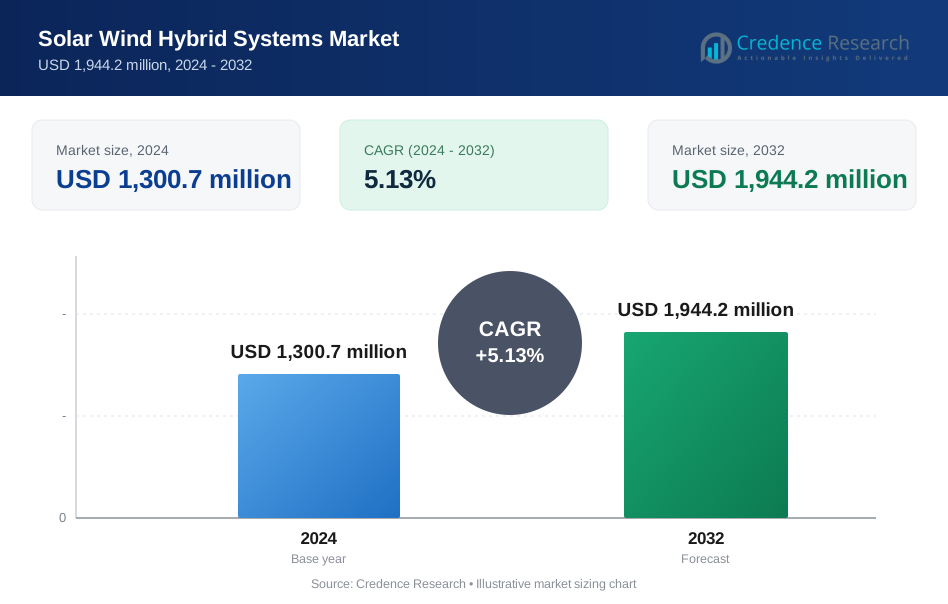
| Solar Wind Hybrid Systems market Size 2024 | USD 1,300.7 million |
| Solar Wind Hybrid Systems market, CAGR | 5.13% |
| Solar Wind Hybrid Systems market Size 2032 | USD 1,944.2 million |
Market Overview:
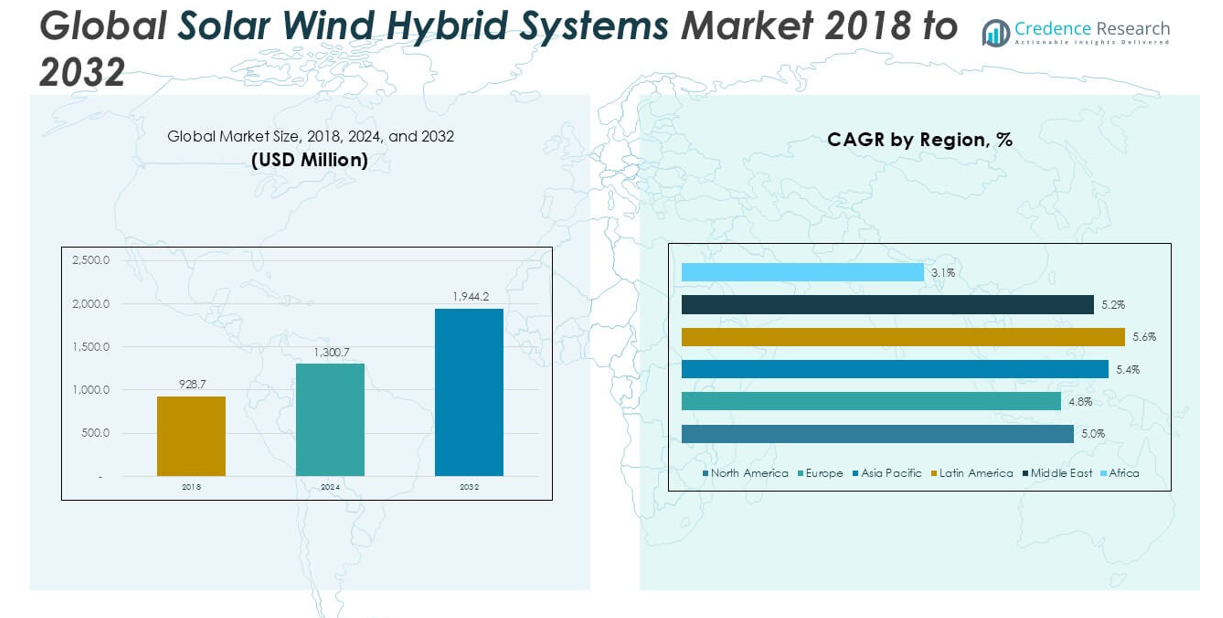
The Solar Wind Hybrid Systems market size was valued at USD 928.7 million in 2018, reached USD 1,300.7 million in 2024, and is anticipated to reach USD 1,944.2 million by 2032, at a CAGR of 5.13% during the forecast period.
Top players in the Solar Wind Hybrid Systems market include Alpha Windmills, Siemens Gamesa, SolarEdge Technologies, Enphase Energy, and Sungrow Power Supply, each recognized for advanced technology, robust product portfolios, and global project execution. These companies maintain strong competitive positions by delivering high-efficiency hybrid solutions and investing in innovation. Asia Pacific leads the market, holding an exact market share of 42.2% in 2024, driven by large-scale adoption in China and India and significant government incentives. Europe and North America follow, with market shares of 22.5% and 18.8% respectively, reflecting steady deployment in commercial and industrial sectors.
Market Insights
- The Solar Wind Hybrid Systems market was valued at USD 1,300.7 million in 2024 and is projected to reach USD 1,944.2 million by 2032, reflecting a CAGR of 5.13%.
- Rising demand for clean and reliable energy, supported by government incentives and sustainability goals, drives strong adoption across commercial, industrial, and remote applications.
- Integration with smart grids, digital energy management, and ongoing cost reductions for solar and wind components are shaping key market trends and accelerating hybrid system deployment.
- Alpha Windmills, Siemens Gamesa, SolarEdge Technologies, Enphase Energy, and Sungrow Power Supply lead a competitive landscape marked by technological innovation and expanding product portfolios, but high initial investment and financing barriers still restrict broader adoption.
- Asia Pacific dominates the market with a 42.2% share, followed by Europe at 22.5% and North America at 18.8%, while grid-connected systems and solar PV panels remain the leading segments by system type and component, respectively.
Market Segmentation Analysis:
By System Type:
Grid-Connected Systems hold the dominant share in the Solar Wind Hybrid Systems market, accounting for over 60% of total installations in 2024. This sub-segment benefits from rapid urbanization and increasing integration with national grids, providing stable and efficient renewable power to urban and peri-urban areas. Government incentives and grid expansion projects further drive adoption. Off-Grid Systems remain vital in remote or rural regions, but Grid-Connected Systems lead due to their scalability and reliability for continuous energy supply.
- For instance, Siemens Gamesa commissioned India’s first large-scale grid-connected solar-wind hybrid plant in Karnataka, which combines 50 megawatts (MW) of wind capacity with 28.8 MW of solar PV.
By Component:
Solar Photovoltaic (PV) Panels represent the largest share within the component segment, contributing more than 40% of market revenue in 2024. This dominance is driven by declining costs of PV technology, high energy conversion efficiency, and widespread deployment in both new and retrofit hybrid projects. Wind Turbines follow closely, especially in areas with strong wind resources. Growth in advanced inverters and efficient batteries further supports hybrid system optimization, but PV panels lead due to consistent performance and cost competitiveness.
- For instance, SolarEdge’s SE100K inverter delivers a maximum output power of 100,000 watts (100 kW) and features peak efficiency up to 98.3%, making it one of the most advanced hybrid-compatible inverters available.
By End User:
The Commercial & Industrial (C&I) Sector emerges as the leading end user, capturing about 45% of the market share in 2024. C&I facilities invest heavily in hybrid systems to ensure energy reliability, meet sustainability goals, and reduce operational costs. The need for uninterrupted power supply, particularly for manufacturing and data centers, drives adoption. While the residential and agricultural sectors see growing interest, especially in regions with unreliable grids, the C&I sector dominates due to scale, investment capacity, and stricter emissions targets.
Market Overview
Increasing Demand for Clean and Reliable Power
Growing concerns over climate change and stringent emission regulations drive the shift toward renewable energy solutions. Solar Wind Hybrid Systems provide consistent and clean power by leveraging both solar and wind resources, reducing reliance on fossil fuels. Rising demand from utilities and industries for reliable, low-carbon electricity solutions strengthens market growth, particularly in regions with ambitious renewable energy targets and commitments to sustainable development.
- For instance, Enphase Energy supplied microinverter-based solar-wind hybrid systems for the Stone Edge Farm Microgrid project in California, which integrated 150 kilowatts (kW) of solar PV with wind and battery storage.
Falling Technology Costs and Improved Efficiency
Significant advancements in photovoltaic panels, wind turbines, and energy storage technologies have substantially lowered overall system costs. Higher efficiency and longer operational lifespans make hybrid solutions more attractive for commercial, industrial, and off-grid applications. Cost competitiveness compared to conventional energy sources encourages both public and private sector investments, accelerating the deployment of hybrid systems across diverse geographies and market segments.
- For instance, Sungrow Power Supply developed a hybrid inverter series supporting up to 110 kW input power and compatible with battery storage capacities of up to 200 kilowatt-hours (kWh) per unit, providing high flexibility and efficiency for large projects.
Government Incentives and Policy Support
Governments across the globe are introducing favorable policies, subsidies, and feed-in tariffs to promote renewable energy adoption. Regulatory frameworks that prioritize hybrid renewable installations, coupled with dedicated financial incentives and tax benefits, encourage widespread deployment. National and regional programs aimed at expanding rural electrification and ensuring grid stability further enhance market momentum, providing a robust foundation for the long-term growth of Solar Wind Hybrid Systems.
Key Trends & Opportunities
Integration with Smart Grids and Digitalization
The increasing integration of Solar Wind Hybrid Systems with smart grids and digital monitoring platforms presents new opportunities for real-time management and optimization. Enhanced digital control allows for more efficient load balancing, predictive maintenance, and improved energy yield. These advancements support grid stability and reliability, enabling hybrid systems to play a central role in future energy infrastructure and grid modernization efforts.
- For instance, SolarEdge’s monitoring platform manages more than 2 million PV systems worldwide, delivering real-time performance analytics for installations ranging from 1 kW to over 10 MW, and is used in multi-megawatt hybrid deployments.
Expansion in Emerging Markets and Remote Areas
Emerging markets and off-grid regions represent significant opportunities for market expansion. Hybrid systems provide reliable power solutions in areas with limited or unstable grid access, supporting rural electrification and economic development. International funding, public-private partnerships, and community-driven projects foster market penetration in Africa, Asia-Pacific, and Latin America, fueling long-term growth prospects for Solar Wind Hybrid Systems.
- For instance, ReGen Powertech installed over 2,700 wind turbines with a combined capacity exceeding 1,600 MW, supporting multiple rural hybrid projects in India and Southeast Asia where local grid access is limited.
Key Challenges
High Initial Capital Investment
One of the primary challenges for Solar Wind Hybrid Systems adoption remains the high upfront capital requirement. Although costs have declined, the initial investment for combined systems including advanced inverters and energy storage can deter smaller commercial and residential buyers. Securing financing and justifying return on investment often poses a barrier, particularly in developing markets.
Intermittency and Resource Variability
The variable nature of both solar and wind resources can impact power generation consistency. Unpredictable weather patterns, seasonal fluctuations, and site-specific resource availability necessitate careful planning and advanced energy storage solutions. Balancing intermittency remains a technical hurdle for system integrators and utilities seeking to ensure stable, uninterrupted energy supply.
Regulatory and Grid Integration Complexities
Navigating diverse regulatory environments and integrating hybrid systems into existing grid infrastructure present additional challenges. Variations in interconnection standards, permitting requirements, and grid codes can delay project timelines. Coordinating with utilities and regulatory authorities for grid connection and power offtake agreements increases the complexity and cost of deployment for Solar Wind Hybrid Systems.
Regional Analysis
North America:
North America accounted for a significant share of the Solar Wind Hybrid Systems market, representing approximately 18.8% of global revenue in 2024 with a market size of USD 241.82 million. The region grew from USD 174.40 million in 2018 and is forecasted to reach USD 356.57 million by 2032, registering a CAGR of 5.0%. Growth is driven by favorable government policies, strong investments in renewable integration, and increasing focus on energy security. Adoption in commercial and industrial sectors remains high, supported by innovation and advanced grid infrastructure.
Europe:
Europe held a market share of about 22.5% in 2024, with a value of USD 292.04 million, rising from USD 212.57 million in 2018. The market is expected to reach USD 425.20 million by 2032, at a CAGR of 4.8%. European growth is propelled by stringent environmental regulations, ambitious renewable energy targets, and cross-border energy cooperation. The region benefits from robust funding for hybrid projects, a mature renewable sector, and strong public and private sector partnerships, reinforcing its leading position in clean energy adoption.
Asia Pacific:
Asia Pacific dominated the Solar Wind Hybrid Systems market in 2024, commanding a market share of nearly 42.2% with revenue reaching USD 548.60 million, up from USD 385.96 million in 2018. Forecasts indicate market size will rise to USD 836.02 million by 2032, achieving the highest regional CAGR of 5.4%. Rapid industrialization, extensive rural electrification programs, and increasing investments in grid infrastructure drive growth. Major economies such as China and India lead adoption due to large-scale renewable deployment and favorable government incentives.
Latin America:
Latin America contributed 6.4% to global revenue in 2024, valued at USD 83.00 million, rising from USD 57.67 million in 2018. The market is projected to reach USD 128.51 million by 2032, exhibiting a CAGR of 5.6%, the fastest among all regions. Regional growth is supported by initiatives to improve rural energy access, government support for renewables, and emerging private sector investment. Key markets such as Brazil and Mexico invest in off-grid and microgrid solutions, expanding hybrid system adoption across diverse geographies.
Middle East:
The Middle East represented 8.6% of the market in 2024, with a market size of USD 111.79 million, up from USD 79.49 million in 2018. The market is expected to reach USD 167.98 million by 2032, growing at a CAGR of 5.2%. The region’s growth is fueled by diversification of the energy mix, solar and wind resource abundance, and major government initiatives to reduce dependency on fossil fuels. The focus on sustainable energy infrastructure and rising investments in hybrid projects drive regional expansion.
Africa:
Africa accounted for 1.8% of the Solar Wind Hybrid Systems market in 2024, with a value of USD 23.45 million, increasing from USD 18.57 million in 2018. The market is forecasted to reach USD 29.94 million by 2032, reflecting the lowest regional CAGR of 3.1%. Despite slower growth, opportunities arise from rural electrification needs and international aid. Many hybrid projects target off-grid communities, helping to address energy poverty and foster regional market development, although overall market share remains limited compared to other regions.
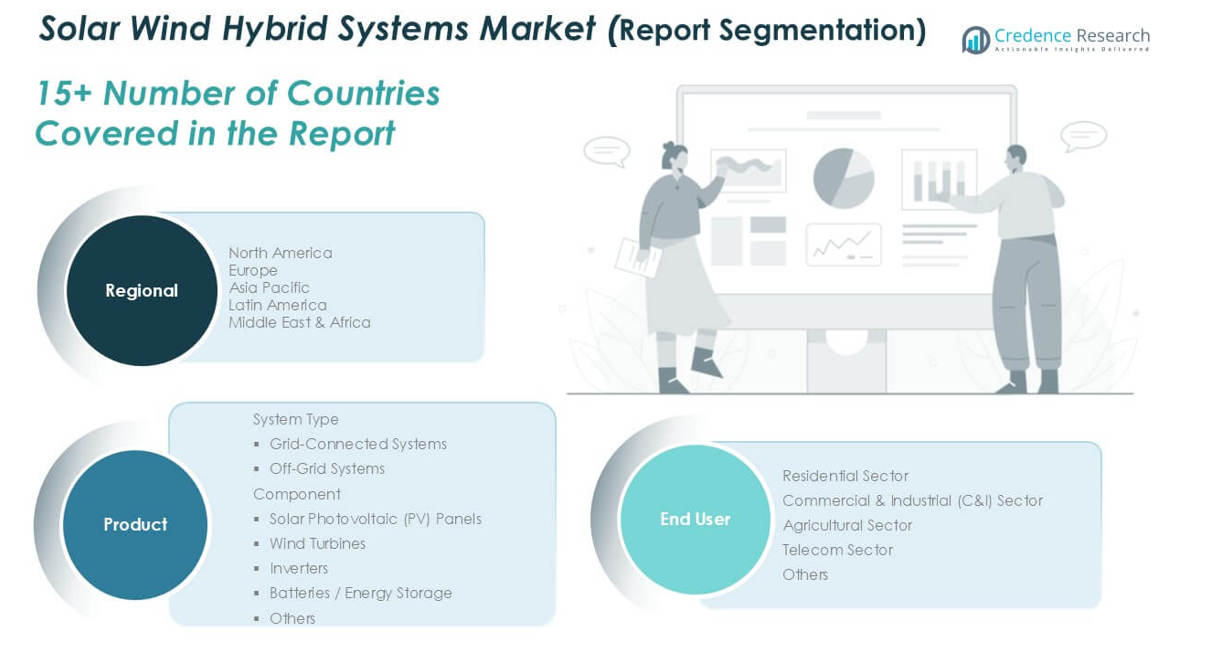
Market Segmentations:
By System Type:
- Grid-Connected Systems
- Off-Grid Systems
By Component:
- Solar Photovoltaic (PV) Panels
- Wind Turbines
- Inverters
- Batteries / Energy Storage
- Others
By End User:
- Residential Sector
- Commercial & Industrial (C&I) Sector
- Agricultural Sector
- Telecom Sector
- Others
By Geography:
- North America
- U.S.
- Canada
- Mexico
- Europe
- Germany
- France
- U.K.
- Italy
- Spain
- Rest of Europe
- Asia Pacific
- China
- Japan
- India
- South Korea
- South-east Asia
- Rest of Asia Pacific
- Latin America
- Brazil
- Argentina
- Rest of Latin America
- Middle East & Africa
- GCC Countries
- South Africa
- Rest of the Middle East and Africa
Competitive Landscape
The competitive landscape of the Solar Wind Hybrid Systems market features a dynamic mix of established energy companies and innovative technology providers striving to strengthen their market positions. Leading players such as Alpha Windmills, Siemens Gamesa, SolarEdge Technologies, Enphase Energy, and Sungrow Power Supply consistently invest in research and development to enhance system efficiency and reliability. Companies including Blue Pacific Solar Product, Inc., Supernova Technologies, Alternate Energy Company, ReGen Powertech, and HES Energy Systems focus on expanding their product portfolios and developing turnkey solutions for diverse end users. Strategic collaborations, mergers, and acquisitions characterize the sector, enabling firms to access new markets and technologies. Competitive differentiation hinges on technological advancement, project execution capabilities, after-sales support, and global reach. As the market expands, providers intensify efforts to offer cost-effective hybrid systems tailored to commercial, industrial, and off-grid applications, with sustainability and energy security remaining core priorities across the competitive landscape.
Key Player Analysis
- Alpha Windmills
- Blue Pacific Solar Product, Inc.
- Siemens Gamesa
- Supernova Technologies
- Alternate Energy Company
- ReGen Powertech
- HES Energy Systems
- SolarEdge Technologies
- Enphase Energy
- Sungrow Power Supply
Recent Developments
- In September 2024, Sungrow presented its latest solar, energy storage, and green hydrogen solutions at RE+ 2024 in Anaheim, USA. Key introductions included the SG200HX-US string inverter for community solar and the PowerTitan 2.0 liquid-cooled energy storage system.
- In January 2022, ReGen Powertech introduced a wind-solar hybrid system that enhances energy storage capacity and combines 200kW to 1000kW of solar with their 1.5MW wind turbines, using shared infrastructure. This "True Hybrid" system allows for greater efficiency and cost-effectiveness by utilizing shared inverters, electrical yards, grid connections, and operations and maintenance (O&M).
Market Concentration & Characteristics
The Solar Wind Hybrid Systems Market demonstrates a moderate to high level of market concentration, with several prominent global players dominating technology innovation, large-scale project execution, and integrated solutions. It exhibits characteristics of a technology-driven sector, where continuous advancements in solar PV panels, wind turbines, and energy storage solutions create strong competitive advantages for established firms. The market attracts new entrants offering niche solutions for off-grid, rural, and emerging market applications, but leading companies such as Siemens Gamesa, SolarEdge Technologies, Enphase Energy, and Alpha Windmills maintain their positions through strategic alliances and broad portfolios. High initial investment requirements and a focus on integrated renewable projects contribute to higher entry barriers, which strengthen market concentration around key incumbents. The market values reliability, scalability, and adaptability, with demand influenced by policy support, sustainability targets, and energy security concerns. It continues to evolve through digital integration, smart grid compatibility, and customization for end-user requirements.
Report Coverage
The research report offers an in-depth analysis based on System Type, Component, End User and Geography. It details leading market players, providing an overview of their business, product offerings, investments, revenue streams, and key applications. Additionally, the report includes insights into the competitive environment, SWOT analysis, current market trends, as well as the primary drivers and constraints. Furthermore, it discusses various factors that have driven market expansion in recent years. The report also explores market dynamics, regulatory scenarios, and technological advancements that are shaping the industry. It assesses the impact of external factors and global economic changes on market growth. Lastly, it provides strategic recommendations for new entrants and established companies to navigate the complexities of the market.
Future Outlook
- The Solar Wind Hybrid Systems Market will expand steadily with growing global emphasis on renewable energy integration.
- It will benefit from ongoing cost reductions in solar PV and wind turbine technologies.
- Widespread deployment of energy storage will enable more reliable dispatchable hybrid power solutions.
- Hybrid systems will integrate deeper into smart grids through advanced digital control and IoT frameworks.
- Rural electrification initiatives will drive growth in off-grid and microgrid hybrid installations.
- Commercial and industrial sectors will increasingly adopt hybrid systems to ensure energy resilience and meet sustainability goals.
- Collaborative ventures between technology providers, utilities, and governments will accelerate large-scale hybrid projects.
- Modular and scalable hybrid systems will cater to diverse site conditions, enhancing market flexibility.
- Increased financing models and green investment instruments will broaden market access and lower entry costs.
- Emerging markets will play a pivotal role in future expansion due to high unmet energy demand and supportive policies.
Request a Free Sample
Fill in your details and we'll send you a free sample report.
- Sample data tables & charts
- Research methodology
Need a Custom Version of This Report?
Tailor the scope, geography, or segments to your exact requirements.
- Custom geography or segment scope
- Direct access to our analyst team
Frequently Asked Questions
What is the size of Solar Wind Hybrid Systems Market?
What factors are driving the growth of the Solar Wind Hybrid Systems Market?
What are the key segments within the Solar Wind Hybrid Systems Market?
Who are the major players in this market?
Table of Content
Chapter 1. Report Introduction
- 1.1 Report Description & Purpose
- 1.1.1 Report Title & Market Definition
- 1.1.2 Unique Selling Propositions (USP) & Key Differentiators
- 1.1.3 Value Proposition for Stakeholders
- 1.2 Research Objectives
- 1.2.1 Market Sizing Objectives (Volume & Revenue)
- 1.2.2 Segmentation Objectives
- 1.2.3 Competitive Intelligence Objectives
- 1.2.4 Forecast & Scenario Objectives
- 1.3 Report Scope
- 1.3.1 Solar Wind Hybrid Systems Scope – Types & Subtypes Covered
- 1.3.2 Geographic Scope – Regions & Countries Covered
- 1.3.3 Historical Period, Base Year & Forecast Period (2024; forecast to 2032)
- 1.3.4 Inclusions & Exclusions
- 1.4 HS Code & Classification Framework
- 1.5 Currency, Units & Pricing Basis
- 1.6 Target Stakeholders
- 1.7 Limitations & Assumptions
Chapter 2. Executive Summary
- 2.1 Global Solar Wind Hybrid Systems Market Snapshot
- 2.1.1 Market Size – Historical (2024) & Forecast (2024-2032) (2024: USD 1,300.7 million → 2032: USD 1,944.2 million)
- 2.1.2 Volume & Revenue – Global Totals
- 2.1.3 Key Market Highlights – Top Five Facts
- 2.2 Solar Wind Hybrid Systems Market Segmentation Snapshot
- 2.2.1 Market Split by Region – 2024 vs. 2032
- 2.3 Competitive Snapshot
- 2.3.1 Top 10 Players by Revenue Share – 2024
- 2.3.2 Top 10 Players by Volume Share – 2024
- 2.3.3 Recent Strategic Developments (18-Month Summary)
- 2.4 Key Investment Highlights & Strategic Conclusions
Chapter 3. Solar Wind Hybrid Systems Market Dynamics & Industry Analysis
- 3.1 Market Overview & Context
- 3.1.1 Solar Wind Hybrid Systems Market Position in the Broader Automotive Value Chain
- 3.1.2 OEM vs. Replacement Market Dynamics
- 3.1.3 Market Maturity & Development Stage by Region
- 3.2 Solar Wind Hybrid Systems Market Drivers
- 3.3 Solar Wind Hybrid Systems Market Restraints & Challenges
- 3.4 Solar Wind Hybrid Systems Market Opportunities
- 3.5 Porter's Five Forces Analysis
- 3.5.1 Threat of New Entrants
- 3.5.2 Bargaining Power of Suppliers
- 3.5.3 Bargaining Power of Buyers
- 3.5.4 Threat of Substitutes
- 3.5.5 Competitive Rivalry – Intensity Assessment
- 3.6 Solar Wind Hybrid Systems Value Chain Analysis
- 3.6.1 Upstream – Raw Material/Input Suppliers
- 3.6.1.1 Raw Material/Input 1
- 3.6.1.2 Raw Material/Input 2
- 3.6.1.3 Raw Material/Input 3
- 3.6.2 Midstream – Production/Manufacturing/Service Delivery
- 3.6.2.1 Production/Process Overview
- 3.6.2.2 Key Facility Locations & Capacity by Manufacturer
- 3.6.3 Downstream – Distribution & End Consumer
- 3.6.3.1 Primary Channel – B2B/OEM
- 3.6.3.2 Secondary Channels – Dealer, Retail, Online, Direct
- 3.6.4 Value Chain Profitability Analysis
- 3.6.1 Upstream – Raw Material/Input Suppliers
- 3.7 PESTEL Analysis
- 3.7.1 Political Factors
- 3.7.2 Economic Factors
- 3.7.3 Social Factors
- 3.7.4 Technological Factors
- 3.7.5 Environmental Factors
- 3.7.6 Legal Factors
- 3.8 Solar Wind Hybrid Systems Supply Chain Analysis
- 3.8.1 Raw Material/Input Supply Risk Assessment
- 3.8.2 Manufacturing Concentration Risk (Geographic Exposure)
- 3.8.3 Trade Disruption Impact Analysis
- 3.9 Regulatory & Policy Landscape
Note: The regulatory and policy landscape section covers regulations based on their applicability to the market, Solar Wind Hybrid Systems category, geography, and scope of the study. Only regulatory frameworks with a material impact on operations, compliance, trade, sustainability, or market access are analyzed in detail.
Chapter 4. Key Investment Pockets & Opportunity Analysis
- 4.1 Solar Wind Hybrid Systems Market Attractiveness Analysis
- 4.1.1 By Region – Investment Attractiveness Matrix (Volume × CAGR)
- 4.2 Absolute Revenue Growth Opportunity
- 4.2.1 By Region – Absolute USD Growth Through 2032
- 4.3 Incremental Volume Opportunity
- 4.3.1 By Region – Incremental Volume Through 2032
- 4.3.2 Segment – Incremental Volume
- 4.4 Emerging Submarket Opportunity Deep Dive (Subject to Applicability)
- 4.5 Emerging Market Opportunity Scorecards
- 4.5.1 United States
- 4.5.2 Europe
- 4.5.3 Asia
- 4.5.4 Middle East & Africa
Note: Emerging Market Opportunity Scorecards will be included based on relevance and strategic importance. Regions listed are indicative and may vary depending on data availability and market dynamics.
Chapter 5. Solar Wind Hybrid Systems Import-Export Analysis & Trade Flows
- 5.1 Global Trade Overview
- 5.1.1 Global Export Value by Country (2024)
- 5.1.2 Global Export Volume by Country (2024)
- 5.1.3 Global Import Value by Country (2024)
- 5.1.4 Global Import Volume by Country (2024)
- 5.1.5 Net Trade Balance by Country (2024)
- 5.2 Export Analysis – Segment
- 5.2.1 Type 1 (HS Code)
- 5.2.2 Type 2 (HS Code)
- 5.2.3 Type 3 (HS Code)
- 5.2.4 Type 4 (HS Code)
- 5.2.5 Type 5 (HS Code)
- 5.3 Import Analysis – Segment
- 5.3.1 Type 1 (HS Code)
- 5.3.2 Type 2 (HS Code)
- 5.3.3 Type 3 (HS Code)
- 5.3.4 Type 4 (HS Code)
- 5.3.5 Type 5 (HS Code)
- 5.4 Average Unit Trade Prices
- 5.4.1 Average Export Price – Segment & Country
- 5.4.2 Average Import Price – Segment & Source Country
- 5.4.3 Price Trends (2024)
- 5.5 Key Trade Route Analysis
- 5.5.1 Trade Route 1
- 5.5.2 Trade Route 2
- 5.5.3 Trade Route 3
- 5.5.4 Trade Route 4
- 5.5.5 Trade Route 5
- 5.6 Trade Policy Impact Assessment
- 5.6.1 US Anti-Dumping & Section 301 Tariffs
- 5.6.2 EU Customs Union Impact
- 5.6.3 Major Free Trade Agreements
- 5.6.4 USMCA Rules of Origin
Note: Trade policy analysis will be included only where relevant to the Solar Wind Hybrid Systems market.
Chapter 6. Competitive Landscape & Company Benchmarking
- 6.1 Solar Wind Hybrid Systems Market Concentration & Structure
- 6.1.1 Herfindahl-Hirschman Index (HHI) – vs. 2024
- 6.1.2 Tier 1, Tier 2 & Tier 3 Market Structure
- 6.1.3 Global, Regional & Local Player Dynamics
- 6.2 Solar Wind Hybrid Systems Market Share Analysis – 2024
- 6.2.1 Global Revenue Share by Company
- 6.2.2 Global Volume Share by Company
- 6.2.3 Regional Revenue Share
- 6.2.4 Market Share Evolution ( vs. 2024)
- 6.2.5 OEM Segment Share by Company
- 6.2.6 Replacement Segment Share by Company
- 6.3 Production/Delivery Capacity & Facility Analysis
- 6.3.1 Global Installed Capacity
- 6.3.2 Capacity Utilization Rates
- 6.3.3 Production/Output Volume
- 6.3.4 Facility Locations & Capacity Map
- 6.3.5 Planned Capacity Additions
- 6.4 Solar Wind Hybrid Systems Competitive Benchmarking Matrix
- 6.4.1 Revenue, Volume, CAGR & Profitability Comparison
- 6.4.2 Channel Revenue Mix
- 6.4.3 Geographic Revenue Exposure
- 6.4.4 R&D Intensity
- 6.4.5 Sustainability Maturity
- 6.5 Strategic Developments in Solar Wind Hybrid Systems (Last 24 Months)
- 6.5.1 Mergers, Acquisitions & Divestments
- 6.5.2 New Solar Wind Hybrid Systems Launches
- 6.5.3 Facility Expansions
- 6.5.4 Strategic Alliances, Joint Ventures & Partnerships
- 6.5.5 Distribution Expansion & Market Entry
- 6.5.6 Sustainability & ESG Initiatives
- 6.6 Competitive Strategy Mapping
- 6.6.1 Leader, Challenger, Follower & Niche Classification
- 6.6.2 Pricing Strategy Comparison
- 6.6.3 Channel Strategy Matrix
Note: Strategic developments are included based on their materiality and the availability of reliable information.
Chapter 7. Global Solar Wind Hybrid Systems Market – By Distribution Channel
- 7.1 Segment Overview
- 7.1.1 Volume & Revenue Split by Channel (2024 & 2032)
- 7.1.2 Channel Mix Evolution (2024-2032)
Chapter 8. Regional Market Analysis – Global Overview
- 8.1 Global Regional Overview
- 8.1.1 Regional Volume Share
- 8.1.2 Regional Revenue Share
- 8.1.3 Regional Volume by Region
- 8.1.4 Regional Revenue by Region
- 8.1.5 Regional Forecast Through 2032
- 8.2 Cross-Regional Segment Analysis
- 8.2.1 By Distribution Channel
- 8.2.2 By Brand/Price Tier
Chapter 9. North America Solar Wind Hybrid Systems Market
- 9.1 United States
- 9.2 Canada
- 9.3 Mexico
Chapter 10. Europe Solar Wind Hybrid Systems Market
- 10.1 Germany
- 10.2 France
- 10.3 Italy
- 10.4 United Kingdom
- 10.5 Spain
- 10.6 Poland
- 10.7 Russia
- 10.8 Netherlands
- 10.9 Belgium
- 10.10 Sweden
- 10.11 Denmark
- 10.12 Norway
- 10.13 Rest of Europe
Chapter 11. Asia Pacific Solar Wind Hybrid Systems Market
- 11.1 China
- 11.2 India
- 11.3 Japan
- 11.4 South Korea
- 11.5 Thailand
- 11.6 Indonesia
- 11.7 Vietnam
- 11.8 Malaysia
- 11.9 Australia
- 11.10 Rest of Asia Pacific
Chapter 12. Latin America Solar Wind Hybrid Systems Market
- 12.1 Brazil
- 12.2 Argentina
- 12.3 Colombia
- 12.4 Chile
- 12.5 Rest of Latin America
Chapter 13. Middle East Solar Wind Hybrid Systems Market
- 13.1 Saudi Arabia
- 13.2 United Arab Emirates
- 13.3 Turkey
- 13.4 Israel
- 13.5 Iran
- 13.6 Rest of the Middle East
Chapter 14. Africa Solar Wind Hybrid Systems Market
- 14.1 South Africa
- 14.2 Egypt
- 14.3 Nigeria
- 14.4 Morocco
- 14.5 Rest of Africa
Chapter 15. Solar Wind Hybrid Systems Company Profiles
- 15.1 [Company 01]
- 15.1.1 Company Overview
- 15.1.2 Key Management Personnel
- 15.1.3 Products & Services Portfolio
- 15.1.4 Financial Performance
- 15.1.5 Key Market Focus & Geographic Presence
- 15.1.6 Recent Developments & Strategic Initiatives
Note: The company profile list is preliminary and may change based on research findings, market developments, data availability, and client requirements.
Chapter 16. Appendices
- Appendix A – List of Abbreviations & Acronyms
- Appendix B – Industry Classification Code Reference – Full Series
- Appendix C – Production & Capacity Data Tables
- Appendix D – End-Use & Demand Base Tables
- Appendix E – Consumption & Replacement Rate Assumptions
- Appendix F – ASP Reference Tables
- Appendix G – Manufacturing & Facility Database
- Appendix H – Import-Export Data Tables
- Appendix I – Regulatory Summary Tables
- Appendix J – Primary Research Participant List (Anonymized)
- Appendix K – Primary Research Questionnaire Framework
- Appendix L – Data Sources & Bibliography
- Appendix M – Market Size Divergence & Source Comparison
Chapter 17. Research Methodology
- 17.1 Research Framework & Philosophy
- 17.2 Secondary Research – Sources, Hierarchy & Data Extraction
- 17.3 Data Modeling – Bottom-Up & Top-Down Market Sizing
- 17.4 Primary Research – Stakeholder Framework, LOI & Sample Sizes
- 17.5 Forecast Methodology – Regression, Scenario & Sensitivity Analysis
- 17.6 Quality Control – Four-Layer Validation Framework
- 17.7 Limitations & Standard Assumptions
- 17.8 Disclaimer
