
| REPORT ATTRIBUTE | DETAILS |
|---|---|
| Historical Period | 2019-2022 |
| Base Year | 2023 |
| Forecast Period | 2024-2032 |
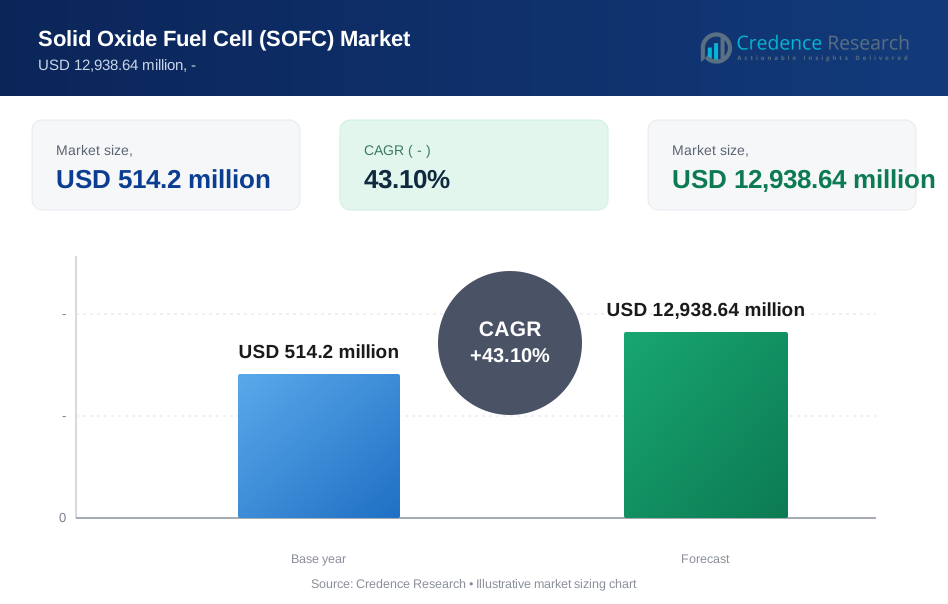
| Solid Oxide Fuel Cell (SOFC) Market Size 2023 | USD 514.2 million |
| Solid Oxide Fuel Cell (SOFC) Market, CAGR | 43.10% |
| Solid Oxide Fuel Cell (SOFC) Market Size 2032 | USD 12938.64 million |
Market Insights
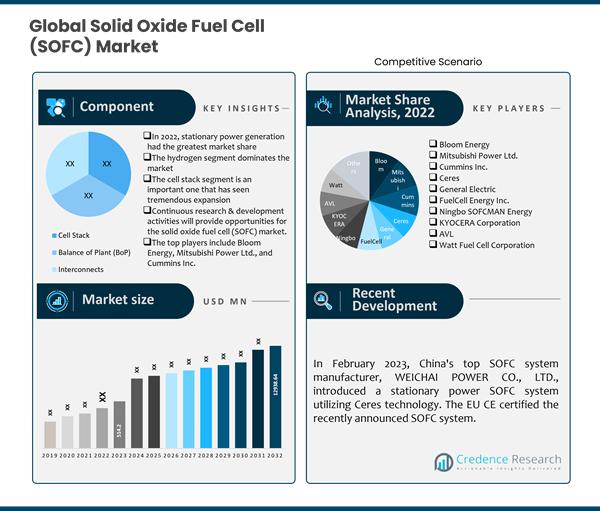
- Between 2024 and 2032, the global market for solid oxide fuel cells (SOFC) is projected to expand at a compound annual growth rate (CAGR) of 43.10%, from an estimated USD 514.2 million in 2023 to USD 12938.64 million in 2032.
- The largest category is stationary power generation. Propulsion systems, on the other hand, are expected to grow at a strong CAGR.
- The hydrogen category will expand at a rapid rate of growth.
- Throughout the projected period, the CAGR for cell stack is anticipated to be the highest.
- Throughout the projection period, the residential should have the largest compound annual growth rate.
- Asia Pacific controlled the solid oxide fuel cell (SOFC) market.
- Regarding the market share of solid oxide fuel cells (SOFC), Europe is expected to come second.
- North America is expected to experience the fastest growth in the solid oxide fuel cell (SOFC) industry.
- The growing need for renewable energy, governmental laws and policies, and technical developments are propelling the global market's growth.
- Increased fossil fuel prices, reduced greenhouse gas emissions relative to conventional power generation, and the high efficiency of SOFCs could all have a positive effect on the solid oxide fuel cell (SOFC) market.
Executive Summary
Market Definition
A high-temperature electrochemical device known as a solid oxide fuel cell (SOFC) leverages the chemical energy of the fuel to directly produce electrical energy. Furthermore, through internal reformation within the fuel cell stack itself, it is capable of directly converting hydrocarbon fuels into hydrogen-rich gas. Since SOFC is immune to the contaminants in intake fuels, it may be used with a wide variety of fuels, which is its primary benefit over other fuel cell types. It is observed that the fuel's high working temperature is mostly responsible for its flexibility.
Market Overview
It is predicted that the solid oxide fuel cell (SOFC) industry will continue its upward trajectory between 2024 and 2032, growing at a compound annual growth rate (CAGR) of 43.10%. From its projected USD 514.2 million in 2023 to USD 12938.64 million in 2032, the market will continue to grow.
The most rapidly developing end markets for power generation systems in the US are data centers and the commercial and industrial sectors. Data centers use a lot of energy and require a lot of power. Furthermore, data centers need continuous electricity to reduce the possibility of important data being lost.
The International Energy Agency (IEA) projects that data center power consumption in 2022 will be between 240 and 340 TWh or roughly 1% to 1.3% of global electricity demand. Data centers choose to save costs by implementing distributed power generation, especially fuel cells, as a result of the high power usage. In the past, the US has witnessed great growth in fuel cells, particularly SOFCs. The quickest pace of expansion has been spurred by Google (US), IBM (US), and Equinix (US) adopting it for data centers. Since the total number of data centers in the US is still very small, the widespread use of SOFC by data centers is currently one of the most profitable industries.
The use of SOFCs for both stationary and portable power generation is growing in the military industry. Additionally, SOFCs have a chance in this market due to the requirement for quiet and effective power production for military applications. End users in the military and defense sector are increasingly using SOFC-powered portable devices.
Segmentation by Application
- Stationary power generation is the market leader in terms of application. Solid oxide fuel cells are in high demand for stationary power generation due to their decentralized, dependable, and sustainable energy solutions in commercial, industrial, and residential applications. They are also easily adapted to use a variety of fuels and have low emissions.
- The propulsion systems category will exhibit a sizable CAGR during the projected period. Because of their excellent efficiency, fuel flexibility, and low emissions, solid oxide fuel cells are becoming more and more in demand for propulsion systems. These attributes make them ideal for extending the range and sustainability of electric vehicles, maritime vessels, and aerospace applications.
- Other applications, including distributed generation, combined heat and power (CHP), backup power, portable power systems, remote power, military applications, transportation, and auxiliary power units (APUS), also support the need for solid oxide fuel cells (SOFC).
Segmentation by Type of Fuel
- Hydrogen is considered the best type of fuel. As a clean, effective fuel source that promotes the shift to sustainable energy solutions in a variety of industries, including transportation, stationary power production, and industrial uses, hydrogen is becoming increasingly in demand for use in solid oxide fuel cells.
- The biogas category will likely register a significant CAGR during forecasting. Because biogas can be produced sustainably, produces energy with minimal emissions, and supports energy diversity in both dispersed energy applications and stationary power generation, it is becoming increasingly popular for utilization in Solid Oxide Fuel Cells.
- The need for solid oxide fuel cells (SOFCs) is further enhanced by other fuels, such as natural gas.
Segmentation by Component
- The cell stack category is projected to grow faster over the projection period. The cell stack of solid oxide fuel cells is essential for converting chemical energy into electrical energy in applications such as combined heat and power (CHP) installations, distributed generation infrastructure, and stationary power plants. Effectively generating electricity at high temperatures is required for this.
- Other components, including the balance of plant (BoP) and interconnects, influence the need for solid oxide fuel cells (SOFC).
Segmentation by End-User
- Throughout the forecast period, the residential category is probably going to have the greatest CAGR. Due to their capacity to produce efficient, dependable, and low-emission electricity and heat, solid oxide fuel cells are becoming increasingly in demand for residential applications. This is because they are perfect for distributed energy solutions and can increase homeowners' energy independence.
- Other end-users, such as commercial, industrial, utilities, military, and defense, also contribute to the demand for solid oxide fuel cells (SOFC).
Segmentation by Region
- Asia Pacific leads the solid oxide fuel cell (SOFC) industry. This is due to the rising demand for solid oxide fuel cells from the Asia Pacific countries such as China, India, Australia, and other countries.
- Europe is estimated to rank second in solid oxide fuel cell (SOFC) market size.
- It is anticipated that the solid oxide fuel cell (SOFC) market in North America will grow quickly.
- The remaining need for solid oxide fuel cell (SOFC) is met by regions including Latin America, the Middle East, and Africa.
The requirement to reduce carbon emissions and implement hydrogen-based combined heat and power (CHP) systems, along with the expanding demand for renewable energy generation, are propelling the European SOFC industry. According to projections made in 2019 by the Fuel Cells and Hydrogen Joint Undertaking (FCH JU), a joint research and development effort between the public and commercial sectors in Europe, hydrogen fuel is expected to account for about 24% of the region's total energy consumption by 2050.
Asia Pacific is expected to become the world's largest market for solid oxide fuel cells (SOFCs). Demand for power has surged throughout the region as a result of industrialization and population increase, necessitating extensive infrastructure development. As per the Indian Electrical and Electronics Manufacturers' Association (IEEMA), the country's energy generation capacity has the potential to increase from 200 GW in 2010 to more than 800 GW by 2032 to fulfill the nation's increasing demand for power. Solid oxide fuel cells will become more popular as a result of the requirement for a significant investment of roughly USD 300 billion in the manufacturing of power equipment over the next three to four years.
It is projected that the solid oxide fuel cell (SOFC) market will develop at the fastest rate in the North American region. The market size in North America is anticipated to increase due to advantageous regulatory measures, including tax breaks and financial incentives in both the United States and Canada. Governments have also set goals for the use of fuel cell technology and launched a special R&D program for FC systems that benefits the local business environment.
Key Highlights of the Report
The global solid oxide fuel cell (SOFC) market is segmented by application, type of fuel, component, end-user, and region. As far as the application is concerned, stationary power generation is the market spearhead. Hydrogen is the top fuel type category. Throughout the forecast period, the category of cell stack is expected to grow at the greatest CAGR. During the predicted period, the category with the highest CAGR will be the residential industry. Asia Pacific is seeing the most growth in the solid oxide fuel cell (SOFC) market.
Numerous collaborative public-private efforts have entered the solid oxide fuel cell industry with the goal of launching new models with state-of-the-art characteristics. Furthermore, some top research teams from various academic institutions have launched new initiatives to carry out R&D projects that are solely focused on the technology. For example, a group of researchers from South Korea's Korea Institute of Science and Technology (KIST) and Seoul National University presented a novel thin-film 3-D technique and micro-patterning technology in August 2020 to produce more efficient SOFC units.
The region with the largest projected market share for solid oxide fuel cells (SOFC) globally is expected to be Asia Pacific. Because of the government's encouragement of using sustainable energy sources in the region's home energy mix, The greatest increase in fuel cell use is anticipated to occur in Asia-Pacific. From hybrid heat and power systems for households to data center backup services, China and Japan are leading the way in the field of fuel cell applications. In addition, it is projected that the market in North America will grow at the quickest rate. Because of the government's strong backing and deliberate market emphasis, the solid oxide fuel cell (SOFC) sector in the United States has grown at a remarkable rate. It is now larger than it is outside of the country.
Which Key Factors Are Driving The Global Solid Oxide Fuel Cell (SOFC) Market?
The escalating need for dependable and robust energy sources, growing demand for on-site power generation, and declining SOFC technology costs are driving growth in the solid oxide fuel cell (SOFC) market.
What Are The Main Challenges Confronting The Global Solid Oxide Fuel Cell (SOFC) Market?
Long development cycles, competition from alternative technologies, and a lack of infrastructure for the provision of hydrogen and other fuels are the main issues confronting the solid oxide fuel cell (SOFC) sector.
What Market Opportunities Exist For Solid Oxide Fuel Cells (SOFC) Globally?
The solid oxide fuel cell market is expanding due to several factors, including businesses' use of SOFCs to satisfy sustainability goals, the rise in the need for backup power in critical infrastructure, and the incorporation of SOFCs into distributed energy resources (DER) systems.
Market Drivers
Governments' Vast Goals to Reduce Reliance on Fossil Fuels to Promote Growth
The gadgets are easily implemented as a dependable power supply for several verticals, including transport, portable, and fixed. To meet the steadily rising demand, the units produce an output that is hygienic, dependable, and energy-efficient. The consumer demand for the products is expected to rise due to a significant increase in awareness of the need to embrace green power generation techniques as well as the massive targets for hydrogen and other renewable energy to control growing greenhouse gas levels. For instance, the Hydrogen Economy Roadmap, a new program established by the South Korean government in January 2019, outlines the objectives for H2 technologies. According to the policy, by 2040, the nation hopes to build 1,200 hydrogen refueling stations and produce 6.2 million FCEVs. Furthermore, by the target year, the strategy aims to provide approximately 15 GW of FC systems for stationary power generation. These factors are anticipated to support the growth of the solid oxide fuel cell market.
Market Restraints
The Availability of Alternative Fuel Cell Systems Combined With Operational Constraints Could Impede Growth
Certain operational features, like lengthy startup periods, combined with the requirement for high initial production costs since heat-resistant materials are used in construction, are some of the things that could slow down the market's growth. A further factor that could be unfavorable to the industry environment is the widespread availability of other efficient fuel cell technologies, such as phosphoric acid fuel cells (PAFC) and proton-exchange membrane fuel cells (PEMFC).
Opportunities
Promoting Hydrogen Infrastructure Policies by the Government to Support the Industry Prospects
The solid oxide fuel cell market is anticipated to expand as a result of the numerous national and regional authorities implementing supportive regulatory frameworks to ease the transition to hydrogen-based technology. Further, governments have presented their medium- and long-term strategies to expedite the use of advanced, emission-free technologies such as fuel cells and decarbonize the economy. The Funding Opportunity Announcement (FOA) program, for instance, announced in September 2020 that the U.S. Department of Energy (DOE) would provide approximately USD 34 million to support the design and construction of small-scale SOFC systems.
Competitive Landscape
Key Players
The highly competitive global market for solid oxide fuel cells (SOFC) is dominated by a number of significant players. A handful of the top market players are shown below, together with their respective market shares:
- Bloom Energy
- Mitsubishi Power Ltd.
- Cummins Inc.
- Ceres
- General Electric
- FuelCell Energy Inc.
- Ningbo SOFCMAN Energy
- KYOCERA Corporation
- AVL
- Watt Fuel Cell Corporation
- NGK SPARK PLUG CO., LTD.
- Others
In order to stay competitive, these organizations give priority to product innovation, expansion of their distribution channels, and mergers and acquisitions.
By creating cutting-edge ideas and goods, the foremost manufacturers in the global market for solid oxide fuel cells (SOFC) consistently strive to stay one step ahead of the competition.
In February 2024, In order to adjust to fluctuating supply and demand in microgrids and utilities, fuel cell company Bloom Energy configured its energy servers to monitor loads. Companies in microgrids, including data center providers, can take advantage of the 'Be Flexible' offer, which operates on 'both sides of the meter'. Utilities that have fuel cells on hand to make up for generating shortfalls from other sources can also utilize it.
In January 2023, Elcogen AS, Korea Shipbuilding and Offshore Engineering (KSOE), and Fraunhofer Institute for Ceramic Technologies and Systems announced a Memorandum of Understanding (MOU) to collaborate on the development of emission-free power generation systems and green hydrogen production. Elcogen AS will provide its solid oxide fuel cell (SOFC) and solid oxide electrolyzer cell (SOEC) technology in accordance with the cooperation.
How are Companies Performing in the Solid Oxide Fuel Cell (SOFC) Market?
Companies in the solid oxide fuel cell (SOFC) market are performing well due to several important considerations. The majority of companies in the market have concentrated their R&D efforts on creating SOFCs with a variety of applications in mind. The market has, therefore, seen many public-private collaborations.
Several small, medium, and big-scale companies have been noted by the global SOFC market to deliver multiple products across the value chain. Companies performing at the regional and international levels and aiming to introduce new initiatives and products define the industry's competition matrix.
The American fuel cell company Bloom Energy has proven that its lengthy history of technological advancement is a differentiator from its competitors. It has also disclosed its intentions to launch new businesses and work with partners on large-scale projects worldwide. To support the shift to low-carbon hydrogen solutions and the installation and commercialization of innovative technologies, for instance, the company declared in May 2021 that it would be partnering with Baker Hughes, a behemoth in the hydrocarbon technology sector.
Mitsubishi Hitachi Power Systems is leveraging the increasing demand for clean energy by advancing its SOFC technology for power generation and hydrogen production. Their emphasis on significant initiatives and innovation makes them formidable rivals in the global market.
Ceres Power has achieved progress in licensing agreements and partnerships with large firms such as Bosch and Weichai Power by utilizing its SteelCell technology. This has increased its market share and made it easier to integrate technology into a range of applications, including large-scale industrial and household use.
Growing environmental laws and a move toward sustainable energy sources are driving the SOFC market's growth. To spur growth and gain market share, companies are concentrating on developing applications, forming strategic alliances, and improving technology.
Summary of Key Findings
- The increasing electrification of several industries, together with partnerships and collaborations, contributes to the demand for solid oxide fuel cells.
- The market is segmented by application, type of fuel, component, end-user, and region.
- In the market, the most prevalent application is stationary power generation.
- Hydrogen is the foremost type of fuel category.
- Cell stack is expected to grow fastest in terms of CAGR during the forecast period.
- Throughout the projected period, the category with the highest CAGR is likely the residential industry.
- In terms of market development, Asia Pacific is a leader; the market is highly competitive with key players including Bloom Energy, Mitsubishi Power Ltd., Cummins Inc., Ceres, General Electric, FuelCell Energy Inc., Ningbo SOFCMAN Energy, KYOCERA Corporation, AVL, Watt Fuel Cell Corporation, NGK SPARK PLUG CO., LTD., and Others.
Future Outlook
- The solid oxide fuel cell (SOFC) industry is expected to increase significantly in Asia Pacific, and its outlook is positive worldwide.
- Some of the major elements anticipated to propel the market include the availability of advantageous government laws, their capacity to reduce pollution rates, and their utilization of domestic energy sources like natural gas.
- Solid oxide fuel cells present a number of difficulties due to their high operating temperatures, which can reach 1,000°C. Performance is intimately correlated with temperature maintenance, and material deterioration is a major concern.
- Developing new products, reaching a wider market, and maintaining competitive prices are all necessary for major businesses to stay ahead of the competition.
How the Credence Research Solid Oxide Fuel Cell (SOFC) Market Report Can Help CXOs
The Credence Research Solid Oxide Fuel Cell (SOFC) Market Report provides CXOs with an extensive market overview and comprises the following:
- Market size and growth forecast: The study offers comprehensive market estimations for solid oxide fuel cells (SOFC) globally, broken down by application, type of fuel, component, end-user, and region. Furthermore, the report includes market forecasts through 2032, derived from key drivers and trends.
- Market segmentation: The solid oxide fuel cell (SOFC) market is divided into segments by application, type of fuel, component, end-user, and region in the research report. This segmentation helps CXOs understand the market and the opportunities inside each area in great depth.
- Competitive landscape: The study report provides a thorough analysis of the leading businesses in the solid oxide fuel cell (SOFC) sector, together with details on their revenue streams, product lines, and business strategies. With this information, CXOs can assess and identify their competitors.
- Key trends and drivers: The study report analyzes and highlights the key developments and elements driving the market for solid oxide fuel cells (SOFC). CXOs can utilize this information to make well-informed choices regarding their plans and investments.
The Credence Research Solid Oxide Fuel Cell (SOFC) Market Report provides CXOs with insights that they may utilize to:
- Identify growth opportunities: This analysis is likely to help CXOs find fresh growth prospects in the solid oxide fuel cell (SOFC) sector. For example, the research recognizes the increasing requirement for solid oxide fuel cells (SOFC) from utilities as a crucial opportunity.
- Make informed investment decisions: The study aids CXOs in making informed decisions about solid oxide fuel cells (SOFC). For example, it delivers information on the key variables to consider while picking solid oxide fuel cell (SOFC) solutions and evaluating suppliers.
- Develop competitive strategies: CXOs can utilize the research report to establish competitive strategies for their solid oxide fuel cell (SOFC) firms. The study paper explores the primary tactics employed by solid oxide fuel cell (SOFC) providers to set themselves apart from their rivals.
- Track market developments: By tracking market advancements, this research report could assist CXOs in remaining ahead of the curve. For example, it provides information about the latest advancements and patterns in the solid oxide fuel cell (SOFC) industry.
The Credence Research Solid Oxide Fuel Cell (SOFC) Market Report is helpful for CXOs who want to learn more about the market and identify potential opportunities.
Segmentation
-
By Application
- Stationary Power Generation
- Distributed Generation
- Combined Heat and Power (CHP)
- Backup Power
- Portable Power Systems
- Remote Power
- Military Applications
- Transportation
- Auxiliary Power Units (APUs)
- Propulsion Systems
-
By Type of Fuel
- Hydrogen
- Natural Gas
- Biogas
- Other Fuels
-
By Component
- Cell Stack
- Balance of Plant (BoP)
- Interconnects
-
By End-User
- Residential
- Commercial
- Industrial
- Utilities
- Military and Defense
-
By Region
- North America
- U.S
- Canada
- Mexico
- Europe
- Germany
- France
- UK
- Italy
- Spain
- Rest of Europe
- Asia Pacific
- China
- Japan
- India
- South Korea
- South-east Asia
- Rest of Asia Pacific
- Latin America
- Brazil
- Argentina
- Rest of Latin America
- Middle East & Africa
- GCC Countries
- South Africa
- The Rest of the Middle East and Africa
- North America
Adjacent Markets
Several adjacent markets in the solid oxide fuel cell (SOFC) market have high revenue growth opportunities. The key adjacent markets for the solid oxide fuel cell (SOFC) market -
Adjacent Markets |
||
| Hydrogen Production Market | Natural Gas Market | Renewable Energy Market |
| Battery Storage Market | Electric Vehicles (EV) Market | Combined Heat and Power (CHP) Market |
| Power Generation Market | Smart Grid Market | Data Center Power Market |
Request a Free Sample
Fill in your details and we'll send you a free sample report.
- Sample data tables & charts
- Research methodology
Need a Custom Version of This Report?
Tailor the scope, geography, or segments to your exact requirements.
- Custom geography or segment scope
- Direct access to our analyst team
Frequently Asked Questions
How much does the global market currently hold for solid oxide fuel cells (SOFC)
What is the solid oxide fuel cell (SOFC) market's projected growth rate between 2024 and 2032?
In terms of application, which market category is leading?
Regarding the type of fuel, which market category is in the lead?
Which component segment is estimated to have the highest CAGR throughout the forecast period?
In which region is the market for solid oxide fuel cells (SOFC) expanding?
Who are the main players in the global solid oxide fuel cell (SOFC) industry?
Which market factors are the primary drivers of the solid oxide fuel cell (SOFC) industry?
What main market challenges prevent the growth of the solid oxide fuel cell (SOFC) sector?
What are the main market opportunities for the solid oxide fuel cell (SOFC) sector?
Table of Content
Chapter 1. Report Introduction
- 1.1 Report Description & Purpose
- 1.1.1 Report Title & Market Definition
- 1.1.2 Unique Selling Propositions (USP) & Key Differentiators
- 1.1.3 Value Proposition for Stakeholders
- 1.2 Research Objectives
- 1.2.1 Market Sizing Objectives (Volume & Revenue) (Volume Where Applicable)
- 1.2.2 Segmentation Objectives
- 1.2.3 Competitive Intelligence Objectives
- 1.2.4 Forecast & Scenario Objectives
- 1.3 Report Scope
- 1.3.1 Solid Oxide Fuel Cell (SOFC) Scope – Segments & Subsegments Covered
- 1.3.2 Geographic Scope – Regions & Countries Covered
- 1.3.3 Historical Period, Base Year & Forecast Period (the historical period; forecast to the forecast period)
- 1.3.4 Inclusions & Exclusions
- 1.4 Industry Classification & Applicable Codes
- 1.5 Currency, Measurement Units & Valuation Basis
- 1.6 Target Stakeholders
- 1.7 Limitations & Assumptions
Chapter 2. Executive Summary
- 2.1 Global Solid Oxide Fuel Cell (SOFC) Market Snapshot
- 2.1.1 Market Size – Historical (the historical period) & Forecast (the forecast period) (base year: USD 514.2 million → forecast year: USD 12,938.64 million)
- 2.1.2 Volume & Revenue – Global Totals (Volume Where Applicable)
- 2.1.3 Key Market Highlights – Top Five Facts
- 2.2 Solid Oxide Fuel Cell (SOFC) Market Segmentation Snapshot
- 2.2.1 Market Split by Region – vs.
- 2.3 Competitive Snapshot
- 2.3.1 Top 10 Players by Revenue Share –
- 2.3.2 Top 10 Players by Volume Share – (Volume Where Applicable)
- 2.3.3 Recent Strategic Developments (18-Month Summary)
- 2.4 Key Investment Highlights & Strategic Conclusions
Chapter 3. Solid Oxide Fuel Cell (SOFC) Market Dynamics & Industry Analysis
- 3.1 Market Overview & Context
- 3.1.1 Solid Oxide Fuel Cell (SOFC) Market Position in the Broader Industry Value Chain
- 3.1.2 Demand Structure & Purchasing Dynamics
- 3.1.3 Market Maturity & Development Stage by Region
- 3.2 Solid Oxide Fuel Cell (SOFC) Market Drivers
- 3.3 Solid Oxide Fuel Cell (SOFC) Market Restraints & Challenges
- 3.4 Solid Oxide Fuel Cell (SOFC) Market Opportunities
- 3.5 Porter's Five Forces Analysis
- 3.5.1 Threat of New Entrants
- 3.5.2 Bargaining Power of Suppliers
- 3.5.3 Bargaining Power of Buyers
- 3.5.4 Threat of Substitutes
- 3.5.5 Competitive Rivalry – Intensity Assessment
- 3.6 Solid Oxide Fuel Cell (SOFC) Value Chain Analysis
- 3.6.1 Upstream – Key Inputs, Resources & Suppliers
- 3.6.1.1 Key Input/Resource 1
- 3.6.1.2 Key Input/Resource 2
- 3.6.1.3 Key Input/Resource 3
- 3.6.2 Midstream – Core Operations & Value Creation
- 3.6.2.1 Operating Model & Process Overview
- 3.6.2.2 Key Operating Locations & Capabilities by Company
- 3.6.3 Downstream – Market Channels & End Users
- 3.6.3.1 Direct Sales & Customer Engagement Channels
- 3.6.3.2 Indirect Sales, Intermediaries & Partner Channels
- 3.6.4 Value Chain Profitability Analysis
- 3.6.1 Upstream – Key Inputs, Resources & Suppliers
- 3.7 PESTEL Analysis
- 3.7.1 Political Factors
- 3.7.2 Economic Factors
- 3.7.3 Social Factors
- 3.7.4 Technological Factors
- 3.7.5 Environmental Factors
- 3.7.6 Legal Factors
- 3.8 Solid Oxide Fuel Cell (SOFC) Supply Chain Analysis
- 3.8.1 Critical Input & Resource Availability Risk Assessment
- 3.8.2 Supplier & Operational Concentration Risk (Geographic Exposure)
- 3.8.3 Supply & Service Disruption Impact Analysis
- 3.9 Regulatory & Policy Landscape
Note: The regulatory and policy landscape section covers regulations based on their applicability to the market, Solid Oxide Fuel Cell (SOFC) category, geography, and scope of the study. Only regulatory frameworks with a material impact on operations, compliance, trade, sustainability, or market access are analyzed in detail.
Chapter 4. Key Investment Pockets & Opportunity Analysis
- 4.1 Solid Oxide Fuel Cell (SOFC) Market Attractiveness Analysis
- 4.1.1 By Region – Investment Attractiveness Matrix (Market Size × CAGR)
- 4.2 Absolute Revenue Growth Opportunity
- 4.2.1 By Region – Absolute Revenue Growth Through the forecast period
- 4.3 Incremental Demand Opportunity
- 4.3.1 By Region – Incremental Demand Through the forecast period
- 4.3.2 Segment – Incremental Demand
- 4.4 Emerging Submarket Opportunity Deep Dive (Subject to Applicability)
- 4.5 Priority Market Opportunity Scorecards
- 4.5.1 United States
- 4.5.2 Europe
- 4.5.3 Asia
- 4.5.4 Middle East & Africa
Note: Priority market opportunity scorecards reflect the geographic scope and strategic relevance of the study. Listed markets are indicative and may be adapted to the industry.
Chapter 5. Solid Oxide Fuel Cell (SOFC) Cross-Border Trade & Market Access Analysis
- 5.1 International Trade & Cross-Border Activity Overview
- 5.1.1 Global Export Value by Country (the historical period)
- 5.1.2 Global Export Volume by Country (the historical period) (Volume Where Applicable)
- 5.1.3 Global Import Value by Country (the historical period)
- 5.1.4 Global Import Volume by Country (the historical period) (Volume Where Applicable)
- 5.1.5 Net Trade Balance by Country (the historical period)
- 5.2 Export Analysis – Segment
- 5.2.1 Category 1 (Applicable Classification Code)
- 5.2.2 Category 2 (Applicable Classification Code)
- 5.2.3 Category 3 (Applicable Classification Code)
- 5.2.4 Category 4 (Applicable Classification Code)
- 5.2.5 Category 5 (Applicable Classification Code)
- 5.3 Import Analysis – Segment
- 5.3.1 Category 1 (Applicable Classification Code)
- 5.3.2 Category 2 (Applicable Classification Code)
- 5.3.3 Category 3 (Applicable Classification Code)
- 5.3.4 Category 4 (Applicable Classification Code)
- 5.3.5 Category 5 (Applicable Classification Code)
- 5.4 Cross-Border Pricing & Transaction Benchmarks
- 5.4.1 Export Pricing – Segment & Country
- 5.4.2 Import Pricing – Segment & Source Country
- 5.4.3 Price Trends (the historical period)
- 5.5 Key Cross-Border Trade & Delivery Routes
- 5.5.1 Cross-Border Trade/Delivery Route 1
- 5.5.2 Cross-Border Trade/Delivery Route 2
- 5.5.3 Cross-Border Trade/Delivery Route 3
- 5.5.4 Cross-Border Trade/Delivery Route 4
- 5.5.5 Cross-Border Trade/Delivery Route 5
- 5.6 Trade Policy & Market Access Impact Assessment
- 5.6.1 Tariff & Non-Tariff Barriers
- 5.6.2 Regional Trade & Economic Integration Frameworks
- 5.6.3 Bilateral & Multilateral Trade Agreements
- 5.6.4 Cross-Border Operating, Licensing & Localization Requirements
Note: This chapter applies where cross-border trade or delivery is relevant to Solid Oxide Fuel Cell (SOFC). Goods, services, and digital offerings are assessed using applicable classifications and transaction measures. Import-export volumes, trade balances, and route analyses are included only where meaningful to the market.
Chapter 6. Competitive Landscape & Company Benchmarking
- 6.1 Solid Oxide Fuel Cell (SOFC) Market Concentration & Structure
- 6.1.1 Herfindahl-Hirschman Index (HHI) – vs.
- 6.1.2 Leading, Mid-Sized & Emerging Player Structure
- 6.1.3 Global, Regional & Local Player Dynamics
- 6.2 Solid Oxide Fuel Cell (SOFC) Market Share Analysis –
- 6.2.1 Global Revenue Share by Company
- 6.2.2 Global Volume Share by Company (Volume Where Applicable)
- 6.2.3 Regional Revenue Share
- 6.2.4 Market Share Evolution ( vs. )
- 6.2.5 Company Market Share by Key Segment
- 6.2.6 Company Market Share by Customer Group
- 6.3 Operating Scale, Capacity & Infrastructure Analysis
- 6.3.1 Global Operating Scale & Supply Capacity
- 6.3.2 Resource Utilization & Operating Efficiency
- 6.3.3 Output, Service Delivery & Activity Metrics
- 6.3.4 Operating Footprint & Infrastructure Map
- 6.3.5 Planned Operational & Capacity Expansion
- 6.4 Solid Oxide Fuel Cell (SOFC) Competitive Benchmarking Matrix
- 6.4.1 Revenue, Growth, Profitability & Operating Metric Comparison
- 6.4.2 Channel Revenue Mix
- 6.4.3 Geographic Revenue Exposure
- 6.4.4 R&D Intensity
- 6.4.5 Sustainability Maturity
- 6.5 Strategic Developments in Solid Oxide Fuel Cell (SOFC) (Last 24 Months)
- 6.5.1 Mergers, Acquisitions & Divestments
- 6.5.2 New Products, Services & Solutions in Solid Oxide Fuel Cell (SOFC)
- 6.5.3 Operational & Infrastructure Expansions
- 6.5.4 Strategic Alliances, Joint Ventures & Partnerships
- 6.5.5 Distribution Expansion & Market Entry
- 6.5.6 Sustainability & ESG Initiatives
- 6.6 Competitive Strategy Mapping
- 6.6.1 Leader, Challenger, Follower & Niche Classification
- 6.6.2 Pricing Strategy Comparison
- 6.6.3 Channel Strategy Matrix
Note: Strategic developments are included based on their materiality and the availability of reliable information.
Chapter 7. Global Solid Oxide Fuel Cell (SOFC) Market – By Sales & Delivery Channel
- 7.1 Segment Overview
- 7.1.1 Volume & Revenue Split by Channel ( & ) (Volume Where Applicable)
- 7.1.2 Channel Mix Evolution (the forecast period)
Chapter 8. Regional Market Analysis – Global Overview
- 8.1 Global Regional Overview
- 8.1.1 Regional Volume Share (Volume Where Applicable)
- 8.1.2 Regional Revenue Share
- 8.1.3 Regional Volume by Region (Volume Where Applicable)
- 8.1.4 Regional Revenue by Region
- 8.1.5 Regional Forecast Through the forecast period
- 8.2 Cross-Regional Segment Analysis
- 8.2.1 By Sales & Delivery Channel
- 8.2.2 By Competitive Positioning & Price Tier
Chapter 9. North America Solid Oxide Fuel Cell (SOFC) Market
- 9.1 United States
- 9.2 Canada
- 9.3 Mexico
Chapter 10. Europe Solid Oxide Fuel Cell (SOFC) Market
- 10.1 Germany
- 10.2 France
- 10.3 Italy
- 10.4 United Kingdom
- 10.5 Spain
- 10.6 Poland
- 10.7 Russia
- 10.8 Netherlands
- 10.9 Belgium
- 10.10 Sweden
- 10.11 Denmark
- 10.12 Norway
- 10.13 Rest of Europe
Chapter 11. Asia Pacific Solid Oxide Fuel Cell (SOFC) Market
- 11.1 China
- 11.2 India
- 11.3 Japan
- 11.4 South Korea
- 11.5 Thailand
- 11.6 Indonesia
- 11.7 Vietnam
- 11.8 Malaysia
- 11.9 Australia
- 11.10 Rest of Asia Pacific
Chapter 12. Latin America Solid Oxide Fuel Cell (SOFC) Market
- 12.1 Brazil
- 12.2 Argentina
- 12.3 Colombia
- 12.4 Chile
- 12.5 Rest of Latin America
Chapter 13. Middle East Solid Oxide Fuel Cell (SOFC) Market
- 13.1 Saudi Arabia
- 13.2 United Arab Emirates
- 13.3 Turkey
- 13.4 Israel
- 13.5 Iran
- 13.6 Rest of the Middle East
Chapter 14. Africa Solid Oxide Fuel Cell (SOFC) Market
- 14.1 South Africa
- 14.2 Egypt
- 14.3 Nigeria
- 14.4 Morocco
- 14.5 Rest of Africa
Chapter 15. Solid Oxide Fuel Cell (SOFC) Company Profiles
- 15.1 [Company 01]
- 15.1.1 Company Overview
- 15.1.2 Key Management Personnel
- 15.1.3 Products & Services Portfolio
- 15.1.4 Financial Performance
- 15.1.5 Key Market Focus & Geographic Presence
- 15.1.6 Recent Developments & Strategic Initiatives
Note: The company profile list is preliminary and may change based on research findings, market developments, data availability, and client requirements.
Chapter 16. Appendices
- Appendix A – List of Abbreviations & Acronyms
- Appendix B – Industry Classification Code Reference – Full Series
- Appendix C – Supply, Output & Operating Capacity Data Tables
- Appendix D – End-Use & Demand Base Tables
- Appendix E – Demand, Adoption & Usage Assumptions
- Appendix F – Pricing & Revenue Metric Reference Tables
- Appendix G – Company Operations & Infrastructure Database
- Appendix H – Cross-Border Trade & Activity Data Tables (Where Applicable)
- Appendix I – Regulatory Summary Tables
- Appendix J – Primary Research Participant List (Anonymized)
- Appendix K – Primary Research Questionnaire Framework
- Appendix L – Data Sources & Bibliography
- Appendix M – Market Size Divergence & Source Comparison
Chapter 17. Research Methodology
- 17.1 Research Framework & Philosophy
- 17.2 Secondary Research – Sources, Hierarchy & Data Extraction
- 17.3 Data Modeling – Bottom-Up & Top-Down Market Sizing
- 17.4 Primary Research – Stakeholder Framework, LOI & Sample Sizes
- 17.5 Forecast Methodology – Regression, Scenario & Sensitivity Analysis
- 17.6 Quality Control – Four-Layer Validation Framework
- 17.7 Limitations & Standard Assumptions
- 17.8 Disclaimer
