
| REPORT ATTRIBUTE | DETAILS |
|---|---|
| Historical Period | 2019-2022 |
| Base Year | 2023 |
| Forecast Period | 2024-2032 |
| Spot Welding Equipment Market Size 2023 | USD 1125.2 Million |
| Spot Welding Equipment Market, CAGR | 8.00% |
| Spot Welding Equipment Market Size 2032 | USD 2249.28 Million |
Market Insights
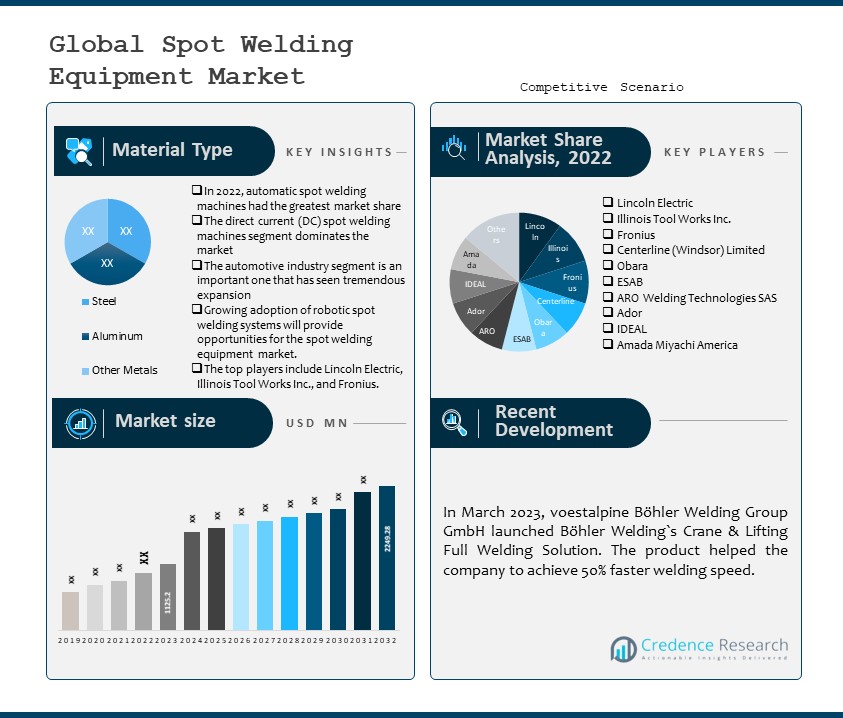
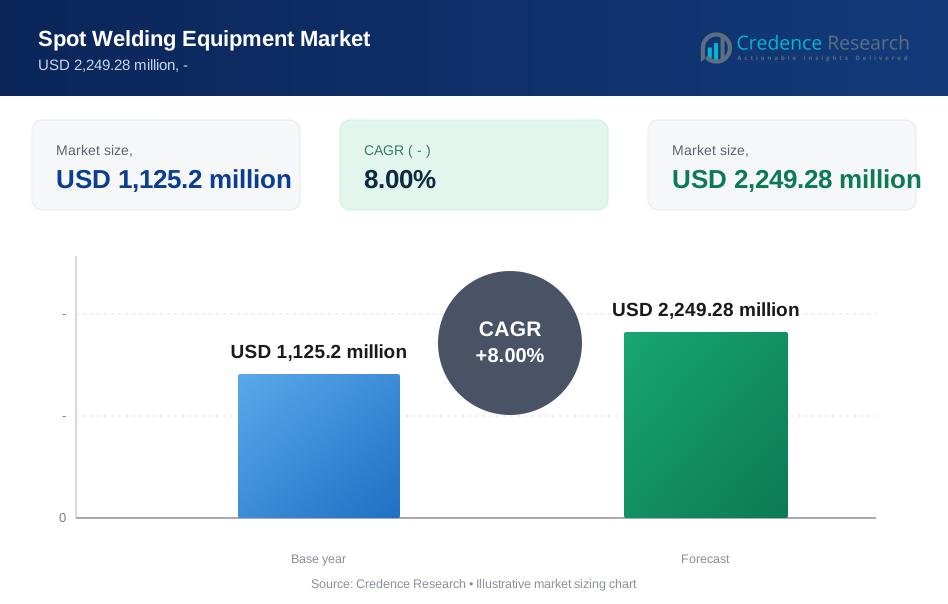
- The market for spot welding equipment is projected to expand at a compound annual growth rate (CAGR) of 8.00% between 2024 and 2032, from an estimated USD 1125.2 million in 2023 to USD 2249.28 million in 2032.
- The largest category is automatic spot welding machines. Semi-automatic spot welding machines, on the other hand, are expected to grow at a strong CAGR.
- The direct current (DC) spot welding machines category will expand rapidly.
- Throughout the projected period, the CAGR for the automotive industry is anticipated to be the highest.
- Throughout the projection period, aluminum should have the largest compound annual growth rate.
- The resistance spot welding (RSW) should have the highest compound annual growth rate throughout the projection period.
- Asia Pacific controlled the spot welding equipment market.
- Regarding the market share of spot welding equipment, Europe is expected to come second.
- North America is expected to experience the fastest growth in the spot welding equipment industry.
- The rising demand for renewable energy projects and government support for manufacturing sectors boosting equipment demand are factors driving the global spot welding equipment market's growth.
- The sector for spot welding equipment may benefit from enhanced welding requirements for modern military equipment and the use of cobots to assist human workers in welding tasks.
Executive Summary
Market Definition
The market for spot welding equipment includes the production, distribution, and sales of equipment for spot welding. This process unites metal surfaces by applying heat and pressure at precise locations. This market serves the electronics, aerospace, and automotive industries. Numerous equipment types are included, including robotic systems, automated welding lines, and portable spot welders. Improvements in welding technology and rising consumer demand for sturdy metal goods are driving market expansion.
Market Overview
The spot welding equipment industry is predicted to continue its upward trajectory between 2024 and 2032, growing at a compound annual growth rate (CAGR) of 8.00%. The market will continue to grow from its projected USD 1125.2 million in 2023 to USD 2249.28 million in 2032.
The market for spot welding equipment is expanding due to the automotive industry. To maximize productivity and maintain strict quality standards, automakers are investing in cutting-edge welding technologies as global auto production rises. Spot welding is becoming more popular because of its dependability and speed, which make it necessary for manufacturing car bodies. This growth is further accelerated by the demand for electric and hybrid automobiles, which frequently call for specialist welding processes. Furthermore, the necessity for lightweight, fuel-efficient automobiles and strict safety standards are driving manufacturers to use cutting-edge welding techniques. The market for spot welding equipment is anticipated to grow rapidly in the next years due to the increased demand for reliable and accurate welding equipment in the automotive industry. This will guarantee improved production capacities and higher-quality vehicles.
Due to rising middle-class incomes, several significant international automobile manufacturers are investing in India. Mercedes-Benz has expanded its premium automobile production to 20,000 units annually, while Hyundai intends to invest USD 1 billion in India by 2020. To bring India up to speed with global automotive norms, the government intends to establish research and development facilities valued at USD 388.5 million.
Robotics integration improves efficiency, speed, and precision in spot welding operations. Automated spot welding systems can accurately complete repetitive jobs, decreasing human error and raising output levels. Sophisticated control systems used in modern spot welding equipment provide improved welding parameter monitoring and adjustment, enhancing weld consistency and quality. Thanks to sensors and Internet of Things technologies, the welding process can be watched in real-time. This reduces maintenance costs and downtime by assisting in the early detection of problems.
Segmentation by Type of Equipment
- Automatic spot welding machines are the market leader in terms of type of equipment because of their high output, quick weld cycle time, and low welding costs. The rapid uptake of this equipment in a number of end-use sectors, including aerospace, construction, and automotive, is anticipated to drive global demand for automatic welding equipment during the projected period.
- The semi-automatic spot welding machines category will exhibit a sizable CAGR during the projected period. The degree of human interaction needed for semi-automatic welding is still higher than for manual welding, but it is still necessary. Flux-cored arc welding (FCAW), metal inert gas (MIG), and metal active gas (MAG) welding are a few types of semi-automatic welding.
- Other types of equipment, including manual spot welding machines and robotic spot welding systems, also support the need for spot welding equipment.
Segmentation by Power Source
- Direct current (DC) spot welding machines are considered the best type of power source. Due to its ability to handle the welding of advanced materials used in vehicle construction, the automobile industry, one of the key consumers of spot welding equipment, frequently needs DC spot welding machines.
- The category of inverter spot welding machines will likely register a significant CAGR during forecasting. Inverter technology allows precise control over welding parameters, including voltage, current, and duration. This feature improves process stability, weld quality, and consistency, especially in complex welding applications with varying material thicknesses.
- Another power source, such as alternating current (AC) spot welding machines, further enhances the need for spot welding equipment.
Segmentation by End User
- The automotive industry category is projected to grow faster over the projection period. Spot welding is commonly used in the production of automobile body structures, joining sheet metal components to create car bodies. Panels, frames, doors, hoods, and other structural elements fall under this category.
- Other end users, including the aerospace, manufacturing, construction, railway, and shipbuilding industries, also influence the need for spot welding equipment.
Segmentation by Material Type
- The aluminum category will likely have the greatest CAGR throughout the forecast period. Aluminum is utilized more often in car manufacturing to lighten vehicles and increase fuel economy. The connecting of aluminum parts in automobile bodies requires spot welding. In addition, because aluminum alloys are lightweight, they are widely used in aeronautical applications. Structures of aircraft are assembled via spot welding.
- Other material types, such as steel and other metals, also contribute to the demand for spot welding equipment.
Segmentation by Technology
- The resistance spot welding (RSW) category is anticipated to grow at a stronger rate during the forecasting period. The automotive, aerospace, and electronics industries are driving demand for resistance spot welding (RSW) technology due to its efficiency in combining metals such as aluminum and steel. In order to satisfy the highest industrial standards, RSW provides strong welds, quick cycle times, and automated system integration. Environmental concerns and technological developments in control systems increase its allure in contemporary industry.
- Other technologies, including laser and ultrasonic spot welding, also influence the need for spot welding equipment.
Segmentation by Region
- Asia Pacific leads the spot welding equipment industry. This is due to the expanding demand for spot welding equipment from the Asia Pacific countries such as China, India, Japan, and other countries.
- Europe is estimated to rank second in the market for spot welding equipment.
- It is anticipated that the spot welding equipment market in North America will grow quickly.
- Regions, including Latin America, the Middle East, and Africa, meet the remaining need for spot welding equipment.
The construction industry is expected to continue growing due to government initiatives in several countries that prioritize infrastructure development and urban planning. The market for spot welding equipment is, therefore, expected to benefit from this growth.
It is anticipated that the spot welding equipment sales in Asia Pacific will surpass those in the entire world. Because of the strong automotive sector, the Asia Pacific market is anticipated to grow at the fastest rate. The market for welding equipment is predicted to grow as the number of electric and hybrid vehicles increases. Moreover, the increasing inclination of consumers towards personalization and preserving the fuel efficiency and ride quality of automobiles is likely to increase the frequency of car maintenance and repairs, which is going to fuel the demand for spot welding equipment.
It is projected that the spot welding equipment market will develop at the fastest rate in the North American region. The North American spot welding equipment market is expanding due to the quickly expanding building and construction sectors in the United States and Canada. Large sums of money are being invested in regional infrastructure development by both public and private enterprises. The U.S. Census Bureau reports that the nation spent over USD 968.7 billion on building during the first nine months of 2019. The spot welding machine is utilized in building projects for a variety of welding tasks, such as structural and pipe welding.
Key Highlights of the Report
The global spot welding equipment market is segmented by type of equipment, power source, end user, material type, technology, and region. As far as the type of equipment is concerned, automatic spot welding machines are the market spearhead. Direct current (DC) spot welding machines are the top power source category. Throughout the forecast period, the automotive industry category is expected to grow at the greatest CAGR. During the predicted period, the category with the highest CAGR will be aluminum. Asia Pacific is seeing the most growth in the spot welding equipment market.
The market for spot welding equipment is growing mostly due to the production of electronics. The need for accurate and effective welding procedures is growing along with the demand for consumer devices like wearables, tablets, and smartphones. In order to assemble electronic components and guarantee dependable connections in circuit boards and microelectronics, spot welding is essential. The necessity of cutting-edge welding technology is further highlighted by developments in miniaturization and the use of novel materials. Thus, in the upcoming years, the spot welding equipment market will likely have significant expansion driven by the electronics manufacturing industry.
It is anticipated that the Asia Pacific will hold the biggest global market share for spot welding equipment. Due to its increasing industrialization, especially in the automotive and electronics sectors, Asia Pacific is predicted to propel significant growth in the market for spot welding equipment. The growing manufacturing base in the area and the developments in welding technologies will increase demand. The market will expand even more as a result of measures to achieve strict quality standards and improve manufacturing efficiency. Thus, Asia Pacific is going to be a major area that will propel the growth of the spot welding equipment market. In addition, it is projected that the market in North America will grow at the quickest rate. North America's advanced automotive and aerospace sectors, together with its growing use of electric vehicles and technological improvements, are expected to propel growth in the spot welding equipment market. The region as a whole has a strong demand for accurate and effective welding solutions because of these factors.
Which Key Factors Are Driving The Global Spot Welding Equipment Market?
Growing demand for high-precision welding in electronic devices and expansion in construction activities needing metal structures are propelling the market for spot welding equipment.
What Are The Main Challenges Confronting The Global Spot Welding Equipment Market?
Ongoing expenses for equipment upkeep and repairs and high energy usage leading to increased operational expenses are the most significant challenges confronting the spot welding equipment industry.
What Market Opportunities Exist For Spot Welding Equipment Globally?
The growth in robotic spot welding systems for precision and efficiency and the implementation of IoT and AI in welding equipment for predictive maintenance and real-time monitoring are some of the factors supporting the market for spot welding equipment.
Market Drivers
Multiple factors propel the spot welding equipment industry across the globe. The primary factors propelling the global spot welding equipment market are as follows:
Growing Aerospace Industry
Spot welding equipment sales are expected to rise significantly as a result of the aerospace industry's expansion. Manufacturers are investing more in cutting-edge welding technologies to meet strict safety and performance criteria as the demand for commercial and military aircraft rises globally. In order to ensure structural integrity and durability, spot welding is essential during the assembly of aircraft structures. Precise and effective welding procedures are even more important as the industry moves toward lightweight materials like composites and alloys. Furthermore, improvements in automation, robotics, and digital manufacturing are speeding up production and increasing productivity in the aerospace industry. The aerospace industry is expected to be a major driver of market expansion in the near future due to the combined effects of these trends, which have increased demand for advanced spot welding equipment designed for aerospace applications.
Market Restraints
There are several obstacles that the global spot welding equipment market must overcome to continue growing. Among them are the following:
High Costs of Spot Welding Equipment
Small and medium-sized businesses are discouraged from investing in these devices due to their high acquisition, installation, and maintenance costs. This expensive barrier prevents the market from growing, especially in areas with low industrial budgets, which in turn keeps the market in check. Growing safety concerns hampered the market. Processes involving spot welding carry safety risks, such as the possibility of burns and eye damage from sparks or bright light. Due to safety concerns, spot welding equipment is discouraged from being used, especially in areas where occupational safety rules are strict.
Opportunities
The spot welding equipment sector presents numerous prospects for development. Among these are the following:
Electric Vehicle Production Demand
The market for spot welding equipment is expected to grow significantly due to the increase in the production of electric vehicles (EVs). Specialized welding techniques are needed for the assembly of battery packs, chassis parts, and lightweight body structures in electric vehicles. Spot welding, which is renowned for its accuracy and dependability, is essential to preserving the integrity and security of EV designs. In response to the growing demand for environmentally friendly transportation options, manufacturers are increasing their production capacity and making investments in cutting-edge welding technology on a global scale. Spot welding equipment use is predicted to increase dramatically as a result of the spike in electric vehicle manufacture, presenting strong growth prospects both within and outside the automotive industry.
Competitive Landscape
Key Players
A number of significant players dominate the highly competitive global market for spot welding equipment. A handful of the top market players are shown below, together with their respective market shares:
- Lincoln Electric
- Illinois Tool Works Inc.
- Fronius
- Centerline (Windsor) Limited
- Obara
- ESAB
- ARO Welding Technologies SAS
- Ador
- IDEAL
- Amada Miyachi America
- Chowel
- DECA
- Others
In order to stay competitive, these organizations give priority to product innovation, expansion of their distribution channels, and mergers and acquisitions.
By creating cutting-edge ideas and goods, the foremost manufacturers in the global market for spot welding equipment consistently strive to stay one step ahead of the competition.
In September 2023, Developed in collaboration with Stanley Black & Decker, ESAB presents the Renegade Volt ES 200i, a cutting-edge battery-powered welding system. It runs entirely on battery power and produces a strong 150A stick output thanks to four DeWalt Flexvolt 12 Ah batteries. Furthermore, it conveniently connects 120V to 230V main power and provides an impressive 200A welding output on 230V, which is a major advancement in portable welding technology.
In September 2023, Miller Electric Manufacturing LLC introduced the Millermatic® 142 MIG Welder, designed for both professionals and do-it-yourselfers. This portable 140-amp equipment guarantees expert-caliber results for seldom welders. According to product manager Robert Rodriguez, Miller stresses delivering high-quality performance even for smaller operations, reaffirming its dedication to welding technology superiority.
How are Companies Performing in the Spot Welding Equipment Market?
Due to a number of significant factors, companies in the spot welding equipment sector are performing well. Some of the significant companies in the spot welding equipment market are concentrating on expanding their product portfolios through agreements and acquisitions of small and medium-sized vendors of spot welding equipment, like ESAB, Miller Electric Mfg. LLC, and Lincoln Electric Company. For example, Miller Electric Mfg. LLC revealed that it has expanded its line of welding machines by acquiring a heavy industrial and power Generation Company situated in Albama. To improve its flow control and oxy-fuel welding solutions, ESAB also bought a Malmo-based supplier of gas control equipment.
Leading companies of spot welding equipment are actively pursuing inorganic marketing strategies to increase their market share globally, including partnerships, technological advancements, investments, acquisitions, and R&D initiatives. In order to make a name for themselves in the global market, numerous startups are also releasing cutting-edge spot welding equipment. For example, YesWelder is a Boulder, Colorado-based startup company that creates accessories and equipment for welders. The company claims that its new MP200 welding equipment is a five-in-one device that can do plasma cutting in addition to four different forms of welding (MIG, MMA, FCAW, and TIG). The MP200 was created by the corporation to reduce the expense and requirement for numerous devices that are limited to single functions.
Summary of Key Findings
- Spot welding equipment is needed in the power generation and distribution energy sector to grow industrial activities in developing countries.
- The market is segmented by type of equipment, power source, end user, material type, technology, and region.
- In the market, the most prevalent type of equipment is automatic spot welding machines.
- Direct current (DC) spot welding machines are the foremost power source category.
- The automotive industry category is expected to grow fastest in terms of CAGR during the forecast period.
- The aluminum category is likely to have the greatest CAGR during the predicted period.
- In terms of market development, Asia Pacific is a leader; the market is highly competitive with key players including Lincoln Electric, Illinois Tool Works Inc., Fronius, Centerline (Windsor) Limited, Obara, ESAB, ARO Welding Technologies SAS, Ador, IDEAL, Amada Miyachi America, Chowel, DECA, and Others.
Future Outlook
- The spot welding equipment industry is expected to increase significantly in Asia Pacific, and its outlook is positive worldwide.
- The market will continue to rise as a result of several factors, including the increased production of household appliances requiring spot welding.
- Risks associated with welding processes requiring strict safety measures and reduced industrial activities during economic downturns may impede market expansion.
- Developing new products, reaching a wider market, and maintaining competitive prices are all necessary for major businesses to stay ahead of the competition.
How the Credence Research Spot Welding Equipment Market Report Can Help CXOs
The Credence Research Spot Welding Equipment Market Report provides CXOs with an extensive market overview and comprises the following:
- Market size and growth forecast: The study offers comprehensive market estimations for spot welding equipment globally, broken down by type of equipment, power source, end user, material type, technology, and region. Furthermore, the report includes market forecasts through 2032, derived from key drivers and trends.
- Market segmentation: The research report divides the spot welding equipment market into segments by type of equipment, power source, end user, material type, technology, and region. This segmentation helps CXOs understand the market and the opportunities inside each area in great depth.
- Competitive landscape: The study report provides a thorough analysis of the leading businesses in the spot welding equipment sector, together with details on their revenue streams, product lines, and business strategies. With this information, CXOs can assess and identify their competitors.
- Key trends and drivers: The study report analyzes and highlights the key developments and elements driving the market for spot welding equipment. CXOs can utilize this information to make well-informed choices regarding their plans and investments.
The Credence Research Spot Welding Equipment Market Report provides CXOs with insights that they may utilize to:
- Identify growth opportunities: This analysis is likely to help CXOs find fresh growth prospects in the spot welding equipment sector. For example, the research recognizes the increasing requirement for spot welding equipment from the automotive industry as a crucial opportunity.
- Make informed investment decisions: The study aids CXOs in making informed decisions about spot welding equipment. For example, it delivers information on the key variables to consider while picking solutions and evaluating suppliers.
- Develop competitive strategies: CXOs can utilize the research report to establish competitive strategies for their spot welding equipment firms. The study paper explores the primary tactics employed by spot welding equipment providers to set themselves apart from their rivals.
- Track market developments: This research report could assist CXOs in remaining ahead of the curve by tracking market advancements. For example, it provides information about the latest advancements and patterns in the spot welding equipment industry.
The Credence Research Spot Welding Equipment Market Report is helpful for CXOs who want to learn more about the market and identify potential opportunities.
Segmentation
- By Type of Equipment
- Manual Spot Welding Machines
- Semi-Automatic Spot Welding Machines
- Automatic Spot Welding Machines
- Robotic Spot Welding Systems
- By Power Source
- Alternating Current (AC) Spot Welding Machines
- Direct Current (DC) Spot Welding Machines
- Inverter Spot Welding Machines
- By End User
- Automotive Industry
- Aerospace Industry
- Manufacturing Industry
- Construction Industry
- Railways and Shipbuilding
- By Material Type
- Steel
- Aluminum
- Other Metals
- By Technology
- Resistance Spot Welding (RSW)
- Laser Spot Welding
- Ultrasonic Spot Welding
- By Region
- North America
- The U.S.
- Canada
- Mexico
- Europe
- Germany
- France
- K.
- Italy
- Spain
- Rest of Europe
- Asia Pacific
- China
- Japan
- India
- South Korea
- South-east Asia
- Rest of Asia Pacific
- Latin America
- Brazil
- Argentina
- Rest of Latin America
- Middle East & Africa
- GCC Countries
- South Africa
- The Rest of the Middle East and Africa
- North America
Adjacent Markets |
||
| Robotic Welding Market | Arc Welding Equipment Market | Industrial Robotics Market |
| Laser Welding Equipment Market | Welding Consumables Market | Metal Fabrication Equipment Market |
| Resistance Welding Equipment Market | Automated Manufacturing Systems Market | Automotive Manufacturing Equipment Market |
Request a Free Sample
Fill in your details and we'll send you a free sample report.
- Sample data tables & charts
- Research methodology
Need a Custom Version of This Report?
Tailor the scope, geography, or segments to your exact requirements.
- Custom geography or segment scope
- Direct access to our analyst team
Frequently Asked Questions
How much does the global market currently hold for spot welding equipment?
What is the spot welding equipment market's projected growth rate between 2024 and 2032?
In terms of the type of equipment, which market category is leading?
Regarding the power source, which market category is in the lead?
Which end-user category is anticipated to grow at the fastest rate throughout the projected period?
In which region is the market for spot welding equipment expanding?
Which major companies lead the global market for spot welding equipment?
Which market factors are the primary drivers of the spot welding equipment industry?
What main market challenges prevent the growth of the spot welding equipment sector?
What are the main market opportunities for the spot welding equipment sector?
Table of Content
Chapter 1. Report Introduction
- 1.1 Report Description & Purpose
- 1.1.1 Report Title & Market Definition
- 1.1.2 Unique Selling Propositions (USP) & Key Differentiators
- 1.1.3 Value Proposition for Stakeholders
- 1.2 Research Objectives
- 1.2.1 Market Sizing Objectives (Volume & Revenue)
- 1.2.2 Segmentation Objectives
- 1.2.3 Competitive Intelligence Objectives
- 1.2.4 Forecast & Scenario Objectives
- 1.3 Report Scope
- 1.3.1 Spot Welding Equipment Scope – Types & Subtypes Covered
- 1.3.2 Geographic Scope – Regions & Countries Covered
- 1.3.3 Historical Period, Base Year & Forecast Period (the historical period; forecast to the forecast period)
- 1.3.4 Inclusions & Exclusions
- 1.4 HS Code & Classification Framework
- 1.5 Currency, Units & Pricing Basis
- 1.6 Target Stakeholders
- 1.7 Limitations & Assumptions
Chapter 2. Executive Summary
- 2.1 Global Spot Welding Equipment Market Snapshot
- 2.1.1 Market Size – Historical (the historical period) & Forecast (the forecast period) (base year: USD 1,125.2 million → forecast year: USD 2,249.28 million)
- 2.1.2 Volume & Revenue – Global Totals
- 2.1.3 Key Market Highlights – Top Five Facts
- 2.2 Spot Welding Equipment Market Segmentation Snapshot
- 2.2.1 Market Split by Region – vs.
- 2.3 Competitive Snapshot
- 2.3.1 Top 10 Players by Revenue Share –
- 2.3.2 Top 10 Players by Volume Share –
- 2.3.3 Recent Strategic Developments (18-Month Summary)
- 2.4 Key Investment Highlights & Strategic Conclusions
Chapter 3. Spot Welding Equipment Market Dynamics & Industry Analysis
- 3.1 Market Overview & Context
- 3.1.1 Spot Welding Equipment Market Position in the Broader Automotive Value Chain
- 3.1.2 OEM vs. Replacement Market Dynamics
- 3.1.3 Market Maturity & Development Stage by Region
- 3.2 Spot Welding Equipment Market Drivers
- 3.3 Spot Welding Equipment Market Restraints & Challenges
- 3.4 Spot Welding Equipment Market Opportunities
- 3.5 Porter's Five Forces Analysis
- 3.5.1 Threat of New Entrants
- 3.5.2 Bargaining Power of Suppliers
- 3.5.3 Bargaining Power of Buyers
- 3.5.4 Threat of Substitutes
- 3.5.5 Competitive Rivalry – Intensity Assessment
- 3.6 Spot Welding Equipment Value Chain Analysis
- 3.6.1 Upstream – Raw Material/Input Suppliers
- 3.6.1.1 Raw Material/Input 1
- 3.6.1.2 Raw Material/Input 2
- 3.6.1.3 Raw Material/Input 3
- 3.6.2 Midstream – Production/Manufacturing/Service Delivery
- 3.6.2.1 Production/Process Overview
- 3.6.2.2 Key Facility Locations & Capacity by Manufacturer
- 3.6.3 Downstream – Distribution & End Consumer
- 3.6.3.1 Primary Channel – B2B/OEM
- 3.6.3.2 Secondary Channels – Dealer, Retail, Online, Direct
- 3.6.4 Value Chain Profitability Analysis
- 3.6.1 Upstream – Raw Material/Input Suppliers
- 3.7 PESTEL Analysis
- 3.7.1 Political Factors
- 3.7.2 Economic Factors
- 3.7.3 Social Factors
- 3.7.4 Technological Factors
- 3.7.5 Environmental Factors
- 3.7.6 Legal Factors
- 3.8 Spot Welding Equipment Supply Chain Analysis
- 3.8.1 Raw Material/Input Supply Risk Assessment
- 3.8.2 Manufacturing Concentration Risk (Geographic Exposure)
- 3.8.3 Trade Disruption Impact Analysis
- 3.9 Regulatory & Policy Landscape
Note: The regulatory and policy landscape section covers regulations based on their applicability to the market, Spot Welding Equipment category, geography, and scope of the study. Only regulatory frameworks with a material impact on operations, compliance, trade, sustainability, or market access are analyzed in detail.
Chapter 4. Key Investment Pockets & Opportunity Analysis
- 4.1 Spot Welding Equipment Market Attractiveness Analysis
- 4.1.1 By Region – Investment Attractiveness Matrix (Volume × CAGR)
- 4.2 Absolute Revenue Growth Opportunity
- 4.2.1 By Region – Absolute USD Growth Through the forecast period
- 4.3 Incremental Volume Opportunity
- 4.3.1 By Region – Incremental Volume Through the forecast period
- 4.3.2 Segment – Incremental Volume
- 4.4 Emerging Submarket Opportunity Deep Dive (Subject to Applicability)
- 4.5 Emerging Market Opportunity Scorecards
- 4.5.1 United States
- 4.5.2 Europe
- 4.5.3 Asia
- 4.5.4 Middle East & Africa
Note: Emerging Market Opportunity Scorecards will be included based on relevance and strategic importance. Regions listed are indicative and may vary depending on data availability and market dynamics.
Chapter 5. Spot Welding Equipment Import-Export Analysis & Trade Flows
- 5.1 Global Trade Overview
- 5.1.1 Global Export Value by Country (the historical period)
- 5.1.2 Global Export Volume by Country (the historical period)
- 5.1.3 Global Import Value by Country (the historical period)
- 5.1.4 Global Import Volume by Country (the historical period)
- 5.1.5 Net Trade Balance by Country (the historical period)
- 5.2 Export Analysis – Segment
- 5.2.1 Type 1 (HS Code)
- 5.2.2 Type 2 (HS Code)
- 5.2.3 Type 3 (HS Code)
- 5.2.4 Type 4 (HS Code)
- 5.2.5 Type 5 (HS Code)
- 5.3 Import Analysis – Segment
- 5.3.1 Type 1 (HS Code)
- 5.3.2 Type 2 (HS Code)
- 5.3.3 Type 3 (HS Code)
- 5.3.4 Type 4 (HS Code)
- 5.3.5 Type 5 (HS Code)
- 5.4 Average Unit Trade Prices
- 5.4.1 Average Export Price – Segment & Country
- 5.4.2 Average Import Price – Segment & Source Country
- 5.4.3 Price Trends (the historical period)
- 5.5 Key Trade Route Analysis
- 5.5.1 Trade Route 1
- 5.5.2 Trade Route 2
- 5.5.3 Trade Route 3
- 5.5.4 Trade Route 4
- 5.5.5 Trade Route 5
- 5.6 Trade Policy Impact Assessment
- 5.6.1 US Anti-Dumping & Section 301 Tariffs
- 5.6.2 EU Customs Union Impact
- 5.6.3 Major Free Trade Agreements
- 5.6.4 USMCA Rules of Origin
Note: Trade policy analysis will be included only where relevant to the Spot Welding Equipment market.
Chapter 6. Competitive Landscape & Company Benchmarking
- 6.1 Spot Welding Equipment Market Concentration & Structure
- 6.1.1 Herfindahl-Hirschman Index (HHI) – vs.
- 6.1.2 Tier 1, Tier 2 & Tier 3 Market Structure
- 6.1.3 Global, Regional & Local Player Dynamics
- 6.2 Spot Welding Equipment Market Share Analysis –
- 6.2.1 Global Revenue Share by Company
- 6.2.2 Global Volume Share by Company
- 6.2.3 Regional Revenue Share
- 6.2.4 Market Share Evolution ( vs. )
- 6.2.5 OEM Segment Share by Company
- 6.2.6 Replacement Segment Share by Company
- 6.3 Production/Delivery Capacity & Facility Analysis
- 6.3.1 Global Installed Capacity
- 6.3.2 Capacity Utilization Rates
- 6.3.3 Production/Output Volume
- 6.3.4 Facility Locations & Capacity Map
- 6.3.5 Planned Capacity Additions
- 6.4 Spot Welding Equipment Competitive Benchmarking Matrix
- 6.4.1 Revenue, Volume, CAGR & Profitability Comparison
- 6.4.2 Channel Revenue Mix
- 6.4.3 Geographic Revenue Exposure
- 6.4.4 R&D Intensity
- 6.4.5 Sustainability Maturity
- 6.5 Strategic Developments in Spot Welding Equipment (Last 24 Months)
- 6.5.1 Mergers, Acquisitions & Divestments
- 6.5.2 New Spot Welding Equipment Launches
- 6.5.3 Facility Expansions
- 6.5.4 Strategic Alliances, Joint Ventures & Partnerships
- 6.5.5 Distribution Expansion & Market Entry
- 6.5.6 Sustainability & ESG Initiatives
- 6.6 Competitive Strategy Mapping
- 6.6.1 Leader, Challenger, Follower & Niche Classification
- 6.6.2 Pricing Strategy Comparison
- 6.6.3 Channel Strategy Matrix
Note: Strategic developments are included based on their materiality and the availability of reliable information.
Chapter 7. Global Spot Welding Equipment Market – By Distribution Channel
- 7.1 Segment Overview
- 7.1.1 Volume & Revenue Split by Channel ( & )
- 7.1.2 Channel Mix Evolution (the forecast period)
Chapter 8. Regional Market Analysis – Global Overview
- 8.1 Global Regional Overview
- 8.1.1 Regional Volume Share
- 8.1.2 Regional Revenue Share
- 8.1.3 Regional Volume by Region
- 8.1.4 Regional Revenue by Region
- 8.1.5 Regional Forecast Through the forecast period
- 8.2 Cross-Regional Segment Analysis
- 8.2.1 By Distribution Channel
- 8.2.2 By Brand/Price Tier
Chapter 9. North America Spot Welding Equipment Market
- 9.1 United States
- 9.2 Canada
- 9.3 Mexico
Chapter 10. Europe Spot Welding Equipment Market
- 10.1 Germany
- 10.2 France
- 10.3 Italy
- 10.4 United Kingdom
- 10.5 Spain
- 10.6 Poland
- 10.7 Russia
- 10.8 Netherlands
- 10.9 Belgium
- 10.10 Sweden
- 10.11 Denmark
- 10.12 Norway
- 10.13 Rest of Europe
Chapter 11. Asia Pacific Spot Welding Equipment Market
- 11.1 China
- 11.2 India
- 11.3 Japan
- 11.4 South Korea
- 11.5 Thailand
- 11.6 Indonesia
- 11.7 Vietnam
- 11.8 Malaysia
- 11.9 Australia
- 11.10 Rest of Asia Pacific
Chapter 12. Latin America Spot Welding Equipment Market
- 12.1 Brazil
- 12.2 Argentina
- 12.3 Colombia
- 12.4 Chile
- 12.5 Rest of Latin America
Chapter 13. Middle East Spot Welding Equipment Market
- 13.1 Saudi Arabia
- 13.2 United Arab Emirates
- 13.3 Turkey
- 13.4 Israel
- 13.5 Iran
- 13.6 Rest of the Middle East
Chapter 14. Africa Spot Welding Equipment Market
- 14.1 South Africa
- 14.2 Egypt
- 14.3 Nigeria
- 14.4 Morocco
- 14.5 Rest of Africa
Chapter 15. Spot Welding Equipment Company Profiles
- 15.1 [Company 01]
- 15.1.1 Company Overview
- 15.1.2 Key Management Personnel
- 15.1.3 Products & Services Portfolio
- 15.1.4 Financial Performance
- 15.1.5 Key Market Focus & Geographic Presence
- 15.1.6 Recent Developments & Strategic Initiatives
Note: The company profile list is preliminary and may change based on research findings, market developments, data availability, and client requirements.
Chapter 16. Appendices
- Appendix A – List of Abbreviations & Acronyms
- Appendix B – Industry Classification Code Reference – Full Series
- Appendix C – Production & Capacity Data Tables
- Appendix D – End-Use & Demand Base Tables
- Appendix E – Consumption & Replacement Rate Assumptions
- Appendix F – ASP Reference Tables
- Appendix G – Manufacturing & Facility Database
- Appendix H – Import-Export Data Tables
- Appendix I – Regulatory Summary Tables
- Appendix J – Primary Research Participant List (Anonymized)
- Appendix K – Primary Research Questionnaire Framework
- Appendix L – Data Sources & Bibliography
- Appendix M – Market Size Divergence & Source Comparison
Chapter 17. Research Methodology
- 17.1 Research Framework & Philosophy
- 17.2 Secondary Research – Sources, Hierarchy & Data Extraction
- 17.3 Data Modeling – Bottom-Up & Top-Down Market Sizing
- 17.4 Primary Research – Stakeholder Framework, LOI & Sample Sizes
- 17.5 Forecast Methodology – Regression, Scenario & Sensitivity Analysis
- 17.6 Quality Control – Four-Layer Validation Framework
- 17.7 Limitations & Standard Assumptions
- 17.8 Disclaimer
