
Market Overview
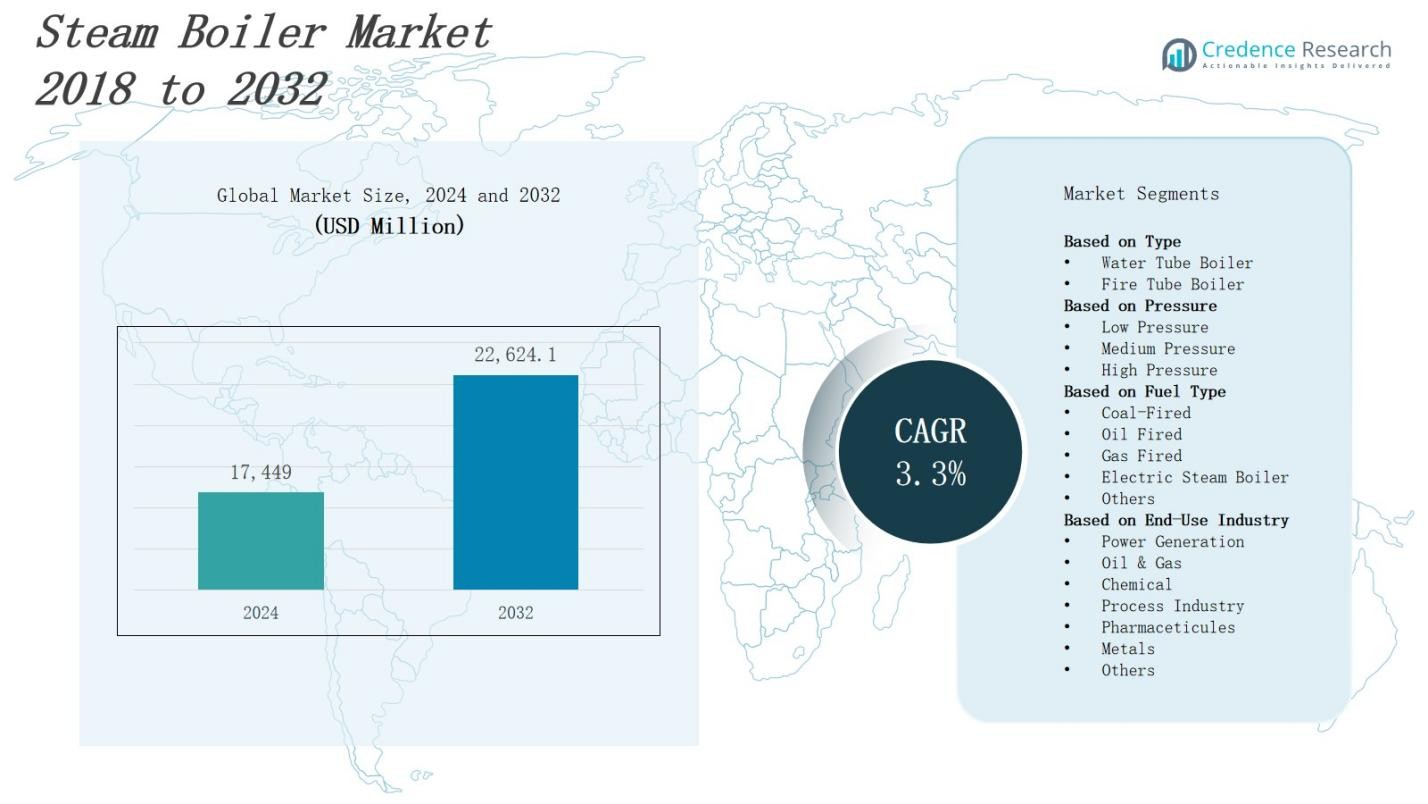
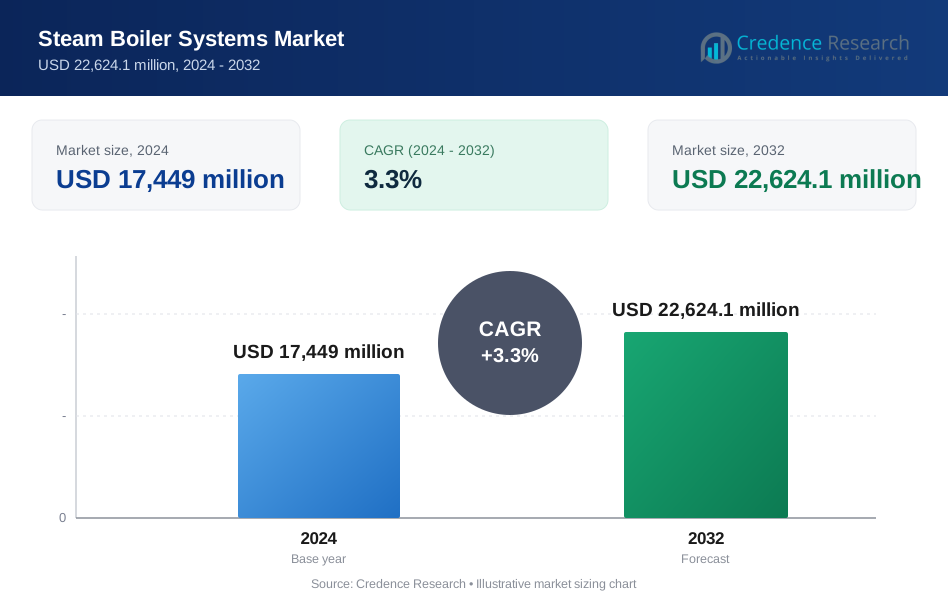
The steam boiler systems market is projected to grow from USD 17,449 million in 2024 to USD 22,624.1 million by 2032, registering a compound annual growth rate (CAGR) of 3.3%.
| REPORT ATTRIBUTE | DETAILS |
|---|---|
| Historical Period | 2020-2024 |
| Base Year | 2024 |
| Forecast Period | 2025-2032 |
| Steam Boiler Market Size 2024 | USD 17,449 Million |
| Steam Boiler Market, CAGR | 3.3% |
| Steam Boiler Market Size 2032 | USD 22,624.1 Million |
The steam boiler systems market growth is driven by increasing industrialization and rising demand for efficient energy generation across manufacturing, power, and chemical sectors. Strict environmental regulations encourage adoption of advanced, low-emission boilers that improve fuel efficiency and reduce carbon footprint. Technological advancements, such as integration of automation and IoT-enabled monitoring systems, enhance operational reliability and maintenance efficiency. Growing investments in renewable energy and combined heat and power (CHP) applications further support market expansion. Trends include a shift towards modular and compact boiler designs to optimize space and installation costs, alongside rising preference for biomass and waste-to-energy boilers that promote sustainability.
The steam boiler systems market spans key regions including Asia-Pacific, North America, Europe, and the Rest of the World, with Asia-Pacific leading due to rapid industrialization and infrastructure growth. North America and Europe maintain strong market shares driven by advanced technologies and stringent environmental regulations. The Rest of the World shows moderate growth supported by emersssging industrial sectors. Key players such as General Electric, Mitsubishi Heavy Industries, Babcock & Wilcox, Viessmann Limited, and Thermax Limited actively compete by focusing on innovation, energy efficiency, and expanding their global footprint across these regions.
Market Insights
- The steam boiler systems market is projected to grow from USD 17,449 million in 2024 to USD 22,624.1 million by 2032, registering a CAGR of 3.3%.
- Growth is driven by increasing industrialization and rising demand for efficient energy generation in manufacturing, power, and chemical sectors, alongside strict environmental regulations promoting low-emission, fuel-efficient boilers.
- Technological advancements including automation and IoT-enabled monitoring improve operational reliability and maintenance efficiency, supporting market expansion.
- Investments in renewable energy and combined heat and power (CHP) applications foster adoption of biomass and waste-to-energy boilers, reflecting sustainability trends.
- Asia-Pacific leads with 32% market share due to rapid industrialization, while North America and Europe hold 30% and 28% shares, driven by advanced technologies and stringent emission standards; the Rest of the World accounts for 10%.
- High initial investment and maintenance costs limit market penetration, especially for small and medium enterprises, while strict regulatory compliance and limited cleaner fuel availability challenge widespread adoption.
- Market players focus on innovation, energy efficiency, and expanding their global footprint, leveraging modular and compact boiler designs to meet diverse industrial needs and environmental requirements.
Market Drivers
Rising Industrialization and Energy Demand Propel Market Expansion
The steam boiler systems market benefits from accelerating industrial growth worldwide, particularly in emerging economies. Industries such as power generation, manufacturing, chemical processing, and oil & gas increasingly rely on steam boiler systemss to meet their energy and heating needs. It supports large-scale operations by providing efficient steam generation and temperature control. Growing infrastructure development and urbanization further intensify demand, fueling the need for robust and scalable boiler systems that sustain continuous industrial output.
- For instance, Babcock & Wilcox boilers at the Egbin Thermal Power Plant in Nigeria have achieved steam generation efficiencies as high as 79.7%, reliably meeting the high energy needs of power generation.
Stringent Environmental Regulations Drive Adoption of Efficient Technologies
The market experiences pressure from regulatory bodies enforcing emission norms and energy efficiency standards. It compels manufacturers and end users to transition toward low-emission boilers with enhanced combustion efficiency. Innovations targeting reduced greenhouse gas emissions help industries comply with environmental mandates while optimizing fuel consumption. The steam boiler systems market responds with advanced designs featuring flue gas treatment and economizer systems that minimize pollution and improve thermal efficiency, supporting sustainable industrial practices.
Technological Integration Enhances Operational Performance and Safety
The incorporation of automation, digital controls, and IoT-enabled monitoring solutions strengthens market growth by improving boiler reliability and maintenance management. It enables real-time data analysis, predictive maintenance, and remote diagnostics, reducing downtime and operational costs. Enhanced safety features embedded in modern steam boiler systemss prevent accidents and extend equipment lifespan. These technological advancements increase user confidence and operational efficiency, making steam boiler systemss indispensable in high-demand industrial environments.
- For instance, Bosch Thermotechnology uses digital controls with remote diagnostics to optimize boiler performance, enhancing safety and cutting maintenance response times by 30%.
Shift Toward Renewable Energy Sources and Compact Designs
The steam boiler systems market witnesses a growing trend toward biomass, waste-to-energy, and other renewable fuel-based boilers that support environmental sustainability. It aligns with global initiatives promoting clean energy and reducing dependence on fossil fuels. Simultaneously, manufacturers develop modular and compact boiler units that save space and facilitate easier installation in confined industrial settings. This combination of green technology adoption and design innovation positions the market for continued growth amid evolving energy and environmental landscapes.
Market Trends
Increasing Adoption of Automation and Digitalization in Boiler Operations
The steam boiler systems market shows a strong trend toward integrating automation and digital technologies to optimize performance and reduce operational costs. It embraces IoT-enabled sensors and control systems that provide continuous monitoring, data analytics, and remote management. These advancements improve efficiency by detecting faults early and facilitating predictive maintenance. Industrial operators gain enhanced control over boiler functions, improving safety, reducing downtime, and extending equipment life. This digital transformation shapes modern boiler management strategies.
- For instance, Bosch Industrial deployed the MEC Optimize digital efficiency assistant in a steam boiler systems system for a beverage brewery, enabling data transparency and process optimization that reduced fuel costs by up to 16 percent.
Growing Preference for Environmentally Friendly and Renewable Fuel Boilers
The market witnesses a rising shift toward steam boiler systemss powered by biomass, biofuels, and waste-derived energy sources. It supports efforts to lower carbon emissions and achieve sustainability targets within industrial sectors. Renewable fuel boilers reduce reliance on traditional fossil fuels while maintaining energy output efficiency. This trend reflects increasing environmental awareness among industries and regulatory encouragement to adopt green technologies. The steam boiler systems market adapts by expanding its product portfolio to include eco-friendly and clean energy solutions.
- For instance, Thermax installed a 22 TPH biomass briquette-fired boiler at Serum Institute’s vaccine factory in Pune, achieving a 30% reduction in fuel costs and significantly lowering environmental impact.
Development of Compact and Modular Boiler Designs for Space Optimization
The steam boiler systems market embraces innovations focused on compact, modular units that simplify installation and maintenance in limited space environments. It offers scalable solutions suited for small- to medium-sized industrial facilities and remote locations. Modular designs reduce lead times and lower upfront costs, allowing quicker deployment. These boilers support flexible capacity adjustments, enabling operators to optimize energy use based on demand fluctuations. This trend reflects a practical approach to meeting diverse industrial requirements efficiently.
Emphasis on Enhancing Energy Efficiency and Reducing Operational Costs
The steam boiler systems market continues to prioritize technologies that maximize thermal efficiency and minimize fuel consumption. It incorporates economizers, condensate recovery systems, and advanced burner technologies to improve energy utilization. These improvements help industries reduce overall operational expenses while complying with strict energy regulations. Focus on efficiency also drives research and development efforts to innovate materials and design features that optimize heat transfer and minimize losses. This trend reinforces the market’s commitment to sustainable and cost-effective solutions.
Market Challenges Analysis
High Initial Investment and Maintenance Costs Hinder Market Penetration
The steam boiler systems market faces challenges due to substantial capital expenditure required for purchasing and installing advanced boiler systems. It demands significant upfront investment in equipment, infrastructure, and skilled labor, which can deter small and medium-sized enterprises from adopting modern technologies. Ongoing maintenance costs, including regular inspections, parts replacement, and downtime management, add to the total cost of ownership. These financial burdens slow market growth in price-sensitive regions and industries with limited budget flexibility.
Strict Regulatory Compliance and Fuel Availability Constraints Limit Expansion
The market encounters difficulties complying with stringent environmental regulations that mandate reduced emissions and higher efficiency standards. It requires continuous upgrades and retrofits to meet evolving legal frameworks, increasing operational complexity and costs. Limited availability and high prices of cleaner fuels such as biomass or low-sulfur coal restrict widespread adoption of environmentally friendly boilers. These constraints create barriers for industries seeking sustainable solutions, slowing the overall adoption rate and challenging market scalability.
Market Opportunities
Expansion into Emerging Economies with Growing Industrial Infrastructure
The steam boiler systems market holds significant opportunities in emerging economies undergoing rapid industrialization and infrastructure development. It can capitalize on increasing energy demands in countries across Asia, Africa, and Latin America, where manufacturing and power generation sectors are expanding. Growing investments in industrial parks, refineries, and chemical plants create substantial demand for efficient steam generation solutions. The market can leverage these growth areas by offering cost-effective, scalable boiler systems tailored to local requirements and regulatory environments.
Advancements in Sustainable Technologies and Green Energy Integration
The market can benefit from rising global focus on sustainability by developing steam boiler systemss compatible with renewable and alternative fuels. It has opportunities to innovate biomass, biofuel, and waste-to-energy boiler technologies that align with environmental regulations and corporate social responsibility goals. Integration of energy recovery systems and smart controls can enhance operational efficiency while reducing emissions. These technological advancements position the steam boiler systems market to address evolving customer needs and regulatory pressures, opening new revenue streams in the clean energy transition.
Market Segmentation Analysis:
By Type
The steam boiler systems market segments include water tube and fire tube boilers, with water tube boilers commanding significant industrial usage due to their high efficiency and ability to operate at elevated pressures and temperatures. It suits large-scale power plants and heavy industries requiring rapid steam generation and better heat transfer. Fire tube boilers find preference in smaller applications with lower pressure demands, offering simpler design and easier maintenance. The market adapts product offerings to meet diverse operational requirements across sectors.
- For instance, the Ivanpah solar-power station uses Rentech Type-D water tube boilers to warm up the plant and provide high-pressure steam when operating as a fossil-fueled power station.
By Pressure
The market classifies steam boiler systemss into low, medium, and high-pressure categories based on operating pressure. It witnesses strong demand for high-pressure boilers in power generation and petrochemical industries, where precise steam control and high output are essential. Medium-pressure boilers serve industrial heating and manufacturing processes requiring moderate pressure, while low-pressure boilers support commercial and small-scale applications. This segmentation allows the market to address varied energy and process needs effectively.
- For instance, Babcock & Wilcox boilers are widely used in thermal power stations for their reliable high-pressure steam output, critical for driving turbines efficiently.
By Fuel Type
The steam boiler systems market includes coal-fired, oil-fired, gas-fired, electric steam boiler systemss, and others, with coal-fired units retaining substantial presence in regions dependent on coal-based energy. It faces increasing competition from gas-fired and electric boilers due to environmental concerns and regulatory pressure. Gas-fired boilers gain popularity for cleaner combustion and operational flexibility. Electric boilers provide efficient, emission-free alternatives suitable for specific industrial and commercial uses. The market continues to evolve fuel preferences to balance performance, cost, and sustainability goals.
Segments:
Based on Type
- Water Tube Boiler
- Fire Tube Boiler
Based on Pressure
- Low Pressure
- Medium Pressure
- High Pressure
Based on Fuel Type
- Coal-Fired
- Oil Fired
- Gas Fired
- Electric Steam boiler systems
- Others
Based on End-Use Industry
- Power Generation
- Oil & Gas
- Chemical
- Process Industry
- Pharmaceticules
- Metals
- Others
Based on the Geography:
- North America
- U.S.
- Canada
- Mexico
- Europe
- Germany
- France
- U.K.
- Italy
- Spain
- Rest of Europe
- Asia Pacific
- China
- Japan
- India
- South Korea
- South-east Asia
- Rest of Asia Pacific
- Latin America
- Brazil
- Argentina
- Rest of Latin America
- Middle East & Africa
- GCC Countries
- South Africa
- Rest of the Middle East and Africa
Regional Analysis
North America
The North American steam boiler systems market holds a significant share of 30%, driven by advanced industrial infrastructure and stringent environmental regulations. It benefits from high investments in upgrading power generation facilities and adopting energy-efficient technologies. Industries such as chemicals, pharmaceuticals, and manufacturing rely heavily on steam boiler systemss for process heating. The market sees strong demand for clean energy-compatible boilers, including gas-fired and electric models. Rising automation and digitalization further improve operational efficiency, reinforcing North America’s leadership in technological innovation.
Europe
Europe captures 28% of the steam boiler systems market, supported by well-established industrial sectors and rigorous emission standards. It prioritizes sustainable energy solutions and enforces policies that promote biomass and waste-to-energy boilers. The region experiences steady growth due to modernization of existing plants and expansion of combined heat and power (CHP) installations. European manufacturers focus on developing compact and modular designs to meet space constraints and diverse industrial requirements. The market dynamics reflect Europe’s commitment to balancing industrial output with environmental responsibility.
Asia-Pacific
Asia-Pacific commands 32% market share, making it the largest regional segment due to rapid industrialization and urbanization across China, India, and Southeast Asia. It experiences increasing demand from power plants, chemical industries, and large-scale manufacturing units. The region’s dependence on coal-fired boilers remains high, though there is growing adoption of gas-fired and renewable fuel boilers driven by regulatory policies. The steam boiler systems market benefits from expanding infrastructure projects and government initiatives supporting energy efficiency and pollution control measures.
Rest of the World
The Rest of the World accounts for 10% of the steam boiler systems market, comprising Latin America, Middle East, and Africa. It shows moderate growth propelled by expanding industrial bases and investments in power generation. Emerging economies focus on upgrading aging infrastructure and integrating cleaner boiler technologies to meet rising energy demands. Market players capitalize on opportunities by offering flexible and cost-effective solutions tailored to local needs. The region’s growth potential lies in balancing industrial development with increasing environmental awareness.
Key Player Analysis
- Viessmann Limited
- Hurst Boiler & Welding, Inc.
- Mitsubishi Heavy Industries, Ltd.
- Thyssenkrupp
- Alfa Laval AB
- IHI Corporation
- General Electric
- Thermax Limited
- Forbes Marshall
- Babcock & Wilcox Enterprises, Inc.
Competitive Analysis
The steam boiler systems market features a competitive landscape dominated by established multinational corporations and specialized regional manufacturers. Leading companies focus on innovation, product quality, and customization to meet diverse industrial requirements. It drives investments in research and development to enhance energy efficiency, reduce emissions, and integrate smart technologies like IoT and automation. Strategic partnerships, mergers, and acquisitions enable key players to expand their product portfolios and geographic presence. Market participants emphasize after-sales service and maintenance support to build long-term customer relationships. Price competitiveness remains critical, especially in emerging economies where cost-sensitive buyers demand reliable yet affordable solutions. Continuous adaptation to evolving environmental regulations and fuel preferences challenges companies to innovate rapidly. The steam boiler systems market rewards those who combine technological expertise with strong supply chain management and customer-centric approaches. It presents opportunities for companies that develop sustainable and efficient boiler systems aligned with global clean energy trends.
Recent Developments
- In April 2025, SDI Group Plc acquired Collins Walker Ltd., a manufacturer of electric boilers, for approximately £1.85 million. This acquisition enabled SDI Group to enter the electric boiler market and expand its offerings to include bespoke steam and hot water systems for industrial applications.
- In September 2024, Babcock Wanson launched the LV-Pack, a low-voltage electric boiler designed for industrial applications, focusing on efficiency and lower energy consumption.
- In March 2024, Volta Aluminium Company (VALCO) inaugurated a state-of-the-art steam boiler systems to enhance power generation and aluminum production.
- In May 2024, Miura, a Japanese industrial equipment manufacturer, acquired Cleaver-Brooks, a U.S.-based provider of industrial and commercial boilers. This move strengthened Miura’s presence in the North American market and enhanced its capabilities in high-efficiency steam solutions.
Market Concentration & Characteristics
The steam boiler systems market exhibits a moderately concentrated structure dominated by a few global players with strong technological capabilities and extensive distribution networks. It features a competitive environment where leading companies focus on innovation, energy efficiency, and compliance with stringent environmental regulations. Market participants invest in advanced product development, including automation and IoT integration, to enhance operational reliability and reduce emissions. The market also includes regional manufacturers catering to localized industrial needs and cost-sensitive customers. It demands continuous adaptation to evolving fuel preferences and regulatory frameworks, driving differentiation through sustainable and modular boiler designs. Customer emphasis on after-sales service, maintenance support, and customization influences vendor selection, fostering long-term partnerships. The steam boiler systems market rewards companies that combine technological expertise with strong supply chain management and customer-centric strategies to maintain competitiveness and expand their global presence.
Report Coverage
The research report offers an in-depth analysis based on Type, Pressure, Fuel Type, End-User Industry and Geography. It details leading market players, providing an overview of their business, product offerings, investments, revenue streams, and key applications. Additionally, the report includes insights into the competitive environment, SWOT analysis, current market trends, as well as the primary drivers and constraints. Furthermore, it discusses various factors that have driven market expansion in recent years. The report also explores market dynamics, regulatory scenarios, and technological advancements that are shaping the industry. It assesses the impact of external factors and global economic changes on market growth. Lastly, it provides strategic recommendations for new entrants and established companies to navigate the complexities of the market.
Future Outlook
- Increasing industrialization will continue to drive demand for efficient steam boiler systems systems globally.
- Technological advancements will focus on enhancing energy efficiency and reducing emissions.
- Integration of digital controls and IoT will improve boiler monitoring and maintenance.
- Renewable fuel-based boilers such as biomass and waste-to-energy will gain wider adoption.
- Modular and compact boiler designs will become more prevalent to optimize space and installation.
- Stricter environmental regulations will push manufacturers toward cleaner and low-emission technologies.
- Emerging economies will offer significant growth opportunities due to expanding infrastructure.
- Automation and smart systems will reduce operational costs and improve safety standards.
- Market players will prioritize sustainable solutions to meet growing corporate and regulatory demands.
- Customer preference for customized and scalable boiler solutions will influence product development.
Request a Free Sample
Fill in your details and we'll send you a free sample report.
- Sample data tables & charts
- Research methodology
Need a Custom Version of This Report?
Tailor the scope, geography, or segments to your exact requirements.
- Custom geography or segment scope
- Direct access to our analyst team
Frequently Asked Questions
What is the current market size for steam boiler systems market, and what is its projected size in 2032?
At what Compound Annual Growth Rate is the steam boiler systems market projected to grow between 2025 and 2032?
Which steam boiler systems market segment held the largest share in 2024?
What are the primary factors fueling the growth of the steam boiler systems market?
Who are the major players in the global Steam Boiler Systems market?
Table of Content
Chapter 1. Report Introduction
- 1.1 Report Description & Purpose
- 1.1.1 Report Title & Market Definition
- 1.1.2 Unique Selling Propositions (USP) & Key Differentiators
- 1.1.3 Value Proposition for Stakeholders
- 1.2 Research Objectives
- 1.2.1 Market Sizing Objectives (Volume & Revenue)
- 1.2.2 Segmentation Objectives
- 1.2.3 Competitive Intelligence Objectives
- 1.2.4 Forecast & Scenario Objectives
- 1.3 Report Scope
- 1.3.1 Steam Boiler Systems Scope – Types & Subtypes Covered
- 1.3.2 Geographic Scope – Regions & Countries Covered
- 1.3.3 Historical Period, Base Year & Forecast Period (2024; forecast to 2032)
- 1.3.4 Inclusions & Exclusions
- 1.4 HS Code & Classification Framework
- 1.5 Currency, Units & Pricing Basis
- 1.6 Target Stakeholders
- 1.7 Limitations & Assumptions
Chapter 2. Executive Summary
- 2.1 Global Steam Boiler Systems Market Snapshot
- 2.1.1 Market Size – Historical (2024) & Forecast (2024-2032) (2024: USD 17,449 million → 2032: USD 22,624.1 million)
- 2.1.2 Volume & Revenue – Global Totals
- 2.1.3 Key Market Highlights – Top Five Facts
- 2.2 Steam Boiler Systems Market Segmentation Snapshot
- 2.2.1 Market Split by Region – 2024 vs. 2032
- 2.3 Competitive Snapshot
- 2.3.1 Top 10 Players by Revenue Share – 2024
- 2.3.2 Top 10 Players by Volume Share – 2024
- 2.3.3 Recent Strategic Developments (18-Month Summary)
- 2.4 Key Investment Highlights & Strategic Conclusions
Chapter 3. Steam Boiler Systems Market Dynamics & Industry Analysis
- 3.1 Market Overview & Context
- 3.1.1 Steam Boiler Systems Market Position in the Broader Automotive Value Chain
- 3.1.2 OEM vs. Replacement Market Dynamics
- 3.1.3 Market Maturity & Development Stage by Region
- 3.2 Steam Boiler Systems Market Drivers
- 3.3 Steam Boiler Systems Market Restraints & Challenges
- 3.4 Steam Boiler Systems Market Opportunities
- 3.5 Porter's Five Forces Analysis
- 3.5.1 Threat of New Entrants
- 3.5.2 Bargaining Power of Suppliers
- 3.5.3 Bargaining Power of Buyers
- 3.5.4 Threat of Substitutes
- 3.5.5 Competitive Rivalry – Intensity Assessment
- 3.6 Steam Boiler Systems Value Chain Analysis
- 3.6.1 Upstream – Raw Material/Input Suppliers
- 3.6.1.1 Raw Material/Input 1
- 3.6.1.2 Raw Material/Input 2
- 3.6.1.3 Raw Material/Input 3
- 3.6.2 Midstream – Production/Manufacturing/Service Delivery
- 3.6.2.1 Production/Process Overview
- 3.6.2.2 Key Facility Locations & Capacity by Manufacturer
- 3.6.3 Downstream – Distribution & End Consumer
- 3.6.3.1 Primary Channel – B2B/OEM
- 3.6.3.2 Secondary Channels – Dealer, Retail, Online, Direct
- 3.6.4 Value Chain Profitability Analysis
- 3.6.1 Upstream – Raw Material/Input Suppliers
- 3.7 PESTEL Analysis
- 3.7.1 Political Factors
- 3.7.2 Economic Factors
- 3.7.3 Social Factors
- 3.7.4 Technological Factors
- 3.7.5 Environmental Factors
- 3.7.6 Legal Factors
- 3.8 Steam Boiler Systems Supply Chain Analysis
- 3.8.1 Raw Material/Input Supply Risk Assessment
- 3.8.2 Manufacturing Concentration Risk (Geographic Exposure)
- 3.8.3 Trade Disruption Impact Analysis
- 3.9 Regulatory & Policy Landscape
Note: The regulatory and policy landscape section covers regulations based on their applicability to the market, Steam Boiler Systems category, geography, and scope of the study. Only regulatory frameworks with a material impact on operations, compliance, trade, sustainability, or market access are analyzed in detail.
Chapter 4. Key Investment Pockets & Opportunity Analysis
- 4.1 Steam Boiler Systems Market Attractiveness Analysis
- 4.1.1 By Region – Investment Attractiveness Matrix (Volume × CAGR)
- 4.2 Absolute Revenue Growth Opportunity
- 4.2.1 By Region – Absolute USD Growth Through 2032
- 4.3 Incremental Volume Opportunity
- 4.3.1 By Region – Incremental Volume Through 2032
- 4.3.2 Segment – Incremental Volume
- 4.4 Emerging Submarket Opportunity Deep Dive (Subject to Applicability)
- 4.5 Emerging Market Opportunity Scorecards
- 4.5.1 United States
- 4.5.2 Europe
- 4.5.3 Asia
- 4.5.4 Middle East & Africa
Note: Emerging Market Opportunity Scorecards will be included based on relevance and strategic importance. Regions listed are indicative and may vary depending on data availability and market dynamics.
Chapter 5. Steam Boiler Systems Import-Export Analysis & Trade Flows
- 5.1 Global Trade Overview
- 5.1.1 Global Export Value by Country (2024)
- 5.1.2 Global Export Volume by Country (2024)
- 5.1.3 Global Import Value by Country (2024)
- 5.1.4 Global Import Volume by Country (2024)
- 5.1.5 Net Trade Balance by Country (2024)
- 5.2 Export Analysis – Segment
- 5.2.1 Type 1 (HS Code)
- 5.2.2 Type 2 (HS Code)
- 5.2.3 Type 3 (HS Code)
- 5.2.4 Type 4 (HS Code)
- 5.2.5 Type 5 (HS Code)
- 5.3 Import Analysis – Segment
- 5.3.1 Type 1 (HS Code)
- 5.3.2 Type 2 (HS Code)
- 5.3.3 Type 3 (HS Code)
- 5.3.4 Type 4 (HS Code)
- 5.3.5 Type 5 (HS Code)
- 5.4 Average Unit Trade Prices
- 5.4.1 Average Export Price – Segment & Country
- 5.4.2 Average Import Price – Segment & Source Country
- 5.4.3 Price Trends (2024)
- 5.5 Key Trade Route Analysis
- 5.5.1 Trade Route 1
- 5.5.2 Trade Route 2
- 5.5.3 Trade Route 3
- 5.5.4 Trade Route 4
- 5.5.5 Trade Route 5
- 5.6 Trade Policy Impact Assessment
- 5.6.1 US Anti-Dumping & Section 301 Tariffs
- 5.6.2 EU Customs Union Impact
- 5.6.3 Major Free Trade Agreements
- 5.6.4 USMCA Rules of Origin
Note: Trade policy analysis will be included only where relevant to the Steam Boiler Systems market.
Chapter 6. Competitive Landscape & Company Benchmarking
- 6.1 Steam Boiler Systems Market Concentration & Structure
- 6.1.1 Herfindahl-Hirschman Index (HHI) – vs. 2024
- 6.1.2 Tier 1, Tier 2 & Tier 3 Market Structure
- 6.1.3 Global, Regional & Local Player Dynamics
- 6.2 Steam Boiler Systems Market Share Analysis – 2024
- 6.2.1 Global Revenue Share by Company
- 6.2.2 Global Volume Share by Company
- 6.2.3 Regional Revenue Share
- 6.2.4 Market Share Evolution ( vs. 2024)
- 6.2.5 OEM Segment Share by Company
- 6.2.6 Replacement Segment Share by Company
- 6.3 Production/Delivery Capacity & Facility Analysis
- 6.3.1 Global Installed Capacity
- 6.3.2 Capacity Utilization Rates
- 6.3.3 Production/Output Volume
- 6.3.4 Facility Locations & Capacity Map
- 6.3.5 Planned Capacity Additions
- 6.4 Steam Boiler Systems Competitive Benchmarking Matrix
- 6.4.1 Revenue, Volume, CAGR & Profitability Comparison
- 6.4.2 Channel Revenue Mix
- 6.4.3 Geographic Revenue Exposure
- 6.4.4 R&D Intensity
- 6.4.5 Sustainability Maturity
- 6.5 Strategic Developments in Steam Boiler Systems (Last 24 Months)
- 6.5.1 Mergers, Acquisitions & Divestments
- 6.5.2 New Steam Boiler Systems Launches
- 6.5.3 Facility Expansions
- 6.5.4 Strategic Alliances, Joint Ventures & Partnerships
- 6.5.5 Distribution Expansion & Market Entry
- 6.5.6 Sustainability & ESG Initiatives
- 6.6 Competitive Strategy Mapping
- 6.6.1 Leader, Challenger, Follower & Niche Classification
- 6.6.2 Pricing Strategy Comparison
- 6.6.3 Channel Strategy Matrix
Note: Strategic developments are included based on their materiality and the availability of reliable information.
Chapter 7. Global Steam Boiler Systems Market – By Distribution Channel
- 7.1 Segment Overview
- 7.1.1 Volume & Revenue Split by Channel (2024 & 2032)
- 7.1.2 Channel Mix Evolution (2024-2032)
Chapter 8. Regional Market Analysis – Global Overview
- 8.1 Global Regional Overview
- 8.1.1 Regional Volume Share
- 8.1.2 Regional Revenue Share
- 8.1.3 Regional Volume by Region
- 8.1.4 Regional Revenue by Region
- 8.1.5 Regional Forecast Through 2032
- 8.2 Cross-Regional Segment Analysis
- 8.2.1 By Distribution Channel
- 8.2.2 By Brand/Price Tier
Chapter 9. North America Steam Boiler Systems Market
- 9.1 United States
- 9.2 Canada
- 9.3 Mexico
Chapter 10. Europe Steam Boiler Systems Market
- 10.1 Germany
- 10.2 France
- 10.3 Italy
- 10.4 United Kingdom
- 10.5 Spain
- 10.6 Poland
- 10.7 Russia
- 10.8 Netherlands
- 10.9 Belgium
- 10.10 Sweden
- 10.11 Denmark
- 10.12 Norway
- 10.13 Rest of Europe
Chapter 11. Asia Pacific Steam Boiler Systems Market
- 11.1 China
- 11.2 India
- 11.3 Japan
- 11.4 South Korea
- 11.5 Thailand
- 11.6 Indonesia
- 11.7 Vietnam
- 11.8 Malaysia
- 11.9 Australia
- 11.10 Rest of Asia Pacific
Chapter 12. Latin America Steam Boiler Systems Market
- 12.1 Brazil
- 12.2 Argentina
- 12.3 Colombia
- 12.4 Chile
- 12.5 Rest of Latin America
Chapter 13. Middle East Steam Boiler Systems Market
- 13.1 Saudi Arabia
- 13.2 United Arab Emirates
- 13.3 Turkey
- 13.4 Israel
- 13.5 Iran
- 13.6 Rest of the Middle East
Chapter 14. Africa Steam Boiler Systems Market
- 14.1 South Africa
- 14.2 Egypt
- 14.3 Nigeria
- 14.4 Morocco
- 14.5 Rest of Africa
Chapter 15. Steam Boiler Systems Company Profiles
- 15.1 [Company 01]
- 15.1.1 Company Overview
- 15.1.2 Key Management Personnel
- 15.1.3 Products & Services Portfolio
- 15.1.4 Financial Performance
- 15.1.5 Key Market Focus & Geographic Presence
- 15.1.6 Recent Developments & Strategic Initiatives
Note: The company profile list is preliminary and may change based on research findings, market developments, data availability, and client requirements.
Chapter 16. Appendices
- Appendix A – List of Abbreviations & Acronyms
- Appendix B – Industry Classification Code Reference – Full Series
- Appendix C – Production & Capacity Data Tables
- Appendix D – End-Use & Demand Base Tables
- Appendix E – Consumption & Replacement Rate Assumptions
- Appendix F – ASP Reference Tables
- Appendix G – Manufacturing & Facility Database
- Appendix H – Import-Export Data Tables
- Appendix I – Regulatory Summary Tables
- Appendix J – Primary Research Participant List (Anonymized)
- Appendix K – Primary Research Questionnaire Framework
- Appendix L – Data Sources & Bibliography
- Appendix M – Market Size Divergence & Source Comparison
Chapter 17. Research Methodology
- 17.1 Research Framework & Philosophy
- 17.2 Secondary Research – Sources, Hierarchy & Data Extraction
- 17.3 Data Modeling – Bottom-Up & Top-Down Market Sizing
- 17.4 Primary Research – Stakeholder Framework, LOI & Sample Sizes
- 17.5 Forecast Methodology – Regression, Scenario & Sensitivity Analysis
- 17.6 Quality Control – Four-Layer Validation Framework
- 17.7 Limitations & Standard Assumptions
- 17.8 Disclaimer
