
Market Overview
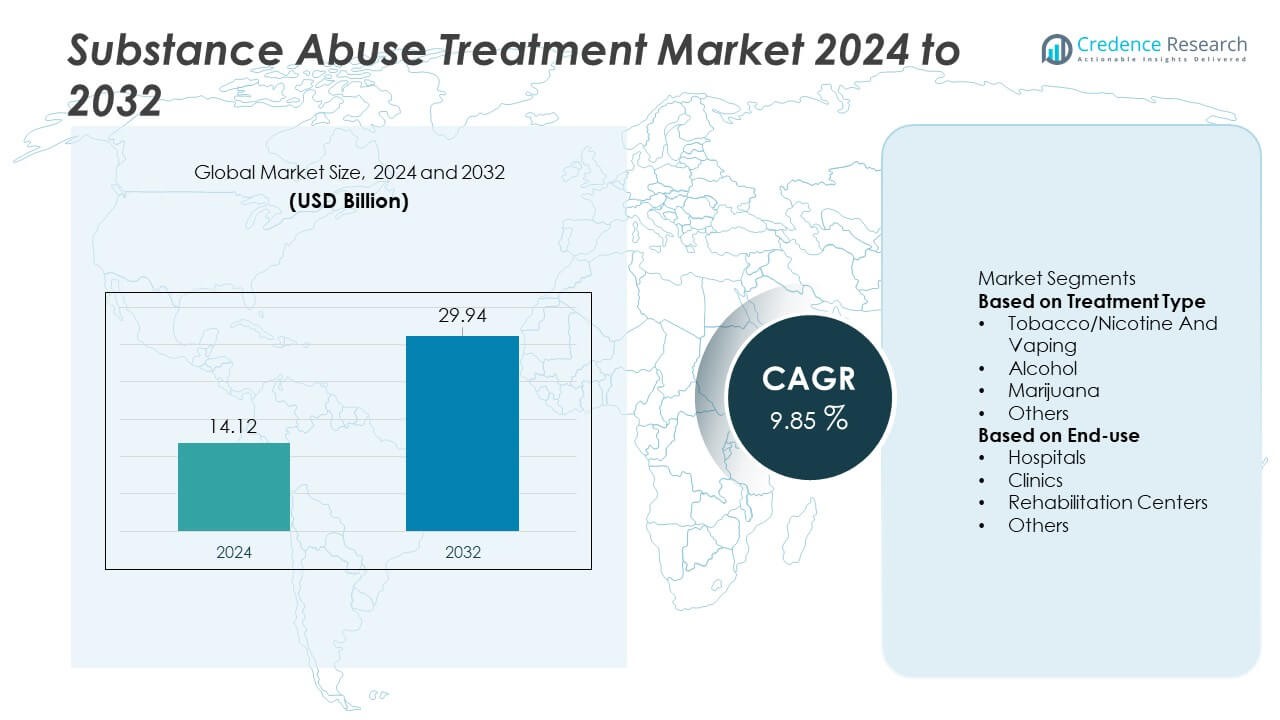
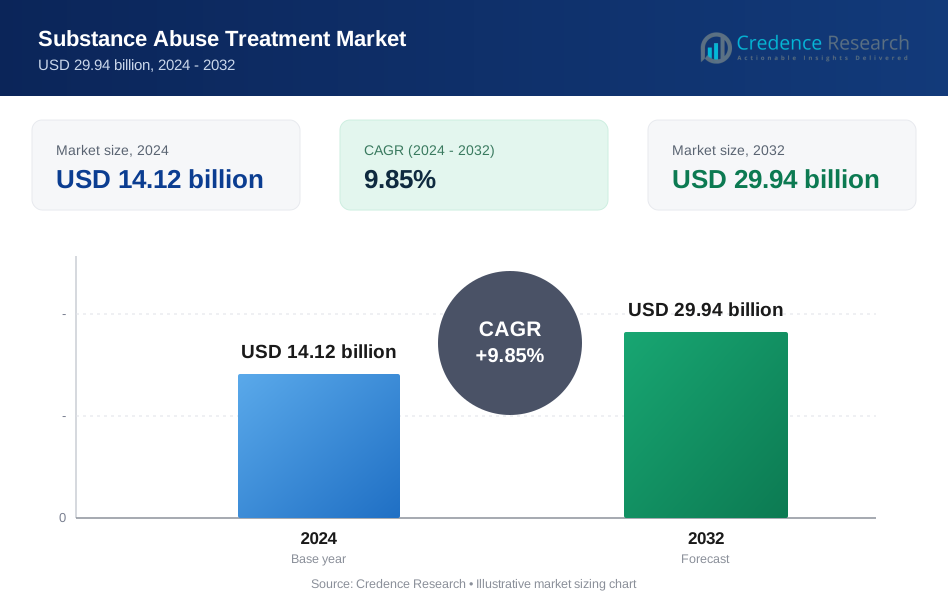
The Substance Abuse Treatment Market reached USD 14.12 billion in 2024. The market is projected to increase to USD 29.94 billion by 2032, supported by a CAGR of 9.85% during the forecast period.
| REPORT ATTRIBUTE | DETAILS |
|---|---|
| Historical Period | 2020-2023 |
| Base Year | 2024 |
| Forecast Period | 2025-2032 |
| Substance Abuse Treatment Market Size 2024 | USD 14.12 Billion |
| Substance Abuse Treatment Market, CAGR | 9.85% |
| Substance Abuse Treatment Market Size 2032 | USD 29.94 Billion |
The top players in the Substance Abuse Treatment market include Teva Pharmaceutical Industries Ltd., Abbott, GSK plc, Cipla Inc., Lilly, Novartis AG, Sun Pharmaceutical Industries Ltd., Dr. Reddy’s Laboratories Ltd., Viatris Inc., and AstraZeneca. These companies strengthen their presence through expanded medication-assisted treatment portfolios, wider global distribution, and continued investment in safer, clinically proven therapies. North America leads the market with a 41% share, driven by strong healthcare infrastructure, advanced treatment adoption, and supportive insurance coverage. Europe and Asia Pacific follow, supported by expanding rehabilitation networks and rising awareness programs that increase treatment demand across diverse patient groups.
Market Insights
- The Substance Abuse Treatment market reached USD 14.12 billion in 2024 and will grow at a CAGR of 9.85 percent through 2032, driven by rising treatment demand across major regions.
- Growing awareness, expanding rehabilitation programs, and broader insurance coverage strengthen market drivers, with tobacco and nicotine treatment leading the segment with a 38 percent share.
- Digital therapy platforms, remote counseling services, and increasing adoption of medication-assisted treatment shape key market trends, improving patient engagement and long-term recovery outcomes.
- Strong competition among Teva, Abbott, GSK, Cipla, Lilly, Novartis, Sun Pharma, Dr. Reddy’s, Viatris, and AstraZeneca influences innovation, while persistent relapse rates and limited access in rural regions remain major restraints.
- North America leads regional growth with a 41 percent share, followed by Europe at 29 percent and Asia Pacific at 21 percent, while rehabilitation centers dominate end-use demand with a 42 percent market share.
Market Segmentation Analysis:
By Treatment Type
Tobacco/Nicotine and Vaping treatment holds the lead with a 38% market share, driven by rising dependence on e-cigarettes and stricter anti-smoking policies. Demand for counseling programs, nicotine replacement therapies, and digital cessation platforms continues to rise. Alcohol treatment follows due to higher relapse rates and increased screening in primary healthcare. Marijuana dependence programs expand as usage climbs among young adults. Other treatment types address opioids and prescription drug misuse, supported by wider adoption of medication-assisted therapy. Growth in all categories connects to better awareness and improved access to structured intervention services.
- For instance, Pfizer reported that its smoking cessation drug Chantix was prescribed to more than 24 million patients worldwide before discontinuation, showing historic clinical-scale adoption.
By End-use
Rehabilitation centers dominate the market with a 42% share, supported by higher patient intake, long-term care programs, and broader insurance coverage for addiction treatment. These centers offer structured detox, therapy, and aftercare services that drive strong adoption. Hospitals follow due to their role in emergency care and detox stabilization, while clinics gain traction with outpatient counseling and early-stage interventions. Other end-use settings include community programs and telehealth platforms that expand access in remote areas. Rising substance misuse rates and policy support sustain the segment growth across all end-use categories.
- For instance, Acadia Healthcare operates more than 250 treatment facilities and serves over 75,000 patients each year, showing high inpatient demand.
Key Growth Drivers
Rising Prevalence of Substance Dependence
Substance dependence continues to rise across tobacco, alcohol, opioids, and emerging recreational drugs, pushing demand for structured treatment programs. Higher addiction rates among young adults, growing vaping-associated disorders, and increased relapse cases drive wider adoption of intervention and rehabilitation services. Governments invest in awareness campaigns and early-stage screening programs to reduce untreated cases. Healthcare systems also expand behavioral therapy access and medication-assisted treatments. These developments strengthen the market outlook and position treatment providers to support a growing patient base with more personalized care pathways.
- For instance, Indivior documented more than 190,000 patients receiving its buprenorphine-based therapies through certified treatment centers in a single year.
Broader Insurance Coverage and Government Support
Insurance expansion for addiction care and rising public funding boost treatment accessibility. Many regions now mandate coverage for detoxification, counseling, and long-term rehabilitation under national health schemes. Grants and public subsidies support new rehabilitation centers and digital therapy platforms. Policymakers also promote early detection programs within schools and community setups. As financial barriers reduce, more individuals seek timely intervention, leading to higher treatment enrollments. This shift improves continuity of care and encourages healthcare providers to enhance service capacity and treatment quality.
- For instance, UnitedHealth Group, through its Optum division, operates a 24-hour Substance Use Helpline (1-855-780-5955) to provide confidential support, guidance on treatment options, and help in finding network providers to individuals and their families.
Growing Adoption of Medication-Assisted Treatment (MAT)
Medication-assisted treatment gains strong traction due to its proven effectiveness in reducing withdrawal symptoms and relapse rates. Demand increases for therapies involving buprenorphine, methadone, and naltrexone as regulatory bodies approve wider clinical use. Clinics and rehabilitation centers integrate MAT into combined care models that include behavioral therapy and long-term monitoring. Expanding manufacturer investments in safer, formulation-controlled drugs boost supply reliability. The rising shift toward evidence-based treatment enhances patient outcomes and supports market expansion for structured and medically supervised programs.
Key Trends & Opportunities
Expansion of Digital and Remote Addiction Treatment Platforms
Telehealth-based counseling, remote monitoring, and app-based recovery tools gain momentum as patients seek flexible and private treatment pathways. Virtual therapy sessions reduce travel barriers and provide real-time support, especially in rural areas. Digital tools also include relapse-prevention alerts, habit-tracking dashboards, and AI-enabled behavioral assessments. Providers partner with technology firms to expand hybrid care models that blend physical visits with online follow-ups. Strong adoption of remote systems opens new opportunities for scalable treatment delivery and broader patient engagement.
- For instance, in the third quarter of 2025, Talkspace recorded approximately 120,600 unique active payor members using its remote therapy platform. The company has also reported having worked with over a million clients total over its lifetime.
Growing Focus on Youth Prevention and Early Intervention Programs
Early intervention programs targeting adolescents and young adults expand as substance misuse increases in educational and social settings. Schools adopt structured awareness modules and mental-health support systems to reduce high-risk behaviors. Healthcare providers offer early screening kits, digital behavior assessments, and youth-focused rehabilitation tracks. Parents and communities show higher participation in prevention campaigns, strengthening demand for supportive services. This trend creates significant opportunities for specialized treatment programs tailored to younger demographics, promoting long-term recovery and reducing relapse rates.
- For instance, CADCA trains over 1,000 youth a year through its National Youth Leadership Initiative (NYLI) programs, which focus on fostering leadership in the design, implementation, and evaluation of strategies addressing community substance use problems.
Key Challenges
Persistent Treatment Gaps and Low Diagnosis Rates
Despite rising addiction cases, many individuals remain untreated due to stigma, lack of awareness, and limited screening. Delayed diagnosis reduces treatment effectiveness and increases relapse risk. Rural and underserved regions face shortages of specialized providers and rehabilitation centers, widening the care gap. Cultural barriers and misconceptions about therapy also discourage timely intervention. These factors limit market penetration and require stronger public education, community support systems, and early detection programs to bridge the treatment divide.
High Relapse Rates and Limited Long-Term Support Systems
Relapse remains a major challenge across alcohol, tobacco, and opioid dependence due to psychological triggers, stress, and inconsistent follow-up care. Many treatment programs struggle to maintain long-term patient engagement, especially after discharge from rehabilitation. Limited access to ongoing counseling, community support networks, and digital monitoring tools increases the risk of recurrence. This challenge highlights the need for integrated care models combining behavioral therapy, medication-assisted treatment, and continued aftercare. Strengthening long-term recovery frameworks remains essential for improving patient outcomes and market stability.
Regional Analysis
North America
North America leads the Substance Abuse Treatment market with a 41% share, driven by high addiction rates involving opioids, alcohol, and vaping products. Strong healthcare infrastructure, supportive insurance policies, and early adoption of medication-assisted treatment strengthen regional growth. Government initiatives target opioid misuse through stricter prescription controls and expanded rehabilitation coverage. Digital therapy platforms also gain traction among younger patients. Rising public awareness, wider screening programs, and active participation from community health centers reinforce the dominance of the region across all treatment categories.
Europe
Europe holds a 29% market share, supported by structured national addiction programs and strong regulatory frameworks targeting alcohol, tobacco, and drug dependence. Countries enhance treatment access through publicly funded rehabilitation centers and integrated mental-health services. The region experiences rising demand for behavioral therapies, outpatient clinics, and MAT solutions. Technological adoption increases, with digital–health platforms improving patient engagement and remote monitoring. Growing awareness campaigns and cross-border health policies further support sustained demand for evidence-based addiction treatment across key European markets.
Asia Pacific
Asia Pacific accounts for a 21% share, driven by rising alcohol consumption, tobacco dependence, and increasing misuse of prescription drugs in emerging economies. Expanding healthcare investment, urbanization, and rising mental-health awareness enhance treatment adoption. Governments integrate addiction services into primary healthcare and expand community-level rehabilitation programs. Private clinics and digital therapy platforms also gain traction as younger populations seek accessible treatment options. Growing public health initiatives and improved regulatory oversight strengthen long-term demand for structured addiction management across the region.
Latin America
Latin America holds a 6% market share, supported by gradual expansion of rehabilitation services and increasing efforts to control alcohol and drug misuse. Public health systems promote early detection and counseling programs, while NGOs support community-based recovery initiatives. Urban centers show rising adoption of MAT and outpatient therapy for alcohol and cocaine dependence. Limited healthcare resources in rural areas remain a challenge, but regional investment in mental-health infrastructure improves access. Strengthening government policies and awareness campaigns support steady market growth.
Middle East & Africa
The Middle East & Africa region represents a 3% market share, with growth driven by rising awareness of substance-related disorders and improving healthcare access. Governments expand rehabilitation centers and enforce stricter regulations on illicit drug use. Urban regions show increasing adoption of behavioral therapy and structured detox programs, while community clinics support early-stage interventions. International collaborations enhance training and treatment standards. Despite limited resources in several countries, expanding public health investment and social-awareness initiatives contribute to growing acceptance of addiction treatment services.
Market Segmentations:
By Treatment Type
- Tobacco/Nicotine And Vaping
- Alcohol
- Marijuana
- Others
By End-use
- Hospitals
- Clinics
- Rehabilitation Centers
- Others
By Geography
- North America
- U.S.
- Canada
- Mexico
- Europe
- Germany
- France
- U.K.
- Italy
- Spain
- Rest of Europe
- Asia Pacific
- China
- Japan
- India
- South Korea
- South-east Asia
- Rest of Asia Pacific
- Latin America
- Brazil
- Argentina
- Rest of Latin America
- Middle East & Africa
- GCC Countries
- South Africa
- Rest of the Middle East and Africa
Competitive Landscape
The competitive landscape features major players such as Teva Pharmaceutical Industries Ltd., Abbott, GSK plc, Cipla Inc., Lilly, Novartis AG, Sun Pharmaceutical Industries Ltd., Dr. Reddy’s Laboratories Ltd., Viatris Inc., and AstraZeneca. These companies expand their presence through advanced medication-assisted treatment portfolios, wider distribution networks, and strategic partnerships with healthcare providers. Manufacturers focus on developing safer formulations for nicotine, opioid, and alcohol dependence while strengthening regulatory approvals across key regions. Many players invest in digital adherence tools and patient-support programs to enhance treatment continuity. Rising demand for evidence-based therapies encourages firms to scale production capacity and diversify treatment options. Collaboration with rehabilitation centers and telehealth platforms also increases patient reach. Overall, continuous innovation and improved treatment accessibility drive stronger competition across the global market.
Key Player Analysis
- Sun Pharmaceutical Industries Ltd.
- AstraZeneca
- Cipla Inc.
- Novartis AG
- Viatris Inc.
- Abbott
- Reddy’s Laboratories Ltd.
- GSK plc.
- Teva Pharmaceutical Industries Ltd.
- Lilly (Eli Lilly and Company)
Recent Developments
- In November 2025, Sun Pharmaceutical Industries Ltd. did recall its ADHD drug Lisdexamfetamine in the U.S.
- In November 2024, AstraZeneca terminated the Phase II trial of its anti-addiction candidate AZD4041, aimed at treating opioid use disorder.
Report Coverage
The research report offers an in-depth analysis based on Treatment Type, End-use and Geography. It details leading market players, providing an overview of their business, product offerings, investments, revenue streams, and key applications. Additionally, the report includes insights into the competitive environment, SWOT analysis, current market trends, as well as the primary drivers and constraints. Furthermore, it discusses various factors that have driven market expansion in recent years. The report also explores market dynamics, regulatory scenarios, and technological advancements that are shaping the industry. It assesses the impact of external factors and global economic changes on market growth. Lastly, it provides strategic recommendations for new entrants and established companies to navigate the complexities of the market.
Future Outlook
- Treatment adoption will rise as awareness programs and early screening efforts expand.
- Digital therapy platforms will grow as patients prefer flexible and remote support options.
- Medication-assisted treatment use will increase due to stronger clinical outcomes.
- Rehabilitation centers will enhance long-term care programs to reduce relapse rates.
- Governments will strengthen regulations to curb substance misuse across major regions.
- Youth-focused prevention programs will expand as dependence among young adults increases.
- AI-enabled monitoring tools will support personalized therapy and continuous recovery tracking.
- Collaboration between pharma companies and treatment providers will accelerate therapy innovation.
- Insurance coverage for addiction treatment will widen across public and private systems.
- Emerging markets will invest more in rehabilitation infrastructure to improve treatment access.
Request a Free Sample
Fill in your details and we'll send you a free sample report.
- Sample data tables & charts
- Research methodology
Need a Custom Version of This Report?
Tailor the scope, geography, or segments to your exact requirements.
- Custom geography or segment scope
- Direct access to our analyst team
Frequently Asked Questions
What is the current market size for the Substance Abuse Treatment market, and what is its projected size in 2032?
At what Compound Annual Growth Rate is the Substance Abuse Treatment market projected to grow between 2025 and 2032?
Which Substance Abuse Treatment market segment held the largest share in 2024?
What are the primary factors fueling the growth of the Substance Abuse Treatment market?
Who are the leading companies in the Substance Abuse Treatment market?
Which region commanded the largest share of the Substance Abuse Treatment market in 2024?
Table of Content
Chapter 1. Report Introduction
- 1.1 Report Description & Purpose
- 1.1.1 Report Title & Market Definition
- 1.1.2 Unique Selling Propositions (USP) & Key Differentiators
- 1.1.3 Value Proposition for Stakeholders
- 1.2 Research Objectives
- 1.2.1 Market Sizing Objectives (Volume & Revenue) (Volume Where Applicable)
- 1.2.2 Segmentation Objectives
- 1.2.3 Competitive Intelligence Objectives
- 1.2.4 Forecast & Scenario Objectives
- 1.3 Report Scope
- 1.3.1 Substance Abuse Treatment Scope – Segments & Subsegments Covered
- 1.3.2 Geographic Scope – Regions & Countries Covered
- 1.3.3 Historical Period, Base Year & Forecast Period (2024; forecast to 2032)
- 1.3.4 Inclusions & Exclusions
- 1.4 Industry Classification & Applicable Codes
- 1.5 Currency, Measurement Units & Valuation Basis
- 1.6 Target Stakeholders
- 1.7 Limitations & Assumptions
Chapter 2. Executive Summary
- 2.1 Global Substance Abuse Treatment Market Snapshot
- 2.1.1 Market Size – Historical (2024) & Forecast (2024-2032) (2024: USD 14.12 billion → 2032: USD 29.94 billion)
- 2.1.2 Volume & Revenue – Global Totals (Volume Where Applicable)
- 2.1.3 Key Market Highlights – Top Five Facts
- 2.2 Substance Abuse Treatment Market Segmentation Snapshot
- 2.2.1 Market Split by Region – 2024 vs. 2032
- 2.3 Competitive Snapshot
- 2.3.1 Top 10 Players by Revenue Share – 2024
- 2.3.2 Top 10 Players by Volume Share – 2024 (Volume Where Applicable)
- 2.3.3 Recent Strategic Developments (18-Month Summary)
- 2.4 Key Investment Highlights & Strategic Conclusions
Chapter 3. Substance Abuse Treatment Market Dynamics & Industry Analysis
- 3.1 Market Overview & Context
- 3.1.1 Substance Abuse Treatment Market Position in the Broader Industry Value Chain
- 3.1.2 Demand Structure & Purchasing Dynamics
- 3.1.3 Market Maturity & Development Stage by Region
- 3.2 Substance Abuse Treatment Market Drivers
- 3.3 Substance Abuse Treatment Market Restraints & Challenges
- 3.4 Substance Abuse Treatment Market Opportunities
- 3.5 Porter's Five Forces Analysis
- 3.5.1 Threat of New Entrants
- 3.5.2 Bargaining Power of Suppliers
- 3.5.3 Bargaining Power of Buyers
- 3.5.4 Threat of Substitutes
- 3.5.5 Competitive Rivalry – Intensity Assessment
- 3.6 Substance Abuse Treatment Value Chain Analysis
- 3.6.1 Upstream – Key Inputs, Resources & Suppliers
- 3.6.1.1 Key Input/Resource 1
- 3.6.1.2 Key Input/Resource 2
- 3.6.1.3 Key Input/Resource 3
- 3.6.2 Midstream – Core Operations & Value Creation
- 3.6.2.1 Operating Model & Process Overview
- 3.6.2.2 Key Operating Locations & Capabilities by Company
- 3.6.3 Downstream – Market Channels & End Users
- 3.6.3.1 Direct Sales & Customer Engagement Channels
- 3.6.3.2 Indirect Sales, Intermediaries & Partner Channels
- 3.6.4 Value Chain Profitability Analysis
- 3.6.1 Upstream – Key Inputs, Resources & Suppliers
- 3.7 PESTEL Analysis
- 3.7.1 Political Factors
- 3.7.2 Economic Factors
- 3.7.3 Social Factors
- 3.7.4 Technological Factors
- 3.7.5 Environmental Factors
- 3.7.6 Legal Factors
- 3.8 Substance Abuse Treatment Supply Chain Analysis
- 3.8.1 Critical Input & Resource Availability Risk Assessment
- 3.8.2 Supplier & Operational Concentration Risk (Geographic Exposure)
- 3.8.3 Supply & Service Disruption Impact Analysis
- 3.9 Regulatory & Policy Landscape
Note: The regulatory and policy landscape section covers regulations based on their applicability to the market, Substance Abuse Treatment category, geography, and scope of the study. Only regulatory frameworks with a material impact on operations, compliance, trade, sustainability, or market access are analyzed in detail.
Chapter 4. Key Investment Pockets & Opportunity Analysis
- 4.1 Substance Abuse Treatment Market Attractiveness Analysis
- 4.1.1 By Region – Investment Attractiveness Matrix (Market Size × CAGR)
- 4.2 Absolute Revenue Growth Opportunity
- 4.2.1 By Region – Absolute Revenue Growth Through 2032
- 4.3 Incremental Demand Opportunity
- 4.3.1 By Region – Incremental Demand Through 2032
- 4.3.2 Segment – Incremental Demand
- 4.4 Emerging Submarket Opportunity Deep Dive (Subject to Applicability)
- 4.5 Priority Market Opportunity Scorecards
- 4.5.1 United States
- 4.5.2 Europe
- 4.5.3 Asia
- 4.5.4 Middle East & Africa
Note: Priority market opportunity scorecards reflect the geographic scope and strategic relevance of the study. Listed markets are indicative and may be adapted to the industry.
Chapter 5. Substance Abuse Treatment Cross-Border Trade & Market Access Analysis
- 5.1 International Trade & Cross-Border Activity Overview
- 5.1.1 Global Export Value by Country (2024)
- 5.1.2 Global Export Volume by Country (2024) (Volume Where Applicable)
- 5.1.3 Global Import Value by Country (2024)
- 5.1.4 Global Import Volume by Country (2024) (Volume Where Applicable)
- 5.1.5 Net Trade Balance by Country (2024)
- 5.2 Export Analysis – Segment
- 5.2.1 Category 1 (Applicable Classification Code)
- 5.2.2 Category 2 (Applicable Classification Code)
- 5.2.3 Category 3 (Applicable Classification Code)
- 5.2.4 Category 4 (Applicable Classification Code)
- 5.2.5 Category 5 (Applicable Classification Code)
- 5.3 Import Analysis – Segment
- 5.3.1 Category 1 (Applicable Classification Code)
- 5.3.2 Category 2 (Applicable Classification Code)
- 5.3.3 Category 3 (Applicable Classification Code)
- 5.3.4 Category 4 (Applicable Classification Code)
- 5.3.5 Category 5 (Applicable Classification Code)
- 5.4 Cross-Border Pricing & Transaction Benchmarks
- 5.4.1 Export Pricing – Segment & Country
- 5.4.2 Import Pricing – Segment & Source Country
- 5.4.3 Price Trends (2024)
- 5.5 Key Cross-Border Trade & Delivery Routes
- 5.5.1 Cross-Border Trade/Delivery Route 1
- 5.5.2 Cross-Border Trade/Delivery Route 2
- 5.5.3 Cross-Border Trade/Delivery Route 3
- 5.5.4 Cross-Border Trade/Delivery Route 4
- 5.5.5 Cross-Border Trade/Delivery Route 5
- 5.6 Trade Policy & Market Access Impact Assessment
- 5.6.1 Tariff & Non-Tariff Barriers
- 5.6.2 Regional Trade & Economic Integration Frameworks
- 5.6.3 Bilateral & Multilateral Trade Agreements
- 5.6.4 Cross-Border Operating, Licensing & Localization Requirements
Note: This chapter applies where cross-border trade or delivery is relevant to Substance Abuse Treatment. Goods, services, and digital offerings are assessed using applicable classifications and transaction measures. Import-export volumes, trade balances, and route analyses are included only where meaningful to the market.
Chapter 6. Competitive Landscape & Company Benchmarking
- 6.1 Substance Abuse Treatment Market Concentration & Structure
- 6.1.1 Herfindahl-Hirschman Index (HHI) – vs. 2024
- 6.1.2 Leading, Mid-Sized & Emerging Player Structure
- 6.1.3 Global, Regional & Local Player Dynamics
- 6.2 Substance Abuse Treatment Market Share Analysis – 2024
- 6.2.1 Global Revenue Share by Company
- 6.2.2 Global Volume Share by Company (Volume Where Applicable)
- 6.2.3 Regional Revenue Share
- 6.2.4 Market Share Evolution ( vs. 2024)
- 6.2.5 Company Market Share by Key Segment
- 6.2.6 Company Market Share by Customer Group
- 6.3 Operating Scale, Capacity & Infrastructure Analysis
- 6.3.1 Global Operating Scale & Supply Capacity
- 6.3.2 Resource Utilization & Operating Efficiency
- 6.3.3 Output, Service Delivery & Activity Metrics
- 6.3.4 Operating Footprint & Infrastructure Map
- 6.3.5 Planned Operational & Capacity Expansion
- 6.4 Substance Abuse Treatment Competitive Benchmarking Matrix
- 6.4.1 Revenue, Growth, Profitability & Operating Metric Comparison
- 6.4.2 Channel Revenue Mix
- 6.4.3 Geographic Revenue Exposure
- 6.4.4 R&D Intensity
- 6.4.5 Sustainability Maturity
- 6.5 Strategic Developments in Substance Abuse Treatment (Last 24 Months)
- 6.5.1 Mergers, Acquisitions & Divestments
- 6.5.2 New Products, Services & Solutions in Substance Abuse Treatment
- 6.5.3 Operational & Infrastructure Expansions
- 6.5.4 Strategic Alliances, Joint Ventures & Partnerships
- 6.5.5 Distribution Expansion & Market Entry
- 6.5.6 Sustainability & ESG Initiatives
- 6.6 Competitive Strategy Mapping
- 6.6.1 Leader, Challenger, Follower & Niche Classification
- 6.6.2 Pricing Strategy Comparison
- 6.6.3 Channel Strategy Matrix
Note: Strategic developments are included based on their materiality and the availability of reliable information.
Chapter 7. Global Substance Abuse Treatment Market – By Sales & Delivery Channel
- 7.1 Segment Overview
- 7.1.1 Volume & Revenue Split by Channel (2024 & 2032) (Volume Where Applicable)
- 7.1.2 Channel Mix Evolution (2024-2032)
Chapter 8. Regional Market Analysis – Global Overview
- 8.1 Global Regional Overview
- 8.1.1 Regional Volume Share (Volume Where Applicable)
- 8.1.2 Regional Revenue Share
- 8.1.3 Regional Volume by Region (Volume Where Applicable)
- 8.1.4 Regional Revenue by Region
- 8.1.5 Regional Forecast Through 2032
- 8.2 Cross-Regional Segment Analysis
- 8.2.1 By Sales & Delivery Channel
- 8.2.2 By Competitive Positioning & Price Tier
Chapter 9. North America Substance Abuse Treatment Market
- 9.1 United States
- 9.2 Canada
- 9.3 Mexico
Chapter 10. Europe Substance Abuse Treatment Market
- 10.1 Germany
- 10.2 France
- 10.3 Italy
- 10.4 United Kingdom
- 10.5 Spain
- 10.6 Poland
- 10.7 Russia
- 10.8 Netherlands
- 10.9 Belgium
- 10.10 Sweden
- 10.11 Denmark
- 10.12 Norway
- 10.13 Rest of Europe
Chapter 11. Asia Pacific Substance Abuse Treatment Market
- 11.1 China
- 11.2 India
- 11.3 Japan
- 11.4 South Korea
- 11.5 Thailand
- 11.6 Indonesia
- 11.7 Vietnam
- 11.8 Malaysia
- 11.9 Australia
- 11.10 Rest of Asia Pacific
Chapter 12. Latin America Substance Abuse Treatment Market
- 12.1 Brazil
- 12.2 Argentina
- 12.3 Colombia
- 12.4 Chile
- 12.5 Rest of Latin America
Chapter 13. Middle East Substance Abuse Treatment Market
- 13.1 Saudi Arabia
- 13.2 United Arab Emirates
- 13.3 Turkey
- 13.4 Israel
- 13.5 Iran
- 13.6 Rest of the Middle East
Chapter 14. Africa Substance Abuse Treatment Market
- 14.1 South Africa
- 14.2 Egypt
- 14.3 Nigeria
- 14.4 Morocco
- 14.5 Rest of Africa
Chapter 15. Substance Abuse Treatment Company Profiles
- 15.1 [Company 01]
- 15.1.1 Company Overview
- 15.1.2 Key Management Personnel
- 15.1.3 Products & Services Portfolio
- 15.1.4 Financial Performance
- 15.1.5 Key Market Focus & Geographic Presence
- 15.1.6 Recent Developments & Strategic Initiatives
Note: The company profile list is preliminary and may change based on research findings, market developments, data availability, and client requirements.
Chapter 16. Appendices
- Appendix A – List of Abbreviations & Acronyms
- Appendix B – Industry Classification Code Reference – Full Series
- Appendix C – Supply, Output & Operating Capacity Data Tables
- Appendix D – End-Use & Demand Base Tables
- Appendix E – Demand, Adoption & Usage Assumptions
- Appendix F – Pricing & Revenue Metric Reference Tables
- Appendix G – Company Operations & Infrastructure Database
- Appendix H – Cross-Border Trade & Activity Data Tables (Where Applicable)
- Appendix I – Regulatory Summary Tables
- Appendix J – Primary Research Participant List (Anonymized)
- Appendix K – Primary Research Questionnaire Framework
- Appendix L – Data Sources & Bibliography
- Appendix M – Market Size Divergence & Source Comparison
Chapter 17. Research Methodology
- 17.1 Research Framework & Philosophy
- 17.2 Secondary Research – Sources, Hierarchy & Data Extraction
- 17.3 Data Modeling – Bottom-Up & Top-Down Market Sizing
- 17.4 Primary Research – Stakeholder Framework, LOI & Sample Sizes
- 17.5 Forecast Methodology – Regression, Scenario & Sensitivity Analysis
- 17.6 Quality Control – Four-Layer Validation Framework
- 17.7 Limitations & Standard Assumptions
- 17.8 Disclaimer
