
| REPORT ATTRIBUTE | DETAILS |
|---|---|
| Historical Period | 2019-2022 |
| Base Year | 2023 |
| Forecast Period | 2024-2032 |
| Surface Mining Equipments Size 2023 | USD 1254.2 Million |
| Surface Mining Equipments, CAGR | 6.50% |
| Surface Mining Equipments Size 2032 | USD 2210.6 Million |
Market Insights
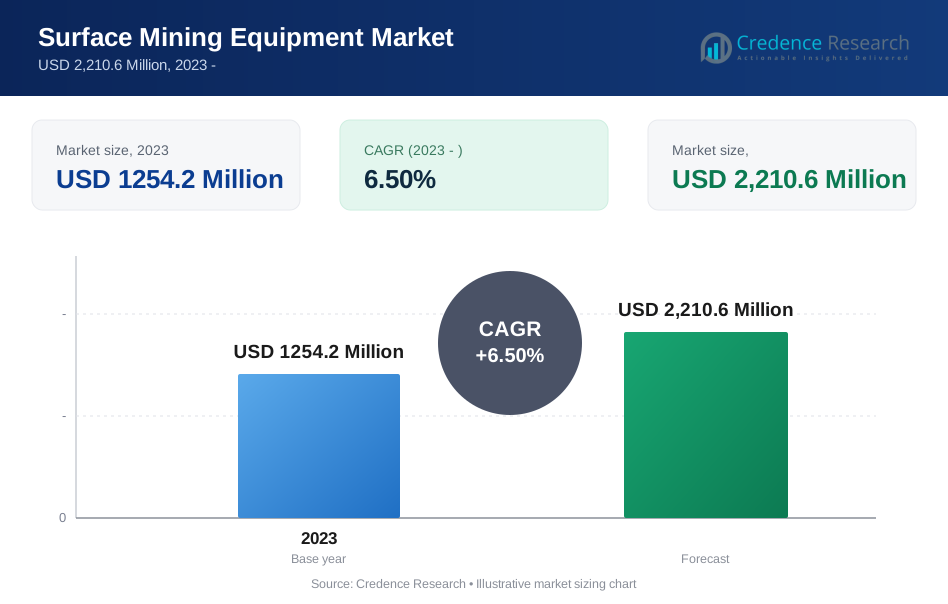
- The global demand for Surface Mining Equipments was valued at USD 1254.2 Million in 2023 and is expected to reach USD 2210.6 Million in 2032, growing at a CAGR of 6.50% between 2024 and 2032.
- Excavators are the most frequent mining equipment, and dump trucks are predicted to increase significantly over the projection period.
- The coal mining application dominated the market, accounting for 37.8% of global revenue in 2023, while the metal mining application segment is predicted to rise at a CAGR of 6.1% over the forecast period.
- Electric is the fastest increasing segment in the Surface Mining Equipment Market.
- The mountain removal mining industry is predicted to maintain its dominance during the forecast period due to its efficiency and lower labor costs.
- The above-1,000 kW segment of the surface mining equipment market is in increasing demand
- The surface mining equipment sector is dominated by the fully autonomous operation segment, but the semi-autonomous operation segment is also substantial.
- The Above Ground category has a significant part of the surface mining equipment industry.
- Shallow Mining has the largest market share in the surface mining equipment market.
- In 2023, Asia Pacific accounted for 35% of global sales, while North America and Europe are expected to grow at CAGRs of 4.1% and 4.5%, respectively.
- The usage of electric machinery in underground mining is predicted to increase, boosting market growth.
- Trading of old mining equipment may affect market growth.

Executive Summary
Market Definition
The Surface Mining Equipment Market includes devices and equipment used to attenuate or minimize harmonic distortion in electrical systems. Non-linear loads, such as electronic devices and variable speed drives, create harmonic distortion, which can result in power quality concerns and equipment malfunction. Surface Mining Equipments are intended to remove these harmonics and maintain the smooth operation of electrical systems. They are commonly employed in industries, commercial buildings, and power distribution networks to ensure power quality, reduce energy losses, and meet regulatory requirements. The Surface Mining Equipment Market is driven by rising need for dependable and efficient power distribution, particularly in industrial, data centers, and renewable energy.
Market Overview
The global Surface Mining Equipment Market has witnessed steady growth in recent years and is expected to grow at a CAGR of 6.50% between 2024 and 2032. The market was valued at USD 1254.2 million in 2023 and is expected to reach USD 2210.6 million in 2032.
The Surface Mining Equipment Market is expanding rapidly due to rising demand for power quality and increased awareness of the negative impacts of harmonic distortion on electrical systems. Factors driving the market include rapid industrialization, increased use of non-linear loads, and the implementation of severe power quality rules. Surface Mining Equipments are widely used in a variety of industries, including manufacturing, data centers, healthcare, and renewable energy, to reduce harmonic distortion and maintain the smooth and efficient operation of electrical systems. The market is likely to expand more as the demand for clean and steady power grows..
Segmentation by Equipment Type
- Excavators are the most common mining equipment. As a result, the segment is expected to account for a significant market share. Modern automated excavators outperform earlier versions due to enhanced technology. They immediately convey information to service centers in the case of a malfunction or operational defect, reducing information flow time and costs.
- Dump trucks are expected to grow significantly over the projection period. The use of automated equipment and the introduction of new technologies in mining have increased the supply of dump trucks under agreements with mining companies.
- Loaders are necessary at mining sites because they remove rubbish and transport commodities from one spot to another.
Segmentation by Application
- The coal mining application dominated the market, accounting for 37.8% of worldwide revenue in 2023. The mining equipment market is predicted to increase significantly in coal mining applications. The expansion is related to growing demand for power generation. As coal extraction has increased, so has the use and use of coal mining equipment.
- The metal mining application segment is expected to grow at a CAGR of 6.1% over the forecast period. Because of rising resource exploration and strong demand for precious metals such as silver, gold, copper, and iron, the metal mining industry is likely to expand as a prominent application sector.
Segmentation by Propulsion Type
- Electric is the fastest growing category of the Surface Mining Equipment Market. The growing emphasis on sustainability and environmental standards has resulted in a higher demand for electric surface mining equipment. Electric mining equipment provides benefits such as fewer emissions, cheaper operating costs, and increased energy efficiency.
Segmentation by Mining Method
- The mountain removal mining segment is expected to maintain its dominance during the projection period due to its efficiency and lower labor costs. This method of mining allows for the extraction of large volumes of materials from mountains, making it cost-effective.
Segmentation by Power Output
- The Above 1,000 kW segment of the surface mining equipment industry is in high demand. This segment includes surface mining equipment with power ratings greater than 1,000 kilowatts. The increased demand for this segment can be attributable to the necessity for larger and more powerful equipment to meet the severe demands of surface mining activities. These high-capacity machines can handle massive amounts of material, improving productivity and efficiency in mining operations.
Segmentation by Automation Level
- The Fully Autonomous Operation segment dominates the surface mining equipment industry. Fully autonomous mining equipment is gaining popularity because it can work without human interference, resulting in greater safety, efficiency, and productivity.
- Another significant area in the surface mining equipment industry is the Semi-Autonomous Operation segment.
Segmentation by Application Terrain
- The Above Ground category holds a major share of the surface mining equipment market. This sector refers to surface mining operations that occur on the earth's surface, such as open-pit mining and quarrying. Above-ground mining necessitates specialized equipment developed to tackle the specific problems of obtaining minerals and commodities from the surface.
Segmentation by Mining Depth
- Shallow Mining is the segment with the highest market share in the surface mining equipment market. Shallow mining is defined as surface mining activities that harvest minerals and resources from shallow depths of up to a few hundred meters. This segment has a larger market share due to numerous considerations. Shallow mining operations are frequently less expensive and require less complex equipment than deep mining.
Segmentation by Region
- In 2023, Asia Pacific accounted for 35% of worldwide sales.
- North America and Europe are predicted to rise at CAGRs of 4.1% and 4.5%, respectively.
- The rest of the world, including Latin America, the Middle East, and Africa, supplies the remaining demand for Surface Mining Equipment.
Asia Pacific dominated the market, accounting for 35% of global sales in 2023. The growing move toward renewable energy resources, as well as the adoption of electric vehicles in developing nations such as China and India, are expected to propel market expansion in the coming years.
The North America region is expected to grow at a CAGR of 4.1% over the forecast period. Rising mineral mining activity, greater usage of cutting-edge mining equipment, and government initiatives in North America are the primary factors driving market expansion. Furthermore, during the projection period, demand for these goods is expected to increase as traditional underground mining gives way to cutting-edge, cost-effective open-pit mining techniques.
Europe is expected to grow at a CAGR of 4.5% over the forecast period. The manufacturers' expanding emphasis on carrying out underground mining activities, lowering carbon emissions, and boosting worker safety in Europe has led in an increase in demand for electrification of underground mining equipment.
Key Highlights of the Report
Type, Application, Propulsion Type, Mining Method, Type, Automation Level, Application Terrain, Mining Depth and region segment of the global Surface Mining Equipment Market. The coal mining application dominated the market, and excavators were the most popular mining equipment. In addition, electric is the fastest expanding category, and the above 1,000 kW portion of the surface mining equipment business is in strong demand. Furthermore, the Above Ground group has a substantial stake, with Asia Pacific leading the market growth.
The market is being driven by increasing worldwide demand for minerals and resources, technological improvements that result in more efficient and advanced equipment, and a growing emphasis on sustainable and ecologically friendly mining methods. Furthermore, stringent government restrictions and environmental concerns, high initial investment and maintenance costs of mining equipment, and volatility in commodity prices affecting mining operations and equipment demand are the primary restraints of the market.
Nonetheless, Asia Pacific dominated the market, accounting for 35% of worldwide sales by 2023. Furthermore, the North American region is predicted to expand at a CAGR of 4.1% over the forecast period, while Europe is expected to grow at a CAGR of 4.5% over the forecast period
What Are The Main Drivers Of The Global Surface Mining Equipment Market?
Several main factors drive the surface mining equipment market. The global demand for minerals and resources has risen significantly, resulting in an increase in mining activity. The increased demand has necessitated the use of efficient and technologically advanced equipment to harvest these important minerals. Furthermore, technological improvements in the mining industry have played an important role in propelling the market. Automation, remote monitoring, and increased safety measures have made mining operations more efficient and productive.
What Are The Major Challenges Faced By The Global Surface Mining Equipment Market?
While the Surface Mining Equipment Market presents promising opportunities, there are also certain restraints that need to be considered. One of the major restraints is the presence of stringent government regulations and environmental concerns. Mining operations are subject to various regulations to ensure responsible and sustainable practices. Compliance with these regulations can increase operational costs and pose challenges for equipment manufacturers. Additionally, the high initial investment and maintenance costs associated with mining equipment can act as a restraint. These costs can be substantial, especially for small and medium-sized mining companies
What Are The Growth Opportunities In The Global Surface Mining Equipment Market?
The Surface Mining Equipment Market also offers several opportunities for growth and innovation. The integration of automation and artificial intelligence in mining equipment is a significant opportunity. This technology can enhance operational efficiency, improve safety, and reduce human intervention in hazardous mining environments. Furthermore, there is a growing focus on expanding mining activities in emerging economies. These regions offer untapped mineral resources and present opportunities for equipment manufacturers to establish a presence and cater to the growing demand.
Market Drivers
Several factors drive the global Surface Mining Equipment Market. The following are the key drivers of the global Surface Mining Equipment Market:
Rising Electric Machinery Usage In Underground Mining
The usage of diesel engines in underground mining equipment generates noise, heat, and pollution, which can worsen uncomfortable working conditions. When installing diesel-powered equipment, proper ventilation is also necessary. Because there is no pollution and low operating costs, using electric mining machinery or battery-powered equipment ensures safer working conditions. It addresses the issue of ventilation in underground mines.
For instance, using battery-powered subterranean loaders results in cleaner air, less noise, and less heat. To support continuing underground mining, high-energy density batteries are employed instead of ordinary batteries. In challenging underground conditions, the operator may use a quiet, ergonomically designed cabin. Furthermore, by providing easy and secure access to all servicing stations, it assures miners' health and safety. Additionally, zero emissions provide lower ventilation expenses.
Market Restraints
The global Surface Mining Equipment Market faces some challenges that may hinder its growth. These include the following:
Trading Of Obsolete Mining Equipment
The use of contemporary mining machinery is based on mining sector investments, which are subject to global economic conditions.
Furthermore, emerging countries such as South Africa, Argentina, and Peru, to name a few, prefer refurbished equipment because it has a long lifespan when properly maintained. Furthermore, industrialized economies in North America, Europe and Latin America, the Middle East and Africa, and Southeast Asia sell such apparatus at a lower cost than modern mining technology. As a result, the sale of new mining machinery is expected to be delayed by the export of old equipment.
Opportunities
The global Surface Mining Equipment Market offers significant growth opportunities. These include the following:
Use Of Autonomous Mining Machines
Numerous advancements have been made in the mining industry, notably with the introduction of autonomous mining equipment. The mining industry is excellent for autonomous machinery since the actions are repetitive, physically demanding, precise, and time-sensitive. To achieve material handling capacity standards, autonomous mining trucks must always take the same precise path. This shortens manufacturing time, eliminates the potential of human error, promotes safety, increases production volume, and improves precision and consistency.
Manufacturers are developing autonomous mining equipment that communicates wirelessly to report status, receive commands, and block radio signals from other equipment. It ensures increased output, safety, and a reduction in unplanned maintenance. Caterpillar Inc. (US), Volvo Construction Equipment (Sweden), and Komatsu Ltd. (Japan) are among the leading market players that produce autonomous mining trucks used in various areas throughout the world.
Competitive Landscape
Key Players
The global Surface Mining Equipment Market is highly competitive, with several key players. Some of the major players in the market and their market share are as follows:
- Atlas Copco
- Caterpillar
- Komatsu
- Sandvik
- Hitachi Construction Machinery
- Epiroc
- Boart Long year Ltd
- China Coal Energy Group Co. Ltd
- Vipeak Mining Machinery Co. Ltd
- Guangdong Leimeng Intelligent Equipment Group Co. Ltd
- Henan Baichy Machinery Equipment Co. Ltd
- Komatsu Ltd
These organizations prioritize product innovation, Propulsion Type expansion, and mergers and acquisitions to stay competitive.
The global Surface Mining Equipment Market's key players continually seek to stay ahead by offering new products and developments.
In March 2020, Sandvik AB introduced the new Leopard DI650i, which features advanced DTH surface drilling capabilities.
In November 2020, AB Volvo introduced the 14-TON DD 145, a China-focused all-around compactor with a big drum diameter and robust vibration capabilities.
In June 2023, Caterpillar Inc. introduced the new Cat 995 Wheel Loader, which boosted productivity by up to 19% over the previous model and increased hydraulic force by 6% while maintaining the same hydraulic cycle time. It also reduces hourly fuel usage by up to 13% while improving efficiency by an additional 8%.
Summary of Key Findings
- Use of autonomous mining machines
- The market is segmented by Equipment Type, Application, Propulsion Type, Mining Method, type, Automation Level, Application Terrain, Mining Depth, and region.
- The mountain removal mining industry is predicted to maintain its dominance during the forecast period
- Excavators are the most frequent mining equipment
- Asia Pacific is leading market growth; the market is highly competitive with key players including Atlas Copco, Caterpillar, Komatsu, Sandvik, Hitachi Construction Machinery and Others.
Future Outlook
- Increasing adoption of automation and advanced technologies.
- Growing demand for sustainable and environmentally friendly mining practices.
- Rising focus on safety measures and equipment efficiency.
- Expansion of mining activities in emerging economies.
- Integration of IoT and data analytics in mining equipment.
- Development of electric and autonomous mining equipment.
How CXOs Can Benefit from the Credence Research Surface Mining Equipment Market Report
The Credence Research Surface Mining Equipment Market Report provides CXOs with a comprehensive overview of the market, including:
- Market size and growth forecast:The report provides detailed estimates of the global Surface Mining Equipment Market size, segmented by Equipment Type, Application, Propulsion Type, Mining Method, type, Automation Level, Application Terrain, Mining Depth, and region. It also includes forecasts for the market through 2032 based on key trends and drivers.
- Market segmentation:The report segments the Surface Mining Equipment Market by Equipment Type, Application, Propulsion Type, Mining Method, type, Automation Level, Application Terrain, Mining Depth, and region. This segmentation provides CXOs with a granular understanding of the market and the opportunities in each segment.
- Competitive Landscape:The report profiles the key players in the Surface Mining Equipment Market and provides insights into their strategies, product offerings, and financial performance. This information can help CXOs to identify and assess their competition.
- Key trends and drivers:The report identifies and analyzes the key trends and drivers that are shaping the Surface Mining Equipment Market. This information can help CXOs to make informed decisions about their investments and strategies.
CXOs can use the insights from the Credence Research Surface Mining Equipment Market Report to:
- Identify growth opportunities:The report can help CXOs to identify new growth opportunities in the Surface Mining Equipment Market. For example, it can provide insights into emerging technologies, market trends, and key market players.
- Make informed investment decisions:The report can help CXOs to make informed investment decisions about Surface Mining Equipments. For example, it can provide insights into market trends, growth potential, competitive landscape, and key players in the industry.
- Develop competitive strategies:The report can help CXOs to develop competitive strategies for their Surface Mining Equipment businesses. For example, the report identifies the key strategies that dark fiber providers are using to differentiate themselves from their competitors.
- Track market developments:The report can help CXOs to track market developments and stay ahead of the curve. For example, the report provides insights into the latest trends and innovations in the Surface Mining Equipment Market.
Overall, the Credence Research Surface Mining Equipment Market Report is a valuable resource for CXOs who are looking to gain a deeper understanding of the market and identify opportunities for growth.
Segmentation
By Equipment Type:
- Excavators
- Loaders
- Dozers
- Dump Trucks
- Draglines
- Graders
- Surface Miners
- Drilling Rigs
- Others
By Power Output:
- Coal Mining
- Metal Mining
- Iron Ore
- Copper
- Gold
- Bauxite
- Others
- Mineral Mining
- Salt
- Phosphate
- Limestone
- Others
By Propulsion Type:
- Diesel
- Electric
- Hybrid
By Mining Method:
- Open Pit Mining
- Mountain Removal Mining
- Strip Mining
- Highwall Mining
- Others
By Power Output:
- Less than 500 kW
- 500 kW to 1,000 kW
- Above 1,000 kW
By Automation Level:
- Manual Operation
- Semi-Autonomous Operation
- Fully Autonomous Operation
By Application Terrain:
- Above Ground
- Below Ground
By Mining Depth:
- Shallow Mining
- Deep Mining
By Region
North America
- US
- Canada
- Mexico
- Europe
- Germany
- France
- UK.
- Italy
- Spain
- Rest of Europe
- Asia Pacific
- China
- Japan
- India
- South Korea
- South-east Asia
- Rest of Asia Pacific
- Latin America
- Brazil
- Argentina
- Rest of Latin America
- Middle East & Africa
- GCC Countries
- South Africa
- Rest of Middle East and Africa
Adjacent Markets
In the Surface Mining Equipment Market, several adjacent markets have high revenue growth opportunities. The key adjacent markets for Surface Mining Equipment Market –
Adjacent Markets |
||
| Oil and Gas Equipment Market | Construction Equipment Market | Industrial Automation Market |
| Agriculture Equipment Market | Underground Mining Equipment Market | Renewable Energy Equipment Market |
| Material Handling Equipment Market | Heavy Equipment Rental Market | Mining Chemicals Market |
Request a Free Sample
Fill in your details and we'll send you a free sample report.
- Sample data tables & charts
- Research methodology
Market Dynamics
Technological Advancements and Automation
The integration of automation, remote monitoring, and fully autonomous equipment is making mining operations safer, more efficient, and productive, driving adoption of advanced surface mining equipment.
Shift Toward Electric and Sustainable Equipment
Growing environmental regulations and the need to reduce emissions are accelerating the adoption of electric and hybrid surface mining equipment, which offer lower operating costs and improved energy efficiency.
Expansion of Mining Activities in Emerging Economies
Rapid industrialization and infrastructure development in Asia Pacific and other emerging regions are increasing the demand for minerals, leading to higher investments in surface mining equipment.
Increasing Demand for High-Capacity Equipment
The need to extract larger volumes of minerals efficiently is boosting demand for high-power (above 1,000 kW) and large-capacity surface mining equipment, enhancing productivity in mining operations.
Need a Custom Version of This Report?
Tailor the scope, geography, or segments to your exact requirements.
- Custom geography or segment scope
- Direct access to our analyst team
Frequently Asked Questions
What is the size of Surface Mining Equipment Market?
What is the expected growth rate of the Surface Mining Equipment Market between 2024 and 2032?
Which segment is leading the market share in terms of Mining Depth?
Which region is fueling the growth of the Surface Mining Equipment industry?
Who are the major players in the global Surface Mining Equipment Market?
8What are the major market drivers of the Surface Mining Equipment industry?
What are the major market restraints of the Surface Mining Equipment industry?
What are the major market opportunities of the Surface Mining Equipment industry?
Table of Content
Chapter 1 Market Segmentation
- 1.1 Segmentation Framework
- 1.1.1 Product and Service Classification
- 1.1.2 Application and End-Use Classification
- 1.1.3 Technology and Solution Classification
- 1.1.4 Customer and Distribution Channel Classification
- 1.1.5 Geographic Segmentation
- 1.1.6 Market Segment Definitions and Boundaries
- 1.2 By Application
- 1.2.1 Coal Mining
- 1.2.2 Metal Mining
- 1.2.3 Mineral Mining
- 1.3 By Equipment Type
- 1.3.1 Excavators
- 1.3.2 Loaders
- 1.3.3 Dozers
- 1.3.4 Dump Trucks
- 1.3.5 Draglines
- 1.3.6 Surface Miners
- 1.4 By Propulsion Type
- 1.4.1 Diesel
- 1.4.2 Electric
- 1.4.3 Hybrid
- 1.5 By Automation Level
- 1.5.1 Manual Operation
- 1.5.2 Semi-Autonomous Operation
- 1.5.3 Fully Autonomous Operation
Chapter 2 Introduction
- 2.1 Report Objectives and Scope
- 2.2 Product Definition and Industry Terminology
- 2.3 Market Inclusions and Exclusions
- 2.4 Research Process
- 2.4.1 Primary Research and Expert Interviews
- 2.4.2 Secondary Research and Source Review
- 2.4.3 Top-Down and Bottom-Up Estimation
- 2.4.4 Data Triangulation and Verification
- 2.5 Market Size Measurement Basis
- 2.5.1 2023: USD 1254.2 Million → 2032: USD 2,210.6 Million
- 2.6 Historical and Forecast Reference Periods
- 2.6.1 Base Year: 2023
- 2.6.2 Forecast Period: 2023-2032
- 2.7 Research Assumptions and Limitations
Chapter 3 Executive Summary
- 3.1 Market Snapshot and Key Findings
- 3.2 Base-Year Market Size, 2023
- 3.3 Forecast Market Size, 2032
- 3.4 Revenue and Volume Growth Outlook
- 3.5 Key Demand and Supply Indicators
- 3.6 Leading Market Segments
- 3.7 Fastest-Growing Market Opportunities
- 3.8 Regional Performance Highlights
- 3.9 Technology and Industry Transformation
- 3.10 Competitive Landscape Summary
- 3.11 Analyst View and Strategic Implications
Chapter 4 Global Surface Mining Equipment Market Trends and Developments
- 4.1 Historical Industry Development
- 4.2 Recent Market Trends and Developments
- 4.3 Demand and Customer Behavior Trends
- 4.4 Technology and Product Innovation
- 4.5 Artificial Intelligence, Automation and Digitalization
- 4.6 Local Manufacturing and Supply Chain Realignment
- 4.7 Industry Partnerships, Mergers and Acquisitions
- 4.8 Sustainability and Circular Economy Developments
- 4.9 Government and Private Sector Investment Trends
- 4.10 Emerging Business Models and Commercialization
- 4.11 Industry Developments and Announcements
Chapter 5 Global Surface Mining Equipment Market Production, Supply and Demand Analysis
- 5.1 Demand Trend and Consumption Analysis
- 5.2 Demand Forecast, 2023-2032
- 5.3 Production and Output Trend
- 5.4 Production and Output Forecast, 2023-2032
- 5.5 Installed Capacity and Capacity Utilization
- 5.6 Company-Wise Production Plants and Statistics
- 5.6.1 Installed Production Capacity
- 5.6.2 Actual Production
- 5.6.3 Planned Capacity and Expansion Targets
- 5.7 Supply Chain Structure and Procurement Trends
- 5.8 Supply-Demand Gap and Bottlenecks
- 5.9 Import Dependence and Sourcing Structure
- 5.10 Contract Manufacturing and Outsourcing
- 5.11 Regional Supply and Demand Concentration
Chapter 6 Global Surface Mining Equipment Market Pricing Analysis
- 6.1 Pricing Structure and Measurement
- 6.2 Historical Pricing Trends
- 6.3 Pricing Outlook, 2023-2032
- 6.4 Average Selling Price and Unit Economics
- 6.5 Pricing by Product and Market Segment
- 6.6 Geographic Pricing Differences
- 6.7 Key Input, Energy, Labor and Logistics Costs
- 6.8 Contract Pricing and Purchasing Models
- 6.9 Pricing Sensitivity and Competitive Positioning
- 6.10 Price, Margin and Profitability Implications
Chapter 7 Global Surface Mining Equipment Market Dynamics
- 7.1 Market Growth Drivers
- 7.1.1 Demand-Side Drivers
- 7.1.2 Technology and Innovation Drivers
- 7.1.3 Infrastructure and Investment Drivers
- 7.1.4 Regulatory and Policy Drivers
- 7.2 Market Restraints
- 7.2.1 Cost and Affordability Constraints
- 7.2.2 Technology and Adoption Barriers
- 7.2.3 Supply Chain and Operational Constraints
- 7.3 Market Challenges
- 7.3.1 Competitive Pressure and Margin Erosion
- 7.3.2 Skills, Infrastructure and Implementation Gaps
- 7.4 Emerging Market Opportunities
- 7.5 Market Dynamics Impact and Time-Horizon Assessment
Chapter 8 Global Surface Mining Equipment Value Chain Analysis
- 8.1 Industry Value Chain Overview
- 8.2 Upstream Suppliers and Critical Inputs
- 8.3 Technology and Component Providers
- 8.4 Manufacturing or Service Delivery
- 8.5 Distribution, Channel Partners and Integrators
- 8.6 Downstream Applications and End Users
- 8.7 Value Addition and Profit Pools
- 8.8 Vertical Integration and Outsourcing
- 8.9 Supplier Concentration and Risk
- 8.10 Supply Chain Localization and Resilience
Chapter 9 Global Surface Mining Equipment Market Regulations and Policies
- 9.1 Relevant Laws, Standards and Compliance Frameworks
- 9.2 Product, Service, Safety and Quality Requirements
- 9.3 Government Policies, Incentives and Subsidies
- 9.4 Imports, Exports and Trade Barriers
- 9.5 Public Procurement and Local Content Requirements
- 9.6 Environmental and Sustainability Compliance
- 9.7 Upcoming Policy Changes and Market Implications
Chapter 10 Global Surface Mining Equipment Market Hotspots and Opportunities
- 10.1 Market Opportunity Mapping and Growth Hotspots
- 10.2 High-Growth Applications and Customer Groups
- 10.3 Underserved Markets and White-Space Opportunities
- 10.4 Emerging Technology and Product Opportunities
- 10.5 New Capacity and Investment Hotspots
- 10.6 Market Entry and Expansion Opportunities
- 10.7 Distribution and Partnership Opportunities
- 10.8 Near-Term and Long-Term Commercial Potential
- 10.9 Opportunity Attractiveness and Execution Risks
Chapter 11 Global Surface Mining Equipment Market Outlook, 2023-2032
- 11.1 Market Size and Analysis
- 11.1.1 Revenue (Market Measurement: 2023: USD 1254.2 Million → 2032: USD 2,210.6 Million)
- 11.1.2 Market Volume and Quantity Sold
- 11.1.3 Historical Market Size
- 11.1.4 Base-Year Market Size, 2023
- 11.2 Market Forecast, 2023-2032
- 11.2.1 Revenue Forecast to 2032
- 11.2.2 Volume Forecast to 2032
- 11.2.3 CAGR and Year-on-Year Growth
- 11.2.4 Incremental Revenue Opportunity
- 11.3 Forecast Assumptions and Scenario Analysis
- 11.3.1 Base-Case Forecast
- 11.3.2 Optimistic and Conservative Scenarios
- 11.3.3 Technology, Pricing and Policy Sensitivities
- 11.4 Market Attractiveness and Growth Outlook
Chapter 12 Global Surface Mining Equipment Market Segmentation and Outlook
- 12.1 Segmentation Summary and Market Shares, 2023
- 12.2 Largest and Fastest-Growing Segments
- 12.3 By Application - Market Size and Forecast, 2023-2032
- 12.3.1 Segment Definition and Scope
- 12.3.2 Historical Market Size
- 12.3.3 Revenue Forecast, 2023-2032
- 12.3.4 Volume Forecast, 2023-2032
- 12.3.5 Base-Year Market Share, 2023
- 12.3.6 Segment CAGR and Growth Drivers
- 12.3.7 Subsegment Market Size and Forecast
- 12.3.7.1 Coal Mining
- 12.3.7.2 Metal Mining
- 12.3.7.3 Mineral Mining
- 12.3.8 Subsegment Pricing and Adoption Trends
- 12.3.9 Leading Suppliers and Competition
- 12.3.10 Regional Demand and Opportunities
- 12.4 By Equipment Type - Market Size and Forecast, 2023-2032
- 12.4.1 Segment Definition and Scope
- 12.4.2 Historical Market Size
- 12.4.3 Revenue Forecast, 2023-2032
- 12.4.4 Volume Forecast, 2023-2032
- 12.4.5 Base-Year Market Share, 2023
- 12.4.6 Segment CAGR and Growth Drivers
- 12.4.7 Subsegment Market Size and Forecast
- 12.4.7.1 Excavators
- 12.4.7.2 Loaders
- 12.4.7.3 Dozers
- 12.4.7.4 Dump Trucks
- 12.4.7.5 Draglines
- 12.4.7.6 Surface Miners
- 12.4.8 Subsegment Pricing and Adoption Trends
- 12.4.9 Leading Suppliers and Competition
- 12.4.10 Regional Demand and Opportunities
- 12.5 By Propulsion Type - Market Size and Forecast, 2023-2032
- 12.5.1 Segment Definition and Scope
- 12.5.2 Historical Market Size
- 12.5.3 Revenue Forecast, 2023-2032
- 12.5.4 Volume Forecast, 2023-2032
- 12.5.5 Base-Year Market Share, 2023
- 12.5.6 Segment CAGR and Growth Drivers
- 12.5.7 Subsegment Market Size and Forecast
- 12.5.7.1 Diesel
- 12.5.7.2 Electric
- 12.5.7.3 Hybrid
- 12.5.8 Subsegment Pricing and Adoption Trends
- 12.5.9 Leading Suppliers and Competition
- 12.5.10 Regional Demand and Opportunities
- 12.6 By Automation Level - Market Size and Forecast, 2023-2032
- 12.6.1 Segment Definition and Scope
- 12.6.2 Historical Market Size
- 12.6.3 Revenue Forecast, 2023-2032
- 12.6.4 Volume Forecast, 2023-2032
- 12.6.5 Base-Year Market Share, 2023
- 12.6.6 Segment CAGR and Growth Drivers
- 12.6.7 Subsegment Market Size and Forecast
- 12.6.7.1 Manual Operation
- 12.6.7.2 Semi-Autonomous Operation
- 12.6.7.3 Fully Autonomous Operation
- 12.6.8 Subsegment Pricing and Adoption Trends
- 12.6.9 Leading Suppliers and Competition
- 12.6.10 Regional Demand and Opportunities
- 12.7 Segment Growth Comparison
- 12.8 Segment Attractiveness and Priority Matrix
Chapter 13 Global Surface Mining Equipment End-Use and Application Market Outlook
- 13.1 End-Use Industry and Customer Demand Structure
- 13.2 Leading Applications and Customer Groups
- 13.3 End-Use Market Size, Share and Forecast
- 13.4 Major End-Use Industry Deep Dives
- 13.4.1 Customer Requirements and Use Cases
- 13.4.2 Demand and Replacement Cycles
- 13.4.3 Technical and Regulatory Considerations
- 13.4.4 Purchasing and Procurement Models
- 13.4.5 Leading Vendors and Distribution Channels
- 13.4.6 Forecast and Commercial Opportunities
- 13.5 Emerging Applications and Cross-Segment Demand
- 13.6 End-Use Industry Investment Priorities
Chapter 14 Global Surface Mining Equipment Geographic Market Outlook, 2023-2032
- 14.1 Regional Market Size and Share, 2023
- 14.2 Regional Market Forecast, 2023-2032
- 14.3 Regional Pricing, Production and Demand Differences
- 14.4 North America
- 14.4.1 United States
- 14.4.2 Canada
- 14.4.3 Mexico
- 14.5 Europe
- 14.5.1 Germany
- 14.5.2 France
- 14.5.3 Italy
- 14.5.4 United Kingdom
- 14.5.5 Spain
- 14.5.6 Poland
- 14.5.7 Russia
- 14.5.8 Netherlands
- 14.5.9 Belgium
- 14.5.10 Sweden
- 14.5.11 Denmark
- 14.5.12 Norway
- 14.5.13 Rest of Europe
- 14.6 Asia Pacific
- 14.6.1 China
- 14.6.2 India
- 14.6.3 Japan
- 14.6.4 South Korea
- 14.6.5 Thailand
- 14.6.6 Indonesia
- 14.6.7 Vietnam
- 14.6.8 Malaysia
- 14.6.9 Australia
- 14.6.10 Rest of Asia Pacific
- 14.7 Latin America
- 14.7.1 Brazil
- 14.7.2 Argentina
- 14.7.3 Colombia
- 14.7.4 Chile
- 14.7.5 Rest of Latin America
- 14.8 Middle East
- 14.8.1 Saudi Arabia
- 14.8.2 United Arab Emirates
- 14.8.3 Turkey
- 14.8.4 Israel
- 14.8.5 Iran
- 14.8.6 Rest of the Middle East
- 14.9 Africa
- 14.9.1 South Africa
- 14.9.2 Egypt
- 14.9.3 Nigeria
- 14.9.4 Morocco
- 14.9.5 Rest of Africa
- 14.10 Regional Investment, Policy and Supply Chain Differences
- 14.11 Regional Competitive Landscape
- 14.12 Geographic Growth Hotspots
Chapter 15 Global Surface Mining Equipment Technology, Innovation and Sustainability Outlook
- 15.1 Technology Landscape and Maturity
- 15.2 Product, Process and Service Innovation
- 15.3 AI, Automation and Digital Tools in the Industry
- 15.4 Technology Adoption and Performance Benchmarking
- 15.5 Innovation Pipeline and R&D Investment
- 15.6 Patent and Intellectual Property Trends
- 15.7 Energy Efficiency and Resource Management
- 15.8 Sustainability, Recycling and Circularity
- 15.9 Technology Roadmap, 2023-2032
- 15.10 Risks of Obsolescence and Technology Substitution
Chapter 16 Global Surface Mining Equipment Market Key Strategic Imperatives
- 16.1 Growth and Market Entry Priorities
- 16.2 High-Return Products and Segments
- 16.3 Pricing, Profitability and Cost Optimization
- 16.4 Technology Investment and Product Differentiation
- 16.5 Supply Chain Localization and Resilience
- 16.6 Distribution and Customer Acquisition
- 16.7 Partnership, Acquisition and Capacity Strategy
- 16.8 Regional Expansion Priorities
- 16.9 Short-, Medium- and Long-Term Actions
Chapter 17 Competition Outlook
- 17.1 Industry Competition Characteristics
- 17.2 Market Structure and Concentration
- 17.3 Market Share and Competitive Positioning, 2023
- 17.4 Company-Wise Revenue and Product Benchmarking
- 17.5 Production and Service Capacity Benchmarking
- 17.6 Technology, Pricing and Differentiation
- 17.7 Regional Footprint and Distribution Strength
- 17.8 Mergers, Acquisitions and Strategic Alliances
- 17.9 New Entrants and Competitive Threats
- 17.10 Porter's Five Forces and Industry Attractiveness
- 17.11 Competitive Outlook, 2023-2032
Chapter 18 Company Profiles
- 18.1 Company Coverage and Selection Criteria
- 18.2 Caterpillar
- 18.2.1 Business Description
- 18.2.2 Company Ownership and Geographic Presence
- 18.2.3 Product and Service Portfolio
- 18.2.4 Manufacturing and Operating Footprint
- 18.2.5 Production Capacity and Expansion Plans
- 18.2.6 Financial Performance and Investment
- 18.2.7 Market Share and Competitive Position
- 18.2.8 Technology and Innovation Capabilities
- 18.2.9 Strategic Alliances or Partnerships
- 18.2.10 Recent Developments
- 18.2.11 Growth Strategy and Outlook
- 18.3 Komatsu
- 18.4 Sandvik
- 18.5 Hitachi Construction Machinery
- 18.6 Atlas Copco
- 18.7 Epiroc
- 18.8 Boart Longyear Ltd
- 18.9 China Coal Energy Group Co. Ltd
- 18.10 Vipeak Mining Machinery Co. Ltd
- 18.11 Volvo Construction Equipment
- 18.12 Other Relevant Market Participants
Note: Every listed company is profiled on the structure shown under the first company. The company list is preliminary and may change based on research findings, market developments, data availability and client requirements.
Chapter 19 Disclaimer
- 19.1 Research and Forecast Disclaimer
- 19.2 Data Source and Estimation Limitations
Note: The depth of individual sections depends on data availability for this market. Volume, capacity, trade and other unit-based metrics are included where applicable.

