
Market Overview:
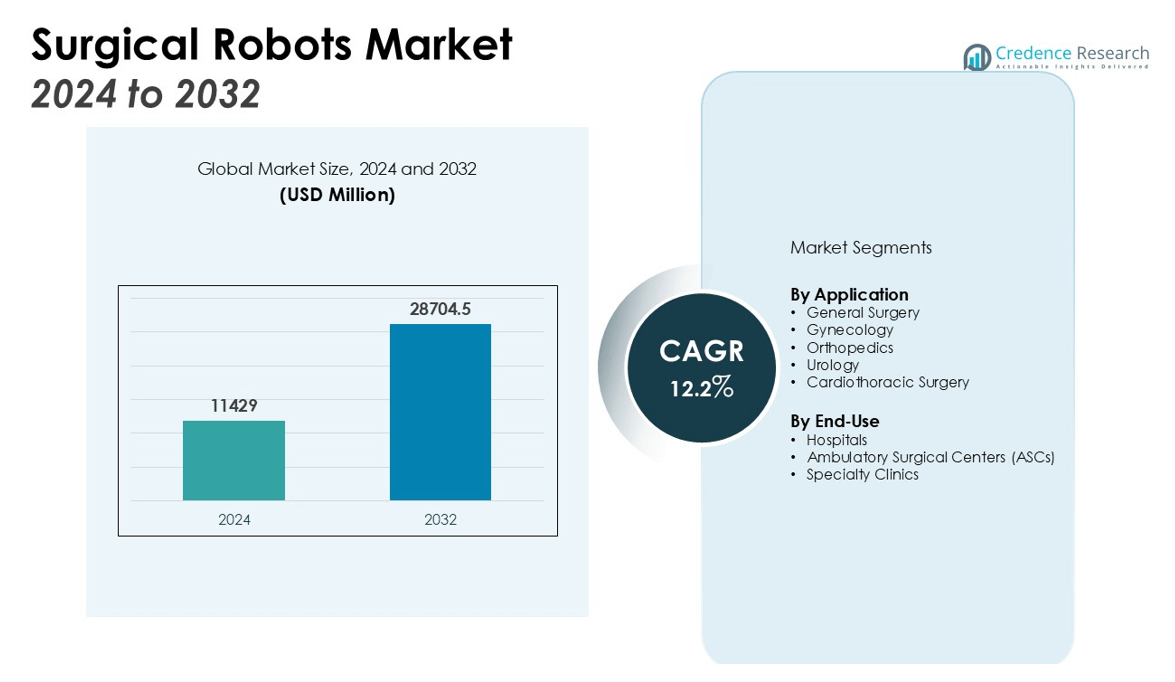
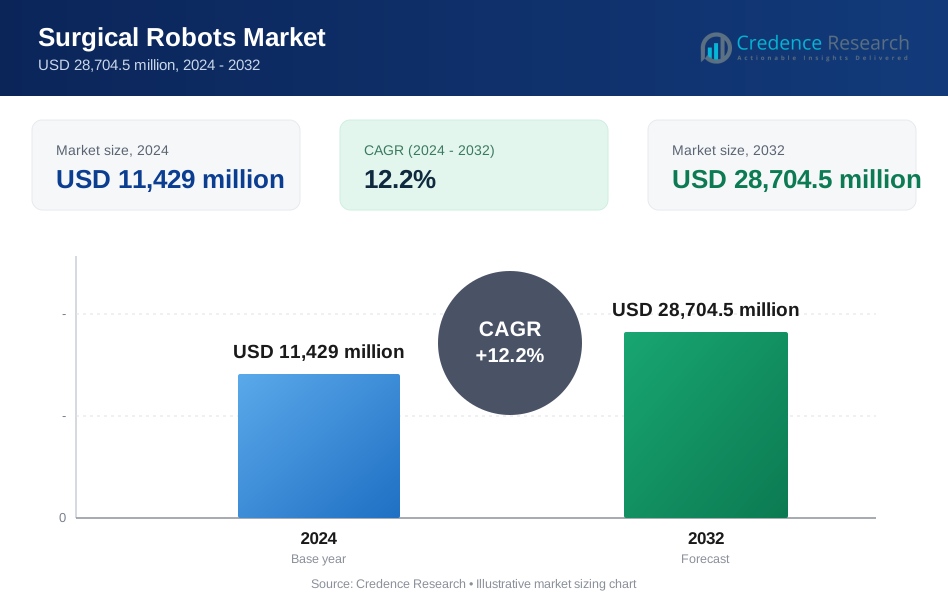
The Surgical Robots Market size was valued at USD 11429 million in 2024 and is anticipated to reach USD 28704.5 million by 2032, at a CAGR of 12.2% during the forecast period (2024-2032).
| REPORT ATTRIBUTE | DETAILS |
|---|---|
| Historical Period | 2019-2022 |
| Base Year | 2023 |
| Forecast Period | 2024-2032 |
| Surgical Robots Market Size 2024 | USD 11429 million |
| Surgical Robots Market, CAGR | 12.2% |
| Surgical Robots Market Size 2032 | USD 28704.5 million |
The primary drivers of the surgical robots market include the growing preference for minimally invasive procedures, which reduce patient trauma, shorten recovery periods, and improve surgical outcomes. Furthermore, technological advancements in robotics, such as improved dexterity, vision, and enhanced AI integration, are driving the market's expansion. Additionally, rising healthcare investments in developed and emerging economies are contributing to increased adoption of surgical robots in hospitals and medical centers. The increasing adoption of robotic surgery in specialized procedures, such as orthopedic, cardiac, and urological surgeries, further propels market growth.
Regionally, North America dominates the surgical robots market, accounting for the largest market share due to its well-established healthcare infrastructure, technological advancements, and high healthcare spending. Europe follows closely, with increasing demand in countries such as Germany and the UK. The Asia Pacific region is expected to witness the highest growth due to improved healthcare facilities and rising investments in medical technologies across countries like China and India.
Market Insights:
- The Surgical Robots Market was valued at USD 11,429 million in 2024 and is projected to reach USD 28,704.5 million by 2032, reflecting a CAGR of 12.2% during the forecast period.
- The market is driven by rising demand for minimally invasive procedures, which offer reduced patient trauma, shorter recovery times, and improved outcomes.
- Technological advancements, including enhanced dexterity, vision, and AI integration, are supporting the adoption of surgical robots across complex specialties.
- Increased healthcare investments and infrastructure development, especially in emerging economies, are expanding access to robotic surgical systems.
- North America leads the market with a 49% share, while Europe follows at 27% and Asia Pacific at 19%, driven by healthcare modernization and growing adoption.
- High initial investment and ongoing maintenance costs, along with limited reimbursement and regulatory complexities, present key challenges for market expansion.
- The market benefits from the surge in specialized robotic surgeries in orthopedics, cardiology, and urology, as hospitals seek greater precision and efficiency in surgical care.
Market Drivers:
Increasing Preference for Minimally Invasive Procedures
The rising preference for minimally invasive procedures is a significant driver of the Surgical Robots Market. These procedures offer several benefits, such as reduced patient trauma, shorter recovery periods, and minimal scarring. As more patients and healthcare providers seek effective alternatives to traditional surgeries, the demand for robotic-assisted surgeries continues to increase. Surgical robots, with their precision and accuracy, enable surgeons to perform complex procedures with less risk, contributing to better patient outcomes.
- For instance, Intuitive Surgical's da Vinci systems have been utilized to perform over 14 million surgical procedures worldwide, with a network of more than 76,000 trained surgeons.
Technological Advancements in Robotics
Advancements in robotic technology play a crucial role in the expansion of the Surgical Robots Market. Enhanced dexterity, improved vision systems, and greater precision enable surgeons to perform intricate tasks with greater control. The integration of Artificial Intelligence (AI) further enhances these capabilities, providing real-time data analysis and guidance during surgeries. These innovations significantly improve surgical performance and efficiency, driving market growth as healthcare institutions increasingly adopt robotic systems.
- For instance, Medtronic enhanced its Touch Surgery™ Performance Insights platform with the introduction of 14 new AI-driven algorithms to analyze surgical video for detailed post-procedure review.
Healthcare Investments and Infrastructure Development
Growing investments in healthcare infrastructure, particularly in developed and emerging economies, contribute to the widespread adoption of surgical robots. Governments and private entities are funding the modernization of healthcare facilities, leading to the acquisition of advanced technologies, including robotic surgical systems. This increased financial backing helps expand access to state-of-the-art surgical options, making robotic systems more accessible to a wider range of healthcare facilities, fueling market demand.
Surge in Specialized Surgery Applications
The expanding applications of robotic surgery in specialized fields such as orthopedics, cardiology, and urology significantly drive the Surgical Robots Market. Robotic systems are increasingly used in complex surgeries where precision is critical. These applications highlight the versatility of surgical robots, attracting more hospitals and surgical centers to incorporate robotic technology into their offerings. The ability to perform highly specialized surgeries with enhanced accuracy boosts the adoption rate of surgical robots across various medical specialties.
Market Trends:
Growing Integration of Artificial Intelligence and Machine Learning in Surgical Robots
The Surgical Robots Market is experiencing a growing trend in the integration of Artificial Intelligence (AI) and Machine Learning (ML) technologies. These advanced technologies enable surgical robots to provide real-time data analysis, predictive insights, and enhanced decision-making capabilities during surgeries. AI-powered systems allow for improved precision in complex procedures by adapting to the surgeon's movements and offering corrective suggestions when necessary. The continuous evolution of AI and ML in robotic surgery is contributing to the enhanced efficiency and safety of these systems, making them more appealing to healthcare institutions seeking cutting-edge solutions for their surgical operations. As AI becomes more embedded in surgical robots, it enhances their role in complex and highly specialized surgeries, improving patient outcomes and pushing the market forward.
- For instance, Medtronic recently expanded its Touch Surgery Performance Insights platform by launching 14 new AI-driven algorithms designed to analyze surgical video and provide actionable insights for surgeons after procedures.
Expansion of Robotic Systems in Emerging Markets
A significant trend in the Surgical Robots Market is the increasing adoption of robotic surgical systems in emerging markets. Countries in the Asia Pacific region, including China and India, are seeing significant investments in healthcare infrastructure, which is facilitating the introduction of advanced technologies like robotic surgery. Hospitals in these regions are embracing robotic systems due to their potential to enhance surgical outcomes, reduce recovery times, and improve overall healthcare delivery. With a growing middle class, improved healthcare access, and government initiatives to support medical innovation, the demand for surgical robots is expanding in these regions. This trend is likely to continue as healthcare providers strive to meet the evolving needs of their populations and modernize their facilities with advanced robotic systems.
- For instance, by the end of 2022, China had installed 314 da Vinci surgical systems across 257 institutions, successfully completing over 378,000 surgical procedures.
Market Challenges Analysis:
High Initial Investment and Maintenance Costs
One of the primary challenges in the Surgical Robots Market is the high initial investment and maintenance costs associated with robotic systems. The price of purchasing and installing a surgical robot can be prohibitive, particularly for small to medium-sized healthcare facilities. These high upfront costs are compounded by ongoing maintenance, training, and software upgrades, which can strain healthcare budgets. While robotic systems offer long-term benefits, the financial barrier remains a significant hurdle, limiting adoption in some regions and institutions. This challenge is further exacerbated by the need for specialized personnel to operate and maintain these systems, increasing operational expenses.
Limited Reimbursement and Regulatory Hurdles
Limited reimbursement for robotic surgeries and regulatory challenges are also hindering the growth of the Surgical Robots Market. Many healthcare providers face difficulties in securing adequate reimbursement for robotic procedures from insurance companies, which slows down the adoption of robotic systems. Additionally, the regulatory approval process for new robotic technologies can be lengthy and complex, delaying market entry for innovative solutions. These challenges create uncertainty for manufacturers and healthcare providers, slowing the widespread adoption of surgical robots despite their potential to improve patient outcomes and surgical efficiency.
Market Opportunities:
Growing Demand for Robotic-Assisted Minimally Invasive Surgery
The increasing demand for minimally invasive surgeries presents significant opportunities for the Surgical Robots Market. These procedures are gaining popularity due to their ability to reduce patient trauma, shorten recovery times, and improve surgical outcomes. Surgical robots are ideally suited for performing complex minimally invasive surgeries with higher precision and control. As more healthcare facilities adopt these advanced technologies, the demand for robotic-assisted surgeries is expected to rise, creating new growth avenues for manufacturers. The ongoing shift toward minimally invasive surgery globally further drives the market, providing a substantial opportunity for expanding the use of robotic systems.
Expansion in Emerging Markets
The rapid expansion of healthcare infrastructure in emerging markets presents a major opportunity for the Surgical Robots Market. Countries in Asia Pacific, Latin America, and the Middle East are increasingly investing in modern medical technologies, including robotic systems, to improve their healthcare offerings. As these regions experience economic growth and rising healthcare access, the demand for advanced surgical technologies like robotics is set to increase. Healthcare institutions in these regions are eager to enhance surgical outcomes and reduce patient recovery times, creating an expanding market for robotic solutions. This shift represents a valuable opportunity for manufacturers to tap into untapped markets with high growth potential.
Market Segmentation Analysis:
By Application
The Surgical Robots Market sees significant growth in various applications, with general surgery holding the largest share. Robotic systems are increasingly used in procedures like hernia repair, cholecystectomy, and bariatric surgery, where they improve precision and reduce complications. Other prominent applications include gynecology, orthopedics, urology, and cardiothoracic surgery. The demand for minimally invasive procedures, especially in gynecology for hysterectomy and myomectomy, further contributes to market expansion. Robotic systems are preferred for their ability to offer enhanced accuracy, reduce patient recovery time, and improve overall surgical outcomes.
- For instance, Stryker's Mako SmartRobotics™ system has been utilized in over 1 million successful hip and knee replacement procedures, demonstrating its significant impact and widespread adoption in orthopedic surgery.
By End-Use
Hospitals remain the dominant end-use segment in the Surgical Robots Market. Their large-scale operations and ability to invest in advanced surgical technologies enable hospitals to drive the adoption of robotic systems for complex and high-volume surgeries. Ambulatory surgical centers (ASCs) are emerging as a growing segment due to the shift toward outpatient care. These centers leverage robotic systems for minimally invasive surgeries, benefiting from reduced recovery times and lower costs. This trend is reshaping the landscape of surgery, as both hospitals and ASCs increasingly adopt robotic platforms to enhance surgical efficiency and patient care.
- For instance, Community Hospital Network in Indiana operates an expanding robotic surgery program that utilizes six da Vinci systems across 4 of its hospitals.
Segmentations:
By Application
- General Surgery
- Gynecology
- Orthopedics
- Urology
- Cardiothoracic Surgery
By End-Use
- Hospitals
- Ambulatory Surgical Centers (ASCs)
- Specialty Clinics
By Region
- North America
- U.S.
- Canada
- Mexico
- Europe
- Germany
- France
- U.K.
- Italy
- Spain
- Rest of Europe
- Asia Pacific
- China
- Japan
- India
- South Korea
- South-east Asia
- Rest of Asia Pacific
- Latin America
- Brazil
- Argentina
- Rest of Latin America
- Middle East & Africa
- GCC Countries
- South Africa
- Rest of the Middle East and Africa
Regional Analysis:
North America Maintains Dominance in the Surgical Robots Market
North America holds 49% share of the global Surgical Robots Market, with the United States contributing the largest portion of this value. The region’s advanced healthcare infrastructure and rapid adoption of innovative technologies fuel market growth. Substantial investments in research, favorable reimbursement policies, and the strong presence of leading market players support expansion. Hospitals across North America implement robotic-assisted surgical systems to improve patient outcomes and operational efficiency. A skilled workforce and ongoing collaborations between technology firms and healthcare providers further strengthen the region’s leadership. North America remains at the forefront of new robotic platform introductions.
Europe Exhibits Steady Growth with Technological Integration
Europe accounts for 27% share of the global Surgical Robots Market, led by countries such as Germany, the UK, and France. Focus on minimally invasive procedures and ongoing technological progress drives the region’s expansion. Regulatory support and healthcare modernization initiatives facilitate the integration of advanced robotic-assisted surgical systems. Hospitals throughout Europe prioritize enhancing surgical precision and patient safety, benefiting from robotic technologies. Established manufacturers and active clinical research programs further reinforce Europe’s market position. The region continues to demonstrate steady growth as its healthcare systems evolve.
Asia Pacific Emerges as a High-Growth Region
Asia Pacific holds 19% share of the global Surgical Robots Market, with China, Japan, and India leading adoption. Improvements in healthcare infrastructure and increasing healthcare investments drive regional demand for robotic surgical systems. The market benefits from a growing middle class, increased awareness of minimally invasive procedures, and government-backed innovation initiatives. Expanding access to advanced care and rising numbers of complex surgeries support faster uptake of robotic technologies. Robust economic development and targeted investments position Asia Pacific as the fastest-growing region for surgical robots worldwide.
Key Player Analysis:
- Intuitive Surgical
- Medrobots Corporation
- Medtronic
- Renishaw plc
- Smith and Nephew
- Stryker Corporation
- THINK Surgical, Inc.
- Transenterix (Asensus Surgical, Inc.)
- Zimmer Biomet
Competitive Analysis:
The Surgical Robots Market features intense competition among leading technology providers and established medical device manufacturers. Key players such as Intuitive Surgical, Stryker, Medtronic, Zimmer Biomet, and Johnson & Johnson drive innovation through continuous product development and strategic collaborations. It is characterized by robust investments in research and development, enabling the launch of advanced robotic systems that offer greater precision and improved clinical outcomes. Companies focus on expanding their portfolios and strengthening their geographic presence to capture a larger market share. Strategic partnerships with hospitals and healthcare providers further enhance market positioning. The presence of emerging players, coupled with advancements in artificial intelligence and machine learning, fosters a dynamic competitive landscape. The market remains highly attractive, with companies competing on technological innovation, reliability, and comprehensive service offerings to meet the evolving demands of healthcare providers worldwide.
Recent Developments:
- In July 2025, Medtronic announced that its VitalFlow Extracorporeal Membrane Oxygenation (ECMO) system received CE Mark approval in Europe.
- In May 2024, Richtech Robotics launched the Medbot, an elevator-enabled robot designed to automate medication delivery within healthcare facilities.
- In March 2024, Stryker launched its next-generation LIFEPAK CR2 automated external defibrillator (AED) in India to enhance responses to sudden cardiac arrest emergencies.
Market Concentration & Characteristics:
The Surgical Robots Market demonstrates a high degree of market concentration, with a few leading companies controlling a significant share of global revenue. It is characterized by advanced technological integration, a strong focus on research and development, and rapid product innovation. The market emphasizes precision, reliability, and improved patient outcomes, driving demand for next-generation robotic systems. Entry barriers remain high due to substantial capital requirements and stringent regulatory standards. The market features long-term partnerships with healthcare institutions and ongoing service agreements, supporting recurring revenue streams and customer loyalty.
Report Coverage:
The research report offers an in-depth analysis based on Application, End-Use and Region. It details leading market players, providing an overview of their business, product offerings, investments, revenue streams, and key applications. Additionally, the report includes insights into the competitive environment, SWOT analysis, current market trends, as well as the primary drivers and constraints. Furthermore, it discusses various factors that have driven market expansion in recent years. The report also explores market dynamics, regulatory scenarios, and technological advancements that are shaping the industry. It assesses the impact of external factors and global economic changes on market growth. Lastly, it provides strategic recommendations for new entrants and established companies to navigate the complexities of the market.
Future Outlook:
- The adoption of robotic systems in minimally invasive surgeries will continue to rise, improving patient outcomes and reducing recovery times.
- Technological advancements, such as AI integration and machine learning, will enhance robotic systems' precision and capabilities, driving market growth.
- The demand for robotic-assisted surgeries in specialized fields, including orthopedics, urology, and cardiology, will increase significantly.
- Emerging economies in Asia Pacific, Latin America, and the Middle East will see rapid growth due to improvements in healthcare infrastructure and rising healthcare investments.
- Increasing healthcare spending globally will support the widespread adoption of surgical robots across various healthcare settings.
- Surgeons’ growing preference for robotic systems that enhance precision and reduce human error will further accelerate market expansion.
- Strategic partnerships between technology firms and healthcare providers will help introduce more cost-effective and innovative robotic solutions.
- The development of smaller, more affordable robotic systems will open new opportunities for small and medium-sized hospitals and surgical centers.
- Rising healthcare regulations and the need for effective training programs will drive further innovation in the sector.
- Integration of 5G and IoT technologies into robotic systems will enable real-time remote surgery and collaborative surgical practices, expanding the market’s scope.
Request a Free Sample
Fill in your details and we'll send you a free sample report.
- Sample data tables & charts
- Research methodology
Need a Custom Version of This Report?
Tailor the scope, geography, or segments to your exact requirements.
- Custom geography or segment scope
- Direct access to our analyst team
Frequently Asked Questions
What is the current market size for Surgical Robots, and what is its projected size in 2032?
At what Compound Annual Growth Rate is the Surgical Robots market projected to grow between 2024 and 2032?
Which Surgical Robots market segment held the largest share in 2024?
What are the primary factors fueling the growth of the Surgical Robots market?
Table of Content
Chapter 1. Report Introduction
- 1.1 Report Description & Purpose
- 1.1.1 Report Title & Market Definition
- 1.1.2 Unique Selling Propositions (USP) & Key Differentiators
- 1.1.3 Value Proposition for Stakeholders
- 1.2 Research Objectives
- 1.2.1 Market Sizing Objectives (Volume & Revenue)
- 1.2.2 Segmentation Objectives
- 1.2.3 Competitive Intelligence Objectives
- 1.2.4 Forecast & Scenario Objectives
- 1.3 Report Scope
- 1.3.1 Surgical Robots Scope – Types & Subtypes Covered
- 1.3.2 Geographic Scope – Regions & Countries Covered
- 1.3.3 Historical Period, Base Year & Forecast Period (2024; forecast to 2032)
- 1.3.4 Inclusions & Exclusions
- 1.4 HS Code & Classification Framework
- 1.5 Currency, Units & Pricing Basis
- 1.6 Target Stakeholders
- 1.7 Limitations & Assumptions
Chapter 2. Executive Summary
- 2.1 Global Surgical Robots Market Snapshot
- 2.1.1 Market Size – Historical (2024) & Forecast (2024-2032) (2024: USD 11,429 million → 2032: USD 28,704.5 million)
- 2.1.2 Volume & Revenue – Global Totals
- 2.1.3 Key Market Highlights – Top Five Facts
- 2.2 Surgical Robots Market Segmentation Snapshot
- 2.2.1 Market Split by Region – 2024 vs. 2032
- 2.3 Competitive Snapshot
- 2.3.1 Top 10 Players by Revenue Share – 2024
- 2.3.2 Top 10 Players by Volume Share – 2024
- 2.3.3 Recent Strategic Developments (18-Month Summary)
- 2.4 Key Investment Highlights & Strategic Conclusions
Chapter 3. Surgical Robots Market Dynamics & Industry Analysis
- 3.1 Market Overview & Context
- 3.1.1 Surgical Robots Market Position in the Broader Automotive Value Chain
- 3.1.2 OEM vs. Replacement Market Dynamics
- 3.1.3 Market Maturity & Development Stage by Region
- 3.2 Surgical Robots Market Drivers
- 3.3 Surgical Robots Market Restraints & Challenges
- 3.4 Surgical Robots Market Opportunities
- 3.5 Porter's Five Forces Analysis
- 3.5.1 Threat of New Entrants
- 3.5.2 Bargaining Power of Suppliers
- 3.5.3 Bargaining Power of Buyers
- 3.5.4 Threat of Substitutes
- 3.5.5 Competitive Rivalry – Intensity Assessment
- 3.6 Surgical Robots Value Chain Analysis
- 3.6.1 Upstream – Raw Material/Input Suppliers
- 3.6.1.1 Raw Material/Input 1
- 3.6.1.2 Raw Material/Input 2
- 3.6.1.3 Raw Material/Input 3
- 3.6.2 Midstream – Production/Manufacturing/Service Delivery
- 3.6.2.1 Production/Process Overview
- 3.6.2.2 Key Facility Locations & Capacity by Manufacturer
- 3.6.3 Downstream – Distribution & End Consumer
- 3.6.3.1 Primary Channel – B2B/OEM
- 3.6.3.2 Secondary Channels – Dealer, Retail, Online, Direct
- 3.6.4 Value Chain Profitability Analysis
- 3.6.1 Upstream – Raw Material/Input Suppliers
- 3.7 PESTEL Analysis
- 3.7.1 Political Factors
- 3.7.2 Economic Factors
- 3.7.3 Social Factors
- 3.7.4 Technological Factors
- 3.7.5 Environmental Factors
- 3.7.6 Legal Factors
- 3.8 Surgical Robots Supply Chain Analysis
- 3.8.1 Raw Material/Input Supply Risk Assessment
- 3.8.2 Manufacturing Concentration Risk (Geographic Exposure)
- 3.8.3 Trade Disruption Impact Analysis
- 3.9 Regulatory & Policy Landscape
Note: The regulatory and policy landscape section covers regulations based on their applicability to the market, Surgical Robots category, geography, and scope of the study. Only regulatory frameworks with a material impact on operations, compliance, trade, sustainability, or market access are analyzed in detail.
Chapter 4. Key Investment Pockets & Opportunity Analysis
- 4.1 Surgical Robots Market Attractiveness Analysis
- 4.1.1 By Region – Investment Attractiveness Matrix (Volume × CAGR)
- 4.2 Absolute Revenue Growth Opportunity
- 4.2.1 By Region – Absolute USD Growth Through 2032
- 4.3 Incremental Volume Opportunity
- 4.3.1 By Region – Incremental Volume Through 2032
- 4.3.2 Segment – Incremental Volume
- 4.4 Emerging Submarket Opportunity Deep Dive (Subject to Applicability)
- 4.5 Emerging Market Opportunity Scorecards
- 4.5.1 United States
- 4.5.2 Europe
- 4.5.3 Asia
- 4.5.4 Middle East & Africa
Note: Emerging Market Opportunity Scorecards will be included based on relevance and strategic importance. Regions listed are indicative and may vary depending on data availability and market dynamics.
Chapter 5. Surgical Robots Import-Export Analysis & Trade Flows
- 5.1 Global Trade Overview
- 5.1.1 Global Export Value by Country (2024)
- 5.1.2 Global Export Volume by Country (2024)
- 5.1.3 Global Import Value by Country (2024)
- 5.1.4 Global Import Volume by Country (2024)
- 5.1.5 Net Trade Balance by Country (2024)
- 5.2 Export Analysis – Segment
- 5.2.1 Type 1 (HS Code)
- 5.2.2 Type 2 (HS Code)
- 5.2.3 Type 3 (HS Code)
- 5.2.4 Type 4 (HS Code)
- 5.2.5 Type 5 (HS Code)
- 5.3 Import Analysis – Segment
- 5.3.1 Type 1 (HS Code)
- 5.3.2 Type 2 (HS Code)
- 5.3.3 Type 3 (HS Code)
- 5.3.4 Type 4 (HS Code)
- 5.3.5 Type 5 (HS Code)
- 5.4 Average Unit Trade Prices
- 5.4.1 Average Export Price – Segment & Country
- 5.4.2 Average Import Price – Segment & Source Country
- 5.4.3 Price Trends (2024)
- 5.5 Key Trade Route Analysis
- 5.5.1 Trade Route 1
- 5.5.2 Trade Route 2
- 5.5.3 Trade Route 3
- 5.5.4 Trade Route 4
- 5.5.5 Trade Route 5
- 5.6 Trade Policy Impact Assessment
- 5.6.1 US Anti-Dumping & Section 301 Tariffs
- 5.6.2 EU Customs Union Impact
- 5.6.3 Major Free Trade Agreements
- 5.6.4 USMCA Rules of Origin
Note: Trade policy analysis will be included only where relevant to the Surgical Robots market.
Chapter 6. Competitive Landscape & Company Benchmarking
- 6.1 Surgical Robots Market Concentration & Structure
- 6.1.1 Herfindahl-Hirschman Index (HHI) – vs. 2024
- 6.1.2 Tier 1, Tier 2 & Tier 3 Market Structure
- 6.1.3 Global, Regional & Local Player Dynamics
- 6.2 Surgical Robots Market Share Analysis – 2024
- 6.2.1 Global Revenue Share by Company
- 6.2.2 Global Volume Share by Company
- 6.2.3 Regional Revenue Share
- 6.2.4 Market Share Evolution ( vs. 2024)
- 6.2.5 OEM Segment Share by Company
- 6.2.6 Replacement Segment Share by Company
- 6.3 Production/Delivery Capacity & Facility Analysis
- 6.3.1 Global Installed Capacity
- 6.3.2 Capacity Utilization Rates
- 6.3.3 Production/Output Volume
- 6.3.4 Facility Locations & Capacity Map
- 6.3.5 Planned Capacity Additions
- 6.4 Surgical Robots Competitive Benchmarking Matrix
- 6.4.1 Revenue, Volume, CAGR & Profitability Comparison
- 6.4.2 Channel Revenue Mix
- 6.4.3 Geographic Revenue Exposure
- 6.4.4 R&D Intensity
- 6.4.5 Sustainability Maturity
- 6.5 Strategic Developments in Surgical Robots (Last 24 Months)
- 6.5.1 Mergers, Acquisitions & Divestments
- 6.5.2 New Surgical Robots Launches
- 6.5.3 Facility Expansions
- 6.5.4 Strategic Alliances, Joint Ventures & Partnerships
- 6.5.5 Distribution Expansion & Market Entry
- 6.5.6 Sustainability & ESG Initiatives
- 6.6 Competitive Strategy Mapping
- 6.6.1 Leader, Challenger, Follower & Niche Classification
- 6.6.2 Pricing Strategy Comparison
- 6.6.3 Channel Strategy Matrix
Note: Strategic developments are included based on their materiality and the availability of reliable information.
Chapter 7. Global Surgical Robots Market – By Distribution Channel
- 7.1 Segment Overview
- 7.1.1 Volume & Revenue Split by Channel (2024 & 2032)
- 7.1.2 Channel Mix Evolution (2024-2032)
Chapter 8. Regional Market Analysis – Global Overview
- 8.1 Global Regional Overview
- 8.1.1 Regional Volume Share
- 8.1.2 Regional Revenue Share
- 8.1.3 Regional Volume by Region
- 8.1.4 Regional Revenue by Region
- 8.1.5 Regional Forecast Through 2032
- 8.2 Cross-Regional Segment Analysis
- 8.2.1 By Distribution Channel
- 8.2.2 By Brand/Price Tier
Chapter 9. North America Surgical Robots Market
- 9.1 United States
- 9.2 Canada
- 9.3 Mexico
Chapter 10. Europe Surgical Robots Market
- 10.1 Germany
- 10.2 France
- 10.3 Italy
- 10.4 United Kingdom
- 10.5 Spain
- 10.6 Poland
- 10.7 Russia
- 10.8 Netherlands
- 10.9 Belgium
- 10.10 Sweden
- 10.11 Denmark
- 10.12 Norway
- 10.13 Rest of Europe
Chapter 11. Asia Pacific Surgical Robots Market
- 11.1 China
- 11.2 India
- 11.3 Japan
- 11.4 South Korea
- 11.5 Thailand
- 11.6 Indonesia
- 11.7 Vietnam
- 11.8 Malaysia
- 11.9 Australia
- 11.10 Rest of Asia Pacific
Chapter 12. Latin America Surgical Robots Market
- 12.1 Brazil
- 12.2 Argentina
- 12.3 Colombia
- 12.4 Chile
- 12.5 Rest of Latin America
Chapter 13. Middle East Surgical Robots Market
- 13.1 Saudi Arabia
- 13.2 United Arab Emirates
- 13.3 Turkey
- 13.4 Israel
- 13.5 Iran
- 13.6 Rest of the Middle East
Chapter 14. Africa Surgical Robots Market
- 14.1 South Africa
- 14.2 Egypt
- 14.3 Nigeria
- 14.4 Morocco
- 14.5 Rest of Africa
Chapter 15. Surgical Robots Company Profiles
- 15.1 [Company 01]
- 15.1.1 Company Overview
- 15.1.2 Key Management Personnel
- 15.1.3 Products & Services Portfolio
- 15.1.4 Financial Performance
- 15.1.5 Key Market Focus & Geographic Presence
- 15.1.6 Recent Developments & Strategic Initiatives
Note: The company profile list is preliminary and may change based on research findings, market developments, data availability, and client requirements.
Chapter 16. Appendices
- Appendix A – List of Abbreviations & Acronyms
- Appendix B – Industry Classification Code Reference – Full Series
- Appendix C – Production & Capacity Data Tables
- Appendix D – End-Use & Demand Base Tables
- Appendix E – Consumption & Replacement Rate Assumptions
- Appendix F – ASP Reference Tables
- Appendix G – Manufacturing & Facility Database
- Appendix H – Import-Export Data Tables
- Appendix I – Regulatory Summary Tables
- Appendix J – Primary Research Participant List (Anonymized)
- Appendix K – Primary Research Questionnaire Framework
- Appendix L – Data Sources & Bibliography
- Appendix M – Market Size Divergence & Source Comparison
Chapter 17. Research Methodology
- 17.1 Research Framework & Philosophy
- 17.2 Secondary Research – Sources, Hierarchy & Data Extraction
- 17.3 Data Modeling – Bottom-Up & Top-Down Market Sizing
- 17.4 Primary Research – Stakeholder Framework, LOI & Sample Sizes
- 17.5 Forecast Methodology – Regression, Scenario & Sensitivity Analysis
- 17.6 Quality Control – Four-Layer Validation Framework
- 17.7 Limitations & Standard Assumptions
- 17.8 Disclaimer
