
| REPORT ATTRIBUTE | DETAILS |
|---|---|
| Historical Period | 2020-2023 |
| Base Year | 2024 |
| Forecast Period | 2025-2032 |
| Switchgear Market Size 2024 | USD 99.5 million |
| Switchgear Market, CAGR | 6.90% |
| Switchgear Market Size 2032 | USD 169.4 million |
Market Overview
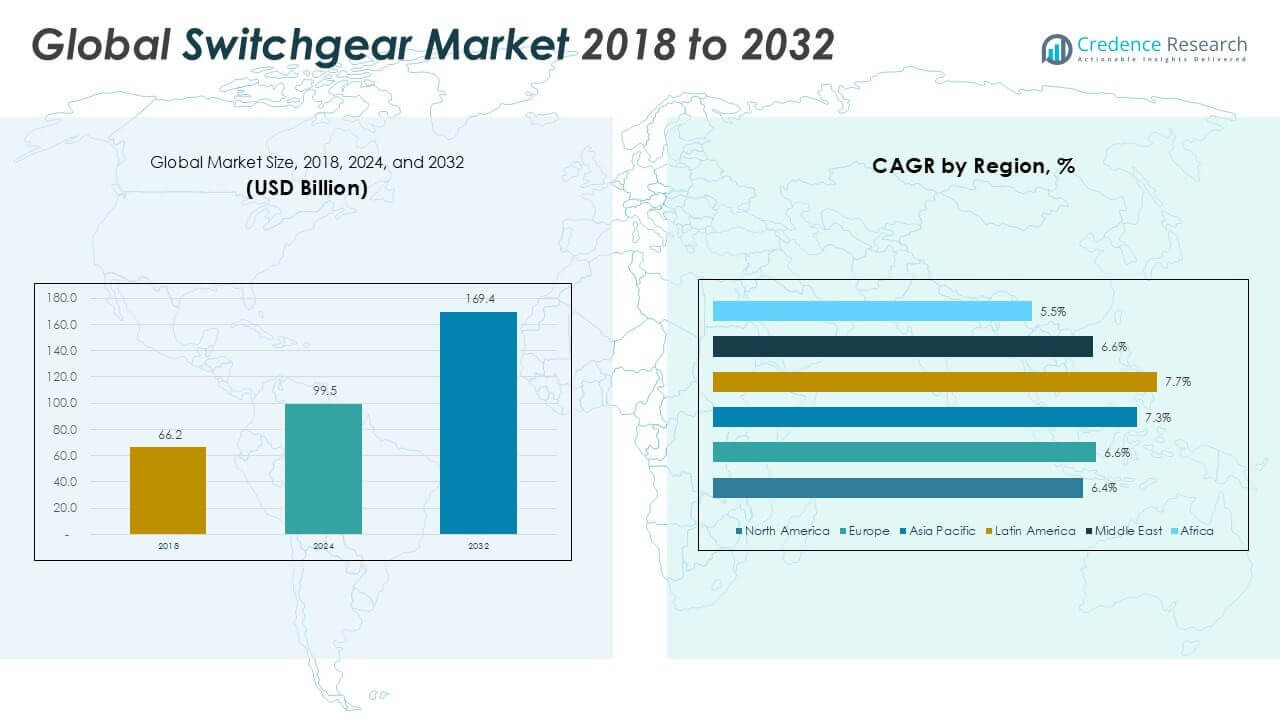
The Global Switchgear Market is projected to grow from USD 99.5 million in 2024 to an estimated USD 169.4 million by 2032, with a compound annual growth rate (CAGR) of 6.90% from 2025 to 2032.
The market is witnessing significant momentum due to growing integration of renewable energy sources, which necessitates the installation of modern switchgear to manage load fluctuations and ensure grid stability. Additionally, smart grid deployment and the advent of digital switchgear with features such as real-time monitoring and predictive maintenance are transforming the industry landscape. Environmental regulations are also encouraging the replacement of oil-based and SF6-based switchgear with eco-friendly alternatives, pushing innovation in sustainable designs.
Regionally, Asia-Pacific holds the dominant share in the global switchgear market, fueled by robust investments in energy infrastructure, especially in countries like China and India. North America and Europe follow, driven by grid modernization efforts and renewable energy targets. Key players operating in the market include Siemens AG, Schneider Electric SE, ABB Ltd., Eaton Corporation, Mitsubishi Electric Corporation, General Electric, and Larsen & Toubro, all of whom are actively investing in R&D and strategic collaborations to strengthen their global footprint.
Market Insights
- The Global Switchgear Market is projected to grow from USD 99.5 million in 2024 to USD 169.4 million by 2032, at a CAGR of 6.90%.
- Rising demand for electricity and ongoing transmission and distribution network expansion are major drivers of switchgear adoption.
- Integration of renewable energy sources and increasing deployment of smart grids boost the demand for intelligent and adaptive switchgear systems.
- High initial installation costs and complex setup procedures limit adoption, particularly among small- and medium-scale utilities.
- Fluctuating raw material prices and global supply chain disruptions pose significant challenges to consistent product availability.
- Asia-Pacific holds the largest share due to strong infrastructure investments in China and India, supported by rapid industrialization.
- Europe and North America follow, driven by grid modernization, strict environmental regulations, and growing renewable integration initiatives.
Market Drivers
Rising Energy Demand and Grid Expansion Accelerate Switchgear Adoption
The Global Switchgear Market is gaining traction due to the steady increase in electricity consumption driven by population growth, urbanization, and industrialization. Nations are expanding and upgrading transmission and distribution networks to meet rising energy needs. This expansion requires reliable, efficient, and safe electrical control systems, making switchgear a critical component in modern power infrastructure. Rapid industrial development in emerging economies fuels the demand for uninterrupted power supply, reinforcing the need for robust switchgear solutions. Governments worldwide are investing in utility-scale projects to enhance grid stability and energy access, driving market growth. Switchgear provides operational control and fault protection, ensuring minimal disruption during power fluctuations.
- For instance, in 2024, China’s State Grid Corporation completed the construction of more than 20,000 kilometers of new ultra-high voltage (UHV) transmission lines to support rising electricity demand and grid expansion, requiring large-scale deployment of advanced switchgear systems.
Modernization of Aging Infrastructure Spurs Demand for Advanced Switchgear
Many developed nations are replacing outdated power infrastructure to improve efficiency and safety, which strengthens demand for advanced switchgear systems. Legacy systems often lack the reliability and automation features that modern grids require. The Global Switchgear Market benefits from this transition, as utilities seek intelligent solutions to reduce maintenance costs and improve outage management. Smart switchgear equipped with sensors and real-time monitoring capabilities meets the expectations of grid operators seeking enhanced performance. Technological upgrades help utilities optimize energy distribution while reducing operational risks. The replacement cycle of aging infrastructure creates long-term opportunities for manufacturers and suppliers.
- For instance, in 2024, the U.S. Department of Energy allocated funding for the replacement of more than 10,000 aging circuit breakers and switchgear units across national transmission networks, reflecting a significant push toward modernization and adoption of intelligent grid solutions.
Renewable Energy Integration Creates Opportunities for Grid-Compatible Switchgear
The growth of renewable energy sources such as solar and wind power increases the need for flexible, grid-compatible switchgear systems. Variable output from renewables requires advanced load management and fault protection, roles that modern switchgear fulfills effectively. The Global Switchgear Market responds to this shift with eco-friendly, intelligent switchgear designs that accommodate diverse generation inputs. Grid operators prioritize systems capable of supporting distributed energy resources and maintaining voltage stability. This shift in energy generation patterns calls for switchgear solutions that can adapt to decentralized and bidirectional energy flows. Innovation in compact, modular switchgear designs supports easy deployment in renewable energy installations.
Stringent Safety Regulations and Rising Focus on Energy Efficiency Drive Adoption
Strict regulatory standards across countries mandate the use of high-quality switchgear that ensures safety, reliability, and energy efficiency. Governments and utilities aim to minimize power losses, fire hazards, and downtime through compliance with national and international standards. The Global Switchgear Market aligns with these goals by offering products that improve operational control and enhance system resilience. Manufacturers focus on creating low-maintenance, environmentally safe solutions that comply with guidelines while delivering high performance. Customers demand energy-efficient systems that reduce long-term operational costs and environmental impact. This regulatory environment encourages innovation and broad adoption across industrial, commercial, and residential sectors.
Market Trends
Digital and Smart Switchgear Solutions Transform Operational Efficiency
The Global Switchgear Market is witnessing a shift toward digital and smart switchgear systems that offer real-time monitoring, diagnostics, and remote control capabilities. Utilities and industries prefer systems that help reduce downtime and enable predictive maintenance. Smart switchgear improves visibility across electrical networks, enhancing system reliability and fault detection. It supports seamless integration with SCADA systems and IoT platforms, driving greater automation and data-driven decision-making. This trend reflects a broader push toward intelligent infrastructure that supports operational agility and long-term cost savings. Manufacturers focus on compact, modular designs that support easier installation and system upgrades.
- For instance, in 2024, over 200 utilities and industrial facilities worldwide upgraded to digital switchgear platforms with integrated IoT sensors and remote diagnostics, according to a leading industry survey.
Eco-Friendly and SF6-Free Switchgear Gains Industry Preference
Environmental concerns and stricter regulations are driving a transition away from sulfur hexafluoride (SF6)-based switchgear toward sustainable alternatives. The Global Switchgear Market is responding to these concerns with air-insulated and vacuum-insulated systems that reduce greenhouse gas emissions. It supports the global movement toward decarbonization and energy transition goals. Utilities and governments seek greener solutions without compromising safety or performance. Manufacturers are investing in R\&D to develop SF6-free technologies that meet international safety standards and offer similar or improved performance levels. This shift strengthens the focus on environmental compliance across both public and private sectors.
- For instance, in 2023, more than 50 countries updated their grid equipment procurement policies to favor SF6-free switchgear, and over 100,000 units of air- and vacuum-insulated switchgear were installed globally, based on regulatory and industry association data.
Decentralized Energy Systems Push Demand for Flexible Switchgear Solutions
The rise of distributed energy resources such as rooftop solar, microgrids, and battery storage systems creates demand for more adaptive switchgear solutions. The Global Switchgear Market is evolving to support bi-directional energy flow and grid interaction in decentralized power systems. It enables efficient load balancing and protection in complex, dynamic networks. The shift from centralized generation to localized power systems increases the need for modular, scalable switchgear designs. Flexibility in installation and operation is now a critical requirement for end-users. This trend is especially visible in regions investing in renewable integration and rural electrification projects.
Urbanization and Infrastructure Development Fuel Market Innovation
Urban growth and infrastructure expansion projects across developing economies increase the need for advanced switchgear installations. The Global Switchgear Market benefits from ongoing metro rail systems, commercial complexes, smart cities, and industrial corridors. It plays a central role in ensuring reliable power supply to large-scale urban infrastructure. Developers seek space-efficient and high-capacity switchgear that meets rising energy demands while reducing operational risks. Innovation in gas-insulated and hybrid switchgear supports compact installation and high-performance use in congested urban spaces. This trend reflects the growing synergy between power infrastructure and urban planning initiatives.
Market Challenges
High Initial Costs and Complex Installation Hinder Widespread Adoption
The Global Switchgear Market faces challenges due to the high upfront costs associated with advanced switchgear systems. Installation requires skilled labor, specialized equipment, and adherence to stringent safety standards, which can increase project expenses. Small and medium-sized enterprises often delay upgrades due to budget constraints. It becomes difficult for organizations in developing regions to adopt modern solutions without financial support or government incentives. Complex site requirements and limited technical infrastructure further delay deployment. These cost-related barriers slow down modernization efforts across utility and industrial sectors.
- For instance, in 2023, the Indian Ministry of Power reported that the average installation cost for a medium-voltage switchgear system in public utility projects exceeded 3 million INR per site, with additional expenses for skilled labor and compliance audits. Several state-run utilities postponed upgrades at more than 120 substations due to insufficient budget allocations and high upfront capital requirements.
Supply Chain Disruptions and Raw Material Volatility Impact Production
Ongoing fluctuations in raw material prices, such as copper and steel, affect manufacturing costs in the Global Switchgear Market. It increases price uncertainty for both manufacturers and buyers, making long-term planning difficult. Supply chain disruptions caused by geopolitical tensions, trade restrictions, or pandemics lead to delays in product availability. Lead times for critical components extend, affecting project timelines and customer satisfaction. Global logistics constraints limit the ability of producers to scale operations efficiently. These supply-side issues continue to pose risks to consistent market growth and product delivery.
Market Opportunities
Smart Grid Expansion and Electrification Projects Open New Growth Avenues
Ongoing investments in smart grid infrastructure and national electrification initiatives present strong opportunities for the Global Switchgear Market. Governments and utilities aim to modernize electrical networks for better efficiency, reliability, and integration with renewable energy. It supports the deployment of intelligent switchgear systems equipped with automation and remote-control features. The demand for digitally enabled solutions grows across urban and rural projects, offering long-term market potential. Electrification of underserved areas and infrastructure upgrades in power-hungry industries also fuel product demand. These large-scale initiatives create favorable conditions for market expansion in both developed and emerging economies.
Renewable Energy Integration and Green Technologies Drive Demand for Innovation
The accelerating shift toward clean energy creates significant opportunities for switchgear manufacturers. The Global Switchgear Market can benefit from designing systems that support decentralized generation, microgrids, and variable load conditions. It enables safer and more efficient power distribution in wind and solar energy installations. Development of SF6-free and environmentally sustainable switchgear aligns with global climate commitments. Export opportunities expand for manufacturers offering eco-friendly and technologically advanced products. This trend encourages innovation in compact, energy-efficient designs tailored to evolving power sector requirements.
Market Segmentation Analysis
By Insulation
Gas-insulated, air-insulated, and vacuum switchgear each serve specific performance needs. The Global Switchgear Market sees gas-insulated gear excel in space-constrained applications due to its compact design. It finds widespread use in urban substations and high-rise buildings. Air-insulated equipment offers cost efficiency and straightforward maintenance, making it popular in medium-voltage networks. Vacuum switchgear delivers reliable arc interruption with minimal environmental impact, earning it favor in eco-sensitive projects.
- For instance, Siemens Energy reported delivering over 100,000 gas-insulated switchgear panels worldwide by 2024, with a significant portion installed in metropolitan substations and high-rise buildings.
By Installation
Indoor and outdoor installations present distinct technical and economic considerations. Indoor switchgear systems benefit from controlled environments that extend equipment life and simplify diagnostics. It suits commercial complexes, data centers, and manufacturing plants. Outdoor switchgear tolerates harsh weather and delivers flexibility for remote and rural networks. Modular outdoor units reduce setup times and facilitate rapid deployment in expanding grids.
- For instance, ABB installed more than 5,000 modular outdoor switchgear units across utility networks in Asia and Europe in 2023, supporting rapid grid expansion and rural electrification projects.
By Voltage
Low-, medium-, and high-voltage switchgear address varied grid requirements. Low-voltage gear meets protection needs in residential and light commercial buildings. It provides reliable circuit control and safety features. Medium-voltage equipment dominates industrial sites and local distribution networks by balancing cost and performance. High-voltage switchgear supports long-distance transmission and utility interconnections, offering robust fault management in heavy-duty applications.
By End Use
Transmission & distribution utilities, manufacturing & process industries, and commercial & residential infrastructure drive demand for tailored switchgear solutions. Utilities rely on high-capacity systems to maintain grid stability and manage peak load. It supports critical operations in power plants and substations. Industries require modular switchgear that harmonizes with automated production lines. Buildings and complexes use compact designs that deliver safety and ease of service.
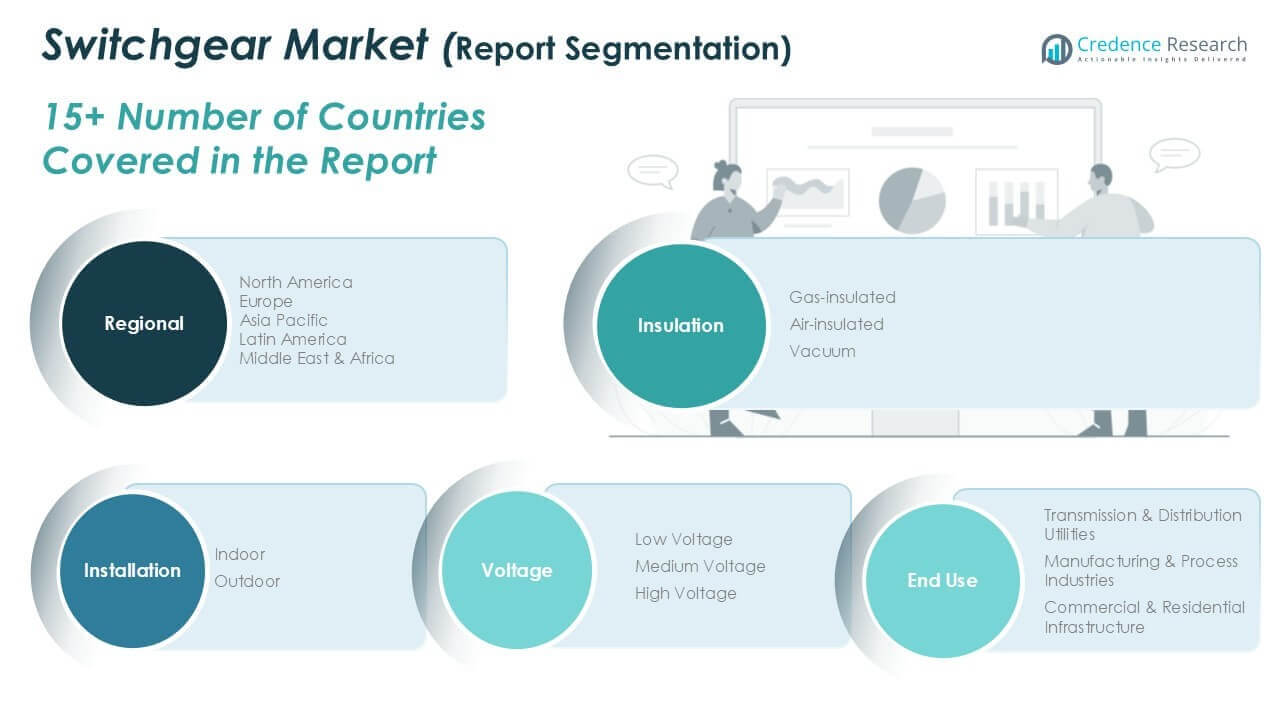
Segments
Based on Insulation
- Gas-insulated
- Air-insulated
- Vacuum
Based on Installation
- Indoor
- Outdoor
Based on Form
- Low Voltage
- Medium Voltage
- High Voltage
Based on End Use
- Transmission & Distribution Utilities
- Manufacturing & Process Industries
- Commercial & Residential Infrastructure
Based on Region
- North America
- U.S.
- Canada
- Mexico
- Europe
- UK
- France
- Germany
- Italy
- Spain
- Russia
- Belgium
- Netherlands
- Austria
- Sweden
- Poland
- Denmark
- Switzerland
- Rest of Europe
- Asia Pacific
- China
- Japan
- South Korea
- India
- Australia
- Thailand
- Indonesia
- Vietnam
- Malaysia
- Philippines
- Taiwan
- Rest of Asia Pacific
- Latin America
- Brazil
- Argentina
- Peru
- Chile
- Colombia
- Rest of Latin America
- Middle East
- UAE
- KSA
- Israel
- Turkey
- Iran
- Rest of Middle East
- Africa
- Egypt
- Nigeria
- Algeria
- Morocco
- Rest of Africa
Regional Analysis
North America Switchgear Market
The North America Switchgear Market reached USD 17.11 billion in 2024 and is projected to hit USD 28.07 billion by 2032, expanding at a CAGR of 6.4%. It accounted for approximately 17.2% of the global market share in 2024. The United States leads the region, driven by modernization of aging grid infrastructure and investments in renewable integration. Demand from industrial automation, data centers, and energy-efficient commercial buildings continues to strengthen the market. Utilities invest in advanced monitoring and digital switchgear systems to improve grid reliability and reduce outages. North American players focus on smart technologies to support predictive maintenance and system upgrades.
Europe Switchgear Market
Europe recorded a market size of USD 22.33 billion in 2024 and is expected to reach USD 37.27 billion by 2032, growing at a CAGR of 6.6%. It represented 22.4% of the global share in 2024. Countries like Germany, the UK, and France lead the switchgear demand, fueled by aggressive renewable targets and smart grid rollouts. Regulatory mandates for SF6-free switchgear promote adoption of eco-friendly alternatives. Industrial and transportation electrification also supports market growth. Governments fund large-scale infrastructure upgrades that require compact, efficient, and modular switchgear systems. The market shows a strong shift toward sustainable technologies.
Asia Pacific Switchgear Market
The Asia Pacific Switchgear Market stood at USD 40.90 billion in 2024 and will grow to USD 71.93 billion by 2032, registering a CAGR of 7.3%. It held the largest market share of 41.0% in 2024. China and India dominate demand due to their massive investments in transmission and distribution networks. Rapid urbanization and industrial development increase electricity consumption across commercial and manufacturing sectors. It supports strong adoption of both low- and medium-voltage switchgear systems. Governments invest in rural electrification and grid expansion, creating long-term growth potential. Regional players also focus on cost-effective, high-performance products to meet diverse needs.
Latin America Switchgear Market
Latin America reported USD 6.36 billion in 2024 and is expected to grow to USD 11.49 billion by 2032, reflecting a CAGR of 7.7%. The region captured 6.4% of the global market share in 2024. Brazil and Mexico drive demand through energy access projects and industrial sector growth. Infrastructure modernization and growing urban populations increase electricity demand and pressure on transmission systems. The market sees rising interest in modular outdoor switchgear that offers flexibility in grid expansion. Renewable integration, especially in wind and solar, further supports the need for advanced control systems. Market growth remains reliant on foreign investments and public-private partnerships.
Middle East Switchgear Market
The Middle East Switchgear Market reached USD 8.15 billion in 2024 and is forecast to grow to USD 13.55 billion by 2032, expanding at a CAGR of 6.6%. It accounted for 8.2% of the global share in 2024. Countries like Saudi Arabia and the UAE invest in smart cities and large-scale infrastructure projects. Power sector diversification and national grid upgrades increase demand for advanced switchgear systems. It supports high-voltage installations across oil, gas, and utility sectors. Projects linked to clean energy transitions also drive new switchgear deployments. Regional manufacturers collaborate with global brands to enhance product capabilities and market reach.
Africa Switchgear Market
Africa’s market was valued at USD 4.62 billion in 2024 and will rise to USD 7.10 billion by 2032, at a CAGR of 5.5%. It represented 4.6% of the global market share in 2024. Energy infrastructure remains underdeveloped in several countries, creating large-scale opportunities for electrification projects. South Africa, Nigeria, and Kenya lead regional growth with investments in grid expansion and rural connectivity. It favors low- and medium-voltage systems for decentralized and off-grid applications. Funding from international agencies supports energy access and modernization programs. The market holds long-term potential as governments prioritize reliable power distribution.
Key players
- ABB Ltd
- Eaton Corporation PLC
- General Electric
- Mitsubishi Electric Corporation
- TE Connectivity Ltd
- Toshiba Corporation
- Schneider Electric SA
- Siemens AG
- Hitachi Ltd
- Crompton Greaves
Competitive Analysis
The Global Switchgear Market is characterized by intense competition among multinational companies focusing on innovation, energy efficiency, and advanced automation. Major players such as ABB Ltd, Siemens AG, and Schneider Electric SA lead through robust product portfolios, global presence, and continuous investment in R\&D. It sees frequent strategic alliances, mergers, and technological collaborations to expand customer reach and strengthen market position. Companies like Mitsubishi Electric and Hitachi Ltd focus on high-voltage applications and sustainable switchgear technologies. Regional players and emerging manufacturers compete on cost, targeting medium- and low-voltage segments in developing economies. Customization, service integration, and digital monitoring capabilities are key differentiators driving competitive advantage.
Recent Developments
- In Q1 2025, Siemens AG achieved key targets under its “ONE Tech Company” strategy, increased R&D investment, and announced the acquisition of Altair to enhance digital twin and AI-driven technologies.
- In May 2024,ABB opened a new EUR 20 million injection molding manufacturing facility in Evergem, Belgium. The facility will focus on producing power distribution enclosures, which are protective housings for electrical distribution components like circuit breakers and switches. This new site is designed to meet the growing demand for safe, smart, and sustainable electrification solutions in Europe and is part of ABB's Mission to Zero™ initiative. The new facility replaces an older one that became part of ABB after the acquisition of GE Industrial Solutions in 2018.
Market Concentration and Characteristics
The Global Switchgear Market exhibits moderate to high market concentration, with a few multinational corporations dominating global revenue share. It features a blend of established global brands and regional players competing across insulation types, voltage levels, and end-use applications. The market is technology-driven, with digitalization, remote monitoring, and eco-friendly switchgear emerging as key characteristics. Product innovation, regulatory compliance, and service integration influence buyer preference and vendor differentiation. It remains capital-intensive, with long-term contracts, high entry barriers, and strong reliance on infrastructure and utility investments. The industry prioritizes safety, operational reliability, and scalability in product development.
Report Coverage
The research report offers an in-depth analysis based on Insulation, Installation, Form, End Use and Region. It details leading market players, providing an overview of their business, product offerings, investments, revenue streams, and key applications. Additionally, the report includes insights into the competitive environment, SWOT analysis, current market trends, as well as the primary drivers and constraints. Furthermore, it discusses various factors that have driven market expansion in recent years. The report also explores market dynamics, regulatory scenarios, and technological advancements that are shaping the industry. It assesses the impact of external factors and global economic changes on market growth. Lastly, it provides strategic recommendations for new entrants and established companies to navigate the complexities of the market.
Future Outlook
- Governments worldwide will continue to invest in solar and wind infrastructure, boosting demand for switchgear that supports decentralized and grid-connected systems.
- The rise of smart grid projects will accelerate the adoption of intelligent switchgear with real-time monitoring, digital control, and automation features.
- Rapid industrialization and urban development in Asia Pacific, Latin America, and Africa will drive strong demand for low- and medium-voltage switchgear.
- Environmental concerns and regulatory mandates will encourage manufacturers to transition toward vacuum and air-insulated technologies with lower emissions.
- Aging electrical infrastructure in North America and Europe will lead to higher spending on grid modernization and replacement of outdated switchgear systems.
- Customers will prefer modular, compact, and scalable switchgear systems tailored to application-specific requirements, especially in space-constrained installations.
- The future will see greater deployment of switchgear with embedded sensors and analytics tools that enable predictive maintenance and reduce unplanned outages.
- The growing number of smart buildings and data centers will fuel demand for reliable and energy-efficient switchgear systems to ensure uninterrupted power.
- Key players will pursue joint ventures, acquisitions, and partnerships to expand geographic reach, product offerings, and technological capabilities.
- Sustainability goals will push manufacturers to adopt greener materials, energy-efficient production methods, and localized supply chain strategies to remain competitive.

Request a Free Sample
Fill in your details and we'll send you a free sample report.
- Sample data tables & charts
- Research methodology
Market Dynamics
Grid Modernization and Expansion
Ongoing investments in upgrading and expanding transmission and distribution networks, especially in emerging economies, are driving demand for advanced switchgear to ensure grid reliability, safety, and operational efficiency.
Renewable Energy Integration
The increasing adoption of renewable energy sources such as solar and wind requires modern switchgear capable of managing variable loads, supporting distributed generation, and maintaining grid stability, thus fueling market growth.
Smart Grid and Digitalization Initiatives
Deployment of smart grids and digital switchgear with real-time monitoring, automation, and predictive maintenance features is transforming power infrastructure, enabling utilities and industries to optimize performance and reduce downtime.
Regulatory Push for Eco-Friendly Solutions
Stringent environmental regulations and the global shift toward sustainability are accelerating the replacement of SF6-based and oil-based switchgear with vacuum and air-insulated alternatives, encouraging innovation in green technologies.
Urbanization and Infrastructure Development
Rapid urbanization and the construction of new commercial, industrial, and residential infrastructure, particularly in Asia Pacific and developing regions, are increasing the need for reliable, compact, and scalable switchgear systems.
Need a Custom Version of This Report?
Tailor the scope, geography, or segments to your exact requirements.
- Custom geography or segment scope
- Direct access to our analyst team
Frequently Asked Questions
What is the size of Switchgears Market?
What factors are driving the growth of the switchgear market?
Which region holds the largest share in the switchgear market?
Who are the major players in this market?
Table of Content
Chapter 1 Market Segmentation
- 1.1 Segmentation Framework
- 1.1.1 Product and Service Classification
- 1.1.2 Application and End-Use Classification
- 1.1.3 Technology and Solution Classification
- 1.1.4 Customer and Distribution Channel Classification
- 1.1.5 Geographic Segmentation
- 1.1.6 Market Segment Definitions and Boundaries
- 1.2 By End Use
- 1.2.1 Transmission & Distribution Utilities
- 1.2.2 Manufacturing & Process Industries
- 1.2.3 Commercial & Residential Infrastructure
- 1.3 By Voltage
- 1.3.1 Low Voltage
- 1.3.2 Medium Voltage
- 1.3.3 High Voltage
- 1.4 By Insulation
- 1.4.1 Gas-insulated
- 1.4.2 Air-insulated
- 1.4.3 Vacuum
- 1.5 By Installation
- 1.5.1 Indoor
- 1.5.2 Outdoor
Chapter 2 Introduction
- 2.1 Report Objectives and Scope
- 2.2 Product Definition and Industry Terminology
- 2.3 Market Inclusions and Exclusions
- 2.4 Research Process
- 2.4.1 Primary Research and Expert Interviews
- 2.4.2 Secondary Research and Source Review
- 2.4.3 Top-Down and Bottom-Up Estimation
- 2.4.4 Data Triangulation and Verification
- 2.5 Market Size Measurement Basis
- 2.5.1 2023: USD 93.1 million → 2032: USD 169.4 million
- 2.6 Historical and Forecast Reference Periods
- 2.6.1 Base Year: 2023
- 2.6.2 Forecast Period: 2023-2032
- 2.7 Research Assumptions and Limitations
Chapter 3 Executive Summary
- 3.1 Market Snapshot and Key Findings
- 3.2 Base-Year Market Size, 2023
- 3.3 Forecast Market Size, 2032
- 3.4 Revenue and Volume Growth Outlook
- 3.5 Key Demand and Supply Indicators
- 3.6 Leading Market Segments
- 3.7 Fastest-Growing Market Opportunities
- 3.8 Regional Performance Highlights
- 3.9 Technology and Industry Transformation
- 3.10 Competitive Landscape Summary
- 3.11 Analyst View and Strategic Implications
Chapter 4 Global Switchgears Market Trends and Developments
- 4.1 Historical Industry Development
- 4.2 Recent Market Trends and Developments
- 4.3 Demand and Customer Behavior Trends
- 4.4 Technology and Product Innovation
- 4.5 Artificial Intelligence, Automation and Digitalization
- 4.6 Local Manufacturing and Supply Chain Realignment
- 4.7 Industry Partnerships, Mergers and Acquisitions
- 4.8 Sustainability and Circular Economy Developments
- 4.9 Government and Private Sector Investment Trends
- 4.10 Emerging Business Models and Commercialization
- 4.11 Industry Developments and Announcements
Chapter 5 Global Switchgears Market Production, Supply and Demand Analysis
- 5.1 Demand Trend and Consumption Analysis
- 5.2 Demand Forecast, 2023-2032
- 5.3 Production and Output Trend
- 5.4 Production and Output Forecast, 2023-2032
- 5.5 Installed Capacity and Capacity Utilization
- 5.6 Company-Wise Production Plants and Statistics
- 5.6.1 Installed Production Capacity
- 5.6.2 Actual Production
- 5.6.3 Planned Capacity and Expansion Targets
- 5.7 Supply Chain Structure and Procurement Trends
- 5.8 Supply-Demand Gap and Bottlenecks
- 5.9 Import Dependence and Sourcing Structure
- 5.10 Contract Manufacturing and Outsourcing
- 5.11 Regional Supply and Demand Concentration
Chapter 6 Global Switchgears Market Pricing Analysis
- 6.1 Pricing Structure and Measurement
- 6.2 Historical Pricing Trends
- 6.3 Pricing Outlook, 2023-2032
- 6.4 Average Selling Price and Unit Economics
- 6.5 Pricing by Product and Market Segment
- 6.6 Geographic Pricing Differences
- 6.7 Key Input, Energy, Labor and Logistics Costs
- 6.8 Contract Pricing and Purchasing Models
- 6.9 Pricing Sensitivity and Competitive Positioning
- 6.10 Price, Margin and Profitability Implications
Chapter 7 Global Switchgears Market Dynamics
- 7.1 Market Growth Drivers
- 7.1.1 Demand-Side Drivers
- 7.1.2 Technology and Innovation Drivers
- 7.1.3 Infrastructure and Investment Drivers
- 7.1.4 Regulatory and Policy Drivers
- 7.2 Market Restraints
- 7.2.1 Cost and Affordability Constraints
- 7.2.2 Technology and Adoption Barriers
- 7.2.3 Supply Chain and Operational Constraints
- 7.3 Market Challenges
- 7.3.1 Competitive Pressure and Margin Erosion
- 7.3.2 Skills, Infrastructure and Implementation Gaps
- 7.4 Emerging Market Opportunities
- 7.5 Market Dynamics Impact and Time-Horizon Assessment
Chapter 8 Global Switchgears Value Chain Analysis
- 8.1 Industry Value Chain Overview
- 8.2 Upstream Suppliers and Critical Inputs
- 8.3 Technology and Component Providers
- 8.4 Manufacturing or Service Delivery
- 8.5 Distribution, Channel Partners and Integrators
- 8.6 Downstream Applications and End Users
- 8.7 Value Addition and Profit Pools
- 8.8 Vertical Integration and Outsourcing
- 8.9 Supplier Concentration and Risk
- 8.10 Supply Chain Localization and Resilience
Chapter 9 Global Switchgears Market Regulations and Policies
- 9.1 Relevant Laws, Standards and Compliance Frameworks
- 9.2 Product, Service, Safety and Quality Requirements
- 9.3 Government Policies, Incentives and Subsidies
- 9.4 Imports, Exports and Trade Barriers
- 9.5 Public Procurement and Local Content Requirements
- 9.6 Environmental and Sustainability Compliance
- 9.7 Upcoming Policy Changes and Market Implications
Chapter 10 Global Switchgears Market Hotspots and Opportunities
- 10.1 Market Opportunity Mapping and Growth Hotspots
- 10.2 High-Growth Applications and Customer Groups
- 10.3 Underserved Markets and White-Space Opportunities
- 10.4 Emerging Technology and Product Opportunities
- 10.5 New Capacity and Investment Hotspots
- 10.6 Market Entry and Expansion Opportunities
- 10.7 Distribution and Partnership Opportunities
- 10.8 Near-Term and Long-Term Commercial Potential
- 10.9 Opportunity Attractiveness and Execution Risks
Chapter 11 Global Switchgears Market Outlook, 2023-2032
- 11.1 Market Size and Analysis
- 11.1.1 Revenue (Market Measurement: 2023: USD 93.1 million → 2032: USD 169.4 million)
- 11.1.2 Market Volume and Quantity Sold
- 11.1.3 Historical Market Size
- 11.1.4 Base-Year Market Size, 2023
- 11.2 Market Forecast, 2023-2032
- 11.2.1 Revenue Forecast to 2032
- 11.2.2 Volume Forecast to 2032
- 11.2.3 CAGR and Year-on-Year Growth
- 11.2.4 Incremental Revenue Opportunity
- 11.3 Forecast Assumptions and Scenario Analysis
- 11.3.1 Base-Case Forecast
- 11.3.2 Optimistic and Conservative Scenarios
- 11.3.3 Technology, Pricing and Policy Sensitivities
- 11.4 Market Attractiveness and Growth Outlook
Chapter 12 Global Switchgears Market Segmentation and Outlook
- 12.1 Segmentation Summary and Market Shares, 2023
- 12.2 Largest and Fastest-Growing Segments
- 12.3 By End Use - Market Size and Forecast, 2023-2032
- 12.3.1 Segment Definition and Scope
- 12.3.2 Historical Market Size
- 12.3.3 Revenue Forecast, 2023-2032
- 12.3.4 Volume Forecast, 2023-2032
- 12.3.5 Base-Year Market Share, 2023
- 12.3.6 Segment CAGR and Growth Drivers
- 12.3.7 Subsegment Market Size and Forecast
- 12.3.7.1 Transmission & Distribution Utilities
- 12.3.7.2 Manufacturing & Process Industries
- 12.3.7.3 Commercial & Residential Infrastructure
- 12.3.8 Subsegment Pricing and Adoption Trends
- 12.3.9 Leading Suppliers and Competition
- 12.3.10 Regional Demand and Opportunities
- 12.4 By Voltage - Market Size and Forecast, 2023-2032
- 12.4.1 Segment Definition and Scope
- 12.4.2 Historical Market Size
- 12.4.3 Revenue Forecast, 2023-2032
- 12.4.4 Volume Forecast, 2023-2032
- 12.4.5 Base-Year Market Share, 2023
- 12.4.6 Segment CAGR and Growth Drivers
- 12.4.7 Subsegment Market Size and Forecast
- 12.4.7.1 Low Voltage
- 12.4.7.2 Medium Voltage
- 12.4.7.3 High Voltage
- 12.4.8 Subsegment Pricing and Adoption Trends
- 12.4.9 Leading Suppliers and Competition
- 12.4.10 Regional Demand and Opportunities
- 12.5 By Insulation - Market Size and Forecast, 2023-2032
- 12.5.1 Segment Definition and Scope
- 12.5.2 Historical Market Size
- 12.5.3 Revenue Forecast, 2023-2032
- 12.5.4 Volume Forecast, 2023-2032
- 12.5.5 Base-Year Market Share, 2023
- 12.5.6 Segment CAGR and Growth Drivers
- 12.5.7 Subsegment Market Size and Forecast
- 12.5.7.1 Gas-insulated
- 12.5.7.2 Air-insulated
- 12.5.7.3 Vacuum
- 12.5.8 Subsegment Pricing and Adoption Trends
- 12.5.9 Leading Suppliers and Competition
- 12.5.10 Regional Demand and Opportunities
- 12.6 By Installation - Market Size and Forecast, 2023-2032
- 12.6.1 Segment Definition and Scope
- 12.6.2 Historical Market Size
- 12.6.3 Revenue Forecast, 2023-2032
- 12.6.4 Volume Forecast, 2023-2032
- 12.6.5 Base-Year Market Share, 2023
- 12.6.6 Segment CAGR and Growth Drivers
- 12.6.7 Subsegment Market Size and Forecast
- 12.6.7.1 Indoor
- 12.6.7.2 Outdoor
- 12.6.8 Subsegment Pricing and Adoption Trends
- 12.6.9 Leading Suppliers and Competition
- 12.6.10 Regional Demand and Opportunities
- 12.7 Segment Growth Comparison
- 12.8 Segment Attractiveness and Priority Matrix
Chapter 13 Global Switchgears End-Use and Application Market Outlook
- 13.1 End-Use Industry and Customer Demand Structure
- 13.2 Leading Applications and Customer Groups
- 13.3 End-Use Market Size, Share and Forecast
- 13.4 Major End-Use Industry Deep Dives
- 13.4.1 Customer Requirements and Use Cases
- 13.4.2 Demand and Replacement Cycles
- 13.4.3 Technical and Regulatory Considerations
- 13.4.4 Purchasing and Procurement Models
- 13.4.5 Leading Vendors and Distribution Channels
- 13.4.6 Forecast and Commercial Opportunities
- 13.5 Emerging Applications and Cross-Segment Demand
- 13.6 End-Use Industry Investment Priorities
Chapter 14 Global Switchgears Geographic Market Outlook, 2023-2032
- 14.1 Regional Market Size and Share, 2023
- 14.2 Regional Market Forecast, 2023-2032
- 14.3 Regional Pricing, Production and Demand Differences
- 14.4 North America
- 14.4.1 United States
- 14.4.2 Canada
- 14.4.3 Mexico
- 14.5 Europe
- 14.5.1 Germany
- 14.5.2 France
- 14.5.3 Italy
- 14.5.4 United Kingdom
- 14.5.5 Spain
- 14.5.6 Poland
- 14.5.7 Russia
- 14.5.8 Netherlands
- 14.5.9 Belgium
- 14.5.10 Sweden
- 14.5.11 Denmark
- 14.5.12 Norway
- 14.5.13 Rest of Europe
- 14.6 Asia Pacific
- 14.6.1 China
- 14.6.2 India
- 14.6.3 Japan
- 14.6.4 South Korea
- 14.6.5 Thailand
- 14.6.6 Indonesia
- 14.6.7 Vietnam
- 14.6.8 Malaysia
- 14.6.9 Australia
- 14.6.10 Rest of Asia Pacific
- 14.7 Latin America
- 14.7.1 Brazil
- 14.7.2 Argentina
- 14.7.3 Colombia
- 14.7.4 Chile
- 14.7.5 Rest of Latin America
- 14.8 Middle East
- 14.8.1 Saudi Arabia
- 14.8.2 United Arab Emirates
- 14.8.3 Turkey
- 14.8.4 Israel
- 14.8.5 Iran
- 14.8.6 Rest of the Middle East
- 14.9 Africa
- 14.9.1 South Africa
- 14.9.2 Egypt
- 14.9.3 Nigeria
- 14.9.4 Morocco
- 14.9.5 Rest of Africa
- 14.10 Regional Investment, Policy and Supply Chain Differences
- 14.11 Regional Competitive Landscape
- 14.12 Geographic Growth Hotspots
Chapter 15 Global Switchgears Technology, Innovation and Sustainability Outlook
- 15.1 Technology Landscape and Maturity
- 15.2 Product, Process and Service Innovation
- 15.3 AI, Automation and Digital Tools in the Industry
- 15.4 Technology Adoption and Performance Benchmarking
- 15.5 Innovation Pipeline and R&D Investment
- 15.6 Patent and Intellectual Property Trends
- 15.7 Energy Efficiency and Resource Management
- 15.8 Sustainability, Recycling and Circularity
- 15.9 Technology Roadmap, 2023-2032
- 15.10 Risks of Obsolescence and Technology Substitution
Chapter 16 Global Switchgears Market Key Strategic Imperatives
- 16.1 Growth and Market Entry Priorities
- 16.2 High-Return Products and Segments
- 16.3 Pricing, Profitability and Cost Optimization
- 16.4 Technology Investment and Product Differentiation
- 16.5 Supply Chain Localization and Resilience
- 16.6 Distribution and Customer Acquisition
- 16.7 Partnership, Acquisition and Capacity Strategy
- 16.8 Regional Expansion Priorities
- 16.9 Short-, Medium- and Long-Term Actions
Chapter 17 Competition Outlook
- 17.1 Industry Competition Characteristics
- 17.2 Market Structure and Concentration
- 17.3 Market Share and Competitive Positioning, 2023
- 17.4 Company-Wise Revenue and Product Benchmarking
- 17.5 Production and Service Capacity Benchmarking
- 17.6 Technology, Pricing and Differentiation
- 17.7 Regional Footprint and Distribution Strength
- 17.8 Mergers, Acquisitions and Strategic Alliances
- 17.9 New Entrants and Competitive Threats
- 17.10 Porter's Five Forces and Industry Attractiveness
- 17.11 Competitive Outlook, 2023-2032
Chapter 18 Company Profiles
- 18.1 Company Coverage and Selection Criteria
- 18.2 Siemens AG
- 18.2.1 Business Description
- 18.2.2 Company Ownership and Geographic Presence
- 18.2.3 Product and Service Portfolio
- 18.2.4 Manufacturing and Operating Footprint
- 18.2.5 Production Capacity and Expansion Plans
- 18.2.6 Financial Performance and Investment
- 18.2.7 Market Share and Competitive Position
- 18.2.8 Technology and Innovation Capabilities
- 18.2.9 Strategic Alliances or Partnerships
- 18.2.10 Recent Developments
- 18.2.11 Growth Strategy and Outlook
- 18.3 Schneider Electric SE
- 18.4 ABB Ltd.
- 18.5 Eaton Corporation PLC
- 18.6 Mitsubishi Electric Corporation
- 18.7 General Electric
- 18.8 Larsen & Toubro
- 18.9 Hitachi Ltd
- 18.10 Toshiba Corporation
- 18.11 Crompton Greaves
- 18.12 Other Relevant Market Participants
Note: Every listed company is profiled on the structure shown under the first company. The company list is preliminary and may change based on research findings, market developments, data availability and client requirements.
Chapter 19 Disclaimer
- 19.1 Research and Forecast Disclaimer
- 19.2 Data Source and Estimation Limitations
Note: The depth of individual sections depends on data availability for this market. Volume, capacity, trade and other unit-based metrics are included where applicable.

