
| REPORT ATTRIBUTE | DETAILS |
|---|---|
| Historical Period | 2019-2022 |
| Base Year | 2023 |
| Forecast Period | 2024-2032 |
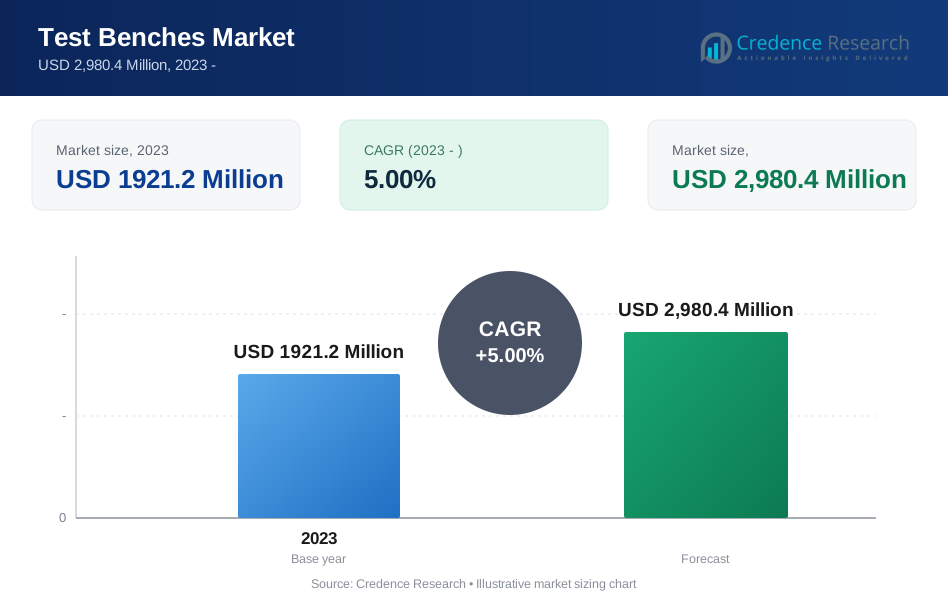
| Test Benches Market Size 2023 | USD 1921.2 Million |
| Test Benches Market, CAGR | 5.00% |
| Test Benches Market Size 2032 | USD 2980.4 Million |
Market Insights
- The Test Benches Market attained a valuation of USD 1921.2 Million in 2023 and is anticipated to escalate to USD 2980.4 Million by 2032, exhibiting a robust CAGR of 5.00% during the forecast period from 2024 to 2032.
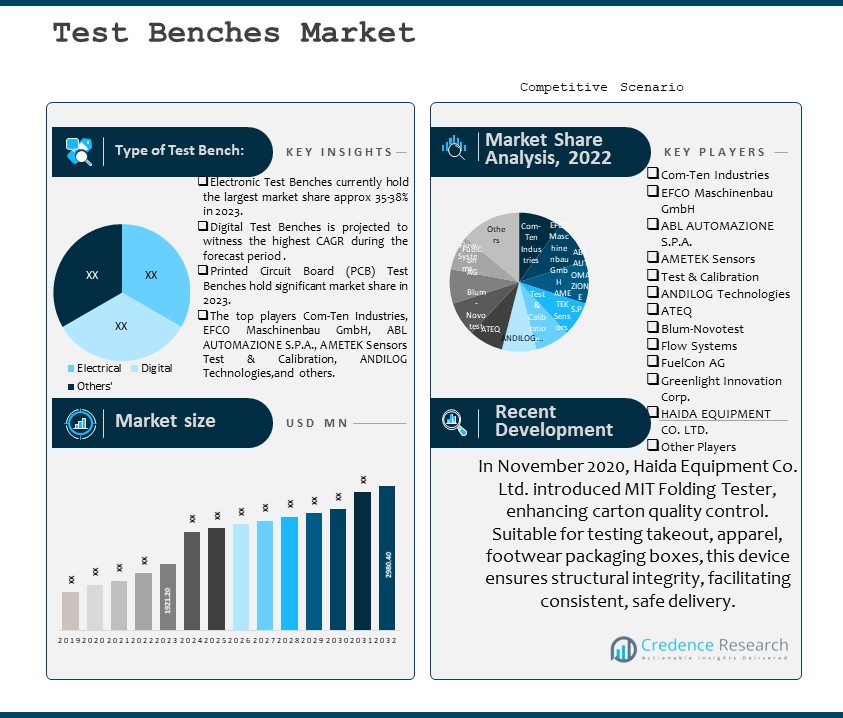
- Among the key segments, Electronic Test Benches emerged as the market leader by type, constituting approximately 35-38% of the total market share in 2023. However, Digital Test Benches are projected to witness the highest CAGR during the forecast period.
- Electronics and Semiconductor currently hold the largest market share approx 25-28% in 2023 due to heavy R&D investments, technological advancements, and growing applications in many sectors such as AI, IoT, robotics etc. Construction and Infrastructure are projected to witness the highest CAGR during the forecast period due to digital transformation, smart cities initiatives, and rise in investment in infrastructure sector.
- Component Testing currently holds the largest market share approx 25-30% in 2023 owing to reliability and performance. Research and Development (R&D) Testing is projected to witness the highest CAGR during the forecast period. This increase is driven by the ever-increasing capacity for innovation, customization and growth in many industries.
- Automated Test Benches currently hold the largest market share approx 35-38% in 2023 due to factors such as increased productivity, reduced human error, greater accuracy and increased safety compared to manual alternatives.
- Modular Test Benches currently hold the largest market share approx 45-50% in 2023 owing to their inherent flexibility, design, scalability, ease of integration, and compatibility with a wide range of accessories and modules.
- Asia Pacific held the largest share around 38-42% of the market in 2023. North America and Europe collectively account for just under 55% share in 2023.
- The increasing adoption of automation and digitization in the manufacturing industry, increases in R&D expenditures by private companies and the public sector, and rapid urbanization are also contributing to the market growth.
- Key opportunities in the market include the adoption of various strategies among market players, expansion of applications in emerging industries such as renewable energy and telecommunications, and increasing attention to product reliability and performance.
Executive Summary
Market Definition
Test benches An engineer defines test programs to test the performance, reliability, and compatibility of specific products, devices, or entire systems before use. Typically, software suites and hardware platforms are included, test benches ensure to be easily integrated, facilitates analysis, assures and delivers compatibility with desired business processes. Test benches span a wide range of applications, from testing electronic circuits, devices, batteries, engines, and fluid systems to complex systems involving robotics, telecommunications systems, or IoT ecosystems validating systems. Key considerations that govern the selection and use of a test bench include precision, repeatability, accuracy, ease of use, scalability, affordability, and repairability. Modern testing benches tend to adopt a modular design, allowing users to change their roles according to the constant evolution of technology and the needs of the business. Because of its critical importance in setting up systems and securing financial investments, test benches are central to virtually every engineering discipline, crossing boundaries in academia, research firms, and industry and reliable allies in reducing la continue to test benches in form.
Market Overview
The Test Benches Market has exhibited steady growth and is anticipated to maintain a robust Compound Annual Growth Rate (CAGR) of 5.00% from 2024 to 2032. Valued at USD 1921.2 million in 2023, this market is forecasted to reach USD 2980.4 million by 2032.
Among the primary segments, Electronic Test Benches emerged as the dominant segment by type, comprising approximately 35-38% of the total market share in 2023. However, Digital Test Benches are expected to witness the highest CAGR over the forecast period, driven by the proliferation of IoT devices, autonomous vehicles, and wireless communication technologies.
Electronics and Semiconductor currently hold the largest market share approx 25-28% in 2023, attributed to substantial R&D investments, technological advancements, and widespread applications across industries such as AI, IoT, and robotics. On the other hand, Construction and Infrastructure are projected to witness the highest CAGR during the forecast period, fueled by digital transformation initiatives and increased investment in infrastructure projects.
Component Testing stands out as the leading application segment, holding approximately 25-30% of the market share in 2023, driven by the critical need for reliability and performance assessment. Research and Development (R&D) Testing, however, is anticipated to experience the highest CAGR during the forecast period, fueled by continuous innovation and customization demands across various industries.
In terms of technology, Automated Test Benches currently dominate the market with a share of approximately 35-38% in 2023, owing to factors such as enhanced productivity, reduced human error, and increased safety compared to manual alternatives. Nevertheless, Portable Test Benches are projected to witness the highest CAGR during the forecast period, driven by their advantages in portability, flexibility, and cost-effectiveness.
Regionally, Asia Pacific held the largest market share around 38-42% in 2023, buoyed by growing economies, high infrastructure and manufacturing growth, and favorable government policies promoting regional manufacturing. North America and Europe collectively accounted for just under 55% share in 2023, with North America leading in terms of market share.
The burgeoning adoption of automation and digitization in the manufacturing industry, coupled with increasing R&D expenditures by both private and public sectors, contributes significantly to the market growth. Additionally, rapid urbanization further fuels demand for test benches across various industries, consolidating the market's position globally..
Segmentation by Type of Test Bench
- Electronic Test Benches currently hold the largest market share approx 35-38% in 2023 due to its widespread use in industries such as automotive, consumer electronics, telecommunications, healthcare for testing electronic products, devices and systems.
- Digital Test Benches is projected to witness the highest CAGR during the forecast period due to IoT devices, autonomous vehicles, wireless communication technologies and manufacturing.
Segmentation by End-Use Industry
- Electronics and Semiconductor currently hold the largest market share approx 25-28% in 2023 due to heavy R&D investments, technological advancements, and growing applications in many sectors such as AI, IoT, robotics etc.
- Construction and Infrastructure is projected to witness the highest CAGR during the forecast period due to digital transformation, smart cities initiatives, and rise in investment in infrastructure sector.
Segmentation by Application
- Component Testing currently hold the largest market share approx 25-30% in 2023 owing to reliability and performance.
- Research and Development (R&D) Testing is projected to witness the highest CAGR during the forecast period. This increase is driven by the ever-increasing capacity for innovation, customization and growth in many industries.
Segmentation by Technology
- Automated Test Benches currently hold the largest market share approx 35-38% in 2023 due to factors such as increased productivity, reduced human error, greater accuracy and increased safety compared to manual alternatives.
- Portable Test Benches is projected to witness the highest CAGR during the forecast period due to the advantages of portability, flexibility, convenience, and lower cost compared to permanent counterparts.
Segmentation by Product Type
- Modular Test Benches currently hold the largest market share approx 45-50% in 2023 owing to their inherent flexibility, design, scalability, ease of integration, and compatibility with a wide range of accessories and modules.
- Customized Test Benches hold significant share approx 15-18% in 2023 owing to continuous technological evolution and customization.
Segmentation by Region
- Asia Pacific held largest share around 38-42% of the market in 2023. This is owing to growing economies, high growth in infrastructure and manufacturing, favorable government policies promoting regional manufacturing contributed to the market growth.
- North America and Europe collectively account for just under 55% share in 2023, with North America holding over 20% share in the same year.
- The rest of the world, including Latin America, the Middle East, and Africa, supplies the remaining demand for Test Benches.
Increasing adoption of automation and digitization in the manufacturing industry, increases in R&D expenditures by private companies and the public sector, and rapid urbanization are also contributing to the market growth.
Asia Pacific region holds the largest market share in the Test Benches market. The growing emerging economies of China, India, Japan, South Korea, Taiwan, and other countries are fueling manufacturing growth. As a result, the increasing number of factories and manufacturing facilities directly translates into greater demand for test benches, solidifying the company’s grip on the market leadership. However, Asia-Pacific governments actively promote the interdependence of domestic manufacturing and industrial ecosystems through the use of friendly policies and subsidies. For instance, in January2024, India's Union Cabinet authorized the MoU between India and the EU focusing on semiconductors. This collaboration aims to create a robust supply chain, encourage shared knowledge, spark joint R&D ventures, cultivate talents, guarantee fairness, and ultimately propel technological breakthroughs in the chip sector. This partnership aims to enhance talent development and ensure fairness, ultimately leading to technological advancements in the chip industry, thereby positively impacting the APAC test bench market. Moreover, disruptive technologies such as artificial intelligence, machine learning, Internet of Things, robotics, autonomous vehicles, electric vehicle charging stations, smart grids, energy generation of new systems and the emergence of advanced wireless communication systems are alsoc contributed to the test bench market.
Europe hold significant market share of the global Test Benches market. One reason is the strict EU emissions rules, which mandate vehicle manufacturers to utilize advanced testing equipment for compliance. Additionally, Europe has robust automotive industry, where manufacturers need test benches for quality assurance and performance testing of vehicles and components. For instance, in April 2022, IAV expands high-voltage Test Benches for electric cars at its Chemnitz/Stollberg development center. Enhancing testing capacities, adding new HV pre-integration workstations (VIP) for software version backup and release, catering to growing customer demand for electric vehicle testing. Moreover, electronics European companies are also investing in R&D to launch new product to enhance test bench capabilities, and improve efficiency. For instance, in February 2023, Danisense introduces a new current transducer, DN1000ID, designed specifically for automotive (EV) test benches and battery testing. Ideal for easy cable fitting and fast changes in EV test environments.
Key Highlights of the Report
The Test Benches Market is segmented by Type of Test Bench, End-Use Industry, Application, Technology, Product Type and Region. The growing demand for test benches is propelled by factors such as increasing automation and digitization in manufacturing, rising R&D expenditures, and rapid urbanization, particularly in regions with high infrastructure and manufacturing growth.
Electronic Test Benches dominate the segment, offering versatile solutions for testing electronic products, devices, and systems across industries such as automotive, consumer electronics, and telecommunications. Component Testing holds a significant market share, emphasizing the importance of reliability and performance assessment in various applications.
One-way rentals are projected to witness the highest CAGR during the forecast period, driven by the need for flexible testing solutions that accommodate evolving technological requirements. Meanwhile, Research and Development (R&D) Testing is expected to experience the highest CAGR, reflecting continuous innovation demands across industries.
Automated Test Benches currently hold the largest market share, offering increased productivity, accuracy, and safety compared to manual alternatives. However, Portable Test Benches are projected to witness the highest CAGR, driven by their advantages in portability, flexibility, and cost-effectiveness.
Asia Pacific held the largest share of the test benches market, supported by growing economies, high infrastructure and manufacturing growth, and favorable government policies promoting regional manufacturing. North America and Europe collectively accounted for just under 55% share, with North America leading in terms of market share.
Key players like Com-Ten Industries, EFCO Maschinenbau GmbH, and ABL AUTOMAZIONE S.P.A. compete in the market, focusing on product innovation, distribution network expansion, and strategic alliances to maintain competitiveness. Collaborations and technological advancements contribute to Asia Pacific's leadership in the Test Benches Market, with major players expanding their offerings to meet diverse customer needs in the region.
What Are The Main Drivers Of The Global Test Benches Market?
The global Test Benches market is driven by stringent regulatory requirements in the automotive, aerospace and other industries that require thorough testing of products and systems along with reliable and quality products increased requirements for test bench adoption for quality assurance. Advances in technology and the need for efficient and accurate testing methods are fueling the growth of the market. In addition, the expansion of industries such as electronics and renewable energy is creating new opportunities for test bench applications.
What Are The Major Challenges Faced By The Global Test Benches Market?
The global Test Benches market is mainly challenged by complex and diverse testing requirements across industries, which require versatile and scalable test bench solutions. In addition, there are challenges to keep up with the changing requirements of rapid technological advances and evolving testing standards. The limited availability of skilled person for operating and maintaining sophisticated test bench equipment is another challenges which hinder the market growth.
What Are The Growth Opportunities In The Global Test Benches Market?
The global Test Benches market presents numerous growth opportunities due to expansion in applications in emerging industries such as renewable energy, electric vehicles and telecommunications, which drive specialized demand for test bench solutions. Furthermore, increasing attention to product reliability and performance is creating the need for advanced test equipment, creating opportunities for innovation and technical improvement coupled with the increasing outsourcing of testing services and the adoption of automated testing solutions. In addition, adoption of various strategies among market players makes significant opportunity for the market.
Market Drivers
The global Test Benches market is driven by several factors. The following are the key drivers of the global Test Benches market:
Increasing Launches Of EV Motor Test Benches
The global Test Benches market has significant growth, driven by the increasing launches of EV motor test benches. As the automotive industry transitions to electric propulsion, the number of test benches designed specifically for electric motor testing increases. This specialized test bench plays a key role in ensuring the performance, efficiency and durability of the EV motor, driving market growth. Various market players are adopting of various strategies including mergers & acquisitions, collaborations, funding, and new product launches, to cater the market demand. For instance, in September 2023, Nidec Advance Technology launched two new EV motor test benches: TDAS-1202P for motors up to 20,000 rpm & 700 Nm, and TDAS-2032P for E-Axles with built-in motor, gear, and inverter. Designed for external sales, these test benches improve performance evaluation capabilities in the EV traction motor unit.
Market Restraints
The global Test Benches market faces some challenges that may hinder its growth. These include the following:
Limited Availability Of Skilled Person
Limited availability of skilled person create challenges for Test Benches market. Lack of trained personnel skilled in operation and maintenance of test bench equipment is hampering the growth of the market. Without the right staff, companies struggle to successfully implement and sustain sophisticated testing solutions. This shortcoming impacts businesses that rely on test benches for quality assurance and regulatory compliance. To address this issue, it is necessary to invest in training programs to develop competent technicians who can maximize the potential of test bench technology. There is a need to unlock the full potential of the test bench market and bridge the skills gap to meet the testing needs of different industries.
Opportunities
The global Test Benches market offers significant growth opportunities. These include the following:
Adoption Of Various Strategies Among Market Players
The major companies serving the global Test Benches Market are Com-Ten Industries, Com-Ten Industries, EFCO Maschinenbau GmbH, ABL AUTOMAZIONE S.P.A., ZF, AMETEK Sensors Test & Calibration, ANDILOG Technologies, ATEQ, EFCO Maschinenbau GmbH, ABL AUTOMAZIONE S.P.A., AMETEK Sensors Test & Calibration, ANDILOG Technologies, ATEQ, among others. The market players are considerably contributing to the market growth by the adoption of various strategies including mergers & acquisitions, collaborations, funding, and new product launches, to stay competitive in the market. For instance, in April 2023, ZF introduced an upgraded e-mobility test bench, allowing comprehensive testing of electric drive axles, motors, and axle drives. The modular system features a drive module with an oil-cooled synchronous motor, offering versatility for single or multi-machine operation.
Competitive Landscape
Key Players
The global Test Benches market is highly competitive, with several key players. Some of the major players in the market and their market share are as follows:
- Com-Ten Industries
- EFCO Maschinenbau GmbH
- ABL AUTOMAZIONE S.P.A.
- AMETEK Sensors
- Test & Calibration
- ANDILOG Technologies
- ATEQ
- Blum-Novotest
- Flow Systems
- FuelCon AG
- Greenlight Innovation Corp.
- HAIDA EQUIPMENT CO. LTD
- Others
These organizations prioritize product innovation, distribution channel expansion, and mergers and acquisitions to stay competitive.
The global Test Benches market's key players continually seek to stay ahead by offering new products and developments.
In January 2023, ABB introduced latest L&W Bending Tester, simplifying paper testing with operator-neutral design, personalization, and digitalization options. New model eases laboratory tests, extends longevity, and improves precision in bend resistance and stiffness measurement through ABB data management integration.
In November 2020, Haida Equipment Co. Ltd. introduced MIT Folding Tester, enhancing carton quality control. Suitable for testing takeout, apparel, footwear packaging boxes, this device ensures structural integrity, facilitating consistent, safe delivery.
Summary of Key Findings
- The Test Benches Market is experiencing notable growth driven by increasing adoption across various industries such as automotive, electronics, and telecommunications. This growth is fueled by factors like the need for reliable testing solutions, technological advancements, and the expansion of manufacturing and R&D activities.
- Market segmentation encompasses various factors including type of test bench, end-use industry, application, technology, product type and region, reflecting the diverse requirements and applications of test benches across different sectors.
- Electronic Test Benches emerge as the predominant segment, providing versatile testing solutions for electronic products, devices, and systems. Research and Development (R&D) Testing is anticipated to witness significant growth, driven by the continuous demand for innovation and customization across industries.
- Asia Pacific holds the largest share of the market, driven by growing economies, infrastructure development, and favorable government policies supporting regional manufacturing. Major players like Com-Ten Industries, EFCO Maschinenbau GmbH, and ABL AUTOMAZIONE S.P.A. are competing in the market, focusing on innovation and strategic partnerships to maintain competitiveness.
Future Outlook
- The Test Benches Market presents promising growth opportunities, especially in regions like Asia Pacific where industrial growth and technological advancements drive demand for testing solutions. Anticipated challenges include evolving technological requirements and the need for skilled personnel.
- Strategies for maintaining competitiveness include continuous innovation, expanding market presence, and forming strategic collaborations to address evolving market demands and sustain growth in the dynamic Test Benches Market.
How CXOs Can Benefit from the Credence Research Test Benches Networks Market Report
The Credence Research Test Benches Networks Market Report provides CXOs with a comprehensive overview of the market, including:
- Market size and growth forecast:The report provides detailed estimates of the global Test Benches networks market size, segmented by type of test bench, end-use industry, application, technology, product type and region. It also includes forecasts for the market through 2032, based on key trends and drivers.
- Market segmentation:The report segments the Test Benches networks market by type of test bench, end-use industry, application, technology, product type and region. The increasing demand for advanced solutions is driven. This segmentation provides CXOs with a granular understanding of the market and the opportunities in each segment.
- Competitive landscape:The report profiles the key players in the Test Benches networks market and provides insights into their strategies, product offerings, and financial performance. This information can help CXOs to identify and assess their competition.
- Key trends and drivers:The report identifies and analyzes the key trends and drivers that are shaping the Test Benches networks market. This information can help CXOs to make informed decisions about their investments and strategies.
CXOs can use the insights from the Credence Research Test Benches Networks Market Report to:
- Identify growth opportunities:The report can help CXOs to identify new growth opportunities in the Test Benches networks market. For example, the report identifies the growing demand for Test Benches networks from cloud computing providers and telecom companies as a key opportunity.
- Make informed investment decisions:The report can help CXOs to make informed investment decisions about Test Benches networks. For example, the report provides insights into the key factors to consider when evaluating Test Benches providers and selecting Test Benches solutions.
- Develop competitive strategies:The report can help CXOs to develop competitive strategies for their Test Benches networks businesses. For example, the report identifies the key strategies that Test Benches providers are using to differentiate themselves from their competitors.
- Track market developments:The report can help CXOs to track market developments and stay ahead of the curve. For example, the report provides insights into the latest trends and innovations in the Test Benches networks market.
Overall, the Credence Research Test Benches Networks Market Report is a valuable resource for CXOs who are looking to gain a deeper understanding of the market and identify opportunities for growth.
Segmentation
- Type of Test Bench:
- Mechanical Test Benches
- Tensile Test Benches
- Compression Test Benches
- Fatigue Test Benches
- Torque Test Benches
- Impact Test Benches
- Others
- Electrical Test Benches
- Voltage Test Benches
- Current Test Benches
- Power Test Benches
- Insulation Test Benches
- Grounding Test Benches
- Others
- Electronic Test Benches
- Printed Circuit Board (PCB) Test Benches
- Semiconductor Test Benches
- Radio Frequency (RF) Test Benches
- Digital Test Benches
- Communication Test Benches
- Others
- Mechanical Test Benches
- End-Use Industry:
- Automotive
- Aerospace and Defense
- Electronics and Semiconductor
- Energy and Power
- Construction and Infrastructure
- Manufacturing
- Oil and Gas
- Telecommunications
- Medical Devices
- Research and Development (R&D) Laboratories
- Others
- Application:
- Component Testing
- System Testing
- Material Testing
- End-of-Line Testing
- Quality Control Testing
- Research and Development (R&D) Testing
- Certification Testing
- Others
- Technology:
- Hydraulic Test Benches
- Pneumatic Test Benches
- Electric Test Benches
- Manual Test Benches
- Automated Test Benches
- Portable Test Benches
- Benchtop Test Benches
- Customized Test Benches
- Others
- Product Type:
- Bench-mounted Test Benches
- Floor-standing Test Benches
- Modular Test Benches
- Portable Test Benches
- Benchtop Test Benches
- Customized Test Benches
- Others
- By Region
- North America
- The U.S.
- Canada
- Mexico
- Europe
- Germany
- France
- The U.K.
- Italy
- Spain
- Rest of Europe
- Asia Pacific
- China
- Japan
- India
- South Korea
- South-east Asia
- Rest of Asia Pacific
- Latin America
- Brazil
- Argentina
- Rest of Latin America
- Middle East & Africa
- GCC Countries
- South Africa
- Rest of Middle East and Africa
- North America
Adjacent Markets
In the Test Benches market, there are several adjacent markets which has high revenue growth opportunities. The key adjacent markets for Test Benches market -
Adjacent Markets |
||
| Test and Measurement Equipment Market | Electronics Testing Equipment Market | Semiconductor Testing Equipment Market |
| Automotive Testing Equipment Market | Energy Storage Testing Equipment Market | Industrial Automation Testing Equipment Market |
| Aerospace Testing Equipment Market | Renewable Energy Testing Equipment Market | Medical Device Testing Equipment Market |
Request a Free Sample
Fill in your details and we'll send you a free sample report.
- Sample data tables & charts
- Research methodology
Need a Custom Version of This Report?
Tailor the scope, geography, or segments to your exact requirements.
- Custom geography or segment scope
- Direct access to our analyst team
Frequently Asked Questions
What is the current size of the global Test Benches market?
What is the expected growth rate of the Test Benches market between 2024 and 2032?
Which segment is leading the market share in terms of Type of Test Bench?
Which End-Use Industry governs the demand for Test Benchess in the world?
Which Application segment is expected to post the highest CAGR during the forecast period?
Which region is fueling the growth of the Test Benches industry?
Who are the major players in the global Test Benches market?
What are the major market drivers of the Test Benches industry?
What are the major market restraints of the Test Benches industry?
What are the major market opportunities of the Test Benches industry?
Table of Content
Chapter 1. Report Introduction
- 1.1 Report Description & Purpose
- 1.1.1 Report Title & Market Definition
- 1.1.2 Unique Selling Propositions (USP) & Key Differentiators
- 1.1.3 Value Proposition for Stakeholders
- 1.2 Research Objectives
- 1.2.1 Market Sizing Objectives (Volume & Revenue)
- 1.2.2 Segmentation Objectives
- 1.2.3 Competitive Intelligence Objectives
- 1.2.4 Forecast & Scenario Objectives
- 1.3 Report Scope
- 1.3.1 Test Benches Scope – Types & Subtypes Covered
- 1.3.2 Geographic Scope – Regions & Countries Covered
- 1.3.3 Historical Period, Base Year & Forecast Period (2023; forecast to the forecast period)
- 1.3.4 Inclusions & Exclusions
- 1.4 HS Code & Classification Framework
- 1.5 Currency, Units & Pricing Basis
- 1.6 Target Stakeholders
- 1.7 Limitations & Assumptions
Chapter 2. Executive Summary
- 2.1 Global Test Benches Market Snapshot
- 2.1.1 Market Size – Historical (2023) & Forecast (the forecast period) (2023: USD 1921.2 Million → forecast year: USD 2,980.4 Million)
- 2.1.2 Volume & Revenue – Global Totals
- 2.1.3 Key Market Highlights – Top Five Facts
- 2.2 Test Benches Market Segmentation Snapshot
- 2.2.1 Market Split by Region – 2023 vs.
- 2.3 Competitive Snapshot
- 2.3.1 Top 10 Players by Revenue Share – 2023
- 2.3.2 Top 10 Players by Volume Share – 2023
- 2.3.3 Recent Strategic Developments (18-Month Summary)
- 2.4 Key Investment Highlights & Strategic Conclusions
Chapter 3. Test Benches Market Dynamics & Industry Analysis
- 3.1 Market Overview & Context
- 3.1.1 Test Benches Market Position in the Broader Automotive Value Chain
- 3.1.2 OEM vs. Replacement Market Dynamics
- 3.1.3 Market Maturity & Development Stage by Region
- 3.2 Test Benches Market Drivers
- 3.3 Test Benches Market Restraints & Challenges
- 3.4 Test Benches Market Opportunities
- 3.5 Porter's Five Forces Analysis
- 3.5.1 Threat of New Entrants
- 3.5.2 Bargaining Power of Suppliers
- 3.5.3 Bargaining Power of Buyers
- 3.5.4 Threat of Substitutes
- 3.5.5 Competitive Rivalry – Intensity Assessment
- 3.6 Test Benches Value Chain Analysis
- 3.6.1 Upstream – Raw Material/Input Suppliers
- 3.6.1.1 Raw Material/Input 1
- 3.6.1.2 Raw Material/Input 2
- 3.6.1.3 Raw Material/Input 3
- 3.6.2 Midstream – Production/Manufacturing/Service Delivery
- 3.6.2.1 Production/Process Overview
- 3.6.2.2 Key Facility Locations & Capacity by Manufacturer
- 3.6.3 Downstream – Distribution & End Consumer
- 3.6.3.1 Primary Channel – B2B/OEM
- 3.6.3.2 Secondary Channels – Dealer, Retail, Online, Direct
- 3.6.4 Value Chain Profitability Analysis
- 3.6.1 Upstream – Raw Material/Input Suppliers
- 3.7 PESTEL Analysis
- 3.7.1 Political Factors
- 3.7.2 Economic Factors
- 3.7.3 Social Factors
- 3.7.4 Technological Factors
- 3.7.5 Environmental Factors
- 3.7.6 Legal Factors
- 3.8 Test Benches Supply Chain Analysis
- 3.8.1 Raw Material/Input Supply Risk Assessment
- 3.8.2 Manufacturing Concentration Risk (Geographic Exposure)
- 3.8.3 Trade Disruption Impact Analysis
- 3.9 Regulatory & Policy Landscape
Note: The regulatory and policy landscape section covers regulations based on their applicability to the market, Test Benches category, geography, and scope of the study. Only regulatory frameworks with a material impact on operations, compliance, trade, sustainability, or market access are analyzed in detail.
Chapter 4. Key Investment Pockets & Opportunity Analysis
- 4.1 Test Benches Market Attractiveness Analysis
- 4.1.1 By Region – Investment Attractiveness Matrix (Volume × CAGR)
- 4.2 Absolute Revenue Growth Opportunity
- 4.2.1 By Region – Absolute USD Growth Through the forecast period
- 4.3 Incremental Volume Opportunity
- 4.3.1 By Region – Incremental Volume Through the forecast period
- 4.3.2 Segment – Incremental Volume
- 4.4 Emerging Submarket Opportunity Deep Dive (Subject to Applicability)
- 4.5 Emerging Market Opportunity Scorecards
- 4.5.1 United States
- 4.5.2 Europe
- 4.5.3 Asia
- 4.5.4 Middle East & Africa
Note: Emerging Market Opportunity Scorecards will be included based on relevance and strategic importance. Regions listed are indicative and may vary depending on data availability and market dynamics.
Chapter 5. Test Benches Import-Export Analysis & Trade Flows
- 5.1 Global Trade Overview
- 5.1.1 Global Export Value by Country (2023)
- 5.1.2 Global Export Volume by Country (2023)
- 5.1.3 Global Import Value by Country (2023)
- 5.1.4 Global Import Volume by Country (2023)
- 5.1.5 Net Trade Balance by Country (2023)
- 5.2 Export Analysis – Segment
- 5.2.1 Type 1 (HS Code)
- 5.2.2 Type 2 (HS Code)
- 5.2.3 Type 3 (HS Code)
- 5.2.4 Type 4 (HS Code)
- 5.2.5 Type 5 (HS Code)
- 5.3 Import Analysis – Segment
- 5.3.1 Type 1 (HS Code)
- 5.3.2 Type 2 (HS Code)
- 5.3.3 Type 3 (HS Code)
- 5.3.4 Type 4 (HS Code)
- 5.3.5 Type 5 (HS Code)
- 5.4 Average Unit Trade Prices
- 5.4.1 Average Export Price – Segment & Country
- 5.4.2 Average Import Price – Segment & Source Country
- 5.4.3 Price Trends (2023)
- 5.5 Key Trade Route Analysis
- 5.5.1 Trade Route 1
- 5.5.2 Trade Route 2
- 5.5.3 Trade Route 3
- 5.5.4 Trade Route 4
- 5.5.5 Trade Route 5
- 5.6 Trade Policy Impact Assessment
- 5.6.1 US Anti-Dumping & Section 301 Tariffs
- 5.6.2 EU Customs Union Impact
- 5.6.3 Major Free Trade Agreements
- 5.6.4 USMCA Rules of Origin
Note: Trade policy analysis will be included only where relevant to the Test Benches market.
Chapter 6. Competitive Landscape & Company Benchmarking
- 6.1 Test Benches Market Concentration & Structure
- 6.1.1 Herfindahl-Hirschman Index (HHI) – vs. 2023
- 6.1.2 Tier 1, Tier 2 & Tier 3 Market Structure
- 6.1.3 Global, Regional & Local Player Dynamics
- 6.2 Test Benches Market Share Analysis – 2023
- 6.2.1 Global Revenue Share by Company
- 6.2.2 Global Volume Share by Company
- 6.2.3 Regional Revenue Share
- 6.2.4 Market Share Evolution ( vs. 2023)
- 6.2.5 OEM Segment Share by Company
- 6.2.6 Replacement Segment Share by Company
- 6.3 Production/Delivery Capacity & Facility Analysis
- 6.3.1 Global Installed Capacity
- 6.3.2 Capacity Utilization Rates
- 6.3.3 Production/Output Volume
- 6.3.4 Facility Locations & Capacity Map
- 6.3.5 Planned Capacity Additions
- 6.4 Test Benches Competitive Benchmarking Matrix
- 6.4.1 Revenue, Volume, CAGR & Profitability Comparison
- 6.4.2 Channel Revenue Mix
- 6.4.3 Geographic Revenue Exposure
- 6.4.4 R&D Intensity
- 6.4.5 Sustainability Maturity
- 6.5 Strategic Developments in Test Benches (Last 24 Months)
- 6.5.1 Mergers, Acquisitions & Divestments
- 6.5.2 New Test Benches Launches
- 6.5.3 Facility Expansions
- 6.5.4 Strategic Alliances, Joint Ventures & Partnerships
- 6.5.5 Distribution Expansion & Market Entry
- 6.5.6 Sustainability & ESG Initiatives
- 6.6 Competitive Strategy Mapping
- 6.6.1 Leader, Challenger, Follower & Niche Classification
- 6.6.2 Pricing Strategy Comparison
- 6.6.3 Channel Strategy Matrix
Note: Strategic developments are included based on their materiality and the availability of reliable information.
Chapter 7. Global Test Benches Market – By Distribution Channel
- 7.1 Segment Overview
- 7.1.1 Volume & Revenue Split by Channel (2023 & )
- 7.1.2 Channel Mix Evolution (the forecast period)
Chapter 8. Regional Market Analysis – Global Overview
- 8.1 Global Regional Overview
- 8.1.1 Regional Volume Share
- 8.1.2 Regional Revenue Share
- 8.1.3 Regional Volume by Region
- 8.1.4 Regional Revenue by Region
- 8.1.5 Regional Forecast Through the forecast period
- 8.2 Cross-Regional Segment Analysis
- 8.2.1 By Distribution Channel
- 8.2.2 By Brand/Price Tier
Chapter 9. North America Test Benches Market
- 9.1 United States
- 9.2 Canada
- 9.3 Mexico
Chapter 10. Europe Test Benches Market
- 10.1 Germany
- 10.2 France
- 10.3 Italy
- 10.4 United Kingdom
- 10.5 Spain
- 10.6 Poland
- 10.7 Russia
- 10.8 Netherlands
- 10.9 Belgium
- 10.10 Sweden
- 10.11 Denmark
- 10.12 Norway
- 10.13 Rest of Europe
Chapter 11. Asia Pacific Test Benches Market
- 11.1 China
- 11.2 India
- 11.3 Japan
- 11.4 South Korea
- 11.5 Thailand
- 11.6 Indonesia
- 11.7 Vietnam
- 11.8 Malaysia
- 11.9 Australia
- 11.10 Rest of Asia Pacific
Chapter 12. Latin America Test Benches Market
- 12.1 Brazil
- 12.2 Argentina
- 12.3 Colombia
- 12.4 Chile
- 12.5 Rest of Latin America
Chapter 13. Middle East Test Benches Market
- 13.1 Saudi Arabia
- 13.2 United Arab Emirates
- 13.3 Turkey
- 13.4 Israel
- 13.5 Iran
- 13.6 Rest of the Middle East
Chapter 14. Africa Test Benches Market
- 14.1 South Africa
- 14.2 Egypt
- 14.3 Nigeria
- 14.4 Morocco
- 14.5 Rest of Africa
Chapter 15. Test Benches Company Profiles
- 15.1 [Company 01]
- 15.1.1 Company Overview
- 15.1.2 Key Management Personnel
- 15.1.3 Products & Services Portfolio
- 15.1.4 Financial Performance
- 15.1.5 Key Market Focus & Geographic Presence
- 15.1.6 Recent Developments & Strategic Initiatives
Note: The company profile list is preliminary and may change based on research findings, market developments, data availability, and client requirements.
Chapter 16. Appendices
- Appendix A – List of Abbreviations & Acronyms
- Appendix B – Industry Classification Code Reference – Full Series
- Appendix C – Production & Capacity Data Tables
- Appendix D – End-Use & Demand Base Tables
- Appendix E – Consumption & Replacement Rate Assumptions
- Appendix F – ASP Reference Tables
- Appendix G – Manufacturing & Facility Database
- Appendix H – Import-Export Data Tables
- Appendix I – Regulatory Summary Tables
- Appendix J – Primary Research Participant List (Anonymized)
- Appendix K – Primary Research Questionnaire Framework
- Appendix L – Data Sources & Bibliography
- Appendix M – Market Size Divergence & Source Comparison
Chapter 17. Research Methodology
- 17.1 Research Framework & Philosophy
- 17.2 Secondary Research – Sources, Hierarchy & Data Extraction
- 17.3 Data Modeling – Bottom-Up & Top-Down Market Sizing
- 17.4 Primary Research – Stakeholder Framework, LOI & Sample Sizes
- 17.5 Forecast Methodology – Regression, Scenario & Sensitivity Analysis
- 17.6 Quality Control – Four-Layer Validation Framework
- 17.7 Limitations & Standard Assumptions
- 17.8 Disclaimer
