
Market overview
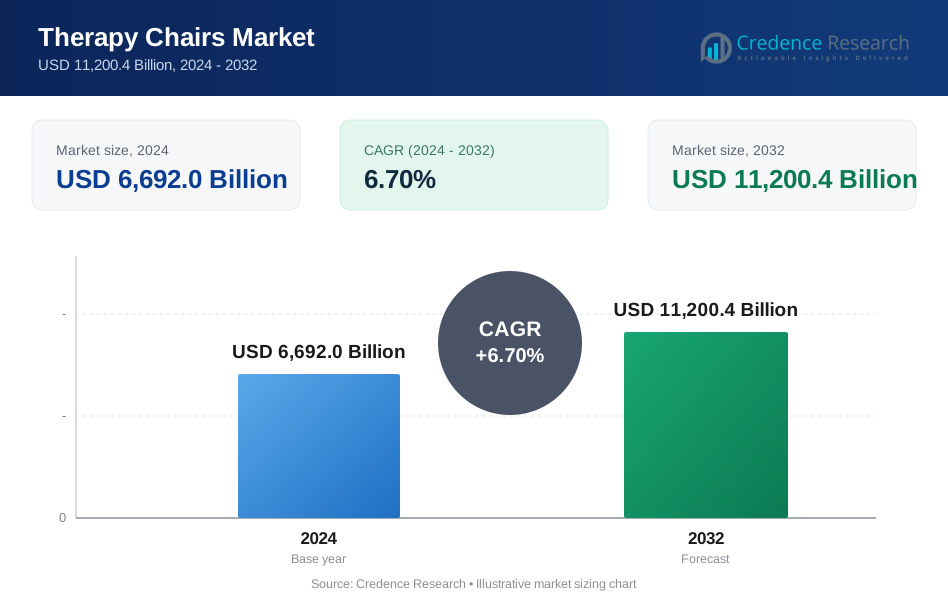
The Global Therapy Chair Market was valued at USD 4,673.9 Billion in 2018, growing to USD 6,692.0 Billion in 2024, and is anticipated to reach USD 11,200.4 Billion by 2032, at a CAGR of 6.70% during the forecast period.
| REPORT ATTRIBUTE | DETAILS |
|---|---|
| Historical Period | 2020-2023 |
| Base Year | 2024 |
| Forecast Period | 2025-2032 |
| Therapy Chair Market Size 2024 | USD 6,692.0 Billion |
| Therapy Chair Market, CAGR | 6.70% |
| Therapy Chair Market Size 2032 | USD 11,200.4 Billion |
The Global Therapy Chair Market is dominated by key players such as Bionic Medizintechnik, LiKAMED GmbH, Fresenius Medical Care, Midmark Corporation, Baxter International, Inc., and Stryker Corporation. These companies lead the market by offering innovative therapy chairs designed for specialized treatments like dialysis, chemotherapy, and recovery care. North America holds the largest market share at 25.7%, driven by its advanced healthcare infrastructure and growing elderly population. Europe follows with a share of 26.5%, fueled by strong healthcare systems and regulatory standards. Asia Pacific, holding a significant 28.3% market share, is expanding rapidly due to urbanization and improving healthcare access in countries like China and India. These regions are witnessing increased demand for ergonomic, electric, and customizable therapy chairs, driving growth across the sector. The market is further supported by strategic partnerships and innovations from leading companies.

Market Insights
- Global Therapy Chair Market size stood at USD 6,692.0 Billion in 2024 and is projected to reach USD 11,200.4 Billion by 2032 at a CAGR of 6.70%.
- The rising prevalence of chronic diseases and expanding home‑care services drive demand for advanced therapy chairs across segments like dialysis chairs (39.8 % share), electric function models (42.0 % share) and long‑duration treatments (40.1 % share).
- Key trends include increasing adoption of eco‑friendly designs, customization for patient comfort, and integration of smart/automated features by leading manufacturers.
- Restraints involve high costs of premium therapy chairs and complex compliance/regulatory requirements that slow product launches and widen cost‑pressure in emerging markets.
- North America commands 25.7 % share, Europe 26.5 %, Asia Pacific 28.3 %, Latin America 5.7 %, Middle East 2.2 % and Africa 1.9 %, with Asia Pacific poised for fastest growth amid improving infrastructure.
Market Segmentation Analysis:
By Product Type
In the Global Therapy Chair market, the dialysis chairs segment currently holds the dominant share at 39.8 %. This leadership is driven by the rising prevalence of chronic kidney disease and end‑stage renal disease, which has spurred the expansion of dialysis centres globally. These facilities prioritise high‑throughput equipment, and specialised dialysis chairs with enhanced ergonomic and safety features have become standard. As a result, manufacturers richly focus their R&D and marketing efforts on this sub‑segment to address patient comfort during lengthy treatments, thereby reinforcing its market dominance.
- For instance, Fresenius Medical Care introduced its 6008 CAREsystem, which optimises dialysis workflows while integrating compatibility with ergonomic treatment chairs to enhance patient comfort during extended sessions.
By Function
Within the function segmentation of the therapy chair market, the electric chairs sub‑segment leads with 42.0 % share according to comparable medical‑chair industry data. The preference for electric models is supported by healthcare providers’ push for advanced, motorised systems that enable precise adjustment, enhanced patient comfort, and operational efficiencies. Electric chairs reduce manual handling, shorten turnaround times, and meet stringent infection‑control standards, making them particularly attractive in hospital and high‑volume care settings. Growing automation and digital integration further strengthen this segment’s appeal.
- For instance, MOTOmed’s Letto2 system integrates electric mobility and therapy functions for bedridden patients, reducing strain on caregivers.
By Application
When segmented by application, the long‑duration treatments sub‑segment emerges as the dominant category, accounting for close to 40.1 % of the market in analogous specialty medical chairs research and serving as a reasonable proxy here. The high share stems from increased demand for therapy chairs in settings such as dialysis, oncology infusion, and prolonged recovery care. These scenarios require chairs designed for extended patient occupancy, with features for repositioning, comfort over time and support of monitoring devices. The surge in chronic illness incidence and extended procedure durations underpins this segment's strong growth trajectory.
Key Growth Drivers
Rising Prevalence of Chronic Diseases
The increasing prevalence of chronic diseases, including kidney failure, cancer, and neurological disorders, is driving the demand for therapy chairs in healthcare settings. As the global population ages and the incidence of these conditions rises, particularly in developed nations, the need for long-duration treatments like dialysis, chemotherapy, and other infusion therapies is intensifying. This has led to a surge in demand for comfortable, functional therapy chairs that can support patients through extended treatments, providing both therapeutic benefits and ease of use for healthcare professionals.
- For instance, Z&Z Medical has developed a Dialysis Chemotherapy Chair that combines ergonomic design with durable construction to support extended treatment sessions comfortably, allowing multiple adjustable positions for both patient and provider convenience.
Technological Advancements in Medical Equipment
Technological innovations in therapy chairs, such as electric adjustments, customizable features, and integration with healthcare monitoring systems, are significantly boosting market growth. Modern therapy chairs are increasingly equipped with automated functionalities that enhance patient comfort, improve safety, and reduce staff workload. Features like adjustable heights, tilt functions, and ergonomic designs ensure better patient care during prolonged treatments. As medical technology evolves, therapy chairs continue to incorporate cutting-edge materials and smart technology, making them more efficient and versatile, which in turn fuels demand across various medical applications.
- For instance, the Comfort Line 2 Therapy Chair features five actuators enabling smooth and precise electric adjustments of the back, foot, seat, and height, equipped with an innovative armrest that springs back for patient safety and is intuitive for healthcare staff to use.
Growth in Healthcare Infrastructure and Home Care
The expansion of healthcare infrastructure, particularly in emerging economies, is contributing to the demand for therapy chairs. New hospitals, outpatient clinics, and rehabilitation centres require specialized medical furniture to accommodate growing patient populations. Additionally, the shift towards home care, where patients undergo treatments such as dialysis and chemotherapy in the comfort of their homes, has increased the need for compact, versatile therapy chairs. Homecare services are adopting these solutions to offer greater patient comfort and facilitate longer treatment durations, driving growth in both medical facilities and at-home care markets.
Key Trends & Opportunities
Sustainability and Eco-friendly Designs
There is a growing trend toward sustainability in the global therapy chair market. With increasing awareness about environmental impact, healthcare providers are prioritizing eco-friendly products that use sustainable materials and energy-efficient systems. Manufacturers are focusing on developing chairs that use recyclable materials, low-impact manufacturing processes, and energy-efficient electric motors. This shift towards sustainability aligns with broader healthcare industry efforts to reduce carbon footprints and support green initiatives. The demand for eco-conscious products creates a significant growth opportunity for companies that can meet these evolving sustainability standards.
- For instance, Resol has developed its Green Edition line of ecological chairs using 100% recycled and recyclable plastic injection techniques, certified to ISO 14001 and ISO 14006 standards, ensuring a minimal environmental impact throughout the product lifecycle.
Rising Demand for Personalized Patient Comfort
As patients’ comfort becomes a focal point in healthcare, there is a rising demand for therapy chairs that can be personalized to individual needs. Customizable features such as temperature control, adjustable positioning, and memory foam cushioning are increasingly in demand to enhance patient experience, particularly for long-duration treatments. These personalized chairs improve patient satisfaction and compliance with medical treatments. Healthcare providers are looking for solutions that not only cater to clinical needs but also enhance patient well-being, making personalized therapy chairs a lucrative opportunity for manufacturers.
- For instance, the Collini Electric Treatment Chair Comfort-line Sense offers an advanced heating system with two adjustable levels and a memory function that stores preferred positions, providing tailored comfort for each patient.

Key Challenges
High Cost of Advanced Therapy Chairs
One of the major challenges facing the therapy chair market is the high cost of advanced models, particularly those with electric functionalities and customizable features. These chairs require significant investment from healthcare providers, and the high initial cost can be a barrier, especially in low- and middle-income countries. While the value of these chairs in enhancing patient comfort and care is clear, the price remains a point of contention for many hospitals and clinics with constrained budgets. Manufacturers must find ways to balance advanced features with affordability to expand their customer base.
Regulatory and Compliance Issues
The therapy chair market is subject to strict regulatory standards and compliance requirements, which can pose significant challenges for manufacturers. The need to adhere to various safety standards, medical certifications, and health regulations across different regions can delay product launches and increase operational costs. These regulations, while necessary to ensure patient safety, create an additional burden for companies striving to bring innovative products to market. Navigating these regulatory frameworks efficiently is crucial for companies aiming to expand globally while maintaining product quality and compliance.
Regional Analysis
North America
North America holds a dominant market share of 25.7% in the Global Therapy Chair Market. The market value was USD 1,080.15 Billion in 2018 and is projected to reach USD 1,565.73 Billion in 2024, growing at a CAGR of 6.9%. By 2032, the market is expected to expand to USD 2,663.46 Billion. The region’s leadership is driven by advanced healthcare infrastructure, the rising elderly population, and an increasing need for therapy chairs in specialized treatments like dialysis and oncology. The demand for home care services and rehabilitation centers further supports this growth, ensuring North America's continued strong position in the market.
Europe
Europe holds a significant share of the Global Therapy Chair Market, contributing 26.5% of the total market value. With a market size of USD 1,277.85 Billion in 2018, it is expected to reach USD 1,794.60 Billion by 2024, at a CAGR of 6.3%, and is projected to grow to USD 2,925.54 Billion by 2032. The region benefits from an aging population, strong healthcare systems, and rising demand for therapy chairs in dialysis, oncology, and rehabilitation. Regulatory standards and a focus on eco-friendly solutions are influencing trends, driving market expansion. The UK, Germany, and France remain key markets for therapy chair adoption.
Asia Pacific
Asia Pacific holds a market share of 28.3% in the Global Therapy Chair Market, with a value of USD 1,625.59 Billion in 2018. By 2024, the market is expected to grow to USD 2,333.78 Billion, reflecting a CAGR of 6.7%. By 2032, the market is projected to reach USD 3,920.14 Billion. Rapid urbanization, increasing healthcare access, and a growing elderly population are fueling demand for therapy chairs in the region. China, India, and Japan are key contributors, with rising chronic disease incidence and improvements in healthcare infrastructure supporting the region’s strong growth outlook.
Latin America
Latin America accounts for 5.7% of the Global Therapy Chair Market, with a market value of USD 405.23 Billion in 2018. The market is expected to grow to USD 590.23 Billion by 2024, at a CAGR of 7.0%, and is projected to reach USD 1,010.28 Billion by 2032. The region's growing demand for therapy chairs is driven by improving healthcare infrastructure, a rising elderly population, and increasing chronic disease awareness. Major markets like Brazil and Mexico are seeing substantial investments in healthcare, with home care and rehabilitation services contributing to the market’s expansion.
Middle East
The Middle East holds a smaller yet rapidly growing share of approximately 2.2% of the Global Therapy Chair Market. The market was valued at USD 150.97 Billion in 2018 and is expected to reach USD 223.89 Billion by 2024, growing at a CAGR of 7.3%. By 2032, the market is projected to expand to USD 392.01 Billion. The region’s market growth is driven by increasing investments in healthcare infrastructure, particularly in GCC countries, and the growing demand for specialized therapy chairs in dialysis and oncology. The rise in elderly populations and government healthcare initiatives will support further market development.
Africa
Africa holds a market share of 1.9% in the Global Therapy Chair Market, valued at USD 134.14 Billion in 2018. By 2024, the market is projected to reach USD 183.74 Billion, growing at a CAGR of 5.9%, and is expected to reach USD 288.97 Billion by 2032. Africa’s market growth is fueled by expanding healthcare infrastructure and rising chronic disease prevalence. Key markets in South Africa and Egypt are seeing growth, driven by increased access to medical equipment and the expansion of healthcare facilities. However, economic constraints in certain regions may limit the market's growth potential in the near term.

Market Segmentations:
By Product Type
- Dialysis Chairs
- Oncology / Chemotherapy / Infusion Chairs
- Patient Recliners / Recovery Chairs
- Other Specialty Chairs
By Function
- Electric
- Manual
By Application
- Long-Duration Treatments
- Short-Duration Procedures
- Rehabilitation & Positioning
By End User
- Hospitals
- Clinics
- Rehabilitation Centers
- Blood Banks & Donation Centers
- Others
By Geography
- North America
- U.S.
- Canada
- Mexico
- Europe
- Germany
- France
- U.K.
- Italy
- Spain
- Rest of Europe
- Asia Pacific
- China
- Japan
- India
- South Korea
- South-east Asia
- Rest of Asia Pacific
- Latin America
- Brazil
- Argentina
- Rest of Latin America
- Middle East & Africa
- GCC Countries
- South Africa
- Rest of the Middle East and Africa
Competitive Landscape
The Global Therapy Chair Market is highly competitive, with key players such as Bionic Medizintechnik, LiKAMED GmbH, Fresenius Medical Care, Midmark Corporation, Baxter International, Inc., and Stryker Corporation leading the market. These companies dominate the market through a combination of innovative product offerings, strategic partnerships, and extensive distribution networks. As the demand for specialized therapy chairs continues to rise, especially in long-duration treatment settings such as dialysis and oncology, these players are increasingly focusing on advanced features such as ergonomic designs, electric functionalities, and integration with healthcare monitoring systems. Furthermore, they are expanding their market presence through collaborations, acquisitions, and entry into emerging markets. The competition is intensifying with the entry of new players offering cost-effective solutions, while established companies are enhancing their R&D capabilities to meet evolving customer needs. The market is also seeing growth in eco-friendly and sustainable therapy chair options, responding to rising consumer preferences for environmentally conscious products.
Key Player Analysis
- Bionic Medizintechnik
- LiKAMED GmbH
- Fresenius Medical Care
- Midmark Corporation
- Baxter International, Inc.
- Stryker Corporation
- Winco
- Lojer Group
- LPA Medical
- Other Key Players
Recent Developments
- In August 2023, Nakanishi Inc. acquired DCI International, a leading U.S. dental chair manufacturer, expanding its specialty medical chair portfolio and strengthening its presence in the American market.
- In June 2023, A-dec Inc. introduced its digitally connected A-dec 500 Pro and A-dec 300 Pro chairs, integrating cutting-edge connectivity features to enhance patient care and operational efficiency in specialty medical chairs, which also relates to therapy chair innovations.
Report Coverage
The research report offers an in-depth analysis based on Product Type, Function, Application, End User and Geography. It details leading market players, providing an overview of their business, product offerings, investments, revenue streams, and key applications. Additionally, the report includes insights into the competitive environment, SWOT analysis, current market trends, as well as the primary drivers and constraints. Furthermore, it discusses various factors that have driven market expansion in recent years. The report also explores market dynamics, regulatory scenarios, and technological advancements that are shaping the industry. It assesses the impact of external factors and global economic changes on market growth. Lastly, it provides strategic recommendations for new entrants and established companies to navigate the complexities of the market.
Future Outlook
- The demand for therapy chairs is expected to increase due to the rising prevalence of chronic diseases like kidney failure and cancer, driving the need for specialized treatment chairs in dialysis and oncology settings.
- Technological advancements, such as electric adjustments, smart monitoring, and ergonomic designs, will continue to shape the future of therapy chairs, enhancing patient comfort and operational efficiency.
- The expansion of home care services will boost the demand for compact, easy-to-use therapy chairs that can be utilized in residential settings for long-duration treatments.
- The increasing elderly population worldwide will drive demand for therapy chairs designed to cater to age-related medical conditions, including mobility issues and long-term care.
- A growing emphasis on sustainability and eco-friendly materials will lead to the development of greener, energy-efficient therapy chairs in response to environmental concerns.
- Emerging markets in Asia Pacific and Latin America are expected to see significant growth, driven by improving healthcare infrastructure and rising healthcare expenditures.
- The shift toward outpatient care and rehabilitation centers will increase the need for specialized therapy chairs for shorter-duration treatments and recovery.
- Partnerships and collaborations between therapy chair manufacturers and healthcare providers will help expand the availability of advanced products in underserved regions.
- The integration of artificial intelligence and automation into therapy chairs for better patient monitoring and real-time adjustments will drive innovation in the market.
- As healthcare regulations and standards become more stringent, therapy chair manufacturers will focus on meeting these requirements to ensure market compliance and patient safety.
Request a Free Sample
Fill in your details and we'll send you a free sample report.
- Sample data tables & charts
- Research methodology
Market Dynamics
Rising Prevalence of Chronic Diseases
The increasing incidence of chronic conditions such as kidney failure, cancer, and neurological disorders is driving demand for therapy chairs, particularly for long-duration treatments like dialysis and chemotherapy. As populations age and chronic disease rates climb, healthcare facilities require more specialized seating solutions to support patient comfort and care.
Technological Advancements in Therapy Chairs
Innovations such as electric adjustments, smart monitoring integration, and ergonomic designs are making therapy chairs more comfortable, efficient, and safer for both patients and healthcare providers. These advancements reduce staff workload, improve patient outcomes, and are a key factor in the market's growth.
Expansion of Healthcare Infrastructure and Home Care
Emerging economies are investing in new hospitals, clinics, and rehabilitation centers, increasing the need for advanced therapy chairs. Additionally, the shift toward home-based care for chronic treatments is boosting demand for compact, versatile chairs suitable for residential use.
Focus on Sustainability and Eco-Friendly Designs
Healthcare providers and manufacturers are increasingly prioritizing eco-friendly therapy chairs made from sustainable materials and energy-efficient systems. This trend is driven by regulatory pressures and consumer demand for greener healthcare solutions, opening new growth opportunities for innovative manufacturers.
Personalization and Enhanced Patient Comfort
There is a growing emphasis on therapy chairs that can be customized to individual patient needs, such as adjustable positioning, temperature control, and memory foam cushioning. Enhanced comfort features improve patient satisfaction and compliance, especially for those undergoing lengthy treatments.
Need a Custom Version of This Report?
Tailor the scope, geography, or segments to your exact requirements.
- Custom geography or segment scope
- Direct access to our analyst team
Frequently Asked Questions
What is the current market size for the Global Therapy Chair Market, and what is its projected size in 2032?
At what Compound Annual Growth Rate is the Global Therapy Chair Market projected to grow between 2025 and 2032?
Which Global Therapy Chair Market segment held the largest share in 2024?
Who are the major players in this market?
What are the primary factors fueling the growth of the Global Therapy Chair Market?
Who are the leading companies in the Global Therapy Chair Market?
Table of Content
Chapter 1 Market Segmentation
- 1.1 Segmentation Framework
- 1.1.1 Product and Service Classification
- 1.1.2 Application and End-Use Classification
- 1.1.3 Technology and Solution Classification
- 1.1.4 Customer and Distribution Channel Classification
- 1.1.5 Geographic Segmentation
- 1.1.6 Market Segment Definitions and Boundaries
- 1.2 By End User
- 1.2.1 Hospitals
- 1.2.2 Clinics
- 1.2.3 Rehabilitation Centers
- 1.2.4 Blood Banks & Donation Centers
- 1.2.5 Others
- 1.3 By Function
- 1.3.1 Electric
- 1.3.2 Manual
- 1.4 By Application
- 1.4.1 Long-Duration Treatments
- 1.4.2 Short-Duration Procedures
- 1.4.3 Rehabilitation & Positioning
- 1.5 By Product Type
- 1.5.1 Dialysis Chairs
- 1.5.2 Oncology / Chemotherapy / Infusion Chairs
- 1.5.3 Patient Recliners / Recovery Chairs
- 1.5.4 Other Specialty Chairs
Chapter 2 Introduction
- 2.1 Report Objectives and Scope
- 2.2 Product Definition and Industry Terminology
- 2.3 Market Inclusions and Exclusions
- 2.4 Research Process
- 2.4.1 Primary Research and Expert Interviews
- 2.4.2 Secondary Research and Source Review
- 2.4.3 Top-Down and Bottom-Up Estimation
- 2.4.4 Data Triangulation and Verification
- 2.5 Market Size Measurement Basis
- 2.5.1 2024: USD 6,692.0 Billion → 2032: USD 11,200.4 Billion
- 2.6 Historical and Forecast Reference Periods
- 2.6.1 Base Year: 2024
- 2.6.2 Forecast Period: 2024-2032
- 2.7 Research Assumptions and Limitations
Chapter 3 Executive Summary
- 3.1 Market Snapshot and Key Findings
- 3.2 Base-Year Market Size, 2024
- 3.3 Forecast Market Size, 2032
- 3.4 Revenue and Volume Growth Outlook
- 3.5 Key Demand and Supply Indicators
- 3.6 Leading Market Segments
- 3.7 Fastest-Growing Market Opportunities
- 3.8 Regional Performance Highlights
- 3.9 Technology and Industry Transformation
- 3.10 Competitive Landscape Summary
- 3.11 Analyst View and Strategic Implications
Chapter 4 Global Therapy Chairs Market Trends and Developments
- 4.1 Historical Industry Development
- 4.2 Recent Market Trends and Developments
- 4.3 Demand and Customer Behavior Trends
- 4.4 Technology and Product Innovation
- 4.5 Artificial Intelligence, Automation and Digitalization
- 4.6 Local Manufacturing and Supply Chain Realignment
- 4.7 Industry Partnerships, Mergers and Acquisitions
- 4.8 Sustainability and Circular Economy Developments
- 4.9 Government and Private Sector Investment Trends
- 4.10 Emerging Business Models and Commercialization
- 4.11 Industry Developments and Announcements
Chapter 5 Global Therapy Chairs Market Production, Supply and Demand Analysis
- 5.1 Demand Trend and Consumption Analysis
- 5.2 Demand Forecast, 2024-2032
- 5.3 Production and Output Trend
- 5.4 Production and Output Forecast, 2024-2032
- 5.5 Installed Capacity and Capacity Utilization
- 5.6 Company-Wise Production Plants and Statistics
- 5.6.1 Installed Production Capacity
- 5.6.2 Actual Production
- 5.6.3 Planned Capacity and Expansion Targets
- 5.7 Supply Chain Structure and Procurement Trends
- 5.8 Supply-Demand Gap and Bottlenecks
- 5.9 Import Dependence and Sourcing Structure
- 5.10 Contract Manufacturing and Outsourcing
- 5.11 Regional Supply and Demand Concentration
Chapter 6 Global Therapy Chairs Market Pricing Analysis
- 6.1 Pricing Structure and Measurement
- 6.2 Historical Pricing Trends
- 6.3 Pricing Outlook, 2024-2032
- 6.4 Average Selling Price and Unit Economics
- 6.5 Pricing by Product and Market Segment
- 6.6 Geographic Pricing Differences
- 6.7 Key Input, Energy, Labor and Logistics Costs
- 6.8 Contract Pricing and Purchasing Models
- 6.9 Pricing Sensitivity and Competitive Positioning
- 6.10 Price, Margin and Profitability Implications
Chapter 7 Global Therapy Chairs Market Dynamics
- 7.1 Market Growth Drivers
- 7.1.1 Demand-Side Drivers
- 7.1.2 Technology and Innovation Drivers
- 7.1.3 Infrastructure and Investment Drivers
- 7.1.4 Regulatory and Policy Drivers
- 7.2 Market Restraints
- 7.2.1 Cost and Affordability Constraints
- 7.2.2 Technology and Adoption Barriers
- 7.2.3 Supply Chain and Operational Constraints
- 7.3 Market Challenges
- 7.3.1 Competitive Pressure and Margin Erosion
- 7.3.2 Skills, Infrastructure and Implementation Gaps
- 7.4 Emerging Market Opportunities
- 7.5 Market Dynamics Impact and Time-Horizon Assessment
Chapter 8 Global Therapy Chairs Value Chain Analysis
- 8.1 Industry Value Chain Overview
- 8.2 Upstream Suppliers and Critical Inputs
- 8.3 Technology and Component Providers
- 8.4 Manufacturing or Service Delivery
- 8.5 Distribution, Channel Partners and Integrators
- 8.6 Downstream Applications and End Users
- 8.7 Value Addition and Profit Pools
- 8.8 Vertical Integration and Outsourcing
- 8.9 Supplier Concentration and Risk
- 8.10 Supply Chain Localization and Resilience
Chapter 9 Global Therapy Chairs Market Regulations and Policies
- 9.1 Relevant Laws, Standards and Compliance Frameworks
- 9.2 Product, Service, Safety and Quality Requirements
- 9.3 Government Policies, Incentives and Subsidies
- 9.4 Imports, Exports and Trade Barriers
- 9.5 Public Procurement and Local Content Requirements
- 9.6 Environmental and Sustainability Compliance
- 9.7 Upcoming Policy Changes and Market Implications
Chapter 10 Global Therapy Chairs Market Hotspots and Opportunities
- 10.1 Market Opportunity Mapping and Growth Hotspots
- 10.2 High-Growth Applications and Customer Groups
- 10.3 Underserved Markets and White-Space Opportunities
- 10.4 Emerging Technology and Product Opportunities
- 10.5 New Capacity and Investment Hotspots
- 10.6 Market Entry and Expansion Opportunities
- 10.7 Distribution and Partnership Opportunities
- 10.8 Near-Term and Long-Term Commercial Potential
- 10.9 Opportunity Attractiveness and Execution Risks
Chapter 11 Global Therapy Chairs Market Outlook, 2024-2032
- 11.1 Market Size and Analysis
- 11.1.1 Revenue (Market Measurement: 2024: USD 6,692.0 Billion → 2032: USD 11,200.4 Billion)
- 11.1.2 Market Volume and Quantity Sold
- 11.1.3 Historical Market Size
- 11.1.4 Base-Year Market Size, 2024
- 11.2 Market Forecast, 2024-2032
- 11.2.1 Revenue Forecast to 2032
- 11.2.2 Volume Forecast to 2032
- 11.2.3 CAGR and Year-on-Year Growth
- 11.2.4 Incremental Revenue Opportunity
- 11.3 Forecast Assumptions and Scenario Analysis
- 11.3.1 Base-Case Forecast
- 11.3.2 Optimistic and Conservative Scenarios
- 11.3.3 Technology, Pricing and Policy Sensitivities
- 11.4 Market Attractiveness and Growth Outlook
Chapter 12 Global Therapy Chairs Market Segmentation and Outlook
- 12.1 Segmentation Summary and Market Shares, 2024
- 12.2 Largest and Fastest-Growing Segments
- 12.3 By End User - Market Size and Forecast, 2024-2032
- 12.3.1 Segment Definition and Scope
- 12.3.2 Historical Market Size
- 12.3.3 Revenue Forecast, 2024-2032
- 12.3.4 Volume Forecast, 2024-2032
- 12.3.5 Base-Year Market Share, 2024
- 12.3.6 Segment CAGR and Growth Drivers
- 12.3.7 Subsegment Market Size and Forecast
- 12.3.7.1 Hospitals
- 12.3.7.2 Clinics
- 12.3.7.3 Rehabilitation Centers
- 12.3.7.4 Blood Banks & Donation Centers
- 12.3.7.5 Others
- 12.3.8 Subsegment Pricing and Adoption Trends
- 12.3.9 Leading Suppliers and Competition
- 12.3.10 Regional Demand and Opportunities
- 12.4 By Function - Market Size and Forecast, 2024-2032
- 12.4.1 Segment Definition and Scope
- 12.4.2 Historical Market Size
- 12.4.3 Revenue Forecast, 2024-2032
- 12.4.4 Volume Forecast, 2024-2032
- 12.4.5 Base-Year Market Share, 2024
- 12.4.6 Segment CAGR and Growth Drivers
- 12.4.7 Subsegment Market Size and Forecast
- 12.4.7.1 Electric
- 12.4.7.2 Manual
- 12.4.8 Subsegment Pricing and Adoption Trends
- 12.4.9 Leading Suppliers and Competition
- 12.4.10 Regional Demand and Opportunities
- 12.5 By Application - Market Size and Forecast, 2024-2032
- 12.5.1 Segment Definition and Scope
- 12.5.2 Historical Market Size
- 12.5.3 Revenue Forecast, 2024-2032
- 12.5.4 Volume Forecast, 2024-2032
- 12.5.5 Base-Year Market Share, 2024
- 12.5.6 Segment CAGR and Growth Drivers
- 12.5.7 Subsegment Market Size and Forecast
- 12.5.7.1 Long-Duration Treatments
- 12.5.7.2 Short-Duration Procedures
- 12.5.7.3 Rehabilitation & Positioning
- 12.5.8 Subsegment Pricing and Adoption Trends
- 12.5.9 Leading Suppliers and Competition
- 12.5.10 Regional Demand and Opportunities
- 12.6 By Product Type - Market Size and Forecast, 2024-2032
- 12.6.1 Segment Definition and Scope
- 12.6.2 Historical Market Size
- 12.6.3 Revenue Forecast, 2024-2032
- 12.6.4 Volume Forecast, 2024-2032
- 12.6.5 Base-Year Market Share, 2024
- 12.6.6 Segment CAGR and Growth Drivers
- 12.6.7 Subsegment Market Size and Forecast
- 12.6.7.1 Dialysis Chairs
- 12.6.7.2 Oncology / Chemotherapy / Infusion Chairs
- 12.6.7.3 Patient Recliners / Recovery Chairs
- 12.6.7.4 Other Specialty Chairs
- 12.6.8 Subsegment Pricing and Adoption Trends
- 12.6.9 Leading Suppliers and Competition
- 12.6.10 Regional Demand and Opportunities
- 12.7 Segment Growth Comparison
- 12.8 Segment Attractiveness and Priority Matrix
Chapter 13 Global Therapy Chairs End-Use and Application Market Outlook
- 13.1 End-Use Industry and Customer Demand Structure
- 13.2 Leading Applications and Customer Groups
- 13.3 End-Use Market Size, Share and Forecast
- 13.4 Major End-Use Industry Deep Dives
- 13.4.1 Customer Requirements and Use Cases
- 13.4.2 Demand and Replacement Cycles
- 13.4.3 Technical and Regulatory Considerations
- 13.4.4 Purchasing and Procurement Models
- 13.4.5 Leading Vendors and Distribution Channels
- 13.4.6 Forecast and Commercial Opportunities
- 13.5 Emerging Applications and Cross-Segment Demand
- 13.6 End-Use Industry Investment Priorities
Chapter 14 Global Therapy Chairs Geographic Market Outlook, 2024-2032
- 14.1 Regional Market Size and Share, 2024
- 14.2 Regional Market Forecast, 2024-2032
- 14.3 Regional Pricing, Production and Demand Differences
- 14.4 North America
- 14.4.1 United States
- 14.4.2 Canada
- 14.4.3 Mexico
- 14.5 Europe
- 14.5.1 Germany
- 14.5.2 France
- 14.5.3 Italy
- 14.5.4 United Kingdom
- 14.5.5 Spain
- 14.5.6 Poland
- 14.5.7 Russia
- 14.5.8 Netherlands
- 14.5.9 Belgium
- 14.5.10 Sweden
- 14.5.11 Denmark
- 14.5.12 Norway
- 14.5.13 Rest of Europe
- 14.6 Asia Pacific
- 14.6.1 China
- 14.6.2 India
- 14.6.3 Japan
- 14.6.4 South Korea
- 14.6.5 Thailand
- 14.6.6 Indonesia
- 14.6.7 Vietnam
- 14.6.8 Malaysia
- 14.6.9 Australia
- 14.6.10 Rest of Asia Pacific
- 14.7 Latin America
- 14.7.1 Brazil
- 14.7.2 Argentina
- 14.7.3 Colombia
- 14.7.4 Chile
- 14.7.5 Rest of Latin America
- 14.8 Middle East
- 14.8.1 Saudi Arabia
- 14.8.2 United Arab Emirates
- 14.8.3 Turkey
- 14.8.4 Israel
- 14.8.5 Iran
- 14.8.6 Rest of the Middle East
- 14.9 Africa
- 14.9.1 South Africa
- 14.9.2 Egypt
- 14.9.3 Nigeria
- 14.9.4 Morocco
- 14.9.5 Rest of Africa
- 14.10 Regional Investment, Policy and Supply Chain Differences
- 14.11 Regional Competitive Landscape
- 14.12 Geographic Growth Hotspots
Chapter 15 Global Therapy Chairs Technology, Innovation and Sustainability Outlook
- 15.1 Technology Landscape and Maturity
- 15.2 Product, Process and Service Innovation
- 15.3 AI, Automation and Digital Tools in the Industry
- 15.4 Technology Adoption and Performance Benchmarking
- 15.5 Innovation Pipeline and R&D Investment
- 15.6 Patent and Intellectual Property Trends
- 15.7 Energy Efficiency and Resource Management
- 15.8 Sustainability, Recycling and Circularity
- 15.9 Technology Roadmap, 2024-2032
- 15.10 Risks of Obsolescence and Technology Substitution
Chapter 16 Global Therapy Chairs Market Key Strategic Imperatives
- 16.1 Growth and Market Entry Priorities
- 16.2 High-Return Products and Segments
- 16.3 Pricing, Profitability and Cost Optimization
- 16.4 Technology Investment and Product Differentiation
- 16.5 Supply Chain Localization and Resilience
- 16.6 Distribution and Customer Acquisition
- 16.7 Partnership, Acquisition and Capacity Strategy
- 16.8 Regional Expansion Priorities
- 16.9 Short-, Medium- and Long-Term Actions
Chapter 17 Competition Outlook
- 17.1 Industry Competition Characteristics
- 17.2 Market Structure and Concentration
- 17.3 Market Share and Competitive Positioning, 2024
- 17.4 Company-Wise Revenue and Product Benchmarking
- 17.5 Production and Service Capacity Benchmarking
- 17.6 Technology, Pricing and Differentiation
- 17.7 Regional Footprint and Distribution Strength
- 17.8 Mergers, Acquisitions and Strategic Alliances
- 17.9 New Entrants and Competitive Threats
- 17.10 Porter's Five Forces and Industry Attractiveness
- 17.11 Competitive Outlook, 2024-2032
Chapter 18 Company Profiles
- 18.1 Company Coverage and Selection Criteria
- 18.2 Bionic Medizintechnik
- 18.2.1 Business Description
- 18.2.2 Company Ownership and Geographic Presence
- 18.2.3 Product and Service Portfolio
- 18.2.4 Manufacturing and Operating Footprint
- 18.2.5 Production Capacity and Expansion Plans
- 18.2.6 Financial Performance and Investment
- 18.2.7 Market Share and Competitive Position
- 18.2.8 Technology and Innovation Capabilities
- 18.2.9 Strategic Alliances or Partnerships
- 18.2.10 Recent Developments
- 18.2.11 Growth Strategy and Outlook
- 18.3 LiKAMED GmbH
- 18.4 Fresenius Medical Care
- 18.5 Midmark Corporation
- 18.6 Baxter International, Inc.
- 18.7 Stryker Corporation
- 18.8 Winco
- 18.9 Lojer Group
- 18.10 LPA Medical
- 18.11 A-dec Inc.
- 18.12 Other Relevant Market Participants
Note: Every listed company is profiled on the structure shown under the first company. The company list is preliminary and may change based on research findings, market developments, data availability and client requirements.
Chapter 19 Disclaimer
- 19.1 Research and Forecast Disclaimer
- 19.2 Data Source and Estimation Limitations
Note: The depth of individual sections depends on data availability for this market. Volume, capacity, trade and other unit-based metrics are included where applicable.

