
| REPORT ATTRIBUTE | DETAILS |
|---|---|
| Historical Period | 2020-2023 |
| Base Year | 2024 |
| Forecast Period | 2025-2032 |
| Thermal Energy Storage Market Size 2024 | USD 15,666.94 million |
| Thermal Energy Storage Market, CAGR | 10.48% |
| Thermal Energy Storage Market Size 2032 | USD 34,568.82 million |
Market Overview
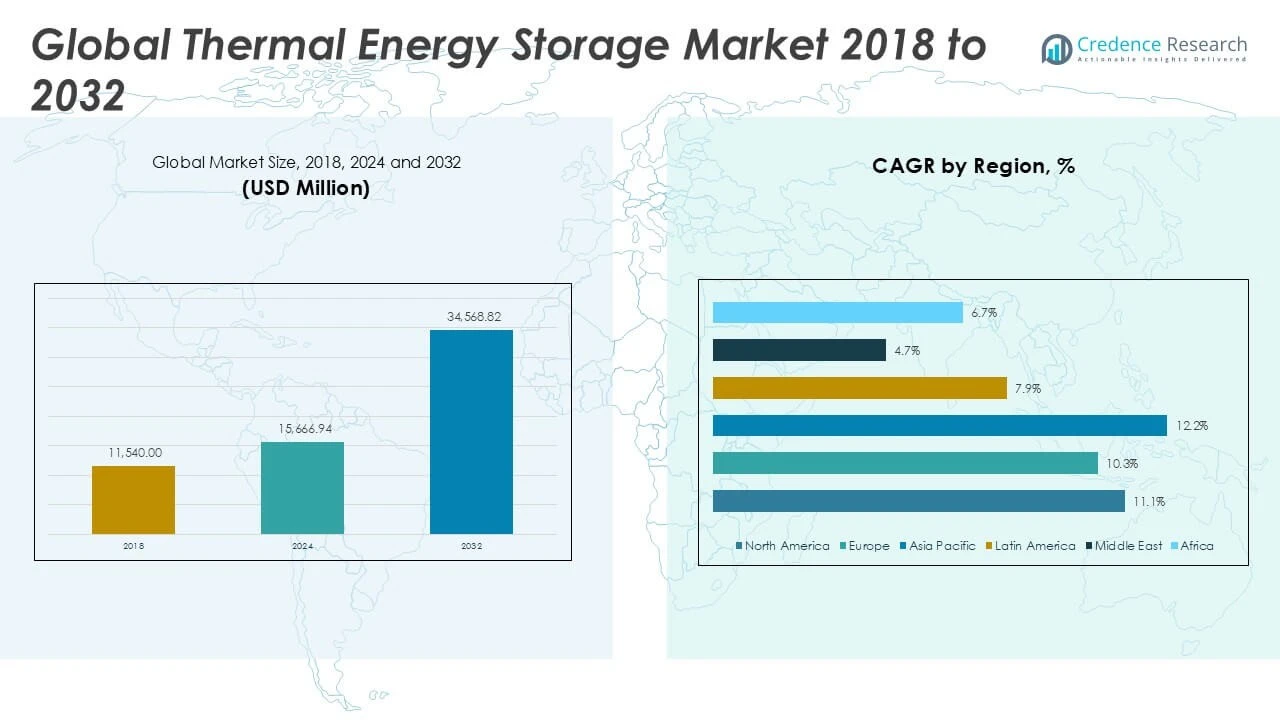
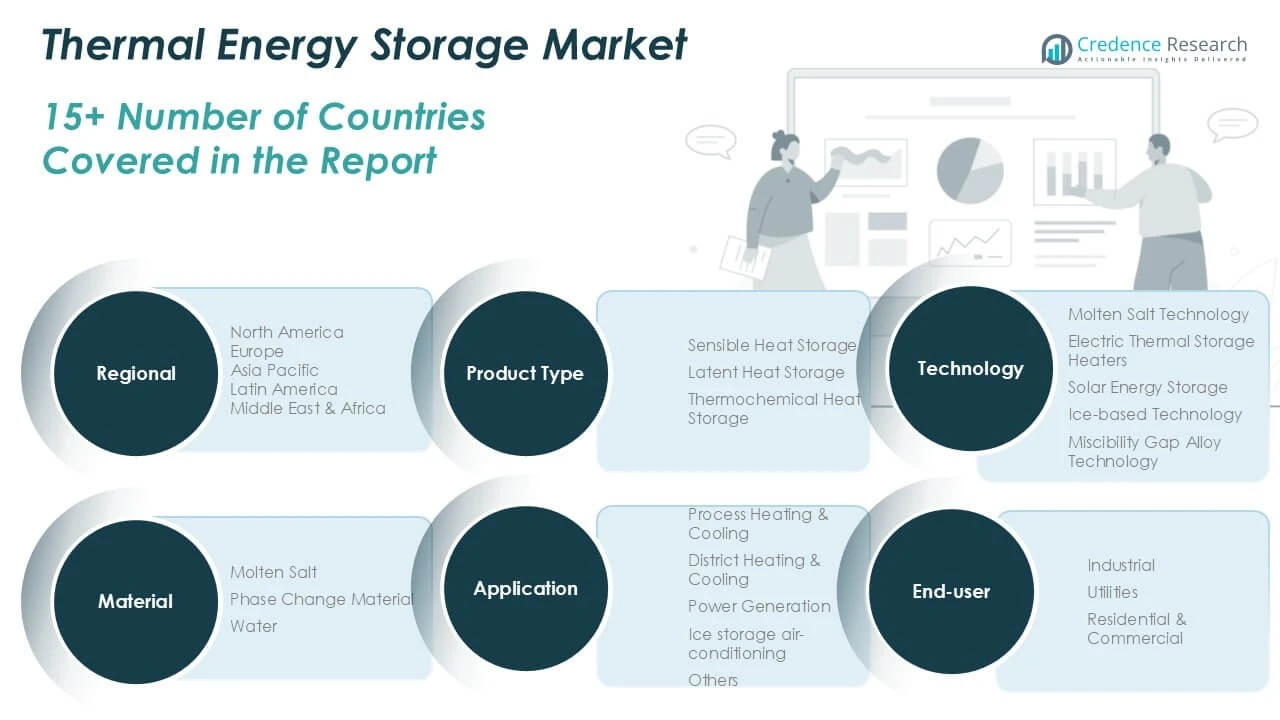
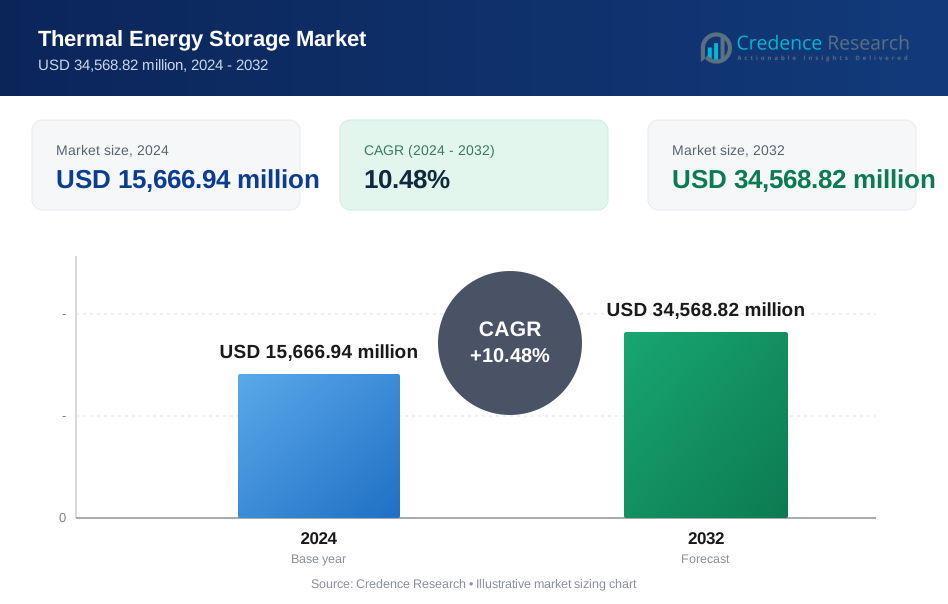
The Global Thermal Energy Storage Market is projected to grow from USD 15,666.94 million in 2024 to an estimated USD34,568.82 million based on 2032, with a compound annual growth rate (CAGR) of 10.48% from 2025 to 2032.
The market is witnessing significant momentum due to technological advancements in storage mediums, such as molten salts and phase change materials, which improve energy efficiency and cost-effectiveness. Growing demand for energy conservation, peak-load management, and reduction of greenhouse gas emissions further accelerates adoption. Additionally, policy frameworks promoting energy efficiency and renewable integration, particularly in industrial and utility-scale applications, are shaping market growth. Trends such as hybrid energy systems and thermal batteries are also gaining traction in the global energy storage ecosystem.
Geographically, North America and Europe represent major markets, supported by advanced grid networks and strong regulatory support for energy transition. Asia Pacific is expected to register the fastest growth during the forecast period, driven by increasing renewable energy installations in countries like China and India. Key players operating in the thermal energy storage market include Abengoa Solar, BrightSource Energy, Siemens AG, CALMAC, and Burns & McDonnell.
Market Insights
- The Global Thermal Energy Storage Market is projected to grow from USD 15,666.94 million in 2024 to USD 34,568.82 million by 2032, registering a CAGR of 10.48% from 2025 to 2032.
- Increasing integration of renewable energy and the need for reliable grid systems are primary drivers fueling market growth.
- Technological advancements in molten salt and phase change materials are improving system efficiency and cost performance.
- High initial capital investment and technical complexity remain key restraints limiting faster adoption across emerging markets.
- North America leads the market with a value of USD 5,291.49 million in 2024, driven by smart grid development and industrial demand.
- Asia Pacific is expected to witness the highest CAGR of 12.2%, supported by large-scale solar projects in China and India.
- Europe contributes a significant market share, backed by strong policy support and widespread deployment of district heating systems.
Market Drivers
Growing Renewable Energy Integration Requires Efficient Storage Solutions
The Global Thermal Energy Storage Market is gaining momentum due to the accelerating deployment of renewable energy sources, particularly solar and wind. These sources produce intermittent energy, creating challenges for grid stability and energy reliability. Thermal energy storage systems help mitigate this issue by storing excess energy during low demand periods and releasing it when needed. This function supports continuous energy supply and enhances the flexibility of power systems. Policymakers in several countries are mandating energy storage integration to stabilize renewable energy contributions to the grid. The market benefits from this regulatory push and the rising demand for clean energy solutions.
- For instance, the U.S. accounted for 33% of the 18 under-construction thermal energy storage projects globally in 2018, highlighting its role in advancing energy storage solutions.
Rising Demand for Energy Efficiency in Industrial Applications
Industries with high thermal energy requirements, such as chemicals, food processing, and power generation, are driving the Global Thermal Energy Storage Market. These sectors seek to reduce operational costs by reusing stored heat and improving overall energy efficiency. Thermal storage helps reduce fuel consumption and minimizes dependency on external energy sources. Governments are also introducing stricter energy efficiency regulations, prompting industries to invest in storage technologies. It aligns with global goals to cut emissions and improve sustainability across industrial operations. Companies are adopting it to meet regulatory compliance and gain competitive advantage.
- For instance, the Canadian government introduced the Commercial Energy Conservation and Efficiency Program, offering USD 15,000 worth of rebates for commercial sector energy upgrades, encouraging investment in thermal storage technologies.
Smart Grid Development and Peak Load Shifting Support Adoption
Modernization of power infrastructure through smart grids is a significant driver for the Global Thermal Energy Storage Market. Smart grids allow precise demand-response management, where thermal storage plays a critical role in peak load shifting. During high electricity demand, stored energy is released, reducing pressure on the grid and avoiding the need for expensive peaking power plants. This enhances grid reliability and lowers overall electricity costs. Utility providers are recognizing the economic and operational benefits of integrating thermal storage into their systems. It contributes to building a more resilient and responsive energy infrastructure.
Favorable Government Policies and Investment in Sustainable Technologies
The Global Thermal Energy Storage Market benefits from favorable policy frameworks and increasing investments in sustainable energy infrastructure. Governments worldwide are introducing incentives, subsidies, and funding programs to promote energy storage technologies. Public and private investments are accelerating research and deployment of cost-effective and scalable thermal energy storage systems. Supportive regulations targeting carbon neutrality and energy security encourage adoption across sectors. International collaborations and energy transition roadmaps further stimulate growth in this market. It is positioned as a strategic component in achieving long-term energy sustainability goals.
Market Trends
Increasing Adoption of Molten Salt and Phase Change Materials for Enhanced Efficiency
The Global Thermal Energy Storage Market is witnessing a strong shift toward advanced storage materials, particularly molten salts and phase change materials (PCMs). These materials offer higher energy density and longer duration storage compared to conventional systems. Molten salt is widely used in concentrated solar power (CSP) plants due to its ability to retain heat for extended periods. PCMs are being explored for both industrial and residential applications to enhance thermal regulation and energy conservation. Innovations in material science are improving system efficiency and reducing energy losses. It allows greater flexibility in energy usage across different timeframes.
- For instance, Fourth Power secured USD 19 million in a Series A funding round in December 2023 for its thermophotovoltaic (TPV) thermal energy storage technology, highlighting growing investment in advanced storage solutions.
Integration with District Heating and Cooling Networks
The use of thermal energy storage in district heating and cooling networks is gaining traction across urban centers. Cities in Europe, Asia, and North America are implementing large-scale thermal storage systems to optimize the operation of centralized heating infrastructure. These systems store heat during off-peak hours and release it during peak demand, improving energy efficiency. It supports the decarbonization of urban energy systems and helps reduce fossil fuel dependency. Governments are supporting these initiatives through smart city policies and low-carbon strategies. The Global Thermal Energy Storage Market is expanding into these integrated urban solutions.
- For instance, district heating systems have been widely adopted in Europe and North America, with Asia-Pacific experiencing the fastest growth due to urbanization and infrastructure projects.
Growth of Concentrated Solar Power (CSP) Deployment
CSP plants are becoming a key application area for thermal energy storage, particularly in sun-rich regions such as the Middle East, North Africa, and parts of the U.S. These plants combine solar power generation with thermal storage to ensure 24/7 energy availability. Integration of thermal storage improves plant reliability and maximizes solar energy utilization. It reduces the need for backup fossil-fuel generators and supports base-load power delivery. Project developers are increasingly including storage components in new CSP installations to meet energy performance standards. The Global Thermal Energy Storage Market is closely aligned with the CSP market’s growth trajectory.
Advancement in Modular and Scalable Storage Solutions
Technological innovation is driving the development of modular thermal energy storage systems that cater to both large and small-scale applications. These modular systems offer flexibility in deployment, ease of installation, and lower capital investment. Companies are focusing on designing scalable storage units that can be expanded based on demand growth. It is particularly beneficial for commercial buildings, microgrids, and renewable hybrid systems. The trend is also supported by digital controls and automation that enhance operational efficiency. The Global Thermal Energy Storage Market is responding to the need for decentralized and adaptable storage options.
Market Challenges
High Initial Capital Investment and Infrastructure Requirements Limit Adoption
The Global Thermal Energy Storage Market faces a major challenge in the form of high upfront costs. Setting up thermal storage systems demands significant investment in specialized materials, large-scale infrastructure, and integration with existing energy networks. For many stakeholders, especially in developing economies, the financial barrier outweighs long-term efficiency gains. Limited access to financing and absence of clear return-on-investment timelines deter adoption in cost-sensitive sectors. It requires coordinated government support and private sector confidence to scale effectively. Without financial incentives or subsidies, project developers may prioritize cheaper, short-term solutions over thermal storage.
- For instance, government-led initiatives such as the EU Innovation Project and the U.S. Department of Energy's Industrial Heat Shot are providing funding to companies developing thermal energy storage technologies to help offset high upfront costs.
Technical Complexities and Efficiency Concerns Impact Market Growth
Technical complexity remains a persistent hurdle in the Global Thermal Energy Storage Market. Maintaining thermal efficiency over long storage durations poses engineering challenges, especially in large-scale applications. System performance can vary based on storage material type, insulation quality, and ambient conditions. It often requires ongoing maintenance to prevent degradation and energy loss. The lack of standardized protocols and limited skilled workforce further complicate deployment and operation. These factors collectively slow down commercialization and hinder widespread technology adoption across markets.
Market Opportunities
Rising Demand for Decarbonization Creates Strong Growth Potential
The Global Thermal Energy Storage Market holds significant opportunity in the global push toward decarbonization. Governments and industries are adopting clean energy policies to reduce greenhouse gas emissions and meet climate targets. Thermal storage supports this transition by enabling better integration of renewable sources and improving energy efficiency. It helps utilities and industries reduce dependency on fossil fuels and maintain stable energy supply. Countries investing in net-zero pathways are prioritizing storage technologies in their infrastructure plans. This shift creates long-term growth prospects across power generation, industrial processes, and urban energy systems.
Expanding Applications Across Emerging Markets and Smart Cities
Emerging economies offer untapped potential for the Global Thermal Energy Storage Market due to rising energy demands and ongoing grid modernization. Urban centers are investing in smart city infrastructure that relies on efficient energy use, making thermal storage a critical component. It can address peak load issues, reduce electricity costs, and support resilient energy networks in densely populated regions. Industrial parks, commercial complexes, and residential developments present growing demand for cost-effective and sustainable heating and cooling solutions. Market players can expand reach by developing modular, low-cost storage systems tailored for these regions. Partnerships with governments and local utilities can accelerate project deployment and scale adoption.
Market Segmentation Analysis
By Type
The Global Thermal Energy Storage Market includes two main types: sensible heat storage and latent heat storage. Sensible heat storage holds the dominant revenue share due to its simple design and cost-effectiveness. It stores energy by raising the temperature of a solid or liquid, typically using water or molten salts. Latent heat storage, which uses phase change materials, offers higher energy density but involves more complex systems. It is gaining interest in applications where space-saving and precise temperature control are critical. Both types serve different needs across industrial and building energy systems.
By Application
Thermal energy storage systems are widely used in process heating and cooling, district heating and cooling, power generation, and ice storage air-conditioning. District heating and cooling holds a significant share, driven by urban infrastructure developments and demand for energy-efficient building solutions. Power generation is another key application, particularly in concentrated solar power plants where thermal storage extends energy availability. Process heating and cooling find strong use in industrial operations seeking energy cost reduction. Ice-based air-conditioning systems are expanding in commercial facilities aiming to lower peak electricity demand. It also finds use in smaller, niche applications under the “others” category.
By End-user
End-users of thermal energy storage include industrial, utilities, and residential and commercial sectors. Industrial users lead the market due to high thermal energy demands and the need for cost and emission control. Utilities deploy thermal storage to stabilize power grids and support renewable integration. Residential and commercial segments are growing steadily with the rise of smart buildings and energy-efficient infrastructure. It serves multiple stakeholders aiming for operational efficiency and sustainability targets.
By Technology
The market encompasses technologies such as molten salt, electric thermal storage heaters, solar energy storage, ice-based technology, and miscibility gap alloy technology. Molten salt technology dominates due to its proven use in CSP plants and long-duration storage capabilities. Ice-based and electric storage heaters find use in buildings and localized systems. Solar energy storage solutions are expanding with the rise in solar installations. Miscibility gap alloy technology, while emerging, offers future potential with enhanced thermal retention properties. It diversifies the technological foundation of the Global Thermal Energy Storage Market.
By Material
Thermal energy storage relies on materials like molten salt, phase change materials (PCMs), and water. Molten salt is the most widely used material, especially in large-scale energy projects, due to its high thermal capacity and cost efficiency. PCMs are gaining attention for their compact design and precise temperature control. Water remains a traditional and accessible material, often used in sensible heat systems. Material selection depends on storage requirements, system design, and application scope. It defines the performance and efficiency of thermal storage systems across sectors.
Segments
Based on Type
- Sensible Heat Storage
- Latent Heat Storage
Based on Application
- Process Heating & Cooling
- District Heating & Cooling
- Power Generation
- Ice storage air-conditioning
- Others
Based on End-user
- Industrial
- Utilities
- Residential & Commercial
Based on Technology
- Molten Salt Technology
- Electric Thermal Storage Heaters
- Solar Energy Storage
- Ice-based Technology
- Miscibility Gap Alloy Technology
Based on Material
- Molten Salt
- Phase Change Material
- Water
Based on Region
- North America
- U.S.
- Canada
- Mexico
- Europe
- UK
- France
- Germany
- Italy
- Spain
- Russia
- Belgium
- Netherlands
- Austria
- Sweden
- Poland
- Denmark
- Switzerland
- Rest of Europe
- Asia Pacific
- China
- Japan
- South Korea
- India
- Australia
- Thailand
- Indonesia
- Vietnam
- Malaysia
- Philippines
- Taiwan
- Rest of Asia Pacific
- Latin America
- Brazil
- Argentina
- Peru
- Chile
- Colombia
- Rest of Latin America
- Middle East
- UAE
- KSA
- Israel
- Turkey
- Iran
- Rest of Middle East
- Africa
- Egypt
- Nigeria
- Algeria
- Morocco
- Rest of Africa
Regional Analysis
North America Thermal Energy Storage Market
North America accounted for the largest regional share in the Global Thermal Energy Storage Market, contributing 33.77% in 2024 with a market value of USD 5,291.49 million. It is projected to reach USD 12,170.58 million by 2032, growing at a CAGR of 11.1%. The market benefits from strong government support for renewable energy integration and the presence of advanced grid infrastructure. The U.S. leads the region, driven by large-scale deployment of concentrated solar power plants and district heating networks. Utilities and industrial sectors are investing in thermal storage to improve energy efficiency and manage peak loads. It continues to see widespread adoption in commercial buildings, smart cities, and university campuses.
Europe Thermal Energy Storage Market
Europe held the second-largest share in the Global Thermal Energy Storage Market, representing 38.02% in 2024 with a value of USD 5,956.86 million. It is expected to grow to USD 13,007.02 million by 2032 at a CAGR of 10.3%. Countries like Germany, France, and Denmark are leading adopters due to strong sustainability goals and established district energy systems. The European Union’s climate policies and energy transition frameworks have accelerated the integration of thermal storage technologies. It plays a key role in reducing fossil fuel use and supporting decentralized heating solutions. The market continues to expand across both industrial and urban applications.
Asia Pacific Thermal Energy Storage Market
Asia Pacific captured 14.96% of the global market in 2024, with a value of USD 2,344.04 million, projected to reach USD 5,866.87 million by 2032, growing at the fastest CAGR of 12.2%. Rapid urbanization, rising energy demands, and strong solar energy programs in China and India are fueling market growth. Governments are investing in smart grid infrastructure and renewable energy storage to manage peak demand. It is gaining popularity in both utility-scale projects and commercial developments. The region shows potential for large-scale deployment across industrial hubs and megacities focused on decarbonization.
Latin America Thermal Energy Storage Market
Latin America held a 6.24% share of the Global Thermal Energy Storage Market in 2024, valued at USD 978.01 million and forecast to reach USD 1,832.77 million by 2032, at a CAGR of 7.9%. Brazil and Chile are emerging leaders with growing renewable capacity and supportive regulatory frameworks. The region focuses on reducing grid instability through thermal storage integration. Industrial and commercial sectors are adopting thermal solutions for process heating and air-conditioning. It finds increasing use in remote and off-grid installations requiring energy autonomy. Government partnerships and foreign investments help drive market penetration.
Middle East Thermal Energy Storage Market
The Middle East contributed 3.97% to the global market in 2024, valued at USD 621.48 million, and is projected to reach USD 926.39 million by 2032, growing at a CAGR of 4.7%. The market is driven by solar thermal projects in countries like the UAE and Saudi Arabia. High solar irradiance and efforts to diversify energy sources support adoption of thermal storage technologies. It plays a supporting role in utility-scale solar power generation and desalination plants. The region faces challenges due to high capital costs and slower policy implementation. However, pilot projects and public-private partnerships signal long-term opportunity.
Africa Thermal Energy Storage Market
Africa held a 3.03% share of the Global Thermal Energy Storage Market in 2024, with a value of USD 475.05 million, expected to reach USD 765.18 million by 2032 at a CAGR of 6.7%. The region is at an early stage of adoption, with efforts focused on rural electrification and improving energy access. South Africa and Morocco are investing in CSP projects that incorporate thermal storage. It is gradually being adopted in off-grid energy systems and industrial processes requiring thermal regulation. Limited infrastructure and financing gaps pose growth constraints. However, international aid programs and technology transfer initiatives are opening new opportunities.
Key players
- Abengoa Solar
- BrightSource Energy
- Siemens AG
- CALMAC
- Burns & McDonnell
- DN Tanks
- Baltimore Aircoil Company
- Steffes Corporation
- Ice Energy
- Cristopia Energy Systems
- Axiom Energy
- Veolia Environnement S.A.
Competitive Analysis
The Global Thermal Energy Storage Market features a mix of established engineering firms and emerging technology developers. Leading players like Siemens AG and Abengoa Solar focus on utility-scale projects and solar thermal integration. Companies such as CALMAC and Ice Energy specialize in modular and building-level storage solutions. New entrants like Axiom Energy are leveraging innovation in phase change materials and energy management systems. Strategic partnerships, R\&D investment, and technology differentiation define competition. It drives innovation in cost reduction, energy efficiency, and application flexibility. Players are expanding globally to tap into new markets driven by renewable energy goals and urban development plans.
Recent Developments
- In February 2025, Baltimore Aircoil Company showcased sustainable ice thermal storage technologies at AHR Expo 2025, reinforcing its leadership in efficient cooling solutions.
- In January 2025, Steffes Corporation’s “Origin” thermal storage system earned the CSE Plumbing Product of the Year award for innovation in multi-family water heating.
- In May 2025, Veolia Environnement S.A. reported a 1.5% increase in Q1 2025 revenue, citing growth in energy services and thermal energy storage programs. .
Market Concentration and Characteristics
The Global Thermal Energy Storage Market shows a moderately concentrated structure with a mix of multinational corporations and niche technology providers. A few dominant players hold significant market share due to their expertise in large-scale infrastructure and long-standing industry presence. It features high entry barriers driven by capital intensity, technical complexity, and regulatory compliance requirements. The market favors companies with strong R&D capabilities and diversified portfolios across storage technologies. Regional players often focus on application-specific solutions, such as district cooling or industrial heat reuse. Competitive differentiation depends on efficiency, scalability, and integration with renewable energy systems. Strategic alliances and technology partnerships continue to shape the market’s evolution.
Report Coverage
The research report offers an in-depth analysis based on Type, Application, End-user, Technology, Material and Region. It details leading market players, providing an overview of their business, product offerings, investments, revenue streams, and key applications. Additionally, the report includes insights into the competitive environment, SWOT analysis, current market trends, as well as the primary drivers and constraints. Furthermore, it discusses various factors that have driven market expansion in recent years. The report also explores market dynamics, regulatory scenarios, and technological advancements that are shaping the industry. It assesses the impact of external factors and global economic changes on market growth. Lastly, it provides strategic recommendations for new entrants and established companies to navigate the complexities of the market.
Future Outlook
- Thermal energy storage will play a critical role in supporting the stability of power grids with high renewable penetration. It will enable smoother energy transitions by balancing supply-demand fluctuations.
- Urban centers will increasingly adopt thermal storage systems to optimize district energy operations. Governments will support these systems as part of sustainable city planning initiatives.
- Advancements in materials such as molten salts and phase change materials will enhance energy density and thermal retention. Research will focus on reducing losses and improving cost-effectiveness.
- Adoption will rise across commercial complexes, smart buildings, and residential units. Consumers will seek thermal storage to manage energy costs and improve HVAC efficiency.
- CSP plants will increasingly include thermal storage to deliver dispatchable renewable electricity. This trend will be especially strong in sun-rich regions like the Middle East, Africa, and parts of Asia.
- Supportive regulations, clean energy mandates, and fiscal incentives will encourage investments in thermal storage. Policy frameworks will align with net-zero targets and energy resilience goals.
- Vendors will develop modular thermal storage solutions that suit varying energy demands. These systems will support decentralized energy networks and microgrid operations.
- Industries will use thermal storage to recover waste heat and reduce reliance on fossil fuels. The market will benefit from industrial energy efficiency mandates and emission reduction goals.
- Digital monitoring and smart controls will enhance storage performance and system responsiveness. Integration with smart grids will allow dynamic load shifting and real-time optimization.
- Developing economies in Asia Pacific, Latin America, and Africa will become key growth regions. Infrastructure upgrades and energy access initiatives will boost market penetration.
Request a Free Sample
Fill in your details and we'll send you a free sample report.
- Sample data tables & charts
- Research methodology
Need a Custom Version of This Report?
Tailor the scope, geography, or segments to your exact requirements.
- Custom geography or segment scope
- Direct access to our analyst team
Frequently Asked Questions
What is the market size and growth rate of the Global Thermal Energy Storage Market?
What is driving the growth of the thermal energy storage market?
What are the key applications of thermal energy storage systems?
Who are the major players in the Global Thermal Energy Storage Market?
Who are the major players in this market?
Table of Content
Chapter 1. Report Introduction
- 1.1 Report Description & Purpose
- 1.1.1 Report Title & Market Definition
- 1.1.2 Unique Selling Propositions (USP) & Key Differentiators
- 1.1.3 Value Proposition for Stakeholders
- 1.2 Research Objectives
- 1.2.1 Market Sizing Objectives (Volume & Revenue) (Volume Where Applicable)
- 1.2.2 Segmentation Objectives
- 1.2.3 Competitive Intelligence Objectives
- 1.2.4 Forecast & Scenario Objectives
- 1.3 Report Scope
- 1.3.1 Thermal Energy Storage Scope – Segments & Subsegments Covered
- 1.3.2 Geographic Scope – Regions & Countries Covered
- 1.3.3 Historical Period, Base Year & Forecast Period (2024; forecast to 2032)
- 1.3.4 Inclusions & Exclusions
- 1.4 Industry Classification & Applicable Codes
- 1.5 Currency, Measurement Units & Valuation Basis
- 1.6 Target Stakeholders
- 1.7 Limitations & Assumptions
Chapter 2. Executive Summary
- 2.1 Global Thermal Energy Storage Market Snapshot
- 2.1.1 Market Size – Historical (2024) & Forecast (2024-2032) (2024: USD 15,666.94 million → 2032: USD 34,568.82 million)
- 2.1.2 Volume & Revenue – Global Totals (Volume Where Applicable)
- 2.1.3 Key Market Highlights – Top Five Facts
- 2.2 Thermal Energy Storage Market Segmentation Snapshot
- 2.2.1 Market Split by Region – 2024 vs. 2032
- 2.3 Competitive Snapshot
- 2.3.1 Top 10 Players by Revenue Share – 2024
- 2.3.2 Top 10 Players by Volume Share – 2024 (Volume Where Applicable)
- 2.3.3 Recent Strategic Developments (18-Month Summary)
- 2.4 Key Investment Highlights & Strategic Conclusions
Chapter 3. Thermal Energy Storage Market Dynamics & Industry Analysis
- 3.1 Market Overview & Context
- 3.1.1 Thermal Energy Storage Market Position in the Broader Industry Value Chain
- 3.1.2 Demand Structure & Purchasing Dynamics
- 3.1.3 Market Maturity & Development Stage by Region
- 3.2 Thermal Energy Storage Market Drivers
- 3.3 Thermal Energy Storage Market Restraints & Challenges
- 3.4 Thermal Energy Storage Market Opportunities
- 3.5 Porter's Five Forces Analysis
- 3.5.1 Threat of New Entrants
- 3.5.2 Bargaining Power of Suppliers
- 3.5.3 Bargaining Power of Buyers
- 3.5.4 Threat of Substitutes
- 3.5.5 Competitive Rivalry – Intensity Assessment
- 3.6 Thermal Energy Storage Value Chain Analysis
- 3.6.1 Upstream – Key Inputs, Resources & Suppliers
- 3.6.1.1 Key Input/Resource 1
- 3.6.1.2 Key Input/Resource 2
- 3.6.1.3 Key Input/Resource 3
- 3.6.2 Midstream – Core Operations & Value Creation
- 3.6.2.1 Operating Model & Process Overview
- 3.6.2.2 Key Operating Locations & Capabilities by Company
- 3.6.3 Downstream – Market Channels & End Users
- 3.6.3.1 Direct Sales & Customer Engagement Channels
- 3.6.3.2 Indirect Sales, Intermediaries & Partner Channels
- 3.6.4 Value Chain Profitability Analysis
- 3.6.1 Upstream – Key Inputs, Resources & Suppliers
- 3.7 PESTEL Analysis
- 3.7.1 Political Factors
- 3.7.2 Economic Factors
- 3.7.3 Social Factors
- 3.7.4 Technological Factors
- 3.7.5 Environmental Factors
- 3.7.6 Legal Factors
- 3.8 Thermal Energy Storage Supply Chain Analysis
- 3.8.1 Critical Input & Resource Availability Risk Assessment
- 3.8.2 Supplier & Operational Concentration Risk (Geographic Exposure)
- 3.8.3 Supply & Service Disruption Impact Analysis
- 3.9 Regulatory & Policy Landscape
Note: The regulatory and policy landscape section covers regulations based on their applicability to the market, Thermal Energy Storage category, geography, and scope of the study. Only regulatory frameworks with a material impact on operations, compliance, trade, sustainability, or market access are analyzed in detail.
Chapter 4. Key Investment Pockets & Opportunity Analysis
- 4.1 Thermal Energy Storage Market Attractiveness Analysis
- 4.1.1 By Region – Investment Attractiveness Matrix (Market Size × CAGR)
- 4.2 Absolute Revenue Growth Opportunity
- 4.2.1 By Region – Absolute Revenue Growth Through 2032
- 4.3 Incremental Demand Opportunity
- 4.3.1 By Region – Incremental Demand Through 2032
- 4.3.2 Segment – Incremental Demand
- 4.4 Emerging Submarket Opportunity Deep Dive (Subject to Applicability)
- 4.5 Priority Market Opportunity Scorecards
- 4.5.1 United States
- 4.5.2 Europe
- 4.5.3 Asia
- 4.5.4 Middle East & Africa
Note: Priority market opportunity scorecards reflect the geographic scope and strategic relevance of the study. Listed markets are indicative and may be adapted to the industry.
Chapter 5. Thermal Energy Storage Cross-Border Trade & Market Access Analysis
- 5.1 International Trade & Cross-Border Activity Overview
- 5.1.1 Global Export Value by Country (2024)
- 5.1.2 Global Export Volume by Country (2024) (Volume Where Applicable)
- 5.1.3 Global Import Value by Country (2024)
- 5.1.4 Global Import Volume by Country (2024) (Volume Where Applicable)
- 5.1.5 Net Trade Balance by Country (2024)
- 5.2 Export Analysis – Segment
- 5.2.1 Category 1 (Applicable Classification Code)
- 5.2.2 Category 2 (Applicable Classification Code)
- 5.2.3 Category 3 (Applicable Classification Code)
- 5.2.4 Category 4 (Applicable Classification Code)
- 5.2.5 Category 5 (Applicable Classification Code)
- 5.3 Import Analysis – Segment
- 5.3.1 Category 1 (Applicable Classification Code)
- 5.3.2 Category 2 (Applicable Classification Code)
- 5.3.3 Category 3 (Applicable Classification Code)
- 5.3.4 Category 4 (Applicable Classification Code)
- 5.3.5 Category 5 (Applicable Classification Code)
- 5.4 Cross-Border Pricing & Transaction Benchmarks
- 5.4.1 Export Pricing – Segment & Country
- 5.4.2 Import Pricing – Segment & Source Country
- 5.4.3 Price Trends (2024)
- 5.5 Key Cross-Border Trade & Delivery Routes
- 5.5.1 Cross-Border Trade/Delivery Route 1
- 5.5.2 Cross-Border Trade/Delivery Route 2
- 5.5.3 Cross-Border Trade/Delivery Route 3
- 5.5.4 Cross-Border Trade/Delivery Route 4
- 5.5.5 Cross-Border Trade/Delivery Route 5
- 5.6 Trade Policy & Market Access Impact Assessment
- 5.6.1 Tariff & Non-Tariff Barriers
- 5.6.2 Regional Trade & Economic Integration Frameworks
- 5.6.3 Bilateral & Multilateral Trade Agreements
- 5.6.4 Cross-Border Operating, Licensing & Localization Requirements
Note: This chapter applies where cross-border trade or delivery is relevant to Thermal Energy Storage. Goods, services, and digital offerings are assessed using applicable classifications and transaction measures. Import-export volumes, trade balances, and route analyses are included only where meaningful to the market.
Chapter 6. Competitive Landscape & Company Benchmarking
- 6.1 Thermal Energy Storage Market Concentration & Structure
- 6.1.1 Herfindahl-Hirschman Index (HHI) – vs. 2024
- 6.1.2 Leading, Mid-Sized & Emerging Player Structure
- 6.1.3 Global, Regional & Local Player Dynamics
- 6.2 Thermal Energy Storage Market Share Analysis – 2024
- 6.2.1 Global Revenue Share by Company
- 6.2.2 Global Volume Share by Company (Volume Where Applicable)
- 6.2.3 Regional Revenue Share
- 6.2.4 Market Share Evolution ( vs. 2024)
- 6.2.5 Company Market Share by Key Segment
- 6.2.6 Company Market Share by Customer Group
- 6.3 Operating Scale, Capacity & Infrastructure Analysis
- 6.3.1 Global Operating Scale & Supply Capacity
- 6.3.2 Resource Utilization & Operating Efficiency
- 6.3.3 Output, Service Delivery & Activity Metrics
- 6.3.4 Operating Footprint & Infrastructure Map
- 6.3.5 Planned Operational & Capacity Expansion
- 6.4 Thermal Energy Storage Competitive Benchmarking Matrix
- 6.4.1 Revenue, Growth, Profitability & Operating Metric Comparison
- 6.4.2 Channel Revenue Mix
- 6.4.3 Geographic Revenue Exposure
- 6.4.4 R&D Intensity
- 6.4.5 Sustainability Maturity
- 6.5 Strategic Developments in Thermal Energy Storage (Last 24 Months)
- 6.5.1 Mergers, Acquisitions & Divestments
- 6.5.2 New Products, Services & Solutions in Thermal Energy Storage
- 6.5.3 Operational & Infrastructure Expansions
- 6.5.4 Strategic Alliances, Joint Ventures & Partnerships
- 6.5.5 Distribution Expansion & Market Entry
- 6.5.6 Sustainability & ESG Initiatives
- 6.6 Competitive Strategy Mapping
- 6.6.1 Leader, Challenger, Follower & Niche Classification
- 6.6.2 Pricing Strategy Comparison
- 6.6.3 Channel Strategy Matrix
Note: Strategic developments are included based on their materiality and the availability of reliable information.
Chapter 7. Global Thermal Energy Storage Market – By Sales & Delivery Channel
- 7.1 Segment Overview
- 7.1.1 Volume & Revenue Split by Channel (2024 & 2032) (Volume Where Applicable)
- 7.1.2 Channel Mix Evolution (2024-2032)
Chapter 8. Regional Market Analysis – Global Overview
- 8.1 Global Regional Overview
- 8.1.1 Regional Volume Share (Volume Where Applicable)
- 8.1.2 Regional Revenue Share
- 8.1.3 Regional Volume by Region (Volume Where Applicable)
- 8.1.4 Regional Revenue by Region
- 8.1.5 Regional Forecast Through 2032
- 8.2 Cross-Regional Segment Analysis
- 8.2.1 By Sales & Delivery Channel
- 8.2.2 By Competitive Positioning & Price Tier
Chapter 9. North America Thermal Energy Storage Market
- 9.1 United States
- 9.2 Canada
- 9.3 Mexico
Chapter 10. Europe Thermal Energy Storage Market
- 10.1 Germany
- 10.2 France
- 10.3 Italy
- 10.4 United Kingdom
- 10.5 Spain
- 10.6 Poland
- 10.7 Russia
- 10.8 Netherlands
- 10.9 Belgium
- 10.10 Sweden
- 10.11 Denmark
- 10.12 Norway
- 10.13 Rest of Europe
Chapter 11. Asia Pacific Thermal Energy Storage Market
- 11.1 China
- 11.2 India
- 11.3 Japan
- 11.4 South Korea
- 11.5 Thailand
- 11.6 Indonesia
- 11.7 Vietnam
- 11.8 Malaysia
- 11.9 Australia
- 11.10 Rest of Asia Pacific
Chapter 12. Latin America Thermal Energy Storage Market
- 12.1 Brazil
- 12.2 Argentina
- 12.3 Colombia
- 12.4 Chile
- 12.5 Rest of Latin America
Chapter 13. Middle East Thermal Energy Storage Market
- 13.1 Saudi Arabia
- 13.2 United Arab Emirates
- 13.3 Turkey
- 13.4 Israel
- 13.5 Iran
- 13.6 Rest of the Middle East
Chapter 14. Africa Thermal Energy Storage Market
- 14.1 South Africa
- 14.2 Egypt
- 14.3 Nigeria
- 14.4 Morocco
- 14.5 Rest of Africa
Chapter 15. Thermal Energy Storage Company Profiles
- 15.1 [Company 01]
- 15.1.1 Company Overview
- 15.1.2 Key Management Personnel
- 15.1.3 Products & Services Portfolio
- 15.1.4 Financial Performance
- 15.1.5 Key Market Focus & Geographic Presence
- 15.1.6 Recent Developments & Strategic Initiatives
Note: The company profile list is preliminary and may change based on research findings, market developments, data availability, and client requirements.
Chapter 16. Appendices
- Appendix A – List of Abbreviations & Acronyms
- Appendix B – Industry Classification Code Reference – Full Series
- Appendix C – Supply, Output & Operating Capacity Data Tables
- Appendix D – End-Use & Demand Base Tables
- Appendix E – Demand, Adoption & Usage Assumptions
- Appendix F – Pricing & Revenue Metric Reference Tables
- Appendix G – Company Operations & Infrastructure Database
- Appendix H – Cross-Border Trade & Activity Data Tables (Where Applicable)
- Appendix I – Regulatory Summary Tables
- Appendix J – Primary Research Participant List (Anonymized)
- Appendix K – Primary Research Questionnaire Framework
- Appendix L – Data Sources & Bibliography
- Appendix M – Market Size Divergence & Source Comparison
Chapter 17. Research Methodology
- 17.1 Research Framework & Philosophy
- 17.2 Secondary Research – Sources, Hierarchy & Data Extraction
- 17.3 Data Modeling – Bottom-Up & Top-Down Market Sizing
- 17.4 Primary Research – Stakeholder Framework, LOI & Sample Sizes
- 17.5 Forecast Methodology – Regression, Scenario & Sensitivity Analysis
- 17.6 Quality Control – Four-Layer Validation Framework
- 17.7 Limitations & Standard Assumptions
- 17.8 Disclaimer
