
Market Overview
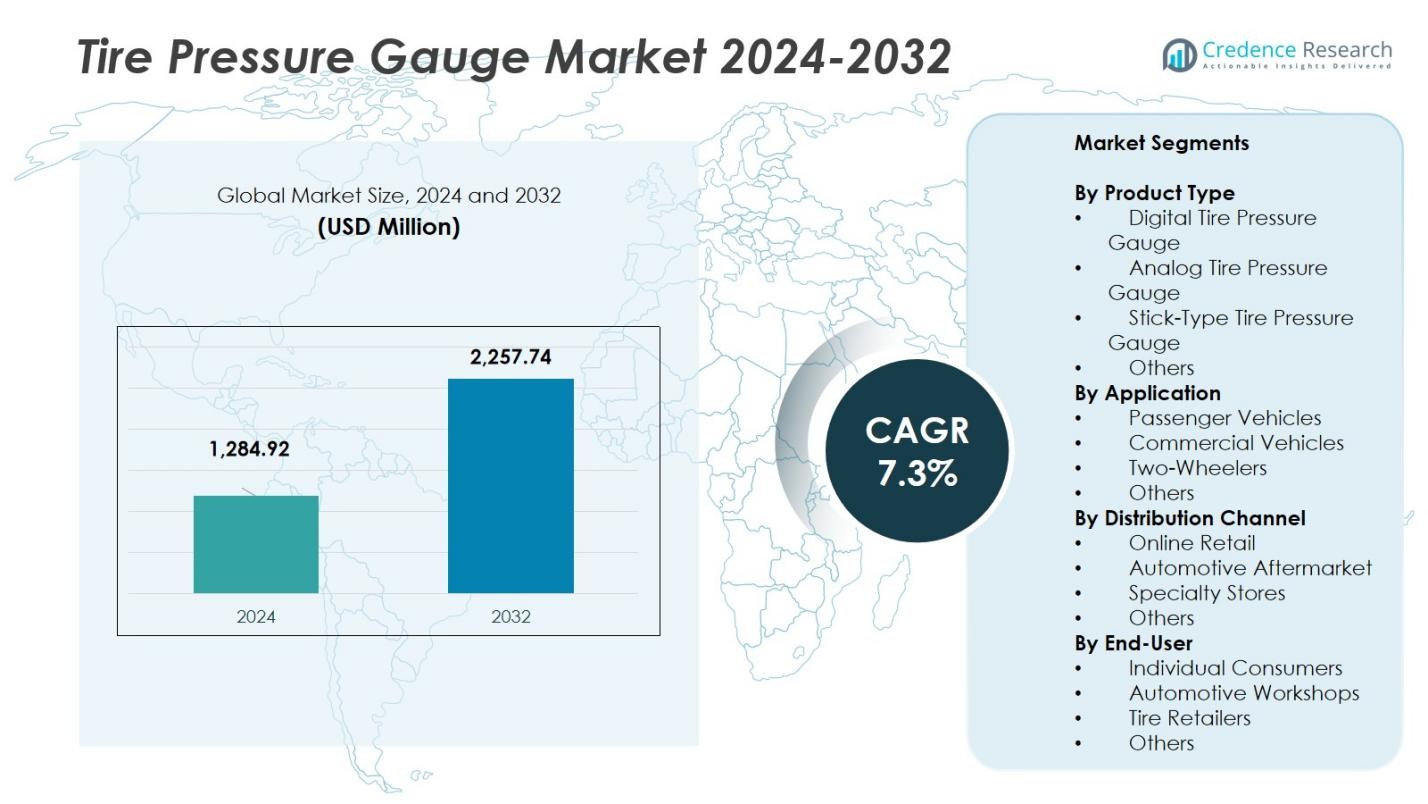
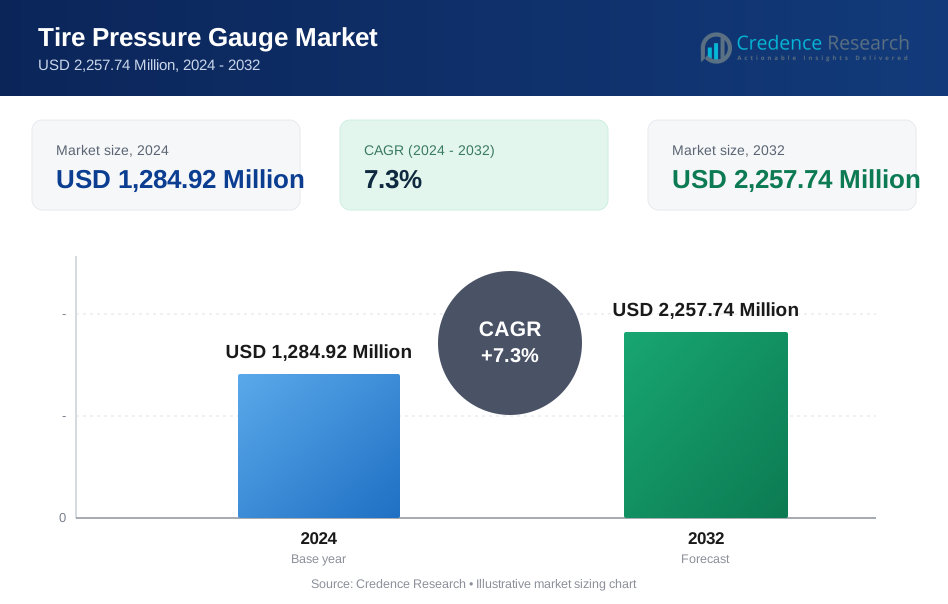
The Tire Pressure Gauge Market size was valued at USD 1,284.92 Million in 2024 and is anticipated to reach USD 2,257.74 Million by 2032, at a CAGR of 7.3% during the forecast period.
| REPORT ATTRIBUTE | DETAILS |
|---|---|
| Historical Period | 2020-2023 |
| Base Year | 2024 |
| Forecast Period | 2025-2032 |
| Tire Pressure Gauge Market Size 2024 | USD 1,284.92 Million |
| Tire Pressure Gauge Market, CAGR | 7.3% |
| Tire Pressure Gauge Market Size 2032 | USD 2,257.74 Million |
The Tire Pressure Gauge Market is driven by key players such as Accutire (Measurement Ltd.), Michelin, Goodyear, TEKTON, JACO Superior Products, Milton Industries, WIKA Instrumentation, and Schrader International. These companies maintain their market leadership through continuous innovation, strong brand recognition, and broad distribution networks across regions. Digital tire pressure gauges are a significant growth segment, with manufacturers enhancing accuracy, ease of use, and added features like backlighting and memory storage. The Asia Pacific region leads the market, capturing 34% of global market share. This dominance is driven by the rapid urbanization and increasing vehicle fleet in economies like China and India. Additionally, rising consumer awareness of vehicle maintenance and the expansion of the automotive aftermarket in this region contribute to the growing demand for tire pressure gauges. The region’s large-scale manufacturing capabilities and increasing e-commerce penetration also create significant opportunities for market expansion, positioning Asia Pacific as a key focus for industry players.
Market Insights
- The global Tire Pressure Gauge market size reached USD 1,284.92 million in 2024 and is projected to grow at a CAGR of 7.3% to USD 2,257.74 million by 2032.
- Increased vehicle ownership and higher maintenance awareness drive demand, with the Passenger Vehicle segment holding about 50% share and the Digital Product Type segment capturing roughly 45% of the market.
- Rising e‑commerce usage and integration with TPMS systems present strong trends, while the Online Retail channel accounts for nearly 40% of distribution.
- Competitive dynamics reflect major players enhancing features and global reach; key firms include Accutire (Measurement Ltd.), Michelin, Goodyear, TEKTON, JACO Superior Products, Milton Industries, WIKA Instrumentation and Schrader International.
- Market restraints include price sensitivity in emerging regions and low consumer awareness, especially in areas where the LAMEA region holds a 12% share and struggles with infrastructure and education gaps.
Market Segmentation Analysis:
By Product Type
The Tire Pressure Gauge market is segmented into Digital, Analog, Stick-Type, and Other gauges. The Digital Tire Pressure Gauge holds the dominant market share, accounting for approximately 45% of the overall market. This growth is driven by the increasing demand for precise readings, ease of use, and technological advancements in digital displays. Consumers are increasingly opting for digital gauges due to their accuracy, ease of reading, and additional features such as memory storage and backlighting, making them ideal for both consumer and professional use.
- For instance, the HiPreMa 4 digital tire pressure gauge used in motorsports offers the ability to store cold and hot tire pressures, ambient temperature, and time data for each session, helping racing teams optimize performance with precise logged information.
By Application
In terms of application, the Tire Pressure Gauge market is divided into Passenger Vehicles, Commercial Vehicles, Two-Wheelers, and Others. The Passenger Vehicle segment holds the largest market share, representing about 50%. This is driven by the growing awareness of vehicle maintenance and the increasing number of passenger vehicles worldwide. The rise in consumer demand for tire safety and fuel efficiency is contributing to the widespread use of tire pressure gauges in passenger cars, especially as more vehicles are equipped with tire pressure monitoring systems (TPMS).
- For instance, Continental AG expanded its Tire Pressure Monitoring System production capacity at its Bangalore plant in India, introducing advanced second-generation TPMS that enhances vehicle safety by transmitting tire pressure, temperature, and motion data in real time.
By Distribution Channel
The distribution channel for tire pressure gauges includes Online Retail, Automotive Aftermarket, Specialty Stores, and Others. The Online Retail segment is leading the market, contributing nearly 40% of the market share. The convenience of purchasing products online, coupled with the increasing popularity of e-commerce, has propelled online retail sales. This segment benefits from a broader consumer reach, competitive pricing, and customer reviews, which influence buying decisions. Additionally, online platforms often offer promotions and discounts, making them an attractive option for consumers.
Key Growth Drivers
Increasing Awareness of Vehicle Maintenance
The growing awareness about vehicle maintenance and tire safety is a significant driver for the Tire Pressure Gauge market. Consumers are becoming more informed about the importance of maintaining optimal tire pressure to ensure vehicle performance, improve fuel efficiency, and enhance safety. As a result, regular use of tire pressure gauges has become a standard practice among vehicle owners. The rising adoption of preventive maintenance among consumers is expected to further boost the demand for tire pressure gauges.
- For instance, Apollo Tyres highlights that maintaining proper tire inflation prevents excessive wear and improves fuel efficiency, with tires losing pressure naturally over time, necessitating regular pressure checks every 2-4 weeks.
Technological Advancements
Technological advancements in tire pressure gauges, particularly digital gauges, are contributing to market growth. Modern digital gauges offer greater precision, enhanced features, such as automatic shut-off, backlighting, and easy-to-read digital displays, which improve the user experience. With the integration of advanced technologies, digital tire pressure gauges are becoming more popular among consumers, particularly for personal and professional use. These advancements help meet the growing demand for accurate, user-friendly tools, thereby driving the market.
- For instance, Michelin’s Digital Tire Gauge features a backlit LCD display and automatic shut-off, providing precise readings and longer battery life for both automotive professionals and consumers.
Rising Vehicle Production and Sales
The increasing production and sales of passenger vehicles, commercial vehicles, and two-wheelers worldwide are fueling the demand for tire pressure gauges. As the number of vehicles on the road rises, the need for regular tire maintenance and pressure checks becomes essential. This growth in the global vehicle fleet, coupled with a growing emphasis on vehicle safety and efficiency, is propelling the tire pressure gauge market. Moreover, the expansion of the automotive aftermarket and the increasing number of consumers looking to purchase these devices for personal use are also contributing to market expansion.
Key Trends & Opportunities
Online Retail Growth
The rise of e-commerce has significantly impacted the distribution channels for tire pressure gauges. The online retail segment is experiencing robust growth due to the increasing convenience of shopping from home, competitive pricing, and easy access to a wide range of products. Consumers now have greater access to customer reviews and product comparisons, which help in making informed purchase decisions. This trend is likely to continue as more consumers prefer the convenience and variety offered by online platforms, creating an opportunity for businesses to expand their online presence.
- For instance, Vulcan Tire (an online‑only tire retailer) lists tire gauges and accessories alongside its core products, and invests in customer‑review display and online buying experience as part of its e‑commerce strategy.
Integration with Automotive Safety Systems
With the integration of tire pressure monitoring systems (TPMS) in modern vehicles, there is a growing opportunity for tire pressure gauges to work in conjunction with these systems. TPMS alerts drivers when tire pressure is low, but having a tire pressure gauge for manual checks remains essential. This trend is expected to create opportunities for manufacturers to develop advanced tire pressure gauges that seamlessly integrate with TPMS for enhanced convenience and accuracy. The continued evolution of automotive safety systems presents a promising growth avenue for tire pressure gauge manufacturers.
- For instance, Continental’s ContiConnect Pressure Check system uses battery-powered sensors inside tires to wirelessly monitor pressure and temperature, sending real-time alerts to vehicle and fleet managers for proactive safety and maintenance management.
Key Challenges
Price Sensitivity
One of the major challenges facing the tire pressure gauge market is price sensitivity. While tire pressure gauges are relatively inexpensive, consumers are increasingly looking for cost-effective options, especially in price-sensitive regions. Lower-priced models, however, may lack advanced features or durability, affecting consumer satisfaction. As competition grows, manufacturers must find ways to balance affordability with functionality to meet diverse consumer preferences while ensuring profitability.
Lack of Consumer Awareness in Emerging Markets
Although awareness about tire safety is growing, many consumers in emerging markets remain unaware of the importance of regular tire pressure checks. This lack of awareness can limit the adoption of tire pressure gauges, especially in regions where vehicle maintenance culture is still developing. Manufacturers face the challenge of educating consumers on the benefits of tire maintenance and the role of tire pressure gauges in ensuring safety and efficiency. Overcoming this knowledge gap is crucial for expanding the market in these regions.
Regional Analysis
North America
The North American region commands a substantial portion of the global tire pressure gauge market, accounting for 28% of total revenue. Strong vehicle ownership rates, rigorous safety regulations, and a robust automotive aftermarket ecosystem drive demand for tire pressure gauges. High consumer awareness of preventive maintenance and routine vehicle servicing further support market expansion. The presence of major manufacturers and extensive distribution networks enhances product availability. These factors combine to make North America a key region for manufacturers seeking growth and market penetration in tire pressure gauge solutions.
Europe
Europe holds approximately 26% of the global tire pressure gauge market share. A mature automotive sector, stringent vehicle safety standards, and the early adoption of digital technologies bolster demand for advanced tire pressure measurement tools. The region’s well‑established aftermarket supports frequent replacements and upgrades of gauges. Manufacturers benefit from high consumer expectations for accuracy and ease of use. Growth opportunities emerge as electric vehicle uptake increases, requiring reliable pressure measurement tools. These dynamics position Europe as a strategically important region for suppliers targeting high‑performance gauges.
Asia Pacific
Asia Pacific leads the market with 34% of global share and offers the fastest growth trajectory. Rapid urbanisation, expanding vehicle fleets in economies such as China and India, and rising consumer awareness of tyre maintenance underpin regional demand. The proliferation of both passenger and commercial vehicles amplifies market opportunity for tire pressure gauges. E‑commerce penetration and increasing aftermarket sophistication further support growth. As automotive production hubs evolve in the region, gauge manufacturers can capitalise on scale and innovation to meet diverse end‑user needs.
Latin America, Middle East & Africa (LAMEA)
The LAMEA region captures about 12% of the tire pressure gauge market share, reflecting diverse market maturity across countries. Emerging vehicle markets and growing aftermarket services in Middle East, Africa, and parts of Latin America contribute to steady demand. However, variable infrastructure and lower consumer purchasing power temper growth compared to more developed regions. Suppliers that tailor affordable, durable products and partner with local distribution channels will unlock latent potential. This region thus represents a valuable frontier for market expansion albeit with distinct local challenges.
Market Segmentations:
By Product Type
- Digital Tire Pressure Gauge
- Analog Tire Pressure Gauge
- Stick-Type Tire Pressure Gauge
- Others
By Application
- Passenger Vehicles
- Commercial Vehicles
- Two-Wheelers
- Others
By Distribution Channel
- Online Retail
- Automotive Aftermarket
- Specialty Stores
- Others
By End-User
- Individual Consumers
- Automotive Workshops
- Tire Retailers
- Others
By Region
- North America
- U.S.
- Canada
- Mexico
- Europe
- Germany
- France
- U.K.
- Italy
- Spain
- Rest of Europe
- Asia Pacific
- China
- Japan
- India
- South Korea
- South-east Asia
- Rest of Asia Pacific
- Latin America
- Brazil
- Argentina
- Rest of Latin America
- Middle East & Africa
- GCC Countries
- South Africa
- Rest of the Middle East and Africa
Competitive Landscape
The competitive landscape of the tire pressure gauge market features primary players such as Accutire (Measurement Ltd.), Michelin, Goodyear, TEKTON, JACO Superior Products, Milton Industries, WIKA Instrumentation, Schrader International and Dunlop. These firms compete through product innovation, pricing strategies, and global distribution networks. Established brands leverage strong recognition and wide aftermarket reach to maintain market leadership, while smaller niche players focus on differentiated features or low‑cost positioning. The market is characterised by moderate to high rivalry, driven by the shift from analog to digital gauges and the rising demand for value‑added features such as smart connectivity. Strategic alliances, geographic expansion and product portfolio diversification serve as key tactics for firms aiming to strengthen their competitive position and capture incremental market share.
Key Player Analysis
- Accutire (Measurement Ltd.)
- Dunlop
- Michelin
- TEKTON
- WIKA Instrumentation
- Goodyear
- JACO Superior Products
- Milton Industries
- Schrader International
- ATEQ
Recent Developments
- In May 2025, Autel Intelligent Technology Corp. launched a new TPMS service tool and wireless TPMS sensors targeting DIY and professional repair shops.
- In March 2025, Schrader International launched its “AirCheck BLE” universal retrofit TPMS kit for light‑duty vehicles in North America.
- In June 2024, Continental AG launched its second‑generation tyre‑pressure monitoring system for passenger cars at its Bangalore plant.
- In October 2022, Parker Meggitt PLC launched the “iPRESS” long‑range wireless tire‑pressure gauge for aviation applications.
Report Coverage
The research report offers an in-depth analysis based on Product Type, Application, Distribution Channel, End User and Region. It details leading market players, providing an overview of their business, product offerings, investments, revenue streams, and key applications. Additionally, the report includes insights into the competitive environment, SWOT analysis, current market trends, as well as the primary drivers and constraints. Furthermore, it discusses various factors that have driven market expansion in recent years. The report also explores market dynamics, regulatory scenarios, and technological advancements that are shaping the industry. It assesses the impact of external factors and global economic changes on market growth. Lastly, it provides strategic recommendations for new entrants and established companies to navigate the complexities of the market.
Future Outlook
- Adoption of digital and smart gauges will increase significantly, driven by demand for connectivity and accuracy.
- Rising global vehicle fleets, especially in developing regions, will boost gauge sales growth.
- Growing regulatory emphasis on tyre safety and inflation monitoring will push market expansion.
- Expansion of online retail and e‑commerce channels will improve accessibility of gauges worldwide.
- Increased aftermarket performance, maintenance culture and DIY vehicle care will drive replacement gauge demand.
- Emerging regions such as Asia‑Pacific and Latin America will become stronger growth frontiers.
- Integration with vehicle diagnostic systems and TPMS will create new product features and premium segments.
- Manufacturers will face pressure to offer affordable, durable gauges suited for cost‑sensitive markets.
- Focus on sustainability and materials innovation may result in eco‑friendly gauge offerings.
- Enhanced consumer awareness campaigns about tire safety and fuel efficiency will raise demand for gauges.
Request a Free Sample
Fill in your details and we'll send you a free sample report.
- Sample data tables & charts
- Research methodology
Need a Custom Version of This Report?
Tailor the scope, geography, or segments to your exact requirements.
- Custom geography or segment scope
- Direct access to our analyst team
Frequently Asked Questions
What is the current market size for Tire pressure gauge market, and what is its projected size in 2032?
At what Compound Annual Growth Rate is the Tire pressure gauge market projected to grow between 2025 and 2032?
Which Tire pressure gauge market segment held the largest share in 2024?
What are the primary factors fueling the growth of the Tire pressure gauge market?
Who are the leading companies in the Tire pressure gauge market?
Which region commanded the largest share of the Tire pressure gauge market in 2024?
Table of Content
Chapter 1. Report Introduction
- 1.1 Report Description & Purpose
- 1.1.1 Report Title & Market Definition
- 1.1.2 Unique Selling Propositions (USP) & Key Differentiators
- 1.1.3 Value Proposition for Stakeholders
- 1.2 Research Objectives
- 1.2.1 Market Sizing Objectives (Volume & Revenue)
- 1.2.2 Segmentation Objectives
- 1.2.3 Competitive Intelligence Objectives
- 1.2.4 Forecast & Scenario Objectives
- 1.3 Report Scope
- 1.3.1 Tire Pressure Gauge Scope – Types & Subtypes Covered
- 1.3.2 Geographic Scope – Regions & Countries Covered
- 1.3.3 Historical Period, Base Year & Forecast Period (2024; forecast to 2032)
- 1.3.4 Inclusions & Exclusions
- 1.4 HS Code & Classification Framework
- 1.5 Currency, Units & Pricing Basis
- 1.6 Target Stakeholders
- 1.7 Limitations & Assumptions
Chapter 2. Executive Summary
- 2.1 Global Tire Pressure Gauge Market Snapshot
- 2.1.1 Market Size – Historical (2024) & Forecast (2024-2032) (2024: USD 1,284.92 Million → 2032: USD 2,257.74 Million)
- 2.1.2 Volume & Revenue – Global Totals
- 2.1.3 Key Market Highlights – Top Five Facts
- 2.2 Tire Pressure Gauge Market Segmentation Snapshot
- 2.2.1 Market Split by Region – 2024 vs. 2032
- 2.3 Competitive Snapshot
- 2.3.1 Top 10 Players by Revenue Share – 2024
- 2.3.2 Top 10 Players by Volume Share – 2024
- 2.3.3 Recent Strategic Developments (18-Month Summary)
- 2.4 Key Investment Highlights & Strategic Conclusions
Chapter 3. Tire Pressure Gauge Market Dynamics & Industry Analysis
- 3.1 Market Overview & Context
- 3.1.1 Tire Pressure Gauge Market Position in the Broader Automotive Value Chain
- 3.1.2 OEM vs. Replacement Market Dynamics
- 3.1.3 Market Maturity & Development Stage by Region
- 3.2 Tire Pressure Gauge Market Drivers
- 3.3 Tire Pressure Gauge Market Restraints & Challenges
- 3.4 Tire Pressure Gauge Market Opportunities
- 3.5 Porter's Five Forces Analysis
- 3.5.1 Threat of New Entrants
- 3.5.2 Bargaining Power of Suppliers
- 3.5.3 Bargaining Power of Buyers
- 3.5.4 Threat of Substitutes
- 3.5.5 Competitive Rivalry – Intensity Assessment
- 3.6 Tire Pressure Gauge Value Chain Analysis
- 3.6.1 Upstream – Raw Material/Input Suppliers
- 3.6.1.1 Raw Material/Input 1
- 3.6.1.2 Raw Material/Input 2
- 3.6.1.3 Raw Material/Input 3
- 3.6.2 Midstream – Production/Manufacturing/Service Delivery
- 3.6.2.1 Production/Process Overview
- 3.6.2.2 Key Facility Locations & Capacity by Manufacturer
- 3.6.3 Downstream – Distribution & End Consumer
- 3.6.3.1 Primary Channel – B2B/OEM
- 3.6.3.2 Secondary Channels – Dealer, Retail, Online, Direct
- 3.6.4 Value Chain Profitability Analysis
- 3.6.1 Upstream – Raw Material/Input Suppliers
- 3.7 PESTEL Analysis
- 3.7.1 Political Factors
- 3.7.2 Economic Factors
- 3.7.3 Social Factors
- 3.7.4 Technological Factors
- 3.7.5 Environmental Factors
- 3.7.6 Legal Factors
- 3.8 Tire Pressure Gauge Supply Chain Analysis
- 3.8.1 Raw Material/Input Supply Risk Assessment
- 3.8.2 Manufacturing Concentration Risk (Geographic Exposure)
- 3.8.3 Trade Disruption Impact Analysis
- 3.9 Regulatory & Policy Landscape
Note: The regulatory and policy landscape section covers regulations based on their applicability to the market, Tire Pressure Gauge category, geography, and scope of the study. Only regulatory frameworks with a material impact on operations, compliance, trade, sustainability, or market access are analyzed in detail.
Chapter 4. Key Investment Pockets & Opportunity Analysis
- 4.1 Tire Pressure Gauge Market Attractiveness Analysis
- 4.1.1 By Region – Investment Attractiveness Matrix (Volume × CAGR)
- 4.2 Absolute Revenue Growth Opportunity
- 4.2.1 By Region – Absolute USD Growth Through 2032
- 4.3 Incremental Volume Opportunity
- 4.3.1 By Region – Incremental Volume Through 2032
- 4.3.2 Segment – Incremental Volume
- 4.4 Emerging Submarket Opportunity Deep Dive (Subject to Applicability)
- 4.5 Emerging Market Opportunity Scorecards
- 4.5.1 United States
- 4.5.2 Europe
- 4.5.3 Asia
- 4.5.4 Middle East & Africa
Note: Emerging Market Opportunity Scorecards will be included based on relevance and strategic importance. Regions listed are indicative and may vary depending on data availability and market dynamics.
Chapter 5. Tire Pressure Gauge Import-Export Analysis & Trade Flows
- 5.1 Global Trade Overview
- 5.1.1 Global Export Value by Country (2024)
- 5.1.2 Global Export Volume by Country (2024)
- 5.1.3 Global Import Value by Country (2024)
- 5.1.4 Global Import Volume by Country (2024)
- 5.1.5 Net Trade Balance by Country (2024)
- 5.2 Export Analysis – Segment
- 5.2.1 Type 1 (HS Code)
- 5.2.2 Type 2 (HS Code)
- 5.2.3 Type 3 (HS Code)
- 5.2.4 Type 4 (HS Code)
- 5.2.5 Type 5 (HS Code)
- 5.3 Import Analysis – Segment
- 5.3.1 Type 1 (HS Code)
- 5.3.2 Type 2 (HS Code)
- 5.3.3 Type 3 (HS Code)
- 5.3.4 Type 4 (HS Code)
- 5.3.5 Type 5 (HS Code)
- 5.4 Average Unit Trade Prices
- 5.4.1 Average Export Price – Segment & Country
- 5.4.2 Average Import Price – Segment & Source Country
- 5.4.3 Price Trends (2024)
- 5.5 Key Trade Route Analysis
- 5.5.1 Trade Route 1
- 5.5.2 Trade Route 2
- 5.5.3 Trade Route 3
- 5.5.4 Trade Route 4
- 5.5.5 Trade Route 5
- 5.6 Trade Policy Impact Assessment
- 5.6.1 US Anti-Dumping & Section 301 Tariffs
- 5.6.2 EU Customs Union Impact
- 5.6.3 Major Free Trade Agreements
- 5.6.4 USMCA Rules of Origin
Note: Trade policy analysis will be included only where relevant to the Tire Pressure Gauge market.
Chapter 6. Competitive Landscape & Company Benchmarking
- 6.1 Tire Pressure Gauge Market Concentration & Structure
- 6.1.1 Herfindahl-Hirschman Index (HHI) – vs. 2024
- 6.1.2 Tier 1, Tier 2 & Tier 3 Market Structure
- 6.1.3 Global, Regional & Local Player Dynamics
- 6.2 Tire Pressure Gauge Market Share Analysis – 2024
- 6.2.1 Global Revenue Share by Company
- 6.2.2 Global Volume Share by Company
- 6.2.3 Regional Revenue Share
- 6.2.4 Market Share Evolution ( vs. 2024)
- 6.2.5 OEM Segment Share by Company
- 6.2.6 Replacement Segment Share by Company
- 6.3 Production/Delivery Capacity & Facility Analysis
- 6.3.1 Global Installed Capacity
- 6.3.2 Capacity Utilization Rates
- 6.3.3 Production/Output Volume
- 6.3.4 Facility Locations & Capacity Map
- 6.3.5 Planned Capacity Additions
- 6.4 Tire Pressure Gauge Competitive Benchmarking Matrix
- 6.4.1 Revenue, Volume, CAGR & Profitability Comparison
- 6.4.2 Channel Revenue Mix
- 6.4.3 Geographic Revenue Exposure
- 6.4.4 R&D Intensity
- 6.4.5 Sustainability Maturity
- 6.5 Strategic Developments in Tire Pressure Gauge (Last 24 Months)
- 6.5.1 Mergers, Acquisitions & Divestments
- 6.5.2 New Tire Pressure Gauge Launches
- 6.5.3 Facility Expansions
- 6.5.4 Strategic Alliances, Joint Ventures & Partnerships
- 6.5.5 Distribution Expansion & Market Entry
- 6.5.6 Sustainability & ESG Initiatives
- 6.6 Competitive Strategy Mapping
- 6.6.1 Leader, Challenger, Follower & Niche Classification
- 6.6.2 Pricing Strategy Comparison
- 6.6.3 Channel Strategy Matrix
Note: Strategic developments are included based on their materiality and the availability of reliable information.
Chapter 7. Global Tire Pressure Gauge Market – By Distribution Channel
- 7.1 Segment Overview
- 7.1.1 Volume & Revenue Split by Channel (2024 & 2032)
- 7.1.2 Channel Mix Evolution (2024-2032)
Chapter 8. Regional Market Analysis – Global Overview
- 8.1 Global Regional Overview
- 8.1.1 Regional Volume Share
- 8.1.2 Regional Revenue Share
- 8.1.3 Regional Volume by Region
- 8.1.4 Regional Revenue by Region
- 8.1.5 Regional Forecast Through 2032
- 8.2 Cross-Regional Segment Analysis
- 8.2.1 By Distribution Channel
- 8.2.2 By Brand/Price Tier
Chapter 9. North America Tire Pressure Gauge Market
- 9.1 United States
- 9.2 Canada
- 9.3 Mexico
Chapter 10. Europe Tire Pressure Gauge Market
- 10.1 Germany
- 10.2 France
- 10.3 Italy
- 10.4 United Kingdom
- 10.5 Spain
- 10.6 Poland
- 10.7 Russia
- 10.8 Netherlands
- 10.9 Belgium
- 10.10 Sweden
- 10.11 Denmark
- 10.12 Norway
- 10.13 Rest of Europe
Chapter 11. Asia Pacific Tire Pressure Gauge Market
- 11.1 China
- 11.2 India
- 11.3 Japan
- 11.4 South Korea
- 11.5 Thailand
- 11.6 Indonesia
- 11.7 Vietnam
- 11.8 Malaysia
- 11.9 Australia
- 11.10 Rest of Asia Pacific
Chapter 12. Latin America Tire Pressure Gauge Market
- 12.1 Brazil
- 12.2 Argentina
- 12.3 Colombia
- 12.4 Chile
- 12.5 Rest of Latin America
Chapter 13. Middle East Tire Pressure Gauge Market
- 13.1 Saudi Arabia
- 13.2 United Arab Emirates
- 13.3 Turkey
- 13.4 Israel
- 13.5 Iran
- 13.6 Rest of the Middle East
Chapter 14. Africa Tire Pressure Gauge Market
- 14.1 South Africa
- 14.2 Egypt
- 14.3 Nigeria
- 14.4 Morocco
- 14.5 Rest of Africa
Chapter 15. Tire Pressure Gauge Company Profiles
- 15.1 [Company 01]
- 15.1.1 Company Overview
- 15.1.2 Key Management Personnel
- 15.1.3 Products & Services Portfolio
- 15.1.4 Financial Performance
- 15.1.5 Key Market Focus & Geographic Presence
- 15.1.6 Recent Developments & Strategic Initiatives
Note: The company profile list is preliminary and may change based on research findings, market developments, data availability, and client requirements.
Chapter 16. Appendices
- Appendix A – List of Abbreviations & Acronyms
- Appendix B – Industry Classification Code Reference – Full Series
- Appendix C – Production & Capacity Data Tables
- Appendix D – End-Use & Demand Base Tables
- Appendix E – Consumption & Replacement Rate Assumptions
- Appendix F – ASP Reference Tables
- Appendix G – Manufacturing & Facility Database
- Appendix H – Import-Export Data Tables
- Appendix I – Regulatory Summary Tables
- Appendix J – Primary Research Participant List (Anonymized)
- Appendix K – Primary Research Questionnaire Framework
- Appendix L – Data Sources & Bibliography
- Appendix M – Market Size Divergence & Source Comparison
Chapter 17. Research Methodology
- 17.1 Research Framework & Philosophy
- 17.2 Secondary Research – Sources, Hierarchy & Data Extraction
- 17.3 Data Modeling – Bottom-Up & Top-Down Market Sizing
- 17.4 Primary Research – Stakeholder Framework, LOI & Sample Sizes
- 17.5 Forecast Methodology – Regression, Scenario & Sensitivity Analysis
- 17.6 Quality Control – Four-Layer Validation Framework
- 17.7 Limitations & Standard Assumptions
- 17.8 Disclaimer
