
| REPORT ATTRIBUTE | DETAILS |
|---|---|
| Historical Period | 2019-2022 |
| Base Year | 2023 |
| Forecast Period | 2024-2032 |
| Train Seat Market Size 2023 | USD 1651.2 Million |
| Train Seat Market, CAGR | 4.80% |
| Train Seat Market Size 2032 | USD 2517.9 Million |
Market Insights
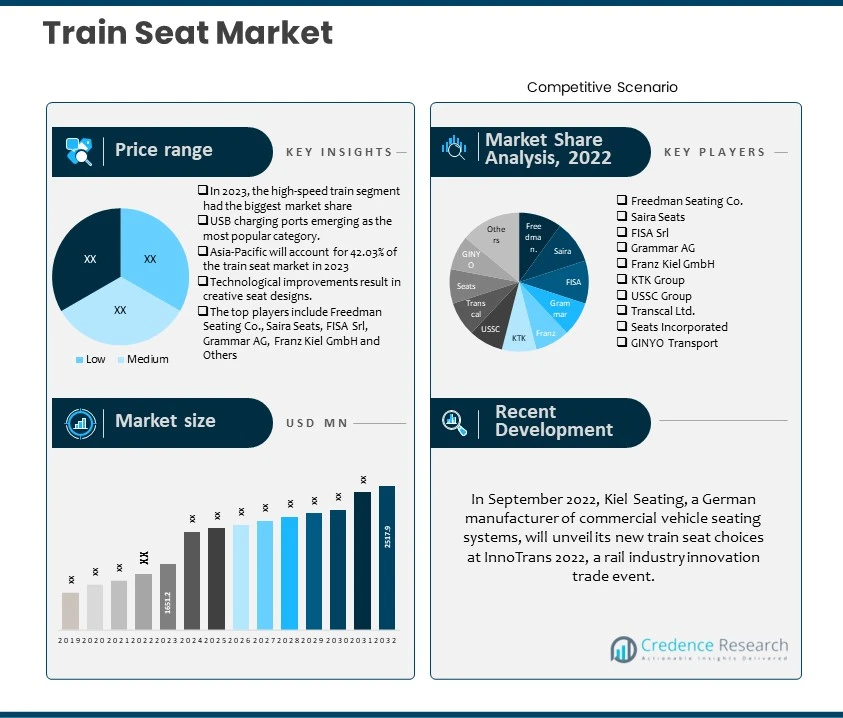
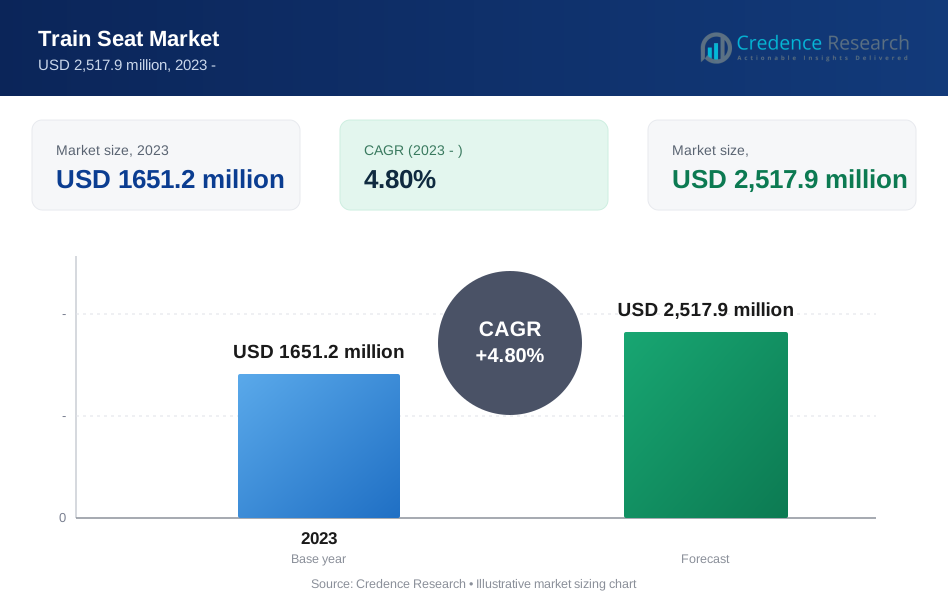
- The global demand for Train Seat was valued at USD 1651.2 million in 2023 and is expected to reach USD 2517.9 million in 2032, growing at a CAGR of 4.80% between 2024 and 2032.
- In 2023, the Standard Seats segment has the largest market share in the Train Seat Market, accounting for around 51.03%. The Premium Economy Seats segment led the industrial market, with a substantial market share.
- The vinyl sector is forecast to see constant, quick revenue development, while the leather segment is expected to see the highest CAGR during the projection period.
- Single Seats are the most common sector. Another popular sector is Double Seats.
- In 2023, the high-speed train segment had the biggest market share in the train seat market, while the long-distance segment had the second-largest revenue market share.
- Rolling stock manufacturers control a substantial percentage of the train seat market.
- Ergonomic Design is predicted to dominate the train seat industry, with USB Charging Ports emerging as the most popular category in the market.
- By 2023, Asia-Pacific will account for 42.03% of the train seat market, while Europe is the fastest-growing area and is expected to have a large market share.
- The increased investment in the railway industry is expected to drive global market growth.
- The train seat manufacturing sector is capital-intensive, which slows market expansion.
Executive Summary
Market Definition
The train seat market refers to the industry that manufactures, distributes, and installs train seats. Train seats are critical to assuring passenger comfort, safety, and convenience during train rides. These seats are intended to offer ergonomic support, durability, and beauty. The market contains a variety of train seats, such as economy class seats, business class seats, first-class seats, and premium seats, to meet the unique needs of passengers throughout train categories.
Market Overview
The global Train Seat Market has witnessed steady growth in recent years and is expected to grow at a CAGR of 4.80% between 2024 and 2032. The market was valued at USD 1651.2 million in 2023 and is expected to reach USD 2517.9 million in 2032.
A train seat is a single seating unit within a train carriage or compartment where passengers sit during their journey. Train seats are an important aspect of passenger comfort and safety since they provide a dedicated space for travelers to sit. These chairs include armrests, tray tables, and adjustable reclining settings.
The train seat market is expanding significantly due to rising population and need for faster, safer, and more pleasant transit. The governments are making significant investments in rail infrastructure and development. Urban quality promotion via high-speed railroads has been examined from a dynamic network perspective, emphasizing the significance of high-speed train networks in urban expansion.
Segmentation by Type of Seat
- In 2023, the Standard Seats segment has the greatest market share in the Train Seat Market, accounting for around 41.03%. According to Credence Research, the segment is predicted to rise at a 3.9% CAGR over the forecast period and keep its dominance until 2030. The standard Seat segment dominates due to its low cost, space-saving design, and versatility; the size is appropriate for local and regional trains.
- The Premium Economy Seats segment led the industry market with a significant market share in 2023 due to its superior comfort compared to other seats available in the market. These seats generally have extra padding, reclining features, and large legroom. They are also associated with a sense of sophistication and status, attracting consumers who are more likely to pay a premium for an elevated and unique experience during the journey.
Segmentation by Material
- During the forecast period, the vinyl sector is predicted to experience consistent, rapid revenue growth in the worldwide train seat market. Vinyl seat covers are suitable for high-traffic train travel environments. They are extremely resilient and impervious to wear and tear. These seat coverings also provide a sanitary seating option that is easy to keep and clean.
- The leather segment is expected to see the highest CAGR during the projection period. The train seat materials market is rapidly transitioning from traditional leather to e-leather fabrics. Transport companies are making large investments to maintain the quality and appearance of the fabric used on train seats.
Segmentation By Seating Arrangement
- Single Seats are the most popular sector because they provide passengers with personal privacy and comfort, particularly for those flying alone.
- Another popular sector is Double Seats, which cater to couples, friends, and tourists who wish to sit together on the journey.
Segmentation by Application
- The High-speed Train Segment has the greatest market share in the Train Seat Market in 2023 and is predicted to maintain its dominance until 2032. High-speed trains provide transportation that is comfortable, efficient, safe, and environmentally friendly at a reasonable cost.
- The long-distance segment had the second-largest revenue market share in 2023, owing largely to the increasing prevalence or proliferation of trains as a highly effective mode of transportation for longer distances. Trains provide a balance of comfort and speed while also reducing road congestion.
Segmentation by End-User
- Rolling Stock Manufacturers have a sizable portion of the train seat market. Rolling stocks have a safe operating space, which ensures that the profile established for rolling stock, structures, and equipment near the line is not exceeded.
Segmentation by Features and Technology
- The Ergonomic Design sector is expected to dominate the train seat market. This characteristic is critical since it focuses on offering maximum comfort and support to passengers during their voyage, making it a crucial aspect in the overall appeal of train seats.
- USB Charging Ports have emerged as the most popular category in the train seat market, owing to passengers' increased dependency on electronic devices while traveling. With the need to be connected, passengers cherish the ability to charge their gadgets while traveling.
Segmentation by Region
- In 2023, Asia-Pacific holds a 42.03% share of the train seat market.
- Europe is the fastest-growing region, projected to have a significant market share by 2023.
- The rest of the world, including Latin America, the Middle East, and Africa, supplies the remaining demand for Train Seat.
Asia-Pacific currently dominates the Train Seat Market. The region is predicted to increase throughout the forecast period and retain its dominance through 2030. The Asia-Pacific region is the largest market due to its large population, the importance of transportation, and the high traffic density in countries such as China and India. So, high-speed trains and metro trains are rapidly expanding. India is investing heavily to improve the train transportation system, promote intercity trade, and build new metro projects. The government's Make in India policy prioritized promoting development operations within the country. They are making significant investments in train infrastructure development and upgrades, recognizing the economic and social benefits of strong rail networks. It has generated a significant demand for new train seats, which is projected to drive the train seat market.
Moreover, Europe is the fastest-growing region, with a sizable market share by 2023. The area is predicted to develop at a CAGR of 3.8% throughout the forecast period, maintaining its dominance by 2030. In Europe, focusing on producing sustainable and eco-friendly seat materials, as well as prioritizing passenger comfort with train seats, results in an increase in demand for reclining chairs with various functions, which promotes the growth of the Train Seat Market.
Key Highlights of the Report
The global Train Seat Market is segmented based on Type of Seat, Material, Seating Arrangement, Application, End-User, Features and Technology, and region. In 2023, the Standard Seats sector will have the most market share, with the leather segment projected to have the highest CAGR. Additionally, single seats are the most popular, with long-distance segments accounting for the second-largest revenue market share in 2023. Also, the long-distance sector had the second-largest revenue market share in 2023 Asia-Pacific is driving market expansion.
The market drivers section focuses on the variables that promote the growth of the train seat industry. These drivers could include increased train passenger volumes and a growing demand for comfortable and expensive rail travel. Furthermore, these constraints may include expensive production and maintenance costs, regulatory hurdles, and limited space available in trains. Additionally, these opportunities may arise from the introduction of innovative materials and technology, the formation of new market segments, and the desire for eco-friendly and sustainable seating solutions.
Asia Pacific now dominates the train seat market. The region is expected to grow over the projected period, maintaining its dominance until 2030. Furthermore, Europe is the fastest-growing region, with a significant market share by 2023. The area is projected to grow at a CAGR of 3.8% throughout the forecast period, maintaining its dominance by 2030.
What Are The Main Drivers Of The Global Train Seat Market?
The market drivers section focuses on the variables that promote the growth of the train seat industry. These factors could include increased train passenger volumes, rising desire for comfortable and luxurious train travel, government measures to improve rail infrastructure, technological breakthroughs in seat production, and increased awareness of passenger safety and comfort. Understanding market drivers helps firms find growth possibilities and establish appropriate strategies.
What Are The Major Challenges Faced By The Global Train Seat Market?
The market restraints section looks at the factors that impede the growth of the train-seat industry. These constraints may include expensive manufacturing and maintenance costs, regulatory issues, restricted space available on trains, and the necessity for frequent refurbishing. Identifying market limitations helps industry participants understand their difficulties and find solutions.
What Are The Growth Opportunities In The Global Train Seat Market?
The market opportunities section delves into prospective growth prospects and unexplored opportunities in the train seat industry. These opportunities may come as a result of the introduction of sophisticated materials and technologies, the formation of new market segments, the desire for eco-friendly and sustainable seating solutions, and the growth of railway networks in emerging countries.
Market Drivers
Several factors drive the global Train Seat Market. The following are the key drivers of the global Train Seat Market:
Increasing Investment In The Railway Industry Is Predicted
Railways are one of the most essential modes of transportation in emerging countries, where train infrastructure is well established. Increased investment in the railway industry will result in increased manufacturing of railway cars, which is likely to boost demand for railway seating materials in the near future. These investments in the rail industry are being pushed by increased urbanization, energy shortages and concerns about green mobility. For example, according to figures published in September 2022 by IBEF (India Brand Equity Foundation), a trust formed by the Ministry of Commerce, Government of India, FDI inflows into railway-related components were US$ 1.23 billion.
Market Restraints
The global Train Seat Market faces some challenges that may hinder its growth. These include the following:
Train Seat Manufacturing Sector Is Capital-Intensive
The railway sector is regarded as one of the most capital-intensive sectors in the economy. The magnitude of operations in the sector makes it one of the most major cost centers. The ancillary industries that support railways are similarly capital-intensive. The government generally orders large amounts of railway components and parts. This necessitates large-scale manufacturing facilities, as well as the procurement of vast quantities of material.
For instance, according to data provided in March 2021 by the Indian Railways portal, the cost of manufacturing various types of train coaches/compartments can reach $1.10 million. Moreover, the market typically has a bigger order quantity. This significant investment in the train manufacturing industry would be unable to attract new participants, stifling growth in the worldwide train seat materials market throughout the projection period.
Opportunities
The global Gasket and seal market offers significant growth opportunities. These include the following:
Introducing New Train Types
Countries emphasizing the importance of public transportation recognize that trains play an important role in encouraging the adoption of public transit. As a result, governments around the world are focusing on the introduction of new trains such as high-speed trains, metros, and various types of intra-city locomotives. These trains are used for both shuttle services and long travels.
For instance, in February 2023, Alstom, a France-based multinational business that manufactures roll stock for the rail industry, announced the launch of a new model of TGV M train that will operate in France and other parts of Europe. The train would be specifically intended to fulfill the interests of international tourists who want to take a picturesque route through Europe. Thus, the creation of new trains would automatically increase demand for train seats and related materials, resulting in the rise of the worldwide train seat materials market over the forecast period.
Competitive Landscape
Key Players
The global Train Seat Market is highly competitive, with several key players. Some of the major players in the market and their market share are as follows:
- Freedman Seating Co.
- Saira Seats
- FISA Srl
- Grammar AG
- Franz Kiel GmbH
- KTK Group
- USSC Group
- Transcal Ltd.
- Seats Incorporated
- GINYO Transport
These organizations prioritize product innovation, Service Provider expansion, and mergers and acquisitions to stay competitive.
The global Train Seat Market's key players continually seek to stay ahead by offering new products and developments.
In September 2021, Grammer announced its entrance into the Chinese automotive industry with the establishment of a new manufacturing plant in Shenyang. The plant produces high-quality center consoles and other interior components for a variety of vehicles, such as trains, lorries, and buses. The new industrial factory has an area of 8,000 square meters, with 3,500 square meters of production space.
In July 2022, Tata Steel Ltd. plans to invest USD 3.65 billion in R&D by 2025-2026, including introducing the 'First in India' seat system for the next-generation Vande Bharat Express. The next-generation Vande Bharat Express has made a USD 176 million deal with Tata Steel's composite business to construct and supply seating systems. This includes the installation of complete seating structures for 22 train seats, each with 16 cars. These chairs have been specifically designed, can spin 180 degrees, and have amenities similar to those seen in flights.
In August 2021, FISA srl, an Italian manufacturer of railway interior items, stated that it would provide LEAN seats for East Midlands Railway's new Aurora fleet.
Summary of Key Findings
- Introducing new train types
- The market is segmented by Type of Seat, Material, Seating The leather category is likely to witness the highest CAGR during the projection period
- Ergonomic Design is predicted to dominate the train seat industry
- Adult patients are the main Application in the Train Seat Market.
- Asia-Pacific is leading market growth. The market is highly competitive, with key players including Freedman Seating Co., Saira Seats, FISA Srl, Grammar AG, Franz Kiel GmbH and Others.
Future Outlook
- Increasing need for comfortable and ergonomic sitting choices.
- Technological improvements result in creative seat designs.
- Increased emphasis on passenger safety and convenience.
- A growing trend of customisation and personalization in train seating
How CXOs Can Benefit from the Credence Research Train Seat Market Report
The Credence Research Train Seat Market Report provides CXOs with a comprehensive overview of the market, including:
- Market Size and Growth Forecast:The report provides detailed estimates of the global Train Seat Market segmented by Type of Seat, Material, Seating Arrangement, Application, End-User, Features and Technology, and Region. It also includes forecasts for the market through 2032 based on key trends and drivers.
- Market segmentation:The report segments the Train Seat Market by Type of Seat, Material, Seating Arrangement, Application, End-User, Features and Technology, and Region. This segmentation provides CXOs with a granular understanding of the market and the opportunities in each segment.
- Competitive Landscape:The report profiles the key players in the Train Seat Market and provides insights into their strategies, product offerings, and financial performance. This information can help CXOs to identify and assess their competition.
- Key trends and drivers:The report identifies and analyzes the key trends and drivers shaping the Train Seat Market. This information can help CXOs make informed decisions about their investments and strategies.
CXOs can use the insights from the Credence Research Train Seat Market Report to:
- Identify growth opportunities:The report can help CXOs identify new growth opportunities in the Train Seat Market. It provides valuable insights and analysis that can assist them in making informed decisions and strategic plans for their businesses.
- Make in Informed investment decisions:The report can help CXOs to make informed investment decisions about Train Seat. For example, it provides valuable market insights such as growth trends, market size, and competitive analysis. CXOs can use this information to assess the potential profitability and growth opportunities in the Train Seat Market.
- Develop competitive strategies:The report can help CXOs develop competitive strategies for their Train Seat businesses. It provides insights into market trends, customer preferences, and competitive landscape analysis.
- Track market developments:The report can help CXOs track market developments and stay ahead of the curve. For example, It provides valuable insights and analysis that can inform strategic decision-making and help them stay ahead of the competition.
Overall, the Credence Research Train Seat Market Report is a valuable resource for CXOs who are looking to gain a deeper understanding of the market and identify opportunities for growth.
Segmentation
- By Type of Seat:
- Standard Seats
- Reclining Seats
- Folding Seats
- Fixed Seats
- Standing Seats
- Bench Seats
- First-Class Seats
- Business-Class Seats
- Premium Economy Seats
- Economy Seats
- Others
- By Material:
- Fabric Seats
- Leather Seats
- Vinyl Seats
- Foam Seats
- Plastic Seats
- Metal Seats
- Others
- By Seating Arrangement:
- Single Seats
- Double Seats
- Three-Seater Configuration
- Four-Seater Configuration
- Facing Seats
- Group Seating
- Others
- By Application:
- Commuter Trains
- High-Speed Trains
- Long-Distance Trains
- Metro and Subway Trains
- Light Rail and Trams
- Tourist Trains
- Others
- By End-User:
- Train Operators
- Railway Authorities
- Rolling Stock Manufacturers
- Others
- By Features and Technology:
- Adjustable Headrests
- Armrests
- Footrests
- Seat Belts
- Ergonomic Design
- Integrated Entertainment Systems
- USB Charging Ports
- Wi-Fi Connectivity
- Others
- North America
- The U.S.
- Canada
- Mexico
- Europe
- Germany
- France
- The U.K.
- Italy
- Spain
- Rest of Europe
- Asia Pacific
- China
- Japan
- India
- South Korea
- South-east Asia
- Rest of Asia Pacific
- Latin America
- Brazil
- Argentina
- Rest of Latin America
- Middle East & Africa
- GCC Countries
- South Africa
- Rest of the Middle East and Africa
Request a Free Sample
Fill in your details and we'll send you a free sample report.
- Sample data tables & charts
- Research methodology
Need a Custom Version of This Report?
Tailor the scope, geography, or segments to your exact requirements.
- Custom geography or segment scope
- Direct access to our analyst team
Frequently Asked Questions
What is the current Type of Seat of the global Train Seat Market?
What is the expected growth rate of the Train Seat Market between 2024 and 2032?
Which segment is leading the market share in terms of Type of Seat?
Which End-User segment governs the demand for rapid pharmaceutical microbiology testing in the world?
Who are the major players in the global Train Seat Market?
Table of Content
Chapter 1. Report Introduction
- 1.1 Report Description & Purpose
- 1.1.1 Report Title & Market Definition
- 1.1.2 Unique Selling Propositions (USP) & Key Differentiators
- 1.1.3 Value Proposition for Stakeholders
- 1.2 Research Objectives
- 1.2.1 Market Sizing Objectives (Volume & Revenue)
- 1.2.2 Segmentation Objectives
- 1.2.3 Competitive Intelligence Objectives
- 1.2.4 Forecast & Scenario Objectives
- 1.3 Report Scope
- 1.3.1 Train Seat Scope – Types & Subtypes Covered
- 1.3.2 Geographic Scope – Regions & Countries Covered
- 1.3.3 Historical Period, Base Year & Forecast Period (2023; forecast to the forecast period)
- 1.3.4 Inclusions & Exclusions
- 1.4 HS Code & Classification Framework
- 1.5 Currency, Units & Pricing Basis
- 1.6 Target Stakeholders
- 1.7 Limitations & Assumptions
Chapter 2. Executive Summary
- 2.1 Global Train Seat Market Snapshot
- 2.1.1 Market Size – Historical (2023) & Forecast (the forecast period) (2023: USD 1651.2 million → forecast year: USD 2,517.9 million)
- 2.1.2 Volume & Revenue – Global Totals
- 2.1.3 Key Market Highlights – Top Five Facts
- 2.2 Train Seat Market Segmentation Snapshot
- 2.2.1 Market Split by Region – 2023 vs.
- 2.3 Competitive Snapshot
- 2.3.1 Top 10 Players by Revenue Share – 2023
- 2.3.2 Top 10 Players by Volume Share – 2023
- 2.3.3 Recent Strategic Developments (18-Month Summary)
- 2.4 Key Investment Highlights & Strategic Conclusions
Chapter 3. Train Seat Market Dynamics & Industry Analysis
- 3.1 Market Overview & Context
- 3.1.1 Train Seat Market Position in the Broader Automotive Value Chain
- 3.1.2 OEM vs. Replacement Market Dynamics
- 3.1.3 Market Maturity & Development Stage by Region
- 3.2 Train Seat Market Drivers
- 3.3 Train Seat Market Restraints & Challenges
- 3.4 Train Seat Market Opportunities
- 3.5 Porter's Five Forces Analysis
- 3.5.1 Threat of New Entrants
- 3.5.2 Bargaining Power of Suppliers
- 3.5.3 Bargaining Power of Buyers
- 3.5.4 Threat of Substitutes
- 3.5.5 Competitive Rivalry – Intensity Assessment
- 3.6 Train Seat Value Chain Analysis
- 3.6.1 Upstream – Raw Material/Input Suppliers
- 3.6.1.1 Raw Material/Input 1
- 3.6.1.2 Raw Material/Input 2
- 3.6.1.3 Raw Material/Input 3
- 3.6.2 Midstream – Production/Manufacturing/Service Delivery
- 3.6.2.1 Production/Process Overview
- 3.6.2.2 Key Facility Locations & Capacity by Manufacturer
- 3.6.3 Downstream – Distribution & End Consumer
- 3.6.3.1 Primary Channel – B2B/OEM
- 3.6.3.2 Secondary Channels – Dealer, Retail, Online, Direct
- 3.6.4 Value Chain Profitability Analysis
- 3.6.1 Upstream – Raw Material/Input Suppliers
- 3.7 PESTEL Analysis
- 3.7.1 Political Factors
- 3.7.2 Economic Factors
- 3.7.3 Social Factors
- 3.7.4 Technological Factors
- 3.7.5 Environmental Factors
- 3.7.6 Legal Factors
- 3.8 Train Seat Supply Chain Analysis
- 3.8.1 Raw Material/Input Supply Risk Assessment
- 3.8.2 Manufacturing Concentration Risk (Geographic Exposure)
- 3.8.3 Trade Disruption Impact Analysis
- 3.9 Regulatory & Policy Landscape
Note: The regulatory and policy landscape section covers regulations based on their applicability to the market, Train Seat category, geography, and scope of the study. Only regulatory frameworks with a material impact on operations, compliance, trade, sustainability, or market access are analyzed in detail.
Chapter 4. Key Investment Pockets & Opportunity Analysis
- 4.1 Train Seat Market Attractiveness Analysis
- 4.1.1 By Region – Investment Attractiveness Matrix (Volume × CAGR)
- 4.2 Absolute Revenue Growth Opportunity
- 4.2.1 By Region – Absolute USD Growth Through the forecast period
- 4.3 Incremental Volume Opportunity
- 4.3.1 By Region – Incremental Volume Through the forecast period
- 4.3.2 Segment – Incremental Volume
- 4.4 Emerging Submarket Opportunity Deep Dive (Subject to Applicability)
- 4.5 Emerging Market Opportunity Scorecards
- 4.5.1 United States
- 4.5.2 Europe
- 4.5.3 Asia
- 4.5.4 Middle East & Africa
Note: Emerging Market Opportunity Scorecards will be included based on relevance and strategic importance. Regions listed are indicative and may vary depending on data availability and market dynamics.
Chapter 5. Train Seat Import-Export Analysis & Trade Flows
- 5.1 Global Trade Overview
- 5.1.1 Global Export Value by Country (2023)
- 5.1.2 Global Export Volume by Country (2023)
- 5.1.3 Global Import Value by Country (2023)
- 5.1.4 Global Import Volume by Country (2023)
- 5.1.5 Net Trade Balance by Country (2023)
- 5.2 Export Analysis – Segment
- 5.2.1 Type 1 (HS Code)
- 5.2.2 Type 2 (HS Code)
- 5.2.3 Type 3 (HS Code)
- 5.2.4 Type 4 (HS Code)
- 5.2.5 Type 5 (HS Code)
- 5.3 Import Analysis – Segment
- 5.3.1 Type 1 (HS Code)
- 5.3.2 Type 2 (HS Code)
- 5.3.3 Type 3 (HS Code)
- 5.3.4 Type 4 (HS Code)
- 5.3.5 Type 5 (HS Code)
- 5.4 Average Unit Trade Prices
- 5.4.1 Average Export Price – Segment & Country
- 5.4.2 Average Import Price – Segment & Source Country
- 5.4.3 Price Trends (2023)
- 5.5 Key Trade Route Analysis
- 5.5.1 Trade Route 1
- 5.5.2 Trade Route 2
- 5.5.3 Trade Route 3
- 5.5.4 Trade Route 4
- 5.5.5 Trade Route 5
- 5.6 Trade Policy Impact Assessment
- 5.6.1 US Anti-Dumping & Section 301 Tariffs
- 5.6.2 EU Customs Union Impact
- 5.6.3 Major Free Trade Agreements
- 5.6.4 USMCA Rules of Origin
Note: Trade policy analysis will be included only where relevant to the Train Seat market.
Chapter 6. Competitive Landscape & Company Benchmarking
- 6.1 Train Seat Market Concentration & Structure
- 6.1.1 Herfindahl-Hirschman Index (HHI) – vs. 2023
- 6.1.2 Tier 1, Tier 2 & Tier 3 Market Structure
- 6.1.3 Global, Regional & Local Player Dynamics
- 6.2 Train Seat Market Share Analysis – 2023
- 6.2.1 Global Revenue Share by Company
- 6.2.2 Global Volume Share by Company
- 6.2.3 Regional Revenue Share
- 6.2.4 Market Share Evolution ( vs. 2023)
- 6.2.5 OEM Segment Share by Company
- 6.2.6 Replacement Segment Share by Company
- 6.3 Production/Delivery Capacity & Facility Analysis
- 6.3.1 Global Installed Capacity
- 6.3.2 Capacity Utilization Rates
- 6.3.3 Production/Output Volume
- 6.3.4 Facility Locations & Capacity Map
- 6.3.5 Planned Capacity Additions
- 6.4 Train Seat Competitive Benchmarking Matrix
- 6.4.1 Revenue, Volume, CAGR & Profitability Comparison
- 6.4.2 Channel Revenue Mix
- 6.4.3 Geographic Revenue Exposure
- 6.4.4 R&D Intensity
- 6.4.5 Sustainability Maturity
- 6.5 Strategic Developments in Train Seat (Last 24 Months)
- 6.5.1 Mergers, Acquisitions & Divestments
- 6.5.2 New Train Seat Launches
- 6.5.3 Facility Expansions
- 6.5.4 Strategic Alliances, Joint Ventures & Partnerships
- 6.5.5 Distribution Expansion & Market Entry
- 6.5.6 Sustainability & ESG Initiatives
- 6.6 Competitive Strategy Mapping
- 6.6.1 Leader, Challenger, Follower & Niche Classification
- 6.6.2 Pricing Strategy Comparison
- 6.6.3 Channel Strategy Matrix
Note: Strategic developments are included based on their materiality and the availability of reliable information.
Chapter 7. Global Train Seat Market – By Distribution Channel
- 7.1 Segment Overview
- 7.1.1 Volume & Revenue Split by Channel (2023 & )
- 7.1.2 Channel Mix Evolution (the forecast period)
Chapter 8. Regional Market Analysis – Global Overview
- 8.1 Global Regional Overview
- 8.1.1 Regional Volume Share
- 8.1.2 Regional Revenue Share
- 8.1.3 Regional Volume by Region
- 8.1.4 Regional Revenue by Region
- 8.1.5 Regional Forecast Through the forecast period
- 8.2 Cross-Regional Segment Analysis
- 8.2.1 By Distribution Channel
- 8.2.2 By Brand/Price Tier
Chapter 9. North America Train Seat Market
- 9.1 United States
- 9.2 Canada
- 9.3 Mexico
Chapter 10. Europe Train Seat Market
- 10.1 Germany
- 10.2 France
- 10.3 Italy
- 10.4 United Kingdom
- 10.5 Spain
- 10.6 Poland
- 10.7 Russia
- 10.8 Netherlands
- 10.9 Belgium
- 10.10 Sweden
- 10.11 Denmark
- 10.12 Norway
- 10.13 Rest of Europe
Chapter 11. Asia Pacific Train Seat Market
- 11.1 China
- 11.2 India
- 11.3 Japan
- 11.4 South Korea
- 11.5 Thailand
- 11.6 Indonesia
- 11.7 Vietnam
- 11.8 Malaysia
- 11.9 Australia
- 11.10 Rest of Asia Pacific
Chapter 12. Latin America Train Seat Market
- 12.1 Brazil
- 12.2 Argentina
- 12.3 Colombia
- 12.4 Chile
- 12.5 Rest of Latin America
Chapter 13. Middle East Train Seat Market
- 13.1 Saudi Arabia
- 13.2 United Arab Emirates
- 13.3 Turkey
- 13.4 Israel
- 13.5 Iran
- 13.6 Rest of the Middle East
Chapter 14. Africa Train Seat Market
- 14.1 South Africa
- 14.2 Egypt
- 14.3 Nigeria
- 14.4 Morocco
- 14.5 Rest of Africa
Chapter 15. Train Seat Company Profiles
- 15.1 [Company 01]
- 15.1.1 Company Overview
- 15.1.2 Key Management Personnel
- 15.1.3 Products & Services Portfolio
- 15.1.4 Financial Performance
- 15.1.5 Key Market Focus & Geographic Presence
- 15.1.6 Recent Developments & Strategic Initiatives
Note: The company profile list is preliminary and may change based on research findings, market developments, data availability, and client requirements.
Chapter 16. Appendices
- Appendix A – List of Abbreviations & Acronyms
- Appendix B – Industry Classification Code Reference – Full Series
- Appendix C – Production & Capacity Data Tables
- Appendix D – End-Use & Demand Base Tables
- Appendix E – Consumption & Replacement Rate Assumptions
- Appendix F – ASP Reference Tables
- Appendix G – Manufacturing & Facility Database
- Appendix H – Import-Export Data Tables
- Appendix I – Regulatory Summary Tables
- Appendix J – Primary Research Participant List (Anonymized)
- Appendix K – Primary Research Questionnaire Framework
- Appendix L – Data Sources & Bibliography
- Appendix M – Market Size Divergence & Source Comparison
Chapter 17. Research Methodology
- 17.1 Research Framework & Philosophy
- 17.2 Secondary Research – Sources, Hierarchy & Data Extraction
- 17.3 Data Modeling – Bottom-Up & Top-Down Market Sizing
- 17.4 Primary Research – Stakeholder Framework, LOI & Sample Sizes
- 17.5 Forecast Methodology – Regression, Scenario & Sensitivity Analysis
- 17.6 Quality Control – Four-Layer Validation Framework
- 17.7 Limitations & Standard Assumptions
- 17.8 Disclaimer
