
| REPORT ATTRIBUTE | DETAILS |
|---|---|
| Historical Period | 2019-2022 |
| Base Year | 2023 |
| Forecast Period | 2024-2032 |
| Transportation Fuel Market Size 2023 | USD 808,154.2 Million |
| Transportation Fuel Market, CAGR | 3.00% |
| Transportation Fuel Market Size 2032 | USD 1,054,457.929 Million |
Market Insights
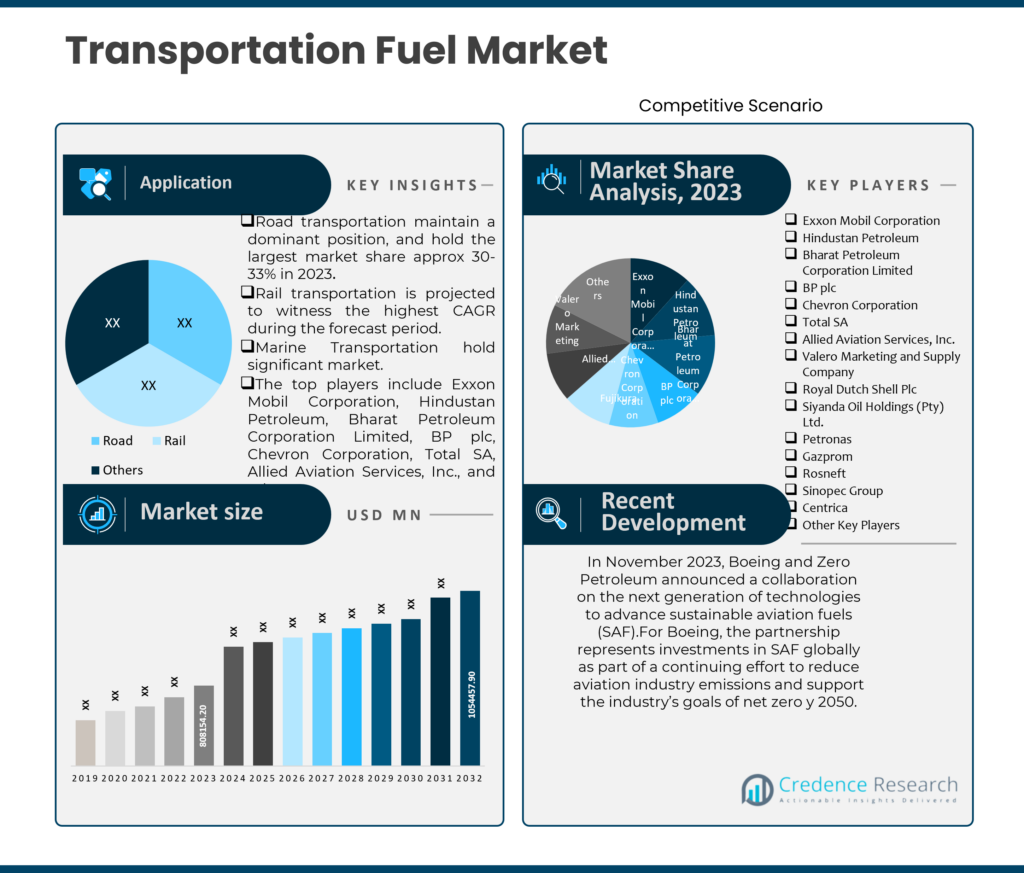
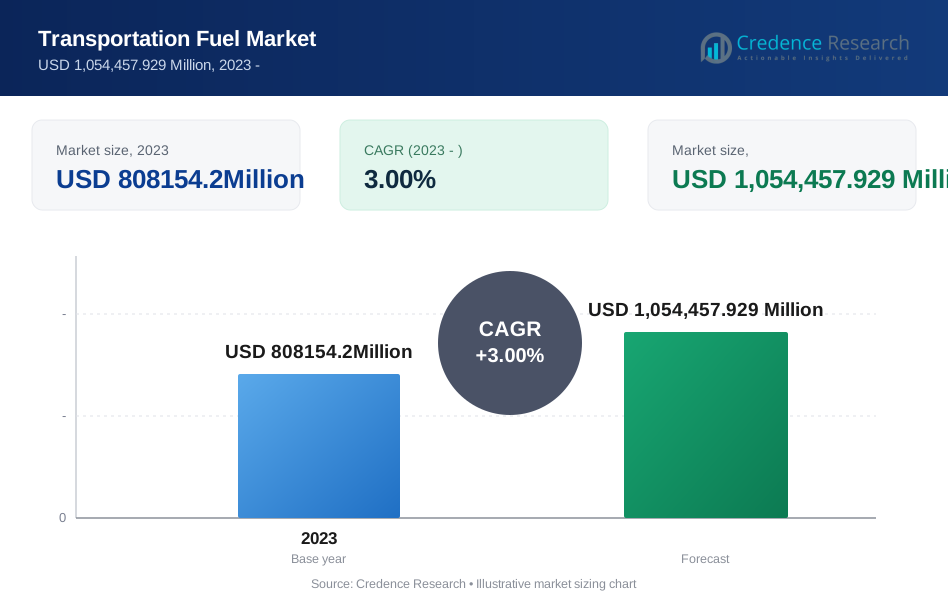
- The transportation fuel market had a valuation of USD 808,154.2 Million in 2023 and is anticipated to grow to USD 1,054,457.929 Million by 2032, with a CAGR of 3.00%. This indicates steady growth in the market over the forecast period.
- Among the key segments, Petroleum-based Fuels emerged as the market leader by type, holding approximately 80-90% of the total market share in 2023. However, Alternative Fuels are expected to witness the highest growth rate during the forecast period.
- Regular Grade Fuels currently hold the largest market share by grade or quality, accounting for approximately 35-40% in 2023, owing to their standard offerings and affordability.
- Road Transportation holds the largest market share by application, constituting approximately 30-33% of the total market in 2023, driven by the extensive use of petroleum-based fuels in automobiles, buses, and trucks.
- North America holds the largest share of the Transportation Fuel Market, accounting for approximately 35-38% of the market in 2023. The region's dominance is attributed to several factors including robust infrastructure, significant industrial development, and a large consumer base driving demand for transportation fuels. Additionally, North America boasts abundant energy resources, including crude oil reserves and natural gas, supporting the production and distribution of petroleum-based fuels. Moreover, the region's commitment to technological innovation and sustainable practices further enhances its position in the transportation fuel market.
Executive Summary
Market Definition
Transportation fuels play a pivotal role in powering global mobility across all modes of transport. As individuals increasingly opt for private transportation due to the advantages it offers in terms of comfort, affordability, and time efficiency, there has been a notable surge in vehicle ownership worldwide. Consequently, this surge has driven a parallel increase in the demand for transportation fuels. However, the environmental impact stemming from the combustion of these fuels poses a significant challenge to the Transportation Fuel Market, acting as a restraint on its growth trajectory. The implementation of stringent emission control norms by governments globally underscores the urgency to address pollution caused by transportation fuel combustion. In response to these regulations, there has been a notable uptick in the utilization of alternative fuels not derived from crude oil. This shift not only reflects a commitment to environmental sustainability but also presents an opportunity for the transportation market to diversify its fuel sources, thereby fostering innovation and inviting new competitors into the market landscape.
Market Overview
- The Transportation Fuel Market achieved a valuation of USD 808154.2 Million in 2023 and is projected to escalate to USD 1054457.9 Million by 2032, showcasing a robust CAGR of 3.00% from 2024 to 2032.
- Petroleum-based Fuels emerged as the dominant segment by type, constituting approximately 35-38% of the total market share in 2023. This segment's growth is primarily attributed to its widespread applications in road transportation, aviation, marine transportation, and off-road vehicles.
- Alternative Fuels are anticipated to witness significant growth during the forecast period, driven by increased environmental concerns, government regulations promoting clean energy initiatives, and technological advancements.
- Road Transportation holds the largest market share by application in 2023, accounting for a significant portion of the total market. The increasing demand for transportation fuels in road transportation drives the growth of the segment.
- Regular Grade Fuels dominate the market by grade or quality segmentation, holding approximately 35-40% of the market share in 2023. The consistent demand for regular-grade fuels contributes to its significant market presence.
Segmentation by Type of Fuel
- Petroleum-based fuels continue to dominate the transportation fuel market segment, accounting for 80-90% market share of global fuel consumption. These fuels, including gasoline, diesel, and aviation fuel, are derived from crude oil and remain the primary choice for powering various modes of transportation such as automobiles, trucks, ships, and airplanes. Despite increasing awareness of environmental concerns and efforts to transition to alternative fuels, petroleum-based fuels maintain their dominance due to factors such as infrastructure availability, energy density, and established supply chains.
- The alternative fuels segment is projected to witness the highest CAGR during the forecast period. The adoption of alternative fuels is driven by various factors, including environmental regulations, energy security concerns, and the desire to reduce greenhouse gas emissions and dependence on fossil fuels. While alternative fuels currently represent a smaller share of the transportation fuel market, ongoing advancements in technology and supportive policies are expected to drive their increased adoption in the coming years.
Segmentation by Application
- In the road transportation segment, petroleum-based fuels maintain a dominant position, and hold the largest market share approx 30-33% in 2023, powering a wide range of vehicles including automobiles, buses, and trucks. Despite increasing efforts to transition to alternative fuels, petroleum-based fuels remain the preferred choice due to their established infrastructure, energy density, and widespread availability.
- Rail transportation is projected to witness the highest CAGR during the forecast period. Rail transportation relies primarily on diesel fuel for locomotives, particularly in freight and long-distance passenger services. Diesel-electric locomotives dominate the rail transportation sector, offering high torque and fuel efficiency for hauling heavy loads over long distances. However, environmental concerns and regulatory pressures are driving the exploration of cleaner alternatives such as biodiesel and hydrogen fuel cells for rail transportation applications.
- In marine transportation, fuel plays a crucial role in powering a wide array of vessels, including cargo ships, tankers, container ships, cruise liners, and ferries. The adoption of liquefied natural gas (LNG) as a marine fuel is increasing, driven by its lower emissions profile and compliance with stricter environmental regulations. As the maritime industry faces increasing pressure to reduce its carbon footprint and comply with emissions regulations, the exploration of alternative fuels and propulsion technologies is expected to accelerate, reshaping the landscape of marine transportation fuels.
- In the aviation sector, the pursuit of sustainable aviation fuels (SAFs) is poised to witness rapid growth, fuelled by regulatory mandates, sustainability goals, and industry collaboration. With increasing pressure to address climate change and curb greenhouse gas emissions, airlines, aircraft manufacturers, and governments are actively investing in SAF production, research, and deployment initiatives.
- Off-road and specialty vehicles encompass a diverse range of applications, including construction equipment, agricultural machinery, mining vehicles, and industrial vehicles. Petroleum-based fuels, such as diesel and gasoline, are commonly used to power off-road and specialty vehicles due to their energy density, high power output, and availability. As technology advances and regulatory pressures intensify, the adoption of alternative fuels and propulsion systems in the off-road and specialty vehicle segment is expected to grow, leading to a more diversified and sustainable fuel mix in the market.
Segmentation by Grade or Quality
- Regular grade fuels hold the largest market share approx 35-40% in 2023. Regular grade fuels represent the standard offerings in the transportation fuel market, catering to the majority of consumers' needs. Regular grade fuels are widely available at fueling stations and are typically priced lower than premium grade fuels, appealing to cost-conscious consumers seeking economical options for their transportation needs.
- Premium grade fuels have a higher octane rating compared to regular grade fuels, typically ranging from 91 to 94 octane or higher. These fuels are designed for vehicles that require higher octane levels to prevent engine knocking and optimize performance, such as high-performance sports cars or vehicles with turbocharged engines.
- Sulfur content is an important factor in fuel quality, as sulfur emissions contribute to air pollution and can harm the environment. Low-sulfur and ultra-low sulfur fuels have significantly reduced levels of sulfur compared to traditional fuels. Low-sulfur fuels typically contain less than 500 parts per million (ppm) of sulfur, while ultra-low sulfur fuels contain 15 ppm or less. These fuels help reduce emissions of sulfur dioxide and particulate matter, leading to cleaner air and improved public health.
- Biofuel blends are fuels that contain a mixture of conventional petroleum-based fuels and renewable biofuels derived from organic sources such as corn, sugarcane, soybeans, or biomass. Biofuel blends offer environmental benefits such as reduced greenhouse gas emissions and decreased reliance on fossil fuels.
Segmentation by Region
- In 2023, North America hold largest share of the transportation fuel market, accounting for approximately 35-38%. The region is home to major players in the transportation fuel industry such as Exxon Mobil Corporation, Chevron Corporation, Valero Marketing and Supply Company, and others. The presence of these companies, coupled with the region's high consumption of transportation fuel due to extensive road networks and significant automotive usage, solidifies North America's position as a key player in the transportation fuel market.
- Europe and Asia Pacific together hold just under 55% share of the transportation fuel market in 2023. Asia Pacific emerges as a significant contributor, holding over 20% shares in the same year. In Europe, key companies like BP plc, Total SA, and Royal Dutch Shell Plc play a crucial role in shaping the transportation fuel landscape. The demand for transportation fuel in these regions is driven by factors such as economic growth, urbanization, and increasing mobility needs.
- The remaining demand for transportation fuel comes from the rest of the world, including Latin America, the Middle East, and Africa. Companies like Petronas, Gazprom, and Sinopec Group have a notable presence in these regions. Factors such as growing populations, expanding economies, and infrastructural developments contribute to the demand for transportation fuel in these areas.
North America hold largest share of the transportation fuel market. This leadership position can be attributed to a number of factors, including the region’s extensive transportation infrastructure, increased urbanization, and significant industrial activity, particularly the US and Canada for their large automobile industries, extensive road networks and strong commercial transportation networks contribute significantly to the fuel market. In addition, North America has a well-established petroleum industry, with substantial reserves and capacity efficiencies to continue to supply transportation fuels such as gasoline, diesel and aviation fuel owned by the industry focus on technological advancements and environmental regulations adoption of cleaner and more efficient fuel alternatives such as biofuels and natural gas has also driven market growth. Asia Pacific hold prominent share of the transportation fuel market. The dominance of the region can be attributed to rapid industrialization, population growth and expanded transport infrastructure. Countries such as China, India and Japan are the major contributors to the transportation fuel market in Asia-Pacific, driven by their large automotive industries, booming commercial transportation and increasing urbanization. Furthermore, Asia Pacific has the fastest growing economies in the world, driving up energy demand and fuel consumption. The region’s abundant natural resources, including substantial oil and gas reserves, play an important role in meeting this growing demand, providing access to transportation fuels such as gasoline, diesel and crude aviation fuels.
Key Highlights of the Report
The Transportation Fuel Market is segmented by Type of Fuel, Grade or Quality, Grade or Quality, and Region. The growing demand for transportation fuels is propelled by factors such as increasing vehicle ownership, economic growth, and rising mobility needs across various sectors, including road, rail, marine, aviation, and off-road vehicles. Petroleum-based fuels dominate the segment, catering to essential functions in powering various transportation modes due to their widespread availability and established infrastructure. Regular Grade Fuels hold a significant market share, offering cost-effectiveness and efficient energy output suitable for most transportation applications. Alternative fuels lead the fuel type segment, driven by environmental regulations, energy security concerns, and the pursuit of sustainable solutions. While the road transportation segment remains a major contributor to the market, with significant demand for transportation fuels in passenger cars, buses, and trucks. Regular grade fuels capture the largest market share in the grade or quality segment, offering standard offerings in the transportation fuel market. Key players like Exxon Mobil Corporation, BP plc, and Royal Dutch Shell Plc compete in the market, focusing on product innovation, distribution channel expansion, and strategic partnerships to maintain competitiveness. Collaborations and technological advancements contribute to Asia Pacific's dominance in the Transportation Fuel Market, with major players expanding their presence and capabilities in the region to meet growing demand.
What Are The Main Drivers Of The Global Transportation Fuel Market?
The main drivers of the global transportation fuel marketis the proliferation of vehicles worldwide. Moreover, the upward trajectory in individuals' disposable income levels has emerged as a significant contributor to the proliferation of vehicles, thereby fuelling the expansion of the global transportation fuel market.
What Are The Major Challenges Faced By The Global Transportation Fuel Market?
Major challenges faced by the global tran sportation fuel market are the tightening of emission control regulations in all nations has amplified the pollution attributable to transportation fuel, posing a significant impediment to the growth of the global transportation fuel market.
What Are The Growth Opportunities In The Global Transportation Fuel Market?
Growth opportunities exist in the global transportation fuel Market such as the increasing awareness of environmental issues and the need to reduce carbon emissions have led to a growing interest in alternative fuel sources such as biofuels, hydrogen, and electric vehicles. Investment and research into these alternative fuels present opportunities for market expansion and diversification.
Market Drivers
Increasing Demand In The Number Of Vehicles
Increasing demand of transportation fuel drives the global transportation fuel market. As disposable incomes rise, more people are opting for private transport, leading to a surge in vehicle ownership across many countries. Consequently, the demand for transportation fuel has also risen in parallel. In India and China, where economic development has surged, the sales of passenger cars have skyrocketed due to an expanding middle class, which in turn directly contributes to the rapidly rising demand for transportation fuel during the forecast period. For instance, according to the Indian Brand Equity Fund, in India in November 2023, total passenger vehicle sales reached 3,34,130. Sales of Passenger Vehicles in November 2023 have been the highest, with a marginal growth of 3.7%, compared to November 2022.
Market Restraints
Strict Emission Control Norms
The global transportation fuel market is primarily constrained by strict emissions by regulatory authority. Despite its many advantages, the global transportation fuel market faces a major challenge. For instance, on March 20, 2024, US Environmental Protection Act, EPA announced a final rule, Multi-Pollutant Emissions Standards for Model Years 2027 and Later Light-Duty and Medium-Duty Vehicles, that sets new, more protective standards to further reduce harmful air pollutant emissions from light-duty and medium-duty vehicles starting with model year 2027.
Opportunities
Adoption Of Various Strategies Among Market Players
The major companies serving the global transportation fuel market are Exxon Mobil Corporation, Hindustan Petroleum, Bharat Petroleum Corporation Limited, BP plc, among others. The market players are considerably contributing to the market growth by the adoption of various strategies including mergers & acquisitions, collaborations, funding, and new product launches, to stay competitive in the market also creates opportunity for market growth. For instance, in November 2023 Emerson was chosen by DG Fuels to provide comprehensive automation and project engineering to help transportation sector decarbonisation efforts through the production of advanced bio fuels. Emerson provides DG Fuels with a suite of advanced sensing, control, systems, equipment monitoring and production optimization technologies and software that enable safe, reliable and sustainable production.
Competitive Landscape
Key Players
The global transportation fuel market is highly competitive, with several key players. Some of the major players in the market and their market share are as follows:
- Exxon Mobil Corporation
- Hindustan Petroleum
- Bharat Petroleum Corporation Limited
- BP plc
- Chevron Corporation
- Total SA
- Allied Aviation Services, Inc.
- Valero Marketing and Supply Company
- Royal Dutch Shell Plc
- Siyanda Oil Holdings (Pty) Ltd.
- Petronas
- Gazprom
- Rosneft
- Sinopec Group
- Centrica
- Others
These organizations prioritize product innovation, distribution channel expansion, and mergers and acquisitions to stay competitive. The global transportation fuel market's key players continually seek to stay ahead by offering new products and developments. In December 2023 Westport Fuel Systems Inc., announced the successful completion of a heavy transport demonstration with KAJ Inrikes and others, of its H2 HPDI fuel system-equipped prototype truck hauling a trailer filled with IKEA home-furnishing products in Älmhult, Sweden. This is the second validation of the H2 HPDI system in a heavy haul application with a major fleet in the last 60 days1 and represents an important step in accelerating decarbonisation in the heavy-duty transport industry. In November 2023, Boeing and Zero Petroleum announced a collaboration on the next generation of technologies to advance sustainable aviation fuels (SAF).For Boeing, the partnership represents investments in SAF globally as part of a continuing effort to reduce aviation industry emissions and support the industry’s goals of net zero y 2050.
Summary of Key Findings
- The Transportation Fuel Market is experiencing steady growth driven by increasing demand across various transportation modes, including road, rail, marine, aviation, and off-road vehicles. This growth is attributed to factors such as rising vehicle ownership, economic growth, and stringent emission regulations.
- Market segmentation includes factors like type of fuel, grade or quality, application, and region, reflecting the diverse applications and requirements within the transportation fuel industry.
- Petroleum-based Fuels emerge as the dominant type, essential for powering various transportation modes due to their widespread availability and established infrastructure. Regular Grade Fuels hold a substantial market share, offering cost-effectiveness and efficient energy output suitable for most transportation applications.
- The road transportation segment holds a prominent market share, with significant demand for transportation fuels in passenger cars, buses, and trucks. Aftermarket sales channel dominates the distribution channel segment, providing consumers with various fuel options compared to traditional petroleum-based fuels..
Future Outlook
- The Transportation Fuel Market presents promising growth opportunities, particularly in emerging markets like Asia Pacific, driven by rapid industrialization, population growth, and expanded transport infrastructure. Anticipated challenges include technological advancements and competition from alternative fuel sources. To overcome these challenges, industry players should focus on innovation, cost-efficiency, and sustainability.
- Strategies for maintaining competitiveness include product innovation, expanding distribution channels, and strategic partnerships to meet evolving market demands and sustain growth in the dynamic Transportation Fuel Market.
How CXOs Can Benefit from the Credence Research Transportation FuelNetworks Market Report
- Market size and growth forecast:The report provides detailed estimates of the global Transportation Fuelnetworks market size, segmented by type of transportation fuel, application, and grade or quality, and region. It also includes forecasts for the market through 2032, based on key trends and drivers.
- Market segmentation:The report segments the Transportation Fuelnetworks market by type of transportation fuel, application, and grade or quality, and region. The increasing demand for advanced solutions is driven. This segmentation provides CXOs with a granular understanding of the market and the opportunities in each segment.
- Competitive landscape:The report profiles the key players in the Transportation Fuelnetworks market and provides insights into their strategies, product offerings, and financial performance. This information can help CXOs to identify and assess their competition.
- Key trends and drivers:The report identifies and analyzes the key trends and drivers that are shaping the Transportation Fuelnetworks market. This information can help CXOs to make informed decisions about their investments and strategies.
CXOs can use the insights from the Credence Research Transportation Fuel Networks Market Report to:
- Identify growth opportunities:The report can help CXOs to identify new growth opportunities in the Transportation Fuelnetworks market. For example, the report identifies the growing demand for Transportation Fuelnetworks from cloud computing providers and telecom companies as a key opportunity.
- Make informed investment decisions:The report can help CXOs to make informed investment decisions about Transportation Fuel For example, the report provides insights into the key factors to consider when evaluating Transportation Fuelproviders and selecting Transportation Fuelsolutions.
- Develop competitive strategies:The report can help CXOs to develop competitive strategies for their Transportation Fuelnetworks businesses. For example, the report identifies the key strategies that Transportation Fuelproviders are using to differentiate themselves from their competitors.
- Track market developments:The report can help CXOs to track market developments and stay ahead of the curve. For example, the report provides insights into the latest trends and innovations in the Transportation Fuelnetworks market.
Overall, the Credence Research Transportation Fuel Networks Market Report is a valuable resource for CXOs who are looking to gain a deeper understanding of the market and identify opportunities for growth.
Segmentation
- Type of Fuel:
- Petroleum-based Fuels:
- Gasoline
- Diesel
- Jet Fuel
- Marine Fuel
- Alternative Fuels:
- Biofuels
- Natural Gas
- Electricity
- Hydrogen
- Application of Transportation Fuel
- Road Transportation
- Rail Transportation
- Marine Transportation
- Aviation
- Off-Road and Specialty Vehicles
- Grade or Quality of Transportation Fuel
- Regular Grade Fuels
- Premium Grade Fuels
- Low-Sulfur and Ultra-Low Sulfur Fuels
- By Region
- North America
- US
- Canada
- Mexico
- Europe
- Germany
- France
- UK.
- Italy
- Spain
- Rest of Europe
- Asia Pacific
- China
- Japan
- India
- South Korea
- South-east Asia
- Rest of Asia Pacific
- Latin America
- Brazil
- Argentina
- Rest of Latin America
- Middle East & Africa
- GCC Countries
- South Africa
- Rest of Middle East and Africa
- North America
- Petroleum-based Fuels:
Adjacent Markets In the transportation fuel market, there are several adjacent markets which has high revenue growth opportunities. The key adjacent markets for transportation fuel market -
| Adjacent Markets | ||
| Aircraft Fuel Tanks | Hydrogen Fuelling Station | Fuel Cells Market |
| Fuel Ethanol | Plastic to Fuel | Hydrogen Fuel Cell Vehicle |
| Renewable Fuel | Alternative fuels | Global Biofuel |
Request a Free Sample
Fill in your details and we'll send you a free sample report.
- Sample data tables & charts
- Research methodology
Need a Custom Version of This Report?
Tailor the scope, geography, or segments to your exact requirements.
- Custom geography or segment scope
- Direct access to our analyst team
Frequently Asked Questions
What is the current size of the global transportation fuel market?
What is the expected growth rate of the Transportation Fuel Market between 2024 and 2032?
Which segment is leading the market share in terms of Type of Fuel Segmentation?
Which Application segments govern the demand for Transportation Fuel in the world?
Which Grade or Quality is expected to post the highest CAGR during the forecast period?
Which region is fueling the growth of the Transportation Fuel industry?
Who are the major players in the global Transportation Fuel Market?
What are the major market drivers of the Transportation Fuel industry?
What are the major market restraints of the Transportation Fuel industry?
What are the major market opportunities of the Transportation Fuelindustry?
Table of Content
Chapter 1. Report Introduction
- 1.1 Report Description & Purpose
- 1.1.1 Report Title & Market Definition
- 1.1.2 Unique Selling Propositions (USP) & Key Differentiators
- 1.1.3 Value Proposition for Stakeholders
- 1.2 Research Objectives
- 1.2.1 Market Sizing Objectives (Volume & Revenue)
- 1.2.2 Segmentation Objectives
- 1.2.3 Competitive Intelligence Objectives
- 1.2.4 Forecast & Scenario Objectives
- 1.3 Report Scope
- 1.3.1 Transportation Fuel Scope – Types & Subtypes Covered
- 1.3.2 Geographic Scope – Regions & Countries Covered
- 1.3.3 Historical Period, Base Year & Forecast Period (2023; forecast to the forecast period)
- 1.3.4 Inclusions & Exclusions
- 1.4 HS Code & Classification Framework
- 1.5 Currency, Units & Pricing Basis
- 1.6 Target Stakeholders
- 1.7 Limitations & Assumptions
Chapter 2. Executive Summary
- 2.1 Global Transportation Fuel Market Snapshot
- 2.1.1 Market Size – Historical (2023) & Forecast (the forecast period) (2023: USD 808154.2Million → forecast year: USD 1,054,457.929 Million)
- 2.1.2 Volume & Revenue – Global Totals
- 2.1.3 Key Market Highlights – Top Five Facts
- 2.2 Transportation Fuel Market Segmentation Snapshot
- 2.2.1 Market Split by Region – 2023 vs.
- 2.3 Competitive Snapshot
- 2.3.1 Top 10 Players by Revenue Share – 2023
- 2.3.2 Top 10 Players by Volume Share – 2023
- 2.3.3 Recent Strategic Developments (18-Month Summary)
- 2.4 Key Investment Highlights & Strategic Conclusions
Chapter 3. Transportation Fuel Market Dynamics & Industry Analysis
- 3.1 Market Overview & Context
- 3.1.1 Transportation Fuel Market Position in the Broader Automotive Value Chain
- 3.1.2 OEM vs. Replacement Market Dynamics
- 3.1.3 Market Maturity & Development Stage by Region
- 3.2 Transportation Fuel Market Drivers
- 3.3 Transportation Fuel Market Restraints & Challenges
- 3.4 Transportation Fuel Market Opportunities
- 3.5 Porter's Five Forces Analysis
- 3.5.1 Threat of New Entrants
- 3.5.2 Bargaining Power of Suppliers
- 3.5.3 Bargaining Power of Buyers
- 3.5.4 Threat of Substitutes
- 3.5.5 Competitive Rivalry – Intensity Assessment
- 3.6 Transportation Fuel Value Chain Analysis
- 3.6.1 Upstream – Raw Material/Input Suppliers
- 3.6.1.1 Raw Material/Input 1
- 3.6.1.2 Raw Material/Input 2
- 3.6.1.3 Raw Material/Input 3
- 3.6.2 Midstream – Production/Manufacturing/Service Delivery
- 3.6.2.1 Production/Process Overview
- 3.6.2.2 Key Facility Locations & Capacity by Manufacturer
- 3.6.3 Downstream – Distribution & End Consumer
- 3.6.3.1 Primary Channel – B2B/OEM
- 3.6.3.2 Secondary Channels – Dealer, Retail, Online, Direct
- 3.6.4 Value Chain Profitability Analysis
- 3.6.1 Upstream – Raw Material/Input Suppliers
- 3.7 PESTEL Analysis
- 3.7.1 Political Factors
- 3.7.2 Economic Factors
- 3.7.3 Social Factors
- 3.7.4 Technological Factors
- 3.7.5 Environmental Factors
- 3.7.6 Legal Factors
- 3.8 Transportation Fuel Supply Chain Analysis
- 3.8.1 Raw Material/Input Supply Risk Assessment
- 3.8.2 Manufacturing Concentration Risk (Geographic Exposure)
- 3.8.3 Trade Disruption Impact Analysis
- 3.9 Regulatory & Policy Landscape
Note: The regulatory and policy landscape section covers regulations based on their applicability to the market, Transportation Fuel category, geography, and scope of the study. Only regulatory frameworks with a material impact on operations, compliance, trade, sustainability, or market access are analyzed in detail.
Chapter 4. Key Investment Pockets & Opportunity Analysis
- 4.1 Transportation Fuel Market Attractiveness Analysis
- 4.1.1 By Region – Investment Attractiveness Matrix (Volume × CAGR)
- 4.2 Absolute Revenue Growth Opportunity
- 4.2.1 By Region – Absolute USD Growth Through the forecast period
- 4.3 Incremental Volume Opportunity
- 4.3.1 By Region – Incremental Volume Through the forecast period
- 4.3.2 Segment – Incremental Volume
- 4.4 Emerging Submarket Opportunity Deep Dive (Subject to Applicability)
- 4.5 Emerging Market Opportunity Scorecards
- 4.5.1 United States
- 4.5.2 Europe
- 4.5.3 Asia
- 4.5.4 Middle East & Africa
Note: Emerging Market Opportunity Scorecards will be included based on relevance and strategic importance. Regions listed are indicative and may vary depending on data availability and market dynamics.
Chapter 5. Transportation Fuel Import-Export Analysis & Trade Flows
- 5.1 Global Trade Overview
- 5.1.1 Global Export Value by Country (2023)
- 5.1.2 Global Export Volume by Country (2023)
- 5.1.3 Global Import Value by Country (2023)
- 5.1.4 Global Import Volume by Country (2023)
- 5.1.5 Net Trade Balance by Country (2023)
- 5.2 Export Analysis – Segment
- 5.2.1 Type 1 (HS Code)
- 5.2.2 Type 2 (HS Code)
- 5.2.3 Type 3 (HS Code)
- 5.2.4 Type 4 (HS Code)
- 5.2.5 Type 5 (HS Code)
- 5.3 Import Analysis – Segment
- 5.3.1 Type 1 (HS Code)
- 5.3.2 Type 2 (HS Code)
- 5.3.3 Type 3 (HS Code)
- 5.3.4 Type 4 (HS Code)
- 5.3.5 Type 5 (HS Code)
- 5.4 Average Unit Trade Prices
- 5.4.1 Average Export Price – Segment & Country
- 5.4.2 Average Import Price – Segment & Source Country
- 5.4.3 Price Trends (2023)
- 5.5 Key Trade Route Analysis
- 5.5.1 Trade Route 1
- 5.5.2 Trade Route 2
- 5.5.3 Trade Route 3
- 5.5.4 Trade Route 4
- 5.5.5 Trade Route 5
- 5.6 Trade Policy Impact Assessment
- 5.6.1 US Anti-Dumping & Section 301 Tariffs
- 5.6.2 EU Customs Union Impact
- 5.6.3 Major Free Trade Agreements
- 5.6.4 USMCA Rules of Origin
Note: Trade policy analysis will be included only where relevant to the Transportation Fuel market.
Chapter 6. Competitive Landscape & Company Benchmarking
- 6.1 Transportation Fuel Market Concentration & Structure
- 6.1.1 Herfindahl-Hirschman Index (HHI) – vs. 2023
- 6.1.2 Tier 1, Tier 2 & Tier 3 Market Structure
- 6.1.3 Global, Regional & Local Player Dynamics
- 6.2 Transportation Fuel Market Share Analysis – 2023
- 6.2.1 Global Revenue Share by Company
- 6.2.2 Global Volume Share by Company
- 6.2.3 Regional Revenue Share
- 6.2.4 Market Share Evolution ( vs. 2023)
- 6.2.5 OEM Segment Share by Company
- 6.2.6 Replacement Segment Share by Company
- 6.3 Production/Delivery Capacity & Facility Analysis
- 6.3.1 Global Installed Capacity
- 6.3.2 Capacity Utilization Rates
- 6.3.3 Production/Output Volume
- 6.3.4 Facility Locations & Capacity Map
- 6.3.5 Planned Capacity Additions
- 6.4 Transportation Fuel Competitive Benchmarking Matrix
- 6.4.1 Revenue, Volume, CAGR & Profitability Comparison
- 6.4.2 Channel Revenue Mix
- 6.4.3 Geographic Revenue Exposure
- 6.4.4 R&D Intensity
- 6.4.5 Sustainability Maturity
- 6.5 Strategic Developments in Transportation Fuel (Last 24 Months)
- 6.5.1 Mergers, Acquisitions & Divestments
- 6.5.2 New Transportation Fuel Launches
- 6.5.3 Facility Expansions
- 6.5.4 Strategic Alliances, Joint Ventures & Partnerships
- 6.5.5 Distribution Expansion & Market Entry
- 6.5.6 Sustainability & ESG Initiatives
- 6.6 Competitive Strategy Mapping
- 6.6.1 Leader, Challenger, Follower & Niche Classification
- 6.6.2 Pricing Strategy Comparison
- 6.6.3 Channel Strategy Matrix
Note: Strategic developments are included based on their materiality and the availability of reliable information.
Chapter 7. Global Transportation Fuel Market – By Distribution Channel
- 7.1 Segment Overview
- 7.1.1 Volume & Revenue Split by Channel (2023 & )
- 7.1.2 Channel Mix Evolution (the forecast period)
Chapter 8. Regional Market Analysis – Global Overview
- 8.1 Global Regional Overview
- 8.1.1 Regional Volume Share
- 8.1.2 Regional Revenue Share
- 8.1.3 Regional Volume by Region
- 8.1.4 Regional Revenue by Region
- 8.1.5 Regional Forecast Through the forecast period
- 8.2 Cross-Regional Segment Analysis
- 8.2.1 By Distribution Channel
- 8.2.2 By Brand/Price Tier
Chapter 9. North America Transportation Fuel Market
- 9.1 United States
- 9.2 Canada
- 9.3 Mexico
Chapter 10. Europe Transportation Fuel Market
- 10.1 Germany
- 10.2 France
- 10.3 Italy
- 10.4 United Kingdom
- 10.5 Spain
- 10.6 Poland
- 10.7 Russia
- 10.8 Netherlands
- 10.9 Belgium
- 10.10 Sweden
- 10.11 Denmark
- 10.12 Norway
- 10.13 Rest of Europe
Chapter 11. Asia Pacific Transportation Fuel Market
- 11.1 China
- 11.2 India
- 11.3 Japan
- 11.4 South Korea
- 11.5 Thailand
- 11.6 Indonesia
- 11.7 Vietnam
- 11.8 Malaysia
- 11.9 Australia
- 11.10 Rest of Asia Pacific
Chapter 12. Latin America Transportation Fuel Market
- 12.1 Brazil
- 12.2 Argentina
- 12.3 Colombia
- 12.4 Chile
- 12.5 Rest of Latin America
Chapter 13. Middle East Transportation Fuel Market
- 13.1 Saudi Arabia
- 13.2 United Arab Emirates
- 13.3 Turkey
- 13.4 Israel
- 13.5 Iran
- 13.6 Rest of the Middle East
Chapter 14. Africa Transportation Fuel Market
- 14.1 South Africa
- 14.2 Egypt
- 14.3 Nigeria
- 14.4 Morocco
- 14.5 Rest of Africa
Chapter 15. Transportation Fuel Company Profiles
- 15.1 [Company 01]
- 15.1.1 Company Overview
- 15.1.2 Key Management Personnel
- 15.1.3 Products & Services Portfolio
- 15.1.4 Financial Performance
- 15.1.5 Key Market Focus & Geographic Presence
- 15.1.6 Recent Developments & Strategic Initiatives
Note: The company profile list is preliminary and may change based on research findings, market developments, data availability, and client requirements.
Chapter 16. Appendices
- Appendix A – List of Abbreviations & Acronyms
- Appendix B – Industry Classification Code Reference – Full Series
- Appendix C – Production & Capacity Data Tables
- Appendix D – End-Use & Demand Base Tables
- Appendix E – Consumption & Replacement Rate Assumptions
- Appendix F – ASP Reference Tables
- Appendix G – Manufacturing & Facility Database
- Appendix H – Import-Export Data Tables
- Appendix I – Regulatory Summary Tables
- Appendix J – Primary Research Participant List (Anonymized)
- Appendix K – Primary Research Questionnaire Framework
- Appendix L – Data Sources & Bibliography
- Appendix M – Market Size Divergence & Source Comparison
Chapter 17. Research Methodology
- 17.1 Research Framework & Philosophy
- 17.2 Secondary Research – Sources, Hierarchy & Data Extraction
- 17.3 Data Modeling – Bottom-Up & Top-Down Market Sizing
- 17.4 Primary Research – Stakeholder Framework, LOI & Sample Sizes
- 17.5 Forecast Methodology – Regression, Scenario & Sensitivity Analysis
- 17.6 Quality Control – Four-Layer Validation Framework
- 17.7 Limitations & Standard Assumptions
- 17.8 Disclaimer
