
Market Overview
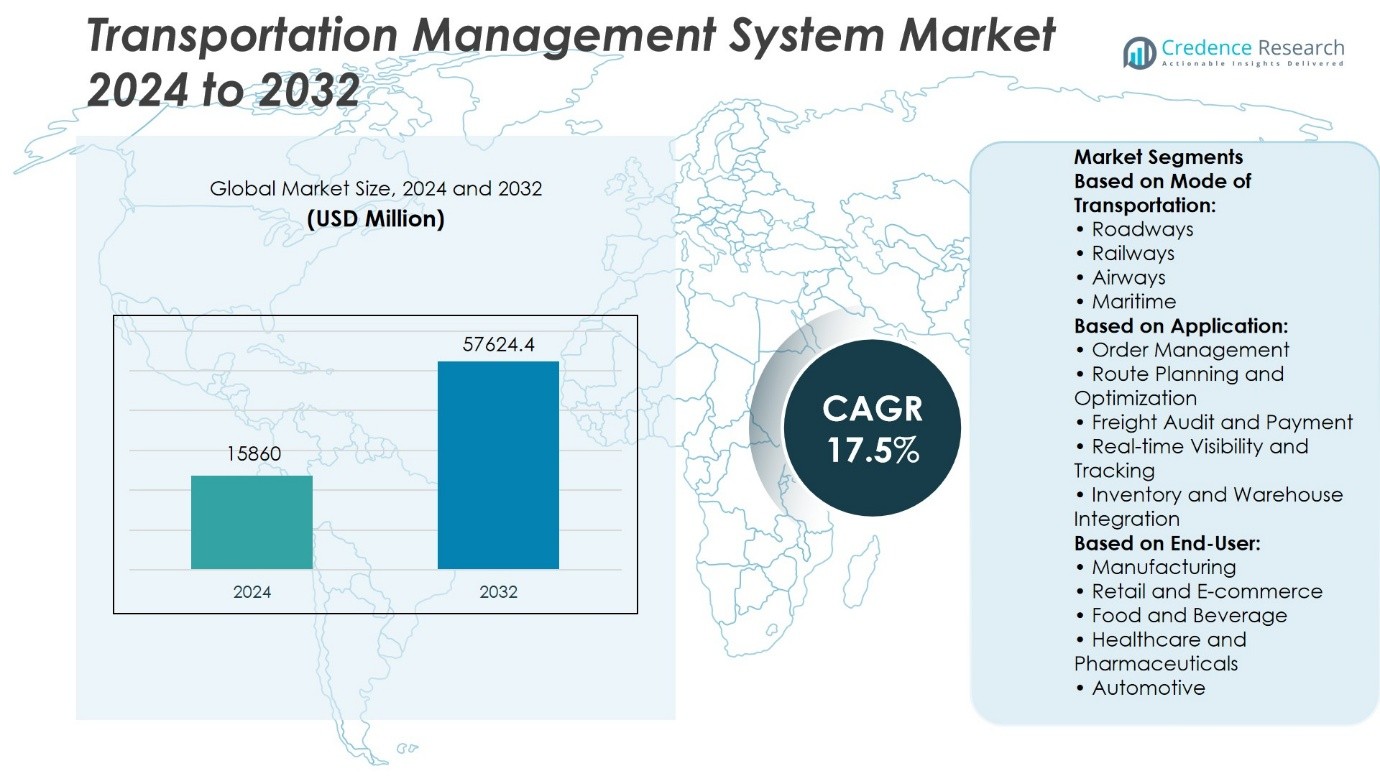
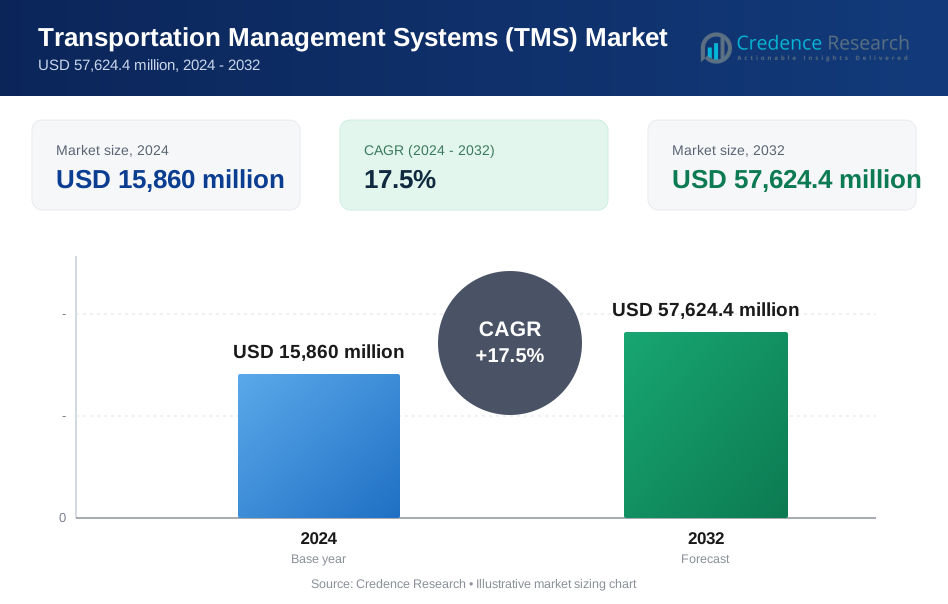
Transportation Management System Market size was valued at USD 15860 million in 2024 and is anticipated to reach USD 57624.4 million by 2032, at a CAGR of 17.5% during the forecast period.| REPORT ATTRIBUTE | DETAILS |
|---|---|
| Historical Period | 2020-2024 |
| Base Year | 2024 |
| Forecast Period | 2025-2032 |
| Transportation Management System Market Size 2024 | USD 15860 Million |
| Transportation Management System Market, CAGR | 17.5% |
| Transportation Management System Market Size 2032 | USD 57624.4 Million |
Market Insights
- Transportation Management System Market size was valued at USD 15860 million in 2024 and is projected to reach USD 57624.4 million by 2032, at a CAGR of 17.5%.
- Rising demand for supply chain visibility, last-mile delivery efficiency, and cost optimization drives strong adoption.
- Cloud-based platforms, AI-driven analytics, and real-time tracking define major market trends with focus on digital transformation.
- The competitive landscape features global players offering automation, predictive insights, and seamless enterprise integration.
- High implementation costs and integration complexity act as restraints for SMEs in cost-sensitive markets.
- North America leads adoption with advanced infrastructure, Europe emphasizes sustainability, and Asia-Pacific grows rapidly with e-commerce expansion, while Latin America and the Middle East & Africa show gradual adoption.
- Innovation in predictive analytics, compliance features, and sustainability-focused solutions continues to shape long-term growth opportunities.
Market Drivers
Rising Demand for Supply Chain Visibility and Optimization The Transportation Management System Market expands strongly due to the rising need for end-to-end supply chain visibility. Companies prioritize real-time tracking to monitor freight status, reduce delays, and improve customer service. It helps organizations optimize load planning and route selection, which reduces empty miles and fuel costs. The growing complexity of global supply chains increases the importance of centralized control over shipments. Cloud-based platforms enhance accessibility, enabling firms to manage transportation operations across regions efficiently. The market gains momentum as enterprises integrates advanced analytics to forecast disruptions and maintain delivery reliability.- For instance, in 2024, 2.71 billion people, or 33% of the global population, shop online, reflecting a 2.7% increase from 2023. This increased volume demands efficient order fulfillment processes, enabling businesses to process and ship orders promptly.
- For instance, Amazon reported handling over 5.9 billion U.S. packages in 2023 through its integrated TMS and delivery service partner program, cutting average delivery time to less than 1.9 days.
Market Trends
Increasing Integration of Artificial Intelligence and Machine Learning The Transportation Management System Market witnesses a strong trend toward the integration of artificial intelligence and machine learning. Companies deploy predictive analytics to forecast demand, identify bottlenecks, and optimize delivery schedules. It improves real-time decision-making, reducing costs and delays. Machine learning models enhance route planning by analyzing traffic, weather, and carrier performance. Automation minimizes manual intervention, which increases accuracy in freight billing and shipment tracking. This trend reinforces efficiency while supporting smarter logistics strategies.- For instance, DHL’s AI-powered Resilience360 platform analyzed 32 billion data points in 2023 to predict supply chain disruptions, cutting average response time to incidents from 72 hours to 6 hours.
- For instance, Oracle reported that its Oracle Transportation Management Cloud processed over 6 billion logistics transactions globally in 2023, supporting enterprises in 150 countries.
Market Challenges Analysis
High Implementation Costs and Integration Complexity The Transportation Management System Market faces challenges due to the high upfront investment required for deployment. Many small and medium-sized enterprises hesitate to adopt advanced systems because of licensing fees, customization expenses, and training costs. It becomes more complex when businesses attempt to integrate TMS platforms with existing enterprise resource planning and warehouse management systems. Legacy infrastructure often lacks compatibility, which delays implementation timelines. Integration issues also increase the risk of operational disruptions during the transition phase. These financial and technical barriers limit adoption, particularly in cost-sensitive markets. Data Security Concerns and Limited Skilled Workforce Cybersecurity threats pose significant risks for enterprises adopting cloud-based transportation solutions. The Transportation Management System Market encounters obstacles as organizations seek to secure sensitive shipping data and customer information. It requires strong data encryption and compliance with global privacy regulations, which demand additional investments. Shortage of skilled professionals further restricts effective deployment and management of advanced systems. Companies struggle to hire staff with expertise in artificial intelligence, analytics, and digital supply chain platforms. The lack of qualified resources delays innovation and weakens the ability to fully leverage TMS capabilities.Market Opportunities
Expansion of Digitalization and Advanced Technology Adoption The Transportation Management System Market creates opportunities through rapid digitalization across global supply chains. Companies adopt automation, artificial intelligence, and Internet of Things integration to improve real-time visibility and operational efficiency. It enables firms to predict demand, enhance route optimization, and reduce fuel consumption. The shift toward predictive analytics supports more accurate forecasting, which strengthens logistics planning. Growing interest in blockchain for transparent documentation also opens new pathways for innovation. Vendors that deliver secure, AI-driven, and data-centric solutions can capture strong demand in this evolving landscape. Rising Demand from Emerging Economies and E-Commerce Growth Expanding trade networks and the surge in e-commerce in developing economies create untapped growth potential. The Transportation Management System Market gains momentum in regions where rising consumer demand and infrastructure development fuel logistics modernization. It supports enterprises in managing high parcel volumes and meeting strict delivery timelines. Governments in Asia-Pacific, Latin America, and the Middle East invest heavily in transportation infrastructure, which increases the relevance of TMS solutions. Cross-border trade agreements further encourage companies to adopt digital platforms for compliance and cost efficiency. The expansion of global e-commerce and emerging market logistics strengthens opportunities for system providers.Market Segmentation Analysis:
By Mode of Transportation The Transportation Management System Market demonstrates strong adoption across roadways, railways, airways, and maritime transport. Roadways hold a dominant role, driven by the growth of e-commerce deliveries, regional freight networks, and the need for real-time tracking solutions. It supports fleet optimization, driver management, and route efficiency in both urban and intercity logistics. Railways leverage TMS for bulk freight management, load optimization, and cross-border cargo compliance. Air and maritime transport integrate TMS platforms to handle complex international shipping requirements and customs processes. This segment reflects the increasing demand for multi-modal solutions that unify all modes of logistics under a single platform.- For instance, SAP SE announced that more than 5,000 companies used its cloud-based logistics solutions in 2023, handling 2.4 billion freight orders annually through SAP Business Network for Logistics.
- For instance, Blue Yonder reported that its Luminate Logistics platform processed over 20 billion forecasts and optimized 1.6 billion transportation decisions for clients in 2023, directly improving route planning accuracy.
Segments:
Based on Mode of Transportation:- Roadways
- Railways
- Airways
- Maritime
- Order Management
- Route Planning and Optimization
- Freight Audit and Payment
- Real-time Visibility and Tracking
- Inventory and Warehouse Integration
- Manufacturing
- Retail and E-commerce
- Food and Beverage
- Healthcare and Pharmaceuticals
- Automotive
- North America
- U.S.
- Canada
- Mexico
- Europe
- Germany
- France
- U.K.
- Italy
- Spain
- Rest of Europe
- Asia Pacific
- China
- Japan
- India
- South Korea
- South-east Asia
- Rest of Asia Pacific
- Latin America
- Brazil
- Argentina
- Rest of Latin America
- Middle East & Africa
- GCC Countries
- South Africa
- Rest of the Middle East and Africa
Regional Analysis
North America North America accounts for 38% share of the Transportation Management System Market, driven by strong digital infrastructure and mature logistics networks. The region benefits from early adoption of advanced technologies, including AI-driven route optimization and cloud-based TMS platforms. It supports large-scale e-commerce, retail, and manufacturing industries that require efficient multi-modal transportation. Companies in the United States invest heavily in automation and last-mile delivery solutions, supported by strong demand for same-day and next-day services. Canada also plays a growing role, with investments in cross-border freight solutions and sustainability initiatives. The regional presence of global leaders strengthens innovation, making North America a leading hub for TMS adoption. Europe Europe holds a 27% share of the Transportation Management System Market, supported by strong regulatory frameworks and an emphasis on green logistics. The European Union enforces sustainability targets, which encourage enterprises to adopt TMS for route optimization and carbon footprint reduction. It enables efficient coordination of road, rail, and maritime transport across countries with complex cross-border trade requirements. Germany, the UK, and France dominate adoption, driven by advanced manufacturing and retail sectors. Eastern Europe also contributes, with growing demand from logistics firms modernizing their transportation systems. Investments in digital freight corridors and cross-European trade enhance regional opportunities for TMS providers. Asia-Pacific Asia-Pacific represents a 22% share of the Transportation Management System Market, making it one of the fastest-growing regions. The rise of e-commerce giants in China, India, and Southeast Asia drives significant demand for advanced logistics platforms. It supports businesses handling high parcel volumes, rapid urbanization, and growing consumer expectations for fast deliveries. Governments in countries like India and China invest in smart logistics infrastructure, creating opportunities for TMS integration. Japan and South Korea contribute with adoption in automotive and electronics supply chains, where precision and efficiency remain critical. The rapid expansion of SMEs in Asia-Pacific further boosts cloud-based TMS deployment, accelerating overall growth. Latin America Latin America captures a 7% share of the Transportation Management System Market, supported by growing modernization of logistics infrastructure. Brazil and Mexico lead adoption, driven by increasing e-commerce penetration and rising international trade activities. It enables companies to manage fragmented transportation networks across diverse geographies. The region experiences strong demand for route optimization and real-time tracking solutions to address urban congestion. Local logistics providers adopt modular cloud-based solutions to overcome financial constraints and improve efficiency. Expanding cross-border trade within the region and with North America strengthens the role of TMS platforms in supply chain operations. Middle East & Africa The Middle East & Africa hold a 6% share of the Transportation Management System Market, reflecting early-stage but promising adoption. The Gulf states, particularly the UAE and Saudi Arabia, invest heavily in digital transformation and logistics hubs that integrate TMS solutions. It supports large-scale infrastructure projects, retail expansion, and global trade flows through strategic ports. Africa shows growing interest, led by South Africa, where transportation modernization initiatives improve supply chain efficiency. Regional logistics firms adopt TMS platforms to reduce operational costs and improve transparency. With ongoing government initiatives to diversify economies and enhance digital adoption, the region provides long-term opportunities for TMS providers.Key Player Analysis
- MercuryGate International, Inc.
- GoComet
- IBM Corporation
- Cargobase
- Manhattan Associates
- Cerasis, Inc.
- JDA Software Group, Inc.
- BluJay Solutions Ltd.
- Infor Inc.
- 3GTMS
Competitive Analysis
The Transportation Management System Market features include BluJay Solutions Ltd., Cargobase, Cerasis, Inc., GoComet, 3GTMS, Infor Inc., IBM Corporation, JDA Software Group, Inc., Manhattan Associates, and MercuryGate International, Inc. The Transportation Management System Market reflects intense competition, driven by the need to deliver advanced, scalable, and efficient logistics solutions. Vendors focus on integrating cloud platforms, predictive analytics, and real-time visibility to address the rising complexities of global supply chains. It evolves as companies emphasize automation to reduce costs, streamline carrier selection, and optimize last-mile delivery. Differentiation comes through AI-driven insights, sustainability-focused features, and seamless integration with enterprise resource planning and warehouse management systems. Firms also expand their reach through regional investments, partnerships, and tailored solutions for small and medium enterprises. The competitive environment highlights continuous innovation, with technology advancements shaping the long-term value of transportation management platforms.Recent Developments
- In May 2025, Siemens Digital Industries Software announced that Thanakorn Vegetable Oil Products Co., Ltd. (TVOP), a leading Thai edible oil producer, adopted Siemens' Digital Logistics solutions to modernize its supply chain.
- In February 2024, Oracle enhanced its Supply Chain and Manufacturing (SCM) Fusion Cloud to improve enterprise logistics management. The updates to Oracle Transportation Management and Oracle Global Trade Management include expanded business intelligence, improved logistics network modeling.
- In February 2024, C.H. Robinson introduced a new technology that enhances freight shipping efficiency by eliminating the need for separate pickup and delivery appointments. This AI-driven solution determines optimal appointment times by analyzing transit-time data.
- In 2023, Hitachi Rail, a division of Hitachi, Ltd., announced the expansion of its digital transport app named 360Pass. Based on this development, Hitachi Rail signed a new contract with Genoa’s (U.S.) city transit authority to connect Genoa's whole public transport infrastructure, including 600,000 citizens with the 360-pass digital transport app.
Market Concentration & Characteristics
The Transportation Management System Market shows a moderately concentrated structure, with a mix of established global providers and emerging niche players competing for market share. Large enterprises dominate through broad portfolios that integrate advanced analytics, automation, and cloud platforms, while smaller vendors focus on offering specialized and cost-effective solutions for regional and mid-sized businesses. It reflects characteristics of high technological intensity, where AI, IoT, and real-time visibility solutions drive differentiation. Strong competition encourages continuous innovation in freight optimization, last-mile delivery, and sustainability-driven features. Market characteristics also include high switching costs for large enterprises, growing demand for modular cloud-based solutions, and significant investments in cybersecurity to protect sensitive logistics data. The balance between global expansion and localized customization defines competitive positioning, shaping the industry’s long-term growth dynamics.Report Coverage
The research report offers an in-depth analysis based on Mode of Transportation, Application, End-User and Geography. It details leading market players, providing an overview of their business, product offerings, investments, revenue streams, and key applications. Additionally, the report includes insights into the competitive environment, SWOT analysis, current market trends, as well as the primary drivers and constraints. Furthermore, it discusses various factors that have driven market expansion in recent years. The report also explores market dynamics, regulatory scenarios, and technological advancements that are shaping the industry. It assesses the impact of external factors and global economic changes on market growth. Lastly, it provides strategic recommendations for new entrants and established companies to navigate the complexities of the market.Future Outlook
- The Transportation Management System Market will expand with stronger adoption of cloud-based platforms for scalable logistics operations.
- It will integrate advanced artificial intelligence and machine learning to improve predictive planning and route optimization.
- Real-time visibility and tracking solutions will gain importance as enterprises prioritize transparency across global supply chains.
- Sustainability goals will drive wider use of TMS for fuel optimization and carbon emission reduction.
- Last-mile delivery optimization will remain a critical growth area supported by the rise of e-commerce.
- Cross-border trade and regulatory compliance will increase reliance on automated documentation and customs management features.
- Small and medium enterprises will adopt modular and cost-effective TMS solutions to modernize logistics.
- Cybersecurity features will become a priority to safeguard sensitive freight and customer data in digital platforms.
- Partnerships and acquisitions will strengthen vendor portfolios and expand global reach.
- Emerging economies will offer high growth potential through infrastructure development and rapid e-commerce expansion.
Request a Free Sample
Fill in your details and we'll send you a free sample report.
- Sample data tables & charts
- Research methodology
Need a Custom Version of This Report?
Tailor the scope, geography, or segments to your exact requirements.
- Custom geography or segment scope
- Direct access to our analyst team
Frequently Asked Questions
What is the current market size for Transportation Management System Market, and what is its projected size in 2032?
At what Compound Annual Growth Rate is the Transportation Management System Market projected to grow between 2025 and 2032?
Which Transportation Management System Market segment held the largest share in 2024?
What are the primary factors fueling the growth of the Transportation Management System Market?
Who are the leading companies in the Transportation Management System Market?
Which region commanded the largest share of the Transportation Management System Market in 2024?
Table of Content
Chapter 1. Report Introduction
- 1.1 Report Description & Purpose
- 1.1.1 Report Title & Market Definition
- 1.1.2 Unique Selling Propositions (USP) & Key Differentiators
- 1.1.3 Value Proposition for Stakeholders
- 1.2 Research Objectives
- 1.2.1 Market Sizing Objectives (Volume & Revenue)
- 1.2.2 Segmentation Objectives
- 1.2.3 Competitive Intelligence Objectives
- 1.2.4 Forecast & Scenario Objectives
- 1.3 Report Scope
- 1.3.1 Transportation Management Systems (TMS) Scope – Types & Subtypes Covered
- 1.3.2 Geographic Scope – Regions & Countries Covered
- 1.3.3 Historical Period, Base Year & Forecast Period (2024; forecast to 2032)
- 1.3.4 Inclusions & Exclusions
- 1.4 HS Code & Classification Framework
- 1.5 Currency, Units & Pricing Basis
- 1.6 Target Stakeholders
- 1.7 Limitations & Assumptions
Chapter 2. Executive Summary
- 2.1 Global Transportation Management Systems (TMS) Market Snapshot
- 2.1.1 Market Size – Historical (2024) & Forecast (2024-2032) (2024: USD 15,860 million → 2032: USD 57,624.4 million)
- 2.1.2 Volume & Revenue – Global Totals
- 2.1.3 Key Market Highlights – Top Five Facts
- 2.2 Transportation Management Systems (TMS) Market Segmentation Snapshot
- 2.2.1 Market Split by Region – 2024 vs. 2032
- 2.3 Competitive Snapshot
- 2.3.1 Top 10 Players by Revenue Share – 2024
- 2.3.2 Top 10 Players by Volume Share – 2024
- 2.3.3 Recent Strategic Developments (18-Month Summary)
- 2.4 Key Investment Highlights & Strategic Conclusions
Chapter 3. Transportation Management Systems (TMS) Market Dynamics & Industry Analysis
- 3.1 Market Overview & Context
- 3.1.1 Transportation Management Systems (TMS) Market Position in the Broader Automotive Value Chain
- 3.1.2 OEM vs. Replacement Market Dynamics
- 3.1.3 Market Maturity & Development Stage by Region
- 3.2 Transportation Management Systems (TMS) Market Drivers
- 3.3 Transportation Management Systems (TMS) Market Restraints & Challenges
- 3.4 Transportation Management Systems (TMS) Market Opportunities
- 3.5 Porter's Five Forces Analysis
- 3.5.1 Threat of New Entrants
- 3.5.2 Bargaining Power of Suppliers
- 3.5.3 Bargaining Power of Buyers
- 3.5.4 Threat of Substitutes
- 3.5.5 Competitive Rivalry – Intensity Assessment
- 3.6 Transportation Management Systems (TMS) Value Chain Analysis
- 3.6.1 Upstream – Raw Material/Input Suppliers
- 3.6.1.1 Raw Material/Input 1
- 3.6.1.2 Raw Material/Input 2
- 3.6.1.3 Raw Material/Input 3
- 3.6.2 Midstream – Production/Manufacturing/Service Delivery
- 3.6.2.1 Production/Process Overview
- 3.6.2.2 Key Facility Locations & Capacity by Manufacturer
- 3.6.3 Downstream – Distribution & End Consumer
- 3.6.3.1 Primary Channel – B2B/OEM
- 3.6.3.2 Secondary Channels – Dealer, Retail, Online, Direct
- 3.6.4 Value Chain Profitability Analysis
- 3.6.1 Upstream – Raw Material/Input Suppliers
- 3.7 PESTEL Analysis
- 3.7.1 Political Factors
- 3.7.2 Economic Factors
- 3.7.3 Social Factors
- 3.7.4 Technological Factors
- 3.7.5 Environmental Factors
- 3.7.6 Legal Factors
- 3.8 Transportation Management Systems (TMS) Supply Chain Analysis
- 3.8.1 Raw Material/Input Supply Risk Assessment
- 3.8.2 Manufacturing Concentration Risk (Geographic Exposure)
- 3.8.3 Trade Disruption Impact Analysis
- 3.9 Regulatory & Policy Landscape
Note: The regulatory and policy landscape section covers regulations based on their applicability to the market, Transportation Management Systems (TMS) category, geography, and scope of the study. Only regulatory frameworks with a material impact on operations, compliance, trade, sustainability, or market access are analyzed in detail.
Chapter 4. Key Investment Pockets & Opportunity Analysis
- 4.1 Transportation Management Systems (TMS) Market Attractiveness Analysis
- 4.1.1 By Region – Investment Attractiveness Matrix (Volume × CAGR)
- 4.2 Absolute Revenue Growth Opportunity
- 4.2.1 By Region – Absolute USD Growth Through 2032
- 4.3 Incremental Volume Opportunity
- 4.3.1 By Region – Incremental Volume Through 2032
- 4.3.2 Segment – Incremental Volume
- 4.4 Emerging Submarket Opportunity Deep Dive (Subject to Applicability)
- 4.5 Emerging Market Opportunity Scorecards
- 4.5.1 United States
- 4.5.2 Europe
- 4.5.3 Asia
- 4.5.4 Middle East & Africa
Note: Emerging Market Opportunity Scorecards will be included based on relevance and strategic importance. Regions listed are indicative and may vary depending on data availability and market dynamics.
Chapter 5. Transportation Management Systems (TMS) Import-Export Analysis & Trade Flows
- 5.1 Global Trade Overview
- 5.1.1 Global Export Value by Country (2024)
- 5.1.2 Global Export Volume by Country (2024)
- 5.1.3 Global Import Value by Country (2024)
- 5.1.4 Global Import Volume by Country (2024)
- 5.1.5 Net Trade Balance by Country (2024)
- 5.2 Export Analysis – Segment
- 5.2.1 Type 1 (HS Code)
- 5.2.2 Type 2 (HS Code)
- 5.2.3 Type 3 (HS Code)
- 5.2.4 Type 4 (HS Code)
- 5.2.5 Type 5 (HS Code)
- 5.3 Import Analysis – Segment
- 5.3.1 Type 1 (HS Code)
- 5.3.2 Type 2 (HS Code)
- 5.3.3 Type 3 (HS Code)
- 5.3.4 Type 4 (HS Code)
- 5.3.5 Type 5 (HS Code)
- 5.4 Average Unit Trade Prices
- 5.4.1 Average Export Price – Segment & Country
- 5.4.2 Average Import Price – Segment & Source Country
- 5.4.3 Price Trends (2024)
- 5.5 Key Trade Route Analysis
- 5.5.1 Trade Route 1
- 5.5.2 Trade Route 2
- 5.5.3 Trade Route 3
- 5.5.4 Trade Route 4
- 5.5.5 Trade Route 5
- 5.6 Trade Policy Impact Assessment
- 5.6.1 US Anti-Dumping & Section 301 Tariffs
- 5.6.2 EU Customs Union Impact
- 5.6.3 Major Free Trade Agreements
- 5.6.4 USMCA Rules of Origin
Note: Trade policy analysis will be included only where relevant to the Transportation Management Systems (TMS) market.
Chapter 6. Competitive Landscape & Company Benchmarking
- 6.1 Transportation Management Systems (TMS) Market Concentration & Structure
- 6.1.1 Herfindahl-Hirschman Index (HHI) – vs. 2024
- 6.1.2 Tier 1, Tier 2 & Tier 3 Market Structure
- 6.1.3 Global, Regional & Local Player Dynamics
- 6.2 Transportation Management Systems (TMS) Market Share Analysis – 2024
- 6.2.1 Global Revenue Share by Company
- 6.2.2 Global Volume Share by Company
- 6.2.3 Regional Revenue Share
- 6.2.4 Market Share Evolution ( vs. 2024)
- 6.2.5 OEM Segment Share by Company
- 6.2.6 Replacement Segment Share by Company
- 6.3 Production/Delivery Capacity & Facility Analysis
- 6.3.1 Global Installed Capacity
- 6.3.2 Capacity Utilization Rates
- 6.3.3 Production/Output Volume
- 6.3.4 Facility Locations & Capacity Map
- 6.3.5 Planned Capacity Additions
- 6.4 Transportation Management Systems (TMS) Competitive Benchmarking Matrix
- 6.4.1 Revenue, Volume, CAGR & Profitability Comparison
- 6.4.2 Channel Revenue Mix
- 6.4.3 Geographic Revenue Exposure
- 6.4.4 R&D Intensity
- 6.4.5 Sustainability Maturity
- 6.5 Strategic Developments in Transportation Management Systems (TMS) (Last 24 Months)
- 6.5.1 Mergers, Acquisitions & Divestments
- 6.5.2 New Transportation Management Systems (TMS) Launches
- 6.5.3 Facility Expansions
- 6.5.4 Strategic Alliances, Joint Ventures & Partnerships
- 6.5.5 Distribution Expansion & Market Entry
- 6.5.6 Sustainability & ESG Initiatives
- 6.6 Competitive Strategy Mapping
- 6.6.1 Leader, Challenger, Follower & Niche Classification
- 6.6.2 Pricing Strategy Comparison
- 6.6.3 Channel Strategy Matrix
Note: Strategic developments are included based on their materiality and the availability of reliable information.
Chapter 7. Global Transportation Management Systems (TMS) Market – By Distribution Channel
- 7.1 Segment Overview
- 7.1.1 Volume & Revenue Split by Channel (2024 & 2032)
- 7.1.2 Channel Mix Evolution (2024-2032)
Chapter 8. Regional Market Analysis – Global Overview
- 8.1 Global Regional Overview
- 8.1.1 Regional Volume Share
- 8.1.2 Regional Revenue Share
- 8.1.3 Regional Volume by Region
- 8.1.4 Regional Revenue by Region
- 8.1.5 Regional Forecast Through 2032
- 8.2 Cross-Regional Segment Analysis
- 8.2.1 By Distribution Channel
- 8.2.2 By Brand/Price Tier
Chapter 9. North America Transportation Management Systems (TMS) Market
- 9.1 United States
- 9.2 Canada
- 9.3 Mexico
Chapter 10. Europe Transportation Management Systems (TMS) Market
- 10.1 Germany
- 10.2 France
- 10.3 Italy
- 10.4 United Kingdom
- 10.5 Spain
- 10.6 Poland
- 10.7 Russia
- 10.8 Netherlands
- 10.9 Belgium
- 10.10 Sweden
- 10.11 Denmark
- 10.12 Norway
- 10.13 Rest of Europe
Chapter 11. Asia Pacific Transportation Management Systems (TMS) Market
- 11.1 China
- 11.2 India
- 11.3 Japan
- 11.4 South Korea
- 11.5 Thailand
- 11.6 Indonesia
- 11.7 Vietnam
- 11.8 Malaysia
- 11.9 Australia
- 11.10 Rest of Asia Pacific
Chapter 12. Latin America Transportation Management Systems (TMS) Market
- 12.1 Brazil
- 12.2 Argentina
- 12.3 Colombia
- 12.4 Chile
- 12.5 Rest of Latin America
Chapter 13. Middle East Transportation Management Systems (TMS) Market
- 13.1 Saudi Arabia
- 13.2 United Arab Emirates
- 13.3 Turkey
- 13.4 Israel
- 13.5 Iran
- 13.6 Rest of the Middle East
Chapter 14. Africa Transportation Management Systems (TMS) Market
- 14.1 South Africa
- 14.2 Egypt
- 14.3 Nigeria
- 14.4 Morocco
- 14.5 Rest of Africa
Chapter 15. Transportation Management Systems (TMS) Company Profiles
- 15.1 [Company 01]
- 15.1.1 Company Overview
- 15.1.2 Key Management Personnel
- 15.1.3 Products & Services Portfolio
- 15.1.4 Financial Performance
- 15.1.5 Key Market Focus & Geographic Presence
- 15.1.6 Recent Developments & Strategic Initiatives
Note: The company profile list is preliminary and may change based on research findings, market developments, data availability, and client requirements.
Chapter 16. Appendices
- Appendix A – List of Abbreviations & Acronyms
- Appendix B – Industry Classification Code Reference – Full Series
- Appendix C – Production & Capacity Data Tables
- Appendix D – End-Use & Demand Base Tables
- Appendix E – Consumption & Replacement Rate Assumptions
- Appendix F – ASP Reference Tables
- Appendix G – Manufacturing & Facility Database
- Appendix H – Import-Export Data Tables
- Appendix I – Regulatory Summary Tables
- Appendix J – Primary Research Participant List (Anonymized)
- Appendix K – Primary Research Questionnaire Framework
- Appendix L – Data Sources & Bibliography
- Appendix M – Market Size Divergence & Source Comparison
Chapter 17. Research Methodology
- 17.1 Research Framework & Philosophy
- 17.2 Secondary Research – Sources, Hierarchy & Data Extraction
- 17.3 Data Modeling – Bottom-Up & Top-Down Market Sizing
- 17.4 Primary Research – Stakeholder Framework, LOI & Sample Sizes
- 17.5 Forecast Methodology – Regression, Scenario & Sensitivity Analysis
- 17.6 Quality Control – Four-Layer Validation Framework
- 17.7 Limitations & Standard Assumptions
- 17.8 Disclaimer
