| REPORT ATTRIBUTE | DETAILS |
|---|---|
| Historical Period | 2019-2022 |
| Base Year | 2023 |
| Forecast Period | 2024-2032 |
| Zinc Chloride Market Size 2023 | USD 305.2 million |
| Zinc Chloride Market, CAGR | 5.20% |
| Zinc Chloride Market Size 2032 | USD 481.64 million |
Market Insights
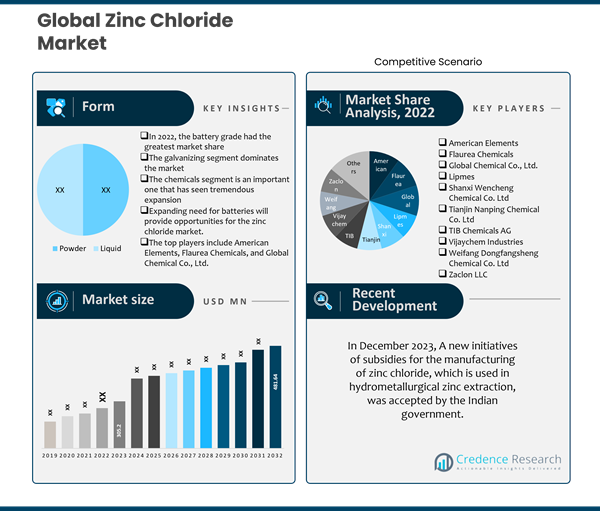
- The global market for zinc chloride is expected to grow from its estimated USD 305.2 million in 2023 to USD 481.64 million in 2032 at a compound annual growth rate (CAGR) of 5.20% between 2024 and 2032.
- The largest category is battery grade. On the other hand, technical grade is expected to grow at a strong CAGR.
- The leading application segment is galvanizing.
- The CAGR for powder is expected to be the highest during the projection period.
- The chemicals will have the highest CAGR throughout the prediction period.
- The hydrometallurgical process is estimated to have the greatest CAGR during the forecast period.
- The liquid (hydrated) is predicted to grow at the fastest pace over the projection period.
- North America dominated the zinc chloride market.
- Regarding the market share of zinc chloride, Europe is expected to come second.
- In the zinc chloride market, Asia Pacific is anticipated to grow fastest.
- Industrial expansion, especially in industries like chemicals, textiles, and electronics, impacts the demand for zinc chloride.
- The factors generating possibilities for the zinc chloride market are the utilization of zinc chloride in galvanizing procedures to prevent corrosion on steel and iron structures and the demand for zinc chloride for the fabrication of batteries, particularly zinc-carbon batteries.
Executive Summary
Market Definition
The market for zinc chloride (ZnCl₂), a chemical compound, can be found globally or regionally. White, crystalline, and very soluble in water is zinc chloride. Because of its many uses, it is primarily utilized in industrial settings. Zinc chloride is produced, sold, and consumed in this market. It is used in many different industries, including chemicals, metallurgy, textiles, batteries, and more.
Market Overview
The zinc chloride sector is estimated to develop at a 5.20% compound annual growth rate (CAGR) between 2024 and 2032, maintaining its current upward trend. The market will keep developing, rising from its estimated value of USD 305.2 million in 2023 to USD 481.64 million in 2032.
In the electronics sector, zinc chloride is utilized as a flux for soldering applications. By assisting with the removal of metal oxides from the surfaces to be soldered, it ensures that the solder adheres properly. Zinc chloride is needed in soldering flux compositions due to the ongoing development and manufacturing of electronic components. Printed circuit boards, or PCBs, are essential parts of electronic equipment, and they're made with zinc chloride. When electronic devices become more common and technologically sophisticated, there will be a corresponding increase in the need for PCBs and the electronics sector.
Zinc chloride is sometimes used in the production processes of resistors and capacitors, among other electronic components. Zinc chloride demand is stimulated by the rise of the electronics industry, which increases the manufacture of these components. Zinc chloride is becoming more and more in demand as a result of breakthroughs in the electronics sector, which include the creation of new technologies like wearables, electric vehicles, and Internet of Things (IoT) gadgets.
Segmentation by Grade
- Battery grade is the market leader by grade. Numerous consumer electronics products, including radios, flashlights, toys, clocks, and remote controls, frequently use zinc chloride batteries. They provide these commonplace objects with a dependable and affordable power source.
- The technical grade category will exhibit a sizable CAGR during the projected period. Technical grade zinc chloride is utilised in labs for several applications, including as dehydrating agents in specific procedures and as reagents in chemical reactions.
- The need for zinc chloride is additionally supported by other grades, including pharmaceutical grade.
Segmentation by Application
- The main application is galvanizing. Zinc chloride is used in the galvanizing process to help coat the steel in a consistent and homogenous manner. This is necessary to guarantee that the steel product is effectively protected against corrosion on its whole surface.
- The petroleum category will likely register a significant CAGR during forecasting. In the petroleum business, zinc chloride is used as a catalyst in some refining procedures. It can be applied to alkylation, isomerization, and catalytic cracking processes to achieve the desired chemical changes.
- Other applications, such as chemical synthesis, textile processing, metallurgical fluxes, pharmaceuticals, wood preservation, and others, also contribute to the demand for zinc chloride.
Segmentation by Form
- It is projected that over the projection period, the powder category will grow at the fastest rate. A useful reagent for chemical synthesis procedures is zinc chloride powder. In various chemical reactions, such as Friedel-Crafts acylation and other organic transformations, it can be employed as a catalyst or reactant.
- The need for zinc chloride is also influenced by other form, including liquid.
Segmentation by End-Use Industry
- The chemicals category will likely have the highest CAGR during the projection period. In laboratories, zinc chloride is utilized for chemical analysis and testing. It can be used as a reagent in various chemical investigations or particular analytical techniques.
- Other end-use industries, such as metallurgy, textiles, pharmaceuticals, wood preservation, batteries, and others, also contribute to the demand for zinc chloride.
Segmentation by Process
- The hydrometallurgical process will be expected to have the foremost CAGR during the prediction period. Zinc chloride can be used in several hydrometallurgical processes to extract metals from their respective ores, such as lead, copper, and zinc. Chloride ions aid in the solubilization of metal ions, making it easier for them to be separated from gangue minerals.
- Other processes, such as the dry cell process, also contribute to the demand for zinc chloride.
Segmentation by Concentration
- Liquid (Hydrated) will be expected to have the foremost CAGR during the prediction period. The synthetic fiber known as viscose rayon is made from cellulose and liquid zinc chloride. The cellulose dissolves with the help of the solution and regenerates into fibers.
- Other concentrations, such as solid (anhydrous), also contribute to the demand for zinc chloride.
Segmentation by Region
- North America leads the zinc chloride industry. The application of zinc chloride as well as the manufacturing process both requires careful attention to health and safety issues. In North America, businesses can spend money on procedures and technologies that protect employees and reduce their negative effects on the ecosystem.
- Europe is estimated to rank second in market size for zinc chloride.
- Asia Pacific will witness the most rapid growth of the zinc chloride market.
- The remaining requirement for zinc chloride is covered by regions of the world such as Africa, the Middle East, and Latin America.
The factors supporting the zinc chloride market include the textile industry's demand and the electronics industry's expanding applications, such as soldering and the production of electronic components.
Based on projections, the zinc chloride market is anticipated to be controlled by North America. Research and development (R&D) spending is a major factor propelling the North American zinc chloride market's expansion. R&D expenditures make it possible to find new uses for zinc chloride and create cutting-edge technology for its manufacture and application. This may present opportunities and new markets.
The ultimate objective of research and development is to increase zinc chloride's purity and quality. Meeting industry standards and regulations requires high-quality products, particularly in sectors like electronics and pharmaceuticals.
Throughout the forecast, the zinc chloride market in Asia-Pacific is anticipated to expand fastest. Businesses in the Asia Pacific area use a range of tactics to maintain their competitiveness, such as innovative production techniques, product differentiation, and price strategies. Zinc chloride is used in pharmaceutical and healthcare applications, mostly due to the region's expanding healthcare industry.
Key Highlights of the Report
The global zinc chloride market is segmented by grade, application, form, end-use industry, process, concentration, and region. As far as the type of grade is concerned, battery grade is the market spearhead. Galvanizing is the top application segment. The powder category is anticipated to increase at the highest CAGR throughout the projection period. The chemicals industry will experience the highest CAGR during the forecast period. Zinc Chloride is expanding mostly in North America.
Zinc chloride is still widely used in metal treatment procedures, such as flux and soldering, especially in the manufacturing and electronics industries. Increased focus on the appropriate handling and disposal of zinc chloride as a result of increased awareness and scrutiny of the effects that chemical use has on the environment and human health.
North America is expected to account for the largest portion of the zinc chloride market globally. Zinc chloride batteries and other energy storage technologies can help control peak loads by storing extra energy during low-demand hours and discharging it during peak-demand hours. As a result, resources in North American smart grids are used more effectively. The Asia Pacific region is also assumed to have the market's sharpest growth. The import and export of zinc chloride in the Asia Pacific area are influenced by regional trade dynamics and agreements.
Which Key Factors Are Driving The Global Zinc Chloride Market?
The chemical industry's transition to more environmentally friendly practices, improvements in production processes and technologies, and shifting customer preferences for zinc chloride-containing products are all driving factors in the zinc chloride market. The market is growing continuously because of all these causes.
What are The Main Challenges Confronting The Zinc Chloride Market Globally?
Growth in the zinc chloride sector is hindered by several factors, including overcapacity problems and the potential for major increases in zinc chloride consumption being hindered by market or application saturation.
What Market Opportunities Exist For Zinc Chloride Globally?
The factors creating opportunities for the zinc chloride market include the expenditure on R&D and the emphasis on health and safety issues in the handling and production of zinc chloride.
Market Drivers
Expanding Need for Batteries
Many businesses, like the battery industry, frequently utilize zinc chloride. Zinc chloride market growth may be aided by rising battery demand, particularly in light of the growing acceptance of electric vehicles and the development of renewable energy sources. There are several uses for zinc chloride batteries, including zinc-carbon and zinc-chloride flow batteries. The move in the automotive sector towards electric vehicles is a major factor in the rise in battery output. Certain types of batteries used in electric vehicles may contain zinc chloride cells. An increasing number of efficient energy storage devices are required as the importance of renewable energy sources, such as solar and wind, grows. Energy storage solutions utilizing zinc chloride batteries can help maintain the stability and dependability of renewable energy sources.
Market Restraints
Variations in Zinc Prices
Zinc is a primary raw material used in the production of zinc chloride, which is generated from zinc. Zinc prices have a direct effect on the cost of producing zinc chloride if they fluctuate or show a notable increase. Higher input costs for manufacturers could result in lower profit margins unless they can be transferred to customers. The fierce rivalry in the zinc chloride industry may make it more difficult for producers to raise prices to customers. Businesses may be under pressure to keep prices competitive; if they are unable to cover the higher expenses, this could have an adverse effect on their profitability and limit market expansion.
Opportunities
Demand for Galvanising Processes is Rising
The need for galvanized steel is supported by rising investments in infrastructure development, which includes building bridges, highways, and buildings. Zinc chloride is positioned as a crucial element in assisting these building projects due to its application in the galvanizing process. Durable and corrosion-resistant materials are becoming increasingly important for industrial facilities and urban infrastructure as these processes continue. Zinc chloride demand rises due to the necessity of zinc-coated galvanized steel, which is shielded from the elements by zinc coatings. To improve corrosion resistance, the automobile industry uses galvanised steel for a variety of components, including as body panels and chassis sections. The automotive industry is experiencing expansion due to rising consumer demand and vehicle production, which in turn is driving the need for zinc chloride for galvanizing automotive steel.
Competitive Landscape
Key Players
There are several major competitors in the fiercely competitive global zinc chloride market. The followings are a few of the leading market participants and their market shares:
- American Elements
- Flaurea Chemicals
- Global Chemical Co., Ltd.
- Lipmes
- Shanxi Wencheng Chemical Co. Ltd
- Tianjin Nanping Chemical Co. Ltd
- TIB Chemicals AG
- Vijaychem Industries
- Weifang Dongfangsheng Chemical Co. Ltd
- Zaclon LLC
- Others
To remain competitive, these companies prioritize product innovation, distribution channel expansion, mergers, and acquisitions.
The largest suppliers in the global zinc chloride market continuously work to keep one step beyond the competition by developing innovative concepts and products.
In October 2023, Renowned zinc chloride company TIB Chemical AG declared that it would be increasing its manufacturing capacity in Germany by 20%. With this move, the European market's expanding need for zinc chloride is expected to be satisfied, with the EV battery industry playing a major role.
In March 2021, Zinc salt toothpaste was developed by Unilever, a well-known brand in the personal care industry. It claims to lower blood pressure and improve nitrate reductase function.
Summary of Key Findings
- The chemical production industry will continue to grow, with the United Kingdom, Germany, France, Russia, and other key chemical production nations driving this growth. This is likely to increase the consumption of zinc chloride.
- The market is segmented by grade, application, form, end-use industry, process, concentration, and region.
- The most popular type of grade in the market is a battery grade.
- Galvanizing is the foremost application category.
- Regarding CAGR, powder is expected to grow the fastest during the forecast period.
- The category for hydrometallurgical process will likely see the highest CAGR during the anticipated time frame.
- North America is leading market development; the market is highly competitive with key players including American Elements, Flaurea Chemicals, Global Chemical Co., Ltd., Lipmes, Shanxi Wencheng Chemical Co. Ltd, Tianjin Nanping Chemical Co. Ltd, TIB Chemicals AG, Vijaychem Industries, Weifang Dongfangsheng Chemical Co. Ltd, Zaclon LLC, and Others.
Future Outlook
- The zinc chloride industry is expected to increase significantly in North America and has a positive outlook worldwide.
- Zinc chloride is becoming more and more common as the consumer electronics sector expands.
- During the forecast duration, one of the main challenges expected to impede the growth of the zinc chloride market is the lack of innovation in creating new applications for the metal.
- To stay ahead of the competition, key enterprises must develop new products, expand their market reach, and keep their prices competitive.
How CXOs Can Benefit from the Credence Research Zinc Chloride Market Report
CXOs may get a detailed picture of the market in the Credence Research Zinc Chloride Market Report, which includes:
- Market size and growth forecast: The report provides detailed estimates of the global zinc chloride market size, segmented by grade, application, form, end-use industry, process, concentration, and region. It also includes forecasts for the market through 2032 based on key trends and drivers.
- Market segmentation: The research report breaks down the market for zinc chloride into segments based on the grade, application, form, end-use industry, process, concentration, and region. This segmentation provides CXOs with a granular understanding of the market and the opportunities in each segment.
- Competitive landscape: The research report offers a detailed analysis of the major companies in the zinc chloride industry, including information on their business plans, line of products, and earnings. CXOs can use this information to evaluate and identify their competitors.
- Key trends and drivers: The research report identifies and evaluates the main trends and factors influencing the market for zinc chloride. CXOs can use this information to make well-informed choices regarding their plans and investments.
CXOs can use the insights from the Credence Research Zinc Chloride Market Report to:
- Identify growth opportunities: With the help of this analysis, CXOs may identify new growth opportunities in the zinc chloride sector. For example, the report identifies the growing demand for zinc chloride from the chemical industry as a key opportunity.
- Make informed investment decisions: With the help of the report, CXOs can choose zinc chloride wisely. For example, the research study provides information on the critical factors to consider while selecting zinc chloride solutions and evaluating zinc chloride suppliers.
- Develop competitive strategies: The research report can be used by CXOs to develop competitive strategies for their zinc chloride businesses. For example, the research paper outlines the main strategies suppliers of zinc chloride utilize to differentiate themselves from competitors.
- Track market developments: CXOs may stay ahead of the curve by tracking market developments with the aid of this research report. For instance, the research report offers insights into the most recent developments and trends in the market for zinc chloride.
In general, CXOs seeking to expand their industry knowledge and spot growth prospects will find the Credence Research Zinc Chloride Market Report a useful tool.
Segmentation
- By Grade
- Battery Grade
- Technical Grade
- Pharmaceutical Grade
- By Application
- Galvanizing
- Petroleum
- Chemical Synthesis
- Textile Processing
- Metallurgical Fluxes
- Pharmaceuticals
- Wood Preservation
- Others
- By Form
- Powder
- Liquid
- By End-Use Industry
- Chemicals
- Metallurgy
- Textiles
- Pharmaceuticals
- Wood Preservation
- Batteries
- Others
- By Process
- Hydrometallurgical Process
- Dry Cell Process
- Others
- By Concentration
- Solid (Anhydrous)
- Liquid (Hydrated)
- By Region
- North America
- The U.S.
- Canada
- Mexico
- Europe
- Germany
- France
- UK
- Italy
- Spain
- Rest of Europe
- Asia Pacific
- China
- Japan
- India
- South Korea
- South-east Asia
- Rest of Asia Pacific
- Latin America
- Brazil
- Argentina
- Rest of Latin America
- Middle East & Africa
- GCC Countries
- South Africa
- Rest of Middle East and Africa
- North America
Adjacent Markets
Several adjacent markets in the zinc chloride market have high revenue growth opportunities. The key adjacent markets for the zinc chloride market -
Adjacent Markets |
||
| Battery Market | Galvanizing Market | Pharmaceuticals Market |
| Electronics Industry Market | Flame Retardants Market | Deicing Salt Market |
| Catalysts Market | Metal Recycling Market | Wood Preservation Market |

Request a Free Sample
Fill in your details and we'll send you a free sample report.
- Sample data tables & charts
- Research methodology
Market Dynamics
Expansion of Battery Manufacturing
The increasing production of batteries, particularly zinc-carbon and zinc-chloride batteries, is driving demand for zinc chloride as a key electrolyte component. The growth of consumer electronics and the shift toward electric vehicles are further fueling battery output, directly boosting zinc chloride consumption.
Growth in Galvanizing Applications
Zinc chloride is essential in the galvanizing process to ensure uniform coating and corrosion resistance for steel and iron structures. Rising investments in infrastructure, construction, and automotive manufacturing are increasing the need for galvanized steel, thereby expanding the zinc chloride market.
Advancements in Chemical Synthesis and Industrial Processes
Zinc chloride serves as a catalyst and reagent in various chemical synthesis processes, including the production of specialty chemicals and intermediates. Ongoing innovation and expansion in the chemicals industry, especially in regions like North America and Europe, are supporting higher zinc chloride usage.
Rising Demand from the Electronics Sector
The electronics industry utilizes zinc chloride as a flux in soldering and printed circuit board manufacturing. As the market for electronic devices, wearables, and IoT technologies grows, so does the requirement for zinc chloride in the production of electronic components.
Hydrometallurgical Process Adoption
The adoption of hydrometallurgical processes for metal extraction, particularly for zinc, copper, and lead, is increasing. Zinc chloride's role in facilitating metal ion solubilization in these processes is driving its demand in the metallurgy and recycling sectors.
Need a Custom Version of This Report?
Tailor the scope, geography, or segments to your exact requirements.
- Custom geography or segment scope
- Direct access to our analyst team
Frequently Asked Questions
How much does the global market currently hold for zinc chloride?
What is the projected growth rate of the zinc chloride market between 2024 and 2032?
In terms of grade type, which market category is leading?
Regarding application, which market category is in the lead?
Which end-use industry segment is estimated to have the highest CAGR throughout theforecast period?
In which region is the market for zinc chloride expanding?
Who are the main players in the zinc chloride industry globally?
Which market factors are the primary drivers of the zinc chloride industry?
Table of Content
Chapter 1 Market Segmentation
- 1.1 Segmentation Framework
- 1.1.1 Product and Service Classification
- 1.1.2 Application and End-Use Classification
- 1.1.3 Technology and Solution Classification
- 1.1.4 Customer and Distribution Channel Classification
- 1.1.5 Geographic Segmentation
- 1.1.6 Market Segment Definitions and Boundaries
- 1.2 By Form
- 1.2.1 Powder
- 1.2.2 Liquid
- 1.3 By Grade
- 1.3.1 Battery Grade
- 1.3.2 Technical Grade
- 1.3.3 Pharmaceutical Grade
- 1.4 By Application
- 1.4.1 Galvanizing
- 1.4.2 Petroleum
- 1.4.3 Chemical Synthesis
- 1.4.4 Textile Processing
- 1.4.5 Metallurgical Fluxes
- 1.4.6 Pharmaceuticals
- 1.4.7 Wood Preservation
- 1.4.8 Others
- 1.5 By End-Use Industry
- 1.5.1 Chemicals
- 1.5.2 Metallurgy
- 1.5.3 Textiles
- 1.5.4 Pharmaceuticals
- 1.5.5 Wood Preservation
- 1.5.6 Batteries
- 1.5.7 Others
Chapter 2 Introduction
- 2.1 Report Objectives and Scope
- 2.2 Product Definition and Industry Terminology
- 2.3 Market Inclusions and Exclusions
- 2.4 Research Process
- 2.4.1 Primary Research and Expert Interviews
- 2.4.2 Secondary Research and Source Review
- 2.4.3 Top-Down and Bottom-Up Estimation
- 2.4.4 Data Triangulation and Verification
- 2.5 Market Size Measurement Basis
- 2.5.1 2023: USD 305.2 million → 2032: USD 481.64 million
- 2.6 Historical and Forecast Reference Periods
- 2.6.1 Base Year: 2023
- 2.6.2 Forecast Period: 2023-2032
- 2.7 Research Assumptions and Limitations
Chapter 3 Executive Summary
- 3.1 Market Snapshot and Key Findings
- 3.2 Base-Year Market Size, 2023
- 3.3 Forecast Market Size, 2032
- 3.4 Revenue and Volume Growth Outlook
- 3.5 Key Demand and Supply Indicators
- 3.6 Leading Market Segments
- 3.7 Fastest-Growing Market Opportunities
- 3.8 Regional Performance Highlights
- 3.9 Technology and Industry Transformation
- 3.10 Competitive Landscape Summary
- 3.11 Analyst View and Strategic Implications
Chapter 4 Global Zinc Chloride Market Trends and Developments
- 4.1 Historical Industry Development
- 4.2 Recent Market Trends and Developments
- 4.3 Demand and Customer Behavior Trends
- 4.4 Technology and Product Innovation
- 4.5 Artificial Intelligence, Automation and Digitalization
- 4.6 Local Manufacturing and Supply Chain Realignment
- 4.7 Industry Partnerships, Mergers and Acquisitions
- 4.8 Sustainability and Circular Economy Developments
- 4.9 Government and Private Sector Investment Trends
- 4.10 Emerging Business Models and Commercialization
- 4.11 Industry Developments and Announcements
Chapter 5 Global Zinc Chloride Market Production, Supply and Demand Analysis
- 5.1 Demand Trend and Consumption Analysis
- 5.2 Demand Forecast, 2023-2032
- 5.3 Production and Output Trend
- 5.4 Production and Output Forecast, 2023-2032
- 5.5 Installed Capacity and Capacity Utilization
- 5.6 Company-Wise Production Plants and Statistics
- 5.6.1 Installed Production Capacity
- 5.6.2 Actual Production
- 5.6.3 Planned Capacity and Expansion Targets
- 5.7 Supply Chain Structure and Procurement Trends
- 5.8 Supply-Demand Gap and Bottlenecks
- 5.9 Import Dependence and Sourcing Structure
- 5.10 Contract Manufacturing and Outsourcing
- 5.11 Regional Supply and Demand Concentration
Chapter 6 Global Zinc Chloride Market Pricing Analysis
- 6.1 Pricing Structure and Measurement
- 6.2 Historical Pricing Trends
- 6.3 Pricing Outlook, 2023-2032
- 6.4 Average Selling Price and Unit Economics
- 6.5 Pricing by Product and Market Segment
- 6.6 Geographic Pricing Differences
- 6.7 Key Input, Energy, Labor and Logistics Costs
- 6.8 Contract Pricing and Purchasing Models
- 6.9 Pricing Sensitivity and Competitive Positioning
- 6.10 Price, Margin and Profitability Implications
Chapter 7 Global Zinc Chloride Market Dynamics
- 7.1 Market Growth Drivers
- 7.1.1 Demand-Side Drivers
- 7.1.2 Technology and Innovation Drivers
- 7.1.3 Infrastructure and Investment Drivers
- 7.1.4 Regulatory and Policy Drivers
- 7.2 Market Restraints
- 7.2.1 Cost and Affordability Constraints
- 7.2.2 Technology and Adoption Barriers
- 7.2.3 Supply Chain and Operational Constraints
- 7.3 Market Challenges
- 7.3.1 Competitive Pressure and Margin Erosion
- 7.3.2 Skills, Infrastructure and Implementation Gaps
- 7.4 Emerging Market Opportunities
- 7.5 Market Dynamics Impact and Time-Horizon Assessment
Chapter 8 Global Zinc Chloride Value Chain Analysis
- 8.1 Industry Value Chain Overview
- 8.2 Upstream Suppliers and Critical Inputs
- 8.3 Technology and Component Providers
- 8.4 Manufacturing or Service Delivery
- 8.5 Distribution, Channel Partners and Integrators
- 8.6 Downstream Applications and End Users
- 8.7 Value Addition and Profit Pools
- 8.8 Vertical Integration and Outsourcing
- 8.9 Supplier Concentration and Risk
- 8.10 Supply Chain Localization and Resilience
Chapter 9 Global Zinc Chloride Market Regulations and Policies
- 9.1 Relevant Laws, Standards and Compliance Frameworks
- 9.2 Product, Service, Safety and Quality Requirements
- 9.3 Government Policies, Incentives and Subsidies
- 9.4 Imports, Exports and Trade Barriers
- 9.5 Public Procurement and Local Content Requirements
- 9.6 Environmental and Sustainability Compliance
- 9.7 Upcoming Policy Changes and Market Implications
Chapter 10 Global Zinc Chloride Market Hotspots and Opportunities
- 10.1 Market Opportunity Mapping and Growth Hotspots
- 10.2 High-Growth Applications and Customer Groups
- 10.3 Underserved Markets and White-Space Opportunities
- 10.4 Emerging Technology and Product Opportunities
- 10.5 New Capacity and Investment Hotspots
- 10.6 Market Entry and Expansion Opportunities
- 10.7 Distribution and Partnership Opportunities
- 10.8 Near-Term and Long-Term Commercial Potential
- 10.9 Opportunity Attractiveness and Execution Risks
Chapter 11 Global Zinc Chloride Market Outlook, 2023-2032
- 11.1 Market Size and Analysis
- 11.1.1 Revenue (Market Measurement: 2023: USD 305.2 million → 2032: USD 481.64 million)
- 11.1.2 Market Volume and Quantity Sold
- 11.1.3 Historical Market Size
- 11.1.4 Base-Year Market Size, 2023
- 11.2 Market Forecast, 2023-2032
- 11.2.1 Revenue Forecast to 2032
- 11.2.2 Volume Forecast to 2032
- 11.2.3 CAGR and Year-on-Year Growth
- 11.2.4 Incremental Revenue Opportunity
- 11.3 Forecast Assumptions and Scenario Analysis
- 11.3.1 Base-Case Forecast
- 11.3.2 Optimistic and Conservative Scenarios
- 11.3.3 Technology, Pricing and Policy Sensitivities
- 11.4 Market Attractiveness and Growth Outlook
Chapter 12 Global Zinc Chloride Market Segmentation and Outlook
- 12.1 Segmentation Summary and Market Shares, 2023
- 12.2 Largest and Fastest-Growing Segments
- 12.3 By Form - Market Size and Forecast, 2023-2032
- 12.3.1 Segment Definition and Scope
- 12.3.2 Historical Market Size
- 12.3.3 Revenue Forecast, 2023-2032
- 12.3.4 Volume Forecast, 2023-2032
- 12.3.5 Base-Year Market Share, 2023
- 12.3.6 Segment CAGR and Growth Drivers
- 12.3.7 Subsegment Market Size and Forecast
- 12.3.7.1 Powder
- 12.3.7.2 Liquid
- 12.3.8 Subsegment Pricing and Adoption Trends
- 12.3.9 Leading Suppliers and Competition
- 12.3.10 Regional Demand and Opportunities
- 12.4 By Grade - Market Size and Forecast, 2023-2032
- 12.4.1 Segment Definition and Scope
- 12.4.2 Historical Market Size
- 12.4.3 Revenue Forecast, 2023-2032
- 12.4.4 Volume Forecast, 2023-2032
- 12.4.5 Base-Year Market Share, 2023
- 12.4.6 Segment CAGR and Growth Drivers
- 12.4.7 Subsegment Market Size and Forecast
- 12.4.7.1 Battery Grade
- 12.4.7.2 Technical Grade
- 12.4.7.3 Pharmaceutical Grade
- 12.4.8 Subsegment Pricing and Adoption Trends
- 12.4.9 Leading Suppliers and Competition
- 12.4.10 Regional Demand and Opportunities
- 12.5 By Application - Market Size and Forecast, 2023-2032
- 12.5.1 Segment Definition and Scope
- 12.5.2 Historical Market Size
- 12.5.3 Revenue Forecast, 2023-2032
- 12.5.4 Volume Forecast, 2023-2032
- 12.5.5 Base-Year Market Share, 2023
- 12.5.6 Segment CAGR and Growth Drivers
- 12.5.7 Subsegment Market Size and Forecast
- 12.5.7.1 Galvanizing
- 12.5.7.2 Petroleum
- 12.5.7.3 Chemical Synthesis
- 12.5.7.4 Textile Processing
- 12.5.7.5 Metallurgical Fluxes
- 12.5.7.6 Pharmaceuticals
- 12.5.7.7 Wood Preservation
- 12.5.7.8 Others
- 12.5.8 Subsegment Pricing and Adoption Trends
- 12.5.9 Leading Suppliers and Competition
- 12.5.10 Regional Demand and Opportunities
- 12.6 By End-Use Industry - Market Size and Forecast, 2023-2032
- 12.6.1 Segment Definition and Scope
- 12.6.2 Historical Market Size
- 12.6.3 Revenue Forecast, 2023-2032
- 12.6.4 Volume Forecast, 2023-2032
- 12.6.5 Base-Year Market Share, 2023
- 12.6.6 Segment CAGR and Growth Drivers
- 12.6.7 Subsegment Market Size and Forecast
- 12.6.7.1 Chemicals
- 12.6.7.2 Metallurgy
- 12.6.7.3 Textiles
- 12.6.7.4 Pharmaceuticals
- 12.6.7.5 Wood Preservation
- 12.6.7.6 Batteries
- 12.6.7.7 Others
- 12.6.8 Subsegment Pricing and Adoption Trends
- 12.6.9 Leading Suppliers and Competition
- 12.6.10 Regional Demand and Opportunities
- 12.7 Segment Growth Comparison
- 12.8 Segment Attractiveness and Priority Matrix
Chapter 13 Global Zinc Chloride End-Use and Application Market Outlook
- 13.1 End-Use Industry and Customer Demand Structure
- 13.2 Leading Applications and Customer Groups
- 13.3 End-Use Market Size, Share and Forecast
- 13.4 Major End-Use Industry Deep Dives
- 13.4.1 Customer Requirements and Use Cases
- 13.4.2 Demand and Replacement Cycles
- 13.4.3 Technical and Regulatory Considerations
- 13.4.4 Purchasing and Procurement Models
- 13.4.5 Leading Vendors and Distribution Channels
- 13.4.6 Forecast and Commercial Opportunities
- 13.5 Emerging Applications and Cross-Segment Demand
- 13.6 End-Use Industry Investment Priorities
Chapter 14 Global Zinc Chloride Geographic Market Outlook, 2023-2032
- 14.1 Regional Market Size and Share, 2023
- 14.2 Regional Market Forecast, 2023-2032
- 14.3 Regional Pricing, Production and Demand Differences
- 14.4 North America
- 14.4.1 United States
- 14.4.2 Canada
- 14.4.3 Mexico
- 14.5 Europe
- 14.5.1 Germany
- 14.5.2 France
- 14.5.3 Italy
- 14.5.4 United Kingdom
- 14.5.5 Spain
- 14.5.6 Poland
- 14.5.7 Russia
- 14.5.8 Netherlands
- 14.5.9 Belgium
- 14.5.10 Sweden
- 14.5.11 Denmark
- 14.5.12 Norway
- 14.5.13 Rest of Europe
- 14.6 Asia Pacific
- 14.6.1 China
- 14.6.2 India
- 14.6.3 Japan
- 14.6.4 South Korea
- 14.6.5 Thailand
- 14.6.6 Indonesia
- 14.6.7 Vietnam
- 14.6.8 Malaysia
- 14.6.9 Australia
- 14.6.10 Rest of Asia Pacific
- 14.7 Latin America
- 14.7.1 Brazil
- 14.7.2 Argentina
- 14.7.3 Colombia
- 14.7.4 Chile
- 14.7.5 Rest of Latin America
- 14.8 Middle East
- 14.8.1 Saudi Arabia
- 14.8.2 United Arab Emirates
- 14.8.3 Turkey
- 14.8.4 Israel
- 14.8.5 Iran
- 14.8.6 Rest of the Middle East
- 14.9 Africa
- 14.9.1 South Africa
- 14.9.2 Egypt
- 14.9.3 Nigeria
- 14.9.4 Morocco
- 14.9.5 Rest of Africa
- 14.10 Regional Investment, Policy and Supply Chain Differences
- 14.11 Regional Competitive Landscape
- 14.12 Geographic Growth Hotspots
Chapter 15 Global Zinc Chloride Technology, Innovation and Sustainability Outlook
- 15.1 Technology Landscape and Maturity
- 15.2 Product, Process and Service Innovation
- 15.3 AI, Automation and Digital Tools in the Industry
- 15.4 Technology Adoption and Performance Benchmarking
- 15.5 Innovation Pipeline and R&D Investment
- 15.6 Patent and Intellectual Property Trends
- 15.7 Energy Efficiency and Resource Management
- 15.8 Sustainability, Recycling and Circularity
- 15.9 Technology Roadmap, 2023-2032
- 15.10 Risks of Obsolescence and Technology Substitution
Chapter 16 Global Zinc Chloride Market Key Strategic Imperatives
- 16.1 Growth and Market Entry Priorities
- 16.2 High-Return Products and Segments
- 16.3 Pricing, Profitability and Cost Optimization
- 16.4 Technology Investment and Product Differentiation
- 16.5 Supply Chain Localization and Resilience
- 16.6 Distribution and Customer Acquisition
- 16.7 Partnership, Acquisition and Capacity Strategy
- 16.8 Regional Expansion Priorities
- 16.9 Short-, Medium- and Long-Term Actions
Chapter 17 Competition Outlook
- 17.1 Industry Competition Characteristics
- 17.2 Market Structure and Concentration
- 17.3 Market Share and Competitive Positioning, 2023
- 17.4 Company-Wise Revenue and Product Benchmarking
- 17.5 Production and Service Capacity Benchmarking
- 17.6 Technology, Pricing and Differentiation
- 17.7 Regional Footprint and Distribution Strength
- 17.8 Mergers, Acquisitions and Strategic Alliances
- 17.9 New Entrants and Competitive Threats
- 17.10 Porter's Five Forces and Industry Attractiveness
- 17.11 Competitive Outlook, 2023-2032
Chapter 18 Company Profiles
- 18.1 Company Coverage and Selection Criteria
- 18.2 American Elements
- 18.2.1 Business Description
- 18.2.2 Company Ownership and Geographic Presence
- 18.2.3 Product and Service Portfolio
- 18.2.4 Manufacturing and Operating Footprint
- 18.2.5 Production Capacity and Expansion Plans
- 18.2.6 Financial Performance and Investment
- 18.2.7 Market Share and Competitive Position
- 18.2.8 Technology and Innovation Capabilities
- 18.2.9 Strategic Alliances or Partnerships
- 18.2.10 Recent Developments
- 18.2.11 Growth Strategy and Outlook
- 18.3 Flaurea Chemicals
- 18.4 Global Chemical Co., Ltd.
- 18.5 Lipmes
- 18.6 Shanxi Wencheng Chemical Co. Ltd
- 18.7 Tianjin Nanping Chemical Co. Ltd
- 18.8 TIB Chemicals AG
- 18.9 Vijaychem Industries
- 18.10 Weifang Dongfangsheng Chemical Co. Ltd
- 18.11 Zaclon LLC
- 18.12 Other Relevant Market Participants
Note: Every listed company is profiled on the structure shown under the first company. The company list is preliminary and may change based on research findings, market developments, data availability and client requirements.
Chapter 19 Disclaimer
- 19.1 Research and Forecast Disclaimer
- 19.2 Data Source and Estimation Limitations
Note: The depth of individual sections depends on data availability for this market. Volume, capacity, trade and other unit-based metrics are included where applicable.