
| REPORT ATTRIBUTE | DETAILS |
|---|---|
| Historical Period | 2019-2022 |
| Base Year | 2023 |
| Forecast Period | 2024-2032 |
| Zinc Citrate Market Size 2023 | USD 3653.09 million |
| Zinc Citrate Market, CAGR | 7.80% |
| Zinc Citrate Market Size 2032 | USD 1858.2 million |
Market Insights
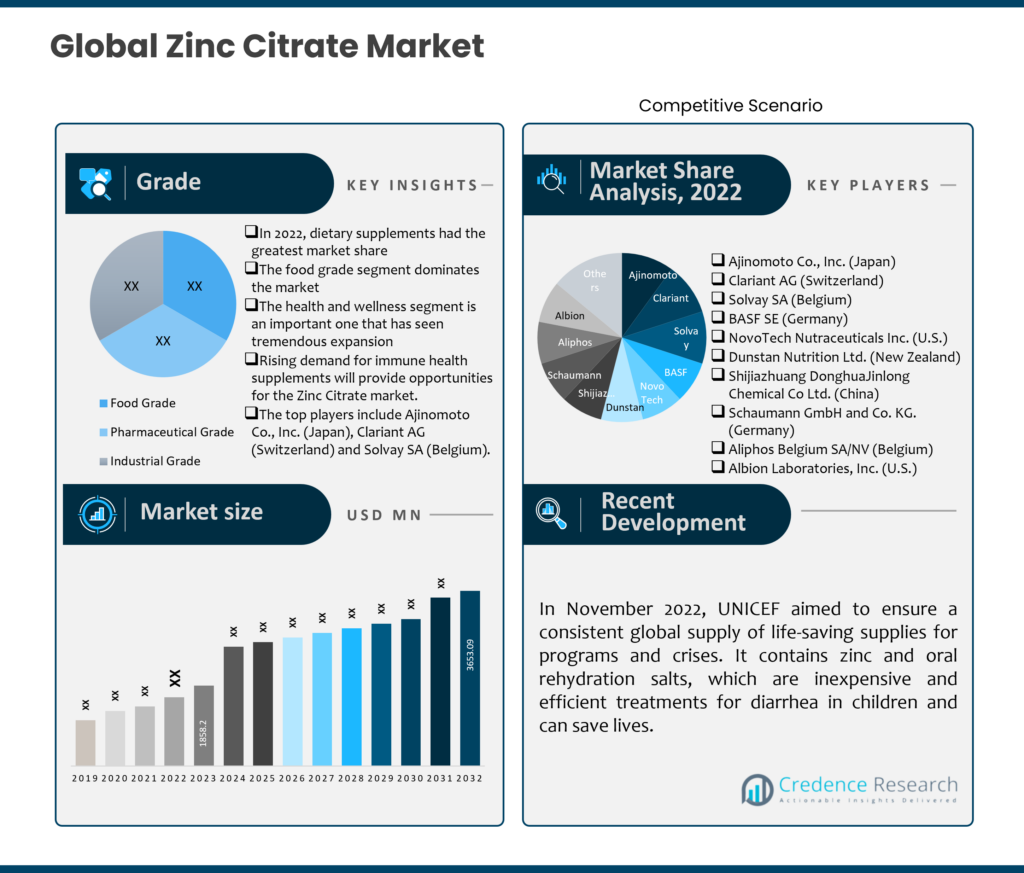
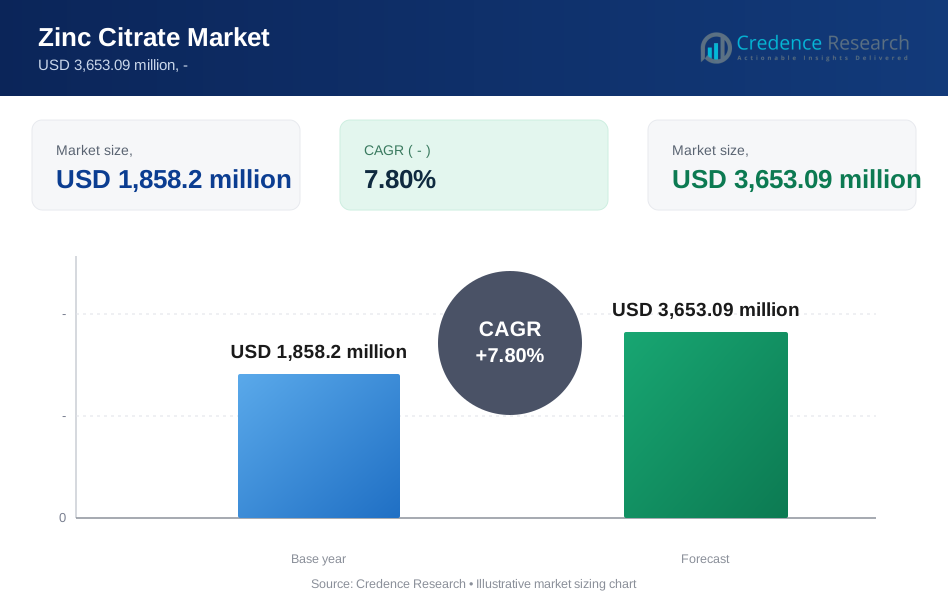
- Between 2024 and 2032, the global market for zinc citrate is projected to rise at a compound annual growth rate (CAGR) of 7.80%, from an estimated USD 1858.2 million in 2023 to USD 3653.09 million in 2032.
- The largest category is dietary supplements. Pharmaceuticals, on the other hand, are expected to grow at a strong CAGR.
- The food grade category will expand at a rapid rate of growth.
- The CAGR for health and wellness is expected to be the highest during the projection period.
- North America governed the market for zinc citrate.
- Regarding the market share of zinc citrate, Europe is expected to come second.
- In the zinc citrate market, Asia Pacific is anticipated to grow fastest.
- The expanding demand for dietary supplements and nutraceuticals, as well as the rise of the pharmaceutical and cosmetics industries, are the main drivers of the global market's expansion.
- The increased use of zinc citrate in fortified foods and drinks, as well as its application in animal feed to enhance the health and productivity of livestock, have led to the development of the zinc citrate industry.
Executive Summary
Market Definition
Zinc Citrate is a dietary supplement that contains zinc and citric acid in the form of zinc salt. Zinc is a vital trace element that functions as an antioxidant, supports a stronger immune system, and is crucial to numerous biological processes. The exact mechanism of action of supplementation with zinc is uncertain, although it may be used to boost protection against viruses or inhibit the replication of some viruses, such as the human papillomavirus (HPV).
Market Overview
The zinc citrate sector is predicted to continue its upward trend between 2024 and 2032, growing at a compound annual growth rate (CAGR) of 7.80%. From its projected USD 1858.2 million in 2023 to USD 3653.09 million in 2032, the market will continue to grow.
Dietary supplements are in high demand as people's attention is shifting more and more toward wellness and health. Numerous physiological functions, including DNA synthesis, wound healing, and immune system function, depend on zinc, an essential mineral for the wellness of humans. Zinc citrate is frequently used in the formulation of zinc supplements because of its high bioavailability. Growing health consciousness among consumers drives up demand for supplements containing zinc citrate, which in turn propels market expansion. Additionally, Zinc citrate is used in many different pharmaceutical formulations, including syrups, tablets, and capsules. It is a component of many drugs used to treat ailments like acne, respiratory infections, and the common cold. Since the pharmaceutical industry is always researching and developing new drugs and improving existing formulas, zinc citrate is in extremely high demand.
Zinc citrate is good for skincare products because it has antimicrobial and anti-inflammatory qualities. It is frequently found in ointments, lotions, and creams meant to treat eczema, acne, and other skin issues. The demand for zinc citrate as an active ingredient in skincare formulations is rising as the global skincare industry continues to grow, which is supporting the market's expansion. Because zinc citrate can stop oral bacteria from growing and lessen the formation of plaque, it is also used in dental care products like mouthwash and toothpaste. Zinc citrate is becoming more and more popular in dental care products as people become more conscious of their oral hygiene and the frequency of dental issues increases.
Segmentation by Application
- The dietary supplements category is the market leader in terms of application. Zinc citrate-containing dietary supplements are among the many products in the larger health and wellness sector that are sold as supplements. A common form of zinc found in dietary supplements is zinc citrate, which has a high bioavailability, and the body can absorb it effectively.
- The pharmaceuticals category will exhibit a sizable CAGR during the projected period. Pharmaceutical companies spend money on R&D to investigate the possible medical applications of zinc citrate. This involves researching how well it works to treat a range of illnesses, including colds, immune system support, wound healing, and skin health.
- Other applications, including food and beverages, oral care products, cosmetics and personal care products, and animal feed and veterinary products, also support the need for zinc citrate.
Segmentation by Grade
- Food grade is considered the best grade category. In the context of the zinc citrate industry, "food grade" refers to the quality level that certifies the product is safe for use in food and beverage applications. Due to its high bioavailability of zinc, a mineral required for many body processes, zinc citrate is a compound that is frequently used as a dietary supplement.
- The pharmaceutical grade category will likely register a significant CAGR during forecasting. Zinc citrate intended for pharmaceutical use needs to be extremely pure, typically more than 99%. The product's efficacy and safety may be impacted by impurities, particularly when they are utilized in pharmaceutical formulations.
- Other grades, such as industrial grade, also contribute to the demand for zinc citrate.
Segmentation by End-Use Industry
- The category of health & wellness is anticipated to expand at a quicker rate during the forecast period. Within the framework of the zinc citrate market, health and wellness pertain to the advantages and impacts of ingesting zinc-citrate-containing products on general health and well-being. Zinc, an important mineral for immune system function, wound healing, DNA synthesis, and growth and development, is found in the form of zinc citrate.
- Other end-use industries, including pharmaceuticals and healthcare, food and beverage, personal care and cosmetics, and animal nutrition, influence the need for zinc citrate.
Segmentation by Region
- North America leads the zinc citrate industry. The region's large population and high expectations for health and wellness products contribute to this need.
- Europe is estimated to rank second in zinc citrate market size.
- The zinc citrate industry is predicted to flourish rapidly in Asia Pacific.
- The remaining need for zinc citrate is covered by regions including Latin America, Africa, and the Middle East.
Moreover, zinc citrate acts as a natural preservative in food and drink items. By preventing the growth of bacteria and fungi, it helps extend the shelf life of perishable goods and preserves their freshness and quality without the use of artificial preservatives. Manufacturers are adding components to their products that provide health benefits beyond basic nutrition in response to the growing trend of functional foods and beverages. A variety of goods, such as juices, dairy products, cereals, and energy bars, can benefit from the addition of zinc citrate to improve their nutritional value and appeal to health-conscious consumers.
Based on projections, North America is anticipated to control the zinc citrate market. The pharmaceutical industry in North America is strong and actively pursues research and development of novel drugs and treatments. Due to the industry's reliance on premium ingredients such as zinc citrate, there is a high level of demand. Zinc citrate is used in many pharmaceutical products, such as over-the-counter cold and flu remedies, ointments that heal wounds, and antidiarrheal drugs. In North America, people frequently emphasize the importance of maintaining general health and seeking preventative medical care. As a result, the market for nutraceuticals and dietary supplements containing zinc citrate is expanding rapidly. Increasingly, consumers want to strengthen their immunity, particularly in view of current public health issues.
The market for zinc citrate in Asia Pacific is anticipated to expand quickly throughout the forecast period. IBEF predicts that the growing healthcare market in India will reach USD 372 billion by 2022 as a result of rising incomes, increased health consciousness, lifestyle diseases, and easier access to insurance. In India, there are approximately 3,000 pharmaceutical companies and over 10,500 manufacturing units. There are more than 60,000 generic brands in 60 different therapeutic areas. India is the world's biggest supplier of generic medications, making up 20% of all generic exports. One hundred fifty nations receive the vaccinations that India exports. These factors are anticipated to boost the growth of the Asia Pacific zinc citrate market.
Key Highlights of the Report
The global zinc citrate market is segmented by application, grade, end-use industry, and region. The dietary supplements category is the market spearhead in terms of application, and food grade is the top-grade category. The health and wellness category is anticipated to increase at the highest CAGR throughout the projection period. The zinc citrate market is expanding mostly in North America.
Various factors propel the zinc citrate market, including the growing use of zinc citrate in pet food and animal feed. When compared to other forms of zinc, zinc citrate is recognized for having a high level of bioavailability and digestibility. This implies that animals will fare better in terms of absorption and utilization of zinc from zinc citrate. Because of this, producers of pet food and animal feed favor adding zinc citrate to their goods in order to give animals the best possible absorption of nutrients.
North America is expected to account for the largest zinc citrate market globally. Zinc citrate can be produced effectively in North America due to its advanced technological capabilities and strong manufacturing infrastructure. Furthermore, the area gains from a thriving industry for dietary supplements and dental care products, the latter of which uses zinc citrate as a primary component for a number of health advantages. It is also anticipated that the market will develop at the fastest rate in the Asia Pacific region. Resources for zinc are plentiful in Asia Pacific nations, and zinc is a necessary raw material for the production of zinc citrate. Being close to raw materials facilitates more affordable manufacturing procedures. Due to the region's investments in R&D, the zinc citrate industry has seen improvements in formulation methods, production processes, and product innovation. This promotes market expansion and increases competition.
Which Key Factors Are Driving The Global Zinc Citrate Market?
Acceptance of zinc citrate in industrial uses, such as prevention of corrosion and increased use of zinc citrate in baby food and formula. These reasons are contributing to the growth of the zinc citrate market.
What Are The Main Challenges Confronting The Global Zinc Citrate Market?
Adverse effects of consumer trends that support natural food sources and the belief that zinc citrate is not a necessary nutrient in some areas. These factors impedes the expansion of the market.
What Market Opportunities Exist For Zinc Citrate Globally?
The use of zinc citrate in animal feed to improve livestock health and productivity, as well as meeting the nutritional needs of expectant and nursing mothers, are some of the factors creating opportunities for the zinc citrate market.
Market Drivers
Growing Demand from the Personal Care and Nutraceutical Industry
As zinc citrate has so many advantages for the skin, it is widely used in the personal care industry. Because of its antibacterial and anti-inflammatory qualities, it is frequently found in skincare products like creams, lotions, and sunscreens. Zinc citrate aids in the treatment of acne, the reduction of skin irritation, and the enhancement of skin health in general. Zinc citrate is in high demand in the personal care industry due to the growing emphasis on skincare and the desire for products with natural and potent ingredients. Zinc citrate is used as a dietary supplement in the nutraceutical industry because of its ability to support immunological health generally and promote healthy bodily functions. It is a necessary nutrient that the body needs for many physiological functions, such as DNA synthesis, wound healing, and immunological function. Zinc citrate is becoming more and more in demand in dietary supplements due to the increased understanding of the value of immunity building and upholding a healthy lifestyle.
Market Restraints
Rising Expenditures for Research And Development and Price Volatility for Raw Materials
Growing expenses for research and development (R&D) could be a major obstacle for the zinc citrate market. Significant R&D investment is necessary for the creation of novel formulations, enhancement of production procedures, assurance of quality control, and compliance with regulatory requirements. Growing costs have the potential to negatively affect producers of zinc citrate by reducing their capacity to invest in innovation and impacting their overall profitability. This could impede the growth of the market by delaying the development of new products. The market for zinc citrate is further restrained by price volatility in raw materials. Zinc is the raw material used to make zinc citrate. Price fluctuations in zinc can be caused by a variety of factors, including shifts in global demand, disruptions in the supply chain, changes in currency exchange rates, and geopolitical events. It can be difficult for manufacturers to forecast production costs and preserve profit margins when raw material prices are unstable. Additionally, they might find it difficult to pass on cost increases to consumers, especially in cutthroat markets where consumers are highly sensitive to price.
Opportunities
Growing Market for Supplements Targeting Joint Health and Mobility
Concerns about joint health and mobility are growing as the world's population ages. Supplements that can reduce stiffness and pain in the joints and enhance general mobility are becoming more and more popular. Zinc citrate meets this need because of its reputation for having potential advantages in promoting joint health. Zinc may have an impact on joint health, although more research is needed to confirm this. It is a part of several physiological processes that may affect the health of cartilage and joint function. The need for zinc citrate is projected to rise as more research indicates the possible advantages of supplementing with zinc for joint health. Consumers are actively looking for ways to maintain their health and prevent age-related issues, such as joint problems, as preventive healthcare becomes more and more important. The market for zinc citrate has benefited from this move toward proactive health management since it fosters the expansion of supplements that address joint health and mobility.
Competitive Landscape
Key Players
In the highly competitive global zinc citrate market, there are a number of significant rivals. A few of the top market players are shown below, together with their respective market shares:
- Ajinomoto Co., Inc. (Japan)
- Clariant AG (Switzerland)
- Solvay SA (Belgium)
- BASF SE (Germany)
- NovoTech Nutraceuticals Inc. (U.S.)
- Dunstan Nutrition Ltd. (New Zealand)
- Shijiazhuang DonghuaJinlong Chemical Co Ltd. (China)
- Schaumann GmbH and Co. KG. (Germany)
- Aliphos Belgium SA/NV (Belgium)
- Albion Laboratories, Inc. (U.S.)
- Others
To stay competitive, these businesses give priority to product innovation, expanding their distribution networks, and completing mergers and acquisitions.
The biggest vendors in the global zinc citrate market consistently strive to keep one step ahead of the competition by creating cutting-edge ideas and goods.
In August 2023, American Elements declared that it would increase its capacity to produce zinc citrate by twenty percent. It is anticipated that this expansion will help meet the increasing demand from various industries for zinc citrate.
In March 2022, The company Chemetall's zinc citrate division was purchased by Albion Laboratories. It is anticipated that this acquisition will improve Albion Laboratories' standing in the industry.
How are Companies Performing in the Zinc Citrate Market?
Several remarkable factors have contributed to the notable performance of companies in the zinc citrate market. Prominent pharmaceutical companies are focusing on making improvements and innovations in order to stay competitive. Their strategic initiatives, which include product development, market expansion, and mergers and acquisitions, are aimed at boosting revenue and strengthening their position. As an illustration, Chroma Dex Corp. introduced Tru Niagen Immune. Zinc citrate, zinc gluconate, vitamin C, and vitamin D for the maintenance of aging cells are among the high-quality and immune-boosting nutrients included in the product.
Companies in the zinc citrate market are discovering that dietary supplements are becoming increasingly significant. For instance, Prinova Europe Limited, a well-known supplier of flavors and ingredients, announced in May 2022 that it would purchase Plandai Biotechnology, Inc. Plandai Biotechnology, Inc. is onePlandai Biotechnology, Inc. is one of the major companies in the manufacturing of dietary supplements and botanical extracts, zinc citrate. With this acquisition, Prinova should be able to offer a wider range of products and strengthen its market position in the dietary supplement industry.
Additionally, leading producer of mineral salts, Dr. Paul Lohmann GmbH KG, announced the introduction of a new grade of zinc citrate in August 2022. It is anticipated that this new product will meet the growing need for premium zinc citrate, particularly in dietary supplements and other uses. The company's decision to introduce a new product highlights its dedication to satisfying the changing needs of the market and its clients as a prominent player in the industry.
Summary of Key Findings
- The global market is expanding due to the development of the pharmaceutical sector, especially in developing nations.
- The market is segmented by application, grade, end-use industry, and region.
- The dietary supplements category is estimated to develop at a significant CAGR over the forecast period.
- Food grade is the foremost grade category.
- The health and wellness category is expected to grow fastest in terms of CAGR during the forecast period.
- North America is leading market development; the market is highly competitive with key players including Ajinomoto Co., Inc. (Japan), Clariant AG (Switzerland), Solvay SA (Belgium), BASF SE (Germany), NovoTech Nutraceuticals Inc. (U.S.), Dunstan Nutrition Ltd. (New Zealand), Shijiazhuang DonghuaJinlong Chemical Co Ltd. (China), Schaumann GmbH and Co. KG. (Germany), Aliphos Belgium SA/NV (Belgium), Albion Laboratories, Inc. (U.S.), and Others.
Future Outlook
- The zinc citrate industry is expected to increase significantly in North America, and its outlook is positive worldwide.
- The expansion of the global market for zinc citrate is being driven by its adoption in industrial applications, such as corrosion inhibition.
- Variations in the cost of raw materials could prevent the market from growing.
- To remain competitive, major corporations must develop new products, expand their customer base, and keep their prices low.
How the Credence Research Zinc Citrate Market Report Can Help CXOs
The Credence Research Zinc Citrate Market Report provides CXOs with an extensive market overview and comprises the following:
- Market size and growth forecast: The study offers comprehensive market estimations for zinc citrate globally, broken down by application, grade, end-use industry, and region. In addition, projections for the market through 2032 based on significant drivers and trends are included.
- Market segmentation: The zinc citrate market is divided into segments by application, grade, end-use industry, and region in the research report. CXOs are given a detailed grasp of the market and the potential inside each sector due to this segmentation.
- Competitive landscape: The study report provides a thorough analysis of the leading businesses in the zinc citrate sector, together with details on their revenue streams, product lines, and business strategies. This information can help CXOs assess and identify their competitors.
- Key trends and drivers: The study report analyzes and highlights the key developments and elements driving the market for zinc citrate. CXOs can utilize this information to make well-informed choices regarding their plans and investments.
The Credence Research Zinc Citrate Market Report provides CXOs with insights that they may utilize to:
- Identify growth opportunities: This analysis is likely to help CXOs find fresh growth prospects in the zinc citrate sector. For example, the research recognizes the increasing requirement for zinc citrate from the health and wellness sectors as a crucial opportunity.
- Make informed investment decisions: The study aids CXOs in making informed decisions about zinc citrate. For example, it delivers information on the key variables to consider while picking solutions and evaluating suppliers.
- Develop competitive strategies: CXOs can utilize the research report to establish competitive strategies for their zinc citrate firms. The study paper explores the primary tactics employed by zinc citrate providers to set themselves apart from their rivals.
- Track market developments: By tracking market advancements, this research report could assist CXOs in remaining ahead of the curve. For example, it provides information about the latest advancements and patterns in the zinc citrate industry.
The Credence Research Zinc Citrate Market Report is helpful for CXOs who want to learn more about the market and identify potential opportunities.
Segmentation
-
By Application
- Dietary Supplements
- Pharmaceuticals
- Food and Beverages
- Oral Care Products
- Cosmetics and Personal Care Products
- Animal Feed and Veterinary Products
-
By Grade
- Food Grade
- Pharmaceutical Grade
- Industrial Grade
-
By End-Use Industry
- Health and Wellness
- Pharmaceuticals and Healthcare
- Food and Beverage
- Personal Care and Cosmetics
- Animal Nutrition
-
By Region
- North America
- U.S.
- Canada
- Mexico
- Europe
- Germany
- France
- UK.
- Italy
- Spain
- Rest of Europe
- Asia Pacific
- China
- Japan
- India
- South Korea
- South-east Asia
- Rest of Asia Pacific
- Latin America
- Brazil
- Argentina
- Rest of Latin America
- Middle East & Africa
- GCC Countries
- South Africa
- The Rest of the Middle East and Africa
- North America
Adjacent Markets
Several adjacent markets in the zinc citrate market have high revenue growth opportunities. The key adjacent markets for the zinc citrate market -
Adjacent Markets |
||
| Zinc Oxide Market | Zinc Phosphate Market | Zinc Alloys Market |
| Zinc Sulfate Market | Zinc Borate Market | Nutraceuticals Market |
| Zinc Chloride Market | Zinc Stearate Market | Oral Care Products Market |
Request a Free Sample
Fill in your details and we'll send you a free sample report.
- Sample data tables & charts
- Research methodology
Need a Custom Version of This Report?
Tailor the scope, geography, or segments to your exact requirements.
- Custom geography or segment scope
- Direct access to our analyst team
Frequently Asked Questions
How much does the global market currently hold for zinc citrate?
What is the zinc citrate market's projected growth rate between 2024 and 2032?
What is the most significant market segment in terms of application?
Regarding the grade, which market category is in the lead?
Which end-use industry is anticipated to grow at the fastest rate throughout the projected period?
In which region is the market for zinc citrate expanding?
Who are the main players in the zinc citrate industry globally?
Which market factors are the primary drivers of the zinc citrate industry?
What main market challenges prevent the growth of the zinc citrate sector?
What are the main market opportunities for the zinc citrate sector?
Table of Content
Chapter 1. Report Introduction
- 1.1 Report Description & Purpose
- 1.1.1 Report Title & Market Definition
- 1.1.2 Unique Selling Propositions (USP) & Key Differentiators
- 1.1.3 Value Proposition for Stakeholders
- 1.2 Research Objectives
- 1.2.1 Market Sizing Objectives (Volume & Revenue)
- 1.2.2 Segmentation Objectives
- 1.2.3 Competitive Intelligence Objectives
- 1.2.4 Forecast & Scenario Objectives
- 1.3 Report Scope
- 1.3.1 Zinc Citrate Scope – Types & Subtypes Covered
- 1.3.2 Geographic Scope – Regions & Countries Covered
- 1.3.3 Historical Period, Base Year & Forecast Period (the historical period; forecast to the forecast period)
- 1.3.4 Inclusions & Exclusions
- 1.4 HS Code & Classification Framework
- 1.5 Currency, Units & Pricing Basis
- 1.6 Target Stakeholders
- 1.7 Limitations & Assumptions
Chapter 2. Executive Summary
- 2.1 Global Zinc Citrate Market Snapshot
- 2.1.1 Market Size – Historical (the historical period) & Forecast (the forecast period) (base year: USD 1,858.2 million → forecast year: USD 3,653.09 million)
- 2.1.2 Volume & Revenue – Global Totals
- 2.1.3 Key Market Highlights – Top Five Facts
- 2.2 Zinc Citrate Market Segmentation Snapshot
- 2.2.1 Market Split by Region – vs.
- 2.3 Competitive Snapshot
- 2.3.1 Top 10 Players by Revenue Share –
- 2.3.2 Top 10 Players by Volume Share –
- 2.3.3 Recent Strategic Developments (18-Month Summary)
- 2.4 Key Investment Highlights & Strategic Conclusions
Chapter 3. Zinc Citrate Market Dynamics & Industry Analysis
- 3.1 Market Overview & Context
- 3.1.1 Zinc Citrate Market Position in the Broader Automotive Value Chain
- 3.1.2 OEM vs. Replacement Market Dynamics
- 3.1.3 Market Maturity & Development Stage by Region
- 3.2 Zinc Citrate Market Drivers
- 3.3 Zinc Citrate Market Restraints & Challenges
- 3.4 Zinc Citrate Market Opportunities
- 3.5 Porter's Five Forces Analysis
- 3.5.1 Threat of New Entrants
- 3.5.2 Bargaining Power of Suppliers
- 3.5.3 Bargaining Power of Buyers
- 3.5.4 Threat of Substitutes
- 3.5.5 Competitive Rivalry – Intensity Assessment
- 3.6 Zinc Citrate Value Chain Analysis
- 3.6.1 Upstream – Raw Material/Input Suppliers
- 3.6.1.1 Raw Material/Input 1
- 3.6.1.2 Raw Material/Input 2
- 3.6.1.3 Raw Material/Input 3
- 3.6.2 Midstream – Production/Manufacturing/Service Delivery
- 3.6.2.1 Production/Process Overview
- 3.6.2.2 Key Facility Locations & Capacity by Manufacturer
- 3.6.3 Downstream – Distribution & End Consumer
- 3.6.3.1 Primary Channel – B2B/OEM
- 3.6.3.2 Secondary Channels – Dealer, Retail, Online, Direct
- 3.6.4 Value Chain Profitability Analysis
- 3.6.1 Upstream – Raw Material/Input Suppliers
- 3.7 PESTEL Analysis
- 3.7.1 Political Factors
- 3.7.2 Economic Factors
- 3.7.3 Social Factors
- 3.7.4 Technological Factors
- 3.7.5 Environmental Factors
- 3.7.6 Legal Factors
- 3.8 Zinc Citrate Supply Chain Analysis
- 3.8.1 Raw Material/Input Supply Risk Assessment
- 3.8.2 Manufacturing Concentration Risk (Geographic Exposure)
- 3.8.3 Trade Disruption Impact Analysis
- 3.9 Regulatory & Policy Landscape
Note: The regulatory and policy landscape section covers regulations based on their applicability to the market, Zinc Citrate category, geography, and scope of the study. Only regulatory frameworks with a material impact on operations, compliance, trade, sustainability, or market access are analyzed in detail.
Chapter 4. Key Investment Pockets & Opportunity Analysis
- 4.1 Zinc Citrate Market Attractiveness Analysis
- 4.1.1 By Region – Investment Attractiveness Matrix (Volume × CAGR)
- 4.2 Absolute Revenue Growth Opportunity
- 4.2.1 By Region – Absolute USD Growth Through the forecast period
- 4.3 Incremental Volume Opportunity
- 4.3.1 By Region – Incremental Volume Through the forecast period
- 4.3.2 Segment – Incremental Volume
- 4.4 Emerging Submarket Opportunity Deep Dive (Subject to Applicability)
- 4.5 Emerging Market Opportunity Scorecards
- 4.5.1 United States
- 4.5.2 Europe
- 4.5.3 Asia
- 4.5.4 Middle East & Africa
Note: Emerging Market Opportunity Scorecards will be included based on relevance and strategic importance. Regions listed are indicative and may vary depending on data availability and market dynamics.
Chapter 5. Zinc Citrate Import-Export Analysis & Trade Flows
- 5.1 Global Trade Overview
- 5.1.1 Global Export Value by Country (the historical period)
- 5.1.2 Global Export Volume by Country (the historical period)
- 5.1.3 Global Import Value by Country (the historical period)
- 5.1.4 Global Import Volume by Country (the historical period)
- 5.1.5 Net Trade Balance by Country (the historical period)
- 5.2 Export Analysis – Segment
- 5.2.1 Type 1 (HS Code)
- 5.2.2 Type 2 (HS Code)
- 5.2.3 Type 3 (HS Code)
- 5.2.4 Type 4 (HS Code)
- 5.2.5 Type 5 (HS Code)
- 5.3 Import Analysis – Segment
- 5.3.1 Type 1 (HS Code)
- 5.3.2 Type 2 (HS Code)
- 5.3.3 Type 3 (HS Code)
- 5.3.4 Type 4 (HS Code)
- 5.3.5 Type 5 (HS Code)
- 5.4 Average Unit Trade Prices
- 5.4.1 Average Export Price – Segment & Country
- 5.4.2 Average Import Price – Segment & Source Country
- 5.4.3 Price Trends (the historical period)
- 5.5 Key Trade Route Analysis
- 5.5.1 Trade Route 1
- 5.5.2 Trade Route 2
- 5.5.3 Trade Route 3
- 5.5.4 Trade Route 4
- 5.5.5 Trade Route 5
- 5.6 Trade Policy Impact Assessment
- 5.6.1 US Anti-Dumping & Section 301 Tariffs
- 5.6.2 EU Customs Union Impact
- 5.6.3 Major Free Trade Agreements
- 5.6.4 USMCA Rules of Origin
Note: Trade policy analysis will be included only where relevant to the Zinc Citrate market.
Chapter 6. Competitive Landscape & Company Benchmarking
- 6.1 Zinc Citrate Market Concentration & Structure
- 6.1.1 Herfindahl-Hirschman Index (HHI) – vs.
- 6.1.2 Tier 1, Tier 2 & Tier 3 Market Structure
- 6.1.3 Global, Regional & Local Player Dynamics
- 6.2 Zinc Citrate Market Share Analysis –
- 6.2.1 Global Revenue Share by Company
- 6.2.2 Global Volume Share by Company
- 6.2.3 Regional Revenue Share
- 6.2.4 Market Share Evolution ( vs. )
- 6.2.5 OEM Segment Share by Company
- 6.2.6 Replacement Segment Share by Company
- 6.3 Production/Delivery Capacity & Facility Analysis
- 6.3.1 Global Installed Capacity
- 6.3.2 Capacity Utilization Rates
- 6.3.3 Production/Output Volume
- 6.3.4 Facility Locations & Capacity Map
- 6.3.5 Planned Capacity Additions
- 6.4 Zinc Citrate Competitive Benchmarking Matrix
- 6.4.1 Revenue, Volume, CAGR & Profitability Comparison
- 6.4.2 Channel Revenue Mix
- 6.4.3 Geographic Revenue Exposure
- 6.4.4 R&D Intensity
- 6.4.5 Sustainability Maturity
- 6.5 Strategic Developments in Zinc Citrate (Last 24 Months)
- 6.5.1 Mergers, Acquisitions & Divestments
- 6.5.2 New Zinc Citrate Launches
- 6.5.3 Facility Expansions
- 6.5.4 Strategic Alliances, Joint Ventures & Partnerships
- 6.5.5 Distribution Expansion & Market Entry
- 6.5.6 Sustainability & ESG Initiatives
- 6.6 Competitive Strategy Mapping
- 6.6.1 Leader, Challenger, Follower & Niche Classification
- 6.6.2 Pricing Strategy Comparison
- 6.6.3 Channel Strategy Matrix
Note: Strategic developments are included based on their materiality and the availability of reliable information.
Chapter 7. Global Zinc Citrate Market – By Distribution Channel
- 7.1 Segment Overview
- 7.1.1 Volume & Revenue Split by Channel ( & )
- 7.1.2 Channel Mix Evolution (the forecast period)
Chapter 8. Regional Market Analysis – Global Overview
- 8.1 Global Regional Overview
- 8.1.1 Regional Volume Share
- 8.1.2 Regional Revenue Share
- 8.1.3 Regional Volume by Region
- 8.1.4 Regional Revenue by Region
- 8.1.5 Regional Forecast Through the forecast period
- 8.2 Cross-Regional Segment Analysis
- 8.2.1 By Distribution Channel
- 8.2.2 By Brand/Price Tier
Chapter 9. North America Zinc Citrate Market
- 9.1 United States
- 9.2 Canada
- 9.3 Mexico
Chapter 10. Europe Zinc Citrate Market
- 10.1 Germany
- 10.2 France
- 10.3 Italy
- 10.4 United Kingdom
- 10.5 Spain
- 10.6 Poland
- 10.7 Russia
- 10.8 Netherlands
- 10.9 Belgium
- 10.10 Sweden
- 10.11 Denmark
- 10.12 Norway
- 10.13 Rest of Europe
Chapter 11. Asia Pacific Zinc Citrate Market
- 11.1 China
- 11.2 India
- 11.3 Japan
- 11.4 South Korea
- 11.5 Thailand
- 11.6 Indonesia
- 11.7 Vietnam
- 11.8 Malaysia
- 11.9 Australia
- 11.10 Rest of Asia Pacific
Chapter 12. Latin America Zinc Citrate Market
- 12.1 Brazil
- 12.2 Argentina
- 12.3 Colombia
- 12.4 Chile
- 12.5 Rest of Latin America
Chapter 13. Middle East Zinc Citrate Market
- 13.1 Saudi Arabia
- 13.2 United Arab Emirates
- 13.3 Turkey
- 13.4 Israel
- 13.5 Iran
- 13.6 Rest of the Middle East
Chapter 14. Africa Zinc Citrate Market
- 14.1 South Africa
- 14.2 Egypt
- 14.3 Nigeria
- 14.4 Morocco
- 14.5 Rest of Africa
Chapter 15. Zinc Citrate Company Profiles
- 15.1 [Company 01]
- 15.1.1 Company Overview
- 15.1.2 Key Management Personnel
- 15.1.3 Products & Services Portfolio
- 15.1.4 Financial Performance
- 15.1.5 Key Market Focus & Geographic Presence
- 15.1.6 Recent Developments & Strategic Initiatives
Note: The company profile list is preliminary and may change based on research findings, market developments, data availability, and client requirements.
Chapter 16. Appendices
- Appendix A – List of Abbreviations & Acronyms
- Appendix B – Industry Classification Code Reference – Full Series
- Appendix C – Production & Capacity Data Tables
- Appendix D – End-Use & Demand Base Tables
- Appendix E – Consumption & Replacement Rate Assumptions
- Appendix F – ASP Reference Tables
- Appendix G – Manufacturing & Facility Database
- Appendix H – Import-Export Data Tables
- Appendix I – Regulatory Summary Tables
- Appendix J – Primary Research Participant List (Anonymized)
- Appendix K – Primary Research Questionnaire Framework
- Appendix L – Data Sources & Bibliography
- Appendix M – Market Size Divergence & Source Comparison
Chapter 17. Research Methodology
- 17.1 Research Framework & Philosophy
- 17.2 Secondary Research – Sources, Hierarchy & Data Extraction
- 17.3 Data Modeling – Bottom-Up & Top-Down Market Sizing
- 17.4 Primary Research – Stakeholder Framework, LOI & Sample Sizes
- 17.5 Forecast Methodology – Regression, Scenario & Sensitivity Analysis
- 17.6 Quality Control – Four-Layer Validation Framework
- 17.7 Limitations & Standard Assumptions
- 17.8 Disclaimer
