
Market Overview
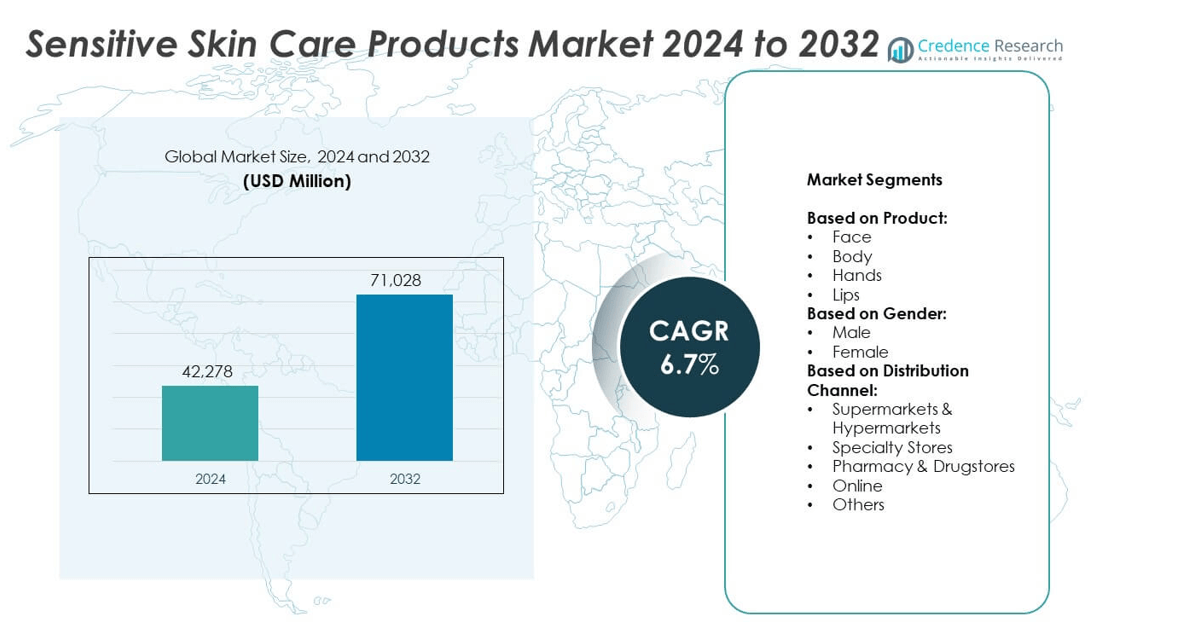
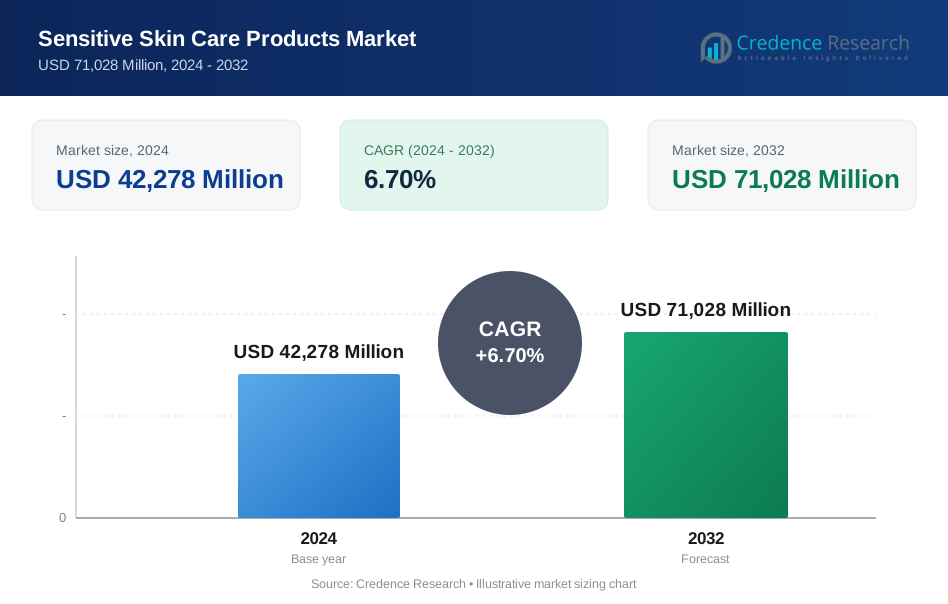
Sensitive Skin Care Products Market size was valued at USD 42,278 Million in 2024 and is expected to reach USD 71,028 Million by 2032, growing at a CAGR of 6.7% during the forecast period.
| REPORT ATTRIBUTE | DETAILS |
|---|---|
| Historical Period | 2020-2023 |
| Base Year | 2024 |
| Forecast Period | 2025-2032 |
| Sensitive Skin Care Products Market Size 2024 | USD 42,278 Million |
| Sensitive Skin Care Products Market, CAGR | 6.7% |
| Sensitive Skin Care Products Market Size 2032 | USD 71,028 Million |
Sensitive Skin Care Products market grows with rising cases of skin irritation, allergies, and pollution-driven sensitivities. Demand for hypoallergenic, fragrance-free, and dermatologist-tested products fuels innovation in clean-label and natural formulations. Consumers seek minimalist routines and multifunctional solutions, pushing brands toward simple, effective products. Digital engagement and influencer marketing educate buyers and drive adoption. E-commerce platforms expand product accessibility, while sustainability efforts such as recyclable packaging and cruelty-free certifications strengthen brand positioning and appeal to environmentally conscious consumers worldwide.
markets )n 80 words) do not write Markets share
North America leads the Sensitive Skin Care Products market due to high awareness and strong dermatology infrastructure. Europe follows with demand for safe, clinically tested products and strict regulatory compliance. Asia-Pacific grows rapidly with rising incomes and urbanization driving adoption of sensitive skin solutions. Key players include L'Oréal S.A., Johnson & Johnson Services Inc., Unilever PLC, and Amorepacific Corporation, focusing on innovation, sustainable packaging, and digital strategies to strengthen presence across established and emerging regions.
Market Insights
- Sensitive Skin Care Products market was valued at USD 42,278 Million in 2024 and is projected to reach USD 71,028 Million by 2032 at a CAGR of 6.7%.
- Rising cases of skin sensitivities, eczema, and allergies drive demand for hypoallergenic and dermatologist-tested solutions.
- Clean-label and natural formulations gain popularity, with consumers preferring plant-based and microbiome-friendly products.
- Leading players such as L'Oréal S.A., Johnson & Johnson Services Inc., Unilever PLC, and Procter & Gamble Company focus on innovation, clinical validation, and sustainable packaging.
- High product development costs and strict regulatory compliance pose challenges for smaller players and delay new launches.
- North America leads the market, followed by Europe, while Asia-Pacific shows fastest growth supported by urbanization and e-commerce adoption.
- Digital campaigns, influencer marketing, and personalized product recommendations strengthen consumer engagement and boost online sales globally.
Market Drivers
Rising Prevalence of Skin Sensitivities and Dermatological Issues
Sensitive Skin Care Products market expands with the growing number of consumers facing skin irritation, allergies, and conditions like eczema or rosacea. Increasing pollution, urban stress, and harsh weather trigger higher skin sensitivity cases. It pushes consumers to choose gentler, dermatologist-tested products. Rising awareness about skin barrier health fuels preference for hypoallergenic and fragrance-free solutions. Social media platforms educate users about skin-friendly routines and ingredients. Dermatologists recommend specialized products, strengthening trust and adoption.
- For instance, La Roche-Posay is recommended by 90,000 dermatologists worldwide.
Increasing Demand for Natural and Clean-Label Formulations
Consumers shift toward products with minimal chemicals, sulfates, and parabens, driving demand for natural solutions. Sensitive Skin Care Products market benefits from brands offering plant-based and non-toxic formulations. It aligns with rising health-conscious behavior and ethical consumption trends. Clean-label certifications enhance brand credibility and consumer loyalty. Manufacturers invest in botanical extracts and microbiome-friendly ingredients to improve product appeal. Regulatory push for safer cosmetic ingredients further encourages adoption of clean-label offerings.
- For instance, Cetaphil has tested its sensitive-skin products on over 32,000 patients across more than 550 clinical studies conducted by Galderma. The studies cover issues like dryness, irritation, roughness, and weakened skin barrier.
Expansion of E-Commerce and Digital Consumer Engagement
Growth of online retail channels strengthens access to specialized sensitive skin care products. E-commerce platforms allow easy product comparison and ingredient research before purchase. It supports niche brands reaching a global audience cost-effectively. Social media influencers and dermatologists endorse trusted solutions, boosting consumer confidence. Subscription models and direct-to-consumer channels enhance convenience and repeat sales. Digital campaigns drive consumer education, encouraging informed buying decisions.
R&D Innovation and Technological Advancements in Product Formulation
Continuous innovation supports development of advanced solutions targeting sensitive skin concerns. Sensitive Skin Care Products market witnesses new delivery systems such as microencapsulation for improved ingredient stability. It helps maintain efficacy and reduce irritation risk. Companies adopt pH-balanced and non-comedogenic formulations to ensure wider acceptance. Clinical testing and dermatological trials validate product safety and effectiveness. Collaboration between cosmetic chemists and dermatologists drives breakthrough product launches.
Market Trends
Growing Popularity of Personalized and Customized Skin Care Solutions
Sensitive Skin Care Products market sees rising interest in tailored solutions for unique skin needs. Brands use AI-powered skin analysis to recommend suitable products. It enhances consumer satisfaction by reducing trial-and-error purchases. Customizable formulations like serums and creams allow precise ingredient selection. Data-driven platforms offer quizzes to guide consumers toward effective routines. This trend fosters deeper engagement and brand loyalty.
- For instance, Kenvue reported that 69% of its packaging portfolio is now recyclable or refillable, with a goal to reach 100% by 2025. Additionally, the company has reduced its use of virgin plastic by over 21% (from its 2020 baseline), aiming for 25% by 2025 and 50% by 2030.
Shift Toward Minimalist and Multi-Functional Product Formulations
Consumers demand simple, effective routines with fewer steps, boosting interest in multifunctional products. Sensitive Skin Care Products market benefits from cleansers, moisturizers, and sunscreens offering combined benefits. It appeals to time-conscious users seeking efficiency and safety. Brands emphasize minimal ingredient lists to lower irritation risks. Packaging highlights essential actives like ceramides and niacinamide to build trust. This shift supports a streamlined, skin-friendly approach.
- For instance, Graphic Packaging Holding Company reported in its 2024 Impact Report that 97% of its packaging products sold are now characterized as recyclable. It also replaced roughly 1 billion plastic packages with paperboard packaging.
Rising Influence of Social Media and Dermatologist Endorsements
Online platforms shape purchase decisions through influencer recommendations and expert advice. Sensitive Skin Care Products market gains momentum through clinical claims showcased on social media. It builds consumer confidence in ingredient transparency and proven results. Dermatologists collaborate with brands to create education-driven campaigns. Viral trends encourage mass adoption of products suitable for sensitive skin. User-generated content amplifies brand credibility and awareness.
Focus on Sustainable and Ethical Product Development
Sustainability drives innovation in packaging, sourcing, and manufacturing across the market. Sensitive Skin Care Products market players adopt recyclable materials and refillable formats. It meets consumer demand for eco-friendly beauty solutions. Brands integrate cruelty-free testing and ethical sourcing certifications. Transparency in supply chain practices strengthens brand image. Sustainable formulations with biodegradable ingredients gain preference among environmentally conscious buyers.
Market Challenges Analysis
High Product Development Costs and Stringent Regulatory Compliance
Sensitive Skin Care Products market faces rising costs due to complex formulation requirements. Brands must invest heavily in R&D to ensure safety, hypoallergenic claims, and clinical validation. It raises time-to-market and limits smaller players' competitiveness. Regulatory bodies demand strict compliance with cosmetic safety and labeling standards. This pressure slows product launches and increases certification expenses. Failure to meet guidelines can lead to recalls, damaging brand reputation and consumer trust.
Intense Competition and Risk of Product Mislabeling
Fierce competition challenges brands to differentiate in a crowded market. Sensitive Skin Care Products market players struggle with greenwashing accusations and false hypoallergenic claims. It creates skepticism among consumers, affecting loyalty. Counterfeit and low-quality products increase risks of skin irritation and erode confidence. Price wars reduce profit margins for premium solutions. Maintaining consistent quality across multiple markets becomes difficult for global brands.
Market Opportunities
Expansion into Emerging Markets and Untapped Consumer Segments
Sensitive Skin Care Products market holds strong potential in Asia-Pacific, Latin America, and Middle East regions. Rising disposable incomes and growing awareness about skin health drive product demand. It creates opportunities for brands to introduce dermatologist-tested and affordable solutions. Localized formulations targeting regional skin concerns enhance acceptance. Distribution partnerships with pharmacies and online retailers expand market reach. Brands that invest in education campaigns can build trust with first-time buyers.
Innovation in Advanced Formulations and Technology Integration
Advances in biotechnology and dermatological research open new growth avenues. Sensitive Skin Care Products market benefits from probiotic-based, microbiome-friendly, and peptide-enriched products. It allows brands to offer targeted solutions with proven clinical results. AI-driven skin diagnostics support personalized product recommendations. Smart packaging with QR codes provides ingredient transparency and usage guidance. Collaborations with research institutes accelerate development of next-generation sensitive skin care lines.
Market Segmentation Analysis:
By Product:
Sensitive Skin Care Products market shows strong demand across multiple product categories. Face care segment leads with high adoption of moisturizers, cleansers, and sunscreens formulated for sensitive skin. It benefits from rising awareness of facial skin health and preference for fragrance-free, pH-balanced solutions. Body care products follow, supported by lotions and shower gels designed to reduce irritation and dryness. Hand care segment grows due to frequent handwashing and sanitizer use, which increase skin dryness. Lip care products gain popularity with demand for hydrating balms and SPF-infused options.
- For instance, Galderma conducted a large global survey involving nearly 17,000 participants in 2025. The results showed up to 70% of people worldwide describe having some degree of sensitive skin.
By Gender:
Female consumers as the dominant buyers of sensitive skin solutions. Women seek targeted face serums, creams, and anti-aging products tailored to delicate skin. It also shows rising adoption among male consumers due to increasing grooming habits and awareness of skin health. Male-oriented products like aftershave balms, facial cleansers, and soothing moisturizers address irritation from shaving and pollution exposure. Brands launch gender-neutral lines to appeal to a wider audience. This shift supports inclusive marketing strategies and product positioning.
- For instance, a JAMA Dermatology--backed pilot survey in 2023 found that 57% of respondents self-reported sensitive skin. Within that group, 15% said they experienced their skin symptoms daily. The study also revealed women (60%) reported sensitive skin more often than men (46.2%).
By Distribution Channel:
Supermarkets and hypermarkets as leading sales points due to broad product availability and convenience. Specialty stores attract consumers seeking dermatologist-recommended and premium solutions. It benefits from in-store consultations and expert guidance. Pharmacies and drugstores maintain steady demand from health-conscious buyers prioritizing clinically tested products. Online channels grow rapidly with the influence of e-commerce, offering personalized recommendations and reviews to guide buyers. Other channels, including direct-to-consumer and department stores, contribute to niche demand, helping brands expand reach across regions.
Segments:
Based on Product:
- Face
- Body
- Hands
- Lips
Based on Gender:
- Male
- Female
Based on Distribution Channel:
- Supermarkets & Hypermarkets
- Specialty Stores
- Pharmacy & Drugstores
- Online
- Others
Based on the Geography:
- North America
- U.S.
- Canada
- Mexico
- Europe
- UK
- France
- Germany
- Italy
- Spain
- Russia
- Belgium
- Netherlands
- Austria
- Sweden
- Poland
- Denmark
- Switzerland
- Rest of Europe
- Asia Pacific
- China
- Japan
- South Korea
- India
- Australia
- Thailand
- Indonesia
- Vietnam
- Malaysia
- Philippines
- Taiwan
- Rest of Asia Pacific
- Latin America
- Brazil
- Argentina
- Peru
- Chile
- Colombia
- Rest of Latin America
- Middle East
- UAE
- KSA
- Israel
- Turkey
- Iran
- Rest of Middle East
- Africa
- Egypt
- Nigeria
- Algeria
- Morocco
- Rest of Africa
Regional Analysis
North America
North America holds the largest share of the Sensitive Skin Care Products market, accounting for 35% of global revenue. High awareness about skin sensitivities and strong dermatological infrastructure support market dominance. Consumers in the U.S. and Canada demand fragrance-free, dermatologist-tested, and hypoallergenic products. It benefits from rising cases of eczema, rosacea, and contact dermatitis linked to pollution and stress. The region sees a surge in demand for clean-label and natural formulations, pushing companies to invest in plant-based ingredients and transparent labeling. Major players focus on clinical validation and dermatologist endorsements to build consumer trust. E-commerce platforms and specialty stores play a critical role in educating buyers and promoting premium products.
Europe
Europe represents 28% of the global market share, supported by high regulatory standards and preference for safe, clinically proven solutions. Consumers in Germany, France, and the UK are highly aware of skin health and seek allergen-free products. It encourages brands to maintain compliance with strict EU regulations, including REACH and Cosmetics Directive standards. Demand rises for sustainable and cruelty-free products, aligning with regional focus on ethical beauty. Growing popularity of pharmacy chains and dermo-cosmetic brands like La Roche-Posay and Avène strengthens sales. Influencer-driven marketing and dermatologist collaborations further expand awareness. Premiumization trends fuel growth in facial serums, moisturizers, and sunscreen products specifically for sensitive skin.
Asia-Pacific
Asia-Pacific captures 22% of the Sensitive Skin Care Products market, making it the fastest-growing region. Rising disposable incomes and growing awareness about skincare routines drive strong adoption. It benefits from urbanization, pollution-related skin concerns, and cultural emphasis on skin health. Countries like China, Japan, and South Korea lead demand for innovative formulations, including microbiome-friendly and lightweight textures suitable for humid climates. K-beauty and J-beauty trends influence product development worldwide, inspiring brands to create advanced solutions for sensitive skin. E-commerce platforms dominate distribution, offering localized products and subscription models. Local players compete with global brands by introducing affordable, dermatologist-approved options.
Latin America
Latin America accounts for 9% of the market share, driven by rising middle-class population and increasing grooming awareness. Consumers in Brazil and Mexico focus on affordable, soothing formulations to address skin irritation from climate and pollution. It creates opportunities for mass-market brands and pharmacy-led sales. Marketing campaigns focus on educating consumers about skin sensitivity and prevention of allergic reactions. Growth of specialty stores and dermatology clinics expands access to premium brands. Regional demand for sun protection and lightweight moisturizers strengthens product sales. Local players collaborate with dermatologists to increase trust and market penetration.
Middle East & Africa
Middle East & Africa represent 6% of global revenue but offer strong potential for future expansion. Harsh climatic conditions, including heat and dryness, heighten the need for hydrating and protective products. It encourages demand for soothing creams, sunscreens, and barrier-repair formulations. Consumers in the UAE, Saudi Arabia, and South Africa prefer dermatologist-endorsed brands and premium solutions. E-commerce and pharmacy channels are growing rapidly, offering better accessibility and variety. Rising awareness about skin health through social media and medical campaigns supports market growth. Global players invest in localized marketing and product launches to cater to specific skin concerns in the region.
Key Player Analysis
- Kao Corporation
- Johnson & Johnson Services Inc.
- Pevonia International Inc
- The Estée Lauder Companies Inc.
- maxingvest AG (Beiersdorf AG)
- L'Oréal S.A.
- Amorepacific Corporation
- Unilever PLC
- Sebapharma GmbH & Co. KG
- Procter & Gamble Company
Competitive Analysis
The competitive landscape of the Sensitive Skin Care Products market is shaped by leading players such as Kao Corporation, Johnson & Johnson Services Inc., Pevonia International Inc, The Estée Lauder Companies Inc., maxingvest AG (Beiersdorf AG), L'Oréal S.A., Amorepacific Corporation, Unilever PLC, Sebapharma GmbH & Co. KG, and Procter & Gamble Company. These companies compete through strong brand portfolios, continuous product innovation, and global distribution networks. They invest in advanced formulations such as pH-balanced, fragrance-free, and microbiome-friendly products to meet the rising demand for sensitive skin solutions. Leading players focus on clinical validation and dermatologist endorsements to build consumer trust and credibility. Many launch gender-neutral and multifunctional products to capture wider consumer segments. Sustainability initiatives, including recyclable packaging and cruelty-free certifications, strengthen brand positioning among eco-conscious buyers. Strategic mergers, acquisitions, and collaborations expand market presence and accelerate R&D efforts. Digital marketing and e-commerce partnerships allow them to engage directly with consumers and boost online sales. Regional expansion strategies target high-growth markets like Asia-Pacific and Latin America, aligning offerings with local preferences. The intense competition encourages constant innovation and drives the overall market toward premiumization and transparency in product labeling.
Recent Developments
- In 2024, Unilever launched a body wash collection addressing nine skincare needs, including hydration with 6% hyaluronic acid serum and Acne Clear formula targeting acne-prone sensitive skin on body areas
- In 2023, L'Oréal acquired Aesop, expanding its footprint in high-end natural sensitive skincare products, especially in China
- In 2022, La Roche-Posay (a L'Oréal brand) launched Anthelios UVMune 400 technology with products offering broad photoprotection designed for sensitive skin including an oily skin formulatio
Report Coverage
The research report offers an in-depth analysis based on Product, Gender, Distribution Channel and Geography. It details leading market players, providing an overview of their business, product offerings, investments, revenue streams, and key applications. Additionally, the report includes insights into the competitive environment, SWOT analysis, current market trends, as well as the primary drivers and constraints. Furthermore, it discusses various factors that have driven market expansion in recent years. The report also explores market dynamics, regulatory scenarios, and technological advancements that are shaping the industry. It assesses the impact of external factors and global economic changes on market growth. Lastly, it provides strategic recommendations for new entrants and established companies to navigate the complexities of the market.
Future Outlook
- Demand for dermatologist-tested and hypoallergenic products will continue to rise.
- Brands will focus on clean-label and natural ingredient formulations for sensitive skin.
- E-commerce will grow as a leading sales channel, offering wider product accessibility.
- Personalized skin care solutions using AI and data-driven tools will gain popularity.
- Sustainable packaging and eco-friendly production methods will become a key differentiator.
- Collaborations with dermatologists and medical professionals will boost product credibility.
- Emerging markets will see rapid adoption due to rising income and awareness levels.
- Multifunctional and minimalist products will dominate consumer preferences.
- Clinical testing and regulatory compliance will remain critical for market trust.
- Digital marketing and influencer collaborations will drive stronger consumer engagement.
Request a Free Sample
Fill in your details and we'll send you a free sample report.
- Sample data tables & charts
- Research methodology
Market Dynamics
Rising Prevalence of Skin Sensitivities and Dermatological Issues
Increasing cases of skin irritation, allergies, eczema, and rosacea—driven by pollution, urban stress, and harsh weather—are pushing consumers toward gentler, dermatologist-tested products, fueling market growth.
Increasing Demand for Natural and Clean-Label Formulations
Consumers are shifting toward products with minimal chemicals, sulfates, and parabens, boosting demand for plant-based, non-toxic, and microbiome-friendly sensitive skin care solutions.
Expansion of E-Commerce and Digital Consumer Engagement
Online retail channels and digital marketing make sensitive skin care products more accessible, allowing consumers to research ingredients, compare products, and receive personalized recommendations, which drives adoption and repeat purchases.
R&D Innovation and Technological Advancements in Product Formulation
Continuous innovation in delivery systems, pH-balanced and non-comedogenic formulations, and clinical validation enables brands to launch safer, more effective products for sensitive skin, expanding the market.
Focus on Sustainable and Ethical Product Development
Growing consumer preference for recyclable packaging, cruelty-free certifications, and ethical sourcing is encouraging brands to invest in sustainable practices, enhancing brand appeal and market differentiation.
Need a Custom Version of This Report?
Tailor the scope, geography, or segments to your exact requirements.
- Custom geography or segment scope
- Direct access to our analyst team
Frequently Asked Questions
What is the current market size for Sensitive Skin Care Products market, and what is its projected size in 2032?
Which Sensitive Skin Care Products market segment held the largest share in 2024?
What are the primary factors fueling the growth of the Sensitive Skin Care Products market?
Who are the leading companies in the Sensitive Skin Care Products Market?
Table of Content
Chapter 1 Market Segmentation
- 1.1 Segmentation Framework
- 1.1.1 Product and Service Classification
- 1.1.2 Application and End-Use Classification
- 1.1.3 Technology and Solution Classification
- 1.1.4 Customer and Distribution Channel Classification
- 1.1.5 Geographic Segmentation
- 1.1.6 Market Segment Definitions and Boundaries
- 1.2 By Gender
- 1.2.1 Male
- 1.2.2 Female
- 1.3 By Product
- 1.3.1 Face
- 1.3.2 Body
- 1.3.3 Hands
- 1.3.4 Lips
Chapter 2 Introduction
- 2.1 Report Objectives and Scope
- 2.2 Product Definition and Industry Terminology
- 2.3 Market Inclusions and Exclusions
- 2.4 Research Process
- 2.4.1 Primary Research and Expert Interviews
- 2.4.2 Secondary Research and Source Review
- 2.4.3 Top-Down and Bottom-Up Estimation
- 2.4.4 Data Triangulation and Verification
- 2.5 Market Size Measurement Basis
- 2.5.1 2024: USD 42,278 Million → 2032: USD 71,028 Million
- 2.6 Historical and Forecast Reference Periods
- 2.6.1 Base Year: 2024
- 2.6.2 Forecast Period: 2024-2032
- 2.7 Research Assumptions and Limitations
Chapter 3 Executive Summary
- 3.1 Market Snapshot and Key Findings
- 3.2 Base-Year Market Size, 2024
- 3.3 Forecast Market Size, 2032
- 3.4 Revenue and Volume Growth Outlook
- 3.5 Key Demand and Supply Indicators
- 3.6 Leading Market Segments
- 3.7 Fastest-Growing Market Opportunities
- 3.8 Regional Performance Highlights
- 3.9 Technology and Industry Transformation
- 3.10 Competitive Landscape Summary
- 3.11 Analyst View and Strategic Implications
Chapter 4 Global Sensitive Skin Care Products Market Trends and Developments
- 4.1 Historical Industry Development
- 4.2 Recent Market Trends and Developments
- 4.3 Demand and Customer Behavior Trends
- 4.4 Technology and Product Innovation
- 4.5 Artificial Intelligence, Automation and Digitalization
- 4.6 Local Manufacturing and Supply Chain Realignment
- 4.7 Industry Partnerships, Mergers and Acquisitions
- 4.8 Sustainability and Circular Economy Developments
- 4.9 Government and Private Sector Investment Trends
- 4.10 Emerging Business Models and Commercialization
- 4.11 Industry Developments and Announcements
Chapter 5 Global Sensitive Skin Care Products Market Production, Supply and Demand Analysis
- 5.1 Demand Trend and Consumption Analysis
- 5.2 Demand Forecast, 2024-2032
- 5.3 Production and Output Trend
- 5.4 Production and Output Forecast, 2024-2032
- 5.5 Installed Capacity and Capacity Utilization
- 5.6 Company-Wise Production Plants and Statistics
- 5.6.1 Installed Production Capacity
- 5.6.2 Actual Production
- 5.6.3 Planned Capacity and Expansion Targets
- 5.7 Supply Chain Structure and Procurement Trends
- 5.8 Supply-Demand Gap and Bottlenecks
- 5.9 Import Dependence and Sourcing Structure
- 5.10 Contract Manufacturing and Outsourcing
- 5.11 Regional Supply and Demand Concentration
Chapter 6 Global Sensitive Skin Care Products Market Pricing Analysis
- 6.1 Pricing Structure and Measurement
- 6.2 Historical Pricing Trends
- 6.3 Pricing Outlook, 2024-2032
- 6.4 Average Selling Price and Unit Economics
- 6.5 Pricing by Product and Market Segment
- 6.6 Geographic Pricing Differences
- 6.7 Key Input, Energy, Labor and Logistics Costs
- 6.8 Contract Pricing and Purchasing Models
- 6.9 Pricing Sensitivity and Competitive Positioning
- 6.10 Price, Margin and Profitability Implications
Chapter 7 Global Sensitive Skin Care Products Market Dynamics
- 7.1 Market Growth Drivers
- 7.1.1 Demand-Side Drivers
- 7.1.2 Technology and Innovation Drivers
- 7.1.3 Infrastructure and Investment Drivers
- 7.1.4 Regulatory and Policy Drivers
- 7.2 Market Restraints
- 7.2.1 Cost and Affordability Constraints
- 7.2.2 Technology and Adoption Barriers
- 7.2.3 Supply Chain and Operational Constraints
- 7.3 Market Challenges
- 7.3.1 Competitive Pressure and Margin Erosion
- 7.3.2 Skills, Infrastructure and Implementation Gaps
- 7.4 Emerging Market Opportunities
- 7.5 Market Dynamics Impact and Time-Horizon Assessment
Chapter 8 Global Sensitive Skin Care Products Value Chain Analysis
- 8.1 Industry Value Chain Overview
- 8.2 Upstream Suppliers and Critical Inputs
- 8.3 Technology and Component Providers
- 8.4 Manufacturing or Service Delivery
- 8.5 Distribution, Channel Partners and Integrators
- 8.6 Downstream Applications and End Users
- 8.7 Value Addition and Profit Pools
- 8.8 Vertical Integration and Outsourcing
- 8.9 Supplier Concentration and Risk
- 8.10 Supply Chain Localization and Resilience
Chapter 9 Global Sensitive Skin Care Products Market Regulations and Policies
- 9.1 Relevant Laws, Standards and Compliance Frameworks
- 9.2 Product, Service, Safety and Quality Requirements
- 9.3 Government Policies, Incentives and Subsidies
- 9.4 Imports, Exports and Trade Barriers
- 9.5 Public Procurement and Local Content Requirements
- 9.6 Environmental and Sustainability Compliance
- 9.7 Upcoming Policy Changes and Market Implications
Chapter 10 Global Sensitive Skin Care Products Market Hotspots and Opportunities
- 10.1 Market Opportunity Mapping and Growth Hotspots
- 10.2 High-Growth Applications and Customer Groups
- 10.3 Underserved Markets and White-Space Opportunities
- 10.4 Emerging Technology and Product Opportunities
- 10.5 New Capacity and Investment Hotspots
- 10.6 Market Entry and Expansion Opportunities
- 10.7 Distribution and Partnership Opportunities
- 10.8 Near-Term and Long-Term Commercial Potential
- 10.9 Opportunity Attractiveness and Execution Risks
Chapter 11 Global Sensitive Skin Care Products Market Outlook, 2024-2032
- 11.1 Market Size and Analysis
- 11.1.1 Revenue (Market Measurement: 2024: USD 42,278 Million → 2032: USD 71,028 Million)
- 11.1.2 Market Volume and Quantity Sold
- 11.1.3 Historical Market Size
- 11.1.4 Base-Year Market Size, 2024
- 11.2 Market Forecast, 2024-2032
- 11.2.1 Revenue Forecast to 2032
- 11.2.2 Volume Forecast to 2032
- 11.2.3 CAGR and Year-on-Year Growth
- 11.2.4 Incremental Revenue Opportunity
- 11.3 Forecast Assumptions and Scenario Analysis
- 11.3.1 Base-Case Forecast
- 11.3.2 Optimistic and Conservative Scenarios
- 11.3.3 Technology, Pricing and Policy Sensitivities
- 11.4 Market Attractiveness and Growth Outlook
Chapter 12 Global Sensitive Skin Care Products Market Segmentation and Outlook
- 12.1 Segmentation Summary and Market Shares, 2024
- 12.2 Largest and Fastest-Growing Segments
- 12.3 By Gender - Market Size and Forecast, 2024-2032
- 12.3.1 Segment Definition and Scope
- 12.3.2 Historical Market Size
- 12.3.3 Revenue Forecast, 2024-2032
- 12.3.4 Volume Forecast, 2024-2032
- 12.3.5 Base-Year Market Share, 2024
- 12.3.6 Segment CAGR and Growth Drivers
- 12.3.7 Subsegment Market Size and Forecast
- 12.3.7.1 Male
- 12.3.7.2 Female
- 12.3.8 Subsegment Pricing and Adoption Trends
- 12.3.9 Leading Suppliers and Competition
- 12.3.10 Regional Demand and Opportunities
- 12.4 By Product - Market Size and Forecast, 2024-2032
- 12.4.1 Segment Definition and Scope
- 12.4.2 Historical Market Size
- 12.4.3 Revenue Forecast, 2024-2032
- 12.4.4 Volume Forecast, 2024-2032
- 12.4.5 Base-Year Market Share, 2024
- 12.4.6 Segment CAGR and Growth Drivers
- 12.4.7 Subsegment Market Size and Forecast
- 12.4.7.1 Face
- 12.4.7.2 Body
- 12.4.7.3 Hands
- 12.4.7.4 Lips
- 12.4.8 Subsegment Pricing and Adoption Trends
- 12.4.9 Leading Suppliers and Competition
- 12.4.10 Regional Demand and Opportunities
- 12.5 Segment Growth Comparison
- 12.6 Segment Attractiveness and Priority Matrix
Chapter 13 Global Sensitive Skin Care Products Geographic Market Outlook, 2024-2032
- 13.1 Regional Market Size and Share, 2024
- 13.2 Regional Market Forecast, 2024-2032
- 13.3 Regional Pricing, Production and Demand Differences
- 13.4 North America
- 13.4.1 United States
- 13.4.2 Canada
- 13.4.3 Mexico
- 13.5 Europe
- 13.5.1 Germany
- 13.5.2 France
- 13.5.3 Italy
- 13.5.4 United Kingdom
- 13.5.5 Spain
- 13.5.6 Poland
- 13.5.7 Russia
- 13.5.8 Netherlands
- 13.5.9 Belgium
- 13.5.10 Sweden
- 13.5.11 Denmark
- 13.5.12 Norway
- 13.5.13 Rest of Europe
- 13.6 Asia Pacific
- 13.6.1 China
- 13.6.2 India
- 13.6.3 Japan
- 13.6.4 South Korea
- 13.6.5 Thailand
- 13.6.6 Indonesia
- 13.6.7 Vietnam
- 13.6.8 Malaysia
- 13.6.9 Australia
- 13.6.10 Rest of Asia Pacific
- 13.7 Latin America
- 13.7.1 Brazil
- 13.7.2 Argentina
- 13.7.3 Colombia
- 13.7.4 Chile
- 13.7.5 Rest of Latin America
- 13.8 Middle East
- 13.8.1 Saudi Arabia
- 13.8.2 United Arab Emirates
- 13.8.3 Turkey
- 13.8.4 Israel
- 13.8.5 Iran
- 13.8.6 Rest of the Middle East
- 13.9 Africa
- 13.9.1 South Africa
- 13.9.2 Egypt
- 13.9.3 Nigeria
- 13.9.4 Morocco
- 13.9.5 Rest of Africa
- 13.10 Regional Investment, Policy and Supply Chain Differences
- 13.11 Regional Competitive Landscape
- 13.12 Geographic Growth Hotspots
Chapter 14 Global Sensitive Skin Care Products Technology, Innovation and Sustainability Outlook
- 14.1 Technology Landscape and Maturity
- 14.2 Product, Process and Service Innovation
- 14.3 AI, Automation and Digital Tools in the Industry
- 14.4 Technology Adoption and Performance Benchmarking
- 14.5 Innovation Pipeline and R&D Investment
- 14.6 Patent and Intellectual Property Trends
- 14.7 Energy Efficiency and Resource Management
- 14.8 Sustainability, Recycling and Circularity
- 14.9 Technology Roadmap, 2024-2032
- 14.10 Risks of Obsolescence and Technology Substitution
Chapter 15 Global Sensitive Skin Care Products Market Key Strategic Imperatives
- 15.1 Growth and Market Entry Priorities
- 15.2 High-Return Products and Segments
- 15.3 Pricing, Profitability and Cost Optimization
- 15.4 Technology Investment and Product Differentiation
- 15.5 Supply Chain Localization and Resilience
- 15.6 Distribution and Customer Acquisition
- 15.7 Partnership, Acquisition and Capacity Strategy
- 15.8 Regional Expansion Priorities
- 15.9 Short-, Medium- and Long-Term Actions
Chapter 16 Competition Outlook
- 16.1 Industry Competition Characteristics
- 16.2 Market Structure and Concentration
- 16.3 Market Share and Competitive Positioning, 2024
- 16.4 Company-Wise Revenue and Product Benchmarking
- 16.5 Production and Service Capacity Benchmarking
- 16.6 Technology, Pricing and Differentiation
- 16.7 Regional Footprint and Distribution Strength
- 16.8 Mergers, Acquisitions and Strategic Alliances
- 16.9 New Entrants and Competitive Threats
- 16.10 Porter's Five Forces and Industry Attractiveness
- 16.11 Competitive Outlook, 2024-2032
Chapter 17 Company Profiles
- 17.1 Company Coverage and Selection Criteria
- 17.2 L'Oréal S.A.
- 17.2.1 Business Description
- 17.2.2 Company Ownership and Geographic Presence
- 17.2.3 Product and Service Portfolio
- 17.2.4 Manufacturing and Operating Footprint
- 17.2.5 Production Capacity and Expansion Plans
- 17.2.6 Financial Performance and Investment
- 17.2.7 Market Share and Competitive Position
- 17.2.8 Technology and Innovation Capabilities
- 17.2.9 Strategic Alliances or Partnerships
- 17.2.10 Recent Developments
- 17.2.11 Growth Strategy and Outlook
- 17.3 Johnson & Johnson Services Inc.
- 17.4 Unilever PLC
- 17.5 Amorepacific Corporation
- 17.6 Procter & Gamble Company
- 17.7 Kao Corporation
- 17.8 The Estée Lauder Companies Inc.
- 17.9 maxingvest AG (Beiersdorf AG)
- 17.10 Sebapharma GmbH & Co. KG
- 17.11 Pevonia International Inc
- 17.12 Other Relevant Market Participants
Note: Every listed company is profiled on the structure shown under the first company. The company list is preliminary and may change based on research findings, market developments, data availability and client requirements.
Chapter 18 Disclaimer
- 18.1 Research and Forecast Disclaimer
- 18.2 Data Source and Estimation Limitations
Note: The depth of individual sections depends on data availability for this market. Volume, capacity, trade and other unit-based metrics are included where applicable.
