
| REPORT ATTRIBUTE | DETAILS |
|---|---|
| Historical Period | 2020-2023 |
| Base Year | 2024 |
| Forecast Period | 2025-2032 |
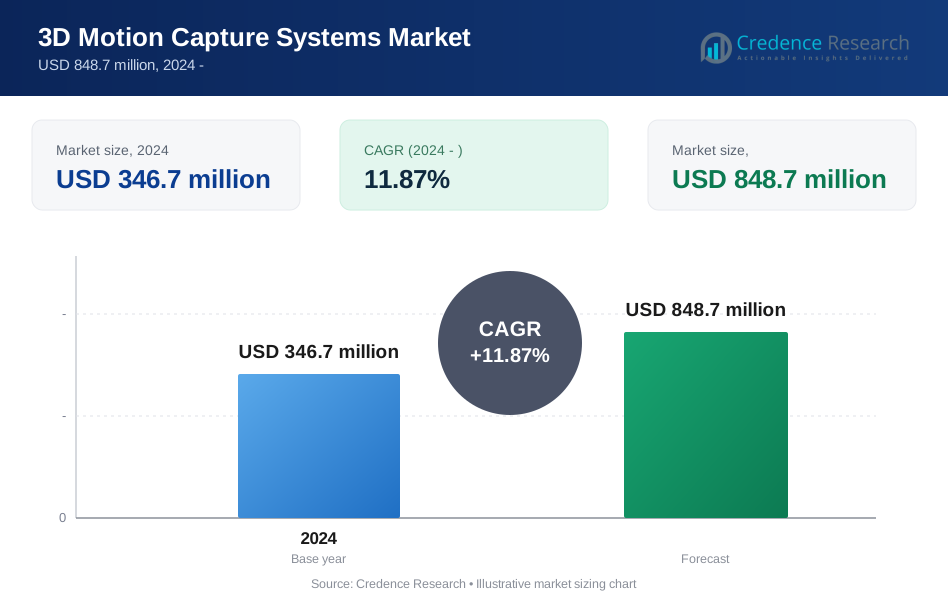
| 3D Motion Capture Systems Market Size 2024 | USD 346.7 Million |
| 3D Motion Capture Systems Market, CAGR | 11.87 % |
| 3D Motion Capture Systems Market Size 2032 | USD 848.7 Million |
Market Overview
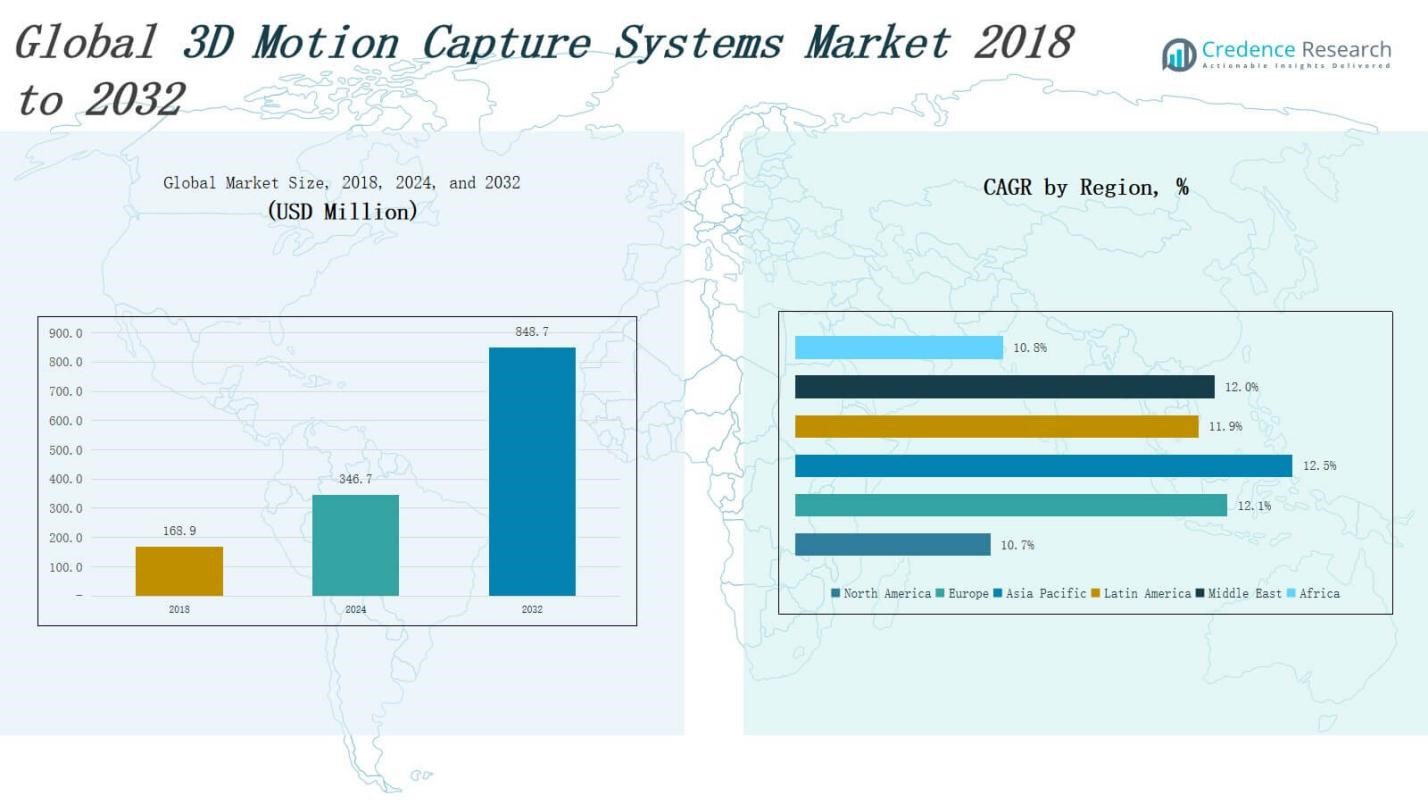
The 3D Motion Capture Systems Market size was valued at USD 168.9 million in 2018 to USD 346.7 million in 2024 and is anticipated to reach USD 848.7 million by 2032, at a CAGR of 11.87 % during the forecast period.
The 3D motion capture systems market is driven by rising demand for realistic animation and simulation in media, gaming, and film production, along with increasing adoption in sports science, biomechanics, and healthcare for movement analysis and injury prevention. Advancements in sensor technology, real-time data processing, and wireless systems enhance system accuracy and usability, expanding deployment across multiple industries. The growing interest in virtual production and the integration of AI for automated motion tracking are accelerating innovation and reducing production costs. In the industrial sector, 3D motion capture supports ergonomics optimization and human-robot interaction analysis, contributing to workplace safety and efficiency. Academic and research institutions are leveraging motion capture systems for cognitive and behavioral studies, further diversifying application scope. The trend toward compact, markerless, and software-integrated solutions is reshaping the competitive landscape, appealing to users seeking portability and cost-efficiency. These factors collectively strengthen market expansion and open new opportunities for cross-sector applications globally.
The 3D Motion Capture Systems Market spans key regions including North America, Europe, Asia Pacific, Latin America, the Middle East, and Africa. North America leads in technological adoption, followed by Europe with strong demand in healthcare and sports science. Asia Pacific shows the fastest growth due to rising investments in gaming and education. Latin America and the Middle East demonstrate increasing uptake in media and rehabilitation sectors, while Africa shows potential in academic and public health applications. Major players driving global market competitiveness include Xsens Technologies B.V., Vicon Motion Systems Ltd., OptiTrack, Qualisys AB, STT Systems, Simi Reality Motion Systems GmbH, Notch Interfaces, Inc., Noraxon U.S.A., Inc., Centroid 3D, and Perception Neuron. These companies compete on accuracy, system scalability, and innovation across hardware, software, and integrated solutions to serve evolving needs across sectors and regions.
Market Insights
- The 3D Motion Capture Systems Market was valued at USD 169.8 million in North America in 2032, led by strong presence in media, healthcare, and sports technology with early adoption of virtual production.
- Europe reached USD 230.2 million by 2032, driven by rising usage in medical diagnostics, biomechanics, and industrial automation across Germany, France, and the UK.
- Asia Pacific leads in growth, projected to hit USD 280.1 million by 2032, supported by gaming, animation, and cost-effective manufacturing in China, Japan, South Korea, and India.
- Latin America is growing steadily, with Brazil and Mexico boosting adoption in sports, education, and animation, reaching USD 96.3 million by 2032.
- The Middle East is expanding rapidly with motion capture used in defense, rehabilitation, and AR/VR; the market is forecast to reach USD 46.8 million by 2032.
- Africa remains small but promising, expected to reach USD 25.7 million by 2032 with use in sports science, education, and health monitoring.
- Key players such as Xsens, Vicon, OptiTrack, Qualisys, Perception Neuron, and others are investing in scalable, AI-integrated solutions to serve global demand across media, healthcare, and industrial sectors
Market Drivers
Expanding Applications in Entertainment and Media
The 3D Motion Capture Systems Market is primarily driven by growing demand from the film, television, and gaming industries. Studios are increasingly using these systems to create lifelike animations, simulate realistic movements, and streamline visual effects production. The rise of virtual production and digital characters requires highly accurate motion data, which these systems provide. Real-time capabilities reduce post-production time and cost. Adoption continues to grow with advancements in markerless and wireless systems that improve creative flexibility and output quality.
- For instance, in James Cameron’s "Avatar," 3D motion capture systems were pivotal in capturing both facial and body movements of actors, making the Na’vi characters exceptionally lifelike and revolutionizing CGI for cinema. This technology set new standards for realism in character animation.
Increased Utilization in Sports Science and Biomechanics
Adoption of 3D motion capture technology is rising in sports science, biomechanics, and rehabilitation. It supports performance analysis, injury prevention, and physical therapy through detailed tracking of joint movements and body mechanics. Elite sports teams and healthcare providers rely on these systems for optimizing training and recovery protocols. The 3D Motion Capture Systems Market benefits from growing investments in athlete monitoring solutions. Accuracy, repeatability, and non-invasiveness make motion capture ideal for clinical and sports applications.
- For instance, Manchester United utilizes Vicon’s optical motion capture systems to monitor athlete performance, allowing coaches to track players’ biomechanical data and tailor individualized training regimens based on real-time three-dimensional joint movement analysis.
Rising Integration in Industrial and Robotics Applications
Industrial sectors are integrating motion capture systems to improve human-machine interaction, ergonomics, and operational safety. These systems capture real-time motion data of workers interacting with machines, enabling improved design and workflow assessment. Robotics development also benefits from motion tracking for gesture-based control and training autonomous systems. The 3D Motion Capture Systems Market gains traction in industrial R&D, supported by automation trends and workplace safety initiatives. System accuracy and scalability support enterprise-level deployment.
Technological Advancements and System Miniaturization
Continuous improvements in sensor technology, software processing, and hardware miniaturization support the market's growth. Lightweight, wireless, and markerless systems offer portability and flexibility, expanding use in field research and compact studio environments. AI integration enhances automation, noise filtering, and pose estimation accuracy. The 3D Motion Capture Systems Market evolves with demand for low-latency, real-time performance across applications. Vendors invest in developing compact and cost-effective solutions to reach broader user segments, including academia and independent creators.
Market Trends
Growing Adoption of Markerless and Wireless Motion Capture Systems
The transition from traditional marker-based systems to markerless and wireless technologies marks a key trend in the 3D Motion Capture Systems Market. These systems simplify setup, reduce subject discomfort, and increase flexibility in movement analysis. Real-time processing capabilities are improving through better cameras, AI-driven algorithms, and powerful onboard processors. The trend aligns with demand for streamlined workflows in gaming, sports, and live entertainment. It drives wider adoption among small studios, academic institutions, and mobile production teams.
- For instance, OptiTrack utilizes both proprietary marker-based solutions and computer vision-powered markerless systems, supporting real-time, high-precision motion capture for applications in entertainment, sports science, and robotics.
Rising Use in Virtual Production and Digital Twins
The use of 3D motion capture in virtual production environments is expanding rapidly, especially in film and commercial production. It allows seamless integration of live actor movements with virtual characters and CGI environments. The 3D Motion Capture Systems Market benefits from growth in digital twins, where motion data models real-world human actions for simulation. These applications require real-time performance, precision, and scalability. Studios and industrial design teams are integrating motion capture directly into their pipelines for continuous production efficiency.
- For instance, Sony’s virtual production technology now integrates ultra-high-resolution LED displays and advanced camera tracking with real-time VFX compositing, empowering studios to deliver cinematic-quality scenes in-camera while maintaining production speed and flexibility.
Integration of Artificial Intelligence and Machine Learning
Artificial intelligence is transforming how motion capture data is processed, interpreted, and applied. AI improves gesture recognition, noise reduction, and skeletal mapping, enhancing system accuracy across environments. The 3D Motion Capture Systems Market incorporates machine learning to support predictive modeling, biomechanics evaluation, and personalized animation techniques. AI-powered platforms also automate repetitive tasks, saving time in post-processing and analysis. This shift drives the creation of more intuitive systems that appeal to users beyond traditional entertainment sectors.
Expansion into Healthcare, AR/VR, and Education Sectors
New applications in healthcare, AR/VR training, and education are expanding the addressable market for 3D motion capture systems. Medical researchers use the technology for neurological studies, rehabilitation monitoring, and musculoskeletal analysis. In AR/VR, it enables more immersive and interactive experiences through accurate tracking. The 3D Motion Capture Systems Market is responding to educational demand with affordable and user-friendly systems tailored for lab use. This diversification strengthens its relevance across multiple high-growth industries worldwide.
Market Challenges Analysis
High System Costs and Infrastructure Requirements
The 3D Motion Capture Systems Market faces challenges related to high initial costs and infrastructure demands. Advanced systems require expensive cameras, sensors, and software, making them inaccessible to smaller studios, educational institutions, and independent developers. Installation often demands large, controlled environments with consistent lighting and calibration. These requirements restrict adoption in resource-constrained settings. While prices are gradually decreasing, cost remains a major barrier for broader market penetration. It limits the reach of motion capture in emerging markets and non-traditional industries.
Complexity in Operation and Data Processing
Operational complexity and steep learning curves present another challenge in the 3D Motion Capture Systems Market. Users must manage system calibration, multi-angle camera setups, and post-processing workflows, which require technical expertise. Data from motion capture systems is often large, complex, and difficult to interpret without advanced software tools. Errors in marker placement, occlusion, or environmental interference can compromise accuracy. These limitations reduce productivity and user satisfaction, especially for non-specialists and first-time users entering the market.
Market Opportunities
Expansion Across Healthcare and Rehabilitation Applications
The 3D Motion Capture Systems Market holds strong opportunities in healthcare and rehabilitation. Medical professionals are adopting motion capture to analyze musculoskeletal disorders, monitor post-surgical recovery, and customize physiotherapy treatments. It offers accurate, non-invasive diagnostics that improve clinical decision-making. Rehabilitation centers and sports medicine facilities increasingly use the technology for movement assessment and therapy design. Rising focus on preventive care and remote monitoring supports integration of motion capture in telehealth. These applications open new revenue streams beyond entertainment and gaming.
Emergence of Education, Training, and AR/VR Integration
The growing use of motion capture in education and AR/VR-based training creates fresh growth avenues. Universities and technical institutes are incorporating it into research labs and animation programs to enhance experiential learning. The 3D Motion Capture Systems Market can meet this demand with compact, affordable solutions. In AR/VR, it enables lifelike avatar movements and real-time interaction in immersive environments. Simulation-based training for defense, healthcare, and manufacturing benefits from precise motion input. These segments offer scalable adoption potential across diverse user bases.
Market Segmentation Analysis:
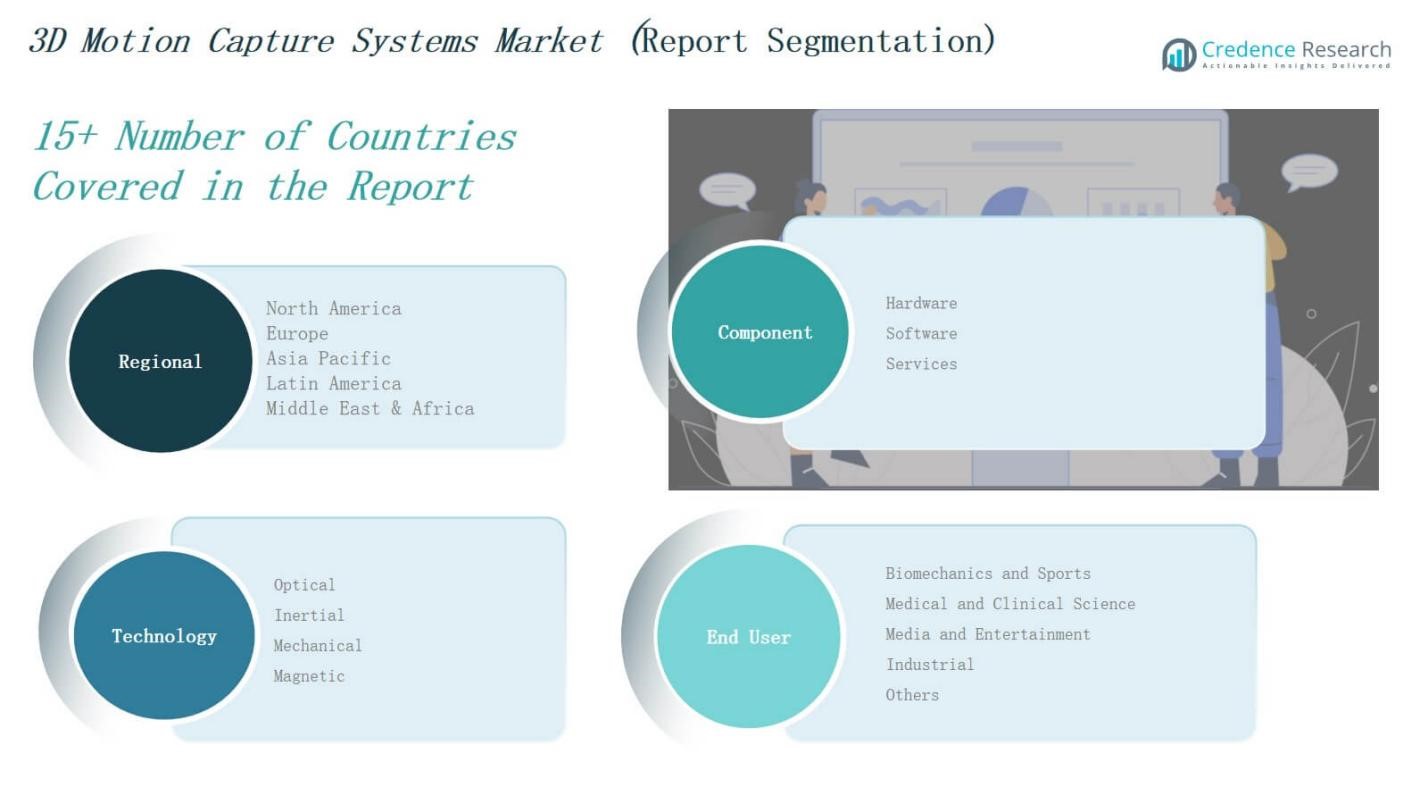
By Component
The 3D Motion Capture Systems Market includes five core component categories: hardware, software, services, bowles, and others. Hardware dominates revenue share due to high demand for cameras, sensors, and suits in full-body capture. Software plays a critical role in data processing, animation, and real-time integration with design tools. Services contribute through installation, training, and system maintenance. Bowles and other niche components support specialized functions. It continues to see innovation in modular and wireless component offerings.
- For instance, Noraxon’s myoMOTION system combines motion capture data with EMG analysis and allows export to third-party tools for sophisticated research and visualization.
By Technology
Based on technology, the 3D Motion Capture Systems Market is segmented into optical, inertial, mechanical, and magnetic systems. Optical technology leads adoption due to its high precision and widespread use in animation and sports science. Inertial systems offer portability and are gaining ground in field-based applications. Mechanical and magnetic systems serve niche industrial and academic use cases, offering durable performance in controlled settings. It reflects varied technological preferences based on accuracy, cost, and environment.
- For instance, Xsens inertial motion capture suits are used by sports teams and ergonomics professionals for wireless, markerless tracking in real-world and outdoor environments, delivering reliable data even outside studio settings.
By End User
End-user segmentation in the 3D Motion Capture Systems Market includes biomechanics and sports, medical and clinical science, media and entertainment, industrial, and others. Media and entertainment hold the largest share due to high reliance on realistic motion for film and gaming. Biomechanics and medical sectors adopt these systems for movement analysis, rehabilitation, and diagnostics. Industrial users apply motion capture for ergonomics, robotics, and human-machine interface development. It continues to expand across sectors seeking precision motion data.
Segments:
Based on Component
- Hardware
- Software
- Services
- Bowles
- Others
Based on Technology
- Optical
- Inertial
- Mechanical
- Magnetic
Based on End User
- Biomechanics and Sports
- Medical and Clinical Science
- Media and Entertainment
- Industrial
- Others
Based on Region
- North America
- Europe
- Asia Pacific
- Latin America
- Middle East
- Africa
Regional Analysis
North America
The North America 3D Motion Capture Systems Market size was valued at USD 39.03 million in 2018 to USD 75.49 million in 2024 and is anticipated to reach USD 169.75 million by 2032, at a CAGR of 10.7% during the forecast period. North America holds a substantial share of the global market due to its strong presence in entertainment, sports technology, and healthcare innovation. It benefits from the presence of leading studios, research institutions, and system manufacturers. High investment in R&D and early adoption of virtual production platforms continue to drive demand. The U.S. remains the primary revenue contributor with wide-scale deployment across media, clinical, and academic applications. The region also shows steady growth in defense and industrial motion tracking use cases.
Europe
The Europe 3D Motion Capture Systems Market size was valued at USD 44.45 million in 2018 to USD 92.43 million in 2024 and is anticipated to reach USD 230.18 million by 2032, at a CAGR of 12.1% during the forecast period. Europe ranks second in market share and shows strong adoption across healthcare, biomechanics, and sports science. Countries like Germany, France, and the UK drive regional demand with increasing use in medical diagnostics, education, and industrial automation. It supports innovation through academic partnerships and publicly funded projects. European users favor compact and markerless systems due to space and compliance constraints. The region also focuses on integrating AI-driven systems for precision analytics.
Asia Pacific
The Asia Pacific 3D Motion Capture Systems Market size was valued at USD 51.42 million in 2018 to USD 109.34 million in 2024 and is anticipated to reach USD 280.08 million by 2032, at a CAGR of 12.5% during the forecast period. Asia Pacific leads the global market by volume and shows the fastest growth rate due to rising investments in gaming, animation, and healthcare. China, Japan, South Korea, and India are key contributors, driven by rapid digitization and increasing use in education and sports technology. It benefits from cost-effective manufacturing and government-backed innovation programs. Demand is also rising for wearable and wireless motion capture systems in academic and mobile field applications. Regional companies are entering the market with affordable, scalable solutions.
Latin America
The Latin America 3D Motion Capture Systems Market size was valued at USD 19.00 million in 2018 to USD 39.13 million in 2024 and is anticipated to reach USD 96.25 million by 2032, at a CAGR of 11.9% during the forecast period. Latin America shows increasing adoption in sports training, animation production, and university research. Brazil and Mexico lead in deployment due to growing creative industries and government investments in education technology. It faces infrastructure limitations but compensates through mobile, plug-and-play solutions. Market expansion is supported by international vendors partnering with local distributors. Demand is also emerging in physical therapy and biomechanical research sectors.
Middle East
The Middle East 3D Motion Capture Systems Market size was valued at USD 9.12 million in 2018 to USD 18.88 million in 2024 and is anticipated to reach USD 46.77 million by 2032, at a CAGR of 12.0% during the forecast period. The Middle East is adopting motion capture systems across sectors such as defense training, medical rehabilitation, and sports technology. The UAE and Saudi Arabia lead adoption with smart infrastructure projects and growing focus on digital entertainment. It sees rising interest in AR/VR integration for simulation-based learning and remote diagnostics. Regional investments in healthcare digitization and e-learning tools support market expansion. The market is gradually shifting from import dependence to localized integration solutions.
Africa The Africa 3D Motion Capture Systems Market size was valued at USD 5.86 million in 2018 to USD 11.38 million in 2024 and is anticipated to reach USD 25.72 million by 2032, at a CAGR of 10.8% during the forecast period. Africa holds a modest share of the global market but shows potential in sports science, education, and public health research. South Africa leads adoption, supported by university labs and performance analytics initiatives. It faces challenges in cost and infrastructure but benefits from mobile, software-driven systems. Awareness is growing about motion capture’s role in rehabilitation and injury prevention. Demand is also rising in digital content creation, especially among startups and educational institutions.
Key Player Analysis
- Perception Neuron
- STT Systems
- OptiTrack
- Centroid 3D
- Xsens Technologies B.V.
- Notch Interfaces, Inc.
- Simi Reality Motion Systems GmbH
- Vicon Motion Systems Ltd.
- Qualisys AB
- Noraxon U.S.A., Inc.
- Other Key Players
Competitive Analysis
The 3D Motion Capture Systems Market features a competitive landscape dominated by technology-focused firms offering specialized hardware and integrated software platforms. Companies such as Vicon Motion Systems Ltd., Xsens Technologies B.V., and OptiTrack lead through innovation in optical tracking, real-time data processing, and scalable system architecture. New entrants like Notch Interfaces, Inc. and Perception Neuron focus on portable, affordable systems for emerging applications. The market emphasizes system accuracy, ease of use, and cross-platform compatibility. It rewards vendors that invest in AI-enhanced analytics, wireless designs, and cloud-based services. Strategic partnerships with healthcare institutions, film studios, and research labs support brand expansion. Players compete on customization, technical support, and long-term upgrade paths. Global presence, IP portfolios, and pricing flexibility remain key differentiators. The 3D Motion Capture Systems Market continues to evolve through product diversification and targeted solutions for media, sports, medical, and industrial sectors.
Recent Developments
- In May 2025, Movella launched Xsens Animate 2025, featuring enhanced motion engine, Auto Sensor Mapping, and gender-specific anatomy models for improved realism and setup speed.
- In March 2025, Vicon unveiled its Markerless Motion Capture system at GDC, integrating new Vanguard cameras with Shōgun Markerless software for high-precision, marker-free tracking.
- In May 2025, Vicon introduced the Active Crown, a dedicated camera tracking solution for in-camera virtual production, designed to improve reliability and reduce system interference.
- In April 2025, OptiTrack launched its Versaˣ Outdoor Camera lineup at NAB 2025, designed for high-precision motion tracking in outdoor and broadcast environments.
- In February 2024, Arctek launched the VR-Motion System, a cutting-edge 3D motion capture solution designed for virtual reality and gaming applications. The system offers high-precision tracking and real-time feedback for immersive experiences.
Market Concentration & Characteristics
The 3D Motion Capture Systems Market shows moderate to high market concentration, with a few key players controlling a significant share of global revenue. Companies such as Vicon, Xsens, OptiTrack, and Qualisys dominate through advanced technology portfolios, strong distribution networks, and recurring contracts with leading studios and research institutions. It features characteristics such as high entry barriers due to capital-intensive R&D, technical expertise requirements, and the need for precision hardware-software integration. The market favors vendors that offer customizable, scalable systems with real-time data capabilities and seamless integration into existing workflows. Product innovation, miniaturization, and AI-based enhancements drive competition. Buyers prioritize system accuracy, support services, and platform interoperability. It serves diverse applications across media, sports, healthcare, industrial design, and education. While leading players maintain stronghold in North America and Europe, local and regional providers are expanding in Asia Pacific and Latin America with cost-effective and portable solutions targeting emerging market demands.
Report Coverage
The research report offers an in-depth analysis based on Component, Technology, End-User and Region. It details leading market players, providing an overview of their business, product offerings, investments, revenue streams, and key applications. Additionally, the report includes insights into the competitive environment, SWOT analysis, current market trends, as well as the primary drivers and constraints. Furthermore, it discusses various factors that have driven market expansion in recent years. The report also explores market dynamics, regulatory scenarios, and technological advancements that are shaping the industry. It assesses the impact of external factors and global economic changes on market growth. Lastly, it provides strategic recommendations for new entrants and established companies to navigate the complexities of the market.
Future Outlook
- Demand will rise across media and entertainment for real-time virtual production and digital character animation.
- Sports organizations will increasingly use motion capture for performance analysis and injury prevention.
- Healthcare providers will adopt these systems for rehabilitation, gait analysis, and neurological assessments.
- Industrial sectors will expand use in ergonomics, robotics training, and workplace safety monitoring.
- AI integration will improve motion data accuracy, automation, and post-processing efficiency.
- Markerless and wireless systems will gain popularity due to easier setup and higher mobility.
- Educational institutions will adopt cost-effective systems for research, training, and academic projects.
- Adoption will grow in emerging markets through local partnerships and affordable system offerings.
- Companies will invest in software platforms that support cloud-based collaboration and real-time analytics.
- Competitive focus will shift toward miniaturized, portable, and user-friendly motion capture solutions.
Request a Free Sample
Fill in your details and we'll send you a free sample report.
- Sample data tables & charts
- Research methodology
Need a Custom Version of This Report?
Tailor the scope, geography, or segments to your exact requirements.
- Custom geography or segment scope
- Direct access to our analyst team
Frequently Asked Questions
What is the current size of the 3D Motion Capture Systems Market?
What factors are driving the growth of the 3D Motion Capture Systems Market?
What are the key segments within the 3D Motion Capture Systems Market?
What are some challenges faced by the 3D Motion Capture Systems Market?
Who are the major players in the 3D Motion Capture Systems Market?
Table of Content
Chapter 1. Report Introduction
- 1.1 Report Description & Purpose
- 1.1.1 Report Title & Market Definition
- 1.1.2 Unique Selling Propositions (USP) & Key Differentiators
- 1.1.3 Value Proposition for Stakeholders
- 1.2 Research Objectives
- 1.2.1 Market Sizing Objectives (Volume & Revenue)
- 1.2.2 Segmentation Objectives
- 1.2.3 Competitive Intelligence Objectives
- 1.2.4 Forecast & Scenario Objectives
- 1.3 Report Scope
- 1.3.1 3D Motion Capture Systems Scope – Types & Subtypes Covered
- 1.3.2 Geographic Scope – Regions & Countries Covered
- 1.3.3 Historical Period, Base Year & Forecast Period (2024; forecast to the forecast period)
- 1.3.4 Inclusions & Exclusions
- 1.4 HS Code & Classification Framework
- 1.5 Currency, Units & Pricing Basis
- 1.6 Target Stakeholders
- 1.7 Limitations & Assumptions
Chapter 2. Executive Summary
- 2.1 Global 3D Motion Capture Systems Market Snapshot
- 2.1.1 Market Size – Historical (2024) & Forecast (the forecast period) (2024: USD 346.7 million → forecast year: USD 848.7 million)
- 2.1.2 Volume & Revenue – Global Totals
- 2.1.3 Key Market Highlights – Top Five Facts
- 2.2 3D Motion Capture Systems Market Segmentation Snapshot
- 2.2.1 Market Split by Region – 2024 vs.
- 2.3 Competitive Snapshot
- 2.3.1 Top 10 Players by Revenue Share – 2024
- 2.3.2 Top 10 Players by Volume Share – 2024
- 2.3.3 Recent Strategic Developments (18-Month Summary)
- 2.4 Key Investment Highlights & Strategic Conclusions
Chapter 3. 3D Motion Capture Systems Market Dynamics & Industry Analysis
- 3.1 Market Overview & Context
- 3.1.1 3D Motion Capture Systems Market Position in the Broader Automotive Value Chain
- 3.1.2 OEM vs. Replacement Market Dynamics
- 3.1.3 Market Maturity & Development Stage by Region
- 3.2 3D Motion Capture Systems Market Drivers
- 3.3 3D Motion Capture Systems Market Restraints & Challenges
- 3.4 3D Motion Capture Systems Market Opportunities
- 3.5 Porter's Five Forces Analysis
- 3.5.1 Threat of New Entrants
- 3.5.2 Bargaining Power of Suppliers
- 3.5.3 Bargaining Power of Buyers
- 3.5.4 Threat of Substitutes
- 3.5.5 Competitive Rivalry – Intensity Assessment
- 3.6 3D Motion Capture Systems Value Chain Analysis
- 3.6.1 Upstream – Raw Material/Input Suppliers
- 3.6.1.1 Raw Material/Input 1
- 3.6.1.2 Raw Material/Input 2
- 3.6.1.3 Raw Material/Input 3
- 3.6.2 Midstream – Production/Manufacturing/Service Delivery
- 3.6.2.1 Production/Process Overview
- 3.6.2.2 Key Facility Locations & Capacity by Manufacturer
- 3.6.3 Downstream – Distribution & End Consumer
- 3.6.3.1 Primary Channel – B2B/OEM
- 3.6.3.2 Secondary Channels – Dealer, Retail, Online, Direct
- 3.6.4 Value Chain Profitability Analysis
- 3.6.1 Upstream – Raw Material/Input Suppliers
- 3.7 PESTEL Analysis
- 3.7.1 Political Factors
- 3.7.2 Economic Factors
- 3.7.3 Social Factors
- 3.7.4 Technological Factors
- 3.7.5 Environmental Factors
- 3.7.6 Legal Factors
- 3.8 3D Motion Capture Systems Supply Chain Analysis
- 3.8.1 Raw Material/Input Supply Risk Assessment
- 3.8.2 Manufacturing Concentration Risk (Geographic Exposure)
- 3.8.3 Trade Disruption Impact Analysis
- 3.9 Regulatory & Policy Landscape
Note: The regulatory and policy landscape section covers regulations based on their applicability to the market, 3D Motion Capture Systems category, geography, and scope of the study. Only regulatory frameworks with a material impact on operations, compliance, trade, sustainability, or market access are analyzed in detail.
Chapter 4. Key Investment Pockets & Opportunity Analysis
- 4.1 3D Motion Capture Systems Market Attractiveness Analysis
- 4.1.1 By Region – Investment Attractiveness Matrix (Volume × CAGR)
- 4.2 Absolute Revenue Growth Opportunity
- 4.2.1 By Region – Absolute USD Growth Through the forecast period
- 4.3 Incremental Volume Opportunity
- 4.3.1 By Region – Incremental Volume Through the forecast period
- 4.3.2 Segment – Incremental Volume
- 4.4 Emerging Submarket Opportunity Deep Dive (Subject to Applicability)
- 4.5 Emerging Market Opportunity Scorecards
- 4.5.1 United States
- 4.5.2 Europe
- 4.5.3 Asia
- 4.5.4 Middle East & Africa
Note: Emerging Market Opportunity Scorecards will be included based on relevance and strategic importance. Regions listed are indicative and may vary depending on data availability and market dynamics.
Chapter 5. 3D Motion Capture Systems Import-Export Analysis & Trade Flows
- 5.1 Global Trade Overview
- 5.1.1 Global Export Value by Country (2024)
- 5.1.2 Global Export Volume by Country (2024)
- 5.1.3 Global Import Value by Country (2024)
- 5.1.4 Global Import Volume by Country (2024)
- 5.1.5 Net Trade Balance by Country (2024)
- 5.2 Export Analysis – Segment
- 5.2.1 Type 1 (HS Code)
- 5.2.2 Type 2 (HS Code)
- 5.2.3 Type 3 (HS Code)
- 5.2.4 Type 4 (HS Code)
- 5.2.5 Type 5 (HS Code)
- 5.3 Import Analysis – Segment
- 5.3.1 Type 1 (HS Code)
- 5.3.2 Type 2 (HS Code)
- 5.3.3 Type 3 (HS Code)
- 5.3.4 Type 4 (HS Code)
- 5.3.5 Type 5 (HS Code)
- 5.4 Average Unit Trade Prices
- 5.4.1 Average Export Price – Segment & Country
- 5.4.2 Average Import Price – Segment & Source Country
- 5.4.3 Price Trends (2024)
- 5.5 Key Trade Route Analysis
- 5.5.1 Trade Route 1
- 5.5.2 Trade Route 2
- 5.5.3 Trade Route 3
- 5.5.4 Trade Route 4
- 5.5.5 Trade Route 5
- 5.6 Trade Policy Impact Assessment
- 5.6.1 US Anti-Dumping & Section 301 Tariffs
- 5.6.2 EU Customs Union Impact
- 5.6.3 Major Free Trade Agreements
- 5.6.4 USMCA Rules of Origin
Note: Trade policy analysis will be included only where relevant to the 3D Motion Capture Systems market.
Chapter 6. Competitive Landscape & Company Benchmarking
- 6.1 3D Motion Capture Systems Market Concentration & Structure
- 6.1.1 Herfindahl-Hirschman Index (HHI) – vs. 2024
- 6.1.2 Tier 1, Tier 2 & Tier 3 Market Structure
- 6.1.3 Global, Regional & Local Player Dynamics
- 6.2 3D Motion Capture Systems Market Share Analysis – 2024
- 6.2.1 Global Revenue Share by Company
- 6.2.2 Global Volume Share by Company
- 6.2.3 Regional Revenue Share
- 6.2.4 Market Share Evolution ( vs. 2024)
- 6.2.5 OEM Segment Share by Company
- 6.2.6 Replacement Segment Share by Company
- 6.3 Production/Delivery Capacity & Facility Analysis
- 6.3.1 Global Installed Capacity
- 6.3.2 Capacity Utilization Rates
- 6.3.3 Production/Output Volume
- 6.3.4 Facility Locations & Capacity Map
- 6.3.5 Planned Capacity Additions
- 6.4 3D Motion Capture Systems Competitive Benchmarking Matrix
- 6.4.1 Revenue, Volume, CAGR & Profitability Comparison
- 6.4.2 Channel Revenue Mix
- 6.4.3 Geographic Revenue Exposure
- 6.4.4 R&D Intensity
- 6.4.5 Sustainability Maturity
- 6.5 Strategic Developments in 3D Motion Capture Systems (Last 24 Months)
- 6.5.1 Mergers, Acquisitions & Divestments
- 6.5.2 New 3D Motion Capture Systems Launches
- 6.5.3 Facility Expansions
- 6.5.4 Strategic Alliances, Joint Ventures & Partnerships
- 6.5.5 Distribution Expansion & Market Entry
- 6.5.6 Sustainability & ESG Initiatives
- 6.6 Competitive Strategy Mapping
- 6.6.1 Leader, Challenger, Follower & Niche Classification
- 6.6.2 Pricing Strategy Comparison
- 6.6.3 Channel Strategy Matrix
Note: Strategic developments are included based on their materiality and the availability of reliable information.
Chapter 7. Global 3D Motion Capture Systems Market – By Distribution Channel
- 7.1 Segment Overview
- 7.1.1 Volume & Revenue Split by Channel (2024 & )
- 7.1.2 Channel Mix Evolution (the forecast period)
Chapter 8. Regional Market Analysis – Global Overview
- 8.1 Global Regional Overview
- 8.1.1 Regional Volume Share
- 8.1.2 Regional Revenue Share
- 8.1.3 Regional Volume by Region
- 8.1.4 Regional Revenue by Region
- 8.1.5 Regional Forecast Through the forecast period
- 8.2 Cross-Regional Segment Analysis
- 8.2.1 By Distribution Channel
- 8.2.2 By Brand/Price Tier
Chapter 9. North America 3D Motion Capture Systems Market
- 9.1 United States
- 9.2 Canada
- 9.3 Mexico
Chapter 10. Europe 3D Motion Capture Systems Market
- 10.1 Germany
- 10.2 France
- 10.3 Italy
- 10.4 United Kingdom
- 10.5 Spain
- 10.6 Poland
- 10.7 Russia
- 10.8 Netherlands
- 10.9 Belgium
- 10.10 Sweden
- 10.11 Denmark
- 10.12 Norway
- 10.13 Rest of Europe
Chapter 11. Asia Pacific 3D Motion Capture Systems Market
- 11.1 China
- 11.2 India
- 11.3 Japan
- 11.4 South Korea
- 11.5 Thailand
- 11.6 Indonesia
- 11.7 Vietnam
- 11.8 Malaysia
- 11.9 Australia
- 11.10 Rest of Asia Pacific
Chapter 12. Latin America 3D Motion Capture Systems Market
- 12.1 Brazil
- 12.2 Argentina
- 12.3 Colombia
- 12.4 Chile
- 12.5 Rest of Latin America
Chapter 13. Middle East 3D Motion Capture Systems Market
- 13.1 Saudi Arabia
- 13.2 United Arab Emirates
- 13.3 Turkey
- 13.4 Israel
- 13.5 Iran
- 13.6 Rest of the Middle East
Chapter 14. Africa 3D Motion Capture Systems Market
- 14.1 South Africa
- 14.2 Egypt
- 14.3 Nigeria
- 14.4 Morocco
- 14.5 Rest of Africa
Chapter 15. 3D Motion Capture Systems Company Profiles
- 15.1 [Company 01]
- 15.1.1 Company Overview
- 15.1.2 Key Management Personnel
- 15.1.3 Products & Services Portfolio
- 15.1.4 Financial Performance
- 15.1.5 Key Market Focus & Geographic Presence
- 15.1.6 Recent Developments & Strategic Initiatives
Note: The company profile list is preliminary and may change based on research findings, market developments, data availability, and client requirements.
Chapter 16. Appendices
- Appendix A – List of Abbreviations & Acronyms
- Appendix B – Industry Classification Code Reference – Full Series
- Appendix C – Production & Capacity Data Tables
- Appendix D – End-Use & Demand Base Tables
- Appendix E – Consumption & Replacement Rate Assumptions
- Appendix F – ASP Reference Tables
- Appendix G – Manufacturing & Facility Database
- Appendix H – Import-Export Data Tables
- Appendix I – Regulatory Summary Tables
- Appendix J – Primary Research Participant List (Anonymized)
- Appendix K – Primary Research Questionnaire Framework
- Appendix L – Data Sources & Bibliography
- Appendix M – Market Size Divergence & Source Comparison
Chapter 17. Research Methodology
- 17.1 Research Framework & Philosophy
- 17.2 Secondary Research – Sources, Hierarchy & Data Extraction
- 17.3 Data Modeling – Bottom-Up & Top-Down Market Sizing
- 17.4 Primary Research – Stakeholder Framework, LOI & Sample Sizes
- 17.5 Forecast Methodology – Regression, Scenario & Sensitivity Analysis
- 17.6 Quality Control – Four-Layer Validation Framework
- 17.7 Limitations & Standard Assumptions
- 17.8 Disclaimer
