
| REPORT ATTRIBUTE | DETAILS |
|---|---|
| Historical Period | 2019-2022 |
| Base Year | 2023 |
| Forecast Period | 2024-2032 |
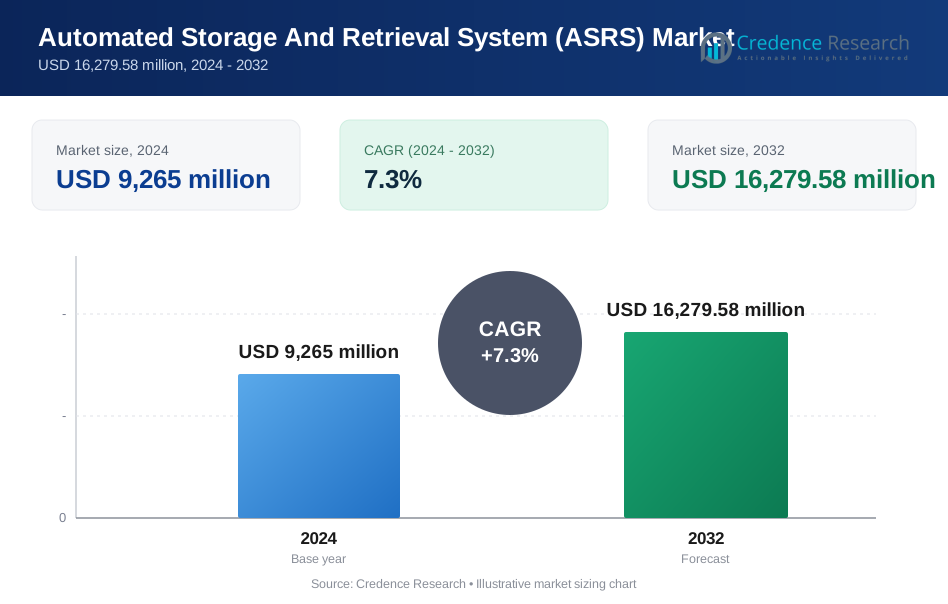
| Automated Storage and Retrieval System (ASRS) Market Size 2024 | USD 9,265 Million |
| Automated Storage and Retrieval System (ASRS) Market, CAGR | 7.3% |
| Automated Storage and Retrieval System (ASRS) Market Size 2032 | USD 16,279.58 Million |
Market Overview
The Automated Storage and Retrieval System (ASRS) market is projected to grow from USD 9,265 million in 2024 to USD 16,279.58 million by 2032, reflecting a compound annual growth rate (CAGR) of 7.3%. The Automated Storage and Retrieval System (ASRS) market is driven by increasing demand for efficient inventory management, enhanced operational efficiency, and the need to optimize warehouse space. The growth of e-commerce and the trend toward automation in supply chain management are key factors propelling market growth. Additionally, advancements in robotics and artificial intelligence (AI) are enabling more sophisticated ASRS solutions, providing real-time data and improving accuracy. The rising focus on reducing labor costs and improving speed and accuracy in material handling operations is further driving the adoption of ASRS across various industries. The Automated Storage and Retrieval System (ASRS) market is dominated by North America, holding a significant share due to the early adoption of advanced technologies and the strong presence of key players like Dematic Corp. and Bastian Solutions. Europe also commands a substantial market share, driven by industrial automation in sectors such as automotive and manufacturing, with prominent companies like Kardex Group and SSI Schaefer AG leading the region. Asia Pacific is emerging as a rapidly growing market, fueled by expanding e-commerce and manufacturing industries in countries like China and Japan. Key players in this region include Daifuku Co., Ltd. and Murata Machinery, Ltd.Market Drivers
Rising Labor Costs The rising costs associated with labor have made automation more attractive, and ASRS addresses this need by automating repetitive, labor-intensive tasks. This reduces the dependency on manual labor, leading to substantial cost savings. For instance, labor costs take around 50% to 70% of a company’s warehousing budget, making it the highest operating cost in a warehouse. In addition, ASRS enhances workplace safety by eliminating the need for employees to perform hazardous tasks, such as handling heavy items or operating in high-risk environments. By automating these processes, companies can reduce the risk of workplace injuries and create a safer, more efficient working environment. E-commerce Growth The rapid expansion of e-commerce has heightened demand for faster and more accurate order fulfillment, and ASRS plays a crucial role in meeting this need. With its ability to support quick retrieval and storage of items, ASRS helps e-commerce businesses achieve faster delivery times, which are increasingly demanded by consumers. For instance, projections indicate that the e-commerce fulfillment industry will continue to grow in value, with the North American e-commerce fulfillment market representing a significant portion of the global market. Furthermore, as e-commerce companies continue to expand their warehouse networks, the need for efficient storage solutions like ASRS is growing, providing scalable options for managing larger inventories and more complex operations. Increased Efficiency and Productivity Automated Storage and Retrieval Systems (ASRS) significantly enhance operational efficiency by speeding up order fulfillment processes and improving inventory management. These systems can rapidly retrieve and store items, reducing the time required for order processing. Additionally, ASRS ensures more accurate tracking of inventory, minimizing stockouts and overstocking, which can lead to cost savings. One of the major benefits of ASRS is space optimization, as it utilizes vertical storage, maximizing capacity even in limited warehouse areas. By streamlining these operations, ASRS helps companies improve productivity and reduce waste in their supply chains. Advancements in Technology Technological advancements, including the integration of Internet of Things (IoT) devices and the use of robotics and artificial intelligence (AI), are transforming ASRS capabilities. IoT integration allows for real-time monitoring and control, enhancing system efficiency and reliability. Robotics and AI have further advanced the automation of ASRS, allowing systems to operate more intelligently and independently. These innovations are optimizing supply chain processes, improving visibility, and providing companies with data-driven insights that enable more informed decision-making.Market Trends
Integration with Advanced Technologies and Modular Designs The integration of advanced technologies, such as the Internet of Things (IoT) and artificial intelligence (AI), is reshaping the Automated Storage and Retrieval System (ASRS) market. These technologies enable real-time monitoring, predictive maintenance, and intelligent decision-making, allowing businesses to streamline operations and improve system reliability. For instance, IoT devices can track system performance in real time, while AI algorithms optimize retrieval routes and inventory management. Robotics is also playing a key role in expanding ASRS capabilities, enabling more complex tasks such as autonomous picking and sorting, which were previously challenging. This technological evolution is helping businesses enhance efficiency, reduce downtime, and boost overall productivity. In tandem with this technological shift, ASRS systems are becoming more modular and scalable, providing businesses with the flexibility to tailor systems to their specific needs. Modular designs allow companies to start small and scale up as their requirements grow, which is especially beneficial for businesses with limited initial capital but long-term growth plans. Cloud-Based Solutions and Sustainability The rise of cloud-based ASRS solutions is also a significant trend in the market, offering remote management and monitoring capabilities. These cloud-based platforms allow businesses to manage their systems from anywhere, optimizing operations and reducing the need for on-site IT infrastructure. Additionally, cloud-based ASRS solutions provide access to valuable data analytics, enabling businesses to track system performance and make informed decisions that improve efficiency and reduce operational costs. This trend is particularly attractive to businesses looking for scalable, cost-effective solutions that can easily adapt to changing demands. Sustainability is another emerging focus within the ASRS market, with manufacturers developing more energy-efficient systems that minimize environmental impact. Energy-efficient systems not only reduce operating costs but also align with global sustainability goals.Market Challenges Analysis
Adaptability to Changing Needs and Environmental Concerns ASRS systems, while technologically advanced, may lack the flexibility needed to adapt quickly to changing product lines or demand patterns. This rigidity can become a limitation for businesses that operate in fast-paced industries, requiring them to frequently reconfigure their storage and retrieval processes. Moreover, rapid technological advancements may render certain ASRS systems obsolete over time, necessitating costly upgrades or replacements to remain competitive. For example, a survey by the Environmental Protection Agency (EPA) found that ASRS systems in large warehouses significantly contribute to energy consumption. Environmental concerns also pose challenges, as ASRS systems can consume considerable amounts of energy, increasing both operational costs and carbon footprints. Additionally, proper waste management and disposal of outdated or damaged equipment can be complicated, especially if systems contain hazardous materials. These challenges compel businesses to balance technological advancement with sustainable practices, while also ensuring that their ASRS investments remain relevant in the long term. High Initial Investment and Complexity in Maintenance One of the major challenges facing the Automated Storage and Retrieval System (ASRS) market is the high initial investment required for purchasing, installing, and maintaining these systems. The cost of implementing ASRS can be significant, particularly for small to mid-sized businesses. These companies may struggle to justify the upfront expenses, especially if their financial planning is more short-term. The long-term return on investment (ROI) can be difficult to quantify, further complicating the decision to invest in ASRS. Additionally, maintaining and operating these systems demands specialized technical expertise, which may not be readily available in all regions. Finding and retaining personnel with the required skills adds another layer of cost, and any downtime caused by system failures or maintenance issues can disrupt operations, negatively impacting productivity and customer satisfaction.Market Segmentation Analysis:
By Type: The Automated Storage and Retrieval System (ASRS) market can be segmented by type, including unit load, mini load, vertical lift module, carousel, and mid load systems. Unit load ASRS is designed for handling large, heavy items and is commonly used in industries requiring efficient storage of pallets or bulk materials. Mini load systems are optimized for handling smaller items, providing high-speed storage and retrieval solutions for lightweight products, making them popular in retail and e-commerce. Vertical lift modules are utilized in industries with space constraints, offering vertical storage optimization. Carousels and mid load systems are used for more specialized applications, delivering flexibility and efficiency in various environments. By Vertical: In terms of verticals, the ASRS market is adopted across various industries including automotive, metals and heavy machinery, food and beverages, chemicals, healthcare, semiconductors and electronics, retail, aviation, and e-commerce. The automotive industry uses ASRS for managing complex supply chains and heavy components, while the food and beverages sector leverages ASRS for cold storage and inventory optimization. Healthcare and electronics industries benefit from the precision and control offered by ASRS. Retail and e-commerce sectors, driven by rapid consumer demand, rely heavily on ASRS to streamline order fulfillment and warehouse management. These systems enhance operational efficiency, safety, and inventory accuracy across diverse industries.Segments:
Based on Type:- Unit Load
- Mini Load
- Vertical Lift Module
- Carousel
- Mid Load
- Automotive
- Metals and Heavy Machinery
- Food & Beverages
- Chemicals
- Healthcare
- Semiconductors & Electronics
- Retail
- Aviation
- E-Commerce
- Other Verticals
- North America
- U.S.
- Canada
- Mexico
- Europe
- Germany
- France
- U.K.
- Italy
- Spain
- Rest of Europe
- Asia Pacific
- China
- Japan
- India
- South Korea
- South-east Asia
- Rest of Asia Pacific
- Latin America
- Brazil
- Argentina
- Rest of Latin America
- Middle East & Africa
- GCC Countries
- South Africa
- Rest of the Middle East and Africa
Regional Analysis
North America North America holds a significant market share in the Automated Storage and Retrieval System (ASRS) market, accounting for approximately 35% of the global market. The region’s dominance is driven by advanced technological infrastructure, high labor costs, and the growing adoption of automation across industries like automotive, food and beverages, and healthcare. In the U.S. and Canada, the demand for ASRS is further fueled by the increasing emphasis on warehouse automation to streamline operations and improve efficiency, especially in the retail and e-commerce sectors. Major players in the region are focusing on integrating ASRS with emerging technologies like IoT and artificial intelligence to enhance real-time tracking and improve inventory management. Asia Pacific Asia Pacific is emerging as one of the fastest-growing regions in the ASRS market, accounting for nearly 28% of the global market share. The region's growth is largely driven by the expanding e-commerce and manufacturing sectors in countries like China, Japan, and India. The rise in industrialization, along with government initiatives to promote smart manufacturing, has led to an increased demand for automated systems. Additionally, the region’s focus on improving supply chain efficiency, reducing labor costs, and optimizing warehouse space further accelerates the adoption of ASRS across industries such as automotive, electronics, and retail. Asia Pacific’s strong growth potential makes it a key region for future expansion in the global ASRS market.Key Player Analysis
- Daifuku Co., Ltd.
- Bastian Solutions, LLC
- Mecalux, S.A.
- KUKA AG
- System Logistics Corporation
- Dematic Corp. (Kion Group AG)
- Kardex Group
- SSI Schaefer AG
- TGW Logistics Group GmbH
- Beumer Group GmbH & Co. KG
- Knapp AG
- Murata Machinery, Ltd.
Competitive Analysis
The Automated Storage and Retrieval System (ASRS) market is highly competitive, with leading players like Daifuku Co., Ltd., Bastian Solutions, LLC, and Mecalux, S.A., Murata Machinery, Ltd., Kardex Group, and Dematic Corp. (Kion Group AG) driving innovation and technological advancements. The competition centers around offering scalable, efficient, and energy-saving solutions tailored to the needs of industries such as automotive, e-commerce, and retail. Market players are increasingly integrating advanced technologies like IoT, robotics, and AI to enhance warehouse automation and optimize inventory management. Additionally, companies are expanding their global presence by providing flexible, modular systems that cater to both small and large enterprises. The push for sustainability, alongside the need for efficient supply chain operations, continues to drive competitive dynamics in this rapidly evolving market.Recent Developments
- In September 2024, KUKA established a new software and digital business segment called KUKA Digital to expand its offerings in digitalization.
- In September 2024, Kardex announced a formal partnership with Berkshire Grey to power robotic picking and AutoStore7.
- In March 2023, Dematic equipped KION’s new logistics center with the latest automation technology, including a highly dynamic Dematic Multishuttle®.
- In January 2024, Mecalux equipped British Sugar’s automated warehouse with the Mecalux Group’s Automated Pallet Shuttle system.
Market Concentration & Characteristics
The Automated Storage and Retrieval System (ASRS) market exhibits a moderate to high level of market concentration, with a few dominant players leading the industry. These companies benefit from their established global presence, extensive product portfolios, and continuous investments in research and development. The market is characterized by the increasing demand for automation in industries like automotive, e-commerce, and manufacturing, where efficiency, precision, and space optimization are crucial. Key characteristics of this market include the adoption of advanced technologies such as robotics, IoT, and AI to enhance system performance and operational visibility. While large players dominate the space, there are opportunities for smaller companies to offer specialized or region-specific solutions. The focus on reducing operational costs and improving supply chain efficiency drives innovation, ensuring the market remains dynamic and competitive.Report Coverage
The research report offers an in-depth analysis based on Type, Vertical, and Geography. It details leading market players, providing an overview of their business, product offerings, investments, revenue streams, and key applications. Additionally, the report includes insights into the competitive environment, SWOT analysis, current market trends, as well as the primary drivers and constraints. Furthermore, it discusses various factors that have driven market expansion in recent years. The report also explores market dynamics, regulatory scenarios, and technological advancements that are shaping the industry. It assesses the impact of external factors and global economic changes on market growth. Lastly, it provides strategic recommendations for new entrants and established companies to navigate the complexities of the market.Future Outlook
- The adoption of advanced robotics and AI will further enhance automation capabilities in ASRS systems.
- Increased demand for space optimization in warehouses will drive the growth of vertical lift modules and mini-load systems.
- E-commerce growth will continue to boost the demand for ASRS systems to improve order fulfillment efficiency.
- Integration of ASRS with IoT and cloud-based solutions will provide real-time data insights and improve operational control.
- Energy-efficient and sustainable ASRS solutions will become a focus, driven by environmental concerns.
- Modular and scalable ASRS designs will gain traction as businesses seek flexible solutions that can grow with their needs.
- Healthcare and pharmaceuticals will increasingly adopt ASRS to improve the storage and retrieval of sensitive materials.
- The automotive and electronics industries will continue to rely on ASRS for just-in-time manufacturing and inventory management.
- Technological advancements will make ASRS systems more accessible to small and medium-sized enterprises.
- Global competition will drive innovation and cost reduction, making ASRS more affordable and widespread across industries.
Request a Free Sample
Fill in your details and we'll send you a free sample report.
- Sample data tables & charts
- Research methodology
Need a Custom Version of This Report?
Tailor the scope, geography, or segments to your exact requirements.
- Custom geography or segment scope
- Direct access to our analyst team
Frequently Asked Questions
What is the current size of the Automated Storage And Retrieval System Market?
What factors are driving the growth of the Automated Storage And Retrieval System Market?
What are the key segments within the Automated Storage And Retrieval System Market?
What are some challenges faced by the Automated Storage And Retrieval System Market?
Who are the major players in the Automated Storage And Retrieval System Market?
Table of Content
Chapter 1. Report Introduction
- 1.1 Report Description & Purpose
- 1.1.1 Report Title & Market Definition
- 1.1.2 Unique Selling Propositions (USP) & Key Differentiators
- 1.1.3 Value Proposition for Stakeholders
- 1.2 Research Objectives
- 1.2.1 Market Sizing Objectives (Volume & Revenue)
- 1.2.2 Segmentation Objectives
- 1.2.3 Competitive Intelligence Objectives
- 1.2.4 Forecast & Scenario Objectives
- 1.3 Report Scope
- 1.3.1 Automated Storage And Retrieval System (ASRS) Scope – Types & Subtypes Covered
- 1.3.2 Geographic Scope – Regions & Countries Covered
- 1.3.3 Historical Period, Base Year & Forecast Period (2024; forecast to 2032)
- 1.3.4 Inclusions & Exclusions
- 1.4 HS Code & Classification Framework
- 1.5 Currency, Units & Pricing Basis
- 1.6 Target Stakeholders
- 1.7 Limitations & Assumptions
Chapter 2. Executive Summary
- 2.1 Global Automated Storage And Retrieval System (ASRS) Market Snapshot
- 2.1.1 Market Size – Historical (2024) & Forecast (2024-2032) (2024: USD 9,265 million → 2032: USD 16,279.58 million)
- 2.1.2 Volume & Revenue – Global Totals
- 2.1.3 Key Market Highlights – Top Five Facts
- 2.2 Automated Storage And Retrieval System (ASRS) Market Segmentation Snapshot
- 2.2.1 Market Split by Region – 2024 vs. 2032
- 2.3 Competitive Snapshot
- 2.3.1 Top 10 Players by Revenue Share – 2024
- 2.3.2 Top 10 Players by Volume Share – 2024
- 2.3.3 Recent Strategic Developments (18-Month Summary)
- 2.4 Key Investment Highlights & Strategic Conclusions
Chapter 3. Automated Storage And Retrieval System (ASRS) Market Dynamics & Industry Analysis
- 3.1 Market Overview & Context
- 3.1.1 Automated Storage And Retrieval System (ASRS) Market Position in the Broader Automotive Value Chain
- 3.1.2 OEM vs. Replacement Market Dynamics
- 3.1.3 Market Maturity & Development Stage by Region
- 3.2 Automated Storage And Retrieval System (ASRS) Market Drivers
- 3.3 Automated Storage And Retrieval System (ASRS) Market Restraints & Challenges
- 3.4 Automated Storage And Retrieval System (ASRS) Market Opportunities
- 3.5 Porter's Five Forces Analysis
- 3.5.1 Threat of New Entrants
- 3.5.2 Bargaining Power of Suppliers
- 3.5.3 Bargaining Power of Buyers
- 3.5.4 Threat of Substitutes
- 3.5.5 Competitive Rivalry – Intensity Assessment
- 3.6 Automated Storage And Retrieval System (ASRS) Value Chain Analysis
- 3.6.1 Upstream – Raw Material/Input Suppliers
- 3.6.1.1 Raw Material/Input 1
- 3.6.1.2 Raw Material/Input 2
- 3.6.1.3 Raw Material/Input 3
- 3.6.2 Midstream – Production/Manufacturing/Service Delivery
- 3.6.2.1 Production/Process Overview
- 3.6.2.2 Key Facility Locations & Capacity by Manufacturer
- 3.6.3 Downstream – Distribution & End Consumer
- 3.6.3.1 Primary Channel – B2B/OEM
- 3.6.3.2 Secondary Channels – Dealer, Retail, Online, Direct
- 3.6.4 Value Chain Profitability Analysis
- 3.6.1 Upstream – Raw Material/Input Suppliers
- 3.7 PESTEL Analysis
- 3.7.1 Political Factors
- 3.7.2 Economic Factors
- 3.7.3 Social Factors
- 3.7.4 Technological Factors
- 3.7.5 Environmental Factors
- 3.7.6 Legal Factors
- 3.8 Automated Storage And Retrieval System (ASRS) Supply Chain Analysis
- 3.8.1 Raw Material/Input Supply Risk Assessment
- 3.8.2 Manufacturing Concentration Risk (Geographic Exposure)
- 3.8.3 Trade Disruption Impact Analysis
- 3.9 Regulatory & Policy Landscape
Note: The regulatory and policy landscape section covers regulations based on their applicability to the market, Automated Storage And Retrieval System (ASRS) category, geography, and scope of the study. Only regulatory frameworks with a material impact on operations, compliance, trade, sustainability, or market access are analyzed in detail.
Chapter 4. Key Investment Pockets & Opportunity Analysis
- 4.1 Automated Storage And Retrieval System (ASRS) Market Attractiveness Analysis
- 4.1.1 By Region – Investment Attractiveness Matrix (Volume × CAGR)
- 4.2 Absolute Revenue Growth Opportunity
- 4.2.1 By Region – Absolute USD Growth Through 2032
- 4.3 Incremental Volume Opportunity
- 4.3.1 By Region – Incremental Volume Through 2032
- 4.3.2 Segment – Incremental Volume
- 4.4 Emerging Submarket Opportunity Deep Dive (Subject to Applicability)
- 4.5 Emerging Market Opportunity Scorecards
- 4.5.1 United States
- 4.5.2 Europe
- 4.5.3 Asia
- 4.5.4 Middle East & Africa
Note: Emerging Market Opportunity Scorecards will be included based on relevance and strategic importance. Regions listed are indicative and may vary depending on data availability and market dynamics.
Chapter 5. Automated Storage And Retrieval System (ASRS) Import-Export Analysis & Trade Flows
- 5.1 Global Trade Overview
- 5.1.1 Global Export Value by Country (2024)
- 5.1.2 Global Export Volume by Country (2024)
- 5.1.3 Global Import Value by Country (2024)
- 5.1.4 Global Import Volume by Country (2024)
- 5.1.5 Net Trade Balance by Country (2024)
- 5.2 Export Analysis – Segment
- 5.2.1 Type 1 (HS Code)
- 5.2.2 Type 2 (HS Code)
- 5.2.3 Type 3 (HS Code)
- 5.2.4 Type 4 (HS Code)
- 5.2.5 Type 5 (HS Code)
- 5.3 Import Analysis – Segment
- 5.3.1 Type 1 (HS Code)
- 5.3.2 Type 2 (HS Code)
- 5.3.3 Type 3 (HS Code)
- 5.3.4 Type 4 (HS Code)
- 5.3.5 Type 5 (HS Code)
- 5.4 Average Unit Trade Prices
- 5.4.1 Average Export Price – Segment & Country
- 5.4.2 Average Import Price – Segment & Source Country
- 5.4.3 Price Trends (2024)
- 5.5 Key Trade Route Analysis
- 5.5.1 Trade Route 1
- 5.5.2 Trade Route 2
- 5.5.3 Trade Route 3
- 5.5.4 Trade Route 4
- 5.5.5 Trade Route 5
- 5.6 Trade Policy Impact Assessment
- 5.6.1 US Anti-Dumping & Section 301 Tariffs
- 5.6.2 EU Customs Union Impact
- 5.6.3 Major Free Trade Agreements
- 5.6.4 USMCA Rules of Origin
Note: Trade policy analysis will be included only where relevant to the Automated Storage And Retrieval System (ASRS) market.
Chapter 6. Competitive Landscape & Company Benchmarking
- 6.1 Automated Storage And Retrieval System (ASRS) Market Concentration & Structure
- 6.1.1 Herfindahl-Hirschman Index (HHI) – vs. 2024
- 6.1.2 Tier 1, Tier 2 & Tier 3 Market Structure
- 6.1.3 Global, Regional & Local Player Dynamics
- 6.2 Automated Storage And Retrieval System (ASRS) Market Share Analysis – 2024
- 6.2.1 Global Revenue Share by Company
- 6.2.2 Global Volume Share by Company
- 6.2.3 Regional Revenue Share
- 6.2.4 Market Share Evolution ( vs. 2024)
- 6.2.5 OEM Segment Share by Company
- 6.2.6 Replacement Segment Share by Company
- 6.3 Production/Delivery Capacity & Facility Analysis
- 6.3.1 Global Installed Capacity
- 6.3.2 Capacity Utilization Rates
- 6.3.3 Production/Output Volume
- 6.3.4 Facility Locations & Capacity Map
- 6.3.5 Planned Capacity Additions
- 6.4 Automated Storage And Retrieval System (ASRS) Competitive Benchmarking Matrix
- 6.4.1 Revenue, Volume, CAGR & Profitability Comparison
- 6.4.2 Channel Revenue Mix
- 6.4.3 Geographic Revenue Exposure
- 6.4.4 R&D Intensity
- 6.4.5 Sustainability Maturity
- 6.5 Strategic Developments in Automated Storage And Retrieval System (ASRS) (Last 24 Months)
- 6.5.1 Mergers, Acquisitions & Divestments
- 6.5.2 New Automated Storage And Retrieval System (ASRS) Launches
- 6.5.3 Facility Expansions
- 6.5.4 Strategic Alliances, Joint Ventures & Partnerships
- 6.5.5 Distribution Expansion & Market Entry
- 6.5.6 Sustainability & ESG Initiatives
- 6.6 Competitive Strategy Mapping
- 6.6.1 Leader, Challenger, Follower & Niche Classification
- 6.6.2 Pricing Strategy Comparison
- 6.6.3 Channel Strategy Matrix
Note: Strategic developments are included based on their materiality and the availability of reliable information.
Chapter 7. Global Automated Storage And Retrieval System (ASRS) Market – By Distribution Channel
- 7.1 Segment Overview
- 7.1.1 Volume & Revenue Split by Channel (2024 & 2032)
- 7.1.2 Channel Mix Evolution (2024-2032)
Chapter 8. Regional Market Analysis – Global Overview
- 8.1 Global Regional Overview
- 8.1.1 Regional Volume Share
- 8.1.2 Regional Revenue Share
- 8.1.3 Regional Volume by Region
- 8.1.4 Regional Revenue by Region
- 8.1.5 Regional Forecast Through 2032
- 8.2 Cross-Regional Segment Analysis
- 8.2.1 By Distribution Channel
- 8.2.2 By Brand/Price Tier
Chapter 9. North America Automated Storage And Retrieval System (ASRS) Market
- 9.1 United States
- 9.2 Canada
- 9.3 Mexico
Chapter 10. Europe Automated Storage And Retrieval System (ASRS) Market
- 10.1 Germany
- 10.2 France
- 10.3 Italy
- 10.4 United Kingdom
- 10.5 Spain
- 10.6 Poland
- 10.7 Russia
- 10.8 Netherlands
- 10.9 Belgium
- 10.10 Sweden
- 10.11 Denmark
- 10.12 Norway
- 10.13 Rest of Europe
Chapter 11. Asia Pacific Automated Storage And Retrieval System (ASRS) Market
- 11.1 China
- 11.2 India
- 11.3 Japan
- 11.4 South Korea
- 11.5 Thailand
- 11.6 Indonesia
- 11.7 Vietnam
- 11.8 Malaysia
- 11.9 Australia
- 11.10 Rest of Asia Pacific
Chapter 12. Latin America Automated Storage And Retrieval System (ASRS) Market
- 12.1 Brazil
- 12.2 Argentina
- 12.3 Colombia
- 12.4 Chile
- 12.5 Rest of Latin America
Chapter 13. Middle East Automated Storage And Retrieval System (ASRS) Market
- 13.1 Saudi Arabia
- 13.2 United Arab Emirates
- 13.3 Turkey
- 13.4 Israel
- 13.5 Iran
- 13.6 Rest of the Middle East
Chapter 14. Africa Automated Storage And Retrieval System (ASRS) Market
- 14.1 South Africa
- 14.2 Egypt
- 14.3 Nigeria
- 14.4 Morocco
- 14.5 Rest of Africa
Chapter 15. Automated Storage And Retrieval System (ASRS) Company Profiles
- 15.1 [Company 01]
- 15.1.1 Company Overview
- 15.1.2 Key Management Personnel
- 15.1.3 Products & Services Portfolio
- 15.1.4 Financial Performance
- 15.1.5 Key Market Focus & Geographic Presence
- 15.1.6 Recent Developments & Strategic Initiatives
Note: The company profile list is preliminary and may change based on research findings, market developments, data availability, and client requirements.
Chapter 16. Appendices
- Appendix A – List of Abbreviations & Acronyms
- Appendix B – Industry Classification Code Reference – Full Series
- Appendix C – Production & Capacity Data Tables
- Appendix D – End-Use & Demand Base Tables
- Appendix E – Consumption & Replacement Rate Assumptions
- Appendix F – ASP Reference Tables
- Appendix G – Manufacturing & Facility Database
- Appendix H – Import-Export Data Tables
- Appendix I – Regulatory Summary Tables
- Appendix J – Primary Research Participant List (Anonymized)
- Appendix K – Primary Research Questionnaire Framework
- Appendix L – Data Sources & Bibliography
- Appendix M – Market Size Divergence & Source Comparison
Chapter 17. Research Methodology
- 17.1 Research Framework & Philosophy
- 17.2 Secondary Research – Sources, Hierarchy & Data Extraction
- 17.3 Data Modeling – Bottom-Up & Top-Down Market Sizing
- 17.4 Primary Research – Stakeholder Framework, LOI & Sample Sizes
- 17.5 Forecast Methodology – Regression, Scenario & Sensitivity Analysis
- 17.6 Quality Control – Four-Layer Validation Framework
- 17.7 Limitations & Standard Assumptions
- 17.8 Disclaimer
