Market Overview:
The Global Automotive Power Steering Systems Market size was valued at USD 25,470.8 million in 2018 to USD 32,257.7 million in 2024 and is anticipated to reach USD 41,734.6 million by 2032, at a CAGR of 3.23% during the forecast period.
| REPORT ATTRIBUTE | DETAILS |
|---|---|
| Historical Period | 2020-2023 |
| Base Year | 2024 |
| Forecast Period | 2025-2032 |
| Automotive Power Steering Systems Market Size 2024 | USD 32,257.7 million |
| Automotive Power Steering Systems Market, CAGR | 3.23% |
| Automotive Power Steering Systems Market Size 2032 | USD 41,734.6million |
The shift toward electric power steering (EPS) is reshaping the industry as it improves energy efficiency and reduces mechanical complexity. Automakers are integrating EPS into modern vehicle platforms to support autonomous driving features and reduce emissions. Consumers seek enhanced driving comfort, prompting manufacturers to incorporate advanced driver assistance systems (ADAS) that rely on responsive and adaptable steering mechanisms. As emission regulations tighten globally, OEMs are actively transitioning away from hydraulic systems to electric solutions.
Asia Pacific dominates the automotive power steering systems market, with China, India, and Japan leading due to high vehicle production and strong OEM presence. North America follows closely, especially the U.S., where rising EV sales and safety system integration support market growth. Europe remains a strong player with stringent carbon emission targets and a well-established auto industry driving EPS adoption. Latin America and the Middle East & Africa represent emerging markets, gaining traction due to infrastructure development, increasing disposable income, and expanding automotive manufacturing bases. These regions are witnessing a gradual shift toward more efficient and eco-friendly steering solutions.
Market Insights:
- The Global Automotive Power Steering Systems Market was valued at USD 25,470.8 million in 2018 and is projected to reach USD 41,734.6 million by 2032, growing at a CAGR of 3.23%.
- Electrification of vehicles is accelerating the shift from hydraulic to electric power steering (EPS) systems, enhancing energy efficiency and enabling integration with ADAS.
- Regulatory pressure to meet emission and fuel efficiency standards is prompting OEMs to adopt EPS solutions that reduce engine load and mechanical complexity.
- Rising consumer demand for comfort, safety, and intelligent features like lane-keeping assist and automated parking is driving EPS deployment.
- Automakers are heavily investing in modernization programs and steer-by-wire technologies to align with autonomous driving and smart mobility trends.
- High integration and software calibration costs pose challenges for small manufacturers, especially in budget vehicle segments and emerging markets.
- Asia Pacific leads due to strong automotive production hubs, while North America and Europe benefit from EV growth and stringent emissions laws; emerging regions show rising adoption amid infrastructure expansion.
Market Drivers:
Electrification of Vehicles Enhances Demand for EPS Systems:
The shift toward electric vehicles has amplified the demand for Electric Power Steering (EPS) systems due to their compatibility with battery-driven architectures. Unlike traditional hydraulic systems, EPS eliminates the need for belts, fluids, or pumps, leading to lower maintenance and higher efficiency. Automakers are adopting EPS across vehicle segments to support light weighting and meet emission norms. This technological transition also enables integration with ADAS features, which require precise and programmable steering functions.
- For instance, Toyota equips its hybrid and plug-in hybrid models-including the Prius and RAV4 Hybrid-with EPS to optimize energy efficiency and enable features like Lane Keeping Assist. The 2025 Toyota Prius plug-in hybrid achieves an EPA-estimated fuel economy of up to 52 mpg combined, and the RAV4 Plug-in Hybrid achieves about 42 miles of all-electric range on a full charge, reflecting high efficiency and integration of advanced electronic systems.
Regulatory Push for Fuel Efficiency and Emission Standards:
Governments worldwide are enforcing stringent fuel economy and emission standards. Power steering systems directly impact engine load and vehicle weight. EPS systems help automakers comply with such standards by reducing mechanical complexity and parasitic drag. These factors are encouraging OEMs to phase out hydraulic power steering in favor of more sustainable electronic options, especially in markets such as the U.S., Germany, and Japan.
- For instance, Ford reports that its Electronic Power Assist Steering (EPAS) technology-included in around its lineup since 2012-improves fuel economy by up to 5% compared to hydraulic systems, while also reducing overall vehicle emissions. These advancements are significant in meeting both regulatory and environmental targets.
Surging Demand for Comfort and Safety Enhancements:
Consumer preference for smoother driving experiences is elevating the adoption of advanced power steering solutions. Features such as variable steering ratios, lane-keeping assistance, and automated parking are gaining popularity. EPS supports these features by enabling software-controlled adaptability. With growing urban traffic and aging drivers, the need for less effort-intensive steering systems becomes critical in both passenger and commercial vehicles.
OEM Investments in Vehicle Modernization Programs:
Automakers are heavily investing in modernizing vehicle platforms. Power steering systems are a key component in such upgrades. The ongoing development of steer-by-wire technology also reflects the industry’s shift toward smart mobility. OEMs are actively aligning product roadmaps to integrate responsive steering systems, both for autonomy and enhanced driving experience, pushing the market’s growth trajectory.
Market Trends:
Steer-by-Wire Technology Gains Ground in Next-Gen Vehicles:
The adoption of steer-by-wire is transforming the steering landscape by eliminating mechanical linkages. This enables flexible vehicle design, reduced cabin noise, and easier integration with autonomous systems. Several OEMs and Tier-1 suppliers are piloting or launching wire-controlled systems in premium vehicle segments. It allows real-time control adjustments, which is vital for semi-autonomous driving functionalities.
- For example, Mercedes-Benz will introduce a steer-by-wire system in its 2026 EQS model. This technology uses sensors and electronic signals to control direction, supports features for autonomous electric vehicles, and removes the traditional steering column, allowing for new interior designs. Mercedes-Benz has validated this system over a million test kilometers and designed it to meet high safety standards through redundant architecture.
Integration of AI and IoT in Steering Systems:
AI-powered diagnostics and IoT-enabled sensors are being embedded in power steering systems for predictive maintenance and adaptive performance. Data-driven steering assists enhance driver response and improve vehicle safety. These systems gather real-time data such as road conditions and driver behavior, optimizing steering force and feedback dynamically, contributing to smart mobility goals.
- For example, modern EPS systems utilize multiple sensors such as steering angle, torque, vehicle speed, and external environmental data-processed in real time by electronic control units. AI models, such as those based on recurrent neural networks and reinforcement learning algorithms, allow the steering system to anticipate driver needs, perform predictive maintenance, and adapt steering assistance under diverse driving scenarios.
Lightweight Material Adoption Optimizes Efficiency:
The automotive industry’s push toward weight reduction has accelerated the use of advanced lightweight materials such as aluminum and composites in steering columns and gear housings. It improves fuel efficiency and performance. EPS systems, in particular, benefit from compact electronic components, supporting efficient packaging and lower energy consumption.
Aftermarket Expansion through Remanufactured Steering Components:
The aftermarket for automotive power steering systems is expanding with a surge in demand for remanufactured parts. These offerings provide cost advantages and support sustainability goals by reducing material waste. Independent garages and OEM-certified workshops are actively promoting refurbished EPS and hydraulic components in cost-sensitive markets.
Market Challenges Analysis:
High Costs of Integration, Calibration, and Software Validation Slow Down Adoption:
The Global Automotive Power Steering Systems Market faces a major challenge due to the high costs associated with integrating electric power steering (EPS) technologies. OEMs must invest significantly in recalibrating vehicle dynamics and validating complex electronic controls to ensure safety and performance. These requirements increase development time and overall system cost, creating barriers for small and mid-sized vehicle manufacturers. The need for advanced software, fail-safe mechanisms, and cybersecurity compliance further complicates the process. Entry-level and budget vehicles, particularly in cost-sensitive regions, struggle to absorb these added expenses. This cost burden discourages rapid migration from hydraulic to electric systems, especially in markets where price competition is intense. It delays widespread adoption across all vehicle segments.
Reliability Concerns and Harsh Environmental Limitations Affect Performance:
The Global Automotive Power Steering Systems Market also contends with performance limitations under extreme environmental conditions. EPS units are sensitive to temperature fluctuations, moisture, and electromagnetic interference, which may compromise system reliability. In regions with poor road infrastructure or limited access to advanced repair facilities, maintenance of electronic components becomes difficult. Sudden failures or loss of steering assistance raise safety concerns and lead to recalls, impacting consumer confidence. It requires robust design and thorough testing to ensure consistent performance across varied climates and terrains. These factors make it difficult to scale advanced steering systems in rural or developing markets. Automakers must address these technical vulnerabilities to improve system resilience and long-term trust.
Market Opportunities:
Growing Demand for Electric and Autonomous Vehicles Unlocks New Potential:
The Global Automotive Power Steering Systems Market can capitalize on the accelerating transition to electric and autonomous vehicles. EPS systems are essential in EV platforms due to their compatibility with battery-driven architectures and minimal energy loss. Automakers are expanding EV production globally, increasing demand for steering systems that support ADAS and self-driving functions. It opens new opportunities for steer-by-wire technologies, which offer design flexibility and precision control. Integration of intelligent features such as lane centering and automatic parking further strengthens the role of EPS. The market can benefit from OEM investments in smart mobility and software-defined vehicle platforms.
Rising Adoption in Emerging Markets Expands Revenue Streams:
The Global Automotive Power Steering Systems Market also holds strong growth potential in emerging economies across Asia, Latin America, and Africa. Vehicle ownership is rising in these regions, driven by urbanization, income growth, and infrastructure development. Governments are promoting cleaner mobility solutions, encouraging OEMs to adopt EPS over traditional systems. It creates room for low-cost, compact EPS units tailored to regional needs. Tier-1 suppliers can expand local manufacturing and service capabilities to meet this demand. The market stands to gain from untapped customer bases and expanding middle-class populations.
Market Segmentation Analysis:
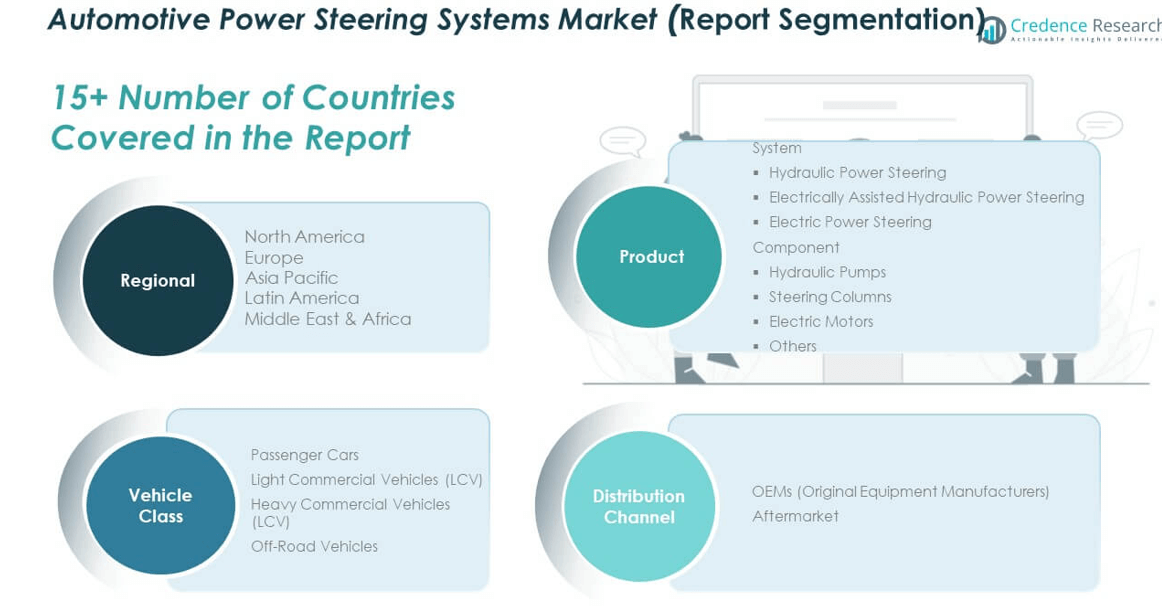
By Product
The Global Automotive Power Steering Systems Market is segmented into Hydraulic Power Steering (HPS), Electrically Assisted Hydraulic Power Steering (EHPS), and Electric Power Steering (EPS). EPS leads the segment due to its superior energy efficiency, reduced mechanical complexity, and compatibility with modern ADAS and EV platforms. HPS remains relevant in cost-sensitive markets and older vehicle models, while EHPS serves as a transitional solution offering partial electrification.
- For instance, Nissan's e-Power-equipped vehicles, such as the European Qashqai, utilize EPS and demonstrate fuel consumption as low as 4.5L/100km (WLTP), with a potential driving range exceeding 1,000 km on a full tank, aiding compliance with strict emissions standards and the transition away from purely hydraulic systems.
By Component
Key components include hydraulic pumps, steering columns, electric motors, and others. Electric motors hold a dominant share, driven by the widespread shift to EPS systems across all vehicle categories. Steering columns play a critical role in both traditional and electronic systems, while hydraulic pumps continue to support legacy HPS and EHPS configurations.
- For example, ZF’s EPS system uses integrated electric motors with closed-loop torque control to support advanced features, including dual-redundant packs for Level 3+ autonomous driving and scalable integration for hybrid and electric vehicles, achieving both high safety and energy efficiency.
By Vehicle Type
The market serves passenger cars, light commercial vehicles (LCVs), heavy commercial vehicles (HCVs), and off-road vehicles. Passenger cars contribute the largest revenue due to high global production and demand for advanced safety features. LCVs and HCVs are adopting EPS to improve fuel economy and comply with emission standards. Off-road vehicles are gradually integrating electric systems to enhance maneuverability and reduce driver fatigue.
By Distribution Channel
The distribution channel is divided into OEMs and aftermarket. OEMs account for the majority share by offering factory-fitted systems that ensure full integration and compliance with vehicle design. The aftermarket supports repair and replacement, particularly in regions with aging vehicle fleets and long product life cycles. It remains vital for maintaining older steering technologies in operation.
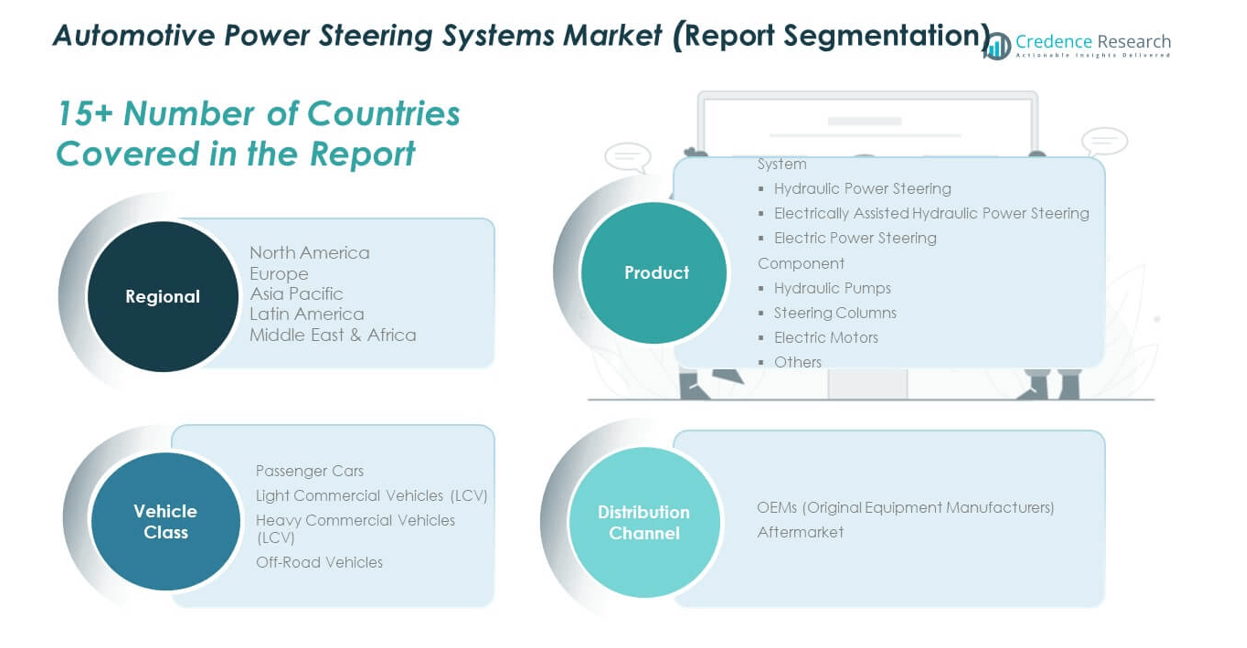
Segmentation:
By Product:
- Hydraulic Power Steering
- Electrically Assisted Hydraulic Power Steering
- Electric Power Steering
By Component:
- Hydraulic Pumps
- Steering Columns
- Electric Motors
- Others
By Vehicle:
- Passenger Cars
- Light Commercial Vehicles (LCV)
- Heavy Commercial Vehicles (HCV)
- Off-Road Vehicles
By Distribution Channel:
- OEMs
- Aftermarket
By Region:
- North America
- U.S.
- Canada
- Mexico
- Europe
- Germany
- France
- U.K.
- Italy
- Spain
- Rest of Europe
- Asia Pacific
- China
- Japan
- India
- South Korea
- South-east Asia
- Rest of Asia Pacific
- Latin America
- Brazil
- Argentina
- Rest of Latin America
- Middle East & Africa
- GCC Countries
- South Africa
- Rest of the Middle East and Africa
Regional Analysis:
North America
The North America Global Automotive Power Steering Systems Market reached USD 7,024.81 million in 2024 and is projected to grow to USD 8,346.92 million by 2032, at a CAGR of 2.1%. The U.S. leads regional growth, driven by high vehicle ownership and substantial investment in EV and ADAS technologies. EPS is widely adopted across both passenger and commercial segments. OEMs prioritize steering system upgrades to enhance comfort, diagnostics, and safety. A strong regulatory environment and a well-developed automotive supply chain further support steady market expansion.
Europe
The Europe Global Automotive Power Steering Systems Market is forecast to grow from USD 8,600.82 million in 2024 to USD 11,318.43 million by 2032, at a CAGR of 3.5%. Germany, France, and the UK spearhead EPS penetration, driven by electrification goals and stringent emission regulations. The presence of established OEMs and Tier-1 suppliers fosters robust innovation in steering technologies. Premium vehicles increasingly feature advanced power steering functionalities as automakers invest in luxury and smart mobility solutions. Regulatory pressure and evolving consumer expectations continue to accelerate the shift toward electric systems.
Asia Pacific
The Asia Pacific Global Automotive Power Steering Systems Market is expected to rise from USD 10,175.00 million in 2024 to USD 13,772.42 million by 2032, registering a CAGR of 3.8%. China, India, and Japan dominate regional production, supporting high-volume growth. OEMs integrate affordable EPS options into compact vehicles to meet cost-sensitive consumer demand. Government incentives for electric vehicles and rising urbanization further propel EPS adoption. The region benefits from a strong supply base and increasing technological advancements in low-cost steering systems.
Latin America
The Latin America Global Automotive Power Steering Systems Market is projected to grow from USD 3,641.43 million in 2024 to USD 4,732.71 million by 2032, with a CAGR of 3.3%. Brazil and Mexico lead the region, supported by a recovering economy and growing light vehicle production. OEMs are slowly transitioning from hydraulic to electric systems, especially in commercial fleets. Infrastructure investments and improved credit access are boosting new vehicle purchases. Gradual technology upgrades in steering components are enhancing vehicle handling and safety.
Middle East
The Middle East Global Automotive Power Steering Systems Market will grow from USD 1,757.12 million in 2024 to USD 2,299.58 million by 2032, at a CAGR of 3.4%. SUV popularity and fleet renewal cycles drive demand across key countries such as Saudi Arabia and the UAE. Mobility modernization efforts support steering system upgrades across private and government fleets. The market requires durable EPS solutions that can withstand extreme climatic conditions. Growth is supported by import-dependent vehicle markets and rising consumer expectations for comfort and safety.
Africa
The Africa Global Automotive Power Steering Systems Market is forecast to expand from USD 1,058.51 million in 2024 to USD 1,264.56 million by 2032, at a CAGR of 2.2%. Nigeria, Egypt, and South Africa present early-stage market opportunities. Vehicle imports dominate regional supply, while infrastructure development increases demand for personal and commercial mobility. Limited local manufacturing restricts OEM EPS penetration but creates aftermarket opportunities. Gradual adoption of EPS is expected as income levels rise and regional service networks improve.
Key Player Analysis:
- Robert Bosch Automotive Steering GmbH
- Mitsubishi Electric Corporation
- Hyundai Mobis Co., Ltd
- JTEKT Corporation
- ThyssenKrupp Presta AG
- Nexteer Automotive Group Ltd
- ZF Friedrichshafen AG
- Mando Corporation
- Daimler AG
- China Automotive Systems, Inc
- Other Key Players
Competitive Analysis:
The Global Automotive Power Steering Systems Market features a competitive landscape marked by the presence of major OEMs and Tier-1 suppliers. Key players include Bosch, JTEKT Corporation, Nexteer Automotive, ZF Friedrichshafen AG, NSK Ltd., and Thyssenkrupp. These companies focus on product innovation, system integration, and partnerships with automakers to strengthen their market position. It emphasizes electric power steering (EPS) development to meet rising demand from EV and ADAS platforms. Firms compete on cost efficiency, steering responsiveness, and safety enhancements. Regional players in Asia are expanding through low-cost manufacturing and strong distribution networks. The market rewards suppliers that offer scalable, software-integrated solutions across vehicle segments. Mergers, joint ventures, and R&D investments drive strategic growth as companies seek to align with global electrification and automation trends. Competitive advantage depends on technological expertise, production capacity, and the ability to meet evolving regulatory and customer requirements.
Recent Developments:
- In April 2025, Nexteer Automotive Group Ltd expanded its product lineup by launching the High-Output Column-Assist Electric Power Steering (HO CEPS) system. This new solution increases steering assist capacity up to 110 Nm, enabling support for larger and heavier vehicles while maintaining efficiency and steering precision, further meeting evolving global OEM requirements.
- In April 2025, Nexteer Automotive launched three new driveline technologies designed to enhance durability, noise-vibration-harshness (NVH), and efficiency-especially for electric vehicles. Highlights include the Face Spline Axle, which integrates seamlessly for improved noise reduction and ease of assembly, and their 8-Ball Joint, achieving over 10% mass reduction versus traditional 6-Ball counterparts. These innovations expand Nexteer’s product portfolio and deliver measurable benefits for both OEMs and end users.
- In January 2025, ThyssenKrupp announced significant progress in corporate transformation, notably marking the EP Group’s acquisition of a 20% stake in its steel segment. The company is also focusing on optimizing its automotive operations through restructuring and the potential sale of select business units, aiming to increase competitiveness and profitability despite ongoing market challenges.
Market Concentration & Characteristics:
The Global Automotive Power Steering Systems Market demonstrates moderate to high market concentration, with a few dominant players accounting for a significant share of global supply. It is characterized by high entry barriers due to complex engineering requirements, integration with electronic systems, and strict safety regulations. Leading companies control core technologies such as electric motors, sensors, and software, giving them a competitive edge. The market favors long-term partnerships between OEMs and Tier-1 suppliers to ensure system compatibility and performance. It also features strong regional clusters, particularly in Asia Pacific and Europe, where manufacturing and R&D capabilities are well established. Innovation cycles are driven by electrification, automation, and lightweight design priorities. Cost sensitivity in emerging markets influences product design and feature scope, while premium segments demand advanced functionalities and diagnostics.
Report Coverage:
The research report offers an in-depth analysis based on product, component, vehicle type and distribution channel. It details leading market players, providing an overview of their business, product offerings, investments, revenue streams, and key applications. Additionally, the report includes insights into the competitive environment, SWOT analysis, current market trends, as well as the primary drivers and constraints. Furthermore, it discusses various factors that have driven market expansion in recent years. The report also explores market dynamics, regulatory scenarios, and technological advancements that are shaping the industry. It assesses the impact of external factors and global economic changes on market growth. Lastly, it provides strategic recommendations for new entrants and established companies to navigate the complexities of the market.
Future Outlook:
- EPS will dominate future installations due to its compatibility with EVs and autonomous driving technologies.
- OEM investments in steer-by-wire systems will accelerate, supporting next-generation vehicle architectures.
- Regulatory pressure for fuel efficiency and emissions will continue to drive the replacement of hydraulic systems.
- Demand for lightweight, energy-efficient components will shape R&D priorities across global suppliers.
- Software-defined steering features will gain traction, enhancing integration with ADAS and mobility platforms.
- Emerging markets will contribute significant volume growth, driven by urbanization and rising vehicle ownership.
- Aftermarket demand for EPS components will expand as system penetration increases in aging fleets.
- Cybersecurity and system redundancy will become standard in steering electronics to meet safety regulations.
- Collaborative innovation between OEMs and Tier-1 suppliers will intensify to reduce cost and improve scalability.
- Digital twin and simulation tools will streamline development cycles for advanced steering system validation.

Request a Free Sample
Fill in your details and we'll send you a free sample report.
- Sample data tables & charts
- Research methodology
Market Dynamics
Electrification of Vehicles Accelerates EPS Adoption
The rapid shift toward electric vehicles is driving demand for Electric Power Steering (EPS) systems, which are more compatible with battery architectures, reduce mechanical complexity, and enable integration with advanced driver assistance systems (ADAS).
Regulatory Pressure for Fuel Efficiency and Emissions
Stringent global regulations on fuel economy and emissions are prompting OEMs to replace hydraulic systems with EPS, which reduces engine load and helps automakers comply with evolving standards.
Consumer Demand for Comfort and Safety Features
Growing expectations for enhanced driving comfort and safety are increasing the adoption of advanced steering solutions, such as variable steering ratios, lane-keeping assist, and automated parking, all of which rely on responsive EPS technologies.
OEM Investments in Modernization and Steer-by-Wire
Automakers are investing heavily in modernizing vehicle platforms and developing steer-by-wire technologies to support autonomous driving and smart mobility, further boosting the demand for advanced power steering systems.
Emerging Market Growth and Urbanization
Rising vehicle ownership, infrastructure development, and increasing disposable incomes in emerging markets are expanding the customer base for power steering systems, especially as governments promote cleaner and more efficient mobility solutions.
Need a Custom Version of This Report?
Tailor the scope, geography, or segments to your exact requirements.
- Custom geography or segment scope
- Direct access to our analyst team
Frequently Asked Questions
What is the current size of the Global Automotive Power Steering Systems Market?
What factors are driving the growth of the Global Automotive Power Steering Systems Market?
What are some challenges faced by the Global Automotive Power Steering Systems Market?
Who are the major players in the Global Automotive Power Steering Systems Market?
Table of Content
Chapter 1 Market Segmentation
- 1.1 Segmentation Framework
- 1.1.1 Product and Service Classification
- 1.1.2 Application and End-Use Classification
- 1.1.3 Technology and Solution Classification
- 1.1.4 Customer and Distribution Channel Classification
- 1.1.5 Geographic Segmentation
- 1.1.6 Market Segment Definitions and Boundaries
- 1.2 By Product
- 1.2.1 Hydraulic Power Steering
- 1.2.2 Electrically Assisted Hydraulic Power Steering
- 1.2.3 Electric Power Steering
- 1.3 By Vehicle
- 1.3.1 Passenger Cars
- 1.3.2 Light Commercial Vehicles (LCV)
- 1.3.3 Heavy Commercial Vehicles (HCV)
- 1.3.4 Off-Road Vehicles
- 1.4 By Component
- 1.4.1 Hydraulic Pumps
- 1.4.2 Steering Columns
- 1.4.3 Electric Motors
- 1.4.4 Others
Chapter 2 Introduction
- 2.1 Report Objectives and Scope
- 2.2 Product Definition and Industry Terminology
- 2.3 Market Inclusions and Exclusions
- 2.4 Research Process
- 2.4.1 Primary Research and Expert Interviews
- 2.4.2 Secondary Research and Source Review
- 2.4.3 Top-Down and Bottom-Up Estimation
- 2.4.4 Data Triangulation and Verification
- 2.5 Market Size Measurement Basis
- 2.5.1 2024: USD 32,257.7 million → 2032: USD 41,734.6 million
- 2.6 Historical and Forecast Reference Periods
- 2.6.1 Base Year: 2024
- 2.6.2 Forecast Period: 2024-2032
- 2.7 Research Assumptions and Limitations
Chapter 3 Executive Summary
- 3.1 Market Snapshot and Key Findings
- 3.2 Base-Year Market Size, 2024
- 3.3 Forecast Market Size, 2032
- 3.4 Revenue and Volume Growth Outlook
- 3.5 Key Demand and Supply Indicators
- 3.6 Leading Market Segments
- 3.7 Fastest-Growing Market Opportunities
- 3.8 Regional Performance Highlights
- 3.9 Technology and Industry Transformation
- 3.10 Competitive Landscape Summary
- 3.11 Analyst View and Strategic Implications
Chapter 4 Global Automotive Power Steering Systems Market Trends and Developments
- 4.1 Historical Industry Development
- 4.2 Recent Market Trends and Developments
- 4.3 Demand and Customer Behavior Trends
- 4.4 Technology and Product Innovation
- 4.5 Artificial Intelligence, Automation and Digitalization
- 4.6 Local Manufacturing and Supply Chain Realignment
- 4.7 Industry Partnerships, Mergers and Acquisitions
- 4.8 Sustainability and Circular Economy Developments
- 4.9 Government and Private Sector Investment Trends
- 4.10 Emerging Business Models and Commercialization
- 4.11 Industry Developments and Announcements
Chapter 5 Global Automotive Power Steering Systems Market Production, Supply and Demand Analysis
- 5.1 Demand Trend and Consumption Analysis
- 5.2 Demand Forecast, 2024-2032
- 5.3 Production and Output Trend
- 5.4 Production and Output Forecast, 2024-2032
- 5.5 Installed Capacity and Capacity Utilization
- 5.6 Company-Wise Production Plants and Statistics
- 5.6.1 Installed Production Capacity
- 5.6.2 Actual Production
- 5.6.3 Planned Capacity and Expansion Targets
- 5.7 Supply Chain Structure and Procurement Trends
- 5.8 Supply-Demand Gap and Bottlenecks
- 5.9 Import Dependence and Sourcing Structure
- 5.10 Contract Manufacturing and Outsourcing
- 5.11 Regional Supply and Demand Concentration
Chapter 6 Global Automotive Power Steering Systems Market Pricing Analysis
- 6.1 Pricing Structure and Measurement
- 6.2 Historical Pricing Trends
- 6.3 Pricing Outlook, 2024-2032
- 6.4 Average Selling Price and Unit Economics
- 6.5 Pricing by Product and Market Segment
- 6.6 Geographic Pricing Differences
- 6.7 Key Input, Energy, Labor and Logistics Costs
- 6.8 Contract Pricing and Purchasing Models
- 6.9 Pricing Sensitivity and Competitive Positioning
- 6.10 Price, Margin and Profitability Implications
Chapter 7 Global Automotive Power Steering Systems Market Dynamics
- 7.1 Market Growth Drivers
- 7.1.1 Demand-Side Drivers
- 7.1.2 Technology and Innovation Drivers
- 7.1.3 Infrastructure and Investment Drivers
- 7.1.4 Regulatory and Policy Drivers
- 7.2 Market Restraints
- 7.2.1 Cost and Affordability Constraints
- 7.2.2 Technology and Adoption Barriers
- 7.2.3 Supply Chain and Operational Constraints
- 7.3 Market Challenges
- 7.3.1 Competitive Pressure and Margin Erosion
- 7.3.2 Skills, Infrastructure and Implementation Gaps
- 7.4 Emerging Market Opportunities
- 7.5 Market Dynamics Impact and Time-Horizon Assessment
Chapter 8 Global Automotive Power Steering Systems Value Chain Analysis
- 8.1 Industry Value Chain Overview
- 8.2 Upstream Suppliers and Critical Inputs
- 8.3 Technology and Component Providers
- 8.4 Manufacturing or Service Delivery
- 8.5 Distribution, Channel Partners and Integrators
- 8.6 Downstream Applications and End Users
- 8.7 Value Addition and Profit Pools
- 8.8 Vertical Integration and Outsourcing
- 8.9 Supplier Concentration and Risk
- 8.10 Supply Chain Localization and Resilience
Chapter 9 Global Automotive Power Steering Systems Market Regulations and Policies
- 9.1 Relevant Laws, Standards and Compliance Frameworks
- 9.2 Product, Service, Safety and Quality Requirements
- 9.3 Government Policies, Incentives and Subsidies
- 9.4 Imports, Exports and Trade Barriers
- 9.5 Public Procurement and Local Content Requirements
- 9.6 Environmental and Sustainability Compliance
- 9.7 Upcoming Policy Changes and Market Implications
Chapter 10 Global Automotive Power Steering Systems Market Hotspots and Opportunities
- 10.1 Market Opportunity Mapping and Growth Hotspots
- 10.2 High-Growth Applications and Customer Groups
- 10.3 Underserved Markets and White-Space Opportunities
- 10.4 Emerging Technology and Product Opportunities
- 10.5 New Capacity and Investment Hotspots
- 10.6 Market Entry and Expansion Opportunities
- 10.7 Distribution and Partnership Opportunities
- 10.8 Near-Term and Long-Term Commercial Potential
- 10.9 Opportunity Attractiveness and Execution Risks
Chapter 11 Global Automotive Power Steering Systems Market Outlook, 2024-2032
- 11.1 Market Size and Analysis
- 11.1.1 Revenue (Market Measurement: 2024: USD 32,257.7 million → 2032: USD 41,734.6 million)
- 11.1.2 Market Volume and Quantity Sold
- 11.1.3 Historical Market Size
- 11.1.4 Base-Year Market Size, 2024
- 11.2 Market Forecast, 2024-2032
- 11.2.1 Revenue Forecast to 2032
- 11.2.2 Volume Forecast to 2032
- 11.2.3 CAGR and Year-on-Year Growth
- 11.2.4 Incremental Revenue Opportunity
- 11.3 Forecast Assumptions and Scenario Analysis
- 11.3.1 Base-Case Forecast
- 11.3.2 Optimistic and Conservative Scenarios
- 11.3.3 Technology, Pricing and Policy Sensitivities
- 11.4 Market Attractiveness and Growth Outlook
Chapter 12 Global Automotive Power Steering Systems Market Segmentation and Outlook
- 12.1 Segmentation Summary and Market Shares, 2024
- 12.2 Largest and Fastest-Growing Segments
- 12.3 By Product - Market Size and Forecast, 2024-2032
- 12.3.1 Segment Definition and Scope
- 12.3.2 Historical Market Size
- 12.3.3 Revenue Forecast, 2024-2032
- 12.3.4 Volume Forecast, 2024-2032
- 12.3.5 Base-Year Market Share, 2024
- 12.3.6 Segment CAGR and Growth Drivers
- 12.3.7 Subsegment Market Size and Forecast
- 12.3.7.1 Hydraulic Power Steering
- 12.3.7.2 Electrically Assisted Hydraulic Power Steering
- 12.3.7.3 Electric Power Steering
- 12.3.8 Subsegment Pricing and Adoption Trends
- 12.3.9 Leading Suppliers and Competition
- 12.3.10 Regional Demand and Opportunities
- 12.4 By Vehicle - Market Size and Forecast, 2024-2032
- 12.4.1 Segment Definition and Scope
- 12.4.2 Historical Market Size
- 12.4.3 Revenue Forecast, 2024-2032
- 12.4.4 Volume Forecast, 2024-2032
- 12.4.5 Base-Year Market Share, 2024
- 12.4.6 Segment CAGR and Growth Drivers
- 12.4.7 Subsegment Market Size and Forecast
- 12.4.7.1 Passenger Cars
- 12.4.7.2 Light Commercial Vehicles (LCV)
- 12.4.7.3 Heavy Commercial Vehicles (HCV)
- 12.4.7.4 Off-Road Vehicles
- 12.4.8 Subsegment Pricing and Adoption Trends
- 12.4.9 Leading Suppliers and Competition
- 12.4.10 Regional Demand and Opportunities
- 12.5 By Component - Market Size and Forecast, 2024-2032
- 12.5.1 Segment Definition and Scope
- 12.5.2 Historical Market Size
- 12.5.3 Revenue Forecast, 2024-2032
- 12.5.4 Volume Forecast, 2024-2032
- 12.5.5 Base-Year Market Share, 2024
- 12.5.6 Segment CAGR and Growth Drivers
- 12.5.7 Subsegment Market Size and Forecast
- 12.5.7.1 Hydraulic Pumps
- 12.5.7.2 Steering Columns
- 12.5.7.3 Electric Motors
- 12.5.7.4 Others
- 12.5.8 Subsegment Pricing and Adoption Trends
- 12.5.9 Leading Suppliers and Competition
- 12.5.10 Regional Demand and Opportunities
- 12.6 Segment Growth Comparison
- 12.7 Segment Attractiveness and Priority Matrix
Chapter 13 Global Automotive Power Steering Systems Geographic Market Outlook, 2024-2032
- 13.1 Regional Market Size and Share, 2024
- 13.2 Regional Market Forecast, 2024-2032
- 13.3 Regional Pricing, Production and Demand Differences
- 13.4 North America
- 13.4.1 United States
- 13.4.2 Canada
- 13.4.3 Mexico
- 13.5 Europe
- 13.5.1 Germany
- 13.5.2 France
- 13.5.3 Italy
- 13.5.4 United Kingdom
- 13.5.5 Spain
- 13.5.6 Poland
- 13.5.7 Russia
- 13.5.8 Netherlands
- 13.5.9 Belgium
- 13.5.10 Sweden
- 13.5.11 Denmark
- 13.5.12 Norway
- 13.5.13 Rest of Europe
- 13.6 Asia Pacific
- 13.6.1 China
- 13.6.2 India
- 13.6.3 Japan
- 13.6.4 South Korea
- 13.6.5 Thailand
- 13.6.6 Indonesia
- 13.6.7 Vietnam
- 13.6.8 Malaysia
- 13.6.9 Australia
- 13.6.10 Rest of Asia Pacific
- 13.7 Latin America
- 13.7.1 Brazil
- 13.7.2 Argentina
- 13.7.3 Colombia
- 13.7.4 Chile
- 13.7.5 Rest of Latin America
- 13.8 Middle East
- 13.8.1 Saudi Arabia
- 13.8.2 United Arab Emirates
- 13.8.3 Turkey
- 13.8.4 Israel
- 13.8.5 Iran
- 13.8.6 Rest of the Middle East
- 13.9 Africa
- 13.9.1 South Africa
- 13.9.2 Egypt
- 13.9.3 Nigeria
- 13.9.4 Morocco
- 13.9.5 Rest of Africa
- 13.10 Regional Investment, Policy and Supply Chain Differences
- 13.11 Regional Competitive Landscape
- 13.12 Geographic Growth Hotspots
Chapter 14 Global Automotive Power Steering Systems Technology, Innovation and Sustainability Outlook
- 14.1 Technology Landscape and Maturity
- 14.2 Product, Process and Service Innovation
- 14.3 AI, Automation and Digital Tools in the Industry
- 14.4 Technology Adoption and Performance Benchmarking
- 14.5 Innovation Pipeline and R&D Investment
- 14.6 Patent and Intellectual Property Trends
- 14.7 Energy Efficiency and Resource Management
- 14.8 Sustainability, Recycling and Circularity
- 14.9 Technology Roadmap, 2024-2032
- 14.10 Risks of Obsolescence and Technology Substitution
Chapter 15 Global Automotive Power Steering Systems Market Key Strategic Imperatives
- 15.1 Growth and Market Entry Priorities
- 15.2 High-Return Products and Segments
- 15.3 Pricing, Profitability and Cost Optimization
- 15.4 Technology Investment and Product Differentiation
- 15.5 Supply Chain Localization and Resilience
- 15.6 Distribution and Customer Acquisition
- 15.7 Partnership, Acquisition and Capacity Strategy
- 15.8 Regional Expansion Priorities
- 15.9 Short-, Medium- and Long-Term Actions
Chapter 16 Competition Outlook
- 16.1 Industry Competition Characteristics
- 16.2 Market Structure and Concentration
- 16.3 Market Share and Competitive Positioning, 2024
- 16.4 Company-Wise Revenue and Product Benchmarking
- 16.5 Production and Service Capacity Benchmarking
- 16.6 Technology, Pricing and Differentiation
- 16.7 Regional Footprint and Distribution Strength
- 16.8 Mergers, Acquisitions and Strategic Alliances
- 16.9 New Entrants and Competitive Threats
- 16.10 Porter's Five Forces and Industry Attractiveness
- 16.11 Competitive Outlook, 2024-2032
Chapter 17 Company Profiles
- 17.1 Company Coverage and Selection Criteria
- 17.2 Robert Bosch Automotive Steering GmbH
- 17.2.1 Business Description
- 17.2.2 Company Ownership and Geographic Presence
- 17.2.3 Product and Service Portfolio
- 17.2.4 Manufacturing and Operating Footprint
- 17.2.5 Production Capacity and Expansion Plans
- 17.2.6 Financial Performance and Investment
- 17.2.7 Market Share and Competitive Position
- 17.2.8 Technology and Innovation Capabilities
- 17.2.9 Strategic Alliances or Partnerships
- 17.2.10 Recent Developments
- 17.2.11 Growth Strategy and Outlook
- 17.3 Mitsubishi Electric Corporation
- 17.4 Hyundai Mobis Co., Ltd
- 17.5 JTEKT Corporation
- 17.6 ThyssenKrupp Presta AG
- 17.7 Nexteer Automotive Group Ltd
- 17.8 ZF Friedrichshafen AG
- 17.9 Mando Corporation
- 17.10 Daimler AG
- 17.11 China Automotive Systems, Inc
- 17.12 Other Relevant Market Participants
Note: Every listed company is profiled on the structure shown under the first company. The company list is preliminary and may change based on research findings, market developments, data availability and client requirements.
Chapter 18 Disclaimer
- 18.1 Research and Forecast Disclaimer
- 18.2 Data Source and Estimation Limitations
Note: The depth of individual sections depends on data availability for this market. Volume, capacity, trade and other unit-based metrics are included where applicable.