
Market Overview:
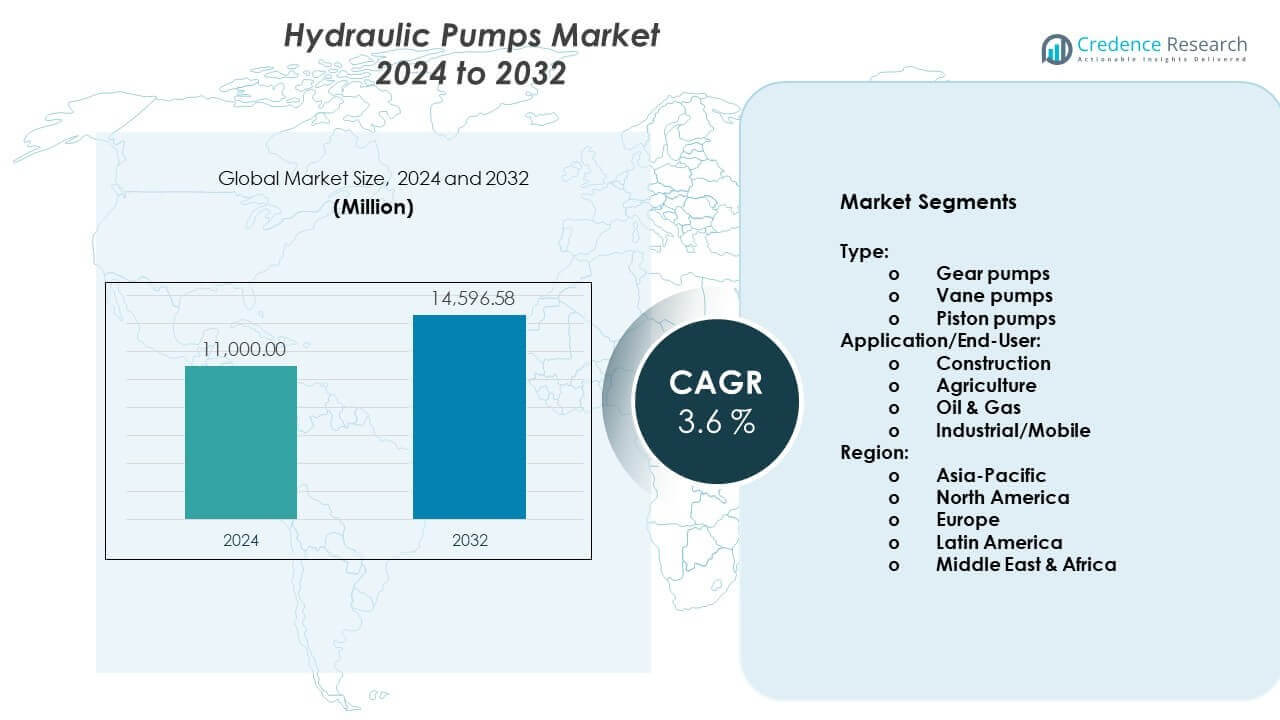
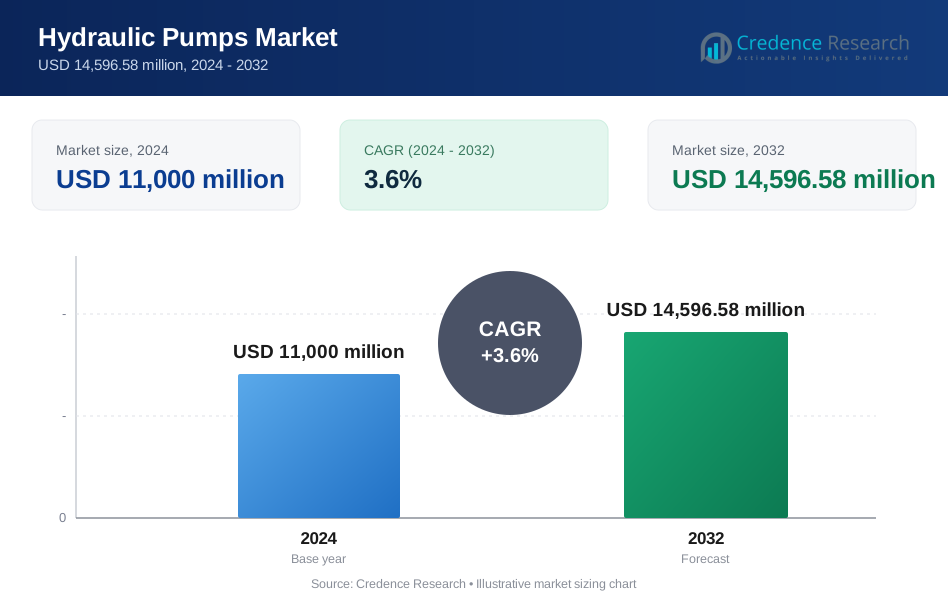
The Hydraulic Pumps Market is projected to grow from USD 11,000 million in 2024 to an estimated USD 14,596.58 million by 2032, registering a CAGR of 3.6% during the forecast period.
| REPORT ATTRIBUTE | DETAILS |
|---|---|
| Historical Period | 2020-2023 |
| Base Year | 2024 |
| Forecast Period | 2025-2032 |
| Hydraulic Pumps Market Size 2024 | USD 11,000 Million |
| Hydraulic Pumps Market, CAGR | 3.6% |
| Hydraulic Pumps Market Size 2032 | USD 14,596.58 Million |
The Hydraulic Pumps Market gains momentum from expanding infrastructure development and industrial automation. Construction machinery relies on hydraulic systems for lifting and earthmoving functions. Manufacturing plants use pumps in presses, injection molding machines, and machine tools. Agricultural mechanization supports demand for tractors and harvesters. Energy efficiency regulations encourage adoption of advanced pump technologies. Mining and oil and gas operations sustain demand for high-pressure and durable systems. Strong aftermarket services further support recurring revenue and equipment lifecycle management.
Asia Pacific leads the Hydraulic Pumps Market due to rapid industrial growth and infrastructure spending. China and India drive demand through construction, manufacturing expansion, and agricultural equipment adoption. Japan and South Korea support steady demand through advanced industrial automation. North America remains a mature market, supported by equipment replacement and energy sector activities. Europe shows stable growth due to manufacturing modernization and efficiency standards. Latin America and the Middle East emerge gradually, driven by infrastructure projects and industrial development.
Market Insights:
- The Hydraulic Pumps Market stood at USD 11,000 million in 2024 and is projected to reach USD 14,596.58 million by 2032, expanding at a CAGR of 3.6%, driven by steady equipment demand across construction, industry, and agriculture.
- Asia-Pacific leads with about 40% share due to large-scale construction, manufacturing expansion, and agricultural mechanization, while North America holds nearly 25% supported by replacement demand and energy sector use, and Europe accounts for around 22% backed by strong manufacturing and machinery exports.
- Latin America emerges as the fastest-growing region with close to 7% share, driven by mining activity, infrastructure development, and rising equipment adoption in Brazil and Chile.
- By type, gear pumps account for roughly 38% share due to cost efficiency and wide use in industrial and mobile equipment, followed by piston pumps at about 34% share supported by high-pressure construction and energy applications.
- By application, construction leads with nearly 36% share driven by heavy equipment usage, while industrial and mobile applications together represent about 33% share due to manufacturing automation and material handling demand.
Market Drivers:
Rising Demand From Construction, Mining, And Heavy Equipment Applications
The Hydraulic Pumps Market gains strong support from large construction activities worldwide. Construction equipment depends on hydraulic pumps for lifting, digging, and earthmoving tasks. Mining operations rely on pumps for high-pressure and continuous-duty performance in harsh conditions. Urban infrastructure projects expand equipment fleets across public and private sectors. Government investment supports long-term use of heavy machinery. Hydraulic systems deliver reliable power under variable load cycles. Equipment owners favor proven pump designs for stability. This driver sustains steady demand across project lifecycles.
- For instance, Caterpillar reports that its large hydraulic excavators operate with system pressures exceeding 35 MPa and achieve duty cycles above 20 hours per day in mining sites, validating sustained pump demand.
Expansion Of Industrial Manufacturing And Automation Across Key Sectors
Manufacturing expansion strengthens demand for hydraulic pump systems across industries. Industrial presses use pumps for controlled force and repeatable output. Injection molding machines depend on hydraulic pressure for product consistency. Machine tools rely on fluid power for precision motion control. Factory automation increases need for efficient hydraulic systems. Production facilities value pumps with low failure rates. Maintenance teams prefer standardized pump platforms for service ease. This driver supports long-term equipment adoption and replacement demand.
- For instance, Bosch Rexroth states that its industrial hydraulic systems support press forces above 10,000 kN with positioning accuracy within ±0.01 mm, supporting automation-driven adoption.
Growing Mechanization Across Agriculture And Material Handling Equipment
Agricultural mechanization increases demand for hydraulic pumps in tractors and harvesters across developing and developed regions. Material handling equipment relies on hydraulic pumps for lifting, tilting, and load control functions. Farming operations depend on hydraulic systems for durability under rough field conditions. Warehouse expansion supports higher use of forklifts and stackers. Logistics hubs deploy equipment that requires stable hydraulic power. Equipment uptime remains critical for operators. Manufacturers focus on pumps with consistent pressure output. This driver maintains recurring demand across rural and industrial users.
Need For Reliable Power Transmission In Energy And Process Industries
Energy and process industries depend on hydraulic pumps for critical operations. Oil and gas equipment uses pumps for drilling, pressure control, and valve actuation. Power plants rely on hydraulic systems for turbine and auxiliary control. Process industries require precise fluid control for safety and accuracy. Hydraulic pumps perform well under extreme temperature and pressure conditions. Operators favor systems with proven operational reliability. Maintenance teams value long service intervals. This driver sustains baseline demand across energy infrastructure.
Market Trends:
Shift Toward Compact And High-Efficiency Pump Designs
Manufacturers focus on compact hydraulic pump designs to meet space constraints. Equipment builders prefer pumps with higher power density. Improved materials enhance durability without increasing size. End users seek lower energy losses in fluid systems. Design optimization supports smoother pressure delivery. Compact pumps fit modern equipment layouts more easily. OEMs integrate pumps into modular platforms. This trend reshapes product development strategies.
- For instance, Danfoss reports that its compact piston pump platforms achieve power densities above 1.5 kW/kg while reducing internal leakage by over 15% compared to prior generations.
Rising Adoption Of Smart Monitoring And Condition Tracking Features
Smart monitoring gains traction within hydraulic pump systems. Sensors track pressure, temperature, and operating cycles. Predictive maintenance reduces unplanned downtime. Plant managers value real-time performance visibility. Remote monitoring supports faster response to faults. Data insights improve maintenance planning accuracy. Digital tools enhance asset utilization. This trend aligns with broader industrial digital adoption.
- For instance, Parker Hannifin’s hydraulic condition monitoring systems, such as the SensoNODE™ wireless sensors, enable real-time diagnostics and have demonstrated a reduction in unplanned downtime of up to 40% across industrial installations, according to company data and industry benchmarks.
Increasing Preference For Low-Noise And Low-Vibration Systems
Noise reduction becomes a key selection factor for hydraulic pumps. Manufacturers refine internal flow paths to reduce vibration. Lower noise improves operator comfort and safety. Urban construction sites demand quieter equipment. Advanced sealing technologies support smoother operation. Compliance with workplace standards drives adoption. End users favor pumps with improved acoustic performance. This trend influences equipment procurement decisions.
Customization Of Pumps For Application-Specific Performance Needs
End users request hydraulic pumps tailored to specific operating conditions. Manufacturers offer customized flow and pressure configurations. Specialized pumps support unique industrial processes. Customization improves efficiency in targeted applications. OEM collaboration enables co-developed solutions. Flexible designs shorten integration timelines. Tailored products strengthen supplier relationships. This trend supports market differentiation.
Market Challenges Analysis:
High Initial Cost And Maintenance Complexity Of Advanced Systems
High initial cost limits adoption of advanced hydraulic pump systems. Small operators face budget constraints for upgrades. Complex designs require skilled maintenance support. Service availability varies across regions. Maintenance errors reduce operational life. Spare part costs raise ownership expenses. Training needs increase operational burden. These challenges slow adoption in cost-sensitive segments.
Exposure To Alternative Technologies And Energy Efficiency Pressure
Alternative technologies create competitive pressure for hydraulic pumps. Some industries shift toward electromechanical systems. Energy efficiency regulations increase compliance requirements. Fluid leakage concerns affect perception of hydraulic systems. Environmental priorities influence equipment selection. Manufacturers face higher redesign costs. Performance balance becomes critical. These factors challenge traditional demand patterns.
Market Opportunities:
Growth In Infrastructure Development Across Emerging Economies
Infrastructure expansion across emerging economies creates strong opportunities for hydraulic pump suppliers. Road, rail, and urban development projects increase equipment deployment. Construction fleets require durable hydraulic systems. Government-backed infrastructure programs support long-term demand. Equipment rental markets expand alongside projects. Local manufacturing investment improves supply access. Pump suppliers gain opportunities through partnerships. This opportunity supports steady market expansion.
Rising Demand For Energy-Efficient And Sustainable Hydraulic Solutions
Demand grows for hydraulic pumps with improved energy efficiency. End users seek lower operating costs. Manufacturers invest in optimized designs and materials. Sustainable fluids gain wider acceptance. Compliance with environmental standards supports innovation. Energy-efficient pumps extend equipment life. Buyers value long-term performance benefits. This opportunity supports premium product adoption.
Market Segmentation Analysis:
By Type
The Hydraulic Pumps Market shows clear performance differences across pump types based on operating needs. Gear pumps hold strong adoption due to simple design, steady flow output, and cost efficiency. Industrial and mobile equipment favor gear pumps for low to medium pressure tasks. Vane pumps gain preference where smooth flow and low noise matter. Manufacturing plants use vane pumps for stable pressure control. Piston pumps serve high-pressure and high-efficiency requirements. Construction and oil applications rely on piston pumps for heavy-duty cycles. This type segmentation reflects varied performance expectations across industries.
- For instance, Eaton reports that its axial piston pumps operate at pressures above 420 bar while maintaining volumetric efficiency above 95% in mobile equipment.
By Application/End-User
Application diversity supports balanced demand across end-user segments. Construction remains a core segment due to extensive use in excavators, loaders, and cranes. Agriculture adopts hydraulic pumps for tractors, harvesters, and irrigation equipment. Oil and gas operations depend on pumps for drilling, pressure control, and offshore equipment. Industrial and mobile applications cover manufacturing machinery, material handling, and transportation equipment. Each end-user segment values reliability, pressure stability, and service life. The Hydraulic Pumps Market benefits from this broad application base, which supports steady replacement demand and long-term equipment utilization across sectors.
- For instance, John Deere confirms that modern agricultural tractors integrate hydraulic systems delivering flow rates above 200 liters per minute to support multiple implements simultaneously, reinforcing multi-sector demand.
Segmentation:
By Type:
- Gear pumps
- Vane pumps
- Piston pumps
By Application/End-User:
- Construction
- Agriculture
- Oil & Gas
- Industrial/Mobile
By Region:
- North America
- The U.S.
- Canada
- Mexico
- Europe
- Germany
- France
- The U.K.
- Italy
- Spain
- Rest of Europe
- Asia Pacific
- China
- Japan
- India
- South Korea
- South-east Asia
- Rest of Asia Pacific
- Latin America
- Brazil
- Argentina
- Rest of Latin America
- Middle East & Africa
- GCC Countries
- South Africa
- Rest of Middle East and Africa
Regional Analysis:
Asia-Pacific Dominates Through Industrial Expansion And Infrastructure Investment
Asia-Pacific holds the largest share of the Hydraulic Pumps Market, accounting for about 40% of global demand. China leads due to large-scale construction, manufacturing growth, and mining activity. India follows with rising infrastructure projects and agricultural mechanization. Japan and South Korea support demand through advanced industrial automation and equipment upgrades. Regional manufacturers benefit from strong OEM partnerships. High equipment production volumes sustain pump consumption. It remains the fastest-growing regional market.
North America Maintains Strong Position Through Replacement And Energy Sectors
North America accounts for nearly 25% of the Hydraulic Pumps Market share. The United States drives regional demand through construction equipment replacement and industrial machinery use. Oil and gas operations support steady pump demand across onshore applications. Manufacturing automation sustains consistent equipment upgrades. Equipment rental fleets contribute to recurring replacement cycles. Canada adds demand through mining and infrastructure projects. It reflects a mature but stable regional market.
Europe, Latin America, And Middle East & Africa Show Balanced Contribution
Europe represents around 22% of the Hydraulic Pumps Market share. Germany, France, and Italy lead due to strong manufacturing and machinery exports. Energy efficiency standards influence pump selection across industries. Latin America holds close to 7% share, supported by mining and infrastructure projects in Brazil and Chile. The Middle East & Africa account for nearly 6% share, driven by oil, gas, and construction activity. Infrastructure investment sustains gradual demand growth. It shows steady expansion across developing regions.
Key Player Analysis:
- Bosch Rexroth AG
- Parker Hannifin Corporation
- Eaton Corporation
- Danfoss
- Kawasaki Heavy Industries, Ltd.
Competitive Analysis:
The Hydraulic Pumps Market features strong competition among global manufacturers with broad portfolios. Leading companies focus on product reliability, pressure efficiency, and long service life. Major players invest in research to improve pump durability and energy performance. Strategic partnerships with OEMs strengthen long-term supply contracts. Regional manufacturing presence supports faster delivery and service support. Brand reputation influences procurement decisions in construction and industrial sectors. Aftermarket service capability remains a key competitive factor. It reflects a market driven by technical expertise and customer trust.
Recent Developments:
- In November 2025, Danfoss announced the acquisition of Hydro Holding Spa, completed in December. Hydro is an Italian hose fittings maker with EUR 60 million turnover. The deal strengthens Danfoss’ Fluid Conveyance division and expands its European OEM offering.
- In June 2025, Eaton announced the acquisition of Ultra PCS for $1.55 billion. Ultra PCS adds aerospace electronics and sensing capabilities with about $240 million in 2025 sales. The move strengthens Eaton’s military and civil aerospace portfolio.
- In April 2025, Parker launched GVI GEN 2 inverters and electrohydraulic actuators at bauma. Nott Company became Parker’s first certified Mobile Electrification Technology Center in North America.
Report Coverage:
The research report offers an in-depth analysis based on Type and Application/End-User segments. It details leading market players, providing an overview of their business, product offerings, investments, revenue streams, and key applications. Additionally, the report includes insights into the competitive environment, SWOT analysis, current market trends, as well as the primary drivers and constraints. Furthermore, it discusses various factors that have driven market expansion in recent years. The report also explores market dynamics, regulatory scenarios, and technological advancements that are shaping the industry. It assesses the impact of external factors and global economic changes on market growth. Lastly, it provides strategic recommendations for new entrants and established companies to navigate the complexities of the market.
Future Outlook:
- Infrastructure expansion will sustain long-term equipment demand.
- Industrial automation will increase hydraulic system integration.
- Energy-efficient pump designs will gain stronger adoption.
- Smart monitoring features will improve maintenance planning.
- Emerging economies will attract manufacturing investments.
- OEM partnerships will shape competitive positioning.
- Aftermarket services will grow in importance.
- Custom pump solutions will support niche applications.
- Material innovation will enhance pump durability.
- Regulatory standards will influence product development priorities.
Request a Free Sample
Fill in your details and we'll send you a free sample report.
- Sample data tables & charts
- Research methodology
Need a Custom Version of This Report?
Tailor the scope, geography, or segments to your exact requirements.
- Custom geography or segment scope
- Direct access to our analyst team
Frequently Asked Questions
What is the current market size for Hydraulic Pumps Market, and what is its projected size in 2032?
At what Compound Annual Growth Rate is the Hydraulic Pumps Market projected to grow between 2025 and 2032?
Which Hydraulic Pumps Market segment held the largest share in 2024?
What are the primary factors fueling the growth of the Hydraulic Pumps Market?
Table of Content
Chapter 1. Report Introduction
- 1.1 Report Description & Purpose
- 1.1.1 Report Title & Market Definition
- 1.1.2 Unique Selling Propositions (USP) & Key Differentiators
- 1.1.3 Value Proposition for Stakeholders
- 1.2 Research Objectives
- 1.2.1 Market Sizing Objectives (Volume & Revenue)
- 1.2.2 Segmentation Objectives
- 1.2.3 Competitive Intelligence Objectives
- 1.2.4 Forecast & Scenario Objectives
- 1.3 Report Scope
- 1.3.1 Hydraulic Pumps Scope – Types & Subtypes Covered
- 1.3.2 Geographic Scope – Regions & Countries Covered
- 1.3.3 Historical Period, Base Year & Forecast Period (2024; forecast to 2032)
- 1.3.4 Inclusions & Exclusions
- 1.4 HS Code & Classification Framework
- 1.5 Currency, Units & Pricing Basis
- 1.6 Target Stakeholders
- 1.7 Limitations & Assumptions
Chapter 2. Executive Summary
- 2.1 Global Hydraulic Pumps Market Snapshot
- 2.1.1 Market Size – Historical (2024) & Forecast (2024-2032) (2024: USD 11,000 million → 2032: USD 14,596.58 million)
- 2.1.2 Volume & Revenue – Global Totals
- 2.1.3 Key Market Highlights – Top Five Facts
- 2.2 Hydraulic Pumps Market Segmentation Snapshot
- 2.2.1 Market Split by Region – 2024 vs. 2032
- 2.3 Competitive Snapshot
- 2.3.1 Top 10 Players by Revenue Share – 2024
- 2.3.2 Top 10 Players by Volume Share – 2024
- 2.3.3 Recent Strategic Developments (18-Month Summary)
- 2.4 Key Investment Highlights & Strategic Conclusions
Chapter 3. Hydraulic Pumps Market Dynamics & Industry Analysis
- 3.1 Market Overview & Context
- 3.1.1 Hydraulic Pumps Market Position in the Broader Automotive Value Chain
- 3.1.2 OEM vs. Replacement Market Dynamics
- 3.1.3 Market Maturity & Development Stage by Region
- 3.2 Hydraulic Pumps Market Drivers
- 3.3 Hydraulic Pumps Market Restraints & Challenges
- 3.4 Hydraulic Pumps Market Opportunities
- 3.5 Porter's Five Forces Analysis
- 3.5.1 Threat of New Entrants
- 3.5.2 Bargaining Power of Suppliers
- 3.5.3 Bargaining Power of Buyers
- 3.5.4 Threat of Substitutes
- 3.5.5 Competitive Rivalry – Intensity Assessment
- 3.6 Hydraulic Pumps Value Chain Analysis
- 3.6.1 Upstream – Raw Material/Input Suppliers
- 3.6.1.1 Raw Material/Input 1
- 3.6.1.2 Raw Material/Input 2
- 3.6.1.3 Raw Material/Input 3
- 3.6.2 Midstream – Production/Manufacturing/Service Delivery
- 3.6.2.1 Production/Process Overview
- 3.6.2.2 Key Facility Locations & Capacity by Manufacturer
- 3.6.3 Downstream – Distribution & End Consumer
- 3.6.3.1 Primary Channel – B2B/OEM
- 3.6.3.2 Secondary Channels – Dealer, Retail, Online, Direct
- 3.6.4 Value Chain Profitability Analysis
- 3.6.1 Upstream – Raw Material/Input Suppliers
- 3.7 PESTEL Analysis
- 3.7.1 Political Factors
- 3.7.2 Economic Factors
- 3.7.3 Social Factors
- 3.7.4 Technological Factors
- 3.7.5 Environmental Factors
- 3.7.6 Legal Factors
- 3.8 Hydraulic Pumps Supply Chain Analysis
- 3.8.1 Raw Material/Input Supply Risk Assessment
- 3.8.2 Manufacturing Concentration Risk (Geographic Exposure)
- 3.8.3 Trade Disruption Impact Analysis
- 3.9 Regulatory & Policy Landscape
Note: The regulatory and policy landscape section covers regulations based on their applicability to the market, Hydraulic Pumps category, geography, and scope of the study. Only regulatory frameworks with a material impact on operations, compliance, trade, sustainability, or market access are analyzed in detail.
Chapter 4. Key Investment Pockets & Opportunity Analysis
- 4.1 Hydraulic Pumps Market Attractiveness Analysis
- 4.1.1 By Region – Investment Attractiveness Matrix (Volume × CAGR)
- 4.2 Absolute Revenue Growth Opportunity
- 4.2.1 By Region – Absolute USD Growth Through 2032
- 4.3 Incremental Volume Opportunity
- 4.3.1 By Region – Incremental Volume Through 2032
- 4.3.2 Segment – Incremental Volume
- 4.4 Emerging Submarket Opportunity Deep Dive (Subject to Applicability)
- 4.5 Emerging Market Opportunity Scorecards
- 4.5.1 United States
- 4.5.2 Europe
- 4.5.3 Asia
- 4.5.4 Middle East & Africa
Note: Emerging Market Opportunity Scorecards will be included based on relevance and strategic importance. Regions listed are indicative and may vary depending on data availability and market dynamics.
Chapter 5. Hydraulic Pumps Import-Export Analysis & Trade Flows
- 5.1 Global Trade Overview
- 5.1.1 Global Export Value by Country (2024)
- 5.1.2 Global Export Volume by Country (2024)
- 5.1.3 Global Import Value by Country (2024)
- 5.1.4 Global Import Volume by Country (2024)
- 5.1.5 Net Trade Balance by Country (2024)
- 5.2 Export Analysis – Segment
- 5.2.1 Type 1 (HS Code)
- 5.2.2 Type 2 (HS Code)
- 5.2.3 Type 3 (HS Code)
- 5.2.4 Type 4 (HS Code)
- 5.2.5 Type 5 (HS Code)
- 5.3 Import Analysis – Segment
- 5.3.1 Type 1 (HS Code)
- 5.3.2 Type 2 (HS Code)
- 5.3.3 Type 3 (HS Code)
- 5.3.4 Type 4 (HS Code)
- 5.3.5 Type 5 (HS Code)
- 5.4 Average Unit Trade Prices
- 5.4.1 Average Export Price – Segment & Country
- 5.4.2 Average Import Price – Segment & Source Country
- 5.4.3 Price Trends (2024)
- 5.5 Key Trade Route Analysis
- 5.5.1 Trade Route 1
- 5.5.2 Trade Route 2
- 5.5.3 Trade Route 3
- 5.5.4 Trade Route 4
- 5.5.5 Trade Route 5
- 5.6 Trade Policy Impact Assessment
- 5.6.1 US Anti-Dumping & Section 301 Tariffs
- 5.6.2 EU Customs Union Impact
- 5.6.3 Major Free Trade Agreements
- 5.6.4 USMCA Rules of Origin
Note: Trade policy analysis will be included only where relevant to the Hydraulic Pumps market.
Chapter 6. Competitive Landscape & Company Benchmarking
- 6.1 Hydraulic Pumps Market Concentration & Structure
- 6.1.1 Herfindahl-Hirschman Index (HHI) – vs. 2024
- 6.1.2 Tier 1, Tier 2 & Tier 3 Market Structure
- 6.1.3 Global, Regional & Local Player Dynamics
- 6.2 Hydraulic Pumps Market Share Analysis – 2024
- 6.2.1 Global Revenue Share by Company
- 6.2.2 Global Volume Share by Company
- 6.2.3 Regional Revenue Share
- 6.2.4 Market Share Evolution ( vs. 2024)
- 6.2.5 OEM Segment Share by Company
- 6.2.6 Replacement Segment Share by Company
- 6.3 Production/Delivery Capacity & Facility Analysis
- 6.3.1 Global Installed Capacity
- 6.3.2 Capacity Utilization Rates
- 6.3.3 Production/Output Volume
- 6.3.4 Facility Locations & Capacity Map
- 6.3.5 Planned Capacity Additions
- 6.4 Hydraulic Pumps Competitive Benchmarking Matrix
- 6.4.1 Revenue, Volume, CAGR & Profitability Comparison
- 6.4.2 Channel Revenue Mix
- 6.4.3 Geographic Revenue Exposure
- 6.4.4 R&D Intensity
- 6.4.5 Sustainability Maturity
- 6.5 Strategic Developments in Hydraulic Pumps (Last 24 Months)
- 6.5.1 Mergers, Acquisitions & Divestments
- 6.5.2 New Hydraulic Pumps Launches
- 6.5.3 Facility Expansions
- 6.5.4 Strategic Alliances, Joint Ventures & Partnerships
- 6.5.5 Distribution Expansion & Market Entry
- 6.5.6 Sustainability & ESG Initiatives
- 6.6 Competitive Strategy Mapping
- 6.6.1 Leader, Challenger, Follower & Niche Classification
- 6.6.2 Pricing Strategy Comparison
- 6.6.3 Channel Strategy Matrix
Note: Strategic developments are included based on their materiality and the availability of reliable information.
Chapter 7. Global Hydraulic Pumps Market – By Distribution Channel
- 7.1 Segment Overview
- 7.1.1 Volume & Revenue Split by Channel (2024 & 2032)
- 7.1.2 Channel Mix Evolution (2024-2032)
Chapter 8. Regional Market Analysis – Global Overview
- 8.1 Global Regional Overview
- 8.1.1 Regional Volume Share
- 8.1.2 Regional Revenue Share
- 8.1.3 Regional Volume by Region
- 8.1.4 Regional Revenue by Region
- 8.1.5 Regional Forecast Through 2032
- 8.2 Cross-Regional Segment Analysis
- 8.2.1 By Distribution Channel
- 8.2.2 By Brand/Price Tier
Chapter 9. North America Hydraulic Pumps Market
- 9.1 United States
- 9.2 Canada
- 9.3 Mexico
Chapter 10. Europe Hydraulic Pumps Market
- 10.1 Germany
- 10.2 France
- 10.3 Italy
- 10.4 United Kingdom
- 10.5 Spain
- 10.6 Poland
- 10.7 Russia
- 10.8 Netherlands
- 10.9 Belgium
- 10.10 Sweden
- 10.11 Denmark
- 10.12 Norway
- 10.13 Rest of Europe
Chapter 11. Asia Pacific Hydraulic Pumps Market
- 11.1 China
- 11.2 India
- 11.3 Japan
- 11.4 South Korea
- 11.5 Thailand
- 11.6 Indonesia
- 11.7 Vietnam
- 11.8 Malaysia
- 11.9 Australia
- 11.10 Rest of Asia Pacific
Chapter 12. Latin America Hydraulic Pumps Market
- 12.1 Brazil
- 12.2 Argentina
- 12.3 Colombia
- 12.4 Chile
- 12.5 Rest of Latin America
Chapter 13. Middle East Hydraulic Pumps Market
- 13.1 Saudi Arabia
- 13.2 United Arab Emirates
- 13.3 Turkey
- 13.4 Israel
- 13.5 Iran
- 13.6 Rest of the Middle East
Chapter 14. Africa Hydraulic Pumps Market
- 14.1 South Africa
- 14.2 Egypt
- 14.3 Nigeria
- 14.4 Morocco
- 14.5 Rest of Africa
Chapter 15. Hydraulic Pumps Company Profiles
- 15.1 [Company 01]
- 15.1.1 Company Overview
- 15.1.2 Key Management Personnel
- 15.1.3 Products & Services Portfolio
- 15.1.4 Financial Performance
- 15.1.5 Key Market Focus & Geographic Presence
- 15.1.6 Recent Developments & Strategic Initiatives
Note: The company profile list is preliminary and may change based on research findings, market developments, data availability, and client requirements.
Chapter 16. Appendices
- Appendix A – List of Abbreviations & Acronyms
- Appendix B – Industry Classification Code Reference – Full Series
- Appendix C – Production & Capacity Data Tables
- Appendix D – End-Use & Demand Base Tables
- Appendix E – Consumption & Replacement Rate Assumptions
- Appendix F – ASP Reference Tables
- Appendix G – Manufacturing & Facility Database
- Appendix H – Import-Export Data Tables
- Appendix I – Regulatory Summary Tables
- Appendix J – Primary Research Participant List (Anonymized)
- Appendix K – Primary Research Questionnaire Framework
- Appendix L – Data Sources & Bibliography
- Appendix M – Market Size Divergence & Source Comparison
Chapter 17. Research Methodology
- 17.1 Research Framework & Philosophy
- 17.2 Secondary Research – Sources, Hierarchy & Data Extraction
- 17.3 Data Modeling – Bottom-Up & Top-Down Market Sizing
- 17.4 Primary Research – Stakeholder Framework, LOI & Sample Sizes
- 17.5 Forecast Methodology – Regression, Scenario & Sensitivity Analysis
- 17.6 Quality Control – Four-Layer Validation Framework
- 17.7 Limitations & Standard Assumptions
- 17.8 Disclaimer
