
| REPORT ATTRIBUTE | DETAILS |
|---|---|
| Historical Period | 2019-2022 |
| Base Year | 2023 |
| Forecast Period | 2024-2032 |
| Barrier Packaging Market Size 2023 | USD 6351.2 Million |
| Barrier Packaging Market, CAGR | 5.80% |
| Barrier Packaging Market Size 2032 | USD 10549.3 Million |
Market Insights
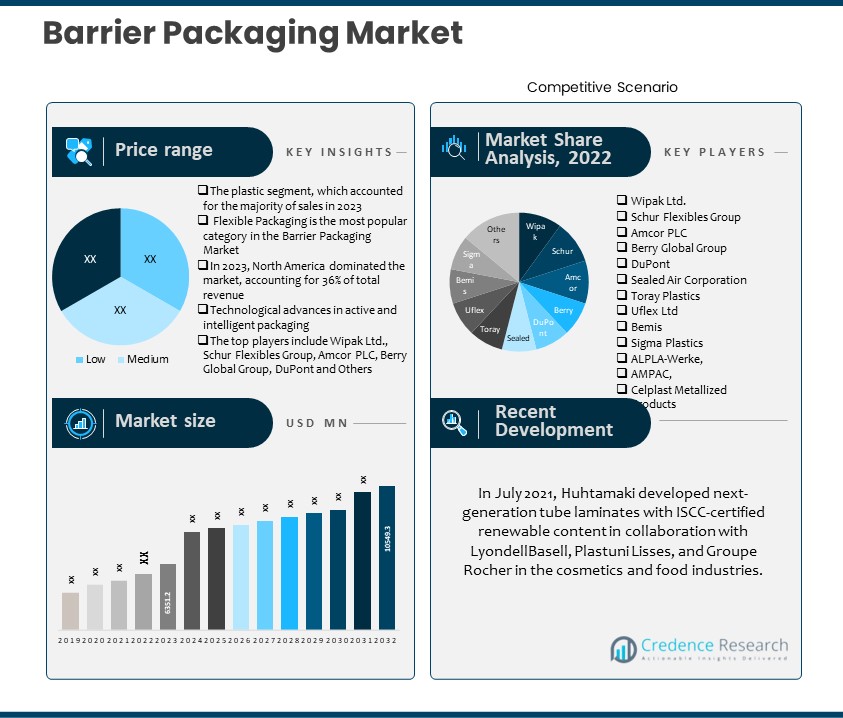
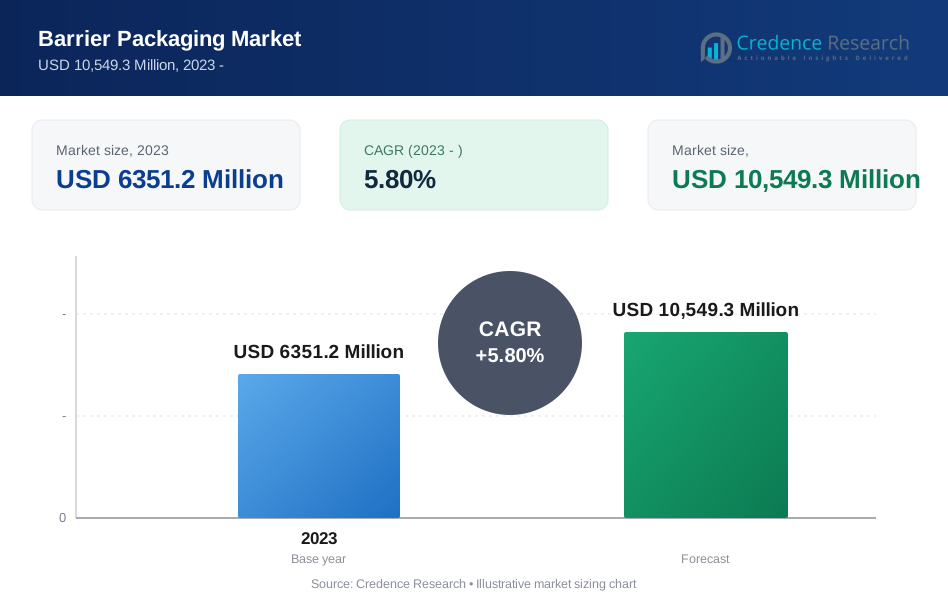
- The global demand for Barrier Packaging was valued at USD 6351.2 Million in 2023 and is expected to reach USD 10549.3 Million in 2032, growing at a CAGR of 5.80% between 2024 and 2032.
- The plastic segment, which accounted for the majority of sales in 2023, and the metalized film category are expected to have the biggest CAGR over the projected period.
- Flexible Packaging is the most popular category in the Barrier Packaging Market, and Modified Atmosphere Packaging (MAP) accounts for a significant market share.
- The food and beverage category is predicted to account for the largest proportion of the market. At the same time, pharmaceuticals and healthcare are expected to be the fastest-expanding section of the Barrier Packaging business.
- Oxygen Barrier is a significant aspect of the Barrier Packaging Market.
- In 2023, North America dominated the market, accounting for 36% of total revenue, while Asia-Pacific is expected to have the quickest growth.
- Increasing demand for multi-layered packaging that keeps oxygen and water out.
- Stringent government regulations and environmental concerns
Executive Summary
Market Definition
Barrier Packaging films are specialty materials used in the packaging business to form an efficient barrier against external elements such as moisture, air, light, and contamination. These films are intended to retain freshness and increase the shelf life of packaged goods, particularly food and beverages, medications, and sensitive electrical devices. Barrier films are essential for safeguarding products from environmental variables that could cause spoilage, degradation, or damage. They are frequently made up of various layers with different features, such as high barrier coatings or laminations, that are adapted to the specific requirements of the packaged objects. Barrier films play an important role in preserving product quality, safety, and integrity throughout storage and transport.
Market Overview
The global Barrier Packaging Market has witnessed steady growth in recent years and is expected to grow at a CAGR of 5.80% between 2024 and 2032. The market was valued at USD 6351.2 million in 2023 and is expected to reach USD 10549.3 million in 2032.
Packaging barrier films are essential components of the packaging industry, providing protective layers against moisture, oxygen, light, and pollutants. These films are vital for preserving freshness and increasing the shelf life of a wide range of products, including food & drinks, pharmaceuticals, and electronics. The global packaging barrier films market is dynamic, driven by numerous growth factors, influenced by industry trends, and filled with both challenges and opportunities.
The market's growth is primarily driven by rising demand for extended shelf life and product protection, particularly in the food and beverage industry. Rising consumer awareness of food safety and sustainability is driving the use of barrier films. Furthermore, advances in packaging technology and materials contribute to market growth. Key developments in the packaging barrier films market include a shift toward sustainable and recyclable materials that are in line with environmental concerns. Multilayer films with specialized barrier qualities are gaining popularity, adapting to specific product requirements.
The demand for convenient, single-serve packaging solutions is also increasing. The market is facing problems due to the cost of advanced barrier films and their impact on production costs. Balancing environmental sustainability with barrier performance remains a difficult challenge. Furthermore, strict rules governing food contact materials necessitate compliance, adding complexity to the sector. There are numerous opportunities for manufacturers that can create innovative, ecological, and cost-effective barrier films.
Segmentation By Material Type
- The plastic segment, which accounted for the majority of sales in 2023, made a considerable contribution to barrier packaging film revenue. During the predicted time, these materials will be used due to their high tensile strength, chemical and dimension stability, reflectivity, transparency, gas and smell barrier qualities, and electrical insulation.
- The metalized film category is predicted to have the greatest CAGR during the projection period. A metalized film is a high-barrier layer composed of a core layer and a metal bonding layer frequently formed through co-extrusion. It offers exceptional oxygen and moisture barrier characteristics.
Segmentation By Packaging Type
- Flexible Packaging is the most popular category in the Barrier Packaging Market because of its adaptability and convenience. Due to its flexibility and lightweight design, it is widely employed in a variety of industries.
- On the other hand, Modified Atmosphere Packaging (MAP) accounts for a large market share. MAP is known for prolonging the shelf life of products by changing the atmosphere inside the package, making it an important choice for food preservation and quality control.
Segmentation by End-Use Industry
- The food and beverage category is estimated to account for the largest share of the market over the forecast period. The food and beverage industry employs high-barrier packaging films to package, store, and ship a wide range of items, including meat, ready-to-eat meals, bread, seafood, dairy products, confectionery, fruits and vegetables, and alcoholic and non-alcoholic beverages.
- The Cosmetics and Personal Care sector produces consumer items for beauty and personal hygiene. Personal care is an expanding market for high-barrier film packaging. This type of product necessitates safety and longer shelf life, which are two of the advantages of barrier film packaging.
- Pharmaceuticals and Healthcare is expected to be the fastest-expanding segment of the Barrier Packaging industry by 2023. Pharmaceuticals and Healthcare require protection from detrimental impacts, as well as proper maintenance at every stage of the product sales cycle, including production operations, packing, warehousing, handling, dealer transportation, and display.
Segmentation By Barrier Property
- Oxygen Barrier is an important part of the Barrier Packaging Market. Oxygen is a primary cause of food decomposition, which affects product quality and shelf life. Implementing effective oxygen barrier packaging solutions helps to maintain the freshness and integrity of diverse items, making it a necessary component in the packaging business.
Segmentation by Region
- In 2023, North America dominated the market, accounting for 36% of total revenue.
- Asia-Pacific is predicted to have the fastest growth.
- The rest of the world, including Latin America, the Middle East, and Africa, supplies the remaining demand for Barrier Packaging.
North America has the greatest revenue share (36% in 2023). Several notable trends exist in the North American barrier packaging film market. There is an increasing emphasis on sustainability, with a greater need for environmentally friendly and recyclable barrier films. Stringent laws on food safety and environmental issues are driving the adoption of compatible films. The advent of e-commerce has increased the demand for barrier films that provide secure and damage-resistant packing during transit. Furthermore, advances in advanced barrier technologies are influencing the industry, with an emphasis on precise control over permeability to lengthen product shelf life.
Furthermore, Asia-Pacific is expected to experience the fastest growth. The Asia-Pacific barrier packaging film market is experiencing rapid growth. A burgeoning middle class and urbanization are major drivers of rising packaged goods demand. Sustainability is a primary priority, as eco-friendly and biodegradable barrier films become more popular. The region's booming e-commerce sector is driving demand for strong packaging solutions, such as improved barrier films. Furthermore, improvements in barrier film technology, particularly in China and India, are influencing the market as manufacturers attempt to fulfill the changing packaging needs of diverse sectors.
Key Highlights of the Report
Material Type, Packaging Type, End-Use Industry, Barrier Property, and region segments of the global Barrier Packaging Market. Flexible packaging is the most popular category, and the food and beverage category is predicted to hold the biggest market share. Additionally, the fastest-growing market is anticipated to be in the pharmaceutical and healthcare sectors, and oxygen barrier plays a significant role in the barrier packaging market and North America, leading the market growth.
The market's primary drivers are increasing demand for longer shelf life, rising consumer awareness of food safety, and technological advances in packaging materials. In addition, the market's primary limitations include high production costs, environmental concerns, and recycling complexity. Moreover, the market's significant opportunities include sustainability and recycling, increased use of bio-based materials, and smart and intelligent packaging.
North America has the highest revenue share (36% by 2023). The North American barrier packaging film market has several important trends. Furthermore, Asia-Pacific is likely to see the most rapid increase. The Asia-Pacific barrier packaging film industry is growing rapidly.
What Are The Main Drivers Of The Global Barrier Packaging Market?
Several main drivers are positively influencing the barrier packaging market. To begin, there is a noteworthy growth in demand for sustainable and environmentally friendly packaging options. Furthermore, developments in barrier materials and container design are driving market expansion. Additionally, the industry is seeing an increase in the use of barrier packaging due to a greater emphasis on food safety and the need to extend product shelf life.
What Are The Major Challenges Faced By The Global Barrier Packaging Market?
On the other hand, the Barrier Packaging Market has some problems that function as constraints. One of the most significant challenges is the substantial initial investment required to install innovative barrier packaging techniques. Furthermore, managing regulatory obstacles and satisfying compliance standards for barrier packaging materials is a substantial limitation.
What Are The Growth Opportunities In The Global Barrier Packaging Market?
The Barrier Packaging Market offers promising potential for expansion. The growing e-commerce industry provides a profitable market for protective and secure barrier packaging solutions. Furthermore, rising demand for easy, on-the-go packaging solutions creates new opportunities for market growth.
Market Drivers
Several factors drive the global Barrier Packaging Market. The following are the key drivers of the global Barrier Packaging Market:
Increasing Demand For Multi-Layered Packaging To Keep Oxygen And Water Out
High-barrier packaging films are made up of many layers that protect against mineral oil and UV light, as well as interaction with moisture, oxygen, and other gases such as carbon dioxide. This robust barrier, constructed with functional elements, aids in the preservation of the materials kept within it, such as the food's quality, color, aroma, texture, taste, and flavor. To retain their integrity, items must have all necessary barrier features, such as gas, moisture, and fragrance. High-barrier films are critical for creating goods with these desired qualities. High-barrier films feature an impenetrable, co-extruded, flexible structure that prevents them from reacting with packaged items such as pharmaceuticals.
Market Restraints
The global Barrier Packaging Market faces some challenges that may hinder its growth. These include the following:
Stringent Government Laws And Environmental Issues
Plastics such as polypropylene and polyethylene are the principal raw materials used to manufacture high-barrier packaging films. These compounds are harmful to the environment, including water and land, and are not biodegradable, difficult to recycle, or recyclable. Governments, regulatory bodies, and environmentalists have all been raising awareness of the dangers of watching such films.
Plastic is employed in the packaging sector at a higher than 40% level, and many countries reject its consumption and use because it decomposes so slowly.
Opportunities
The global Barrier Packaging Market offers significant growth opportunities. These include the following:
Increased Need For Consumer-Friendly Packaging
Consumers consider a few key considerations while selecting packaging films. Some examples include cleanliness, food safety, usability, label information, shelf life, durability, appearance, and environmental impact. Customers prefer fiber-based packaging manufactured from recycled and recyclable plastic. As a result of the rising trend and need for consumer-friendly packaging, the market for high-barrier packaging films has a huge possibility to grow significantly in the future. This can be accomplished by developing more consumer-required, simple-to-use, long-lasting, and ecologically friendly products.
Competitive Landscape
Key Players
The global Barrier Packaging Market is highly competitive, with several key players. Some of the major players in the market and their market share are as follows:
- Wipak Ltd.
- Schur Flexibles Group
- Amcor PLC
- Berry Global Group
- DuPont
- Sealed Air Corporation
- Toray Plastics
- Uflex Ltd
- Bemis
- Sigma Plastics
- ALPLA-Werke,
- AMPAC,
- Celplast Metallized Products,
- Innovia Films
- LINPAC Group
- Mondi plc
- Prairie State Group
- Uflex Ltd
These organizations prioritize product innovation, End-Use Industry expansion, and mergers and acquisitions to stay competitive.
The global Barrier Packaging Market's key players continually seek to stay ahead by offering new products and developments.
In January 2022, Klockner Pentaplast announced a significant investment to extend its post-consumer recycled content (PCR) capacity in North America as part of its ongoing commitment to sustainable innovation in the consumer health, pharmaceutical, and food packaging markets.
In February 2022, Mondi and Henkel collaborated to create a totally recyclable mono-material refill pouch. The two companies will collaborate on a packaging solution for refilling plastic bottles from flexible pouches.
In June 2022, Cosmo Films Limited's manufacturing facility in Aurangabad, India now has an additional 25,000 MT of annual rated capacity.
Summary of Key Findings
- Increased need for consumer-friendly packaging.
- The market is segmented by Material Type: Packaging Type, End-Use Industry, Barrier Property, and regions.
- Modified Atmosphere Packaging (MAP) accounting for a considerable market share.
- Oxygen Barrier is a significant component of the barrier packaging market.
- North America is leading in market growth; the market is highly competitive, with key players including Wipak Ltd., Schur Flexibles Group, Amcor PLC, Berry Global Group, DuPont and Others.
Future Outlook
- Increasing need for environmentally acceptable barrier packaging solutions.
- Technological advances in active and intelligent packaging.
- A growing emphasis on increasing shelf life and maintaining product quality.
- Increased use of barrier packaging in the food and beverage industry.
How CXOs Can Benefit from the Credence Research Barrier Packaging Market Report
The Credence Research Barrier Packaging Market Report provides CXOs with a comprehensive overview of the market, including:
- Market size and growth forecast: The report provides detailed estimates of the global Barrier Packaging Market size, segmented By Material Type, Packaging Type, End-Use Industry, Barrier Property and region. It also includes forecasts for the market through 2032 based on key trends and drivers.
- Market segmentation: The report segments the Barrier Packaging Market By Material Type, Packaging Type, End-Use Industry, Barrier Property and region. This segmentation provides CXOs with a granular understanding of the market and the opportunities in each segment.
- Competitive Landscape: The report profiles the key players in the Barrier Packaging Market and provides insights into their strategies, product offerings, and financial performance. This information can help CXOs to identify and assess their competition.
- Key trends and drivers: The report identifies and analyzes the key trends and drivers that are shaping the Barrier Packaging Market. This information can help CXOs to make informed decisions about their investments and strategies.
CXOs can use the insights from the Credence Research Barrier Packaging Market Report to:
- Identify growth opportunities: The report can help CXOs to identify new growth opportunities in the Barrier Packaging Market. For example, by analyzing the data and trends in the report, they can make informed decisions on where to invest and expand their business.
- Make informed investment decisions: The report can help CXOs make informed investment decisions about Barrier Packaging. For example, it may provide useful insights into market trends, customer preferences, the competitive landscape, and growth prospects in the mobile accessories business..
- Develop competitive strategies: The report can help CXOs develop competitive strategies for their Barrier Packaging businesses. For example, by analyzing market trends, client preferences, and the competitive environment mentioned in the report, CXOs can fine-tune their strategies, differentiate their offers, and effectively position their firms in the marketplace.
- Track market developments: The report can help CXOs monitor market developments and stay ahead of the curve. For example, it provides insights into the latest trends and innovations in the Barrier Packaging Market.
Overall, the Credence Research Barrier Packaging Market Report is a valuable resource for CXOs who are looking to gain a deeper understanding of the market and identify .opportunities for growth.
Segmentation
- By Material Type:
- Plastics
- Metallized Films
- Glass
- Aluminum Foil
- Paper and Paperboard
- By Packaging Type:
- Flexible Packaging
- Rigid Packaging
- Blister Packaging
- Aseptic Packaging
- Modified Atmosphere Packaging (MAP)
- Vacuum Packaging
- By End-Use Industry:
- Food and Beverage
- Pharmaceuticals and Healthcare
- Cosmetics and Personal Care
- Industrial and Chemicals
- Electronics
- By Barrier Property:
- Moisture Barrier
- Oxygen Barrier
- Light Barrier
- Gas Barrier
- By Region
- North America
- The U.S.
- Canada
- Mexico
- Europe
- Germany
- France
- The U.K.
- Italy
- Spain
- Rest of Europe
- Asia Pacific
- China
- Japan
- India
- South Korea
- South-east Asia
- Rest of Asia Pacific
- Latin America
- Brazil
- Argentina
- Rest of Latin America
- Middle East & Africa
- GCC Countries
- South Africa
- Rest of the Middle East and Africa
- North America
Request a Free Sample
Fill in your details and we'll send you a free sample report.
- Sample data tables & charts
- Research methodology
Need a Custom Version of This Report?
Tailor the scope, geography, or segments to your exact requirements.
- Custom geography or segment scope
- Direct access to our analyst team
Frequently Asked Questions
What is the current size of the global Barrier Packaging Market?
What is the expected growth rate of the Barrier Packaging Market between 2024 and 2032?
Which segment is leading the market share in terms of End-Use Industry?
Which Packaging Type segment governs the demand for Barrier Packaging in the world?
Who are the major players in the global Barrier Packaging Market?
Table of Content
Chapter 1. Report Introduction
- 1.1 Report Description & Purpose
- 1.1.1 Report Title & Market Definition
- 1.1.2 Unique Selling Propositions (USP) & Key Differentiators
- 1.1.3 Value Proposition for Stakeholders
- 1.2 Research Objectives
- 1.2.1 Market Sizing Objectives (Volume & Revenue) (Volume Where Applicable)
- 1.2.2 Segmentation Objectives
- 1.2.3 Competitive Intelligence Objectives
- 1.2.4 Forecast & Scenario Objectives
- 1.3 Report Scope
- 1.3.1 Barrier Packaging Scope – Segments & Subsegments Covered
- 1.3.2 Geographic Scope – Regions & Countries Covered
- 1.3.3 Historical Period, Base Year & Forecast Period (2023; forecast to the forecast period)
- 1.3.4 Inclusions & Exclusions
- 1.4 Industry Classification & Applicable Codes
- 1.5 Currency, Measurement Units & Valuation Basis
- 1.6 Target Stakeholders
- 1.7 Limitations & Assumptions
Chapter 2. Executive Summary
- 2.1 Global Barrier Packaging Market Snapshot
- 2.1.1 Market Size – Historical (2023) & Forecast (the forecast period) (2023: USD 6351.2 Million → forecast year: USD 10,549.3 Million)
- 2.1.2 Volume & Revenue – Global Totals (Volume Where Applicable)
- 2.1.3 Key Market Highlights – Top Five Facts
- 2.2 Barrier Packaging Market Segmentation Snapshot
- 2.2.1 Market Split by Region – 2023 vs.
- 2.3 Competitive Snapshot
- 2.3.1 Top 10 Players by Revenue Share – 2023
- 2.3.2 Top 10 Players by Volume Share – 2023 (Volume Where Applicable)
- 2.3.3 Recent Strategic Developments (18-Month Summary)
- 2.4 Key Investment Highlights & Strategic Conclusions
Chapter 3. Barrier Packaging Market Dynamics & Industry Analysis
- 3.1 Market Overview & Context
- 3.1.1 Barrier Packaging Market Position in the Broader Industry Value Chain
- 3.1.2 Demand Structure & Purchasing Dynamics
- 3.1.3 Market Maturity & Development Stage by Region
- 3.2 Barrier Packaging Market Drivers
- 3.3 Barrier Packaging Market Restraints & Challenges
- 3.4 Barrier Packaging Market Opportunities
- 3.5 Porter's Five Forces Analysis
- 3.5.1 Threat of New Entrants
- 3.5.2 Bargaining Power of Suppliers
- 3.5.3 Bargaining Power of Buyers
- 3.5.4 Threat of Substitutes
- 3.5.5 Competitive Rivalry – Intensity Assessment
- 3.6 Barrier Packaging Value Chain Analysis
- 3.6.1 Upstream – Key Inputs, Resources & Suppliers
- 3.6.1.1 Key Input/Resource 1
- 3.6.1.2 Key Input/Resource 2
- 3.6.1.3 Key Input/Resource 3
- 3.6.2 Midstream – Core Operations & Value Creation
- 3.6.2.1 Operating Model & Process Overview
- 3.6.2.2 Key Operating Locations & Capabilities by Company
- 3.6.3 Downstream – Market Channels & End Users
- 3.6.3.1 Direct Sales & Customer Engagement Channels
- 3.6.3.2 Indirect Sales, Intermediaries & Partner Channels
- 3.6.4 Value Chain Profitability Analysis
- 3.6.1 Upstream – Key Inputs, Resources & Suppliers
- 3.7 PESTEL Analysis
- 3.7.1 Political Factors
- 3.7.2 Economic Factors
- 3.7.3 Social Factors
- 3.7.4 Technological Factors
- 3.7.5 Environmental Factors
- 3.7.6 Legal Factors
- 3.8 Barrier Packaging Supply Chain Analysis
- 3.8.1 Critical Input & Resource Availability Risk Assessment
- 3.8.2 Supplier & Operational Concentration Risk (Geographic Exposure)
- 3.8.3 Supply & Service Disruption Impact Analysis
- 3.9 Regulatory & Policy Landscape
Note: The regulatory and policy landscape section covers regulations based on their applicability to the market, Barrier Packaging category, geography, and scope of the study. Only regulatory frameworks with a material impact on operations, compliance, trade, sustainability, or market access are analyzed in detail.
Chapter 4. Key Investment Pockets & Opportunity Analysis
- 4.1 Barrier Packaging Market Attractiveness Analysis
- 4.1.1 By Region – Investment Attractiveness Matrix (Market Size × CAGR)
- 4.2 Absolute Revenue Growth Opportunity
- 4.2.1 By Region – Absolute Revenue Growth Through the forecast period
- 4.3 Incremental Demand Opportunity
- 4.3.1 By Region – Incremental Demand Through the forecast period
- 4.3.2 Segment – Incremental Demand
- 4.4 Emerging Submarket Opportunity Deep Dive (Subject to Applicability)
- 4.5 Priority Market Opportunity Scorecards
- 4.5.1 United States
- 4.5.2 Europe
- 4.5.3 Asia
- 4.5.4 Middle East & Africa
Note: Priority market opportunity scorecards reflect the geographic scope and strategic relevance of the study. Listed markets are indicative and may be adapted to the industry.
Chapter 5. Barrier Packaging Cross-Border Trade & Market Access Analysis
- 5.1 International Trade & Cross-Border Activity Overview
- 5.1.1 Global Export Value by Country (2023)
- 5.1.2 Global Export Volume by Country (2023) (Volume Where Applicable)
- 5.1.3 Global Import Value by Country (2023)
- 5.1.4 Global Import Volume by Country (2023) (Volume Where Applicable)
- 5.1.5 Net Trade Balance by Country (2023)
- 5.2 Export Analysis – Segment
- 5.2.1 Category 1 (Applicable Classification Code)
- 5.2.2 Category 2 (Applicable Classification Code)
- 5.2.3 Category 3 (Applicable Classification Code)
- 5.2.4 Category 4 (Applicable Classification Code)
- 5.2.5 Category 5 (Applicable Classification Code)
- 5.3 Import Analysis – Segment
- 5.3.1 Category 1 (Applicable Classification Code)
- 5.3.2 Category 2 (Applicable Classification Code)
- 5.3.3 Category 3 (Applicable Classification Code)
- 5.3.4 Category 4 (Applicable Classification Code)
- 5.3.5 Category 5 (Applicable Classification Code)
- 5.4 Cross-Border Pricing & Transaction Benchmarks
- 5.4.1 Export Pricing – Segment & Country
- 5.4.2 Import Pricing – Segment & Source Country
- 5.4.3 Price Trends (2023)
- 5.5 Key Cross-Border Trade & Delivery Routes
- 5.5.1 Cross-Border Trade/Delivery Route 1
- 5.5.2 Cross-Border Trade/Delivery Route 2
- 5.5.3 Cross-Border Trade/Delivery Route 3
- 5.5.4 Cross-Border Trade/Delivery Route 4
- 5.5.5 Cross-Border Trade/Delivery Route 5
- 5.6 Trade Policy & Market Access Impact Assessment
- 5.6.1 Tariff & Non-Tariff Barriers
- 5.6.2 Regional Trade & Economic Integration Frameworks
- 5.6.3 Bilateral & Multilateral Trade Agreements
- 5.6.4 Cross-Border Operating, Licensing & Localization Requirements
Note: This chapter applies where cross-border trade or delivery is relevant to Barrier Packaging. Goods, services, and digital offerings are assessed using applicable classifications and transaction measures. Import-export volumes, trade balances, and route analyses are included only where meaningful to the market.
Chapter 6. Competitive Landscape & Company Benchmarking
- 6.1 Barrier Packaging Market Concentration & Structure
- 6.1.1 Herfindahl-Hirschman Index (HHI) – vs. 2023
- 6.1.2 Leading, Mid-Sized & Emerging Player Structure
- 6.1.3 Global, Regional & Local Player Dynamics
- 6.2 Barrier Packaging Market Share Analysis – 2023
- 6.2.1 Global Revenue Share by Company
- 6.2.2 Global Volume Share by Company (Volume Where Applicable)
- 6.2.3 Regional Revenue Share
- 6.2.4 Market Share Evolution ( vs. 2023)
- 6.2.5 Company Market Share by Key Segment
- 6.2.6 Company Market Share by Customer Group
- 6.3 Operating Scale, Capacity & Infrastructure Analysis
- 6.3.1 Global Operating Scale & Supply Capacity
- 6.3.2 Resource Utilization & Operating Efficiency
- 6.3.3 Output, Service Delivery & Activity Metrics
- 6.3.4 Operating Footprint & Infrastructure Map
- 6.3.5 Planned Operational & Capacity Expansion
- 6.4 Barrier Packaging Competitive Benchmarking Matrix
- 6.4.1 Revenue, Growth, Profitability & Operating Metric Comparison
- 6.4.2 Channel Revenue Mix
- 6.4.3 Geographic Revenue Exposure
- 6.4.4 R&D Intensity
- 6.4.5 Sustainability Maturity
- 6.5 Strategic Developments in Barrier Packaging (Last 24 Months)
- 6.5.1 Mergers, Acquisitions & Divestments
- 6.5.2 New Products, Services & Solutions in Barrier Packaging
- 6.5.3 Operational & Infrastructure Expansions
- 6.5.4 Strategic Alliances, Joint Ventures & Partnerships
- 6.5.5 Distribution Expansion & Market Entry
- 6.5.6 Sustainability & ESG Initiatives
- 6.6 Competitive Strategy Mapping
- 6.6.1 Leader, Challenger, Follower & Niche Classification
- 6.6.2 Pricing Strategy Comparison
- 6.6.3 Channel Strategy Matrix
Note: Strategic developments are included based on their materiality and the availability of reliable information.
Chapter 7. Global Barrier Packaging Market – By Sales & Delivery Channel
- 7.1 Segment Overview
- 7.1.1 Volume & Revenue Split by Channel (2023 & ) (Volume Where Applicable)
- 7.1.2 Channel Mix Evolution (the forecast period)
Chapter 8. Regional Market Analysis – Global Overview
- 8.1 Global Regional Overview
- 8.1.1 Regional Volume Share (Volume Where Applicable)
- 8.1.2 Regional Revenue Share
- 8.1.3 Regional Volume by Region (Volume Where Applicable)
- 8.1.4 Regional Revenue by Region
- 8.1.5 Regional Forecast Through the forecast period
- 8.2 Cross-Regional Segment Analysis
- 8.2.1 By Sales & Delivery Channel
- 8.2.2 By Competitive Positioning & Price Tier
Chapter 9. North America Barrier Packaging Market
- 9.1 United States
- 9.2 Canada
- 9.3 Mexico
Chapter 10. Europe Barrier Packaging Market
- 10.1 Germany
- 10.2 France
- 10.3 Italy
- 10.4 United Kingdom
- 10.5 Spain
- 10.6 Poland
- 10.7 Russia
- 10.8 Netherlands
- 10.9 Belgium
- 10.10 Sweden
- 10.11 Denmark
- 10.12 Norway
- 10.13 Rest of Europe
Chapter 11. Asia Pacific Barrier Packaging Market
- 11.1 China
- 11.2 India
- 11.3 Japan
- 11.4 South Korea
- 11.5 Thailand
- 11.6 Indonesia
- 11.7 Vietnam
- 11.8 Malaysia
- 11.9 Australia
- 11.10 Rest of Asia Pacific
Chapter 12. Latin America Barrier Packaging Market
- 12.1 Brazil
- 12.2 Argentina
- 12.3 Colombia
- 12.4 Chile
- 12.5 Rest of Latin America
Chapter 13. Middle East Barrier Packaging Market
- 13.1 Saudi Arabia
- 13.2 United Arab Emirates
- 13.3 Turkey
- 13.4 Israel
- 13.5 Iran
- 13.6 Rest of the Middle East
Chapter 14. Africa Barrier Packaging Market
- 14.1 South Africa
- 14.2 Egypt
- 14.3 Nigeria
- 14.4 Morocco
- 14.5 Rest of Africa
Chapter 15. Barrier Packaging Company Profiles
- 15.1 [Company 01]
- 15.1.1 Company Overview
- 15.1.2 Key Management Personnel
- 15.1.3 Products & Services Portfolio
- 15.1.4 Financial Performance
- 15.1.5 Key Market Focus & Geographic Presence
- 15.1.6 Recent Developments & Strategic Initiatives
Note: The company profile list is preliminary and may change based on research findings, market developments, data availability, and client requirements.
Chapter 16. Appendices
- Appendix A – List of Abbreviations & Acronyms
- Appendix B – Industry Classification Code Reference – Full Series
- Appendix C – Supply, Output & Operating Capacity Data Tables
- Appendix D – End-Use & Demand Base Tables
- Appendix E – Demand, Adoption & Usage Assumptions
- Appendix F – Pricing & Revenue Metric Reference Tables
- Appendix G – Company Operations & Infrastructure Database
- Appendix H – Cross-Border Trade & Activity Data Tables (Where Applicable)
- Appendix I – Regulatory Summary Tables
- Appendix J – Primary Research Participant List (Anonymized)
- Appendix K – Primary Research Questionnaire Framework
- Appendix L – Data Sources & Bibliography
- Appendix M – Market Size Divergence & Source Comparison
Chapter 17. Research Methodology
- 17.1 Research Framework & Philosophy
- 17.2 Secondary Research – Sources, Hierarchy & Data Extraction
- 17.3 Data Modeling – Bottom-Up & Top-Down Market Sizing
- 17.4 Primary Research – Stakeholder Framework, LOI & Sample Sizes
- 17.5 Forecast Methodology – Regression, Scenario & Sensitivity Analysis
- 17.6 Quality Control – Four-Layer Validation Framework
- 17.7 Limitations & Standard Assumptions
- 17.8 Disclaimer
