
Market Overview
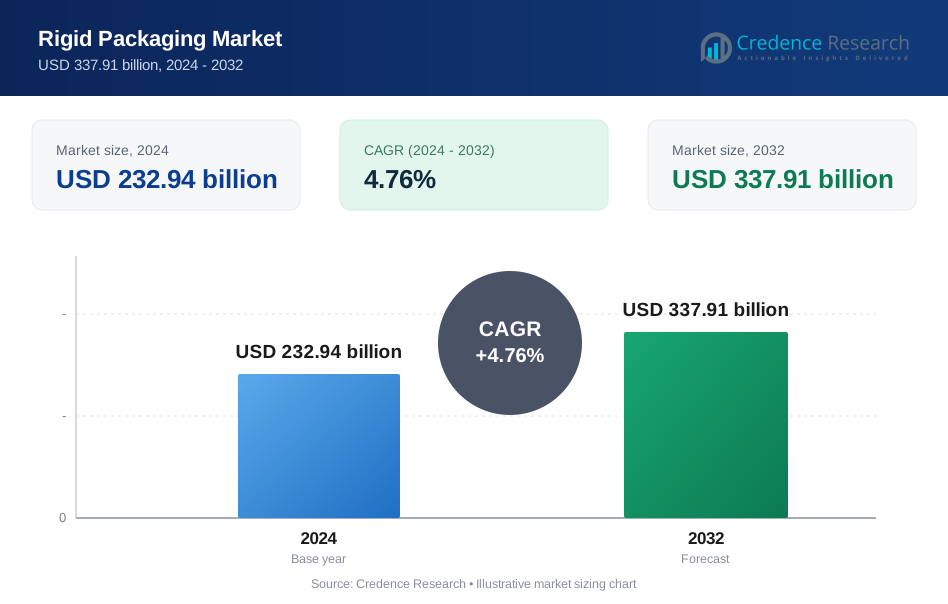
Rigid packaging market size was valued at USD 232.94 Billion in 2024 and is anticipated to reach USD 337.91 Billion by 2032, at a CAGR of 4.76% during the forecast period.
| REPORT ATTRIBUTE | DETAILS |
|---|---|
| Historical Period | 2020-2023 |
| Base Year | 2024 |
| Forecast Period | 2025-2032 |
| Rigid packaging market Size 2024 | USD 232.94 Billion |
| Rigid packaging market, CAGR | 4.76% |
| Rigid packaging market Size 2032 | USD 337.91 Billion |
The rigid packaging market is dominated by key players such as Bemis Manufacturing Company, CCL Industries Inc., 3M, AVERY DENNISON CORPORATION, Constantia Flexibles, Coveris, Flexcon Company, Inc., NORAH Plastics, R.R. Donnelley & Sons Company, and Lecta Adestor. These companies maintain strong market positions through extensive product portfolios, technological innovations, and global distribution networks. Asia-Pacific leads the market, accounting for approximately 35% of the global share, driven by rapid industrialization, expanding food and beverage sectors, and growing e-commerce activity. North America and Europe follow with 28% and 26% shares, respectively, supported by advanced packaging technologies and strict sustainability regulations.
Market Insights
- The rigid packaging market was valued at USD 232.94 billion in 2024 and is projected to reach USD 337.91 billion by 2032, growing at a CAGR of 4.76% during the forecast period.
- Market growth is driven by rising demand from the food, beverage, and pharmaceutical sectors, supported by the need for durable, tamper-evident, and sustainable packaging solutions across global industries.
- Key trends include the shift toward eco-friendly materials, such as bioplastics and recyclable polymers, along with innovations in smart and lightweight packaging for efficiency and reduced carbon footprint.
- The market is highly competitive, with major players like Bemis Manufacturing, CCL Industries, 3M, and AVERY DENNISON CORPORATION investing in sustainability, automation, and advanced packaging technologies to strengthen their global presence.
- Asia-Pacific leads with 35% of the market share, followed by North America (28%) and Europe (26%), while plastic remains the dominant material segment across all applications.
Market Segmentation Analysis:
By Material
Plastic dominates the rigid packaging market, holding the largest share due to its versatility, lightweight properties, and cost efficiency. It is extensively used across food, beverages, and personal care applications, offering superior protection and extended shelf life. Metal follows as a strong performer, driven by demand in beverage cans and industrial packaging, while bioplastics are gaining traction owing to sustainability initiatives and increasing regulatory support for eco-friendly materials. Glass and paper & paperboard maintain steady demand, particularly in premium packaging and recyclable solutions, supporting brand differentiation and consumer preference for environmentally responsible options.
- For instance, for some grades of BASF's ecovio® bioplastic, the bio-based carbon content is certified according to the ASTM D6866 standard, and the material is used in various food service applications, including rigid compostable containers.
By Product
Bottles & jars constitute the leading product sub-segment, capturing the highest market share as a result of widespread adoption in food, beverage, and pharmaceutical sectors. Trays, clamshells, tubs, cups, and pots also witness robust growth driven by convenience-oriented packaging and the expansion of ready-to-eat and frozen foods. Drums, barrels, pallets, and crates remain crucial in industrial and logistics applications, ensuring safe storage and transport. The market is further propelled by the trend toward custom-designed, tamper-evident, and sustainable packaging, which enhances consumer trust and brand value across diverse industries.
- For instance, Drums, barrels, pallets, and crates are crucial in industrial and logistics applications, ensuring safe storage and transport.
By Application
The food segment leads the rigid packaging market, accounting for the largest share due to rising demand for packaged and processed foods, stringent hygiene requirements, and growing e-commerce food delivery services. Beverages follow closely, with metal cans and plastic bottles gaining preference for durability and convenience. Pharmaceutical and healthcare applications benefit from tamper-evident and high-barrier packaging, while personal care and cosmetics rely on aesthetically appealing containers. Automotive and building & construction sectors utilize durable and heavy-duty packaging solutions, driven by industrial safety standards, bulk transport requirements, and increasing adoption of sustainable materials in these industries.
Key Growth Drivers
Rising Demand from the Food and Beverage Industry
The food and beverage sector remains a major growth driver for the rigid packaging market, supported by increasing consumption of packaged and convenience foods worldwide. Urbanization, changing dietary patterns, and the expansion of e-commerce-based grocery delivery services have heightened the demand for durable, tamper-proof, and visually appealing packaging. Rigid plastics, glass, and metal containers ensure product integrity, extended shelf life, and regulatory compliance, making them essential for packaging perishable and non-perishable items. Additionally, the increasing adoption of sustainable materials such as recyclable plastics and lightweight glass bottles further strengthens market growth, as brands aim to balance functionality with environmental responsibility.
- For instance, Tetra Pak delivered 179 billion packages globally, which included aseptic and rigid packaging solutions. It provides these solutions to various food and beverage brands, including Nestlé and Danone. Through its aseptic process, Tetra Pak ensures food safety and extends the shelf life of products without needing refrigeration.
Technological Advancements and Smart Packaging Innovations
Continuous innovation in material science and manufacturing technologies has transformed the rigid packaging landscape. Advanced molding techniques, digital printing, and barrier coating technologies enable producers to create lightweight, cost-efficient, and high-performance packaging. Smart packaging solutions incorporating QR codes, RFID tags, and freshness indicators are gaining traction, particularly in food and pharmaceuticals, for enhanced traceability and consumer engagement. Automation in production lines also reduces operational costs and improves precision, while the integration of recycled and bio-based materials aligns with circular economy goals. These technological advancements collectively boost product differentiation, supply chain efficiency, and sustainability in rigid packaging applications.
- For instance, Amcor plc has developed a range of lightweighting technologies for PET bottles. For its hot-fill, non-carbonated beverage applications, the PowerPost™ technology enables bottle weight reduction of up to 30% while maintaining structural integrity. For carbonated beverage applications, Amcor uses other innovations to create lighter, structurally sound PET containers.
Expanding Pharmaceutical and Healthcare Applications
The pharmaceutical and healthcare industries are increasingly driving rigid packaging demand due to stringent safety and hygiene requirements. Packaging formats such as blister packs, vials, bottles, and containers are essential for ensuring product stability, contamination prevention, and compliance with global regulatory standards. The growing prevalence of chronic diseases, aging populations, and increased healthcare spending have accelerated the need for secure and tamper-evident packaging. Moreover, innovations in child-resistant closures, sterile packaging materials, and recyclable medical-grade plastics further enhance product safety and sustainability. As pharmaceutical exports and biologics manufacturing expand globally, the rigid packaging market is poised to experience steady growth from this segment.
Key Trends & Opportunities
Shift Toward Sustainable and Recyclable Materials
Sustainability is reshaping the rigid packaging market, with growing emphasis on recyclable, biodegradable, and reusable materials. Manufacturers are increasingly replacing conventional plastics with bio-based polymers, paper-based composites, and lightweight metal alternatives to reduce environmental impact. Global initiatives promoting circular economy practices and extended producer responsibility (EPR) programs are compelling companies to redesign packaging for recyclability and minimal waste. Leading brands are also investing in closed-loop recycling systems and post-consumer resin (PCR) integration. This transition not only addresses regulatory pressures but also appeals to eco-conscious consumers, creating long-term growth opportunities for innovative, green packaging solutions.
- For instance, Amcor plc incorporates hundreds of thousands of metric tons of recycled material across its portfolio, including food-grade post-consumer recycled (PCR) PET in its rigid packaging. The company purchased more than 254,000 metric tons of recycled material in fiscal year 2024, maintaining food-grade safety standards for relevant products.
Growth of E-Commerce and Supply Chain Optimization
The rapid rise of e-commerce has amplified the demand for durable and protective rigid packaging to ensure product safety during transportation. Consumers expect packaging that maintains product integrity while offering convenience and aesthetic appeal. Companies are adopting packaging designs that balance strength, lightweight properties, and cost efficiency. Innovations such as impact-resistant plastics, tamper-evident closures, and stackable packaging formats optimize logistics and reduce damage rates. The trend toward smaller, personalized shipment sizes has also driven the need for versatile packaging that meets sustainability goals without compromising performance, opening new avenues for market expansion.
- For instance, Sealed Air's premium "Strong Grade" Bubble Wrap® cushioning offers up to 30% more protection than other air packaging products, thanks to its higher initial thickness and patented Barrier Seal technology
Key Challenges
Environmental Impact and Plastic Waste Management
One of the major challenges facing the rigid packaging industry is its environmental footprint, particularly the issue of plastic waste accumulation. Traditional petroleum-based plastics dominate the market due to their affordability and versatility but contribute significantly to global pollution. Inadequate recycling infrastructure and inconsistent waste management systems in developing regions exacerbate the problem. Regulatory bans on single-use plastics and rising consumer pressure for eco-friendly alternatives are pushing manufacturers to adopt recyclable or biodegradable solutions, which often entail higher costs. Overcoming these sustainability challenges requires coordinated industry efforts, investment in recycling technologies, and policy support to transition toward circular packaging systems.
Fluctuating Raw Material Costs and Supply Chain Disruptions
Volatile prices of raw materials such as resins, metals, and glass have become a persistent concern for packaging manufacturers. Supply chain disruptions caused by geopolitical tensions, transportation bottlenecks, and energy cost fluctuations further strain production economics. These factors increase operational uncertainty and reduce profit margins, particularly for small and medium-sized enterprises. Manufacturers are mitigating these risks by adopting localized sourcing strategies, diversifying suppliers, and investing in recycled content to stabilize input costs. However, maintaining consistent quality while managing cost pressures remains a key challenge that could influence competitiveness and market dynamics over the coming years.
Regional Analysis
North America
North America holds a substantial share of the rigid packaging market, accounting for over 28% of global revenue in 2024. The region’s growth is driven by strong demand from the food, beverages, and healthcare sectors, coupled with the widespread adoption of sustainable and recyclable materials. The United States leads the market, supported by advanced packaging technologies, automation, and robust regulatory standards for food safety and product labeling. Growing investment in eco-friendly packaging by key manufacturers, including Amcor plc and Berry Global, further accelerates the regional shift toward circular economy practices and sustainable packaging formats.
Europe
Europe represents approximately 26% of the global rigid packaging market share, fueled by stringent environmental regulations and high consumer awareness of sustainable products. Countries such as Germany, the UK, France, and Italy are leading adopters of recyclable and biodegradable packaging materials. The region’s focus on carbon reduction and extended producer responsibility (EPR) programs has encouraged innovation in bioplastics and paper-based rigid packaging. Growing demand from the personal care, cosmetics, and beverage sectors also contributes significantly to market expansion. Leading European packaging firms are increasingly investing in circular design and closed-loop recycling systems to achieve sustainability targets.
Asia-Pacific
Asia-Pacific dominates the global rigid packaging market, accounting for over 35% of total revenue in 2024, driven by rapid industrialization, urbanization, and rising disposable incomes. China, India, and Japan are key contributors, supported by expanding food and beverage industries and large-scale manufacturing bases. The region’s growing e-commerce sector further boosts demand for durable, protective packaging materials. Increasing awareness of sustainable alternatives, coupled with government initiatives promoting eco-friendly manufacturing, encourages adoption of recyclable plastics and paperboard. Local and multinational players continue to expand production capacity to meet the surging demand for efficient, cost-effective rigid packaging solutions.
Latin America
Latin America captures around 6% of the global rigid packaging market, supported by growing consumption of packaged food and beverages and expansion of the pharmaceutical sector. Brazil and Mexico lead the regional market, with increasing investment in automated packaging lines and recyclable material innovation. Economic recovery, urban population growth, and rising middle-class income levels contribute to demand for modern, shelf-ready packaging. However, challenges such as limited recycling infrastructure and regulatory inconsistencies persist. Nevertheless, sustainable packaging initiatives and foreign investments in packaging production facilities are expected to drive steady market growth in the region.
Middle East & Africa
The Middle East & Africa region accounts for nearly 5% of the global rigid packaging market share, characterized by increasing industrialization, urbanization, and growth in the food and beverage sector. The Gulf countries, particularly the UAE and Saudi Arabia, are investing in sustainable packaging projects aligned with national visions for waste reduction and resource efficiency. The healthcare and personal care industries also contribute to rising demand for high-quality, durable packaging formats. Despite challenges such as high raw material costs and limited recycling infrastructure, the region presents strong growth opportunities driven by rapid retail and manufacturing expansion.
Market Segmentations:
By Material
- Plastic
- Metal
- Paper & Paperboard
- Glass
- Bioplastic
By Product
- Bottles & Jars
- Trays & Clamshells
- Tubs, Cups, and Pots
- Pallets
- Drums & Barrels
- Crates
- Others
By Application
- Food
- Beverages
- Pharmaceutical & Healthcare
- Personal Care & Cosmetics
- Automotive
- Building & Construction
By Geography
- North America
- U.S.
- Canada
- Europe
- Germany
- France
- U.K.
- Italy
- Spain
- Rest of Europe
- Asia Pacific
- China
- Japan
- India
- South Korea
- South-east Asia
- Rest of Asia Pacific
- Latin America
- Brazil
- Mexico
- Rest of Latin America
- Middle East & Africa
- GCC Countries
- South Africa
- Rest of Middle East and Africa
Competitive Landscape
The rigid packaging market is highly competitive, characterized by the presence of global and regional players focusing on innovation, sustainability, and product differentiation. Leading companies such as Bemis Manufacturing Company, CCL Industries Inc., 3M, and AVERY DENNISON CORPORATION are investing in advanced materials, lightweight designs, and recyclable solutions to strengthen their market position. Strategic mergers, acquisitions, and partnerships remain key approaches to expand production capabilities and global reach. Firms like Constantia Flexibles, Coveris, and Flexcon Company, Inc. emphasize smart and sustainable packaging technologies aligned with evolving consumer preferences and regulatory standards. Additionally, emerging players such as NORAH Plastics and Lecta Adestor are entering the market with eco-friendly innovations and cost-effective manufacturing processes. Overall, the competitive landscape reflects a strong focus on sustainability, efficiency, and technological advancement to meet growing demand across food, beverages, pharmaceuticals, and personal care industries.
Key Player Analysis
- Bemis Manufacturing Company
- CCL Industries Inc.
- 3M
- NORAH Plastics
- Coveris
- Constantia Flexibles
- AVERY DENNISON CORPORATION
- R. Donnelley & Sons Company
- Flexcon Company, Inc.
- Lecta Adestor
Recent Developments
- In March 2024, 3M unveiled a groundbreaking innovation aimed at transforming shipping and packaging. This new product is designed to enhance sustainability and efficiency in logistics, addressing the growing demand for environmentally friendly solutions. By integrating advanced materials and technologies, 3M's innovation promises to reduce waste and improve the overall shipping process. This initiative reflects the company's commitment to sustainability while providing businesses with practical tools to meet modern packaging challenges effectively.
- In May 2022, Lecta announced the expansion of its Adestor line of self-adhesive materials with the introduction of new Adestor Standard Films. This product range includes both polypropylene and polyethylene films designed for various labeling applications across the food, industrial, and hygiene sectors. The new films offer high transparency and flexibility, catering to diverse packaging needs. In addition, Lecta enhances its service offerings with customizable roll products through the Exact Cut program, all manufactured in compliance with stringent environmental and quality standards.
Report Coverage
The research report offers an in-depth analysis based on Material, Product, Application and Geography. It details leading market players, providing an overview of their business, product offerings, investments, revenue streams, and key applications. Additionally, the report includes insights into the competitive environment, SWOT analysis, current market trends, as well as the primary drivers and constraints. Furthermore, it discusses various factors that have driven market expansion in recent years. The report also explores market dynamics, regulatory scenarios, and technological advancements that are shaping the industry. It assesses the impact of external factors and global economic changes on market growth. Lastly, it provides strategic recommendations for new entrants and established companies to navigate the complexities of the market.
Future Outlook
- The rigid packaging market will continue to grow steadily, supported by expanding demand in food, beverage, and healthcare industries.
- Manufacturers will increasingly adopt sustainable materials, including bioplastics and recycled polymers, to meet environmental goals.
- Technological innovation will enhance product durability, design flexibility, and production efficiency.
- Smart and connected packaging solutions will gain traction, improving traceability and consumer engagement.
- Automation and digitalization in packaging production will reduce costs and improve consistency.
- E-commerce expansion will drive demand for protective and tamper-resistant rigid packaging formats.
- Lightweight packaging designs will become a key focus to lower transportation and logistics costs.
- Regulatory emphasis on recyclability and circular economy practices will shape product development.
- Strategic mergers and partnerships among major players will strengthen global market presence.
- Emerging markets in Asia-Pacific and Latin America will present new opportunities for industry expansion.
Request a Free Sample
Fill in your details and we'll send you a free sample report.
- Sample data tables & charts
- Research methodology
Need a Custom Version of This Report?
Tailor the scope, geography, or segments to your exact requirements.
- Custom geography or segment scope
- Direct access to our analyst team
Frequently Asked Questions
What is the current market size for the Rigid Packaging Market, and what is its projected size in 2032?
At what Compound Annual Growth Rate is the Rigid Packaging Market projected to grow between 2025 and 2032?
Which region commanded the largest share of the Rigid Packaging Market in 2024?
What are the primary factors fueling the growth of the Rigid Packaging Market?
Who are the major players in the global Rigid Packaging Market?
Table of Content
Chapter 1. Report Introduction
- 1.1 Report Description & Purpose
- 1.1.1 Report Title & Market Definition
- 1.1.2 Unique Selling Propositions (USP) & Key Differentiators
- 1.1.3 Value Proposition for Stakeholders
- 1.2 Research Objectives
- 1.2.1 Market Sizing Objectives (Volume & Revenue)
- 1.2.2 Segmentation Objectives
- 1.2.3 Competitive Intelligence Objectives
- 1.2.4 Forecast & Scenario Objectives
- 1.3 Report Scope
- 1.3.1 Rigid Packaging Scope – Types & Subtypes Covered
- 1.3.2 Geographic Scope – Regions & Countries Covered
- 1.3.3 Historical Period, Base Year & Forecast Period (2024; forecast to 2032)
- 1.3.4 Inclusions & Exclusions
- 1.4 HS Code & Classification Framework
- 1.5 Currency, Units & Pricing Basis
- 1.6 Target Stakeholders
- 1.7 Limitations & Assumptions
Chapter 2. Executive Summary
- 2.1 Global Rigid Packaging Market Snapshot
- 2.1.1 Market Size – Historical (2024) & Forecast (2024-2032) (2024: USD 232.94 billion → 2032: USD 337.91 billion)
- 2.1.2 Volume & Revenue – Global Totals
- 2.1.3 Key Market Highlights – Top Five Facts
- 2.2 Rigid Packaging Market Segmentation Snapshot
- 2.2.1 Market Split by Region – 2024 vs. 2032
- 2.3 Competitive Snapshot
- 2.3.1 Top 10 Players by Revenue Share – 2024
- 2.3.2 Top 10 Players by Volume Share – 2024
- 2.3.3 Recent Strategic Developments (18-Month Summary)
- 2.4 Key Investment Highlights & Strategic Conclusions
Chapter 3. Rigid Packaging Market Dynamics & Industry Analysis
- 3.1 Market Overview & Context
- 3.1.1 Rigid Packaging Market Position in the Broader Automotive Value Chain
- 3.1.2 OEM vs. Replacement Market Dynamics
- 3.1.3 Market Maturity & Development Stage by Region
- 3.2 Rigid Packaging Market Drivers
- 3.3 Rigid Packaging Market Restraints & Challenges
- 3.4 Rigid Packaging Market Opportunities
- 3.5 Porter's Five Forces Analysis
- 3.5.1 Threat of New Entrants
- 3.5.2 Bargaining Power of Suppliers
- 3.5.3 Bargaining Power of Buyers
- 3.5.4 Threat of Substitutes
- 3.5.5 Competitive Rivalry – Intensity Assessment
- 3.6 Rigid Packaging Value Chain Analysis
- 3.6.1 Upstream – Raw Material/Input Suppliers
- 3.6.1.1 Raw Material/Input 1
- 3.6.1.2 Raw Material/Input 2
- 3.6.1.3 Raw Material/Input 3
- 3.6.2 Midstream – Production/Manufacturing/Service Delivery
- 3.6.2.1 Production/Process Overview
- 3.6.2.2 Key Facility Locations & Capacity by Manufacturer
- 3.6.3 Downstream – Distribution & End Consumer
- 3.6.3.1 Primary Channel – B2B/OEM
- 3.6.3.2 Secondary Channels – Dealer, Retail, Online, Direct
- 3.6.4 Value Chain Profitability Analysis
- 3.6.1 Upstream – Raw Material/Input Suppliers
- 3.7 PESTEL Analysis
- 3.7.1 Political Factors
- 3.7.2 Economic Factors
- 3.7.3 Social Factors
- 3.7.4 Technological Factors
- 3.7.5 Environmental Factors
- 3.7.6 Legal Factors
- 3.8 Rigid Packaging Supply Chain Analysis
- 3.8.1 Raw Material/Input Supply Risk Assessment
- 3.8.2 Manufacturing Concentration Risk (Geographic Exposure)
- 3.8.3 Trade Disruption Impact Analysis
- 3.9 Regulatory & Policy Landscape
Note: The regulatory and policy landscape section covers regulations based on their applicability to the market, Rigid Packaging category, geography, and scope of the study. Only regulatory frameworks with a material impact on operations, compliance, trade, sustainability, or market access are analyzed in detail.
Chapter 4. Key Investment Pockets & Opportunity Analysis
- 4.1 Rigid Packaging Market Attractiveness Analysis
- 4.1.1 By Region – Investment Attractiveness Matrix (Volume × CAGR)
- 4.2 Absolute Revenue Growth Opportunity
- 4.2.1 By Region – Absolute USD Growth Through 2032
- 4.3 Incremental Volume Opportunity
- 4.3.1 By Region – Incremental Volume Through 2032
- 4.3.2 Segment – Incremental Volume
- 4.4 Emerging Submarket Opportunity Deep Dive (Subject to Applicability)
- 4.5 Emerging Market Opportunity Scorecards
- 4.5.1 United States
- 4.5.2 Europe
- 4.5.3 Asia
- 4.5.4 Middle East & Africa
Note: Emerging Market Opportunity Scorecards will be included based on relevance and strategic importance. Regions listed are indicative and may vary depending on data availability and market dynamics.
Chapter 5. Rigid Packaging Import-Export Analysis & Trade Flows
- 5.1 Global Trade Overview
- 5.1.1 Global Export Value by Country (2024)
- 5.1.2 Global Export Volume by Country (2024)
- 5.1.3 Global Import Value by Country (2024)
- 5.1.4 Global Import Volume by Country (2024)
- 5.1.5 Net Trade Balance by Country (2024)
- 5.2 Export Analysis – Segment
- 5.2.1 Type 1 (HS Code)
- 5.2.2 Type 2 (HS Code)
- 5.2.3 Type 3 (HS Code)
- 5.2.4 Type 4 (HS Code)
- 5.2.5 Type 5 (HS Code)
- 5.3 Import Analysis – Segment
- 5.3.1 Type 1 (HS Code)
- 5.3.2 Type 2 (HS Code)
- 5.3.3 Type 3 (HS Code)
- 5.3.4 Type 4 (HS Code)
- 5.3.5 Type 5 (HS Code)
- 5.4 Average Unit Trade Prices
- 5.4.1 Average Export Price – Segment & Country
- 5.4.2 Average Import Price – Segment & Source Country
- 5.4.3 Price Trends (2024)
- 5.5 Key Trade Route Analysis
- 5.5.1 Trade Route 1
- 5.5.2 Trade Route 2
- 5.5.3 Trade Route 3
- 5.5.4 Trade Route 4
- 5.5.5 Trade Route 5
- 5.6 Trade Policy Impact Assessment
- 5.6.1 US Anti-Dumping & Section 301 Tariffs
- 5.6.2 EU Customs Union Impact
- 5.6.3 Major Free Trade Agreements
- 5.6.4 USMCA Rules of Origin
Note: Trade policy analysis will be included only where relevant to the Rigid Packaging market.
Chapter 6. Competitive Landscape & Company Benchmarking
- 6.1 Rigid Packaging Market Concentration & Structure
- 6.1.1 Herfindahl-Hirschman Index (HHI) – vs. 2024
- 6.1.2 Tier 1, Tier 2 & Tier 3 Market Structure
- 6.1.3 Global, Regional & Local Player Dynamics
- 6.2 Rigid Packaging Market Share Analysis – 2024
- 6.2.1 Global Revenue Share by Company
- 6.2.2 Global Volume Share by Company
- 6.2.3 Regional Revenue Share
- 6.2.4 Market Share Evolution ( vs. 2024)
- 6.2.5 OEM Segment Share by Company
- 6.2.6 Replacement Segment Share by Company
- 6.3 Production/Delivery Capacity & Facility Analysis
- 6.3.1 Global Installed Capacity
- 6.3.2 Capacity Utilization Rates
- 6.3.3 Production/Output Volume
- 6.3.4 Facility Locations & Capacity Map
- 6.3.5 Planned Capacity Additions
- 6.4 Rigid Packaging Competitive Benchmarking Matrix
- 6.4.1 Revenue, Volume, CAGR & Profitability Comparison
- 6.4.2 Channel Revenue Mix
- 6.4.3 Geographic Revenue Exposure
- 6.4.4 R&D Intensity
- 6.4.5 Sustainability Maturity
- 6.5 Strategic Developments in Rigid Packaging (Last 24 Months)
- 6.5.1 Mergers, Acquisitions & Divestments
- 6.5.2 New Rigid Packaging Launches
- 6.5.3 Facility Expansions
- 6.5.4 Strategic Alliances, Joint Ventures & Partnerships
- 6.5.5 Distribution Expansion & Market Entry
- 6.5.6 Sustainability & ESG Initiatives
- 6.6 Competitive Strategy Mapping
- 6.6.1 Leader, Challenger, Follower & Niche Classification
- 6.6.2 Pricing Strategy Comparison
- 6.6.3 Channel Strategy Matrix
Note: Strategic developments are included based on their materiality and the availability of reliable information.
Chapter 7. Global Rigid Packaging Market – By Distribution Channel
- 7.1 Segment Overview
- 7.1.1 Volume & Revenue Split by Channel (2024 & 2032)
- 7.1.2 Channel Mix Evolution (2024-2032)
Chapter 8. Regional Market Analysis – Global Overview
- 8.1 Global Regional Overview
- 8.1.1 Regional Volume Share
- 8.1.2 Regional Revenue Share
- 8.1.3 Regional Volume by Region
- 8.1.4 Regional Revenue by Region
- 8.1.5 Regional Forecast Through 2032
- 8.2 Cross-Regional Segment Analysis
- 8.2.1 By Distribution Channel
- 8.2.2 By Brand/Price Tier
Chapter 9. North America Rigid Packaging Market
- 9.1 United States
- 9.2 Canada
- 9.3 Mexico
Chapter 10. Europe Rigid Packaging Market
- 10.1 Germany
- 10.2 France
- 10.3 Italy
- 10.4 United Kingdom
- 10.5 Spain
- 10.6 Poland
- 10.7 Russia
- 10.8 Netherlands
- 10.9 Belgium
- 10.10 Sweden
- 10.11 Denmark
- 10.12 Norway
- 10.13 Rest of Europe
Chapter 11. Asia Pacific Rigid Packaging Market
- 11.1 China
- 11.2 India
- 11.3 Japan
- 11.4 South Korea
- 11.5 Thailand
- 11.6 Indonesia
- 11.7 Vietnam
- 11.8 Malaysia
- 11.9 Australia
- 11.10 Rest of Asia Pacific
Chapter 12. Latin America Rigid Packaging Market
- 12.1 Brazil
- 12.2 Argentina
- 12.3 Colombia
- 12.4 Chile
- 12.5 Rest of Latin America
Chapter 13. Middle East Rigid Packaging Market
- 13.1 Saudi Arabia
- 13.2 United Arab Emirates
- 13.3 Turkey
- 13.4 Israel
- 13.5 Iran
- 13.6 Rest of the Middle East
Chapter 14. Africa Rigid Packaging Market
- 14.1 South Africa
- 14.2 Egypt
- 14.3 Nigeria
- 14.4 Morocco
- 14.5 Rest of Africa
Chapter 15. Rigid Packaging Company Profiles
- 15.1 [Company 01]
- 15.1.1 Company Overview
- 15.1.2 Key Management Personnel
- 15.1.3 Products & Services Portfolio
- 15.1.4 Financial Performance
- 15.1.5 Key Market Focus & Geographic Presence
- 15.1.6 Recent Developments & Strategic Initiatives
Note: The company profile list is preliminary and may change based on research findings, market developments, data availability, and client requirements.
Chapter 16. Appendices
- Appendix A – List of Abbreviations & Acronyms
- Appendix B – Industry Classification Code Reference – Full Series
- Appendix C – Production & Capacity Data Tables
- Appendix D – End-Use & Demand Base Tables
- Appendix E – Consumption & Replacement Rate Assumptions
- Appendix F – ASP Reference Tables
- Appendix G – Manufacturing & Facility Database
- Appendix H – Import-Export Data Tables
- Appendix I – Regulatory Summary Tables
- Appendix J – Primary Research Participant List (Anonymized)
- Appendix K – Primary Research Questionnaire Framework
- Appendix L – Data Sources & Bibliography
- Appendix M – Market Size Divergence & Source Comparison
Chapter 17. Research Methodology
- 17.1 Research Framework & Philosophy
- 17.2 Secondary Research – Sources, Hierarchy & Data Extraction
- 17.3 Data Modeling – Bottom-Up & Top-Down Market Sizing
- 17.4 Primary Research – Stakeholder Framework, LOI & Sample Sizes
- 17.5 Forecast Methodology – Regression, Scenario & Sensitivity Analysis
- 17.6 Quality Control – Four-Layer Validation Framework
- 17.7 Limitations & Standard Assumptions
- 17.8 Disclaimer
