
Market Overview:
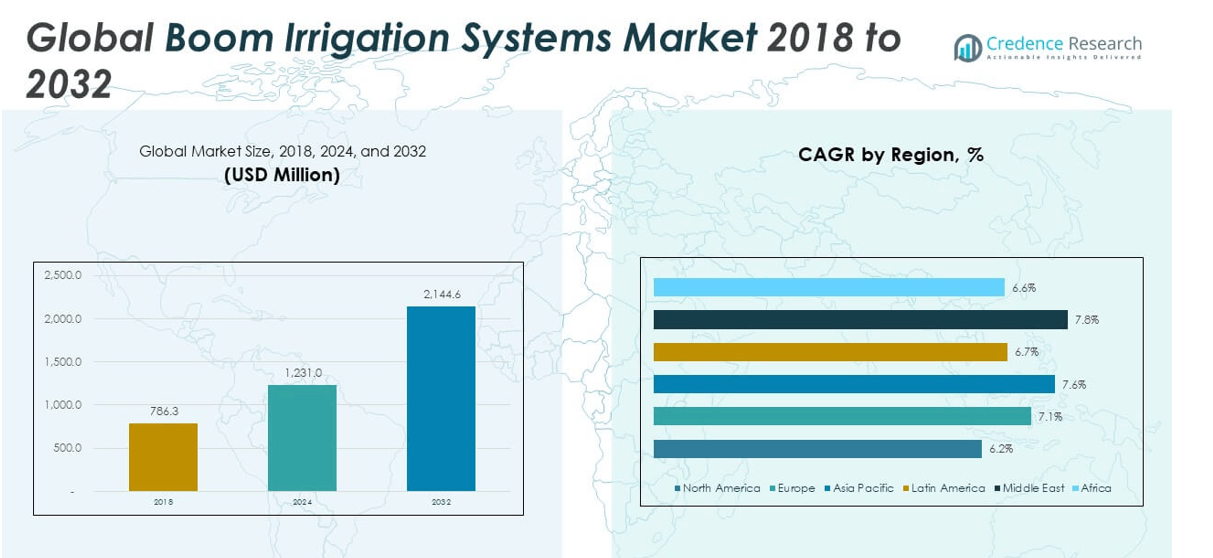
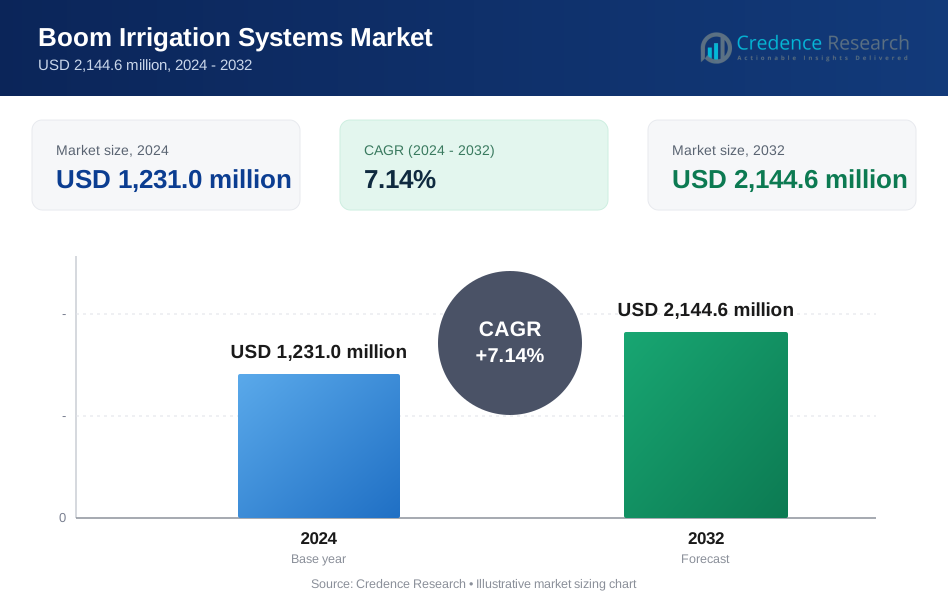
The Boom Irrigation Systems Market size was valued at USD 786.3 million in 2018 to USD 1,231.0 million in 2024 and is anticipated to reach USD 2,144.6 million by 2032, at a CAGR of 7.14% during the forecast period.
| REPORT ATTRIBUTE | DETAILS |
|---|---|
| Historical Period | 2020-2023 |
| Base Year | 2024 |
| Forecast Period | 2025-2032 |
| Boom Irrigation Systems Market Size 2024 | USD 1,231.0 million |
| Boom Irrigation Systems Market, CAGR | 7.14% |
| Boom Irrigation Systems Market Size 2032 | USD 2,144.6 million |
Growth in the Boom Irrigation Systems Market is driven by rising demand for water efficiency and sustainable farming practices. Farmers adopt these systems to reduce water waste, increase crop productivity, and cut labor costs. Government subsidies and financial support encourage adoption across developing economies, while modern farming techniques further strengthen demand. Expanding use in high-value crops such as fruits, vegetables, and flowers also contributes to rapid market growth.
Regionally, Asia Pacific leads the market due to large agricultural land, government initiatives, and growing adoption of mechanized farming. North America shows strong growth supported by advanced infrastructure and large-scale farming operations. Europe maintains steady demand driven by sustainability policies and high-value crop production. Emerging regions such as Latin America and Africa show promising growth potential due to increasing modernization efforts and focus on improving food security.
Market Insights:
- The Boom Irrigation Systems Market size was valued at USD 786.3 million in 2018, USD 1,231.0 million in 2024, and is projected to reach USD 2,144.6 million by 2032, at a CAGR of 7.14%.
- Asia Pacific held the largest share at 35.95%, followed by Europe at 18.77% and North America at 16.08%, supported by mechanized farming, sustainability policies, and large-scale commercial agriculture.
- The Middle East is the fastest-growing region with a 9.71% share, driven by water scarcity challenges and government-backed irrigation initiatives.
- Self-propelled boom irrigators accounted for the dominant share in 2024, reflecting their efficiency in large-scale farming operations.
- Automatic technology held the leading position in 2024, supported by rising adoption of precision farming and reduced labor dependency.
Market Drivers
Rising Demand for Water Efficiency in Modern Agriculture
The increasing need for water efficiency is a core driver of the Boom Irrigation Systems Market. Farmers face growing pressure to conserve water resources while maintaining productivity. Boom irrigation systems allow precise application of water across large farming areas. It reduces wastage and supports efficient management of scarce water supplies. Adoption of these systems is growing in water-stressed regions with limited resources. Agricultural policies promoting water-saving practices strengthen demand. Modern farms seek to reduce overhead costs through efficient irrigation methods. Growing climate challenges make efficient systems a necessity rather than an option.
Adoption of High-Value Crop Cultivation for Better Returns
Expansion of high-value crop farming directly increases adoption of boom irrigation systems. Crops such as fruits, vegetables, and flowers demand accurate irrigation practices. Farmers require consistent water delivery without oversaturation. The Boom Irrigation Systems Market benefits from rising demand in horticulture. It supports better crop quality, which ensures premium pricing in global markets. Farmers gain competitive advantage by meeting export standards. Controlled irrigation reduces disease risks and improves harvest yields. Government incentives targeting high-value agriculture further promote mechanized irrigation.
- For example, the FAO highlights precision irrigation as a key tool for improving water efficiency and crop productivity. Case studies in Mediterranean regions, including Spain and Israel, show that modern mechanized irrigation systems enhance yields and optimize resource use in high-value horticulture.
Supportive Government Policies and Financial Subsidies in Agriculture
Government programs significantly encourage farmers to adopt boom irrigation technologies. Subsidies and low-interest loans are designed to reduce the cost burden. The Boom Irrigation Systems Market experiences steady growth through policy support. It is further reinforced by initiatives to promote sustainable farming. Programs emphasize improved resource management and modern irrigation methods. Farmers in developing countries access financial assistance to upgrade traditional practices. International organizations also promote awareness through training sessions. These measures accelerate adoption across large and medium-sized farms.
- For example, India’s Pradhan Mantri Krishi Sinchayee Yojana (PMKSY) provides financial assistance for micro-irrigation, with subsidy support up to 55% for small and marginal farmers and 45% for other farmers, covering drip and sprinkler systems as per official guidelines. This scheme continues to drive adoption of modern irrigation practices across the country.
Technological Advancements and Integration of Smart Farming Solutions
Advances in automation and precision farming increase adoption of boom irrigation systems. Integration with sensors allows real-time water monitoring. The Boom Irrigation Systems Market grows with rising interest in digital agriculture. It benefits from systems that improve accuracy and reduce manual effort. Farmers utilize data-driven tools to optimize water delivery. Smart irrigation reduces overall operational costs while ensuring crop safety. Manufacturers are focusing on automation to meet modern agricultural needs. Growing digital adoption enhances efficiency and secures consistent demand globally.
Market Trends
Increasing Integration of IoT and Digital Monitoring Technologies
The integration of IoT devices and digital platforms reshapes irrigation practices. The Boom Irrigation Systems Market benefits from advanced data tracking tools. Farmers use real-time monitoring to identify water needs accurately. It ensures timely adjustment of irrigation levels across farms. IoT integration improves productivity by providing precise water distribution. Remote access options enhance flexibility for large-scale operators. Data collection also supports predictive analysis of irrigation schedules. Growing reliance on connected solutions establishes digital transformation as a long-term trend.
- For instance, CropX deploys IoT-enabled soil sensor systems that optimize irrigation through real-time data analytics, enabling farmers to save significant amounts of water while improving crop yields. Independent case studies have highlighted measurable efficiency gains from its global farm deployments.
Expansion of Mechanized Irrigation in Emerging Agricultural Economies
Emerging economies are rapidly shifting toward mechanized farming systems. The Boom Irrigation Systems Market gains momentum in regions modernizing agriculture. It provides farmers with reliable and scalable irrigation solutions. Urbanization and population growth create greater demand for food supply. Farmers seek equipment that maximizes efficiency on limited land. Mechanized systems reduce manual dependency and improve crop reliability. Expanding rural infrastructure supports wider adoption in developing nations. Growing investments in modern farming drive this regional trend further.
- For instance, the Mechanized Irrigation Innovation Project (MIIP) in Nepal, backed by the Asian Development Bank, installed a network of around 500 deep tubewells and almost 900 kilometers of buried pipe to deliver year-round irrigation to 22,400 hectares, using prepaid smart cards for pump operations and directly benefiting more than 121,000 local farmers as of 2024.
Sustainability-Oriented Practices Driving Innovation in Irrigation Design
Sustainability remains a defining trend in irrigation development worldwide. The Boom Irrigation Systems Market aligns with eco-friendly farming practices. It offers solutions that minimize water waste and improve soil health. Farmers adopt these systems to meet sustainability certification requirements. Design improvements focus on reducing environmental impact while maintaining efficiency. Eco-driven policies encourage the use of resource-conserving equipment. Innovation in design addresses both ecological and economic priorities. Sustainability-centered adoption shapes long-term industry direction.
Growing Demand from Commercial Farming and Agribusiness Expansion
Commercial farming operations adopt boom irrigation systems at an accelerating rate. The Boom Irrigation Systems Market benefits from large-scale farming expansion. Agribusinesses invest heavily in reliable irrigation technologies to secure yields. It allows consistent production in high-volume environments. Large corporations require standardized and efficient systems for exports. Growing commercial demand stimulates manufacturers to expand supply. Scaling up operations becomes essential to meet industrialized farming needs. The trend emphasizes greater efficiency in commercial crop management.
Market Challenges Analysis
High Capital Costs and Limited Affordability for Small Farmers
High upfront investment poses a critical challenge in the Boom Irrigation Systems Market. Many small and medium farmers cannot afford advanced systems. It restricts adoption to larger farms or well-funded agribusinesses. High costs of installation, operation, and maintenance slow market penetration. Farmers without financial support remain dependent on conventional irrigation. Uneven access to subsidies across regions limits affordability. Market growth depends on bridging cost gaps for wider access. Without solutions, adoption remains concentrated in wealthy agricultural economies.
Technical Expertise and Infrastructure Barriers in Developing Regions
Limited availability of skilled operators restricts effective use of boom irrigation systems. The Boom Irrigation Systems Market faces gaps in technical training and awareness. Farmers often lack expertise in automation and digital farming methods. Poor rural infrastructure makes system deployment difficult in remote areas. Lack of reliable electricity or connectivity hinders full adoption. It creates barriers for scaling advanced irrigation technology in emerging economies. Without adequate training programs, utilization remains inconsistent. Infrastructure gaps weaken long-term adoption potential.
Market Opportunities
Expanding Demand for Precision Irrigation in High-Yield Farming
Precision irrigation is becoming an opportunity for the Boom Irrigation Systems Market. Farmers prioritize controlled irrigation to boost yield and quality. It ensures efficient use of resources while maximizing profits. Advanced boom systems meet the needs of horticulture and high-value crops. Growing consumer preference for quality food creates higher demand. Export-focused farming requires consistent irrigation standards. Manufacturers gain advantage by offering specialized precision solutions. Rising expectations from premium crop markets fuel future opportunities.
Growing Scope in Emerging Economies through Mechanized Farming Adoption
Emerging agricultural economies present strong opportunities for growth. The Boom Irrigation Systems Market benefits from increasing mechanization demand. It provides scalable irrigation for expanding farmlands. Governments invest in rural modernization to improve productivity. Rising population growth drives demand for reliable food supply chains. International funding supports technology adoption in these regions. Local farmers gain access to affordable systems with government backing. Market expansion is supported by steady agricultural transformation globally.
Market Segmentation Analysis:
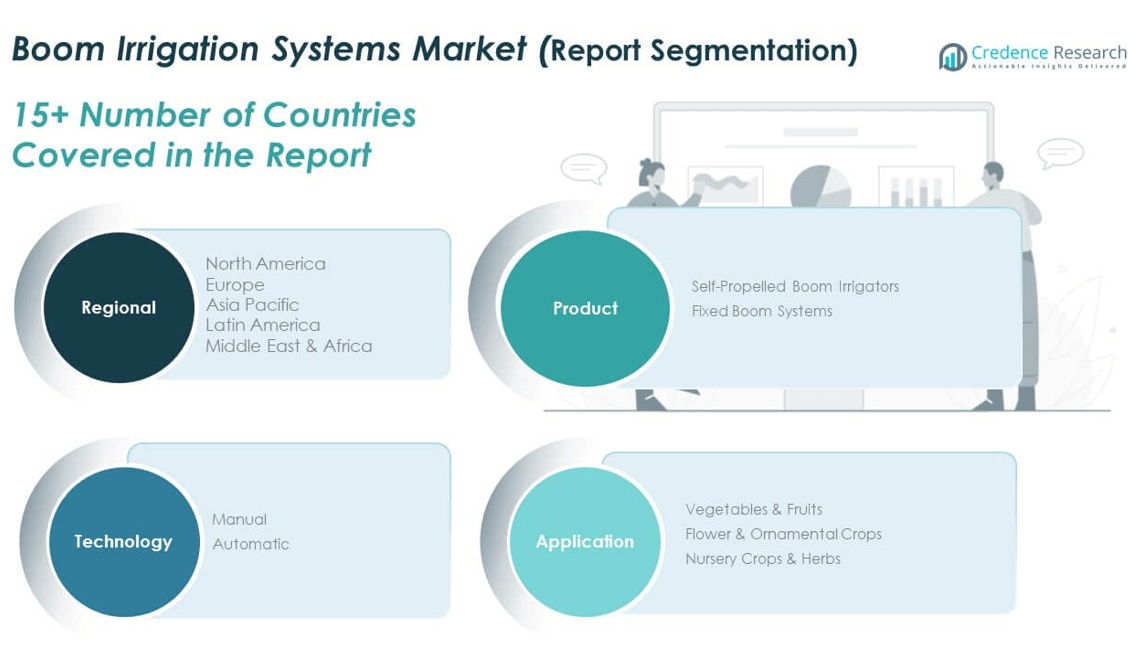
By product, the Boom Irrigation Systems Market is divided into self-propelled boom irrigators and fixed boom systems. Self-propelled boom irrigators held the dominant share due to their mobility and suitability for large-scale farms. It enables efficient coverage across extensive fields and reduces manual effort. Fixed boom systems serve smaller plots and controlled environments where precision and uniformity are prioritized.
- For instance, Labh Group’s self-propelled boom sprayer is engineered for 24-hour continuous operation and has reached over 10,000 customers across more than 100 countries as of October 2023, reflecting its global adoption in modern agriculture.
By technology, the market is segmented into manual and automatic systems. Automatic systems captured the leading share due to increasing demand for precision farming and reduced labor dependency. It supports real-time adjustments, ensuring water efficiency and higher productivity. Manual systems remain relevant in smaller farms where cost sensitivity drives adoption.
- For instance, Novagric provides automated greenhouse boom irrigation systems that are motor-driven and programmable for germination-phase crops, with documented commercial use across multiple regions by June 2024.
By application, the market includes vegetables and fruits, flower and ornamental crops, and nursery crops and herbs. Vegetables and fruits accounted for the largest share given their high water sensitivity and economic value. It ensures consistent crop quality and supports export-focused agriculture. Flower and ornamental crops, along with nursery and herb cultivation, also show steady adoption supported by demand for specialized irrigation in horticulture.
Segmentation:
By Product
- Self-Propelled Boom Irrigators
- Fixed Boom Systems
By Technology
- Manual
- Automatic
By Application
- Vegetables & Fruits
- Flower & Ornamental Crops
- Nursery Crops & Herbs
By Region
- North America
- U.S.
- Canada
- Mexico
- Europe
- Germany
- France
- U.K.
- Italy
- Spain
- Rest of Europe
- Asia Pacific
- China
- Japan
- India
- South Korea
- South-east Asia
- Rest of Asia Pacific
- Latin America
- Brazil
- Argentina
- Rest of Latin America
- Middle East & Africa
- GCC Countries
- South Africa
- Rest of the Middle East and Africa
Regional Analysis:
North America
The North America Boom Irrigation Systems Market size was valued at USD 132.81 million in 2018 to USD 197.95 million in 2024 and is anticipated to reach USD 321.69 million by 2032, at a CAGR of 6.2% during the forecast period. North America accounts for 16.08% share of the global market. The region benefits from large-scale mechanized farming and advanced infrastructure. Farmers in the U.S. and Canada adopt automated systems to ensure productivity in high-value crops. It supports water efficiency and precision farming practices. Strong government support for sustainable irrigation further boosts demand. Growing adoption of smart farming technology also enhances market penetration. The market shows steady expansion with significant investment from agribusiness enterprises.
Europe
The Europe Boom Irrigation Systems Market size was valued at USD 147.59 million in 2018 to USD 231.12 million in 2024 and is anticipated to reach USD 402.76 million by 2032, at a CAGR of 7.1% during the forecast period. Europe holds 18.77% share of the global market. The region focuses strongly on sustainability and high-value crop production. Farmers in countries such as Germany, France, and Spain adopt modern irrigation to meet environmental regulations. It provides precise water application required for fruits, vegetables, and ornamental crops. Increasing demand for export-quality produce supports wider adoption. Advanced mechanization and innovation from European manufacturers enhance growth. Rising awareness of water conservation strengthens future adoption prospects.
Asia Pacific
The Asia Pacific Boom Irrigation Systems Market size was valued at USD 273.88 million in 2018 to USD 440.22 million in 2024 and is anticipated to reach USD 793.51 million by 2032, at a CAGR of 7.6% during the forecast period. Asia Pacific leads with 35.95% share of the global market. The region benefits from vast agricultural land and strong government initiatives for mechanization. Countries such as China, India, and Australia adopt boom irrigation for large-scale farming. It supports higher productivity in cereals, fruits, and vegetables. Growing population and food demand drive modernization of irrigation practices. Expanding infrastructure and investments in agri-tech improve adoption rates. Manufacturers target Asia Pacific due to its strong growth potential and scale.
Latin America
The Latin America Boom Irrigation Systems Market size was valued at USD 109.22 million in 2018 to USD 166.88 million in 2024 and is anticipated to reach USD 281.16 million by 2032, at a CAGR of 6.7% during the forecast period. Latin America contributes 12.73% share of the global market. The region’s growth is fueled by large-scale cultivation of commercial crops such as soybeans, coffee, and sugarcane. Farmers adopt mechanized irrigation to improve yields and reduce labor costs. It plays a vital role in supporting export-oriented agriculture. Brazil and Argentina are key markets, driven by advanced agribusiness models. Growing water management needs create demand for efficient systems. Infrastructure investments further support expansion across diverse farming areas.
Middle East
The Middle East Boom Irrigation Systems Market size was valued at USD 71.63 million in 2018 to USD 116.84 million in 2024 and is anticipated to reach USD 214.46 million by 2032, at a CAGR of 7.8% during the forecast period. The Middle East holds 9.71% share of the global market. Water scarcity and arid climate make advanced irrigation systems a necessity in the region. Countries such as Saudi Arabia, UAE, and Israel lead adoption due to strong government support. It provides efficient water usage required for sustainable farming in desert conditions. Agribusiness investments expand irrigation infrastructure in greenhouse and open-field farming. Advanced technologies such as automated systems are in high demand. Rising food security concerns further drive adoption across the region.
Africa
The Africa Boom Irrigation Systems Market size was valued at USD 51.19 million in 2018 to USD 78.03 million in 2024 and is anticipated to reach USD 131.04 million by 2032, at a CAGR of 6.6% during the forecast period. Africa represents 6.76% share of the global market. The region experiences gradual adoption of mechanized irrigation due to rising food demand. Farmers in South Africa and Egypt show stronger adoption trends compared to other nations. It helps improve yields in both staple and high-value crops. Government programs and international funding support irrigation modernization. Limited infrastructure and affordability remain barriers for small farmers. Growing private sector involvement supports long-term expansion. Africa shows significant potential with increasing focus on sustainable agriculture.
Key Player Analysis:
- Jain Irrigation Systems Ltd.
- Netafim Ltd.
- Rivulis Irrigation
- Nexus Corporation
- Valmont Industries, Inc.
- HOVE International, Inc.
- Irrigation Accessories Company
- Briggs Irrigation
- Cadman Power Equipment Ltd.
- Zwart Systems
- Other Key Players
Competitive Analysis:
The Boom Irrigation Systems Market features strong competition driven by global and regional players. Leading companies such as Jain Irrigation Systems, Netafim, Rivulis Irrigation, and Valmont Industries focus on product innovation, automation, and sustainability to strengthen their positions. It emphasizes advanced solutions that reduce water usage while improving crop productivity. Smaller players like Briggs Irrigation and Cadman Power Equipment serve niche markets with tailored solutions. Competitive strategies include mergers, acquisitions, and regional expansions to capture untapped demand. Companies invest in precision irrigation and digital monitoring technologies to meet rising farmer expectations. Partnerships with governments and agribusinesses support penetration in emerging economies. The market remains dynamic, with a balance of established leaders and new entrants shaping competitive intensity.
Recent Developments:
- In July 2025, Topcon Agriculture launched the UC7 Plus boom height control system, which introduces improved sensors for better terrain response and durability. This system works with both self-propelled and pull-type sprayers, helping boost spraying performance and reduce maintenance costs.
- In August 2025, Lumo unveiled its Pump Automation integration with its smart valve platform. This new product automates irrigation from pump to plant using block-level data, improving safety, reliability, and operational precision across various ranch setups.
Report Coverage:
The research report offers an in-depth analysis based on Product, Technology and Application. It details leading market players, providing an overview of their business, product offerings, investments, revenue streams, and key applications. Additionally, the report includes insights into the competitive environment, SWOT analysis, current market trends, as well as the primary drivers and constraints. Furthermore, it discusses various factors that have driven market expansion in recent years. The report also explores market dynamics, regulatory scenarios, and technological advancements that are shaping the industry. It assesses the impact of external factors and global economic changes on market growth. Lastly, it provides strategic recommendations for new entrants and established companies to navigate the complexities of the market.
Future Outlook:
- The Boom Irrigation Systems Market will witness strong adoption as farms shift toward water-efficient practices.
- Precision agriculture will drive demand for advanced systems that deliver accurate and uniform water application.
- Automation and digital control integration will become standard features across future product offerings.
- Expansion of commercial farming will create steady opportunities for large-scale deployment of boom systems.
- Supportive government policies and subsidies will increase affordability for medium and small-scale farmers.
- Investments in research and innovation will enhance system durability and operational efficiency.
- Emerging economies will drive significant growth through rapid agricultural modernization and infrastructure development.
- Sustainability goals will push manufacturers to design environmentally responsible irrigation solutions.
- Competition among global players will intensify, leading to regional expansions and strategic collaborations.
- Rising food security concerns will sustain market growth and encourage long-term investment in modern irrigation.
Request a Free Sample
Fill in your details and we'll send you a free sample report.
- Sample data tables & charts
- Research methodology
Need a Custom Version of This Report?
Tailor the scope, geography, or segments to your exact requirements.
- Custom geography or segment scope
- Direct access to our analyst team
Frequently Asked Questions
What is the current market size for Boom Irrigation Systems Market, and what is its projected size in 2032?
At what Compound Annual Growth Rate is the Boom Irrigation Systems Market projected to grow between 2024 and 2032?
Which Boom Irrigation Systems Market segment held the largest share in 2024?
What are the primary factors fueling the growth of the Boom Irrigation Systems Market?
Who are the leading companies in the Boom Irrigation Systems Market?
Table of Content
Chapter 1. Report Introduction
- 1.1 Report Description & Purpose
- 1.1.1 Report Title & Market Definition
- 1.1.2 Unique Selling Propositions (USP) & Key Differentiators
- 1.1.3 Value Proposition for Stakeholders
- 1.2 Research Objectives
- 1.2.1 Market Sizing Objectives (Volume & Revenue)
- 1.2.2 Segmentation Objectives
- 1.2.3 Competitive Intelligence Objectives
- 1.2.4 Forecast & Scenario Objectives
- 1.3 Report Scope
- 1.3.1 Boom Irrigation Systems Scope – Types & Subtypes Covered
- 1.3.2 Geographic Scope – Regions & Countries Covered
- 1.3.3 Historical Period, Base Year & Forecast Period (2024; forecast to 2032)
- 1.3.4 Inclusions & Exclusions
- 1.4 HS Code & Classification Framework
- 1.5 Currency, Units & Pricing Basis
- 1.6 Target Stakeholders
- 1.7 Limitations & Assumptions
Chapter 2. Executive Summary
- 2.1 Global Boom Irrigation Systems Market Snapshot
- 2.1.1 Market Size – Historical (2024) & Forecast (2024-2032) (2024: USD 1,231.0 million → 2032: USD 2,144.6 million)
- 2.1.2 Volume & Revenue – Global Totals
- 2.1.3 Key Market Highlights – Top Five Facts
- 2.2 Boom Irrigation Systems Market Segmentation Snapshot
- 2.2.1 Market Split by Region – 2024 vs. 2032
- 2.3 Competitive Snapshot
- 2.3.1 Top 10 Players by Revenue Share – 2024
- 2.3.2 Top 10 Players by Volume Share – 2024
- 2.3.3 Recent Strategic Developments (18-Month Summary)
- 2.4 Key Investment Highlights & Strategic Conclusions
Chapter 3. Boom Irrigation Systems Market Dynamics & Industry Analysis
- 3.1 Market Overview & Context
- 3.1.1 Boom Irrigation Systems Market Position in the Broader Automotive Value Chain
- 3.1.2 OEM vs. Replacement Market Dynamics
- 3.1.3 Market Maturity & Development Stage by Region
- 3.2 Boom Irrigation Systems Market Drivers
- 3.3 Boom Irrigation Systems Market Restraints & Challenges
- 3.4 Boom Irrigation Systems Market Opportunities
- 3.5 Porter's Five Forces Analysis
- 3.5.1 Threat of New Entrants
- 3.5.2 Bargaining Power of Suppliers
- 3.5.3 Bargaining Power of Buyers
- 3.5.4 Threat of Substitutes
- 3.5.5 Competitive Rivalry – Intensity Assessment
- 3.6 Boom Irrigation Systems Value Chain Analysis
- 3.6.1 Upstream – Raw Material/Input Suppliers
- 3.6.1.1 Raw Material/Input 1
- 3.6.1.2 Raw Material/Input 2
- 3.6.1.3 Raw Material/Input 3
- 3.6.2 Midstream – Production/Manufacturing/Service Delivery
- 3.6.2.1 Production/Process Overview
- 3.6.2.2 Key Facility Locations & Capacity by Manufacturer
- 3.6.3 Downstream – Distribution & End Consumer
- 3.6.3.1 Primary Channel – B2B/OEM
- 3.6.3.2 Secondary Channels – Dealer, Retail, Online, Direct
- 3.6.4 Value Chain Profitability Analysis
- 3.6.1 Upstream – Raw Material/Input Suppliers
- 3.7 PESTEL Analysis
- 3.7.1 Political Factors
- 3.7.2 Economic Factors
- 3.7.3 Social Factors
- 3.7.4 Technological Factors
- 3.7.5 Environmental Factors
- 3.7.6 Legal Factors
- 3.8 Boom Irrigation Systems Supply Chain Analysis
- 3.8.1 Raw Material/Input Supply Risk Assessment
- 3.8.2 Manufacturing Concentration Risk (Geographic Exposure)
- 3.8.3 Trade Disruption Impact Analysis
- 3.9 Regulatory & Policy Landscape
Note: The regulatory and policy landscape section covers regulations based on their applicability to the market, Boom Irrigation Systems category, geography, and scope of the study. Only regulatory frameworks with a material impact on operations, compliance, trade, sustainability, or market access are analyzed in detail.
Chapter 4. Key Investment Pockets & Opportunity Analysis
- 4.1 Boom Irrigation Systems Market Attractiveness Analysis
- 4.1.1 By Region – Investment Attractiveness Matrix (Volume × CAGR)
- 4.2 Absolute Revenue Growth Opportunity
- 4.2.1 By Region – Absolute USD Growth Through 2032
- 4.3 Incremental Volume Opportunity
- 4.3.1 By Region – Incremental Volume Through 2032
- 4.3.2 Segment – Incremental Volume
- 4.4 Emerging Submarket Opportunity Deep Dive (Subject to Applicability)
- 4.5 Emerging Market Opportunity Scorecards
- 4.5.1 United States
- 4.5.2 Europe
- 4.5.3 Asia
- 4.5.4 Middle East & Africa
Note: Emerging Market Opportunity Scorecards will be included based on relevance and strategic importance. Regions listed are indicative and may vary depending on data availability and market dynamics.
Chapter 5. Boom Irrigation Systems Import-Export Analysis & Trade Flows
- 5.1 Global Trade Overview
- 5.1.1 Global Export Value by Country (2024)
- 5.1.2 Global Export Volume by Country (2024)
- 5.1.3 Global Import Value by Country (2024)
- 5.1.4 Global Import Volume by Country (2024)
- 5.1.5 Net Trade Balance by Country (2024)
- 5.2 Export Analysis – Segment
- 5.2.1 Type 1 (HS Code)
- 5.2.2 Type 2 (HS Code)
- 5.2.3 Type 3 (HS Code)
- 5.2.4 Type 4 (HS Code)
- 5.2.5 Type 5 (HS Code)
- 5.3 Import Analysis – Segment
- 5.3.1 Type 1 (HS Code)
- 5.3.2 Type 2 (HS Code)
- 5.3.3 Type 3 (HS Code)
- 5.3.4 Type 4 (HS Code)
- 5.3.5 Type 5 (HS Code)
- 5.4 Average Unit Trade Prices
- 5.4.1 Average Export Price – Segment & Country
- 5.4.2 Average Import Price – Segment & Source Country
- 5.4.3 Price Trends (2024)
- 5.5 Key Trade Route Analysis
- 5.5.1 Trade Route 1
- 5.5.2 Trade Route 2
- 5.5.3 Trade Route 3
- 5.5.4 Trade Route 4
- 5.5.5 Trade Route 5
- 5.6 Trade Policy Impact Assessment
- 5.6.1 US Anti-Dumping & Section 301 Tariffs
- 5.6.2 EU Customs Union Impact
- 5.6.3 Major Free Trade Agreements
- 5.6.4 USMCA Rules of Origin
Note: Trade policy analysis will be included only where relevant to the Boom Irrigation Systems market.
Chapter 6. Competitive Landscape & Company Benchmarking
- 6.1 Boom Irrigation Systems Market Concentration & Structure
- 6.1.1 Herfindahl-Hirschman Index (HHI) – vs. 2024
- 6.1.2 Tier 1, Tier 2 & Tier 3 Market Structure
- 6.1.3 Global, Regional & Local Player Dynamics
- 6.2 Boom Irrigation Systems Market Share Analysis – 2024
- 6.2.1 Global Revenue Share by Company
- 6.2.2 Global Volume Share by Company
- 6.2.3 Regional Revenue Share
- 6.2.4 Market Share Evolution ( vs. 2024)
- 6.2.5 OEM Segment Share by Company
- 6.2.6 Replacement Segment Share by Company
- 6.3 Production/Delivery Capacity & Facility Analysis
- 6.3.1 Global Installed Capacity
- 6.3.2 Capacity Utilization Rates
- 6.3.3 Production/Output Volume
- 6.3.4 Facility Locations & Capacity Map
- 6.3.5 Planned Capacity Additions
- 6.4 Boom Irrigation Systems Competitive Benchmarking Matrix
- 6.4.1 Revenue, Volume, CAGR & Profitability Comparison
- 6.4.2 Channel Revenue Mix
- 6.4.3 Geographic Revenue Exposure
- 6.4.4 R&D Intensity
- 6.4.5 Sustainability Maturity
- 6.5 Strategic Developments in Boom Irrigation Systems (Last 24 Months)
- 6.5.1 Mergers, Acquisitions & Divestments
- 6.5.2 New Boom Irrigation Systems Launches
- 6.5.3 Facility Expansions
- 6.5.4 Strategic Alliances, Joint Ventures & Partnerships
- 6.5.5 Distribution Expansion & Market Entry
- 6.5.6 Sustainability & ESG Initiatives
- 6.6 Competitive Strategy Mapping
- 6.6.1 Leader, Challenger, Follower & Niche Classification
- 6.6.2 Pricing Strategy Comparison
- 6.6.3 Channel Strategy Matrix
Note: Strategic developments are included based on their materiality and the availability of reliable information.
Chapter 7. Global Boom Irrigation Systems Market – By Distribution Channel
- 7.1 Segment Overview
- 7.1.1 Volume & Revenue Split by Channel (2024 & 2032)
- 7.1.2 Channel Mix Evolution (2024-2032)
Chapter 8. Regional Market Analysis – Global Overview
- 8.1 Global Regional Overview
- 8.1.1 Regional Volume Share
- 8.1.2 Regional Revenue Share
- 8.1.3 Regional Volume by Region
- 8.1.4 Regional Revenue by Region
- 8.1.5 Regional Forecast Through 2032
- 8.2 Cross-Regional Segment Analysis
- 8.2.1 By Distribution Channel
- 8.2.2 By Brand/Price Tier
Chapter 9. North America Boom Irrigation Systems Market
- 9.1 United States
- 9.2 Canada
- 9.3 Mexico
Chapter 10. Europe Boom Irrigation Systems Market
- 10.1 Germany
- 10.2 France
- 10.3 Italy
- 10.4 United Kingdom
- 10.5 Spain
- 10.6 Poland
- 10.7 Russia
- 10.8 Netherlands
- 10.9 Belgium
- 10.10 Sweden
- 10.11 Denmark
- 10.12 Norway
- 10.13 Rest of Europe
Chapter 11. Asia Pacific Boom Irrigation Systems Market
- 11.1 China
- 11.2 India
- 11.3 Japan
- 11.4 South Korea
- 11.5 Thailand
- 11.6 Indonesia
- 11.7 Vietnam
- 11.8 Malaysia
- 11.9 Australia
- 11.10 Rest of Asia Pacific
Chapter 12. Latin America Boom Irrigation Systems Market
- 12.1 Brazil
- 12.2 Argentina
- 12.3 Colombia
- 12.4 Chile
- 12.5 Rest of Latin America
Chapter 13. Middle East Boom Irrigation Systems Market
- 13.1 Saudi Arabia
- 13.2 United Arab Emirates
- 13.3 Turkey
- 13.4 Israel
- 13.5 Iran
- 13.6 Rest of the Middle East
Chapter 14. Africa Boom Irrigation Systems Market
- 14.1 South Africa
- 14.2 Egypt
- 14.3 Nigeria
- 14.4 Morocco
- 14.5 Rest of Africa
Chapter 15. Boom Irrigation Systems Company Profiles
- 15.1 [Company 01]
- 15.1.1 Company Overview
- 15.1.2 Key Management Personnel
- 15.1.3 Products & Services Portfolio
- 15.1.4 Financial Performance
- 15.1.5 Key Market Focus & Geographic Presence
- 15.1.6 Recent Developments & Strategic Initiatives
Note: The company profile list is preliminary and may change based on research findings, market developments, data availability, and client requirements.
Chapter 16. Appendices
- Appendix A – List of Abbreviations & Acronyms
- Appendix B – Industry Classification Code Reference – Full Series
- Appendix C – Production & Capacity Data Tables
- Appendix D – End-Use & Demand Base Tables
- Appendix E – Consumption & Replacement Rate Assumptions
- Appendix F – ASP Reference Tables
- Appendix G – Manufacturing & Facility Database
- Appendix H – Import-Export Data Tables
- Appendix I – Regulatory Summary Tables
- Appendix J – Primary Research Participant List (Anonymized)
- Appendix K – Primary Research Questionnaire Framework
- Appendix L – Data Sources & Bibliography
- Appendix M – Market Size Divergence & Source Comparison
Chapter 17. Research Methodology
- 17.1 Research Framework & Philosophy
- 17.2 Secondary Research – Sources, Hierarchy & Data Extraction
- 17.3 Data Modeling – Bottom-Up & Top-Down Market Sizing
- 17.4 Primary Research – Stakeholder Framework, LOI & Sample Sizes
- 17.5 Forecast Methodology – Regression, Scenario & Sensitivity Analysis
- 17.6 Quality Control – Four-Layer Validation Framework
- 17.7 Limitations & Standard Assumptions
- 17.8 Disclaimer
