
| REPORT ATTRIBUTE | DETAILS |
|---|---|
| Historical Period | 2019-2022 |
| Base Year | 2023 |
| Forecast Period | 2024-2032 |
| Building Information Modeling (BIM) Market Size 2024 | USD 8,932.04 million |
| Building Information Modeling (BIM) Market, CAGR | 13.3% |
| Building Information Modeling (BIM) Market Size 2032 | USD 24,254.36million |
Market Overview
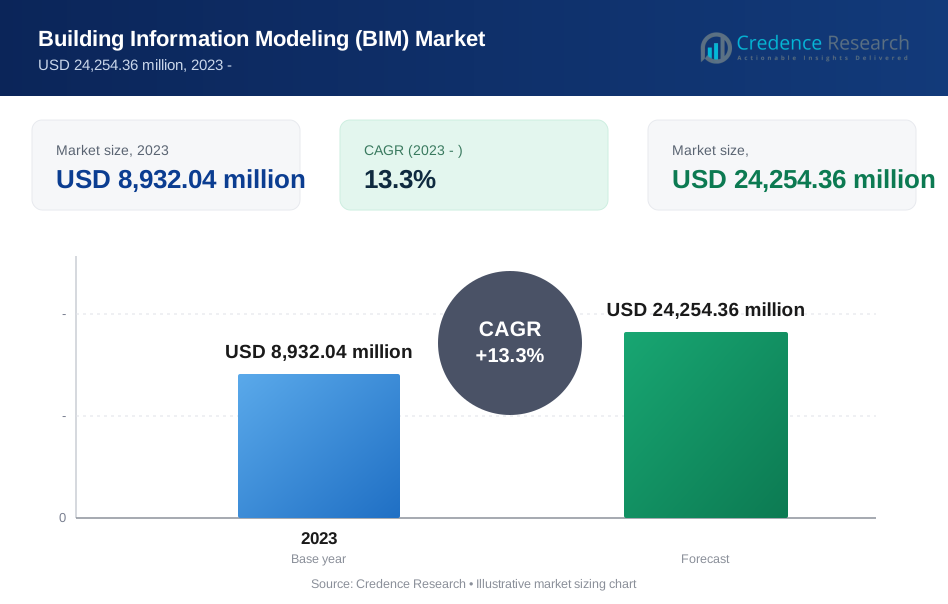
The Building Information Modeling (BIM) Market is projected to grow significantly, expanding from USD 8,932.04 million in 2023 to an estimated USD 24,254.36million by 2032. This growth reflects a compound annual growth rate (CAGR) of 13.3% from 2024 to 2032, driven by the rising adoption of digital construction processes and advancements in cloud technology.
Key drivers of the BIM Market include the demand for efficient and sustainable construction practices, the need for enhanced project collaboration, and the reduction of overall construction costs. Trends such as the growing application of IoT and AI in BIM platforms, increased government mandates for BIM usage, and the shift towards prefabrication and modular construction are propelling market growth. The rise of smart city initiatives and the incorporation of green building standards are also encouraging the widespread adoption of BIM technologies across different construction sectors.
Geographically, North America leads the BIM Market due to early technological adoption and stringent regulatory requirements in construction. Europe follows closely, fueled by government mandates for BIM implementation in public projects, particularly in countries like the United Kingdom and Germany. The Asia-Pacific region is poised for rapid growth, driven by urbanization, infrastructure development, and supportive government policies in countries such as China, Japan, and India. Key players in the global BIM Market include Autodesk, Inc., Bentley Systems, Inc., Nemetschek SE, Trimble Inc., and Dassault Systèmes, each competing to innovate and capture market share in this dynamic and evolving landscape.
Market Drivers
Increasing Demand for Improved Project Efficiency and Cost Management
The construction industry has historically faced challenges related to project delays, cost overruns, and inefficient processes. As a result, there is a growing demand for tools that can streamline project management and improve productivity. BIM offers a solution by enabling professionals to visualize every aspect of a construction project before actual work begins. Through 3D modeling, real-time collaboration, and data integration, BIM helps stakeholders identify potential issues and optimize workflows early in the design phase. This enhanced planning reduces the likelihood of costly errors during construction, thus offering significant cost savings. Additionally, BIM's ability to simulate building performance, assess constructability, and automate quantity take-offs greatly benefits project managers aiming to meet tight budgets and schedules. This demand for cost-effective solutions is driving the adoption of BIM software across the construction and infrastructure sectors. For instance, a study by PlanGrid and FMI found that construction professionals spend 35% of their time on non-productive activities like looking for project information, conflict resolution, and dealing with mistakes and rework. BIM can significantly reduce this wasted time by providing centralized, up-to-date project information.
Rising Government Mandates and Industry Standards
Government mandates and industry standards are playing a crucial role in driving BIM adoption globally. Many governments, particularly in developed nations, have recognized the potential of BIM to improve construction quality, reduce waste, and enhance transparency in project execution. In countries like the United Kingdom, BIM has become mandatory for public infrastructure projects, which has significantly boosted its market penetration. Other regions, including parts of Europe, the Middle East, and Asia-Pacific, are following suit, with governments introducing regulations that require or encourage the use of BIM for public construction projects. For instance, the European Union has recommended BIM for publicly funded construction projects to improve efficiency and sustainability. In the United States, while no federal BIM mandate exists, several states and local authorities have adopted BIM guidelines for specific project types. These mandates create a favorable regulatory environment for BIM, accelerating its adoption across regions and industries. For instance, in the UK, the government's BIM mandate has led to over 70% of construction projects using BIM as of 2020, compared to just 13% in 2011 when the mandate was first announced. This demonstrates the significant impact of government policies on BIM adoption.
Shift Towards Sustainable and Green Building Practices
As environmental concerns grow, the construction industry is under increasing pressure to adopt sustainable practices and reduce its carbon footprint. BIM plays a vital role in this transformation by enabling designers, engineers, and architects to analyze the environmental impact of building materials, optimize energy efficiency, and assess lifecycle performance. The software can simulate building behavior over time, allowing for better decision-making regarding sustainability and energy use. Furthermore, BIM facilitates the integration of renewable energy sources, water conservation systems, and other sustainable technologies into building designs. For companies committed to green building standards, such as LEED or BREEAM, BIM offers the necessary tools to meet certification requirements and demonstrate compliance with environmental regulations. As the focus on sustainability intensifies, the demand for BIM solutions will continue to grow, positioning the market for substantial long-term growth. For instance, a case study of the Shanghai Tower, which utilized BIM throughout its design and construction, showed that the building achieved a 32% reduction in energy consumption compared to a conventional design. This exemplifies how BIM can contribute to significant improvements in building sustainability.
Advancements in Technology and Integration with Emerging Digital Solutions
Rapid advancements in technology are also propelling the BIM market forward. The integration of BIM with other digital solutions, such as artificial intelligence (AI), the Internet of Things (IoT), and cloud computing, is transforming how projects are planned, executed, and maintained. AI-powered BIM applications can analyze vast amounts of data to predict project outcomes, optimize designs, and even automate repetitive tasks, which boosts productivity and decision-making. Similarly, IoT sensors embedded in buildings enable real-time monitoring and management, allowing for data-driven maintenance and operation. Cloud-based BIM platforms enhance collaboration by providing remote access to project data, improving communication among teams located in different geographies. Moreover, the shift toward prefabrication and modular construction methods has further boosted BIM’s relevance, as it enables accurate design and simulation of these approaches. These technological innovations are strengthening BIM’s capabilities and driving its adoption in the construction and infrastructure sectors.
Market Trends
Integration of Advanced Technologies: AI, IoT, and Cloud Computing
The integration of advanced technologies like artificial intelligence (AI), the Internet of Things (IoT), and cloud computing with BIM solutions is rapidly transforming the construction industry. AI-powered BIM tools can analyze extensive data sets to provide predictive insights, optimize designs, and automate complex tasks, enhancing both accuracy and efficiency throughout the project lifecycle. For example, AI algorithms can identify patterns from past projects to forecast potential issues and recommend solutions, helping project managers make data-driven decisions. The incorporation of IoT into BIM allows real-time monitoring of construction sites through connected sensors, enabling the continuous tracking of equipment, materials, and environmental conditions. This real-time data facilitates proactive maintenance, boosts site safety, and enhances resource management. Cloud computing also plays a critical role by providing centralized access to BIM models, allowing for seamless collaboration among teams, regardless of location. Cloud-based BIM platforms enable remote project updates, reducing project timelines and improving communication across stakeholders. As these technologies continue to evolve, they are shaping the future of BIM and expanding its applications in construction, infrastructure, and facilities management. For instance, a study by McKinsey & Company found that AI-powered BIM tools can reduce design time by up to 20% and construction time by up to 15%. Additionally, IoT sensors deployed on construction sites can collect over 50 million data points per day, providing valuable insights for project management and safety monitoring.
Growing Adoption of Modular and Prefabricated Construction
Modular and prefabricated construction are gaining traction as sustainable and cost-effective alternatives to traditional construction methods, and BIM is central to their success. By leveraging BIM for modular construction, architects and engineers can design precise, detailed models of each building component before production, minimizing errors and ensuring better fit and finish. BIM's ability to create accurate 3D models and simulate construction processes allows for precise planning and optimization of the prefabrication process, from material selection to assembly. Additionally, modular construction relies on effective collaboration and coordination, both of which BIM facilitates by providing a shared platform for all project stakeholders. This coordination helps streamline the production and assembly phases, ultimately accelerating project timelines. As construction companies increasingly recognize the efficiency, cost savings, and environmental benefits associated with modular and prefabricated methods, the demand for BIM tools that support these approaches is rising. This trend is anticipated to continue as modular construction becomes a preferred method for residential, commercial, and infrastructure projects worldwide. For instance, a report by the Modular Building Institute revealed that modular construction can reduce project schedules by 30-50% compared to traditional methods. Furthermore, a case study of a 57-story building in China demonstrated that using prefabricated components allowed for completion in just 19 days, showcasing the efficiency gains possible through these methods when combined with BIM technology.
Market Restraints and Challenges
High Implementation Costs and Resource Requirements
Despite the numerous advantages BIM offers, high implementation costs remain a significant barrier, especially for small and medium-sized enterprises (SMEs). BIM software and related technologies require substantial upfront investments, not only in licensing fees but also in the hardware needed to support the software’s functionality. Additionally, companies often need to invest in employee training to ensure they can effectively use these advanced tools. The transition from traditional construction practices to BIM can be complex and resource-intensive, as it demands time, skilled personnel, and a cultural shift within organizations. For many smaller firms operating on limited budgets, these expenses can be prohibitive. Furthermore, ongoing costs related to software updates, maintenance, and technical support contribute to the overall cost burden. Consequently, the high financial commitment associated with BIM implementation can deter potential adopters, slowing the overall market growth.
Lack of Standardization and Interoperability Issues
Another significant challenge in the BIM Market is the lack of standardization and interoperability among different BIM platforms. As BIM software providers develop proprietary solutions, it becomes challenging for various systems to work together seamlessly, particularly in large projects that involve multiple stakeholders using different BIM tools. This lack of interoperability can lead to data silos, miscommunication, and errors, which undermine the collaborative potential of BIM. Additionally, there is an absence of universally accepted standards for data exchange in the BIM ecosystem, creating inconsistencies in how information is shared and interpreted across platforms. This challenge is particularly relevant in multi-stakeholder projects that span across countries with varying standards, regulations, and practices. Until the industry adopts consistent standards for data formats and interoperability, the lack of seamless integration will continue to restrict BIM’s full potential and hinder its adoption across the broader construction industry
Market Segmentation Analysis
By Component
The BIM Market is segmented by component into software and services, with the software segment holding the majority market share due to the rising demand for advanced design and modeling tools. BIM software offers essential features like 3D visualization, simulation, and project management, which streamline construction planning and improve project efficiency. The services segment, encompassing consulting, implementation, and support, is also growing as organizations seek expert assistance to effectively adopt and optimize BIM solutions. The need for ongoing technical support and training further drives demand for BIM-related services, helping companies maximize the software's capabilities.
By Application
BIM is widely utilized across various sectors, with the commercial sector being a primary contributor to market growth due to its ability to streamline complex workflows and improve collaboration on large-scale projects involving multiple stakeholders. In the residential sector, BIM adoption is on the rise as urbanization increases and the demand for sustainable housing solutions grows; BIM’s capabilities in optimizing building designs, simulating energy use, and reducing costs make it an attractive choice for residential construction. The industrial sector also benefits from BIM for the precise planning and construction of complex facilities like factories, warehouses, and plants. Additionally, public infrastructure projects, including roads, bridges, and transportation systems, leverage BIM for comprehensive project planning and management, as governments worldwide invest in smart city initiatives and infrastructure development.
Segments
Based on Component
- Software
- Services
Based on Application
- Commercial
- Residential
- Industrial Public Infrastructure
- Other
Based on End Users
- Architects & Engineers
- Facility/Construction Managers
- Builders & Contractors
Based on Project Phase
- Pre-Construction
- Construction
- Post-Construction
Based on Region
- North America
- US
- Canada
- Mexico
- Europe
- UK
- Germany
- France
- Rest of Europe
- Asia Pacific
- China
- Japan
- India
- Rest of Asia Pacific
- Rest of the Worl
- Middle East & Africa
- South America
Key players
- Autodesk Inc.
- Dassault Systèmes SA
- Bentley Systems Inc.
- Nemetschek AG
- Beck Technology Ltd.
- AVEVA Group Plc
- Hexagon AB
- Pentagon Solution Ltd.
- Trimble Ltd.
- Synchro Software Ltd.
- Pinnacle Infotech
- Plano Group
- LOD Planner Inc.
- ACCA software S.P.A.
Recent Developments
- In February 2024, Autodesk Inc. launched Autodesk Informed Design, a cloudInbased solution connecting design and manufacturing workflows for industrialized construction.
- In March 2020, Bentley Systems Inc. acquired GroupBC, a UK leader in cloud services for construction information management, to advance collaborative BIM and digital twins.
- In October 2023, ALLPLAN, a Nemetschek brand, launched its latest version of BIM software, ALLPLAN 2025, setting a new standard in design and construction workflows.
- In September 2022, Hexagon AB acquired iConstruct Pty Ltd, a provider of BIM software used in commercial, infrastructure, and industrial construction, expanding Hexagon's Smart Digital Reality capabilities.
Market Concentration and Characteristics
The Building Information Modeling (BIM) Market is moderately concentrated, with a few major players such as Autodesk Inc., Bentley Systems Inc., and Dassault Systèmes SA holding significant market shares due to their extensive portfolios and established global presence. These leading companies drive innovation in the market by investing heavily in research and development, integrating advanced technologies like AI, IoT, and cloud computing into their BIM solutions. However, the market also includes numerous smaller players and specialized firms that cater to specific industry segments or regional demands, enhancing market diversity. The BIM Market is characterized by rapid technological advancements, increasing standardization efforts, and growing regulatory support, which collectively encourage wider adoption across various sectors. This combination of dominant players and niche providers fosters a competitive environment focused on innovation, collaboration, and sustainability within the construction industry.
Report Coverage
The research report offers an inIndepth analysis based on Component, Application, End Users, Project Phase and Region. It details leading market players, providing an overview of their business, product offerings, investments, revenue streams, and key applications. Additionally, the report includes insights into the competitive environment, SWOT analysis, current market trends, as well as the primary drivers and constraints. Furthermore, it discusses various factors that have driven market expansion in recent years. The report also explores market dynamics, regulatory scenarios, and technological advancements that are shaping the industry. It assesses the impact of external factors and global economic changes on market growth. Lastly, it provides strategic recommendations for new entrants and established companies to navigate the complexities of the market.
Future Outlook
- The BIM Market is projected to expand steadily, driven by increasing adoption across various sectors, with a compound annual growth rate (CAGR) of 12.50% from 2024 to 2032.
- Emerging technologies such as AI, IoT, and machine learning will continue to enhance BIM capabilities, making project management and design processes more efficient and automated.
- The shift towards cloud-based BIM platforms will accelerate, enabling greater collaboration and real-time data sharing among geographically dispersed teams.
- BIM’s role in supporting sustainable construction and green building practices will grow as environmental regulations become more stringent and sustainability gains importance.
- More countries will likely implement BIM mandates for public infrastructure projects, driving wider adoption across regions such as Asia-Pacific and the Middle East.
- The Asia-Pacific region, particularly China, India, and Southeast Asia, is expected to see rapid BIM adoption due to urbanization and large-scale infrastructure investments.
- BIM’s use in modular and prefabricated construction will rise, improving project timelines and cost efficiency in residential and commercial buildings.
- Industry efforts to improve interoperability between different BIM platforms and establish universal standards will strengthen collaboration and data consistency across projects.
- BIM’s role will expand beyond construction into post-construction facility management, enabling building owners to track assets and optimize operational efficiency.
- BIM will be a crucial tool in the development of smart cities, aiding in the design and management of integrated urban infrastructure systems and enhancing public services.
Request a Free Sample
Fill in your details and we'll send you a free sample report.
- Sample data tables & charts
- Research methodology
Need a Custom Version of This Report?
Tailor the scope, geography, or segments to your exact requirements.
- Custom geography or segment scope
- Direct access to our analyst team
Frequently Asked Questions
What is the size of Building Information Modeling (BIM) Market?
What are the key drivers of growth in the BIM Market?
How does BIM support sustainable building practices?
What role do government mandates play in BIM adoption?
Who are the major players in this Market?
Table of Content
Chapter 1. Report Introduction
- 1.1 Report Description & Purpose
- 1.1.1 Report Title & Market Definition
- 1.1.2 Unique Selling Propositions (USP) & Key Differentiators
- 1.1.3 Value Proposition for Stakeholders
- 1.2 Research Objectives
- 1.2.1 Market Sizing Objectives (Volume & Revenue) (Volume Where Applicable)
- 1.2.2 Segmentation Objectives
- 1.2.3 Competitive Intelligence Objectives
- 1.2.4 Forecast & Scenario Objectives
- 1.3 Report Scope
- 1.3.1 Building Information Modeling (BIM) Scope – Segments & Subsegments Covered
- 1.3.2 Geographic Scope – Regions & Countries Covered
- 1.3.3 Historical Period, Base Year & Forecast Period (2023; forecast to the forecast period)
- 1.3.4 Inclusions & Exclusions
- 1.4 Industry Classification & Applicable Codes
- 1.5 Currency, Measurement Units & Valuation Basis
- 1.6 Target Stakeholders
- 1.7 Limitations & Assumptions
Chapter 2. Executive Summary
- 2.1 Global Building Information Modeling (BIM) Market Snapshot
- 2.1.1 Market Size – Historical (2023) & Forecast (the forecast period) (2023: USD 8,932.04 million → forecast year: USD 24,254.36 million)
- 2.1.2 Volume & Revenue – Global Totals (Volume Where Applicable)
- 2.1.3 Key Market Highlights – Top Five Facts
- 2.2 Building Information Modeling (BIM) Market Segmentation Snapshot
- 2.2.1 Market Split by Region – 2023 vs.
- 2.3 Competitive Snapshot
- 2.3.1 Top 10 Players by Revenue Share – 2023
- 2.3.2 Top 10 Players by Volume Share – 2023 (Volume Where Applicable)
- 2.3.3 Recent Strategic Developments (18-Month Summary)
- 2.4 Key Investment Highlights & Strategic Conclusions
Chapter 3. Building Information Modeling (BIM) Market Dynamics & Industry Analysis
- 3.1 Market Overview & Context
- 3.1.1 Building Information Modeling (BIM) Market Position in the Broader Industry Value Chain
- 3.1.2 Demand Structure & Purchasing Dynamics
- 3.1.3 Market Maturity & Development Stage by Region
- 3.2 Building Information Modeling (BIM) Market Drivers
- 3.3 Building Information Modeling (BIM) Market Restraints & Challenges
- 3.4 Building Information Modeling (BIM) Market Opportunities
- 3.5 Porter's Five Forces Analysis
- 3.5.1 Threat of New Entrants
- 3.5.2 Bargaining Power of Suppliers
- 3.5.3 Bargaining Power of Buyers
- 3.5.4 Threat of Substitutes
- 3.5.5 Competitive Rivalry – Intensity Assessment
- 3.6 Building Information Modeling (BIM) Value Chain Analysis
- 3.6.1 Upstream – Key Inputs, Resources & Suppliers
- 3.6.1.1 Key Input/Resource 1
- 3.6.1.2 Key Input/Resource 2
- 3.6.1.3 Key Input/Resource 3
- 3.6.2 Midstream – Core Operations & Value Creation
- 3.6.2.1 Operating Model & Process Overview
- 3.6.2.2 Key Operating Locations & Capabilities by Company
- 3.6.3 Downstream – Market Channels & End Users
- 3.6.3.1 Direct Sales & Customer Engagement Channels
- 3.6.3.2 Indirect Sales, Intermediaries & Partner Channels
- 3.6.4 Value Chain Profitability Analysis
- 3.6.1 Upstream – Key Inputs, Resources & Suppliers
- 3.7 PESTEL Analysis
- 3.7.1 Political Factors
- 3.7.2 Economic Factors
- 3.7.3 Social Factors
- 3.7.4 Technological Factors
- 3.7.5 Environmental Factors
- 3.7.6 Legal Factors
- 3.8 Building Information Modeling (BIM) Supply Chain Analysis
- 3.8.1 Critical Input & Resource Availability Risk Assessment
- 3.8.2 Supplier & Operational Concentration Risk (Geographic Exposure)
- 3.8.3 Supply & Service Disruption Impact Analysis
- 3.9 Regulatory & Policy Landscape
Note: The regulatory and policy landscape section covers regulations based on their applicability to the market, Building Information Modeling (BIM) category, geography, and scope of the study. Only regulatory frameworks with a material impact on operations, compliance, trade, sustainability, or market access are analyzed in detail.
Chapter 4. Key Investment Pockets & Opportunity Analysis
- 4.1 Building Information Modeling (BIM) Market Attractiveness Analysis
- 4.1.1 By Region – Investment Attractiveness Matrix (Market Size × CAGR)
- 4.2 Absolute Revenue Growth Opportunity
- 4.2.1 By Region – Absolute Revenue Growth Through the forecast period
- 4.3 Incremental Demand Opportunity
- 4.3.1 By Region – Incremental Demand Through the forecast period
- 4.3.2 Segment – Incremental Demand
- 4.4 Emerging Submarket Opportunity Deep Dive (Subject to Applicability)
- 4.5 Priority Market Opportunity Scorecards
- 4.5.1 United States
- 4.5.2 Europe
- 4.5.3 Asia
- 4.5.4 Middle East & Africa
Note: Priority market opportunity scorecards reflect the geographic scope and strategic relevance of the study. Listed markets are indicative and may be adapted to the industry.
Chapter 5. Building Information Modeling (BIM) Cross-Border Trade & Market Access Analysis
- 5.1 International Trade & Cross-Border Activity Overview
- 5.1.1 Global Export Value by Country (2023)
- 5.1.2 Global Export Volume by Country (2023) (Volume Where Applicable)
- 5.1.3 Global Import Value by Country (2023)
- 5.1.4 Global Import Volume by Country (2023) (Volume Where Applicable)
- 5.1.5 Net Trade Balance by Country (2023)
- 5.2 Export Analysis – Segment
- 5.2.1 Category 1 (Applicable Classification Code)
- 5.2.2 Category 2 (Applicable Classification Code)
- 5.2.3 Category 3 (Applicable Classification Code)
- 5.2.4 Category 4 (Applicable Classification Code)
- 5.2.5 Category 5 (Applicable Classification Code)
- 5.3 Import Analysis – Segment
- 5.3.1 Category 1 (Applicable Classification Code)
- 5.3.2 Category 2 (Applicable Classification Code)
- 5.3.3 Category 3 (Applicable Classification Code)
- 5.3.4 Category 4 (Applicable Classification Code)
- 5.3.5 Category 5 (Applicable Classification Code)
- 5.4 Cross-Border Pricing & Transaction Benchmarks
- 5.4.1 Export Pricing – Segment & Country
- 5.4.2 Import Pricing – Segment & Source Country
- 5.4.3 Price Trends (2023)
- 5.5 Key Cross-Border Trade & Delivery Routes
- 5.5.1 Cross-Border Trade/Delivery Route 1
- 5.5.2 Cross-Border Trade/Delivery Route 2
- 5.5.3 Cross-Border Trade/Delivery Route 3
- 5.5.4 Cross-Border Trade/Delivery Route 4
- 5.5.5 Cross-Border Trade/Delivery Route 5
- 5.6 Trade Policy & Market Access Impact Assessment
- 5.6.1 Tariff & Non-Tariff Barriers
- 5.6.2 Regional Trade & Economic Integration Frameworks
- 5.6.3 Bilateral & Multilateral Trade Agreements
- 5.6.4 Cross-Border Operating, Licensing & Localization Requirements
Note: This chapter applies where cross-border trade or delivery is relevant to Building Information Modeling (BIM). Goods, services, and digital offerings are assessed using applicable classifications and transaction measures. Import-export volumes, trade balances, and route analyses are included only where meaningful to the market.
Chapter 6. Competitive Landscape & Company Benchmarking
- 6.1 Building Information Modeling (BIM) Market Concentration & Structure
- 6.1.1 Herfindahl-Hirschman Index (HHI) – vs. 2023
- 6.1.2 Leading, Mid-Sized & Emerging Player Structure
- 6.1.3 Global, Regional & Local Player Dynamics
- 6.2 Building Information Modeling (BIM) Market Share Analysis – 2023
- 6.2.1 Global Revenue Share by Company
- 6.2.2 Global Volume Share by Company (Volume Where Applicable)
- 6.2.3 Regional Revenue Share
- 6.2.4 Market Share Evolution ( vs. 2023)
- 6.2.5 Company Market Share by Key Segment
- 6.2.6 Company Market Share by Customer Group
- 6.3 Operating Scale, Capacity & Infrastructure Analysis
- 6.3.1 Global Operating Scale & Supply Capacity
- 6.3.2 Resource Utilization & Operating Efficiency
- 6.3.3 Output, Service Delivery & Activity Metrics
- 6.3.4 Operating Footprint & Infrastructure Map
- 6.3.5 Planned Operational & Capacity Expansion
- 6.4 Building Information Modeling (BIM) Competitive Benchmarking Matrix
- 6.4.1 Revenue, Growth, Profitability & Operating Metric Comparison
- 6.4.2 Channel Revenue Mix
- 6.4.3 Geographic Revenue Exposure
- 6.4.4 R&D Intensity
- 6.4.5 Sustainability Maturity
- 6.5 Strategic Developments in Building Information Modeling (BIM) (Last 24 Months)
- 6.5.1 Mergers, Acquisitions & Divestments
- 6.5.2 New Products, Services & Solutions in Building Information Modeling (BIM)
- 6.5.3 Operational & Infrastructure Expansions
- 6.5.4 Strategic Alliances, Joint Ventures & Partnerships
- 6.5.5 Distribution Expansion & Market Entry
- 6.5.6 Sustainability & ESG Initiatives
- 6.6 Competitive Strategy Mapping
- 6.6.1 Leader, Challenger, Follower & Niche Classification
- 6.6.2 Pricing Strategy Comparison
- 6.6.3 Channel Strategy Matrix
Note: Strategic developments are included based on their materiality and the availability of reliable information.
Chapter 7. Global Building Information Modeling (BIM) Market – By Sales & Delivery Channel
- 7.1 Segment Overview
- 7.1.1 Volume & Revenue Split by Channel (2023 & ) (Volume Where Applicable)
- 7.1.2 Channel Mix Evolution (the forecast period)
Chapter 8. Regional Market Analysis – Global Overview
- 8.1 Global Regional Overview
- 8.1.1 Regional Volume Share (Volume Where Applicable)
- 8.1.2 Regional Revenue Share
- 8.1.3 Regional Volume by Region (Volume Where Applicable)
- 8.1.4 Regional Revenue by Region
- 8.1.5 Regional Forecast Through the forecast period
- 8.2 Cross-Regional Segment Analysis
- 8.2.1 By Sales & Delivery Channel
- 8.2.2 By Competitive Positioning & Price Tier
Chapter 9. North America Building Information Modeling (BIM) Market
- 9.1 United States
- 9.2 Canada
- 9.3 Mexico
Chapter 10. Europe Building Information Modeling (BIM) Market
- 10.1 Germany
- 10.2 France
- 10.3 Italy
- 10.4 United Kingdom
- 10.5 Spain
- 10.6 Poland
- 10.7 Russia
- 10.8 Netherlands
- 10.9 Belgium
- 10.10 Sweden
- 10.11 Denmark
- 10.12 Norway
- 10.13 Rest of Europe
Chapter 11. Asia Pacific Building Information Modeling (BIM) Market
- 11.1 China
- 11.2 India
- 11.3 Japan
- 11.4 South Korea
- 11.5 Thailand
- 11.6 Indonesia
- 11.7 Vietnam
- 11.8 Malaysia
- 11.9 Australia
- 11.10 Rest of Asia Pacific
Chapter 12. Latin America Building Information Modeling (BIM) Market
- 12.1 Brazil
- 12.2 Argentina
- 12.3 Colombia
- 12.4 Chile
- 12.5 Rest of Latin America
Chapter 13. Middle East Building Information Modeling (BIM) Market
- 13.1 Saudi Arabia
- 13.2 United Arab Emirates
- 13.3 Turkey
- 13.4 Israel
- 13.5 Iran
- 13.6 Rest of the Middle East
Chapter 14. Africa Building Information Modeling (BIM) Market
- 14.1 South Africa
- 14.2 Egypt
- 14.3 Nigeria
- 14.4 Morocco
- 14.5 Rest of Africa
Chapter 15. Building Information Modeling (BIM) Company Profiles
- 15.1 [Company 01]
- 15.1.1 Company Overview
- 15.1.2 Key Management Personnel
- 15.1.3 Products & Services Portfolio
- 15.1.4 Financial Performance
- 15.1.5 Key Market Focus & Geographic Presence
- 15.1.6 Recent Developments & Strategic Initiatives
Note: The company profile list is preliminary and may change based on research findings, market developments, data availability, and client requirements.
Chapter 16. Appendices
- Appendix A – List of Abbreviations & Acronyms
- Appendix B – Industry Classification Code Reference – Full Series
- Appendix C – Supply, Output & Operating Capacity Data Tables
- Appendix D – End-Use & Demand Base Tables
- Appendix E – Demand, Adoption & Usage Assumptions
- Appendix F – Pricing & Revenue Metric Reference Tables
- Appendix G – Company Operations & Infrastructure Database
- Appendix H – Cross-Border Trade & Activity Data Tables (Where Applicable)
- Appendix I – Regulatory Summary Tables
- Appendix J – Primary Research Participant List (Anonymized)
- Appendix K – Primary Research Questionnaire Framework
- Appendix L – Data Sources & Bibliography
- Appendix M – Market Size Divergence & Source Comparison
Chapter 17. Research Methodology
- 17.1 Research Framework & Philosophy
- 17.2 Secondary Research – Sources, Hierarchy & Data Extraction
- 17.3 Data Modeling – Bottom-Up & Top-Down Market Sizing
- 17.4 Primary Research – Stakeholder Framework, LOI & Sample Sizes
- 17.5 Forecast Methodology – Regression, Scenario & Sensitivity Analysis
- 17.6 Quality Control – Four-Layer Validation Framework
- 17.7 Limitations & Standard Assumptions
- 17.8 Disclaimer
