
| REPORT ATTRIBUTE | DETAILS |
|---|---|
| Historical Period | 2020-2023 |
| Base Year | 2024 |
| Forecast Period | 2025-2032 |
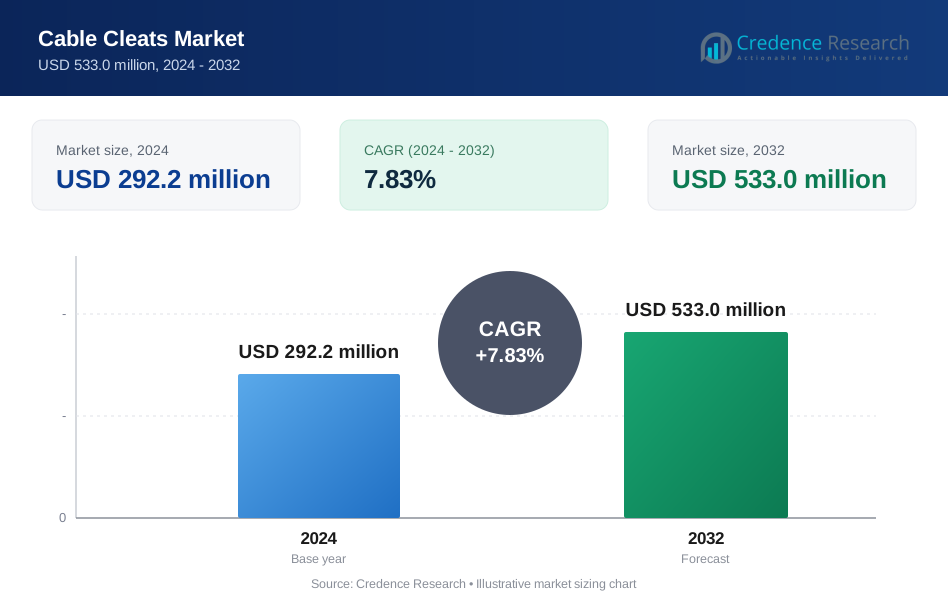
| Cable Cleats Market Size 2024 | USD 292.2 million |
| Cable Cleats Market, CAGR | 7.83% |
| Cable Cleats Market Size 2032 | USD 533.0 million |
Market Overview
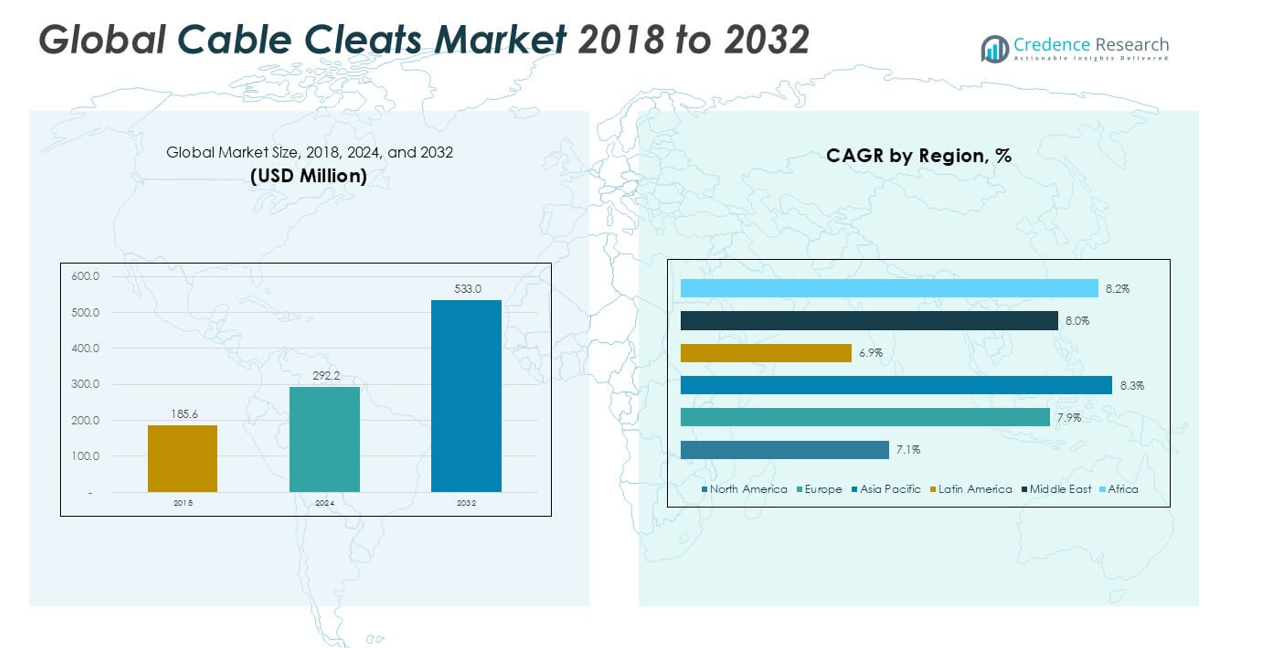
The Cable Cleats market size was valued at USD 185.6 million in 2018, increased to USD 292.2 million in 2024, and is anticipated to reach USD 533.0 million by 2032, growing at a CAGR of 7.83% during the forecast period.
The cable cleats market is characterized by the presence of several key players, including Ellis Patents Ltd, CMP Products Limited, Oglaend System Group, Eland Cables Limited, TransDelta, and Novoflex, each contributing to market innovation and regional expansion. These companies focus on developing high-performance, safety-compliant cleat systems tailored for industrial and utility applications. Asia Pacific leads the global market with a 37.8% share in 2024, driven by rapid urbanization, energy infrastructure development, and increasing industrialization across China, India, and Southeast Asia. Europe and North America follow, supported by strong regulatory frameworks and modernization of electrical networks.
Market Insights
- The global cable cleats market was valued at USD 292.2 million in 2024 and is expected to reach USD 533.0 million by 2032, growing at a CAGR of 7.83% during the forecast period.
- Rising demand for secure cable management systems in energy utilities, oil & gas, and infrastructure sectors is a key market driver, supported by increasing investments in power transmission and renewable energy projects.
- Metallic cable cleats dominate the material segment due to their durability and high load-bearing capacity, while single core cleats lead in the core segment owing to their widespread use in high-voltage applications.
- Asia Pacific holds the largest regional share at 37.8% in 2024, followed by Europe (21.9%) and North America (17.9%), driven by industrialization and infrastructure development across emerging economies.
- Market growth is hindered by high installation costs and limited awareness in developing regions, while competition remains strong among players like CMP Products, Ellis Patents, and Oglaend System.
Market Segmentation Analysis:
By Material
The cable cleats market, segmented by material, comprises metallic and non-metallic types. Among these, metallic cable cleats dominate the segment, accounting for a significant share of the market in 2024 due to their superior mechanical strength, high resistance to extreme temperatures, and enhanced durability in harsh environments. These cleats are extensively used in industrial applications where mechanical stress and fire safety are critical concerns. The growth of energy and heavy industries continues to drive demand for metallic cleats, while the non-metallic segment is gaining traction in environments requiring lightweight and corrosion-resistant alternatives.
- For instance, Ellis Patents Ltd offers the Vulcan+ metallic cleat, which withstands short-circuit forces of up to 114.8 kA peak and is tested to IEC 61914:2015, making it suitable for extreme-duty applications.
By Number of Core
In terms of the number of cores, the cable cleats market is categorized into single core and multi-core cleats. Single core cable cleats hold the dominant market share, driven by their widespread use in high-voltage applications and renewable energy infrastructure, where single conductor cables are preferred. Their ability to securely restrain cables under short circuit conditions further strengthens their adoption across energy utilities and heavy industrial sectors. Although multi-core cleats are gaining popularity in compact installations and commercial projects, they currently hold a smaller share of the overall market.
- For instance, CMP Products' stainless steel Cleat range (such as the 2A and 2B series) is certified for restraining single-core cables up to 1,000 mm² and short-circuit forces up to 140 kA, making them a reliable choice for high-voltage installations.
By Industry Vertical
The industry vertical segmentation includes IT and telecom, energy utilities, oil and gas, transportation, and others. Energy utilities emerge as the leading segment, capturing the largest market share in 2024, fueled by growing investments in power distribution networks and grid modernization projects globally. The increasing need for reliable cable management systems in substations and renewable energy installations is a key driver. Meanwhile, the oil and gas sector shows steady demand due to the critical importance of fire- and corrosion-resistant cleats in hazardous environments. IT and telecom and transportation sectors also contribute moderately with increasing infrastructure expansions.
Market Overview
Expansion of Power Transmission and Distribution Infrastructure
The global expansion of power transmission and distribution infrastructure significantly drives the growth of the cable cleats market. As countries invest in grid modernization and rural electrification, the demand for secure and reliable cable management solutions increases. Cable cleats play a critical role in restraining cables and preventing damage from mechanical stress and short circuits. The growing integration of renewable energy sources into national grids and the construction of substations further contribute to market expansion, especially in emerging economies prioritizing energy access and infrastructure development.
- For instance, Ellis Patents supplied its Emperor cable cleats, tested to withstand peak short-circuit currents of 134 kA, for installation in the 400 kV substations of the National Grid in the UK, supporting power transmission systems over distances exceeding 1,000 km.
Rising Industrialization and Infrastructure Development
Rapid industrialization across developing nations is fueling demand for robust electrical systems, thereby propelling the cable cleats market. Industrial sectors such as manufacturing, oil and gas, and mining require durable cable support systems to ensure safety and operational reliability. Infrastructure developments in transportation, smart cities, and commercial complexes also require extensive electrical installations, boosting the need for high-performance cable cleats. These applications, especially in sectors exposed to harsh environments, increasingly rely on metallic cleats for their durability, driving consistent growth across industrial verticals.
- For instance, CMP Products supplied over 15,000 stainless steel cable cleats for the Ichthys LNG Project in Australia, supporting cable systems operating at 33 kV and withstanding peak short-circuit forces of up to 176 kA, ensuring system reliability under extreme industrial conditions.
Increasing Emphasis on Safety Standards and Regulations
Stringent safety standards and regulatory frameworks are key growth drivers for the cable cleats market. Authorities across regions mandate the use of certified cable management systems in high-risk and high-voltage environments to prevent hazards such as short circuits, cable displacement, or fire. The increasing awareness among industries regarding compliance and operational safety has led to a surge in the adoption of standardized cleats. These regulations not only protect infrastructure and personnel but also encourage manufacturers to innovate and provide products with enhanced performance, boosting market competitiveness and growth.
Key Trends & Opportunities
Growing Adoption of Renewable Energy Projects
The increasing deployment of solar and wind energy projects presents a major opportunity for the cable cleats market. Renewable installations require secure cable arrangements capable of withstanding environmental stresses and dynamic loading. Cable cleats provide mechanical stability and safety, especially in offshore wind farms and large-scale solar plants where heavy-duty cables are laid. As countries strive to meet sustainability targets and transition to green energy, demand for reliable electrical infrastructure will rise, boosting the need for advanced cleat systems across diverse renewable applications.
- For instance, Ellis Patents supplied over 6,000 Emperor cable cleats for the Hornsea One offshore wind farm in the North Sea, where each turbine is connected by 66 kV inter-array cables and designed to withstand peak short-circuit forces up to 134 kA, ensuring cable retention under high fault conditions.
Rising Use of Non-metallic and Composite Cleats
The market is witnessing a growing preference for non-metallic and composite cleats due to their corrosion resistance, lightweight nature, and suitability in sensitive environments such as data centers and telecom installations. These cleats are ideal for indoor applications and are increasingly adopted in cost-sensitive projects. Technological innovations have led to the development of high-strength polymers that offer comparable performance to metallic alternatives. This trend opens new opportunities for manufacturers to diversify product offerings and target segments that prioritize flexibility, aesthetics, and cost-efficiency.
- For instance, CMP Products offers the ProTect non-metallic cable cleat range, manufactured from flame-retardant polyamide, which has been successfully tested to withstand peak short-circuit forces of up to 59.4 kA and temperatures ranging from -40°C to +120°C, ensuring safe performance in compact, indoor electrical installations such as telecom switching stations and server rooms.
Key Challenges
High Installation and Maintenance Costs
One of the significant challenges hindering the cable cleats market is the high cost associated with installation and maintenance. In large-scale or retrofitted projects, installing cleats across extensive cable runs can be labor-intensive and time-consuming. Additionally, improper installation can compromise system integrity, necessitating rework or maintenance. These factors can discourage adoption, particularly among small- and medium-scale enterprises with limited budgets, potentially restricting market penetration in cost-sensitive regions or applications.
Limited Awareness and Standardization in Emerging Economies
In several developing regions, a lack of awareness about the critical role of cable cleats in electrical safety limits their widespread use. Furthermore, the absence of uniform standards and enforcement makes it difficult to ensure consistent product quality and application practices. This gap often results in the use of substandard or makeshift cable support solutions, which can lead to system failures. Addressing this challenge requires targeted education, training, and the establishment of regulatory frameworks that mandate the use of certified cable cleat systems.
Volatility in Raw Material Prices
Fluctuations in the prices of raw materials, particularly metals like aluminum and stainless steel, present a challenge for cable cleat manufacturers. These materials directly affect production costs and pricing strategies. Volatility can disrupt supply chains, reduce profit margins, and create pricing uncertainty for end-users. Manufacturers are under pressure to balance cost efficiency with product quality, especially in a competitive market where cost-sensitive buyers may opt for lower-quality alternatives. This instability underscores the need for material diversification and supply chain resilience.
Regional Analysis
North America
North America accounted for approximately 17.9% of the global cable cleats market in 2024, with a market size rising from USD 34.66 million in 2018 to USD 52.47 million in 2024, and is projected to reach USD 90.62 million by 2032, expanding at a CAGR of 7.1%. The region’s growth is driven by robust investments in electrical infrastructure, increasing modernization of transmission networks, and stringent safety regulations. High demand from sectors such as energy utilities and industrial manufacturing continues to fuel the need for advanced cable management systems. The U.S. remains the dominant contributor to regional revenues.
Europe
Europe held a 21.9% share of the global cable cleats market in 2024, with its value growing from USD 40.43 million in 2018 to USD 64.05 million in 2024, and projected to reach USD 117.80 million by 2032, registering a CAGR of 7.9%. Growth in the region is primarily driven by rapid industrial automation, stringent fire safety norms, and the transition toward renewable energy. Countries like Germany, the UK, and France are investing in grid upgrades and smart city infrastructure, accelerating the adoption of secure cable systems. The rising focus on environmental compliance is further boosting demand for high-quality cleats.
Asia Pacific
Asia Pacific dominates the global cable cleats market with the largest regional share of 37.8% in 2024, up from USD 68.33 million in 2018 to USD 110.31 million in 2024, and is anticipated to reach USD 207.88 million by 2032, growing at the highest CAGR of 8.3%. The region’s expansion is driven by rapid urbanization, industrialization, and massive investments in power infrastructure across China, India, and Southeast Asia. Increasing demand for electricity and expansion of smart grids are propelling the need for reliable cable restraint systems. Favorable government policies and growing renewable energy installations also contribute to market momentum.
Latin America
Latin America contributed approximately 10.7% to the global cable cleats market in 2024, with market size increasing from USD 20.88 million in 2018 to USD 31.31 million in 2024, and forecasted to reach USD 53.30 million by 2032, at a CAGR of 6.9%. The market is driven by infrastructure development and expanding energy distribution networks across Brazil, Mexico, and Argentina. Upgrades in transportation and commercial infrastructure are also boosting demand for durable cable cleats. Although economic fluctuations pose a challenge, government support for energy reforms and industrial safety standards continues to strengthen regional demand.
Middle East
The Middle East cable cleats market held a market share of 5.4% in 2024, growing from USD 10.02 million in 2018 to USD 15.92 million in 2024, and is projected to reach USD 29.37 million by 2032, expanding at a CAGR of 8.0%. The market benefits from large-scale investments in oil & gas, utilities, and infrastructure projects in countries like the UAE and Saudi Arabia. The focus on energy diversification and smart city initiatives further supports demand for secure cable management systems. Harsh environmental conditions in the region also necessitate high-performance metallic cable cleats with superior corrosion and heat resistance.
Africa
Africa represented 6.2% of the global cable cleats market in 2024, with its market size rising from USD 11.30 million in 2018 to USD 18.17 million in 2024, and is expected to reach USD 34.06 million by 2032, growing at a robust CAGR of 8.2%. The region’s growth is driven by expanding power distribution networks, rural electrification initiatives, and infrastructure projects supported by both local governments and international investments. Countries such as South Africa, Nigeria, and Kenya are experiencing rising demand for secure cable installations across utilities and construction. Increasing focus on industrial safety and modernization continues to push market adoption.
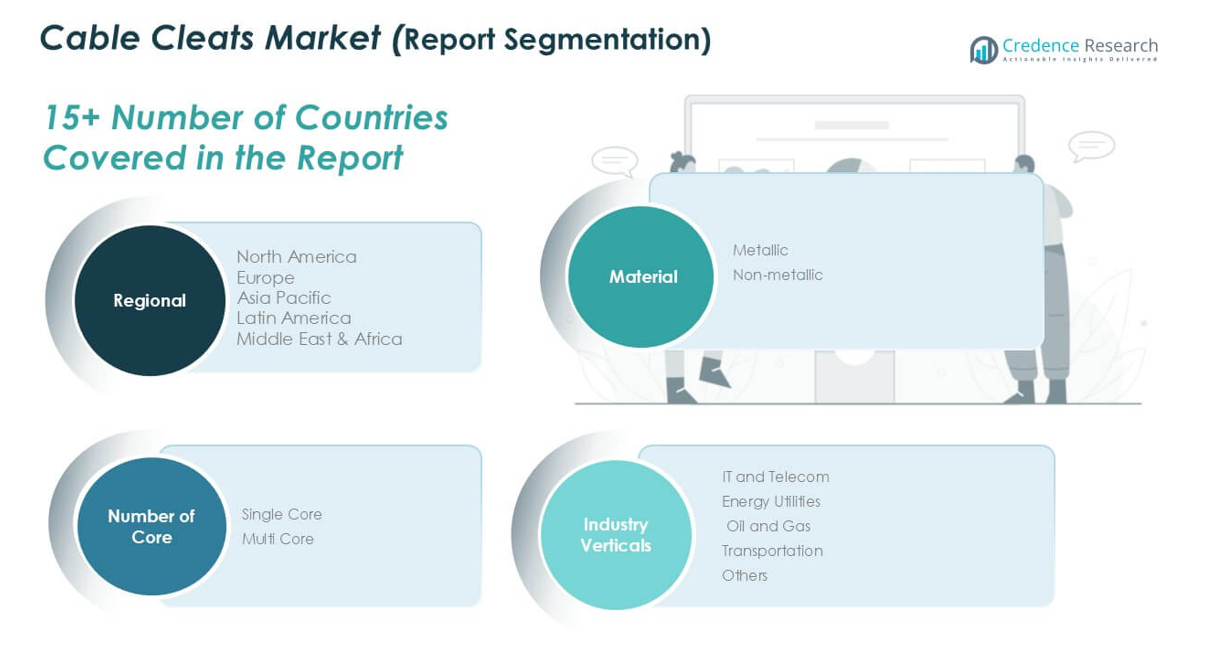
Market Segmentations:
By Material
- Metallic
- Non-metallic
By Number of Core
- Single Core
- Multi Core
By Industry Vertical
- IT and Telecom
- Energy Utilities
- Oil and Gas
- Transportation
- Others
By Geography
- North America
- U.S.
- Canada
- Mexico
- Europe
- Germany
- France
- U.K.
- Italy
- Spain
- Rest of Europe
- Asia Pacific
- China
- Japan
- India
- South Korea
- South-east Asia
- Rest of Asia Pacific
- Latin America
- Brazil
- Argentina
- Rest of Latin America
- Middle East & Africa
- GCC Countries
- South Africa
- Rest of the Middle East and Africa
Competitive Landscape
The cable cleats market features a moderately fragmented competitive landscape, with several key players competing on the basis of product innovation, quality, and regional presence. Leading companies such as Ellis Patents Ltd, CMP Products Limited, and Oglaend System Group hold significant market shares due to their strong engineering capabilities and advanced product portfolios that meet stringent safety and performance standards. These players focus on expanding their global footprint through strategic partnerships, product launches, and investments in R&D. Companies are increasingly adopting materials innovation and smart manufacturing practices to enhance product performance under extreme conditions. The competition is intensifying as manufacturers respond to growing demand from energy, oil & gas, and infrastructure sectors, while also striving to comply with evolving industry regulations and safety codes.
Key Player Analysis
- TransDelta
- Novoflex
- Ellis Patents Ltd
- Oglaend System Group
- Eland Cables Limited
- CMP Products Limited
- Nantong Naco Fluid Equipment Co. Ltd.
- IPD Group Limited
- TransDelta International Industries L.L.C
- Novoflex Marketing Pvt. Ltd.
Recent Developments
- In May 2025, Ellis Patents supplied cable cleats for a major power plant project, demonstrating their ongoing role in supporting critical infrastructure. The project involved the use of their Vulcan+ range of cable cleats, capable of handling up to 132kA, to secure 11kV and 33kV medium voltage cables. These cleats are designed to provide short-circuit restraint, ensuring the safe operation of the power plant's electrical network.
- In December 2023, Unicrimp added metal cables to its growing range of Q-Fire cable accessories. The new metal cable ties comply with BS 7671 (18th edition) and are designed to prevent cables from prematurely collapsing during a fire, keeping emergency services and the public safe. The 18th Edition cable regulations require that cable support systems be constructed of materials that can withstand premature collapse from direct heat.
- In December 2023, Panduit, the world's leading industry leader, was again in the headlines in the dynamic environment of power and network infrastructure solutions. They began an extensive testing program to ensure their cable cleats meet the latest Canadian Standards Association (CSA) technical standards. This important initiative underscored Panduit's unwavering commitment to providing cutting-edge, secure, and reliable solutions that meet the ever-evolving demands of the industry.
- In March 2022, The new V0 series of cable cleats from TE Connectivity (TE), a global leader in connectivity and sensors, improves cable management and protection in various applications, including wind farms, substations, data centers, rail and metro stations, and more. As energy demand increases, the complexity of cable systems increases. Inadequate or unreliable cable management solutions can lead to large financial losses due to property damage caused by short circuits.
Market Concentration & Characteristics
The Cable Cleats Market exhibits moderate to high market concentration, with a few established players holding a significant share due to their strong technical expertise and broad product portfolios. It is characterized by a focus on safety compliance, mechanical performance, and suitability across diverse industrial applications. Manufacturers such as Ellis Patents Ltd, CMP Products Limited, and Oglaend System Group dominate due to their ability to meet stringent international standards and provide customized solutions for high-stress environments. It remains highly application-driven, with demand closely tied to infrastructure development, power transmission, and industrial safety standards. Product differentiation, reliability, and material innovation define competitive positioning. Most companies invest in research to enhance performance in extreme environments and support evolving regulatory requirements. The market structure reflects a growing emphasis on strategic partnerships, geographic expansion, and vertical integration. Emerging players target price-sensitive markets with standard product offerings while larger firms leverage distribution networks to maintain their lead.
Report Coverage
The research report offers an in-depth analysis based on Material, Number of Core, Industry Vertical and Geography. It details leading market players, providing an overview of their business, product offerings, investments, revenue streams, and key applications. Additionally, the report includes insights into the competitive environment, SWOT analysis, current market trends, as well as the primary drivers and constraints. Furthermore, it discusses various factors that have driven market expansion in recent years. The report also explores market dynamics, regulatory scenarios, and technological advancements that are shaping the industry. It assesses the impact of external factors and global economic changes on market growth. Lastly, it provides strategic recommendations for new entrants and established companies to navigate the complexities of the market.
Future Outlook
- The cable cleats market is expected to witness steady growth driven by increased investments in power transmission and distribution networks.
- Demand will rise due to growing emphasis on electrical safety standards across industrial and commercial installations.
- Renewable energy projects, especially solar and wind, will create significant opportunities for cable cleat manufacturers.
- Asia Pacific will continue to dominate the market owing to rapid industrialization and infrastructure development.
- Metallic cleats will remain the preferred choice for high-stress and outdoor environments due to their superior durability.
- Technological advancements in material science will lead to the development of lighter and more corrosion-resistant cleats.
- The oil and gas sector will maintain strong demand for flame-retardant and explosion-resistant cable cleat systems.
- The adoption of smart grid technologies will drive the need for reliable and efficient cable management solutions.
- Manufacturers will focus on product innovation and customization to meet evolving application-specific requirements.
- Regulatory compliance and certification will become critical factors influencing purchasing decisions and market competitiveness.
Request a Free Sample
Fill in your details and we'll send you a free sample report.
- Sample data tables & charts
- Research methodology
Need a Custom Version of This Report?
Tailor the scope, geography, or segments to your exact requirements.
- Custom geography or segment scope
- Direct access to our analyst team
Frequently Asked Questions
What is the current size of the Cable Cleats Market?
What are the key segments within the Cable Cleats Market?
What are some challenges faced by the Cable Cleats Market?
Who are the major players in the Cable Cleats Market?
Table of Content
Chapter 1. Report Introduction
- 1.1 Report Description & Purpose
- 1.1.1 Report Title & Market Definition
- 1.1.2 Unique Selling Propositions (USP) & Key Differentiators
- 1.1.3 Value Proposition for Stakeholders
- 1.2 Research Objectives
- 1.2.1 Market Sizing Objectives (Volume & Revenue) (Volume Where Applicable)
- 1.2.2 Segmentation Objectives
- 1.2.3 Competitive Intelligence Objectives
- 1.2.4 Forecast & Scenario Objectives
- 1.3 Report Scope
- 1.3.1 Cable Cleats Scope – Segments & Subsegments Covered
- 1.3.2 Geographic Scope – Regions & Countries Covered
- 1.3.3 Historical Period, Base Year & Forecast Period (2024; forecast to 2032)
- 1.3.4 Inclusions & Exclusions
- 1.4 Industry Classification & Applicable Codes
- 1.5 Currency, Measurement Units & Valuation Basis
- 1.6 Target Stakeholders
- 1.7 Limitations & Assumptions
Chapter 2. Executive Summary
- 2.1 Global Cable Cleats Market Snapshot
- 2.1.1 Market Size – Historical (2024) & Forecast (2024-2032) (2024: USD 292.2 million → 2032: USD 533.0 million)
- 2.1.2 Volume & Revenue – Global Totals (Volume Where Applicable)
- 2.1.3 Key Market Highlights – Top Five Facts
- 2.2 Cable Cleats Market Segmentation Snapshot
- 2.2.1 Market Split by Region – 2024 vs. 2032
- 2.3 Competitive Snapshot
- 2.3.1 Top 10 Players by Revenue Share – 2024
- 2.3.2 Top 10 Players by Volume Share – 2024 (Volume Where Applicable)
- 2.3.3 Recent Strategic Developments (18-Month Summary)
- 2.4 Key Investment Highlights & Strategic Conclusions
Chapter 3. Cable Cleats Market Dynamics & Industry Analysis
- 3.1 Market Overview & Context
- 3.1.1 Cable Cleats Market Position in the Broader Industry Value Chain
- 3.1.2 Demand Structure & Purchasing Dynamics
- 3.1.3 Market Maturity & Development Stage by Region
- 3.2 Cable Cleats Market Drivers
- 3.3 Cable Cleats Market Restraints & Challenges
- 3.4 Cable Cleats Market Opportunities
- 3.5 Porter's Five Forces Analysis
- 3.5.1 Threat of New Entrants
- 3.5.2 Bargaining Power of Suppliers
- 3.5.3 Bargaining Power of Buyers
- 3.5.4 Threat of Substitutes
- 3.5.5 Competitive Rivalry – Intensity Assessment
- 3.6 Cable Cleats Value Chain Analysis
- 3.6.1 Upstream – Key Inputs, Resources & Suppliers
- 3.6.1.1 Key Input/Resource 1
- 3.6.1.2 Key Input/Resource 2
- 3.6.1.3 Key Input/Resource 3
- 3.6.2 Midstream – Core Operations & Value Creation
- 3.6.2.1 Operating Model & Process Overview
- 3.6.2.2 Key Operating Locations & Capabilities by Company
- 3.6.3 Downstream – Market Channels & End Users
- 3.6.3.1 Direct Sales & Customer Engagement Channels
- 3.6.3.2 Indirect Sales, Intermediaries & Partner Channels
- 3.6.4 Value Chain Profitability Analysis
- 3.6.1 Upstream – Key Inputs, Resources & Suppliers
- 3.7 PESTEL Analysis
- 3.7.1 Political Factors
- 3.7.2 Economic Factors
- 3.7.3 Social Factors
- 3.7.4 Technological Factors
- 3.7.5 Environmental Factors
- 3.7.6 Legal Factors
- 3.8 Cable Cleats Supply Chain Analysis
- 3.8.1 Critical Input & Resource Availability Risk Assessment
- 3.8.2 Supplier & Operational Concentration Risk (Geographic Exposure)
- 3.8.3 Supply & Service Disruption Impact Analysis
- 3.9 Regulatory & Policy Landscape
Note: The regulatory and policy landscape section covers regulations based on their applicability to the market, Cable Cleats category, geography, and scope of the study. Only regulatory frameworks with a material impact on operations, compliance, trade, sustainability, or market access are analyzed in detail.
Chapter 4. Key Investment Pockets & Opportunity Analysis
- 4.1 Cable Cleats Market Attractiveness Analysis
- 4.1.1 By Region – Investment Attractiveness Matrix (Market Size × CAGR)
- 4.2 Absolute Revenue Growth Opportunity
- 4.2.1 By Region – Absolute Revenue Growth Through 2032
- 4.3 Incremental Demand Opportunity
- 4.3.1 By Region – Incremental Demand Through 2032
- 4.3.2 Segment – Incremental Demand
- 4.4 Emerging Submarket Opportunity Deep Dive (Subject to Applicability)
- 4.5 Priority Market Opportunity Scorecards
- 4.5.1 United States
- 4.5.2 Europe
- 4.5.3 Asia
- 4.5.4 Middle East & Africa
Note: Priority market opportunity scorecards reflect the geographic scope and strategic relevance of the study. Listed markets are indicative and may be adapted to the industry.
Chapter 5. Cable Cleats Cross-Border Trade & Market Access Analysis
- 5.1 International Trade & Cross-Border Activity Overview
- 5.1.1 Global Export Value by Country (2024)
- 5.1.2 Global Export Volume by Country (2024) (Volume Where Applicable)
- 5.1.3 Global Import Value by Country (2024)
- 5.1.4 Global Import Volume by Country (2024) (Volume Where Applicable)
- 5.1.5 Net Trade Balance by Country (2024)
- 5.2 Export Analysis – Segment
- 5.2.1 Category 1 (Applicable Classification Code)
- 5.2.2 Category 2 (Applicable Classification Code)
- 5.2.3 Category 3 (Applicable Classification Code)
- 5.2.4 Category 4 (Applicable Classification Code)
- 5.2.5 Category 5 (Applicable Classification Code)
- 5.3 Import Analysis – Segment
- 5.3.1 Category 1 (Applicable Classification Code)
- 5.3.2 Category 2 (Applicable Classification Code)
- 5.3.3 Category 3 (Applicable Classification Code)
- 5.3.4 Category 4 (Applicable Classification Code)
- 5.3.5 Category 5 (Applicable Classification Code)
- 5.4 Cross-Border Pricing & Transaction Benchmarks
- 5.4.1 Export Pricing – Segment & Country
- 5.4.2 Import Pricing – Segment & Source Country
- 5.4.3 Price Trends (2024)
- 5.5 Key Cross-Border Trade & Delivery Routes
- 5.5.1 Cross-Border Trade/Delivery Route 1
- 5.5.2 Cross-Border Trade/Delivery Route 2
- 5.5.3 Cross-Border Trade/Delivery Route 3
- 5.5.4 Cross-Border Trade/Delivery Route 4
- 5.5.5 Cross-Border Trade/Delivery Route 5
- 5.6 Trade Policy & Market Access Impact Assessment
- 5.6.1 Tariff & Non-Tariff Barriers
- 5.6.2 Regional Trade & Economic Integration Frameworks
- 5.6.3 Bilateral & Multilateral Trade Agreements
- 5.6.4 Cross-Border Operating, Licensing & Localization Requirements
Note: This chapter applies where cross-border trade or delivery is relevant to Cable Cleats. Goods, services, and digital offerings are assessed using applicable classifications and transaction measures. Import-export volumes, trade balances, and route analyses are included only where meaningful to the market.
Chapter 6. Competitive Landscape & Company Benchmarking
- 6.1 Cable Cleats Market Concentration & Structure
- 6.1.1 Herfindahl-Hirschman Index (HHI) – vs. 2024
- 6.1.2 Leading, Mid-Sized & Emerging Player Structure
- 6.1.3 Global, Regional & Local Player Dynamics
- 6.2 Cable Cleats Market Share Analysis – 2024
- 6.2.1 Global Revenue Share by Company
- 6.2.2 Global Volume Share by Company (Volume Where Applicable)
- 6.2.3 Regional Revenue Share
- 6.2.4 Market Share Evolution ( vs. 2024)
- 6.2.5 Company Market Share by Key Segment
- 6.2.6 Company Market Share by Customer Group
- 6.3 Operating Scale, Capacity & Infrastructure Analysis
- 6.3.1 Global Operating Scale & Supply Capacity
- 6.3.2 Resource Utilization & Operating Efficiency
- 6.3.3 Output, Service Delivery & Activity Metrics
- 6.3.4 Operating Footprint & Infrastructure Map
- 6.3.5 Planned Operational & Capacity Expansion
- 6.4 Cable Cleats Competitive Benchmarking Matrix
- 6.4.1 Revenue, Growth, Profitability & Operating Metric Comparison
- 6.4.2 Channel Revenue Mix
- 6.4.3 Geographic Revenue Exposure
- 6.4.4 R&D Intensity
- 6.4.5 Sustainability Maturity
- 6.5 Strategic Developments in Cable Cleats (Last 24 Months)
- 6.5.1 Mergers, Acquisitions & Divestments
- 6.5.2 New Products, Services & Solutions in Cable Cleats
- 6.5.3 Operational & Infrastructure Expansions
- 6.5.4 Strategic Alliances, Joint Ventures & Partnerships
- 6.5.5 Distribution Expansion & Market Entry
- 6.5.6 Sustainability & ESG Initiatives
- 6.6 Competitive Strategy Mapping
- 6.6.1 Leader, Challenger, Follower & Niche Classification
- 6.6.2 Pricing Strategy Comparison
- 6.6.3 Channel Strategy Matrix
Note: Strategic developments are included based on their materiality and the availability of reliable information.
Chapter 7. Global Cable Cleats Market – By Sales & Delivery Channel
- 7.1 Segment Overview
- 7.1.1 Volume & Revenue Split by Channel (2024 & 2032) (Volume Where Applicable)
- 7.1.2 Channel Mix Evolution (2024-2032)
Chapter 8. Regional Market Analysis – Global Overview
- 8.1 Global Regional Overview
- 8.1.1 Regional Volume Share (Volume Where Applicable)
- 8.1.2 Regional Revenue Share
- 8.1.3 Regional Volume by Region (Volume Where Applicable)
- 8.1.4 Regional Revenue by Region
- 8.1.5 Regional Forecast Through 2032
- 8.2 Cross-Regional Segment Analysis
- 8.2.1 By Sales & Delivery Channel
- 8.2.2 By Competitive Positioning & Price Tier
Chapter 9. North America Cable Cleats Market
- 9.1 United States
- 9.2 Canada
- 9.3 Mexico
Chapter 10. Europe Cable Cleats Market
- 10.1 Germany
- 10.2 France
- 10.3 Italy
- 10.4 United Kingdom
- 10.5 Spain
- 10.6 Poland
- 10.7 Russia
- 10.8 Netherlands
- 10.9 Belgium
- 10.10 Sweden
- 10.11 Denmark
- 10.12 Norway
- 10.13 Rest of Europe
Chapter 11. Asia Pacific Cable Cleats Market
- 11.1 China
- 11.2 India
- 11.3 Japan
- 11.4 South Korea
- 11.5 Thailand
- 11.6 Indonesia
- 11.7 Vietnam
- 11.8 Malaysia
- 11.9 Australia
- 11.10 Rest of Asia Pacific
Chapter 12. Latin America Cable Cleats Market
- 12.1 Brazil
- 12.2 Argentina
- 12.3 Colombia
- 12.4 Chile
- 12.5 Rest of Latin America
Chapter 13. Middle East Cable Cleats Market
- 13.1 Saudi Arabia
- 13.2 United Arab Emirates
- 13.3 Turkey
- 13.4 Israel
- 13.5 Iran
- 13.6 Rest of the Middle East
Chapter 14. Africa Cable Cleats Market
- 14.1 South Africa
- 14.2 Egypt
- 14.3 Nigeria
- 14.4 Morocco
- 14.5 Rest of Africa
Chapter 15. Cable Cleats Company Profiles
- 15.1 [Company 01]
- 15.1.1 Company Overview
- 15.1.2 Key Management Personnel
- 15.1.3 Products & Services Portfolio
- 15.1.4 Financial Performance
- 15.1.5 Key Market Focus & Geographic Presence
- 15.1.6 Recent Developments & Strategic Initiatives
Note: The company profile list is preliminary and may change based on research findings, market developments, data availability, and client requirements.
Chapter 16. Appendices
- Appendix A – List of Abbreviations & Acronyms
- Appendix B – Industry Classification Code Reference – Full Series
- Appendix C – Supply, Output & Operating Capacity Data Tables
- Appendix D – End-Use & Demand Base Tables
- Appendix E – Demand, Adoption & Usage Assumptions
- Appendix F – Pricing & Revenue Metric Reference Tables
- Appendix G – Company Operations & Infrastructure Database
- Appendix H – Cross-Border Trade & Activity Data Tables (Where Applicable)
- Appendix I – Regulatory Summary Tables
- Appendix J – Primary Research Participant List (Anonymized)
- Appendix K – Primary Research Questionnaire Framework
- Appendix L – Data Sources & Bibliography
- Appendix M – Market Size Divergence & Source Comparison
Chapter 17. Research Methodology
- 17.1 Research Framework & Philosophy
- 17.2 Secondary Research – Sources, Hierarchy & Data Extraction
- 17.3 Data Modeling – Bottom-Up & Top-Down Market Sizing
- 17.4 Primary Research – Stakeholder Framework, LOI & Sample Sizes
- 17.5 Forecast Methodology – Regression, Scenario & Sensitivity Analysis
- 17.6 Quality Control – Four-Layer Validation Framework
- 17.7 Limitations & Standard Assumptions
- 17.8 Disclaimer
