
| REPORT ATTRIBUTE | DETAILS |
|---|---|
| Historical Period | 2019-2022 |
| Base Year | 2023 |
| Forecast Period | 2024-2032 |
| Cable Management Systems Market Size 2023 | USD 17512.8 Million |
| Cable Management Systems Market, CAGR | 12.50% |
| Cable Management Systems Market Size 2032 | USD 50550.8 Million |
Market Insights
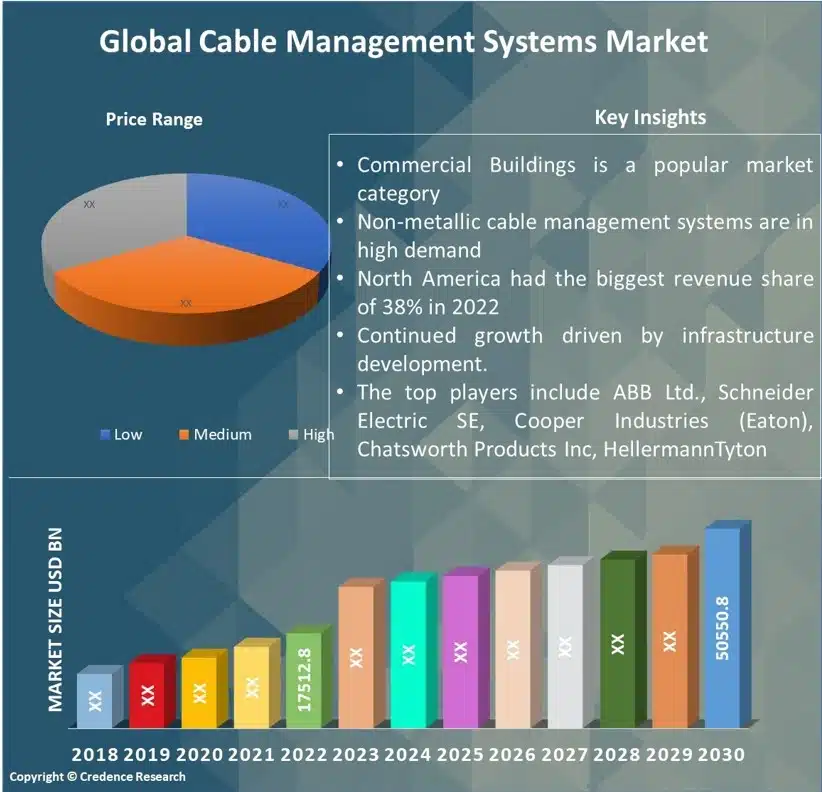
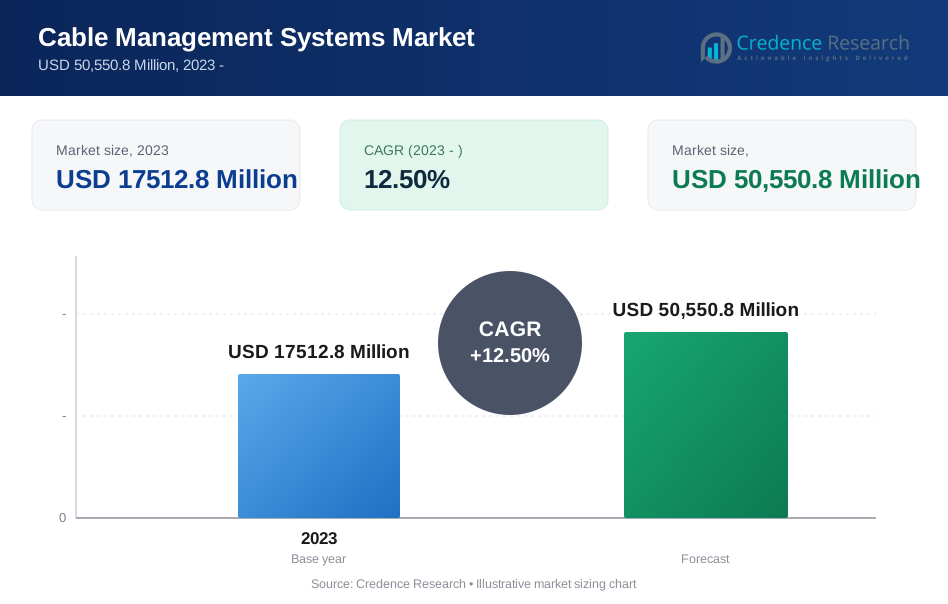
- The global demand for Cable Management Systems was valued at USD 17512.8 Million in 2023 and is expected to reach USD 50550.8 Million in 2032, growing at a CAGR of 12.50% between 2024 and 2032.
- Cable conduits are the market's largest contribution, with cable trays coming in second.
- Non-metallic cable management systems are in great demand in the business, and steel is a major component in the Cable Management Systems Market.
- Commercial Buildings is a popular market category, with Data Centres being the fastest expanding segment.
- IT and Telecom Spiralling need for data communication
- Spiralling demand for data connectivity, and another key sector, Support and Protection.
- Surface-Mounted Cable Management Systems have the most market share. Another popular market segment is Underfloor Cable Management Systems.
- Direct/Manufacturer Sales is the market's largest distributor, and it gives producers more control over the distribution process.
- The most prominent market segment is Fire-Resistant Cable Management Systems.
- North America had the largest revenue share of 38% in 2022, while Europe is predicted to have the highest CAGR over the projection period.
- Rising demand as a result of evolving technology promotes market expansion.
- Inconsistent raw material costs impedes market expansion.
Executive Summary
Market Definition
The Cable Management Systems Market includes goods and solutions for organizing, securing, and protecting cables in a variety of Materials. It covers a diverse range of devices such as cable trays, cable raceways, cable ties, cable clips, and other accessories that aid in cable routing and management. The market serves a variety of sectors, including residential, commercial, industrial, and data centres, where efficient cable management is critical for the safety, organization, and optimal performance of electrical and communication equipment.
Market Overview
The global Cable Management Systems Market has witnessed steady growth in recent years and is expected to grow at a CAGR of 12.50% between 2024 and 2032. The market was valued at USD 17512.8 million in 2023 and is expected to reach USD 50550.8 million in 2032.
The Cable Management Systems Market is seeing rapid expansion and is projected to continue in the coming years. The growing demand for efficient cable organization and management solutions across various sectors is propelling the market forward. Factors such as increased infrastructure development, the necessity for effective cable protection, and the growing usage of new technologies all help to drive market growth. Furthermore, the emphasis on workplace safety standards, combined with the rising complexity of cable networks, is driving demand for novel cable management solutions. The market provides a diverse selection of products and solutions adapted to specific installation requirements, resulting in a vibrant and competitive industry.
Segmentation by Type of Cable Management Systems
- The cable conduits segment is the market's largest contributor and is predicted to increase at a CAGR of 5.5% throughout the forecast period. A conduit system is a series of tubes that protect and route electrical cables in buildings and other structures.
- Cable trays can hold shielded electrical wiring for power distribution and communication. Because of its adaptability and flexibility, the cable tray industry has risen tremendously with increased technical awareness and innovation.
Segmentation by Material
- Non-metallic cable management systems are in high demand in the industry. These systems, such as PVC (Polyvinyl Chloride) and HDPE (High-Density Polyethylene), are widely used due to their versatility, low cost, and ease of installation.
- Steel is a prominent element in the Cable Management Systems Market. Steel cable management systems are renowned for their toughness and longevity. They are often utilized in heavy-duty applications where strength and load-bearing capabilities are required.
Segmentation by Application
- Commercial Buildings is a popular market category. Cable management systems are frequently employed in commercial buildings to organize and secure cables, resulting in more efficient and safe electrical installations.
- Data Centres are the fastest growing segment. With the growing demand for data storage and processing, data centres require reliable cable management solutions to manage the complicated network infrastructure and assure peak performance.
Segmentation by End-User Industry
- Spiralling demand for data communications and a growing need for high-performance data cabling in the IT and telecom industries are expected to drive market growth during the forecast period. The main segment of the telecommunications industry is made up of wired telecommunications carriers, who use management systems when establishing cable networks.
Segmentation by Product Function
- Routing and Securing is the dominant segment. This part focuses on correct cable routing and securing to enable efficient and orderly cable management across a variety of applications.
- Another significant sector is Support and Protection. This segment entails providing support structures and protective measures to avoid damage and extend the life of cables in various conditions.
Segmentation by Installation Type
- Surface-Mounted Cable Management Systems account for the greatest market share. These systems are commonly utilized in a variety of environments, including offices, residential complexes, and commercial spaces, where wires are organized and maintained on the surface of walls or ceilings.
- Another popular market sector is Underfloor Cable Management Systems.
Segmentation by Distribution Channel
- Direct/Manufacturer Sales is the market's major distributor. Manufacturers use this distribution channel to offer their products directly to customers, eliminating the need for intermediaries.
- Direct sales provide producers more control over the distribution process, allowing them to build direct ties with clients and offer specialized services.
Segmentation by Fire Rating
- The most popular market sector is Fire-Retardant Cable Management Systems. These systems are intended to inhibit the spread of fire by utilizing flame-resistant materials capable of withstanding high temperatures.
Segmentation by Region
- North America had the biggest revenue share of 38% in 2022.
- Europe is expected to have the highest CAGR over the forecast period.
- The rest of the world, including Latin America, the Middle East, and Africa, supplies the remaining demand for Cable Management Systems.
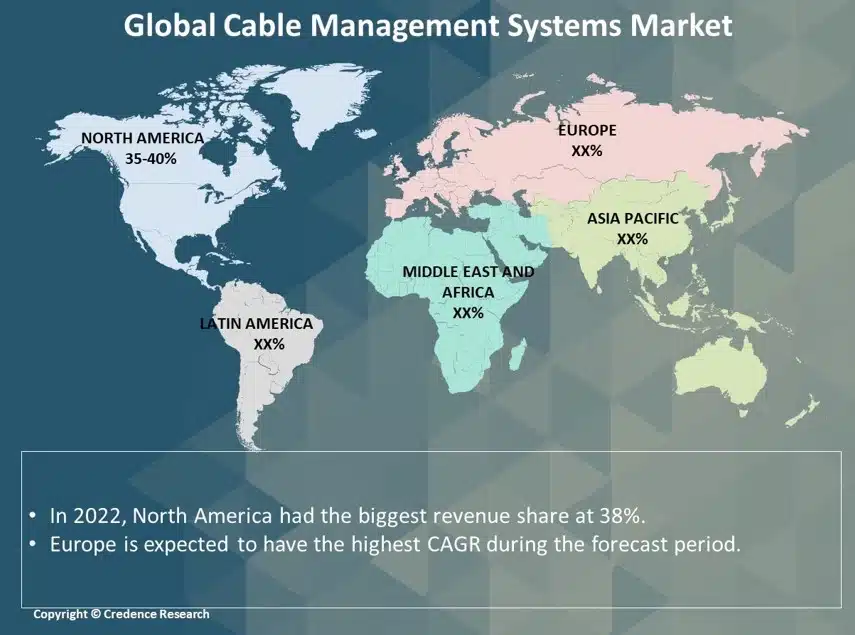
North America is the largest global market shareholder in 2022. Cable management devices have a large growth potential in North America in industries such as IT, construction, manufacturing, healthcare, and others. North America's lifestyle and living standards have also progressed, emphasizing the importance of proper cable management in the residential and commercial sectors, corporate offices, and other settings to ensure safety and minimal maintenance. The area's GDP growth rate contributes to the sluggish adoption of cable management technologies. North America is a major aerospace and space program region, which includes NASA and the USSR. Spiral wraps, lacing tapes, heat shrink tubes, and cable tie wraps are all essential components in the aerospace sector. High Voltage Direct Current (HVDC), HVAC (Heat, Ventilation, and Air Conditioning), MV (Medium Voltage), and other cable systems in submarines provide efficient power transfer between networks with wide coverage.
Europe is predicted to see the highest CAGR during the projection period. The European economy has been recovering since 2012, following the 2009 financial crisis, which hurt countries such as Germany, the United Kingdom, the Netherlands, Russia, and France. The headquarters of 195 of the 500 manufacturing companies on the Fortune Global 500 list are in Europe. Leading European cable management product providers such as Prysmian, Nexans, Legrand, and others operate on a global scale and offer a wide range of products to fulfill customer requirements. Leading economies from around the world, including Greece, Luxembourg, the Netherlands, France, Russia, and others, are helping to drive economic growth in Europe. Cable management products are popular in Europe for the home appliance, infrastructure, information End-User Industry, construction, and industrial industries.
Key Highlights of the Report
The global Cable Management Systems Market is segmented by Type of Cable Management Systems, Material, Applications, End-User Industry, Product Function, Installation Type, Distribution Channel, Fire Rating and region. In 2022, Surface-Mounted Cable Management Systems have the largest market share, and the most popular market segment is Fire-Retardant Cable Management Systems. Furthermore, Data Centres are the fastest growing area, and nonmetallic cable management systems are in high demand in the industry. Additionally, Direct/Manufacturer Sales is the market's primary distributor, with North America leading the market growth.
The market's primary drivers are increasing demand for efficient cable organization and management solutions across sectors, an emphasis on workplace safety laws and compliance, and the growing adoption of new technologies and infrastructure development. Furthermore, high initial installation and maintenance costs, limited knowledge and understanding of the need of appropriate cable management, and difficulties in retrofitting existing infrastructure with cable management systems are the significant limitations of the market.
Nonetheless, In 2022, North America will be the world's largest market shareholder. Cable management devices have a high growth potential in North American industries such as information technology, construction, manufacturing, and healthcare, among others. Furthermore, Europe is expected to have the greatest CAGR during the projection period.
What Are The Main Drivers Of The Global Cable Management Systems Market?
Several main factors are driving the cable management systems market. There is an increasing demand for effective cable organizing and management solutions across sectors. As technology advances, appropriate cable management becomes increasingly critical to guarantee that electrical and communication equipment work optimally and safely. Furthermore, there is a focus on workplace safety rules and compliance, which increases demand for effective cable management systems.
What Are The Major Challenges Faced By The Global Cable Management Systems Market?
While the Cable Management Systems Market is showing promising growth, there are a few factors to consider. One of the most significant problems is the high initial installation and maintenance expenses associated with deploying cable management systems. This may discourage some businesses from investing in these solutions, particularly smaller organizations with limited resources. Furthermore, there is a lack of awareness and understanding of the need of efficient cable management, which may impede market growth.
What Are The Growth Opportunities In The Global Cable Management Systems Market?
The Cable Management Systems Market provides numerous chances for growth and innovation. One of the significant prospects is the growing need for smart and automated cable management systems. As technology advances, including smart features into cable management systems can improve productivity and provide real-time monitoring and control. Another possibility is to expand into emerging areas and increase construction activity. As these markets expand, the demand for dependable and well-organized cable management systems will increase.
Market Drivers
The global Cable Management Systems Market is driven by several factors. The following are the key drivers of the global Cable Management Systems Market:
Rising Demand As A Result Of Advancing Technologies
Technological advancements have raised global demand for energy, high-speed connectivity, massive amounts of bandwidth, and data centralization. The demand for new HVDC cables and cable overheads has also surged dramatically. Effective cable management is critical for safe and efficient resource utilization. The growing public awareness of End-User Industry and its widespread use has pushed the cable management business forward.
Numerous Industrial Verticals
The cable management industry has grown significantly over time due to a growth in the number of Materials in Application sectors. Cable management products are used in a wide range of industries, including information End-User Industry, telecommunications, construction, infrastructure, healthcare, transportation, aerospace, maritime, and others. Cable trays, conduits, raceways, cable chains and reels, and other devices have a high market demand due to their distinct characteristics and functions.
Market Restraints
The global Cable Management Systems Market faces some challenges that may hinder its growth. These include the following:
Inconsistent Raw Material Costs
The market for cables and wires is quite large and diverse. The cable management market's direct end users include the IT, electricity, construction, and telecommunications industries. Copper, rubber, thermoplastics, aluminium, and other materials are common raw materials. Prices fluctuate due to the diverse distribution of raw material suppliers across areas. Changes in raw material prices lead to market instability, and some function as barriers in the worldwide cable management industry.
Opportunities
The global Cable Management Systems Market offers significant growth opportunities. These include the following:
Expansion Of The IT And Telecom Sector
The IT and telecoms industry remains dominant and will continue to grow, creating prospects for the cable management market. One of the world's leading sectors, they have a significant demand for cable management. Cable management products are widely utilized in the communication networks that connect two-thirds of the world's population. Cable trays, rack systems, IT infrastructure, data transmission, and other associated Materials are all experiencing growth in demand.
Competitive Landscape
Key Players
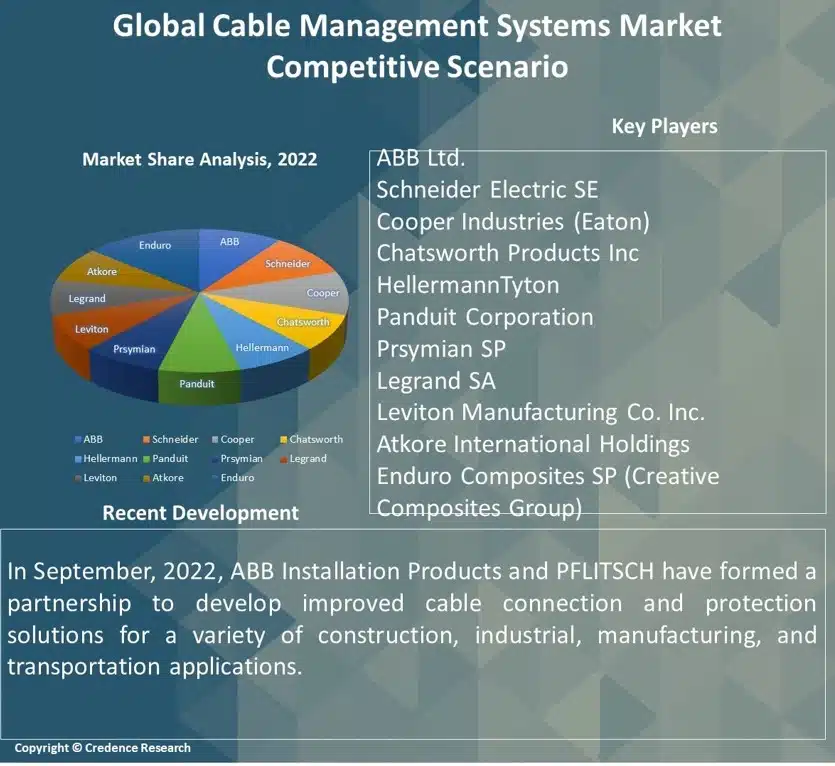
The global Cable Management Systems Market is highly competitive, with several key players. Some of the major players in the market and their market share are as follows:
- ABB Ltd.
- Schneider Electric SE
- Cooper Industries (Eaton)
- Chatsworth Products Inc
- HellermannTyton
- Panduit Corporation
- Prsymian SP
- Legrand SA
- Leviton Manufacturing Co. Inc.
- Atkore International Holdings
- Enduro Composites SP (Creative Composites Group)
These organizations prioritize product innovation, Cable Management Systems Centers expansion, and mergers and acquisitions to stay competitive.
The global Cable Management Systems Market's key players continually seek to stay ahead by offering new products and developments.
In January 2023, The Houdson Group has formed a new cooperation with Wibe Group to deliver specialized cable management solutions for corrosive and hazardous situations. This agreement is intended to see Wibe cable ladders and Mita Glass Reinforced Polymer (GRP) containment products supplied in the UK under 'Milton,' a new division of the Hudson Group.
In September 2022, ABB Ltd. announced that it would invest USD 13 million in its Installation Products Division's Iberville manufacturing plant in Saint-Jean-sur-Richelieu, Quebec, to increase production capacity and establish a research and development facility at its cable tray manufacturing centre.
Summary of Key Findings
- Growth of the IT and telecom sectors
- Market segmented by Type of Cable Management Systems, Material, Applications, End-User Industry, Product Function, Installation Type, Distribution Channel, Fire Rating and region.
- Surface-Mounted Cable Management Systems account for the largest market shar
- The most popular market sector is Fire-Retardant Cable Management Systems
- North America is leading market growth; the market is highly competitive with key players including ABB Ltd., Schneider Electric SE, Cooper Industries (Eaton), Chatsworth Products Inc, HellermannTyton, Panduit Corporation and Others.
Future Outlook
- Continued growth driven by infrastructure development.
- Increasing demand for advanced cable protection solutions.
- Adoption of innovative technologies for efficient cable management.
- Emphasis on workplace safety regulations driving market expansion.
- Growing complexity of cable networks boosting the need for organized solutions.
How CXOs Can Benefit from the Credence Research Cable Management Systems Market Report
The Credence Research Cable Management Systems Market Report provides CXOs with a comprehensive overview of the market, including:
- Market size and growth forecast: The report provides detailed estimates of the global Cable Management Systems Market size, segmented by Type of Cable Management Systems, Material, Applications, End-User Industry, Product Function, Installation Type, Distribution Channel, Fire Rating and region. It also includes forecasts for the market through 2032, based on key trends and drivers.
- Market segmentation: The report segments the Cable Management Systems Market by Type of Cable Management Systems, Material, Applications, End-User Industry, Product Function, Installation Type, Distribution Channel, Fire Rating and region. This segmentation provides CXOs with a granular understanding of the market and the opportunities in each segment.
- Competitive landscape: The report profiles the key players in the Cable Management Systems Market and provides insights into their strategies, product offerings, and financial performance. This information can help CXOs to identify and assess their competition.
- Key trends and drivers: The report identifies and analyzes the key trends and drivers that are shaping the Cable Management Systems Market. This information can help CXOs to make informed decisions about their investments and strategies.
CXOs can use the insights from the Credence Research Cable Management Systems Market Report to:
- Identify growth opportunities: The report can help CXOs to identify new growth opportunities in the Cable Management Systems Market. For example, it can provide insights into emerging technologies, market trends, and customer demands. This information can guide CXOs in identifying untapped market segments and developing strategies to capitalize on these opportunities.
- Make informed investment decisions: The report can help CXOs to make informed investment decisions about Cable Management Systems. For example, it provides valuable market insights, including market size, growth rate, competitive landscape, and key trends. This information can guide CXOs in evaluating investment opportunities and developing effective strategies for their businesses in the Cable Management Systems market.
- Develop competitive strategies: The report can help CXOs to develop competitive strategies for their Cable Management Systems businesses. For example, it provides in-depth analysis of market dynamics, including key players, market share, and competitive landscape. With this valuable information, CXOs can identify their strengths, weaknesses, and opportunities, allowing them to develop effective strategies to stay ahead in the Cable Management Systems market.
- Track market developments: The report can help CXOs to track market developments and stay ahead of the curve. For example, the report provides insights into the latest trends and innovations in the Cable Management Systems Market.
Overall, the Credence Research Cable Management Systems Market Report is a valuable resource for CXOs who are looking to gain a deeper understanding of the market and identify opportunities for growth.
Segmentation
By Type of Cable Management Systems:
- Cable Trays:
- Ladder Trays
- Wire Mesh Trays
- Solid Bottom Trays
- Channel Trays
- Cable Conduits
- Raceways:
- Surface-Mounted Raceways
- Flush-Mounted Raceways
- Cable Glands and Connectors
- Cable Lugs and Tools
- Cable Markers and Labels
- Cable Ties and Clips
- Cable Sleeves and Wraps
By Material:
- Metal Cable Management Systems
- Steel
- Aluminum
- Stainless Steel
- Non-Metallic Cable Management Systems
- PVC (Polyvinyl Chloride)
- HDPE (High-Density Polyethylene)
- Others
By Application:
- Commercial Buildings
- Data Centers
- Industrial Facilities
- Residential Buildings
- Others
By End-User Industry:
- IT and Telecom
- Manufacturing
- Energy and Utility
- Healthcare
- Mining
- Oil and Gas
- Transportation
- Others
By Product Function:
- Organizing and Sorting
- Support and Protection
- Routing and Securing
- Connection and Termination
By Installation Type:
- Surface-Mounted Cable Management Systems
- Underfloor Cable Management Systems
- Flush-Mounted Cable Management Systems
By Distribution Channel:
- Direct Sales/Manufacturer Sales
- Distributors
- E-commerce Platforms
By Fire Rating:
- Fire-Retardant Cable Management Systems
- Non-Fire-Retardant Cable Management Systems
By Region
- North America
- The U.S.
- Canada
- Mexico
- Europe
- Germany
- France
- The U.K.
- Italy
- Spain
- Rest of Europe
- Asia Pacific
- China
- Japan
- India
- South Korea
- South-east Asia
- Rest of Asia Pacific
- Latin America
- Brazil
- Argentina
- Rest of Latin America
- Middle East & Africa
- GCC Countries
- South Africa
- Rest of Middle East and Africa
Request a Free Sample
Fill in your details and we'll send you a free sample report.
- Sample data tables & charts
- Research methodology
Need a Custom Version of This Report?
Tailor the scope, geography, or segments to your exact requirements.
- Custom geography or segment scope
- Direct access to our analyst team
Frequently Asked Questions
What is the current size of the global Cable Management Systems Market?
What is the expected growth rate of the Cable Management Systems Market between 2024 and 2032?
Which segment is leading the market share in terms of Type of Cable Management Systems?
Which Material segment governs the demand for Product Function?
Who are the major players in the global Cable Management Systems Market?
Table of Content
Chapter 1. Report Introduction
- 1.1 Report Description & Purpose
- 1.1.1 Report Title & Market Definition
- 1.1.2 Unique Selling Propositions (USP) & Key Differentiators
- 1.1.3 Value Proposition for Stakeholders
- 1.2 Research Objectives
- 1.2.1 Market Sizing Objectives (Volume & Revenue)
- 1.2.2 Segmentation Objectives
- 1.2.3 Competitive Intelligence Objectives
- 1.2.4 Forecast & Scenario Objectives
- 1.3 Report Scope
- 1.3.1 Cable Management Systems Scope – Types & Subtypes Covered
- 1.3.2 Geographic Scope – Regions & Countries Covered
- 1.3.3 Historical Period, Base Year & Forecast Period (2023; forecast to the forecast period)
- 1.3.4 Inclusions & Exclusions
- 1.4 HS Code & Classification Framework
- 1.5 Currency, Units & Pricing Basis
- 1.6 Target Stakeholders
- 1.7 Limitations & Assumptions
Chapter 2. Executive Summary
- 2.1 Global Cable Management Systems Market Snapshot
- 2.1.1 Market Size – Historical (2023) & Forecast (the forecast period) (2023: USD 17512.8 Million → forecast year: USD 50,550.8 Million)
- 2.1.2 Volume & Revenue – Global Totals
- 2.1.3 Key Market Highlights – Top Five Facts
- 2.2 Cable Management Systems Market Segmentation Snapshot
- 2.2.1 Market Split by Region – 2023 vs.
- 2.3 Competitive Snapshot
- 2.3.1 Top 10 Players by Revenue Share – 2023
- 2.3.2 Top 10 Players by Volume Share – 2023
- 2.3.3 Recent Strategic Developments (18-Month Summary)
- 2.4 Key Investment Highlights & Strategic Conclusions
Chapter 3. Cable Management Systems Market Dynamics & Industry Analysis
- 3.1 Market Overview & Context
- 3.1.1 Cable Management Systems Market Position in the Broader Automotive Value Chain
- 3.1.2 OEM vs. Replacement Market Dynamics
- 3.1.3 Market Maturity & Development Stage by Region
- 3.2 Cable Management Systems Market Drivers
- 3.3 Cable Management Systems Market Restraints & Challenges
- 3.4 Cable Management Systems Market Opportunities
- 3.5 Porter's Five Forces Analysis
- 3.5.1 Threat of New Entrants
- 3.5.2 Bargaining Power of Suppliers
- 3.5.3 Bargaining Power of Buyers
- 3.5.4 Threat of Substitutes
- 3.5.5 Competitive Rivalry – Intensity Assessment
- 3.6 Cable Management Systems Value Chain Analysis
- 3.6.1 Upstream – Raw Material/Input Suppliers
- 3.6.1.1 Raw Material/Input 1
- 3.6.1.2 Raw Material/Input 2
- 3.6.1.3 Raw Material/Input 3
- 3.6.2 Midstream – Production/Manufacturing/Service Delivery
- 3.6.2.1 Production/Process Overview
- 3.6.2.2 Key Facility Locations & Capacity by Manufacturer
- 3.6.3 Downstream – Distribution & End Consumer
- 3.6.3.1 Primary Channel – B2B/OEM
- 3.6.3.2 Secondary Channels – Dealer, Retail, Online, Direct
- 3.6.4 Value Chain Profitability Analysis
- 3.6.1 Upstream – Raw Material/Input Suppliers
- 3.7 PESTEL Analysis
- 3.7.1 Political Factors
- 3.7.2 Economic Factors
- 3.7.3 Social Factors
- 3.7.4 Technological Factors
- 3.7.5 Environmental Factors
- 3.7.6 Legal Factors
- 3.8 Cable Management Systems Supply Chain Analysis
- 3.8.1 Raw Material/Input Supply Risk Assessment
- 3.8.2 Manufacturing Concentration Risk (Geographic Exposure)
- 3.8.3 Trade Disruption Impact Analysis
- 3.9 Regulatory & Policy Landscape
Note: The regulatory and policy landscape section covers regulations based on their applicability to the market, Cable Management Systems category, geography, and scope of the study. Only regulatory frameworks with a material impact on operations, compliance, trade, sustainability, or market access are analyzed in detail.
Chapter 4. Key Investment Pockets & Opportunity Analysis
- 4.1 Cable Management Systems Market Attractiveness Analysis
- 4.1.1 By Region – Investment Attractiveness Matrix (Volume × CAGR)
- 4.2 Absolute Revenue Growth Opportunity
- 4.2.1 By Region – Absolute USD Growth Through the forecast period
- 4.3 Incremental Volume Opportunity
- 4.3.1 By Region – Incremental Volume Through the forecast period
- 4.3.2 Segment – Incremental Volume
- 4.4 Emerging Submarket Opportunity Deep Dive (Subject to Applicability)
- 4.5 Emerging Market Opportunity Scorecards
- 4.5.1 United States
- 4.5.2 Europe
- 4.5.3 Asia
- 4.5.4 Middle East & Africa
Note: Emerging Market Opportunity Scorecards will be included based on relevance and strategic importance. Regions listed are indicative and may vary depending on data availability and market dynamics.
Chapter 5. Cable Management Systems Import-Export Analysis & Trade Flows
- 5.1 Global Trade Overview
- 5.1.1 Global Export Value by Country (2023)
- 5.1.2 Global Export Volume by Country (2023)
- 5.1.3 Global Import Value by Country (2023)
- 5.1.4 Global Import Volume by Country (2023)
- 5.1.5 Net Trade Balance by Country (2023)
- 5.2 Export Analysis – Segment
- 5.2.1 Type 1 (HS Code)
- 5.2.2 Type 2 (HS Code)
- 5.2.3 Type 3 (HS Code)
- 5.2.4 Type 4 (HS Code)
- 5.2.5 Type 5 (HS Code)
- 5.3 Import Analysis – Segment
- 5.3.1 Type 1 (HS Code)
- 5.3.2 Type 2 (HS Code)
- 5.3.3 Type 3 (HS Code)
- 5.3.4 Type 4 (HS Code)
- 5.3.5 Type 5 (HS Code)
- 5.4 Average Unit Trade Prices
- 5.4.1 Average Export Price – Segment & Country
- 5.4.2 Average Import Price – Segment & Source Country
- 5.4.3 Price Trends (2023)
- 5.5 Key Trade Route Analysis
- 5.5.1 Trade Route 1
- 5.5.2 Trade Route 2
- 5.5.3 Trade Route 3
- 5.5.4 Trade Route 4
- 5.5.5 Trade Route 5
- 5.6 Trade Policy Impact Assessment
- 5.6.1 US Anti-Dumping & Section 301 Tariffs
- 5.6.2 EU Customs Union Impact
- 5.6.3 Major Free Trade Agreements
- 5.6.4 USMCA Rules of Origin
Note: Trade policy analysis will be included only where relevant to the Cable Management Systems market.
Chapter 6. Competitive Landscape & Company Benchmarking
- 6.1 Cable Management Systems Market Concentration & Structure
- 6.1.1 Herfindahl-Hirschman Index (HHI) – vs. 2023
- 6.1.2 Tier 1, Tier 2 & Tier 3 Market Structure
- 6.1.3 Global, Regional & Local Player Dynamics
- 6.2 Cable Management Systems Market Share Analysis – 2023
- 6.2.1 Global Revenue Share by Company
- 6.2.2 Global Volume Share by Company
- 6.2.3 Regional Revenue Share
- 6.2.4 Market Share Evolution ( vs. 2023)
- 6.2.5 OEM Segment Share by Company
- 6.2.6 Replacement Segment Share by Company
- 6.3 Production/Delivery Capacity & Facility Analysis
- 6.3.1 Global Installed Capacity
- 6.3.2 Capacity Utilization Rates
- 6.3.3 Production/Output Volume
- 6.3.4 Facility Locations & Capacity Map
- 6.3.5 Planned Capacity Additions
- 6.4 Cable Management Systems Competitive Benchmarking Matrix
- 6.4.1 Revenue, Volume, CAGR & Profitability Comparison
- 6.4.2 Channel Revenue Mix
- 6.4.3 Geographic Revenue Exposure
- 6.4.4 R&D Intensity
- 6.4.5 Sustainability Maturity
- 6.5 Strategic Developments in Cable Management Systems (Last 24 Months)
- 6.5.1 Mergers, Acquisitions & Divestments
- 6.5.2 New Cable Management Systems Launches
- 6.5.3 Facility Expansions
- 6.5.4 Strategic Alliances, Joint Ventures & Partnerships
- 6.5.5 Distribution Expansion & Market Entry
- 6.5.6 Sustainability & ESG Initiatives
- 6.6 Competitive Strategy Mapping
- 6.6.1 Leader, Challenger, Follower & Niche Classification
- 6.6.2 Pricing Strategy Comparison
- 6.6.3 Channel Strategy Matrix
Note: Strategic developments are included based on their materiality and the availability of reliable information.
Chapter 7. Global Cable Management Systems Market – By Distribution Channel
- 7.1 Segment Overview
- 7.1.1 Volume & Revenue Split by Channel (2023 & )
- 7.1.2 Channel Mix Evolution (the forecast period)
Chapter 8. Regional Market Analysis – Global Overview
- 8.1 Global Regional Overview
- 8.1.1 Regional Volume Share
- 8.1.2 Regional Revenue Share
- 8.1.3 Regional Volume by Region
- 8.1.4 Regional Revenue by Region
- 8.1.5 Regional Forecast Through the forecast period
- 8.2 Cross-Regional Segment Analysis
- 8.2.1 By Distribution Channel
- 8.2.2 By Brand/Price Tier
Chapter 9. North America Cable Management Systems Market
- 9.1 United States
- 9.2 Canada
- 9.3 Mexico
Chapter 10. Europe Cable Management Systems Market
- 10.1 Germany
- 10.2 France
- 10.3 Italy
- 10.4 United Kingdom
- 10.5 Spain
- 10.6 Poland
- 10.7 Russia
- 10.8 Netherlands
- 10.9 Belgium
- 10.10 Sweden
- 10.11 Denmark
- 10.12 Norway
- 10.13 Rest of Europe
Chapter 11. Asia Pacific Cable Management Systems Market
- 11.1 China
- 11.2 India
- 11.3 Japan
- 11.4 South Korea
- 11.5 Thailand
- 11.6 Indonesia
- 11.7 Vietnam
- 11.8 Malaysia
- 11.9 Australia
- 11.10 Rest of Asia Pacific
Chapter 12. Latin America Cable Management Systems Market
- 12.1 Brazil
- 12.2 Argentina
- 12.3 Colombia
- 12.4 Chile
- 12.5 Rest of Latin America
Chapter 13. Middle East Cable Management Systems Market
- 13.1 Saudi Arabia
- 13.2 United Arab Emirates
- 13.3 Turkey
- 13.4 Israel
- 13.5 Iran
- 13.6 Rest of the Middle East
Chapter 14. Africa Cable Management Systems Market
- 14.1 South Africa
- 14.2 Egypt
- 14.3 Nigeria
- 14.4 Morocco
- 14.5 Rest of Africa
Chapter 15. Cable Management Systems Company Profiles
- 15.1 [Company 01]
- 15.1.1 Company Overview
- 15.1.2 Key Management Personnel
- 15.1.3 Products & Services Portfolio
- 15.1.4 Financial Performance
- 15.1.5 Key Market Focus & Geographic Presence
- 15.1.6 Recent Developments & Strategic Initiatives
Note: The company profile list is preliminary and may change based on research findings, market developments, data availability, and client requirements.
Chapter 16. Appendices
- Appendix A – List of Abbreviations & Acronyms
- Appendix B – Industry Classification Code Reference – Full Series
- Appendix C – Production & Capacity Data Tables
- Appendix D – End-Use & Demand Base Tables
- Appendix E – Consumption & Replacement Rate Assumptions
- Appendix F – ASP Reference Tables
- Appendix G – Manufacturing & Facility Database
- Appendix H – Import-Export Data Tables
- Appendix I – Regulatory Summary Tables
- Appendix J – Primary Research Participant List (Anonymized)
- Appendix K – Primary Research Questionnaire Framework
- Appendix L – Data Sources & Bibliography
- Appendix M – Market Size Divergence & Source Comparison
Chapter 17. Research Methodology
- 17.1 Research Framework & Philosophy
- 17.2 Secondary Research – Sources, Hierarchy & Data Extraction
- 17.3 Data Modeling – Bottom-Up & Top-Down Market Sizing
- 17.4 Primary Research – Stakeholder Framework, LOI & Sample Sizes
- 17.5 Forecast Methodology – Regression, Scenario & Sensitivity Analysis
- 17.6 Quality Control – Four-Layer Validation Framework
- 17.7 Limitations & Standard Assumptions
- 17.8 Disclaimer
