
Market Overview
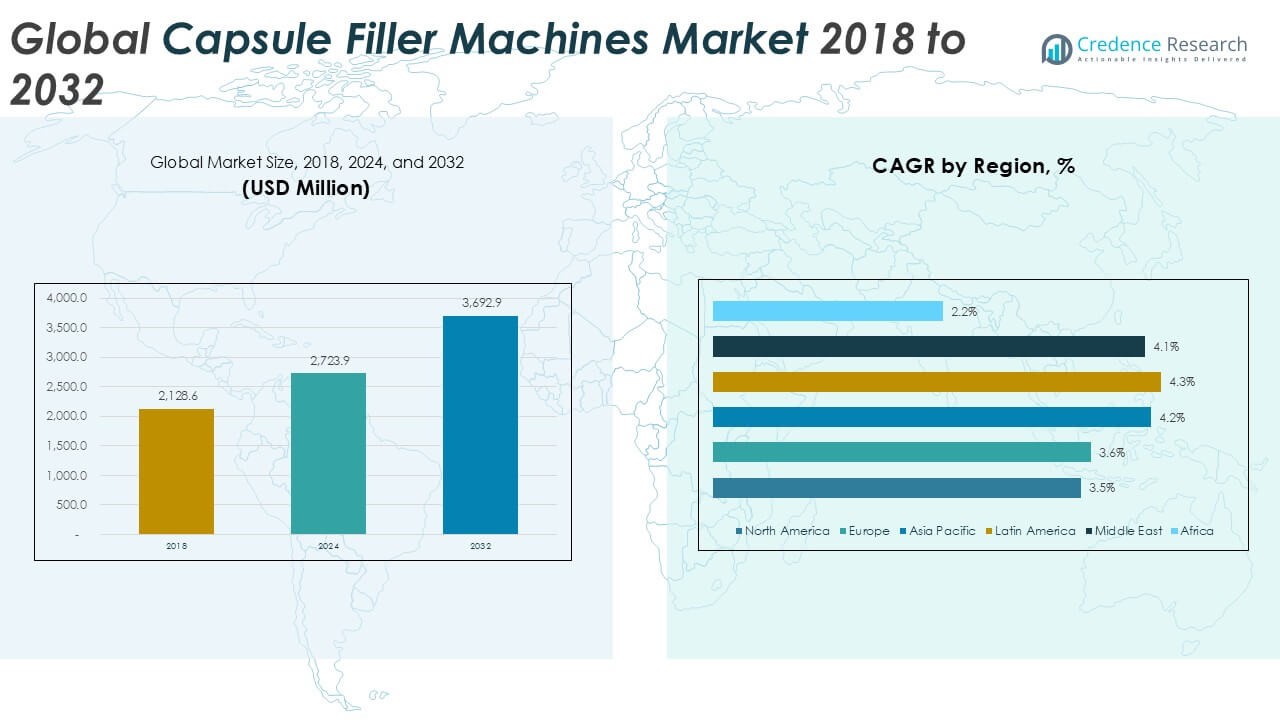
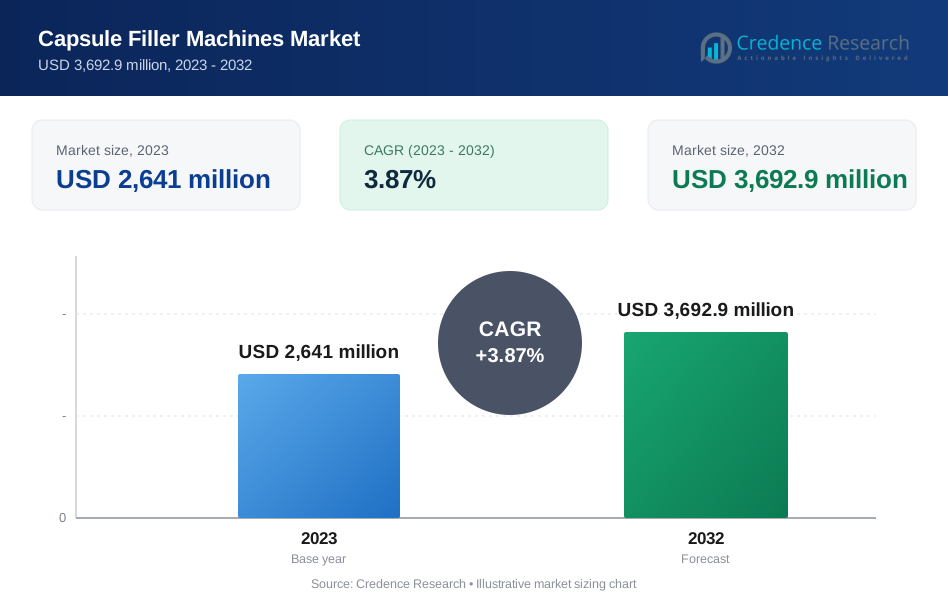
The Global Capsule Filler Machines Market is projected to grow from USD 2,723.9 million in 2024 to an estimated USD 3,692.9 million by 2032, with a compound annual growth rate (CAGR) of 3.87% from 2025 to 2032.
| REPORT ATTRIBUTE | DETAILS |
|---|---|
| Historical Period | 2020-2023 |
| Base Year | 2024 |
| Forecast Period | 2025-2032 |
| Capsule Filler Machines Market Size 2024 | USD 2,723.9 Million |
| Capsule Filler Machines Market, CAGR | 3.87% |
| Capsule Filler Machines Market Size 2032 | USD 3,692.9 Million |
Market growth is propelled by several key factors including the growing need for high-speed, precision-based capsule filling solutions in the pharmaceutical industry. A notable trend is the shift toward fully automated machines that reduce operational errors and enhance productivity. Additionally, the increasing use of herbal and nutraceutical products in capsule form has boosted demand for capsule filler machines. Industry players are also focusing on technological innovations such as real-time monitoring and integration with smart factory systems to cater to GMP and FDA compliance requirements, further driving market development.
Geographically, North America dominates the global market due to advanced pharmaceutical infrastructure and high R\&D spending. Europe follows closely, supported by a strong generics market and favorable regulatory frameworks. The Asia Pacific region is witnessing the fastest growth, particularly in countries like China and India, where pharmaceutical manufacturing is rapidly expanding. Key players operating in this market include Bosch Packaging Technology, Capsugel (Lonza), MG2, IMA Group, and ACG Worldwide.
Market Insights
- The Global Capsule Filler Machines Market is projected to grow from USD 2,723.9 million in 2024 to USD 3,692.9 million by 2032, registering a CAGR of 3.87% from 2025 to 2032.
- Market expansion is supported by increasing demand for pharmaceutical capsules, particularly for chronic disease treatment and preventive healthcare.
- Rising adoption of automated and precision-based capsule filling machines enhances production efficiency and reduces operational errors.
- High capital investment and ongoing maintenance costs pose challenges for small and mid-sized manufacturers.
- Technological complexity and a shortage of skilled operators restrict the smooth implementation of advanced machines.
- Asia Pacific leads global growth with over 36% market share, driven by manufacturing expansion in China and India.
- North America and Europe maintain strong market positions due to robust infrastructure, regulatory compliance, and high R\&D spending.
Market Drivers
Rising Demand for Pharmaceutical and Nutraceutical Capsules Accelerates Equipment Adoption
The Global Capsule Filler Machines Market is witnessing strong growth due to increasing demand for capsules in both pharmaceutical and nutraceutical applications. Consumers prefer capsules for their ease of swallowing, faster dissolution, and ability to mask unpleasant tastes. Pharmaceutical manufacturers are increasing production to meet growing demand for chronic disease treatments, preventive supplements, and personalized medication. Nutraceutical companies are expanding product portfolios to include plant-based and dietary supplements in capsule form. Capsule filler machines enable high-volume, consistent production, which is critical for both industries. It supports scalability and compliance with stringent quality standards, further solidifying its importance across sectors.
- For instance, Lonza, a leading capsule manufacturer, reported producing over 250,000,000,000 hard capsules globally in 2024 to supply pharmaceutical and nutraceutical companies, illustrating the scale of demand driving equipment adoption.
Automation and Precision in Capsule Filling Support Operational Efficiency
The Global Capsule Filler Machines Market benefits from the industry’s shift toward automation and precision engineering. Pharmaceutical companies seek solutions that reduce manual errors, minimize material waste, and shorten production cycles. Automated capsule fillers offer real-time monitoring, better control over fill weight, and integration with smart manufacturing systems. These features help meet regulatory compliance and improve operational output. It also allows small and mid-sized manufacturers to compete by optimizing resources and maintaining quality. This drive for efficiency and consistency continues to push demand for advanced capsule filling equipment.
- For instance more than 3,500 fully automated capsule filling machines were installed in pharmaceutical manufacturing plants across India and China in a single year, reflecting the rapid adoption of automation to boost efficiency and output.
Growing Generic Drug Production Strengthens Equipment Investments
The Global Capsule Filler Machines Market experiences growth from the rising production of generic drugs. Governments and healthcare providers promote generics to lower healthcare costs and improve medicine accessibility. Capsule filler machines play a central role in producing large volumes of generic drugs with consistent quality. Manufacturers invest in equipment that ensures speed, accuracy, and flexibility to handle multiple drug formulations. It enables cost-effective manufacturing while adhering to global regulatory standards. This trend fuels strong demand for both semi-automatic and fully automatic capsule filler machines.
Expansion of Pharmaceutical Manufacturing Facilities in Emerging Markets
The Global Capsule Filler Machines Market gains momentum from the expansion of pharmaceutical manufacturing in Asia Pacific, Latin America, and the Middle East. Countries such as India and China have become manufacturing hubs due to skilled labor, supportive policies, and cost advantages. Local and multinational companies establish new facilities or upgrade existing ones to meet global demand. Capsule filler machines are essential for meeting production targets and achieving GMP compliance. It helps companies scale output while maintaining product safety and efficiency. This industrial growth boosts long-term investments in capsule filling technologies.
Market Trends
Shift Toward Fully Automatic Machines Drives Technological Advancement
The Global Capsule Filler Machines Market is moving toward full automation to meet the growing need for precision and speed. Manufacturers are replacing manual and semi-automatic systems with fully automatic machines that offer higher throughput and better fill accuracy. These machines reduce human intervention, lower contamination risks, and support round-the-clock operations. It enables pharmaceutical companies to scale production efficiently while ensuring compliance with quality standards. Technological improvements include touch-screen interfaces, programmable controls, and data integration features. These developments support operational transparency and help manufacturers align with regulatory requirements.
- For instance, in 2024, a leading pharmaceutical equipment manufacturer reported delivering over 1,800 fully automatic capsule filler machines to production sites worldwide, with major installations in India, China, and the United States, according to company shipment records and industry surveys.
Integration of Smart Factory Solutions Enhances Production Monitoring
The adoption of Industry 4.0 principles is shaping the Global Capsule Filler Machines Market by enabling intelligent and connected manufacturing. Manufacturers are integrating capsule fillers with centralized monitoring systems and IoT-enabled devices. It allows real-time performance tracking, predictive maintenance, and remote diagnostics. These capabilities improve uptime, reduce operational disruptions, and support consistent product quality. The shift toward data-driven decision-making is influencing equipment design and supplier offerings. Companies are focusing on machines that can seamlessly connect to enterprise resource planning (ERP) and manufacturing execution systems (MES).
- For instance, in 2024, more than 420 pharmaceutical manufacturing plants in Europe and Asia integrated IoT-enabled capsule filler machines with centralized monitoring systems, as documented in an industry association survey and government technology adoption reports.
Rising Use of Capsule Fillers in Nutraceutical and Herbal Sectors
The Global Capsule Filler Machines Market is expanding beyond pharmaceutical applications into nutraceuticals and herbal supplement production. Consumers are showing stronger preference for natural, plant-based products in capsule form. Nutraceutical firms are increasing production capacity to cater to global wellness trends. It drives the demand for flexible machines that can handle diverse powder, granule, or liquid-based formulations. Equipment manufacturers are designing machines compatible with sensitive and organic ingredients. This shift is opening new opportunities and reshaping market dynamics for filler technologies.
Demand for Customization and Versatility in Capsule Filling Equipment
The Global Capsule Filler Machines Market is seeing a rise in demand for machines that offer customization and versatility. Manufacturers are developing modular equipment that allows quick changeovers between capsule sizes, fill materials, and batch volumes. It supports small-batch production and personalized medicine trends gaining traction in regulated markets. Pharmaceutical firms seek equipment that can handle multi-product lines with minimal downtime. The need for high-speed operation without sacrificing flexibility is influencing new product development. Custom solutions are becoming essential to remain competitive and responsive to evolving production needs.
Market Challenges
High Capital Investment and Maintenance Costs Restrain Market Adoption
The Global Capsule Filler Machines Market faces challenges due to the significant upfront investment required for advanced machinery. High-precision automatic machines often come with substantial procurement and installation costs, limiting accessibility for small and mid-sized manufacturers. Maintenance expenses, including spare parts and technical support, add to the financial burden. It creates hesitation among businesses with limited budgets or those operating in price-sensitive markets. The cost factor also slows equipment upgrades in facilities using older systems. Manufacturers must weigh return on investment against evolving production needs.
- For instance, industry data shows that new capsule fillers typically range from 15,000 to 150,000 units for standard models, while high-performance automatic machines can cost up to 500,000 units. Maintenance and spare parts can add tens of thousands of units annually to operational expenses, making such investments a significant hurdle for smaller manufacturers
Technical Complexity and Operator Skill Gaps Hinder Operational Efficiency
The Global Capsule Filler Machines Market encounters obstacles from the complexity of modern machines and the need for skilled operators. Fully automatic systems demand technical knowledge for setup, calibration, and troubleshooting. A lack of trained personnel can lead to errors, inefficiencies, or prolonged downtimes. It impacts production continuity and reduces confidence in adopting high-end equipment. In regions with limited access to technical education or training programs, this challenge becomes more pronounced. Manufacturers must invest in operator training and ongoing support to ensure effective machine use.
Market Opportunities
Expansion of Contract Manufacturing and CDMO Sector Creates Strong Demand
The Global Capsule Filler Machines Market holds significant opportunity due to the expanding role of contract development and manufacturing organizations (CDMOs). Pharmaceutical and nutraceutical companies increasingly outsource production to reduce costs and focus on core R\&D activities. CDMOs invest in high-capacity, flexible capsule filling machines to handle diverse client needs. It supports quick turnaround times and ensures compliance with international standards. This growing demand for third-party manufacturing boosts equipment sales and encourages innovation in modular and scalable machine designs. Equipment suppliers can tap into this trend by offering tailored solutions and service contracts.
Rising Demand for Personalized Medicine and Small-Batch Production
The Global Capsule Filler Machines Market benefits from the growing focus on personalized medicine and targeted therapies. Manufacturers need equipment that supports small-batch production without compromising speed or accuracy. It opens opportunities for compact, semi-automatic machines with quick changeover capabilities. Regulatory support for customized treatments, especially in oncology and rare diseases, further drives this shift. Machine builders who offer flexible and user-friendly equipment will gain a competitive edge. The market will continue to grow in regions emphasizing innovation-driven healthcare and patient-centric drug delivery.
Market Segmentation Analysis
By Machines
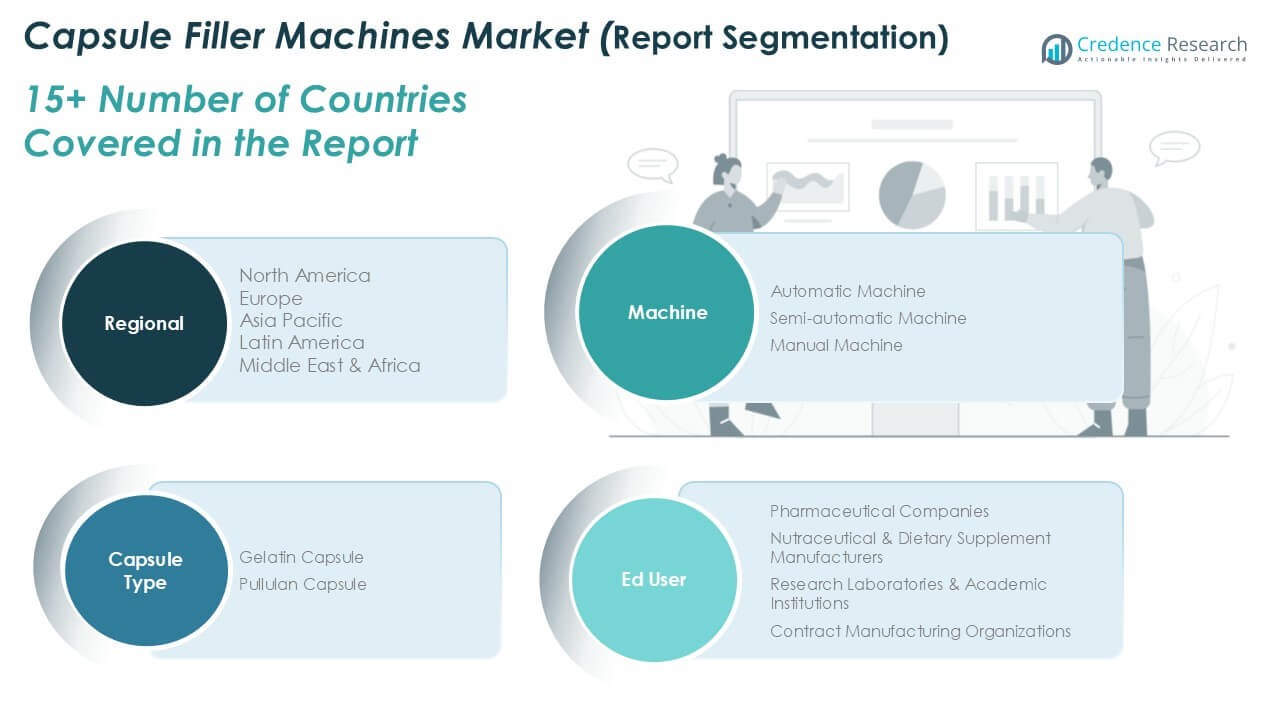
The Global Capsule Filler Machines Market is segmented by machine type into automatic, semi-automatic, and manual machines. Automatic machines hold the largest market share due to their ability to support high-speed, large-scale production with minimal human intervention. Pharmaceutical manufacturers prefer them for their precision, efficiency, and compliance with GMP standards. Semi-automatic machines remain popular among mid-sized and specialty producers seeking a balance between automation and flexibility. Manual machines serve niche or low-volume applications, especially in academic institutions and small labs. It continues to evolve with increased demand for faster, integrated systems tailored to varying production needs.
- For instance, a leading industry survey reported that over 14,000 automatic capsule filling machines were installed in pharmaceutical production facilities worldwide as of 2024.
By Capsule
Based on capsule type, the market is divided into gelatin and pullulan capsules. Gelatin capsules dominate the market due to their widespread use in pharmaceutical and nutraceutical applications. They offer affordability, ease of manufacture, and a long-standing history of regulatory acceptance. Pullulan capsules are gaining traction among vegetarian and vegan consumers, especially in health supplements. It supports clean-label and plant-based product lines, making them a preferred option for nutraceutical brands. This shift encourages equipment manufacturers to design machines compatible with both capsule types.
- For instance, global industry data indicate that more than 400 billion gelatin capsules were produced for pharmaceutical and nutraceutical use in 2023, compared to approximately 28 billion pullulan capsules.
By End User
The end user segmentation includes pharmaceutical companies, nutraceutical and dietary supplement manufacturers, research laboratories and academic institutions, and contract manufacturing organizations (CMOs). Pharmaceutical companies lead the market, driven by high production volume and compliance needs. Nutraceutical firms are expanding rapidly, fueled by growing wellness awareness and supplement demand. CMOs are increasing their machine investments to meet outsourced production requirements. It provides scalability and quick product changeovers. Research institutions use capsule fillers for trials and innovation, contributing to steady demand in this segment.
Segments
Based on Machines
- Automatic Machines
- Semi-automatic Machines
- Manual Machines
Based on Capsule
- Gelatin Capsule
- Pullulan Capsule
Based on End User
- Pharmaceutical Companies
- Nutraceutical & Dietary Supplement Manufacturers
- Research Laboratories & Academic Institutions
- Contract Manufacturing Organizations
Based on Region
- North America
- U.S.
- Canada
- Mexico
- Europe
- UK
- France
- Germany
- Italy
- Spain
- Russia
- Belgium
- Netherlands
- Austria
- Sweden
- Poland
- Denmark
- Switzerland
- Rest of Europe
- Asia Pacific
- China
- Japan
- South Korea
- India
- Australia
- Thailand
- Indonesia
- Vietnam
- Malaysia
- Philippines
- Taiwan
- Rest of Asia Pacific
- Latin America
- Brazil
- Argentina
- Peru
- Chile
- Colombia
- Rest of Latin America
- Middle East
- UAE
- KSA
- Israel
- Turkey
- Iran
- Rest of Middle East
- Africa
- Egypt
- Nigeria
- Algeria
- Morocco
- Rest of Africa
Regional Analysis
North America Capsule Filler Machines Market
The North America Capsule Filler Machines Market reached a value of USD 468.90 million in 2024 and is projected to reach USD 619.68 million by 2032, growing at a CAGR of 3.5%. It accounts for approximately 17.2% of the global market share in 2024. The United States dominates the regional landscape with its advanced pharmaceutical infrastructure and high R\&D investments. Increasing production of generics and continuous innovation in drug delivery support steady equipment demand. Pharmaceutical companies in the region invest heavily in automation and compliance technologies. It strengthens the market position through early adoption of smart capsule filling systems.
Europe Capsule Filler Machines Market
The Europe Capsule Filler Machines Market was valued at USD 585.56 million in 2024 and is forecasted to reach USD 779.95 million by 2032, growing at a CAGR of 3.6%. Europe represents 21.5% of the global market share, supported by a mature pharmaceutical industry and strong regulatory framework. Germany, France, and the UK are key contributors due to the presence of major pharmaceutical manufacturers and contract development firms. The region's focus on sustainable and plant-based healthcare products drives demand for advanced, eco-friendly capsule filling solutions. It remains a stable market with rising emphasis on automation and export-driven growth.
Asia Pacific Capsule Filler Machines Market
The Asia Pacific Capsule Filler Machines Market stood at USD 1,003.45 million in 2024 and is expected to reach USD 1,396.30 million by 2032, registering the highest CAGR of 4.2%. With a commanding 36.8% share of the global market, it leads in volume and growth potential. China and India are major manufacturing hubs, supported by low production costs, a growing generics sector, and supportive government policies. The rapid expansion of local pharmaceutical and nutraceutical companies increases demand for both high-speed automatic and cost-effective semi-automatic machines. It serves a wide base of domestic and international customers, making it a key driver of global growth.
Latin America Capsule Filler Machines Market
The Latin America Capsule Filler Machines Market was valued at USD 351.23 million in 2024 and is projected to reach USD 492.64 million by 2032, at a CAGR of 4.3%. The region captures around 12.9% of the global market share. Brazil and Mexico lead regional demand, driven by expanding pharmaceutical production and rising health awareness. Local companies and regional subsidiaries of global players are investing in advanced filling equipment to increase production capacity and efficiency. It is also seeing greater demand from nutraceutical companies focusing on preventive healthcare. Government support for domestic pharmaceutical manufacturing enhances regional growth prospects.
Middle East Capsule Filler Machines Market
The Middle East Capsule Filler Machines Market recorded a value of USD 149.54 million in 2024 and is set to reach USD 207.17 million by 2032, growing at a CAGR of 4.1%. It contributes approximately 5.5% to the global market share. Saudi Arabia and the UAE are key markets, driven by ongoing healthcare infrastructure development and government-funded pharmaceutical projects. The demand for capsule filling machines is increasing to meet rising medication needs and reduce reliance on imports. It supports local production initiatives and aligns with national strategies for pharmaceutical self-sufficiency. Growth remains steady due to infrastructure investments and technology adoption.
Africa Capsule Filler Machines Market
The Africa Capsule Filler Machines Market reached USD 165.22 million in 2024 and is projected to grow to USD 197.20 million by 2032, with the lowest CAGR of 2.2%. The region holds a modest 4.8% share of the global market. South Africa and Egypt are the primary contributors due to their relatively developed pharmaceutical sectors. Limited access to advanced technology and funding constraints hinder faster adoption of modern equipment. It presents opportunities for basic and manual capsule fillers suitable for smaller production environments. International aid programs and public-private partnerships can improve market potential in the long term.
Key players
- IMA Group
- Harro Höfliger Verpackungsmaschinen GmbH
- ACG Group
- SaintyCo
- ACG Pam Pharma Technologies Private Limited
- Glenvale Packaging Ltd.
- MG America, Inc.
- Riva GB Ltd.
- Schaefer Technologies, Inc.
Competitive Analysis
The Global Capsule Filler Machines Market is highly competitive, with key players focusing on technology advancement, product range expansion, and geographic outreach. IMA Group, Harro Höfliger, and ACG Group dominate the market with strong global footprints and comprehensive machine portfolios. Companies invest in R\&D to introduce high-speed, precision-driven systems that comply with international quality standards. It drives innovation through integration of automation, smart factory features, and multi-format capabilities. Regional players such as SaintyCo and Glenvale Packaging strengthen their positions through cost-effective solutions tailored for emerging markets. Strategic partnerships, product upgrades, and service expansion remain vital tools for market penetration. Competitive differentiation depends on machine flexibility, operational efficiency, and post-installation support.
Recent Developments
- In October 2024, the IMA Group launched the SYNKRO, a high-speed filling and sealing machine for compostable coffee capsules. This machine stands out due to its independent magnetic shuttles and flexible dwell times, making it well-suited for eco-friendly materials.
Market Concentration and Characteristics
The Global Capsule Filler Machines Market exhibits a moderately concentrated structure, with a mix of established global players and regional manufacturers competing across various segments. It features strong product standardization in high-end machines, while lower-end models vary by regional demand and application. Leading companies such as IMA Group, ACG Group, and Harro Höfliger control significant market share due to their extensive distribution networks and advanced product offerings. The market is characterized by steady technological upgrades, regulatory compliance requirements, and a growing preference for automation and smart manufacturing capabilities. Entry barriers remain high due to capital intensity, technical expertise, and regulatory certification processes.
Report Coverage
The research report offers an in-depth analysis based on Machines, Capsule, End User and Region. It details leading market players, providing an overview of their business, product offerings, investments, revenue streams, and key applications. Additionally, the report includes insights into the competitive environment, SWOT analysis, current market trends, as well as the primary drivers and constraints. Furthermore, it discusses various factors that have driven market expansion in recent years. The report also explores market dynamics, regulatory scenarios, and technological advancements that are shaping the industry. It assesses the impact of external factors and global economic changes on market growth. Lastly, it provides strategic recommendations for new entrants and established companies to navigate the complexities of the market.
Future Outlook
- Manufacturers will increasingly adopt fully automatic capsule filler machines to enhance speed, reduce labor dependency, and ensure higher accuracy in pharmaceutical production.
- Integration of IoT, real-time monitoring, and data analytics will become essential for process control, predictive maintenance, and regulatory compliance across production lines.
- The growing popularity of dietary supplements and plant-based wellness products will expand machine demand beyond pharmaceuticals, especially in flexible production environments.
- Markets in Asia Pacific, Latin America, and the Middle East will see greater machine installations due to expanding local pharmaceutical infrastructure and favorable government policies.
- Personalized medicine and targeted therapy trends will boost demand for compact, quick-changeover machines capable of small-volume yet high-precision operations.
- Machine manufacturers will develop energy-efficient systems with reduced waste output to support green production goals and meet environmental regulations.
- Rising outsourcing in pharmaceutical and nutraceutical industries will drive CMOs to invest in scalable, high-throughput capsule filler machines to meet client requirements.
- Equipment will evolve to handle a wider range of fill materials, including powders, liquids, pellets, and combination formulations, meeting complex dosage demands.
- Stricter global quality and safety standards will compel manufacturers to upgrade or replace existing equipment with advanced machines meeting cGMP and FDA norms.
- Global players will focus on offering comprehensive maintenance, training, and remote assistance to improve customer satisfaction and retain long-term equipment user.
Request a Free Sample
Fill in your details and we'll send you a free sample report.
- Sample data tables & charts
- Research methodology
Need a Custom Version of This Report?
Tailor the scope, geography, or segments to your exact requirements.
- Custom geography or segment scope
- Direct access to our analyst team
Frequently Asked Questions
What was the market size of the Global Capsule Filler Machines Market in 2023, and what is its forecast for 2032?
What is driving the demand for capsule filler machines globally?
Why are fully automated capsule filler machines gaining popularity?
Which regions are expected to experience the fastest growth in this market?
Who are the key players in the Global Capsule Filler Machines Market?
Table of Content
Chapter 1. Report Introduction
- 1.1 Report Description & Purpose
- 1.1.1 Report Title & Market Definition
- 1.1.2 Unique Selling Propositions (USP) & Key Differentiators
- 1.1.3 Value Proposition for Stakeholders
- 1.2 Research Objectives
- 1.2.1 Market Sizing Objectives (Volume & Revenue) (Volume Where Applicable)
- 1.2.2 Segmentation Objectives
- 1.2.3 Competitive Intelligence Objectives
- 1.2.4 Forecast & Scenario Objectives
- 1.3 Report Scope
- 1.3.1 Capsule Filler Machines Scope – Segments & Subsegments Covered
- 1.3.2 Geographic Scope – Regions & Countries Covered
- 1.3.3 Historical Period, Base Year & Forecast Period (2023; forecast to 2032)
- 1.3.4 Inclusions & Exclusions
- 1.4 Industry Classification & Applicable Codes
- 1.5 Currency, Measurement Units & Valuation Basis
- 1.6 Target Stakeholders
- 1.7 Limitations & Assumptions
Chapter 2. Executive Summary
- 2.1 Global Capsule Filler Machines Market Snapshot
- 2.1.1 Market Size – Historical (2023) & Forecast (2023-2032) (2023: USD 2,641 million → 2032: USD 3,692.9 million)
- 2.1.2 Volume & Revenue – Global Totals (Volume Where Applicable)
- 2.1.3 Key Market Highlights – Top Five Facts
- 2.2 Capsule Filler Machines Market Segmentation Snapshot
- 2.2.1 Market Split by Region – 2023 vs. 2032
- 2.3 Competitive Snapshot
- 2.3.1 Top 10 Players by Revenue Share – 2023
- 2.3.2 Top 10 Players by Volume Share – 2023 (Volume Where Applicable)
- 2.3.3 Recent Strategic Developments (18-Month Summary)
- 2.4 Key Investment Highlights & Strategic Conclusions
Chapter 3. Capsule Filler Machines Market Dynamics & Industry Analysis
- 3.1 Market Overview & Context
- 3.1.1 Capsule Filler Machines Market Position in the Broader Industry Value Chain
- 3.1.2 Demand Structure & Purchasing Dynamics
- 3.1.3 Market Maturity & Development Stage by Region
- 3.2 Capsule Filler Machines Market Drivers
- 3.3 Capsule Filler Machines Market Restraints & Challenges
- 3.4 Capsule Filler Machines Market Opportunities
- 3.5 Porter's Five Forces Analysis
- 3.5.1 Threat of New Entrants
- 3.5.2 Bargaining Power of Suppliers
- 3.5.3 Bargaining Power of Buyers
- 3.5.4 Threat of Substitutes
- 3.5.5 Competitive Rivalry – Intensity Assessment
- 3.6 Capsule Filler Machines Value Chain Analysis
- 3.6.1 Upstream – Key Inputs, Resources & Suppliers
- 3.6.1.1 Key Input/Resource 1
- 3.6.1.2 Key Input/Resource 2
- 3.6.1.3 Key Input/Resource 3
- 3.6.2 Midstream – Core Operations & Value Creation
- 3.6.2.1 Operating Model & Process Overview
- 3.6.2.2 Key Operating Locations & Capabilities by Company
- 3.6.3 Downstream – Market Channels & End Users
- 3.6.3.1 Direct Sales & Customer Engagement Channels
- 3.6.3.2 Indirect Sales, Intermediaries & Partner Channels
- 3.6.4 Value Chain Profitability Analysis
- 3.6.1 Upstream – Key Inputs, Resources & Suppliers
- 3.7 PESTEL Analysis
- 3.7.1 Political Factors
- 3.7.2 Economic Factors
- 3.7.3 Social Factors
- 3.7.4 Technological Factors
- 3.7.5 Environmental Factors
- 3.7.6 Legal Factors
- 3.8 Capsule Filler Machines Supply Chain Analysis
- 3.8.1 Critical Input & Resource Availability Risk Assessment
- 3.8.2 Supplier & Operational Concentration Risk (Geographic Exposure)
- 3.8.3 Supply & Service Disruption Impact Analysis
- 3.9 Regulatory & Policy Landscape
Note: The regulatory and policy landscape section covers regulations based on their applicability to the market, Capsule Filler Machines category, geography, and scope of the study. Only regulatory frameworks with a material impact on operations, compliance, trade, sustainability, or market access are analyzed in detail.
Chapter 4. Key Investment Pockets & Opportunity Analysis
- 4.1 Capsule Filler Machines Market Attractiveness Analysis
- 4.1.1 By Region – Investment Attractiveness Matrix (Market Size × CAGR)
- 4.2 Absolute Revenue Growth Opportunity
- 4.2.1 By Region – Absolute Revenue Growth Through 2032
- 4.3 Incremental Demand Opportunity
- 4.3.1 By Region – Incremental Demand Through 2032
- 4.3.2 Segment – Incremental Demand
- 4.4 Emerging Submarket Opportunity Deep Dive (Subject to Applicability)
- 4.5 Priority Market Opportunity Scorecards
- 4.5.1 United States
- 4.5.2 Europe
- 4.5.3 Asia
- 4.5.4 Middle East & Africa
Note: Priority market opportunity scorecards reflect the geographic scope and strategic relevance of the study. Listed markets are indicative and may be adapted to the industry.
Chapter 5. Capsule Filler Machines Cross-Border Trade & Market Access Analysis
- 5.1 International Trade & Cross-Border Activity Overview
- 5.1.1 Global Export Value by Country (2023)
- 5.1.2 Global Export Volume by Country (2023) (Volume Where Applicable)
- 5.1.3 Global Import Value by Country (2023)
- 5.1.4 Global Import Volume by Country (2023) (Volume Where Applicable)
- 5.1.5 Net Trade Balance by Country (2023)
- 5.2 Export Analysis – Segment
- 5.2.1 Category 1 (Applicable Classification Code)
- 5.2.2 Category 2 (Applicable Classification Code)
- 5.2.3 Category 3 (Applicable Classification Code)
- 5.2.4 Category 4 (Applicable Classification Code)
- 5.2.5 Category 5 (Applicable Classification Code)
- 5.3 Import Analysis – Segment
- 5.3.1 Category 1 (Applicable Classification Code)
- 5.3.2 Category 2 (Applicable Classification Code)
- 5.3.3 Category 3 (Applicable Classification Code)
- 5.3.4 Category 4 (Applicable Classification Code)
- 5.3.5 Category 5 (Applicable Classification Code)
- 5.4 Cross-Border Pricing & Transaction Benchmarks
- 5.4.1 Export Pricing – Segment & Country
- 5.4.2 Import Pricing – Segment & Source Country
- 5.4.3 Price Trends (2023)
- 5.5 Key Cross-Border Trade & Delivery Routes
- 5.5.1 Cross-Border Trade/Delivery Route 1
- 5.5.2 Cross-Border Trade/Delivery Route 2
- 5.5.3 Cross-Border Trade/Delivery Route 3
- 5.5.4 Cross-Border Trade/Delivery Route 4
- 5.5.5 Cross-Border Trade/Delivery Route 5
- 5.6 Trade Policy & Market Access Impact Assessment
- 5.6.1 Tariff & Non-Tariff Barriers
- 5.6.2 Regional Trade & Economic Integration Frameworks
- 5.6.3 Bilateral & Multilateral Trade Agreements
- 5.6.4 Cross-Border Operating, Licensing & Localization Requirements
Note: This chapter applies where cross-border trade or delivery is relevant to Capsule Filler Machines. Goods, services, and digital offerings are assessed using applicable classifications and transaction measures. Import-export volumes, trade balances, and route analyses are included only where meaningful to the market.
Chapter 6. Competitive Landscape & Company Benchmarking
- 6.1 Capsule Filler Machines Market Concentration & Structure
- 6.1.1 Herfindahl-Hirschman Index (HHI) – vs. 2023
- 6.1.2 Leading, Mid-Sized & Emerging Player Structure
- 6.1.3 Global, Regional & Local Player Dynamics
- 6.2 Capsule Filler Machines Market Share Analysis – 2023
- 6.2.1 Global Revenue Share by Company
- 6.2.2 Global Volume Share by Company (Volume Where Applicable)
- 6.2.3 Regional Revenue Share
- 6.2.4 Market Share Evolution ( vs. 2023)
- 6.2.5 Company Market Share by Key Segment
- 6.2.6 Company Market Share by Customer Group
- 6.3 Operating Scale, Capacity & Infrastructure Analysis
- 6.3.1 Global Operating Scale & Supply Capacity
- 6.3.2 Resource Utilization & Operating Efficiency
- 6.3.3 Output, Service Delivery & Activity Metrics
- 6.3.4 Operating Footprint & Infrastructure Map
- 6.3.5 Planned Operational & Capacity Expansion
- 6.4 Capsule Filler Machines Competitive Benchmarking Matrix
- 6.4.1 Revenue, Growth, Profitability & Operating Metric Comparison
- 6.4.2 Channel Revenue Mix
- 6.4.3 Geographic Revenue Exposure
- 6.4.4 R&D Intensity
- 6.4.5 Sustainability Maturity
- 6.5 Strategic Developments in Capsule Filler Machines (Last 24 Months)
- 6.5.1 Mergers, Acquisitions & Divestments
- 6.5.2 New Products, Services & Solutions in Capsule Filler Machines
- 6.5.3 Operational & Infrastructure Expansions
- 6.5.4 Strategic Alliances, Joint Ventures & Partnerships
- 6.5.5 Distribution Expansion & Market Entry
- 6.5.6 Sustainability & ESG Initiatives
- 6.6 Competitive Strategy Mapping
- 6.6.1 Leader, Challenger, Follower & Niche Classification
- 6.6.2 Pricing Strategy Comparison
- 6.6.3 Channel Strategy Matrix
Note: Strategic developments are included based on their materiality and the availability of reliable information.
Chapter 7. Global Capsule Filler Machines Market – By Sales & Delivery Channel
- 7.1 Segment Overview
- 7.1.1 Volume & Revenue Split by Channel (2023 & 2032) (Volume Where Applicable)
- 7.1.2 Channel Mix Evolution (2023-2032)
Chapter 8. Regional Market Analysis – Global Overview
- 8.1 Global Regional Overview
- 8.1.1 Regional Volume Share (Volume Where Applicable)
- 8.1.2 Regional Revenue Share
- 8.1.3 Regional Volume by Region (Volume Where Applicable)
- 8.1.4 Regional Revenue by Region
- 8.1.5 Regional Forecast Through 2032
- 8.2 Cross-Regional Segment Analysis
- 8.2.1 By Sales & Delivery Channel
- 8.2.2 By Competitive Positioning & Price Tier
Chapter 9. North America Capsule Filler Machines Market
- 9.1 United States
- 9.2 Canada
- 9.3 Mexico
Chapter 10. Europe Capsule Filler Machines Market
- 10.1 Germany
- 10.2 France
- 10.3 Italy
- 10.4 United Kingdom
- 10.5 Spain
- 10.6 Poland
- 10.7 Russia
- 10.8 Netherlands
- 10.9 Belgium
- 10.10 Sweden
- 10.11 Denmark
- 10.12 Norway
- 10.13 Rest of Europe
Chapter 11. Asia Pacific Capsule Filler Machines Market
- 11.1 China
- 11.2 India
- 11.3 Japan
- 11.4 South Korea
- 11.5 Thailand
- 11.6 Indonesia
- 11.7 Vietnam
- 11.8 Malaysia
- 11.9 Australia
- 11.10 Rest of Asia Pacific
Chapter 12. Latin America Capsule Filler Machines Market
- 12.1 Brazil
- 12.2 Argentina
- 12.3 Colombia
- 12.4 Chile
- 12.5 Rest of Latin America
Chapter 13. Middle East Capsule Filler Machines Market
- 13.1 Saudi Arabia
- 13.2 United Arab Emirates
- 13.3 Turkey
- 13.4 Israel
- 13.5 Iran
- 13.6 Rest of the Middle East
Chapter 14. Africa Capsule Filler Machines Market
- 14.1 South Africa
- 14.2 Egypt
- 14.3 Nigeria
- 14.4 Morocco
- 14.5 Rest of Africa
Chapter 15. Capsule Filler Machines Company Profiles
- 15.1 [Company 01]
- 15.1.1 Company Overview
- 15.1.2 Key Management Personnel
- 15.1.3 Products & Services Portfolio
- 15.1.4 Financial Performance
- 15.1.5 Key Market Focus & Geographic Presence
- 15.1.6 Recent Developments & Strategic Initiatives
Note: The company profile list is preliminary and may change based on research findings, market developments, data availability, and client requirements.
Chapter 16. Appendices
- Appendix A – List of Abbreviations & Acronyms
- Appendix B – Industry Classification Code Reference – Full Series
- Appendix C – Supply, Output & Operating Capacity Data Tables
- Appendix D – End-Use & Demand Base Tables
- Appendix E – Demand, Adoption & Usage Assumptions
- Appendix F – Pricing & Revenue Metric Reference Tables
- Appendix G – Company Operations & Infrastructure Database
- Appendix H – Cross-Border Trade & Activity Data Tables (Where Applicable)
- Appendix I – Regulatory Summary Tables
- Appendix J – Primary Research Participant List (Anonymized)
- Appendix K – Primary Research Questionnaire Framework
- Appendix L – Data Sources & Bibliography
- Appendix M – Market Size Divergence & Source Comparison
Chapter 17. Research Methodology
- 17.1 Research Framework & Philosophy
- 17.2 Secondary Research – Sources, Hierarchy & Data Extraction
- 17.3 Data Modeling – Bottom-Up & Top-Down Market Sizing
- 17.4 Primary Research – Stakeholder Framework, LOI & Sample Sizes
- 17.5 Forecast Methodology – Regression, Scenario & Sensitivity Analysis
- 17.6 Quality Control – Four-Layer Validation Framework
- 17.7 Limitations & Standard Assumptions
- 17.8 Disclaimer
