
| REPORT ATTRIBUTE | DETAILS |
|---|---|
| Historical Period | 2019-2022 |
| Base Year | 2023 |
| Forecast Period | 2024-2032 |
| Cell Culture Media And Reagents Market Size 2023 | USD 6525.2 Million |
| Cell Culture Media And Reagents Market, CAGR | 8.20% |
| Cell Culture Media And Reagents Market Size 2032 | USD 13262.92 Million |
Market Insights
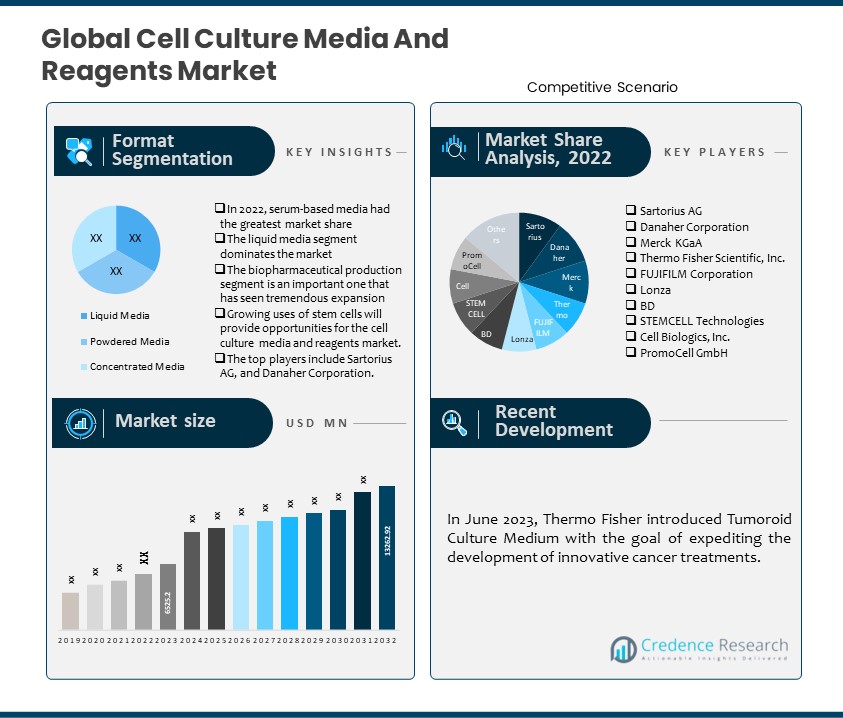
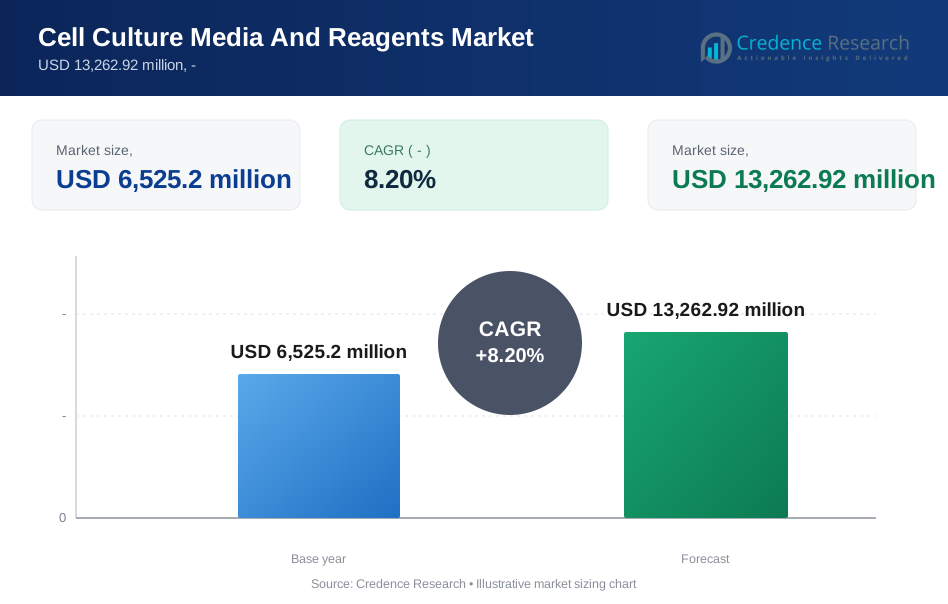
- The global market for cell culture media and reagents is expected to develop at a compound annual growth rate (CAGR) of 8.20% between 2024 and 2032, from its estimated USD 6525.2 million in 2023 to USD 13262.92 million in 2032.
- The largest category is serum-based media. Serum-free media, on the other hand, is expected to grow at a strong CAGR.
- Liquid media is the top category.
- It is anticipated that during the projected period, the CAGR for supplements will be the highest.
- The biopharmaceutical production will have the highest CAGR throughout the prediction period.
- Biotechnology and pharmaceutical companies are estimated to have the greatest CAGR during the forecast period.
- Asia Pacific dominated the cell culture media and reagents market.
- Regarding the market share of cell culture media and reagents, Europe is expected to come second.
- In the cell culture media and reagents market, North America is anticipated to grow fastest.
- Growing uses of stem cells, rising demand for biopharmaceuticals, and developments in regenerative medicine are driving the global market for cell culture media and reagents.
- Innovation in biotechnology, public and private support for life sciences research, and a growing emphasis on cell line creation for drug discovery and bioproduction are some of the variables that impact the potential of the global market for cell culture media and reagents.
Executive Summary
Market Definition
The cell culture media and reagents market describes the global market for goods used in the in vitro (beyond the cell's natural environment) cultivation, maintenance, and experimentation of cells. Products, including cell culture media, sera, supplements, reagents, and other associated consumables, are all included in this industry. These goods are necessary for several uses in the fields of vaccine development, regenerative medicine, biopharmaceutical manufacturing, and cell biology research.
Market Overview
The cell culture media and reagents sector is estimated to develop at an 8.20% compound annual growth rate (CAGR) between 2024 and 2032, maintaining its current upward trend. The market will continue to develop, rising from its estimated USD 6525.2 million in 2023 to USD 13262.92 million in 2032.
In most cases, cell culture media is a gel or liquid that contains substances needed to control and promote the growth of cells or microorganisms utilized in the production of biopharmaceuticals. Culture media is the fastest-growing industry segment and is an essential component in the production of biopharmaceuticals since it promotes cell proliferation. Growing government policies, rising R&D spending, and the growing need for biopharmaceuticals are the primary drivers of this growth.
The demand for proven cell-based vaccine manufacturing technology has increased as a result of the COVID-19 outbreak. It has also led to a few scientific breakthroughs, most notably in the development and testing of vaccine technologies. The Vero cell line, for example, was developed from the kidney of an African green monkey and has been widely utilized in the production of viral vaccines. Different SARS-CoV variants have also been developed using it. Lonza Bioscience's ProVeroTM1 Serum-free Medium is a non-animal, protein-free medium that is intended to promote the growth of Vero cells and MDCK.
Moreover, AAV vectors generated from cell cultures have emerged as one of the most successful methods for delivering proteins and genes in gene therapy and vaccine production. The major participants in the market are increasing the capacity for production. Due to rising demand for its core products as well as additional client needs for COVID-19 vaccines and treatments in 2021, Sartorius increased production across all locations. The demand for biosimilars has the potential for explosive expansion. The reason for this growth is the expected launch of multiple mAb biosimilars in the coming years due to the expiration of patents on major medications, including trastuzumab (Roche's Herceptin), infliximab (J&J's Remicade), and adalimumab (Abbott's Humira).
Furthermore, the efficacy of cell-based influenza vaccinations may be improved by the FDA's clearance of cell-based candidate vaccine viruses (CVVs) for use in these vaccines. Other vaccines licensed in the United States that have been developed using cell culture technology include those for polio, smallpox, rotavirus, rubella, hepatitis, and chickenpox. Additionally, all four of the flu viruses utilized in the cell-based vaccination for the 2021–2022 influenza season are produced from cells. For example, the first and only cell-based influenza vaccine in the United States, FLUCELVAX QUADRIVALENT, was approved by the FDA in October 2021 and was distributed by Seqirus. These factors drive the growth of the cell culture media and reagents market.
Segmentation by Type of Media
- Serum-based media are the market leader by type of media. Serum-based media are frequently chosen to maintain cell lines with well-established methods. They have been used extensively in cell culture for decades. For consistency and historical data comparability, researchers and biopharmaceutical producers may still use serum-based media.
- The serum-free media category will exhibit a sizable CAGR during the projected period. A serum-free medium is an important instrument that enables researchers to cultivate a certain cell type or carry out particular tasks without the need for serum. Using serum-free media has several benefits, such as improved control over physiological sensitivity, more consistent growth and productivity, and a lower chance of infection in the culture via serum-borne adventitious agents.
- Other types of media, including chemically defined media and specialty media, support the need for cell culture media and reagents.
Segmentation by Format
- The significant category is liquid media. Due to variables like rapid mycobacterial growth and high isolation rates, more and more biologics and biosimilar manufacturers—both upstream and downstream—are moving from premixed powders to liquid media. In addition, it eliminates a few process stages, lowers the risk of hazardous exposure, and simplifies and increases manufacturing and development compared to powdered media.
- The powdered media category will likely register a significant CAGR during forecasting. Because powdered media are less likely to deteriorate and become contaminated, they have a longer shelf life than liquid media. This reduces the logistical obstacles and expenses for manufacturers and end users by making them easier to store and transport.
- Other formats, such as concentrated media, also contribute to the demand for cell culture media and reagents.
Segmentation by Reagent
- The supplements category is projected to grow faster over the projection period. Supplements supply nutrients that may be absent from baseline media formulations, hence optimizing cell growth and viability in culture systems. These nutrients, which are essential for cellular metabolism and proliferation, include vitamins, minerals, amino acids, and carbohydrates.
- Other reagents influence the need for cell culture media and reagents, including cytokines and growth factors, antibiotics and antimycotics, buffer solutions, enzymes, and stains and dyes.
Segmentation by Application
- The biopharmaceutical production category will likely have the highest CAGR during the projection period. The market is experiencing substantial growth due to the biopharmaceutical industry's need for more defined and repeatable media to meet rising production volumes and lower the risk of interference in downstream procedures.
- Other applications, such as research and development, cell therapy and regenerative medicine, and diagnostic testing, also contribute to the demand for cell culture media and reagents.
Segmentation by End-User
- Biotechnology and pharmaceutical companies are expected to have the foremost CAGR during the prediction period. To guarantee the security, effectiveness, and uniformity of pharmaceutical goods, biotechnology, and pharmaceutical businesses use cell-based assays for assay development and quality control testing. As part of protocols for quality control testing, cell culture media and reagents are utilized in a variety of analytical assays, including assays for cell viability, proliferation, and strength.
- Other end-users, such as academic and research institutes, clinical laboratories and hospitals, and contract research organizations (CROs), also contribute to the demand for cell culture media and reagents.
Segmentation by Region
- The Asia Pacific leads the cell culture media and reagents industry. The market for cell culture media and reagents is growing as a result of Japan's aging population and high frequency of chronic diseases, which create a need for novel therapies and medication development.
- Europe is estimated to rank second in market size for cell culture media and reagents.
- The cell culture media and reagents industry is predicted to flourish rapidly in North America.
- Regions such as Africa, the Middle East, and Latin America cover the remaining requirement for cell culture media and reagents.
Research on chronic diseases, including neurological disorders, diabetes, cancer, and cardiovascular diseases, is highly focused. Cell culture systems are crucial resources for researching the fundamental causes of many illnesses, vetting possible medication candidates, and creating novel treatment approaches. The need for cell culture media and reagents to assist this research and medication development is rising in tandem with the frequency of chronic diseases.
Based on projections, the cell culture media and reagents market is anticipated to be controlled by Asia Pacific. This is because more people are becoming aware of the benefits of using the cell culture process. In addition, profitable prospects are anticipated as a result of major market players' strategic efforts to increase their footprint in the Asia Pacific region in order to gain a large market share. For example, Fujifilm Irvine Scientific, Inc. began building a new bioprocessing center in China in December 2021 with the goal of guaranteeing cell culture medium optimization support for the development of biotherapeutic drugs, vaccines, and advanced therapies.
The cell culture media and reagents market in North America is anticipated to expand fastest throughout the forecast. This is brought on by the expansion of the biotechnology and pharmaceutical sectors, the increasing number of vaccines based on cell cultures being approved, the rising prevalence of diseases like cancer, and the funding and investments made in cell-based research in North America.
Key Highlights of the Report
The global cell culture media and reagents market is segmented by type of media, format, reagent, application, end-user, and region. As far as the type of media is concerned, serum-based media are the market spearhead. Liquid media is the top category. The supplements category is anticipated to increase at the highest CAGR throughout the projection period. The biotechnology and pharmaceutical companies category will experience the highest CAGR during the forecast period. The cell culture media and reagents market is expanding mostly in the Asia Pacific.
The goal of personalized medicine is to customize medical care to each patient's unique traits, taking into account their lifestyle, genetic composition, and environmental influences. Modeling patient-specific medication and treatment responses requires the use of cell culture techniques. Drug toxicity testing and screening are carried out by researchers using patient-derived cells cultivated in specialized conditions and reagents, guaranteeing that therapies are both safe and effective for each individual. The detection and confirmation of biomarkers—indicators of the existence, course, or reaction to treatment—is essential to personalized medicine. The expression and functionality of biomarkers in patient-derived cells, tissues, or organoids are investigated using cell culture techniques. Specialized cell culture media and reagents that are designed to preserve cell viability, functioning, and biomarker expression under certain experimental circumstances are needed for this research.
Asia Pacific is expected to account for the largest cell culture media and reagents market globally. India has one of the largest pharmaceutical industries in the world, and it is expanding quickly as a result of the country's enormous population base, rising healthcare demands, and expanding middle class. The demand for cell culture media and reagents is rising as a result of government initiatives like "Make in India" and other programs to encourage biotechnology innovation, which is driving investments in R&D and industrial infrastructure. The North American region is also assumed to have the market's sharpest growth. With a huge number of biotech businesses, academic institutions, and research organizations supporting R&D operations, the US leads the world in biopharmaceutical innovation. This leadership encourages the need for superior cell culture media and reagents.
Which Key Factors Are Driving The Global Cell Culture Media And Reagents Market?
A number of factors, including the growing prevalence of chronic illnesses, the move toward customized therapy, and the usage of 3D cell culture methods that call for specific media and reagents, are driving the growth of the market for cell culture media and reagents.
What are The Main Challenges Confronting The Cell Culture Media And Reagents Market Globally?
The primary obstacles to the global market for cell culture media and reagents are the high cost of cell culture goods, ethical concerns about the use of animal-derived ingredients in these products, and the complexity of cell culture procedures.
What Market Opportunities Exist For Cell Culture Media And Reagents Globally?
Numerous factors, including the need for sophisticated culture systems due to advances in tissue engineering, high-throughput screening, and drug development activities, and the growing demand for vaccines, could propel the market for cell culture media and reagents.
Market Drivers
Multiple factors propel the cell culture media and reagents industry across the globe. The primary factors propelling the global cell culture media and reagents market are as follows:
Stem Cell Research and the Rise in Contract Manufacturing Requirements
The global market for cell culture media and reagents is mostly driven by research on stem cells. The market is expanding due to increased knowledge of stem cell therapy's potential for treating a range of illnesses. As a result, contract manufacturing is in greater demand. The global market for cell culture media and reagents is growing due to a number of factors, including the quick growth of pharmaceutical businesses, improved drug development and discovery processes, and an increase in clinical research institutes globally.
Contract manufacturing organizations (CMOs) are widely used by biopharmaceutical companies, especially those engaged in cell therapy and regenerative medicine, to manufacture their cell-based medicines on a large scale. The infrastructure, experience, and regulatory compliance that is required for the large-scale manufacture of cell treatments are provided by contract manufacturing services. For these CMOs to support their production processes, a dependable and constant supply of reagents and cell culture media is necessary. The need for cell culture media and reagents is driven by the growing outsourcing of cell therapy production to CMOs, which propels the expansion of the market.
Market Restraints
There are several obstacles that the global cell culture media and reagents market must overcome to continue growing. Among them are the following:
Exorbitant Prices for Specialized Goods
Specialized cell culture media and reagents can be expensive, which can make them inaccessible, especially for laboratories with restricted resources, smaller research organizations, or those in developing nations. Less demand and slower market growth could result from researchers' inability or unwillingness to invest in pricey products. SMEs, biotech companies, and university institutions frequently have restricted funding for research. A sizeable amount of these funds may be spent on pricey specialist goods, leaving researchers with less money for other necessary equipment or research tasks. This limitation could influence market demand by making researchers look for more affordable options or reducing the scope of their studies. Cost-benefit evaluations are frequently carried out by researchers and procurement personnel prior to the acquisition of specialized cell culture media and reagents. If the alleged advantages of utilizing these items do not balance their exorbitant expenses, scientists can choose more reasonably priced substitutes or adjust their study methodologies. The market demand may be affected by this decision-making process, which may result in a slower rate of increase in the sales of specialist goods.
Opportunities
There are plenty of potential prospects in the global cell culture media and reagents industry. Among these are the following:
Increased Need for Biopharmaceuticals
Products made from cell cultures reduce production costs and boost productivity. Cell culture involves isolating cells from an animal or plant source and using them to make biological or biosimilar medicines. In the biopharmaceutical industry, the cell culture method is found to be successful and efficient due to the growing need for biosimilar and biologic products for the treatment of cancer and several other chronic and cardiovascular diseases.
Biosimilar products have become incredibly popular in North America and Europe. Artificial organs and reasonably priced cell culture products are in greater demand globally. The most widely utilized cell culture reagents in underdeveloped countries are antibiotics and supplements, including amino acids. Furthermore, fetal bovine serum (FBS) is finding more uses in controlling cell membrane permeability, which is driving the expansion of the global market.
Competitive Landscape
Key Players
Several major competitors exist in the fiercely competitive global cell culture media and reagents market. The following are a few of the leading market participants and their market shares:
- Sartorius AG
- Danaher Corporation
- Merck KGaA
- Thermo Fisher Scientific, Inc.
- FUJIFILM Corporation
- Lonza
- BD
- STEMCELL Technologies
- Cell Biologics, Inc.
- PromoCell GmbH
- Others
These companies prioritize product innovation, distribution channel expansion, mergers, and acquisitions to remain competitive.
The largest suppliers in the global cell culture media and reagents market continuously work to stay one step ahead of the competition by developing innovative concepts and products.
In September 2023, Celltrion committed USD 94.5 million to build a factory in Songdo, Incheon, with an annual production capacity of 8 million vials. The new project is anticipated to go online in 2027 and boost the bioreactor's capacity to 600,000 L.
In March 2023, Samsung Biologics declared that it would start building a fifth plant with a 180,000-liter capacity. After completion, Samsung Biologics will continue to lead the world in biomanufacturing capacity, with a total of 784,000 liters.
In April 2023, FUJIFILM Irvine Scientific introduced the BalanCD CHO Media Platform Portfolio for Bioprocessing.
In March 2022, Shenandoah Biotechnology was purchased by FUJIFILM Irvine Scientific. The agreement would assist the business in offering clients a single point of contact for all of their needs related to cell and gene therapy, discovery, and life science research.
In January 2022, Cytiva and Nucleus Biologics LLC partnered to improve the creation of customized cell mediums for gene and cell therapies.
Summary of Key Findings
- The market is expanded by the growing use of cell culture technology in developing nations. There is an increasing need for specific media and reagents in cell culture research due to the growing usage of bioinformatics technologies.
- The market is segmented by type of media, format, reagent, application, end-user, and region.
- The most popular type of media in the market is serum-based media.
- Liquid media is the foremost category.
- Supplements are expected to grow fastest in terms of CAGR during the forecast period.
- The biopharmaceutical production category will likely see the highest CAGR during the anticipated time frame.
- Asia Pacific is leading market development; the market is highly competitive with key players including Sartorius AG, Danaher Corporation, Merck KGaA, Thermo Fisher Scientific, Inc., FUJIFILM Corporation, Lonza, BD, STEMCELL Technologies, Cell Biologics, Inc., PromoCell GmbH, and Others.
Future Outlook
- The cell culture media and reagents industry is expected to increase significantly in Asia Pacific, and its outlook is positive worldwide.
- Improvements in cancer immunotherapy and rising public awareness of cell-based therapies are among the drivers supporting the growth of the global market.
- A lack of qualified workers knowledgeable about regulatory requirements and cell culture processes may impede the adoption and use of cell culture products.
- To stay ahead of the competition, key enterprises must develop new products, expand their market reach, and keep their prices competitive.
How CXOs Can Benefit from the Credence Research Cell Culture Media And Reagents Market Report
CXOs may get a detailed picture of the market in the Credence Research Cell Culture Media And Reagents Market Report, which includes:
- Market size and growth forecast: The report provides detailed estimates of the global cell culture media and reagents market size, segmented by type of media, format, reagent, application, end-user, and region. It also includes forecasts for the market through 2032 based on key trends and drivers.
- Market segmentation: The research report breaks down the market for cell culture media and reagents into segments based on the type of media, format, reagent, application, end-user, and region. This segmentation provides CXOs with a granular understanding of the market and the opportunities in each segment.
- Competitive landscape: The research report offers a detailed analysis of the major companies in the cell culture media and reagents industry, including information on their business plans, product lines, and earnings. CXOs can use this information to evaluate and identify their competitors.
- Key trends and drivers: The research report identifies and evaluates the main trends and factors influencing the cell culture media and reagents market. CXOs can use this information to make well-informed choices regarding their plans and investments.
CXOs can use the insights from the Credence Research Cell Culture Media And Reagents Market Report to:
- Identify growth opportunities: This analysis may help CXOs identify new growth opportunities in the cell culture media and reagents sector. For example, the report identifies the growing demand for cell culture media and reagents from the biotechnology and pharmaceutical companies as a key opportunity.
- Make informed investment decisions: The report helps CXOs choose cell culture media and reagents wisely. For example, the research study provides information on the critical factors to consider when selecting cell culture media and reagent solutions and evaluating suppliers.
- Develop competitive strategies: CXOs can use the research report to develop competitive strategies for their cell culture media and reagents businesses. For example, the research paper outlines the main strategies that cell culture media and reagents suppliers utilize to differentiate themselves from competitors.
- Track market developments: This research report may help CXOs stay ahead of the curve by tracking market developments. For instance, it offers insights into the most recent developments and trends in the cell culture media and reagents market.
CXOs seeking to expand their industry knowledge and spot growth prospects will find the Credence Research Cell Culture Media And Reagents Market Report useful.
Segmentation
- By Type of Media
- Serum-based Media
- Serum-free Media
- Chemically Defined Media
- Specialty Media
- By Format
- Liquid Media
- Powdered Media
- Concentrated Media
- By Reagent
- Supplements
- Cytokines and Growth Factors
- Antibiotics and Antimycotics
- Buffer Solutions
- Enzymes
- Stains and Dyes
- By Application
- Biopharmaceutical Production
- Research and Development
- Cell Therapy and Regenerative Medicine
- Diagnostic Testing
- By End-User
- Biotechnology and Pharmaceutical Companies
- Academic and Research Institutes
- Clinical Laboratories and Hospitals
- Contract Research Organizations (CROs)
- By Region
- North America
- The U.S.
- Canada
- Mexico
- Europe
- Germany
- France
- The U.K.
- Italy
- Spain
- Rest of Europe
- Asia Pacific
- China
- Japan
- India
- South Korea
- South-east Asia
- Rest of Asia Pacific
- Latin America
- Brazil
- Argentina
- Rest of Latin America
- Middle East & Africa
- GCC Countries
- South Africa
- The Rest of the Middle East and Africa
- North America
Request a Free Sample
Fill in your details and we'll send you a free sample report.
- Sample data tables & charts
- Research methodology
Need a Custom Version of This Report?
Tailor the scope, geography, or segments to your exact requirements.
- Custom geography or segment scope
- Direct access to our analyst team
Frequently Asked Questions
How much does the global market currently hold for cell culture media and reagents?
What is the cell culture media and reagents market's projected growth rate between 2024 and 2032?
In terms of type of media, which market category is leading?
Which end-user segment is estimated to have the highest CAGR throughout the forecast period?
Who are the main players globally in the cell culture media and reagents industry?
Table of Content
Chapter 1. Report Introduction
- 1.1 Report Description & Purpose
- 1.1.1 Report Title & Market Definition
- 1.1.2 Unique Selling Propositions (USP) & Key Differentiators
- 1.1.3 Value Proposition for Stakeholders
- 1.2 Research Objectives
- 1.2.1 Market Sizing Objectives (Volume & Revenue)
- 1.2.2 Segmentation Objectives
- 1.2.3 Competitive Intelligence Objectives
- 1.2.4 Forecast & Scenario Objectives
- 1.3 Report Scope
- 1.3.1 Cell Culture Media And Reagents Scope – Types & Subtypes Covered
- 1.3.2 Geographic Scope – Regions & Countries Covered
- 1.3.3 Historical Period, Base Year & Forecast Period (the historical period; forecast to the forecast period)
- 1.3.4 Inclusions & Exclusions
- 1.4 HS Code & Classification Framework
- 1.5 Currency, Units & Pricing Basis
- 1.6 Target Stakeholders
- 1.7 Limitations & Assumptions
Chapter 2. Executive Summary
- 2.1 Global Cell Culture Media And Reagents Market Snapshot
- 2.1.1 Market Size – Historical (the historical period) & Forecast (the forecast period) (base year: USD 6,525.2 million → forecast year: USD 13,262.92 million)
- 2.1.2 Volume & Revenue – Global Totals
- 2.1.3 Key Market Highlights – Top Five Facts
- 2.2 Cell Culture Media And Reagents Market Segmentation Snapshot
- 2.2.1 Market Split by Region – vs.
- 2.3 Competitive Snapshot
- 2.3.1 Top 10 Players by Revenue Share –
- 2.3.2 Top 10 Players by Volume Share –
- 2.3.3 Recent Strategic Developments (18-Month Summary)
- 2.4 Key Investment Highlights & Strategic Conclusions
Chapter 3. Cell Culture Media And Reagents Market Dynamics & Industry Analysis
- 3.1 Market Overview & Context
- 3.1.1 Cell Culture Media And Reagents Market Position in the Broader Automotive Value Chain
- 3.1.2 OEM vs. Replacement Market Dynamics
- 3.1.3 Market Maturity & Development Stage by Region
- 3.2 Cell Culture Media And Reagents Market Drivers
- 3.3 Cell Culture Media And Reagents Market Restraints & Challenges
- 3.4 Cell Culture Media And Reagents Market Opportunities
- 3.5 Porter's Five Forces Analysis
- 3.5.1 Threat of New Entrants
- 3.5.2 Bargaining Power of Suppliers
- 3.5.3 Bargaining Power of Buyers
- 3.5.4 Threat of Substitutes
- 3.5.5 Competitive Rivalry – Intensity Assessment
- 3.6 Cell Culture Media And Reagents Value Chain Analysis
- 3.6.1 Upstream – Raw Material/Input Suppliers
- 3.6.1.1 Raw Material/Input 1
- 3.6.1.2 Raw Material/Input 2
- 3.6.1.3 Raw Material/Input 3
- 3.6.2 Midstream – Production/Manufacturing/Service Delivery
- 3.6.2.1 Production/Process Overview
- 3.6.2.2 Key Facility Locations & Capacity by Manufacturer
- 3.6.3 Downstream – Distribution & End Consumer
- 3.6.3.1 Primary Channel – B2B/OEM
- 3.6.3.2 Secondary Channels – Dealer, Retail, Online, Direct
- 3.6.4 Value Chain Profitability Analysis
- 3.6.1 Upstream – Raw Material/Input Suppliers
- 3.7 PESTEL Analysis
- 3.7.1 Political Factors
- 3.7.2 Economic Factors
- 3.7.3 Social Factors
- 3.7.4 Technological Factors
- 3.7.5 Environmental Factors
- 3.7.6 Legal Factors
- 3.8 Cell Culture Media And Reagents Supply Chain Analysis
- 3.8.1 Raw Material/Input Supply Risk Assessment
- 3.8.2 Manufacturing Concentration Risk (Geographic Exposure)
- 3.8.3 Trade Disruption Impact Analysis
- 3.9 Regulatory & Policy Landscape
Note: The regulatory and policy landscape section covers regulations based on their applicability to the market, Cell Culture Media And Reagents category, geography, and scope of the study. Only regulatory frameworks with a material impact on operations, compliance, trade, sustainability, or market access are analyzed in detail.
Chapter 4. Key Investment Pockets & Opportunity Analysis
- 4.1 Cell Culture Media And Reagents Market Attractiveness Analysis
- 4.1.1 By Region – Investment Attractiveness Matrix (Volume × CAGR)
- 4.2 Absolute Revenue Growth Opportunity
- 4.2.1 By Region – Absolute USD Growth Through the forecast period
- 4.3 Incremental Volume Opportunity
- 4.3.1 By Region – Incremental Volume Through the forecast period
- 4.3.2 Segment – Incremental Volume
- 4.4 Emerging Submarket Opportunity Deep Dive (Subject to Applicability)
- 4.5 Emerging Market Opportunity Scorecards
- 4.5.1 United States
- 4.5.2 Europe
- 4.5.3 Asia
- 4.5.4 Middle East & Africa
Note: Emerging Market Opportunity Scorecards will be included based on relevance and strategic importance. Regions listed are indicative and may vary depending on data availability and market dynamics.
Chapter 5. Cell Culture Media And Reagents Import-Export Analysis & Trade Flows
- 5.1 Global Trade Overview
- 5.1.1 Global Export Value by Country (the historical period)
- 5.1.2 Global Export Volume by Country (the historical period)
- 5.1.3 Global Import Value by Country (the historical period)
- 5.1.4 Global Import Volume by Country (the historical period)
- 5.1.5 Net Trade Balance by Country (the historical period)
- 5.2 Export Analysis – Segment
- 5.2.1 Type 1 (HS Code)
- 5.2.2 Type 2 (HS Code)
- 5.2.3 Type 3 (HS Code)
- 5.2.4 Type 4 (HS Code)
- 5.2.5 Type 5 (HS Code)
- 5.3 Import Analysis – Segment
- 5.3.1 Type 1 (HS Code)
- 5.3.2 Type 2 (HS Code)
- 5.3.3 Type 3 (HS Code)
- 5.3.4 Type 4 (HS Code)
- 5.3.5 Type 5 (HS Code)
- 5.4 Average Unit Trade Prices
- 5.4.1 Average Export Price – Segment & Country
- 5.4.2 Average Import Price – Segment & Source Country
- 5.4.3 Price Trends (the historical period)
- 5.5 Key Trade Route Analysis
- 5.5.1 Trade Route 1
- 5.5.2 Trade Route 2
- 5.5.3 Trade Route 3
- 5.5.4 Trade Route 4
- 5.5.5 Trade Route 5
- 5.6 Trade Policy Impact Assessment
- 5.6.1 US Anti-Dumping & Section 301 Tariffs
- 5.6.2 EU Customs Union Impact
- 5.6.3 Major Free Trade Agreements
- 5.6.4 USMCA Rules of Origin
Note: Trade policy analysis will be included only where relevant to the Cell Culture Media And Reagents market.
Chapter 6. Competitive Landscape & Company Benchmarking
- 6.1 Cell Culture Media And Reagents Market Concentration & Structure
- 6.1.1 Herfindahl-Hirschman Index (HHI) – vs.
- 6.1.2 Tier 1, Tier 2 & Tier 3 Market Structure
- 6.1.3 Global, Regional & Local Player Dynamics
- 6.2 Cell Culture Media And Reagents Market Share Analysis –
- 6.2.1 Global Revenue Share by Company
- 6.2.2 Global Volume Share by Company
- 6.2.3 Regional Revenue Share
- 6.2.4 Market Share Evolution ( vs. )
- 6.2.5 OEM Segment Share by Company
- 6.2.6 Replacement Segment Share by Company
- 6.3 Production/Delivery Capacity & Facility Analysis
- 6.3.1 Global Installed Capacity
- 6.3.2 Capacity Utilization Rates
- 6.3.3 Production/Output Volume
- 6.3.4 Facility Locations & Capacity Map
- 6.3.5 Planned Capacity Additions
- 6.4 Cell Culture Media And Reagents Competitive Benchmarking Matrix
- 6.4.1 Revenue, Volume, CAGR & Profitability Comparison
- 6.4.2 Channel Revenue Mix
- 6.4.3 Geographic Revenue Exposure
- 6.4.4 R&D Intensity
- 6.4.5 Sustainability Maturity
- 6.5 Strategic Developments in Cell Culture Media And Reagents (Last 24 Months)
- 6.5.1 Mergers, Acquisitions & Divestments
- 6.5.2 New Cell Culture Media And Reagents Launches
- 6.5.3 Facility Expansions
- 6.5.4 Strategic Alliances, Joint Ventures & Partnerships
- 6.5.5 Distribution Expansion & Market Entry
- 6.5.6 Sustainability & ESG Initiatives
- 6.6 Competitive Strategy Mapping
- 6.6.1 Leader, Challenger, Follower & Niche Classification
- 6.6.2 Pricing Strategy Comparison
- 6.6.3 Channel Strategy Matrix
Note: Strategic developments are included based on their materiality and the availability of reliable information.
Chapter 7. Global Cell Culture Media And Reagents Market – By Distribution Channel
- 7.1 Segment Overview
- 7.1.1 Volume & Revenue Split by Channel ( & )
- 7.1.2 Channel Mix Evolution (the forecast period)
Chapter 8. Regional Market Analysis – Global Overview
- 8.1 Global Regional Overview
- 8.1.1 Regional Volume Share
- 8.1.2 Regional Revenue Share
- 8.1.3 Regional Volume by Region
- 8.1.4 Regional Revenue by Region
- 8.1.5 Regional Forecast Through the forecast period
- 8.2 Cross-Regional Segment Analysis
- 8.2.1 By Distribution Channel
- 8.2.2 By Brand/Price Tier
Chapter 9. North America Cell Culture Media And Reagents Market
- 9.1 United States
- 9.2 Canada
- 9.3 Mexico
Chapter 10. Europe Cell Culture Media And Reagents Market
- 10.1 Germany
- 10.2 France
- 10.3 Italy
- 10.4 United Kingdom
- 10.5 Spain
- 10.6 Poland
- 10.7 Russia
- 10.8 Netherlands
- 10.9 Belgium
- 10.10 Sweden
- 10.11 Denmark
- 10.12 Norway
- 10.13 Rest of Europe
Chapter 11. Asia Pacific Cell Culture Media And Reagents Market
- 11.1 China
- 11.2 India
- 11.3 Japan
- 11.4 South Korea
- 11.5 Thailand
- 11.6 Indonesia
- 11.7 Vietnam
- 11.8 Malaysia
- 11.9 Australia
- 11.10 Rest of Asia Pacific
Chapter 12. Latin America Cell Culture Media And Reagents Market
- 12.1 Brazil
- 12.2 Argentina
- 12.3 Colombia
- 12.4 Chile
- 12.5 Rest of Latin America
Chapter 13. Middle East Cell Culture Media And Reagents Market
- 13.1 Saudi Arabia
- 13.2 United Arab Emirates
- 13.3 Turkey
- 13.4 Israel
- 13.5 Iran
- 13.6 Rest of the Middle East
Chapter 14. Africa Cell Culture Media And Reagents Market
- 14.1 South Africa
- 14.2 Egypt
- 14.3 Nigeria
- 14.4 Morocco
- 14.5 Rest of Africa
Chapter 15. Cell Culture Media And Reagents Company Profiles
- 15.1 [Company 01]
- 15.1.1 Company Overview
- 15.1.2 Key Management Personnel
- 15.1.3 Products & Services Portfolio
- 15.1.4 Financial Performance
- 15.1.5 Key Market Focus & Geographic Presence
- 15.1.6 Recent Developments & Strategic Initiatives
Note: The company profile list is preliminary and may change based on research findings, market developments, data availability, and client requirements.
Chapter 16. Appendices
- Appendix A – List of Abbreviations & Acronyms
- Appendix B – Industry Classification Code Reference – Full Series
- Appendix C – Production & Capacity Data Tables
- Appendix D – End-Use & Demand Base Tables
- Appendix E – Consumption & Replacement Rate Assumptions
- Appendix F – ASP Reference Tables
- Appendix G – Manufacturing & Facility Database
- Appendix H – Import-Export Data Tables
- Appendix I – Regulatory Summary Tables
- Appendix J – Primary Research Participant List (Anonymized)
- Appendix K – Primary Research Questionnaire Framework
- Appendix L – Data Sources & Bibliography
- Appendix M – Market Size Divergence & Source Comparison
Chapter 17. Research Methodology
- 17.1 Research Framework & Philosophy
- 17.2 Secondary Research – Sources, Hierarchy & Data Extraction
- 17.3 Data Modeling – Bottom-Up & Top-Down Market Sizing
- 17.4 Primary Research – Stakeholder Framework, LOI & Sample Sizes
- 17.5 Forecast Methodology – Regression, Scenario & Sensitivity Analysis
- 17.6 Quality Control – Four-Layer Validation Framework
- 17.7 Limitations & Standard Assumptions
- 17.8 Disclaimer
