
| REPORT ATTRIBUTE | DETAILS |
|---|---|
| Historical Period | 2019-2022 |
| Base Year | 2023 |
| Forecast Period | 2024-2032 |
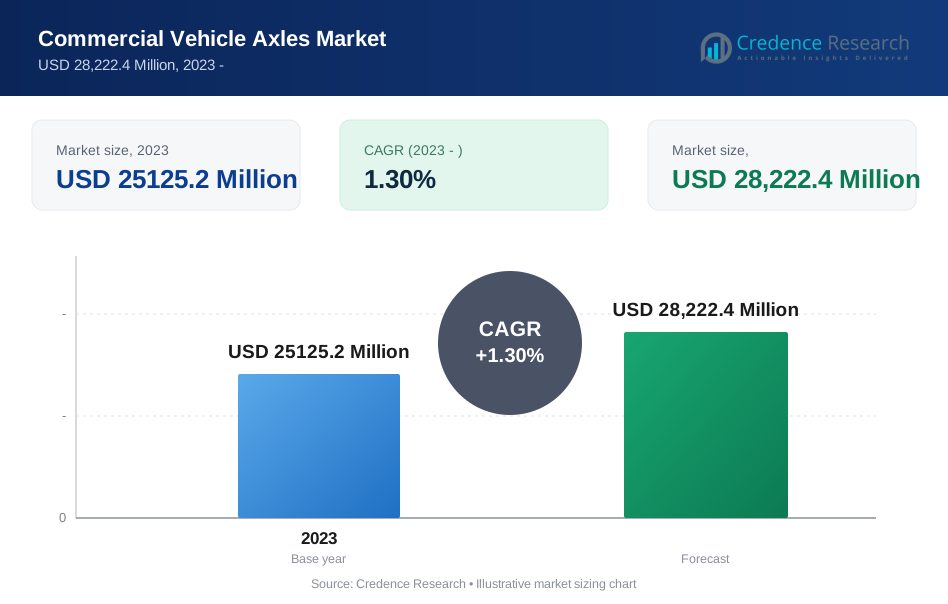
| Commercial Vehicle Axles Market Size 2023 | USD 25125.2 Million |
| Commercial Vehicle Axles Market, CAGR | 1.30% |
| Commercial Vehicle Axles Market Size 2032 | USD 28222.4 Million |
Market Insights
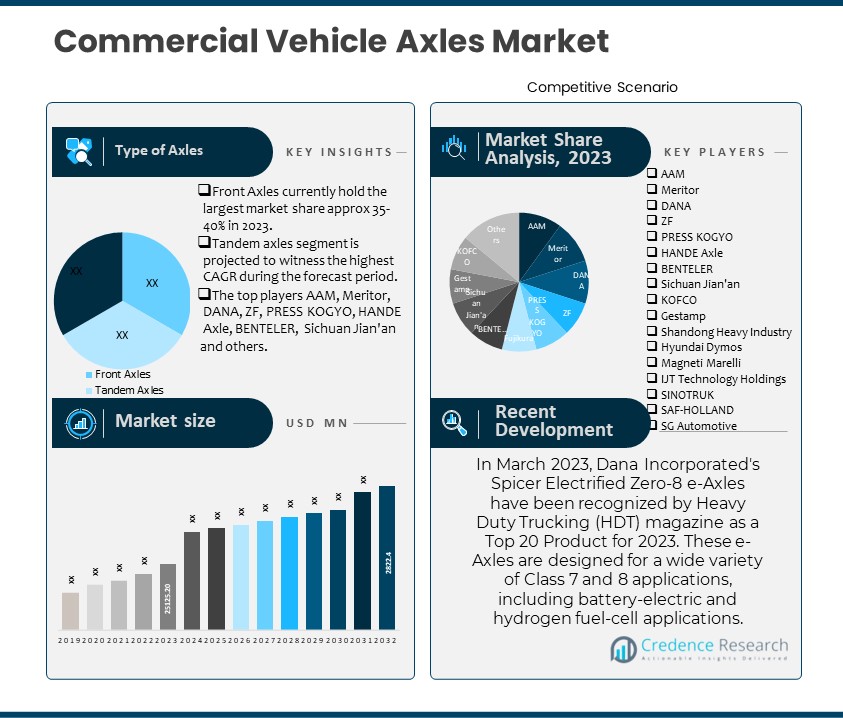
- The Commercial Vehicle Axles Market attained a valuation of USD 25125.2 Million in 2023 and is anticipated to escalate to USD 28222.4 Million by 2032, exhibiting a robust CAGR of 1.30% during the forecast period from 2024 to 2032.
- Among the key segments, Front Axles emerged as the dominant type, holding approximately 35-40% of the total market share in 2023. However, Tandem Axles are projected to witness the highest growth rate during the forecast period.
- Commercial Fleets lead the market by end-user, holding around 30-38% of the market share in 2023, driven by the primary usage of commercial vehicles in fleet operations.
- Single Axle Vehicles currently hold the largest market share approx 40-45% in 2023. While, Tandem Axle Vehicles are the second-largest segment, accounting for around 25% of the market in 2023.
- Leaf Spring Axles currently hold the largest market share approx 30-32% in 2023, while Air Suspension Axles are projected to witness the highest CAGR during the forecast period.
- OEMs hold the largest share of the market by sales channel, accounting for approximately 65-70% in 2023, attributed to their long-term contracts and customized solutions for automakers.
- Asia Pacific holds the largest share of the market in 2023, followed by North America and Europe with a collective share of just under 55%.
- The rise in demand for commercial vehicles, driven by factors such as infrastructure development and logistics expansion, fuels the growth of the Commercial Vehicle Axles Market.
- Key opportunities in the market include significant growth potential in electric and hybrid commercial vehicles, increased demand in the construction and mining sectors, and advancements in axle technology fostering market expansion.
Executive Summary
Market Definition
Commercial Vehicle Axles Market defines an industry segment that focuses on the manufacture, distribution and repair of axles designed for use in trucks, buses, passenger cars, etc. Axles are important components of in commercial vehicles, responsible for supporting vehicle loads, transmitting power from the engine to the wheels. This market develops axles to meet the needs of commercial vehicle manufacturers and consumers. These include front axles, rear axles, driving axles and trailer axles, each designed to withstand different loads, operating conditions and vehicle configurations. Factors such as economic growth, infrastructure development, vehicle modernization, regulatory requirements regarding emissions and safety standards influence the demand for commercial vehicle axles. Furthermore, growth developments in axle technology, such as lightweight materials, integrated braking systems and electricity, and determine the future direction of the market.
Market Overview
The Commercial Vehicle Axles Market has exhibited steady growth and is anticipated to maintain a robust Compound Annual Growth Rate (CAGR) of 1.30% from 2024 to 2032. Valued at USD 25125.2 million in 2023, this market is forecasted to reach USD 28222.4 million by 2032.
Among the primary segments, Front Axles dominated the market landscape by axle type, comprising approximately 35-40% of the total market share in 2023. However, Tandem Axles are anticipated to observe the highest CAGR over the forecast period.
Leaf Spring Axles currently hold the largest market share approx 30-32% in 2023 driven by simple, durable, and cost-effective.
Commercial Fleets segment captured around 30-38% of the market share in 2023, driven by the primary usage of commercial vehicles in fleet operations.
Leaf Spring Axles held the largest market share approximately 30-32% in 2023, while Air Suspension Axles are projected to witness the highest CAGR during the forecast period.
OEMs constituted the largest share of the market by sales channel, accounting for approximately 65-70% in 2023, attributed to their long-term contracts and customized solutions for automakers.
Asia Pacific constituted a significant portion of the market in 2023, followed by North America and Europe, collectively representing just under 55% of the market share.
The rise in demand for commercial vehicle axles is driven by factors such as infrastructure development, logistics expansion, and the need for reliable transportation solutions, particularly in regions like Asia Pacific.
Continuous advancements in axle technology, including lightweight materials and integrated braking systems, are further driving the demand for commercial vehicle axles, especially in industries requiring enhanced vehicle performance and safety standards.
Segmentation by Type of Axles
- Front Axles currently hold the largest market share approx 35-40% in 2023. This is because most commercial vehicles have a front engine configuration, which requires the front axle to support the weight of the engine and transmission drive the segment growth.
- Tandem axles segment is projected to witness the highest CAGR during the forecast period. This is due to growing demand of heavy duty trucks and trailers, which require tandem axles for loading excessive capability and stability drive the segment CAGR.
Segmentation by Axle Configuration
- Single Axle Vehicles currently hold the largest market share approx 40-45% in 2023. As single axle vehicles are the most common commercial vehicles, used in a variety of applications such as pickup trucks, trailers, and service vehicles, they are simple in design, easily maintained, and offers efficient urban applications.
- Tandem Axle Vehicles are the second-largest segment, accounting for around 25% of the market in 2023. It is commonly used in heavy duty trucks, tractors and trailers, where it increases load capacity and stability. Tandem axles help distribute the weight more evenly, allowing the vehicle to carry heavier loads over longer distances.
Segmentation by Axle Type by Suspension
- Leaf Spring Axles currently hold the largest market share approx 30-32% in 2023. They are simple, durable, and cost-effective, making them popular for use in many commercial vehicles.
- Air suspension axles segment is projected to witness the highest CAGR during the forecast period. This is due to the growing demand for comfortable and efficient commercial vehicles , as well as growing awareness on the importance of ride comfort and handling in commercial vehicle industry.
Segmentation by End-User
- Commercial Fleets currently hold the largest market share approx 30-38% in 2023. This is because commercial fleets are the primary users of commercial vehicles, and they require reliable and durable axles to ensure the smooth operation of their vehicles. Commercial vehicle manufacturers often choose leaf spring axles, which are cost-effective and it provides adequate support for their vehicles.
- Construction and mining segment is projected to witness the highest CAGR during the forecast period. Increasing infrastructure and mining activities are driving the demand for robust axles and increased reliability in handling rough terrain and heavy loads.
Segmentation by Sales Channel
- OEMs currently hold the largest market share approx 65-70% in 2023. This is because OEMs typically have long-term contracts with automakers and provide customized solutions that meet the specific requirements of their vehicles.
- Aftermarket segment is projected to witness the highest CAGR during the forecast period. This growth can be attributed to factors such as increasing demand for replacement parts, increasing number of vehicles, and longer life of commercial vehicles. As commercial vehicles age, the need for maintenance and repair increases, increasing the demand for aftermarket goods and services.
Segmentation by Region
- Asia Pacific held largest share around 38-42% of the market in 2023. This is due to the presence of major automotive manufacturers in China, India, and Japan.
- North America and Europe collectively account for just under 55% share in 2023, with North America holding over 20% share in the same year.
- The rest of the world, including Latin America, the Middle East, and Africa, supplies the remaining demand for Commercial Vehicle Axles.
growing demand for electric and hybrid commercial vehicles, government initiatives to promote green transport and the expansion of e-commerce services are also contributing to the market growth.
The Asia Pacific region holds the largest market share in the Commercial Vehicle Axles market. This dominance can be attributed to several factors such as the rapid growth of the automobile industry, the increasing demand for transportation and logistics, and major automakers in countries such as China, Japan and South Korea. China in particular has emerged as a key player in the global commercial vehicle axle market, with a number of domestic manufacturers and suppliers catering to domestic and international customers. Another important factor that contributes to the leadership position of the sector is the presence of well-established automobile companies such as Toyota, Honda, Hyundai, Kia etc. These companies invest heavily in R&D, introducing new products that it meets the evolving needs of the commercial vehicle industry it has become easier for companies to maintain costs by ensuring quality. For instance, in June 2020, Toyota Motor Corporation and five Chinese companies, including China FAW Corporation Limited, Dongfeng Motor Corporation, Beijing Automotive Group Co., Ltd., Guangzhou Automobile Group Co., Ltd., and Beijing SinoHytec Co., Ltd., established a joint venture named United Fuel Cell System R&D (Beijing) Co., Ltd. (FCRD) to develop fuel cell systems for commercial vehicles in China.
Europe is an important market for commercial vehicle axles owing to the presence of leading automotive manufacturers and large commercial vehicles. The share of the region in the global commercial vehicle axles market can be attributed to various factors. European countries have implemented stringent emissions regulations to reduce carbon emissions and promote sustainable transport. This has led to increased demand for electric and hybrid commercial vehicles, which require special axles designed to suit their unique powertrain designs and as a result, manufacturers are investing in axle design in advanced varieties in line with the changing requirements of the market. Alongwith, Europe has some of the world’s leading automakers, such as Mercedes-Benz, Volkswagen and BMW, which manufacture a wide range of commercial vehicles such as vans, buses, trucks etc. These OEMs (Original Equipment Manufacturers) usually work with local axles manufacturers to design and supply customized axles that meet the specific requirements of their vehicles. For instance, in October 2023, Allison Transmission introduces the eGen Power 85S, a new fully electric axle, in partnership with Anadolu Isuzu. The eGen Power 85S is integrated into the Isuzu Novo VOLT fully electric bus, which is being showcased at Busworld Europe in Brussels, Belgium. The partnership provides a new bus option that delivers zero emissions and reduced noise levels. Furthermore, EU policies to promote sustainable transport and reduce reliance on fossil fuels have pushed for new propulsion technologies, such as hydrogen fuel cells, the use of battery electricity and this shift to cleaner modes of transport provides opportunities for new axle designs. You can make the cars more efficient.
Key Highlights of the Report
The Commercial Vehicle Axles Market is segmented by Type of Axles, End-User, Axle Configuration, Axle Type by Suspension, Sales Channel, and Region. The growing demand for commercial vehicle axles is driven by factors such as infrastructure development, logistics expansion, and the need for reliable transportation solutions across various sectors including construction, mining, and commercial fleets.
Front Axles dominate the segment, serving critical functions in supporting vehicle loads and transmitting power from the engine to the wheels in commercial vehicles such as trucks and buses. Leaf Spring Axles lead the axle type by suspension segment, providing durable and cost-effective solutions for various commercial vehicle applications.
Commercial Fleets hold a significant market share in the end-user segment, relying on durable and reliable axles to ensure smooth operation and efficiency of their vehicles. The aftermarket sales channel is witnessing rapid growth, driven by the increasing demand for replacement parts and maintenance services as commercial vehicles age.
Asia Pacific held the largest share of the Commercial Vehicle Axles market, supported by the presence of major automotive manufacturers and infrastructure development initiatives. Key players such as AAM and Meritor focus on product innovation and strategic collaborations to maintain their market position and competitiveness in the industry..
What Are The Main Drivers Of The Global Commercial Vehicle Axles Market?
The global Commercial Vehicle Axles market is driven by various factors such as rising demand for commercial vehicles due to industrialization and infrastructure development, stringent government regulations on vehicle emissions and fuel efficiency about, advances in axle technology aimed at improving vehicle performance and performance. Moreover, expanding manufacturing and logistics infrastructure, as well as increasing urbanization, contribute to the demand for commercial vehicles, thereby boosting the market.
What Are The Major Challenges Faced By The Global Commercial Vehicle Axles Market?
The global Commercial Vehicle Axles market is mainly challenged by fluctuating raw material prices affecting manufacturing costs, stringent emission norms requiring technological improvements a high costs, the need to meet evolving security standards and economic uncertainty and geopolitical pressures. Also, competition from new transportation technologies, such as electric vehicles, is a challenge, compelling traditional axle manufacturers to innovate and adapt.
What Are The Growth Opportunities In The Global Commercial Vehicle Axles Market?
The global Commercial Vehicle Axles market presents numerous growth opportunities due to increasing demand for lightweight and fuel-efficient axles to improve vehicle performance and meet stringent emission standards, widespread adoption of commercial electric vehicles. In addition to the demand for specialized axles, the expansion of logistics and transportation services in emerging markets provides an avenue for market expansion. Additionally, technological advances such as integrated axle design and predictive maintenance solutions provide opportunities for innovation and differentiation. In addition, adoption of various strategies among market players also makes significant opportunity for the market.
Market Drivers
The global Commercial Vehicle Axles market is driven by several factors. The following are the key drivers of the global Commercial Vehicle Axles market:
Rising Demand For Commercial Vehicles Due To Industrialization And Infrastructure Development
The global Commercial Vehicle Axles market has significant growth, driven by the rising demand for commercial vehicles due to industrialization and infrastructure development. As countries invest in expanding their infrastructure, such as roads, highways and transportation infrastructure, the demand for commercial vehicles equipped with stronger and more efficient axles increases correspondingly. For instance, emerging economies like India and China are witnessing extensive infrastructure projects, including the construction of highways, bridges, and urban development, which require a large fleet of commercial vehicles. This led in infrastructure development drives the need for commercial vehicles for transporting goods, materials, and equipment, further propel the demand for commercial vehicle axles.
Market Restraints
The global Commercial Vehicle Axles market faces some challenges that may hinder its growth. These include the following:
Stringent Emission Norms
Stringent emission norms restrained the demand Commercial Vehicle Axles Market. Governments around the world have implemented more stringent regulations to address vehicle emissions, promoting cleaner and more fuel-efficient technologies. These regulations force manufacturers of commercial vehicles to they invest heavily in R&D to develop axles that meet emission standards and remain efficient. For instance, Euro 6/VI vehicle emission standards provides a detailed overview of the regulations that tighten the limits on air pollutant emissions established in prior European standards and require the best available technology for vehicle emissions control. Simillarly, the law mandates uses of advanced technologies such as exhaust gas recirculation (EGR) systems and selective catalytic reduction (SCR) systems are can increase the cost of the vehicle and its components, including axles further restrain the market.
Opportunities
The global Commercial Vehicle Axles market offers significant growth opportunities. These include the following:
Adoption Of Various Strategies Among Market Players
The major companies serving the global Commercial Vehicle Axles Market are AAM, Meritor, DANA, ZF, PRESS KOGYO, HANDE Axle, BENTELER, Sichuan Jian'an, among others. The market players are considerably contributing to the market growth by the adoption of various strategies including mergers & acquisitions, collaborations, funding, and new product launches, to stay competitive in the market. For instance, in September 2021, Dana Inc. has expanded its Spicer Electrified e-powertrain offerings to include a family of single and tandem e-axles designed for a range of Class 7 and 8 applications. These Zero-8 e-axles are designed to integrate into most existing chassis and are available in 4x2, 6x2, and 6x4 multi-speed configurations, compatible with drum or disc brakes and available as integrated and fully dressed assemblies. The e-axles use existing Dana technologies, including TM4 motors and inverters, Spicer axle gearing, Graziano synchronizers, transmission controllers, system software, and shift system and controls.
Competitive Landscape
Key Players
The global Commercial Vehicle Axles market is highly competitive, with several key players. Some of the major players in the market and their market share are as follows:
- AAM
- Meritor
- DANA
- ZF
- PRESS KOGYO
- HANDE Axle
- BENTELER
- Sichuan Jian'an
- KOFCO
- Gestamp
- Shandong Heavy Industry
- Hyundai Dymos
- Magneti Marelli
- IJT Technology Holdings
- SINOTRUK
- SAF-HOLLAND
- SG Automotive
- Others
These organizations prioritize product innovation, distribution channel expansion, and mergers and acquisitions to stay competitive.
The global Commercial Vehicle Axles market's key players continually seek to stay ahead by offering new products and developments.
In March 2023, Dana Incorporated's Spicer Electrified Zero-8 e-Axles have been recognized by Heavy Duty Trucking (HDT) magazine as a Top 20 Product for 2023. These e-Axles are designed for a wide variety of Class 7 and 8 applications, including battery-electric and hydrogen fuel-cell applications.
In November 2022, American Axle & Manufacturing (AAM) will supply high-efficiency axles for General Motors' (GM) next generation mid-size pickup trucks, including the 2023 Chevrolet Colorado and GMC Canyon. AAM's partnership with GM expands with this new contract, and the company will provide its latest driveline technologies for the vehicles.
Summary of Key Findings
- The Commercial Vehicle Axles Market is experiencing steady growth, driven by the increasing demand for reliable transportation solutions and infrastructure development across various sectors including construction, mining, and commercial fleets. Key drivers fueling this growth include the need for efficient axle systems to support vehicle loads and ensure smooth operation.
- Market segmentation within the Commercial Vehicle Axles Market encompasses factors such as type of axles, axle configuration, axle type by suspension, end-user, sales channel, and region, reflecting the diverse requirements and applications of commercial vehicle axles.
- Front Axles emerge as the dominant segment, holding the majority market share due to their critical role in supporting vehicle loads and transmitting power from the engine to the wheels. Other segments such as Tandem Axles also contribute significantly, particularly in heavy-duty trucks and trailers.
- Commercial Fleets emerge as the leading end-user segment, relying on durable and reliable axles to ensure efficient operation of their vehicles. The aftermarket sales channel witnesses substantial growth, driven by the increasing demand for replacement parts and maintenance services.
- Geographically, Asia Pacific holds the largest market share, supported by the presence of major automotive manufacturers and infrastructure development initiatives. North America and Europe collectively account for a significant share of the market, with North America benefiting from advanced technologies and favorable government policies promoting sustainable transportation solutions.
Future Outlook
- The future outlook for the Commercial Vehicle Axles Market indicates promising growth opportunities, particularly within sectors such as construction, mining, and transportation, driven by the increasing demand for efficient and reliable axle systems. However, anticipated challenges include fluctuating raw material prices, regulatory barriers, and competition from alternative transportation technologies.
- To maintain competitiveness in the Commercial Vehicle Axles Market, industry players should adopt various strategies such as continuous technological innovation, strategic collaborations, securing investments for research and development, and expanding market reach. It is crucial for companies to prioritize addressing sustainability concerns, improving axle design and performance, and exploring new applications in emerging markets to ensure sustained growth amidst evolving industry dynamics.
How CXOs Can Benefit from the Credence Research Commercial Vehicle Axles Networks Market Report
The Credence Research Commercial Vehicle Axles Networks Market Report provides CXOs with a comprehensive overview of the market, including:
- Market size and growth forecast: The report provides detailed estimates of the global Commercial Vehicle Axles networks market size, segmented by type of axles, axle configuration, axle type by suspension, end-user, sales channel, and region. It also includes forecasts for the market through 2032, based on key trends and drivers.
- Market segmentation: The report segments the Commercial Vehicle Axles networks market by type of axles, axle configuration, axle type by suspension, end-user, sales channel, and region. The increasing demand for advanced solutions is driven. This segmentation provides CXOs with a granular understanding of the market and the opportunities in each segment.
- Competitive landscape: The report profiles the key players in the Commercial Vehicle Axles networks market and provides insights into their strategies, product offerings, and financial performance. This information can help CXOs to identify and assess their competition.
- Key trends and drivers: The report identifies and analyzes the key trends and drivers that are shaping the Commercial Vehicle Axles networks market. This information can help CXOs to make informed decisions about their investments and strategies.
CXOs can use the insights from the Credence Research Commercial Vehicle Axles Networks Market Report to:
- Identify growth opportunities: The report can help CXOs to identify new growth opportunities in the Commercial Vehicle Axles networks market. For example, the report identifies the growing demand for Commercial Vehicle Axles networks from cloud computing providers and telecom companies as a key opportunity.
- Make informed investment decisions: The report can help CXOs to make informed investment decisions about Commercial Vehicle Axles networks. For example, the report provides insights into the key factors to consider when evaluating Commercial Vehicle Axles providers and selecting Commercial Vehicle Axles solutions.
- Develop competitive strategies: The report can help CXOs to develop competitive strategies for their Commercial Vehicle Axles networks businesses. For example, the report identifies the key strategies that Commercial Vehicle Axles providers are using to differentiate themselves from their competitors.
- Track market developments: The report can help CXOs to track market developments and stay ahead of the curve. For example, the report provides insights into the latest trends and innovations in the Commercial Vehicle Axles networks market.
Overall, the Credence Research Commercial Vehicle Axles Networks Market Report is a valuable resource for CXOs who are looking to gain a deeper understanding of the market and identify opportunities for growth.
Segmentation
- By Type of Axles:
- Front Axles
- Rear Axles
- Drive Axles
- Non-Drive Axles
- Tandem Axles
- Steerable Axles
- Lift Axles
- Axle Configuration:
- Single Axle Vehicles
- Tandem Axle Vehicles
- Tridem Axle Vehicles
- Multi-Axle Vehicles
- Axle Type by Suspension:
- Leaf Spring Axles
- Air Suspension Axles
- Independent Suspension Axles
- Hydraulic Suspension Axles
- Mechanical Suspension Axles
- End-User Segmentation:
- Commercial Fleets
- Public Transportation
- Construction and Mining
- Utility and Specialty Vehicles
- Trailer Manufacturers
- Sales Channel
- Aftermarket
- OEMs
- By Region
- North America
- The U.S.
- Canada
- Mexico
- Europe
- Germany
- France
- The U.K.
- Italy
- Spain
- Rest of Europe
- Asia Pacific
- China
- Japan
- India
- South Korea
- South-east Asia
- Rest of Asia Pacific
- Latin America
- Brazil
- Argentina
- Rest of Latin America
- Middle East & Africa
- GCC Countries
- South Africa
- Rest of Middle East and Africa
- North America
Request a Free Sample
Fill in your details and we'll send you a free sample report.
- Sample data tables & charts
- Research methodology
Need a Custom Version of This Report?
Tailor the scope, geography, or segments to your exact requirements.
- Custom geography or segment scope
- Direct access to our analyst team
Frequently Asked Questions
What is the current size of the global Commercial Vehicle Axles market?
The global Commercial Vehicle Axles market was valued at USD 25125.2 Million in 2023.
Which segment is leading the market share in terms of Type of Axles?
Which Axle Configuration segments governs the demand for Commercial Vehicle Axless in the world?
Who are the major players in the global Commercial Vehicle Axles market?
Table of Content
Chapter 1. Report Introduction
- 1.1 Report Description & Purpose
- 1.1.1 Report Title & Market Definition
- 1.1.2 Unique Selling Propositions (USP) & Key Differentiators
- 1.1.3 Value Proposition for Stakeholders
- 1.2 Research Objectives
- 1.2.1 Market Sizing Objectives (Volume & Revenue)
- 1.2.2 Segmentation Objectives
- 1.2.3 Competitive Intelligence Objectives
- 1.2.4 Forecast & Scenario Objectives
- 1.3 Report Scope
- 1.3.1 Commercial Vehicle Axles Scope – Types & Subtypes Covered
- 1.3.2 Geographic Scope – Regions & Countries Covered
- 1.3.3 Historical Period, Base Year & Forecast Period (2023; forecast to the forecast period)
- 1.3.4 Inclusions & Exclusions
- 1.4 HS Code & Classification Framework
- 1.5 Currency, Units & Pricing Basis
- 1.6 Target Stakeholders
- 1.7 Limitations & Assumptions
Chapter 2. Executive Summary
- 2.1 Global Commercial Vehicle Axles Market Snapshot
- 2.1.1 Market Size – Historical (2023) & Forecast (the forecast period) (2023: USD 25125.2 Million → forecast year: USD 28,222.4 Million)
- 2.1.2 Volume & Revenue – Global Totals
- 2.1.3 Key Market Highlights – Top Five Facts
- 2.2 Commercial Vehicle Axles Market Segmentation Snapshot
- 2.2.1 Market Split by Region – 2023 vs.
- 2.3 Competitive Snapshot
- 2.3.1 Top 10 Players by Revenue Share – 2023
- 2.3.2 Top 10 Players by Volume Share – 2023
- 2.3.3 Recent Strategic Developments (18-Month Summary)
- 2.4 Key Investment Highlights & Strategic Conclusions
Chapter 3. Commercial Vehicle Axles Market Dynamics & Industry Analysis
- 3.1 Market Overview & Context
- 3.1.1 Commercial Vehicle Axles Market Position in the Broader Automotive Value Chain
- 3.1.2 OEM vs. Replacement Market Dynamics
- 3.1.3 Market Maturity & Development Stage by Region
- 3.2 Commercial Vehicle Axles Market Drivers
- 3.3 Commercial Vehicle Axles Market Restraints & Challenges
- 3.4 Commercial Vehicle Axles Market Opportunities
- 3.5 Porter's Five Forces Analysis
- 3.5.1 Threat of New Entrants
- 3.5.2 Bargaining Power of Suppliers
- 3.5.3 Bargaining Power of Buyers
- 3.5.4 Threat of Substitutes
- 3.5.5 Competitive Rivalry – Intensity Assessment
- 3.6 Commercial Vehicle Axles Value Chain Analysis
- 3.6.1 Upstream – Raw Material/Input Suppliers
- 3.6.1.1 Raw Material/Input 1
- 3.6.1.2 Raw Material/Input 2
- 3.6.1.3 Raw Material/Input 3
- 3.6.2 Midstream – Production/Manufacturing/Service Delivery
- 3.6.2.1 Production/Process Overview
- 3.6.2.2 Key Facility Locations & Capacity by Manufacturer
- 3.6.3 Downstream – Distribution & End Consumer
- 3.6.3.1 Primary Channel – B2B/OEM
- 3.6.3.2 Secondary Channels – Dealer, Retail, Online, Direct
- 3.6.4 Value Chain Profitability Analysis
- 3.6.1 Upstream – Raw Material/Input Suppliers
- 3.7 PESTEL Analysis
- 3.7.1 Political Factors
- 3.7.2 Economic Factors
- 3.7.3 Social Factors
- 3.7.4 Technological Factors
- 3.7.5 Environmental Factors
- 3.7.6 Legal Factors
- 3.8 Commercial Vehicle Axles Supply Chain Analysis
- 3.8.1 Raw Material/Input Supply Risk Assessment
- 3.8.2 Manufacturing Concentration Risk (Geographic Exposure)
- 3.8.3 Trade Disruption Impact Analysis
- 3.9 Regulatory & Policy Landscape
Note: The regulatory and policy landscape section covers regulations based on their applicability to the market, Commercial Vehicle Axles category, geography, and scope of the study. Only regulatory frameworks with a material impact on operations, compliance, trade, sustainability, or market access are analyzed in detail.
Chapter 4. Key Investment Pockets & Opportunity Analysis
- 4.1 Commercial Vehicle Axles Market Attractiveness Analysis
- 4.1.1 By Region – Investment Attractiveness Matrix (Volume × CAGR)
- 4.2 Absolute Revenue Growth Opportunity
- 4.2.1 By Region – Absolute USD Growth Through the forecast period
- 4.3 Incremental Volume Opportunity
- 4.3.1 By Region – Incremental Volume Through the forecast period
- 4.3.2 Segment – Incremental Volume
- 4.4 Emerging Submarket Opportunity Deep Dive (Subject to Applicability)
- 4.5 Emerging Market Opportunity Scorecards
- 4.5.1 United States
- 4.5.2 Europe
- 4.5.3 Asia
- 4.5.4 Middle East & Africa
Note: Emerging Market Opportunity Scorecards will be included based on relevance and strategic importance. Regions listed are indicative and may vary depending on data availability and market dynamics.
Chapter 5. Commercial Vehicle Axles Import-Export Analysis & Trade Flows
- 5.1 Global Trade Overview
- 5.1.1 Global Export Value by Country (2023)
- 5.1.2 Global Export Volume by Country (2023)
- 5.1.3 Global Import Value by Country (2023)
- 5.1.4 Global Import Volume by Country (2023)
- 5.1.5 Net Trade Balance by Country (2023)
- 5.2 Export Analysis – Segment
- 5.2.1 Type 1 (HS Code)
- 5.2.2 Type 2 (HS Code)
- 5.2.3 Type 3 (HS Code)
- 5.2.4 Type 4 (HS Code)
- 5.2.5 Type 5 (HS Code)
- 5.3 Import Analysis – Segment
- 5.3.1 Type 1 (HS Code)
- 5.3.2 Type 2 (HS Code)
- 5.3.3 Type 3 (HS Code)
- 5.3.4 Type 4 (HS Code)
- 5.3.5 Type 5 (HS Code)
- 5.4 Average Unit Trade Prices
- 5.4.1 Average Export Price – Segment & Country
- 5.4.2 Average Import Price – Segment & Source Country
- 5.4.3 Price Trends (2023)
- 5.5 Key Trade Route Analysis
- 5.5.1 Trade Route 1
- 5.5.2 Trade Route 2
- 5.5.3 Trade Route 3
- 5.5.4 Trade Route 4
- 5.5.5 Trade Route 5
- 5.6 Trade Policy Impact Assessment
- 5.6.1 US Anti-Dumping & Section 301 Tariffs
- 5.6.2 EU Customs Union Impact
- 5.6.3 Major Free Trade Agreements
- 5.6.4 USMCA Rules of Origin
Note: Trade policy analysis will be included only where relevant to the Commercial Vehicle Axles market.
Chapter 6. Competitive Landscape & Company Benchmarking
- 6.1 Commercial Vehicle Axles Market Concentration & Structure
- 6.1.1 Herfindahl-Hirschman Index (HHI) – vs. 2023
- 6.1.2 Tier 1, Tier 2 & Tier 3 Market Structure
- 6.1.3 Global, Regional & Local Player Dynamics
- 6.2 Commercial Vehicle Axles Market Share Analysis – 2023
- 6.2.1 Global Revenue Share by Company
- 6.2.2 Global Volume Share by Company
- 6.2.3 Regional Revenue Share
- 6.2.4 Market Share Evolution ( vs. 2023)
- 6.2.5 OEM Segment Share by Company
- 6.2.6 Replacement Segment Share by Company
- 6.3 Production/Delivery Capacity & Facility Analysis
- 6.3.1 Global Installed Capacity
- 6.3.2 Capacity Utilization Rates
- 6.3.3 Production/Output Volume
- 6.3.4 Facility Locations & Capacity Map
- 6.3.5 Planned Capacity Additions
- 6.4 Commercial Vehicle Axles Competitive Benchmarking Matrix
- 6.4.1 Revenue, Volume, CAGR & Profitability Comparison
- 6.4.2 Channel Revenue Mix
- 6.4.3 Geographic Revenue Exposure
- 6.4.4 R&D Intensity
- 6.4.5 Sustainability Maturity
- 6.5 Strategic Developments in Commercial Vehicle Axles (Last 24 Months)
- 6.5.1 Mergers, Acquisitions & Divestments
- 6.5.2 New Commercial Vehicle Axles Launches
- 6.5.3 Facility Expansions
- 6.5.4 Strategic Alliances, Joint Ventures & Partnerships
- 6.5.5 Distribution Expansion & Market Entry
- 6.5.6 Sustainability & ESG Initiatives
- 6.6 Competitive Strategy Mapping
- 6.6.1 Leader, Challenger, Follower & Niche Classification
- 6.6.2 Pricing Strategy Comparison
- 6.6.3 Channel Strategy Matrix
Note: Strategic developments are included based on their materiality and the availability of reliable information.
Chapter 7. Global Commercial Vehicle Axles Market – By Distribution Channel
- 7.1 Segment Overview
- 7.1.1 Volume & Revenue Split by Channel (2023 & )
- 7.1.2 Channel Mix Evolution (the forecast period)
Chapter 8. Regional Market Analysis – Global Overview
- 8.1 Global Regional Overview
- 8.1.1 Regional Volume Share
- 8.1.2 Regional Revenue Share
- 8.1.3 Regional Volume by Region
- 8.1.4 Regional Revenue by Region
- 8.1.5 Regional Forecast Through the forecast period
- 8.2 Cross-Regional Segment Analysis
- 8.2.1 By Distribution Channel
- 8.2.2 By Brand/Price Tier
Chapter 9. North America Commercial Vehicle Axles Market
- 9.1 United States
- 9.2 Canada
- 9.3 Mexico
Chapter 10. Europe Commercial Vehicle Axles Market
- 10.1 Germany
- 10.2 France
- 10.3 Italy
- 10.4 United Kingdom
- 10.5 Spain
- 10.6 Poland
- 10.7 Russia
- 10.8 Netherlands
- 10.9 Belgium
- 10.10 Sweden
- 10.11 Denmark
- 10.12 Norway
- 10.13 Rest of Europe
Chapter 11. Asia Pacific Commercial Vehicle Axles Market
- 11.1 China
- 11.2 India
- 11.3 Japan
- 11.4 South Korea
- 11.5 Thailand
- 11.6 Indonesia
- 11.7 Vietnam
- 11.8 Malaysia
- 11.9 Australia
- 11.10 Rest of Asia Pacific
Chapter 12. Latin America Commercial Vehicle Axles Market
- 12.1 Brazil
- 12.2 Argentina
- 12.3 Colombia
- 12.4 Chile
- 12.5 Rest of Latin America
Chapter 13. Middle East Commercial Vehicle Axles Market
- 13.1 Saudi Arabia
- 13.2 United Arab Emirates
- 13.3 Turkey
- 13.4 Israel
- 13.5 Iran
- 13.6 Rest of the Middle East
Chapter 14. Africa Commercial Vehicle Axles Market
- 14.1 South Africa
- 14.2 Egypt
- 14.3 Nigeria
- 14.4 Morocco
- 14.5 Rest of Africa
Chapter 15. Commercial Vehicle Axles Company Profiles
- 15.1 [Company 01]
- 15.1.1 Company Overview
- 15.1.2 Key Management Personnel
- 15.1.3 Products & Services Portfolio
- 15.1.4 Financial Performance
- 15.1.5 Key Market Focus & Geographic Presence
- 15.1.6 Recent Developments & Strategic Initiatives
Note: The company profile list is preliminary and may change based on research findings, market developments, data availability, and client requirements.
Chapter 16. Appendices
- Appendix A – List of Abbreviations & Acronyms
- Appendix B – Industry Classification Code Reference – Full Series
- Appendix C – Production & Capacity Data Tables
- Appendix D – End-Use & Demand Base Tables
- Appendix E – Consumption & Replacement Rate Assumptions
- Appendix F – ASP Reference Tables
- Appendix G – Manufacturing & Facility Database
- Appendix H – Import-Export Data Tables
- Appendix I – Regulatory Summary Tables
- Appendix J – Primary Research Participant List (Anonymized)
- Appendix K – Primary Research Questionnaire Framework
- Appendix L – Data Sources & Bibliography
- Appendix M – Market Size Divergence & Source Comparison
Chapter 17. Research Methodology
- 17.1 Research Framework & Philosophy
- 17.2 Secondary Research – Sources, Hierarchy & Data Extraction
- 17.3 Data Modeling – Bottom-Up & Top-Down Market Sizing
- 17.4 Primary Research – Stakeholder Framework, LOI & Sample Sizes
- 17.5 Forecast Methodology – Regression, Scenario & Sensitivity Analysis
- 17.6 Quality Control – Four-Layer Validation Framework
- 17.7 Limitations & Standard Assumptions
- 17.8 Disclaimer
