
Market Overview
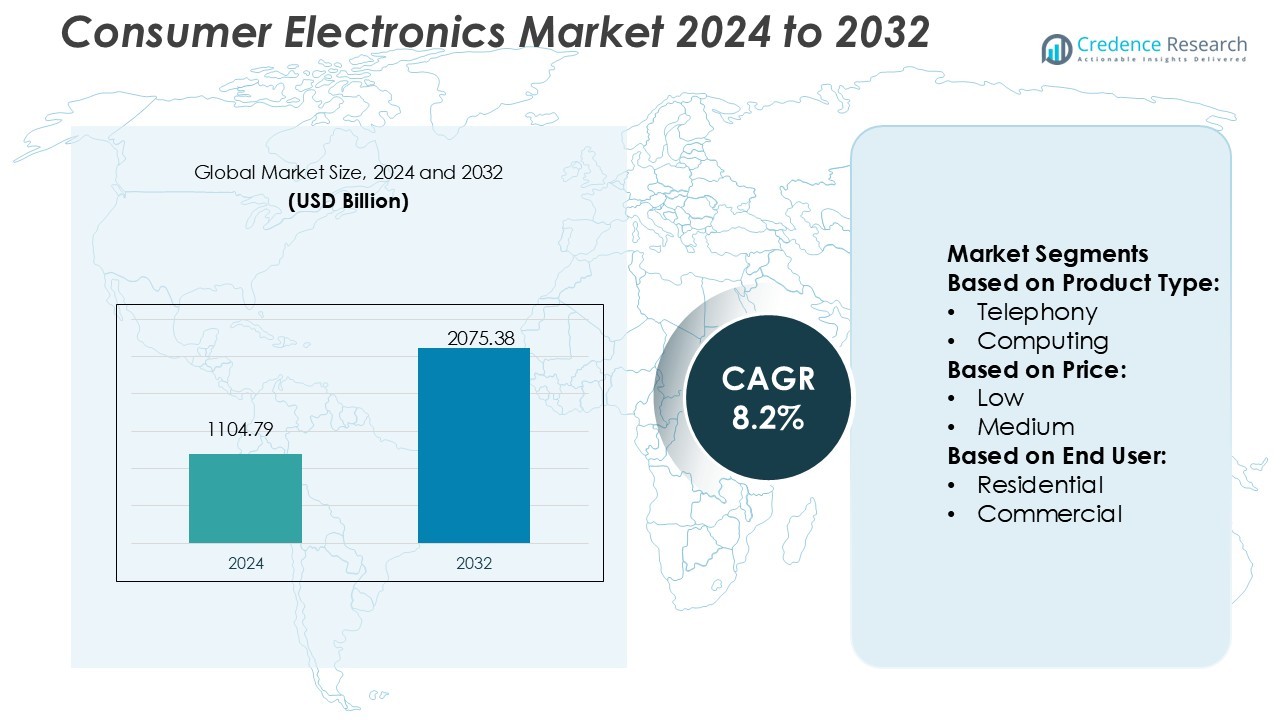
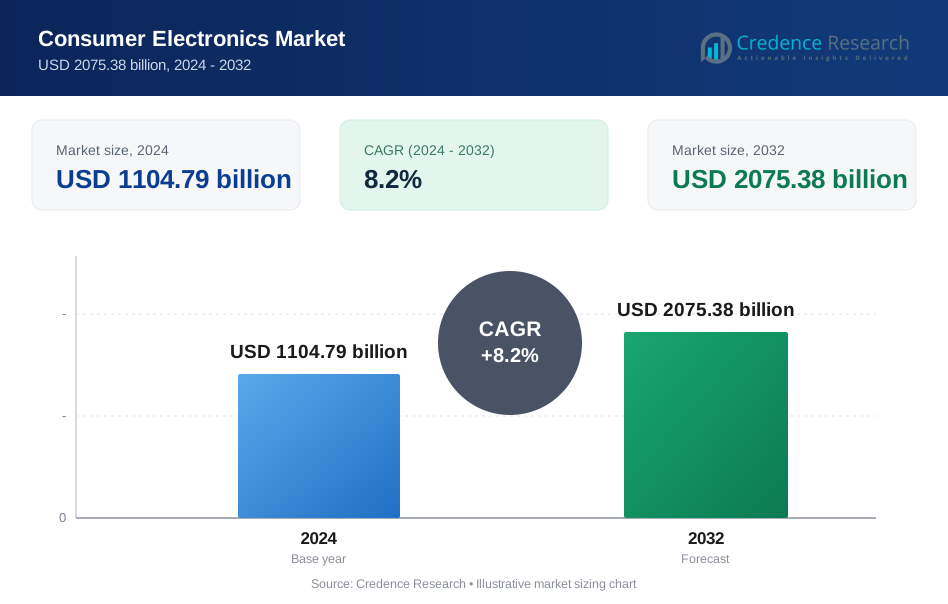
Consumer Electronics Market size was valued USD 1104.79 billion in 2024 and is anticipated to reach USD 2075.38 billion by 2032, at a CAGR of 8.2% during the forecast period.
| REPORT ATTRIBUTE | DETAILS |
|---|---|
| Historical Period | 2020-2023 |
| Base Year | 2024 |
| Forecast Period | 2025-2032 |
| Consumer Electronics Market Size 2024 | USD 1104.79 Billion |
| Consumer Electronics Market, CAGR | 8.2% |
| Consumer Electronics Market Size 2032 | USD 2075.38 Billion |
The consumer electronics market is driven by major players including Samsung Electronics, Apple Inc., LG Electronics, Sony Group Corporation, Huawei Technologies, Microsoft Corp., Panasonic Corporation, Dell Technologies, HP Inc., and Lenovo Group. These companies focus on innovation, design efficiency, and digital integration to strengthen their market positions. They invest heavily in R&D, develop AI-powered devices, and expand global distribution networks to meet rising consumer demand. Asia-Pacific leads the global consumer electronics market with a 39% share in 2024, driven by strong manufacturing capabilities, urbanization, and growing middle-class income. The region’s dominance is further supported by technological innovation, large-scale production facilities, and expanding e-commerce penetration.
Market Insights
- The consumer electronics market was valued at USD 1104.79 billion in 2024 and is projected to reach USD 2075.38 billion by 2032, growing at a CAGR of 8.2%.
- Strong R&D investments and product innovation by Samsung, Apple, Sony, and LG drive technological growth, focusing on AI integration, sustainability, and energy-efficient designs.
- Key trends include the rising use of smart home devices, wearable technologies, and IoT-based automation enhancing consumer convenience and lifestyle personalization.
- High production costs and semiconductor supply fluctuations act as market restraints, impacting pricing strategies and product availability globally.
- Asia-Pacific dominates with a 39% regional share in 2024 due to strong manufacturing capabilities, expanding e-commerce, and growing middle-class income, while the computing and telephony segments hold the largest revenue share within product categories.
Market Segmentation Analysis:
By Product Type
The computing segment dominated the consumer electronics market, accounting for a 34% share in 2024. This segment leads due to strong demand for laptops, tablets, and hybrid devices supporting remote work and digital education. Advancements in AI-enabled processors, lightweight designs, and extended battery life fuel adoption. Increasing cloud integration and gaming performance optimization also attract both residential and professional users. Major players focus on integrating sustainable materials and faster chipsets, aligning with the growing consumer preference for eco-friendly and high-performance electronics.
- For instance, LG’s AI research division validated the Furiosa RNGD chip for use in computing and edge servers, achieving 512 TFLOPS FP8 throughput with a TDP of 150 W in LG’s internal benchmark tests.
By Price
The medium-price segment held the largest market share of 46% in 2024, driven by balanced affordability and advanced features. Mid-range products attract a wide customer base seeking durability and performance without premium costs. Rising disposable incomes and the availability of feature-rich smartphones, laptops, and smart TVs strengthen this category. Companies focus on modular designs, local manufacturing, and regional customization to enhance competitiveness. The segment benefits from technological diffusion from premium lines, offering consumers enhanced connectivity and smart integration at accessible price points.
- For instance, Microsoft announced Surface Copilot+ PCs that include on-device Neural Processing Units (NPUs) delivering over 40 TOPS of AI inferencing performance.
By End User
The residential segment dominated the market with a 68% share in 2024, supported by growing smart home adoption and lifestyle upgrades. Consumers increasingly prefer interconnected devices for entertainment, communication, and daily convenience. Expansion of IoT ecosystems, coupled with home automation systems and streaming services, boosts product integration across households. E-commerce platforms and brand-specific online stores further drive product accessibility. Continuous innovation in energy-efficient appliances and AI-powered smart assistants sustains strong demand within the residential electronics market.
Key Growth Drivers
Rising Adoption of Smart and Connected Devices
The growing demand for IoT-enabled and AI-integrated consumer electronics is a major growth driver. Devices such as smart TVs, wearables, and voice-assisted appliances are increasingly popular due to improved convenience and automation. The integration of AI enhances personalization and energy efficiency, attracting a wide consumer base. Manufacturers are also leveraging connectivity for remote operation and real-time monitoring. This trend is accelerating the replacement of traditional devices with smart counterparts, boosting global sales and expanding the consumer electronics market.
- For instance, Huawei in 2025 claimed that its WATCH GT 6 can run for 21 days on a single charge under its TruSense health monitoring framework. Huawei’s CloudMatrix384 supernode integrates 384 Ascend 910C NPUs and 192 Kunpeng CPUs, enabling 6,688 tokens/sec prefill throughput per NPU and 1,943 tokens/sec decode throughput per NPU in large language model inference operations.
Increasing Disposable Income and Urbanization
Rapid urbanization and rising disposable incomes are significantly fueling demand for advanced consumer electronics. Consumers in urban areas are adopting premium and multifunctional devices for better comfort and efficiency. Expanding middle-class populations in Asia-Pacific and Latin America further contribute to increased purchasing power. The availability of financing options and online retail platforms makes high-end electronics more accessible. This combination of lifestyle transformation and economic improvement continues to support strong global market growth.
- For instance, Panasonic developed the H₂ Kibou Field, a renewable energy demonstration facility in Kusatsu, Japan. The facility combines a 495 kW hydrogen fuel cell system, 570 kW of solar panels, and a 1.1 MWh lithium-ion storage system.
Advancements in Manufacturing and Energy Efficiency
Technological innovation in manufacturing and energy-efficient designs is driving market expansion. The introduction of lightweight materials, miniaturization, and enhanced battery performance improves product longevity and user experience. Energy-efficient electronics reduce power consumption, aligning with sustainability goals and government energy regulations. Automation and robotics in production lines have lowered costs and increased scalability. These advancements enable companies to deliver high-quality, affordable products while meeting eco-friendly standards and consumer expectations.
Key Trends & Opportunities
Growing Demand for Sustainable and Eco-Friendly Products
Consumers are increasingly favoring electronics designed with recyclable materials and low carbon footprints. Companies are developing energy-efficient products that comply with environmental regulations. The adoption of green technologies and circular economy principles presents strong growth opportunities. Firms investing in eco-certifications and sustainable packaging are gaining consumer trust and brand value. This shift toward sustainability enhances long-term competitiveness in the global market.
- For instance, HP reports that in its 2023 operations it incorporated 34,400 tonnes of post-consumer recycled (PCR) plastic into its product portfolio, meeting 18 % of its total plastic demand.
Expansion of E-Commerce and Omnichannel Retailing
E-commerce has become a vital distribution channel for consumer electronics. Online platforms enable product comparison, easy financing, and doorstep delivery, driving convenience-led purchasing behavior. Omnichannel strategies-combining digital and physical experiences-are helping brands strengthen customer engagement. Enhanced logistics, AR-based product visualization, and post-purchase support further improve user satisfaction. The digital retail ecosystem thus continues to shape the future of electronics sales.
Integration of Artificial Intelligence and Voice Assistance
AI-driven technologies are transforming user interaction with electronic devices. Voice assistants like Alexa and Google Assistant enable seamless control, enhancing convenience and personalization. Smart home ecosystems integrating AI-based recommendations are becoming mainstream. Manufacturers using predictive analytics and machine learning enhance product efficiency and user engagement. This trend continues to open new possibilities for innovation and premium product development.
- For instance, Samsung’s Latin America e-commerce team partnered with Kluge to deploy Web AR for over 200 3D product models, enabling users to place virtual TVs and appliances in their homes without installing an app.
Key Challenges
High Competition and Price Sensitivity
The consumer electronics market faces intense competition from numerous global and regional brands. Continuous innovation leads to frequent product launches, increasing price pressure. Many consumers prioritize affordability, forcing manufacturers to balance between quality and cost. This environment limits profit margins and compels firms to optimize supply chains. Price sensitivity, especially in emerging markets, remains a persistent challenge for sustainable growth.
Supply Chain Disruptions and Semiconductor Shortages
Global supply chain disruptions and chip shortages have severely impacted production cycles. Semiconductor scarcity affects manufacturing timelines and increases product costs. Dependence on limited suppliers makes the industry vulnerable to geopolitical and logistic risks. Companies are now investing in regional manufacturing and diversified sourcing to mitigate these issues. However, rebuilding supply resilience requires time and significant capital investment.
Regional Analysis
North America
North America holds a 27% share of the global consumer electronics market in 2024. The region benefits from high adoption of smart home devices, advanced connectivity, and strong purchasing power. Major players such as Apple, Samsung, and Sony dominate through continuous innovation in wearables, entertainment systems, and IoT-based appliances. The U.S. leads regional growth, supported by increasing demand for AI-integrated and energy-efficient devices. Expanding 5G infrastructure and the rise of digital lifestyles further accelerate product replacement cycles, strengthening market expansion across both residential and commercial sectors.
Europe
Europe accounts for a 24% share of the consumer electronics market in 2024. Strong environmental regulations and consumer demand for sustainable, energy-efficient products drive regional growth. Countries like Germany, the U.K., and France lead adoption due to high disposable incomes and tech-savvy consumers. European manufacturers focus on eco-friendly designs, smart connectivity, and compliance with the EU’s Green Deal. E-commerce expansion and smart home penetration continue to enhance product accessibility. The region’s focus on digital transformation and innovation in smart appliances ensures consistent growth within both premium and mid-range segments.
Asia-Pacific
Asia-Pacific dominates the global consumer electronics market with a 39% share in 2024. The region’s leadership is driven by high population density, rapid urbanization, and growing middle-class income. China, Japan, South Korea, and India serve as major production and consumption hubs. Strong government initiatives supporting manufacturing and smart city development fuel market expansion. The dominance of regional players like Samsung, LG, Xiaomi, and Sony enhances innovation and competitive pricing. Growing e-commerce networks and rising adoption of connected devices sustain the region’s growth momentum, making Asia-Pacific the fastest-evolving electronics market globally.
Latin America
Latin America holds a 6% share of the global consumer electronics market in 2024. Market growth is supported by increasing smartphone penetration, expanding internet access, and the popularity of e-commerce platforms. Brazil and Mexico dominate regional demand, driven by young consumers’ preference for smart and affordable devices. The adoption of 4G and emerging 5G networks stimulates sales of connected products. Local distributors and international brands are expanding partnerships to meet diverse consumer needs. Despite currency fluctuations and import costs, the region’s growing digital economy provides favorable conditions for steady market expansion.
Middle East & Africa
The Middle East & Africa region represents a 4% share of the consumer electronics market in 2024. Growth is driven by rising urbanization, improving living standards, and expanding retail infrastructure. Gulf countries like the UAE and Saudi Arabia lead adoption, supported by smart city initiatives and tech-friendly policies. Africa’s market is developing rapidly due to affordable smartphone availability and expanding internet access. Global brands are increasing investments in localized manufacturing and after-sales networks. Although the market faces challenges from price sensitivity and limited distribution, growing digitalization continues to enhance regional opportunities.
Market Segmentations:
By Product Type:
- Telephony
- Computing
By Price:
- Low
- Medium
By End User:
- Residential
- Commercial
By Geography
- North America
- US
- Canada
- Mexico
- Europe
- Germany
- France
- UK.
- Italy
- Spain
- Rest of Europe
- Asia Pacific
- China
- Japan
- India
- South Korea
- South-east Asia
- Rest of Asia Pacific
- Latin America
- Brazil
- Argentina
- Rest of Latin America
- Middle East & Africa
- GCC Countries
- South Africa
- Rest of Middle East and Africa
Competitive Landscape
The competitive landscape of the consumer electronics market features key players such as LG Electronics, Microsoft Corp., Huawei Technologies, Panasonic Corporation, HP Inc., Samsung Electronics, Dell Technologies, Sony Group Corporation, Lenovo Group, and Apple Inc. The consumer electronics market is highly competitive, driven by continuous innovation, rapid technological advancement, and changing consumer preferences. Companies compete by offering smart, connected, and energy-efficient products tailored to modern digital lifestyles. The industry focuses on integrating artificial intelligence, the Internet of Things (IoT), and cloud-based ecosystems to enhance user experience. Manufacturers are investing heavily in research and development to introduce innovative designs and multifunctional features. The growing emphasis on sustainability, recyclability, and low-energy consumption further differentiates leading brands. Competitive intensity remains high, with global players expanding product portfolios and strengthening distribution networks to capture diverse market segments.
Key Player Analysis
- LG Electronics
- Microsoft Corp.
- Huawei Technologies
- Panasonic Corporation
- HP Inc.
- Samsung Electronics
- Dell Technologies
- Sony Group Corporation
- Lenovo Group
- Apple Inc.
Recent Developments
- In February 2025, ZeroAvia secured its first commercial agreement for a standalone electric propulsion system, with Jetcruzer International purchasing the company's 600kW system. The propulsion system will support Jetcruzer International's ongoing electric aircraft development program.
- In January 2025, Samsung Electronics America unveiled its latest innovation, Samsung Vision AI1, at the CES First Look 2025 event. This advanced AI technology showcases groundbreaking applications designed to deliver exceptional picture quality and serve as adaptive, intelligent companions that simplify and enhance daily life.
- In June 2024, HORIBA introduced its STARS Battery software, aimed at improving battery testing capabilities in the mobility sector. This new software supports the testing of diverse battery types-single cells, modules, and packs-and provides performance and durability assessments essential for ensuring the reliability of electric propulsion systems.
- In May 2023, Sony Electronics Inc. launched the ‘Xperia 1V’ smartphone, fit with advanced and cutting edge technology, along with a CMOS image sensor with two-layer transistor pixel.
Report Coverage
The research report offers an in-depth analysis based on Product Type, Price, End-User and Geography. It details leading market players, providing an overview of their business, product offerings, investments, revenue streams, and key applications. Additionally, the report includes insights into the competitive environment, SWOT analysis, current market trends, as well as the primary drivers and constraints. Furthermore, it discusses various factors that have driven market expansion in recent years. The report also explores market dynamics, regulatory scenarios, and technological advancements that are shaping the industry. It assesses the impact of external factors and global economic changes on market growth. Lastly, it provides strategic recommendations for new entrants and established companies to navigate the complexities of the market.
Future Outlook
- The market will expand steadily due to rising demand for smart and connected devices.
- Artificial intelligence and IoT integration will enhance product performance and personalization.
- Energy-efficient and eco-friendly electronics will gain stronger consumer preference.
- E-commerce and direct-to-consumer channels will drive higher global sales.
- 5G connectivity will accelerate adoption of advanced mobile and home devices.
- Wearables and health-monitoring gadgets will become mainstream in consumer use.
- Cloud-based ecosystems will improve device interconnectivity and remote management.
- Emerging economies will witness strong growth through increased digital adoption.
- Companies will focus more on circular economy models and sustainable production.
- Continuous innovation in display, battery, and semiconductor technologies will shape future competitiveness.
Request a Free Sample
Fill in your details and we'll send you a free sample report.
- Sample data tables & charts
- Research methodology
Market Dynamics
Rising Adoption of Smart and Connected Devices
The proliferation of IoT-enabled and AI-integrated consumer electronics, such as smart TVs, wearables, and voice-assisted appliances, is driving market growth by enhancing convenience, automation, and personalization for consumers. This trend is accelerating the replacement of traditional devices with smart counterparts, expanding the global market.
Increasing Disposable Income and Urbanization
Rapid urbanization and rising disposable incomes, especially in Asia-Pacific and Latin America, are fueling demand for advanced and multifunctional consumer electronics. The expanding middle class and greater access to financing and e-commerce platforms make high-end electronics more accessible, supporting robust market expansion.
Advancements in Manufacturing and Energy Efficiency
Technological innovation in manufacturing, including lightweight materials, miniaturization, and improved battery performance, is enabling the production of energy-efficient and sustainable electronics. These advancements reduce power consumption, align with regulatory requirements, and meet consumer expectations for eco-friendly products.
Expansion of E-Commerce and Omnichannel Retailing
The growth of online retail and omnichannel strategies is making consumer electronics more accessible, allowing consumers to compare products, access financing, and benefit from convenient delivery. Enhanced digital retail experiences are driving higher global sales and shaping purchasing behavior.
Integration of Artificial Intelligence and Voice Assistance
AI-driven technologies and voice assistants are transforming user interaction with electronic devices, enabling seamless control and personalized experiences. Manufacturers leveraging AI and machine learning are enhancing product efficiency, user engagement, and opening new avenues for premium product development.
Need a Custom Version of This Report?
Tailor the scope, geography, or segments to your exact requirements.
- Custom geography or segment scope
- Direct access to our analyst team
Frequently Asked Questions
What is the current market size for the Consumer Electronics Market, and what is its projected size in 2032?
At what Compound Annual Growth Rate is the Consumer Electronics Market projected to grow between 2025 and 2032?
Which Consumer Electronics Market segment held the largest share in 2024?
What are the primary factors fueling the growth of the Consumer Electronics Market?
Who are the leading companies in the Consumer Electronics Market?
Which region commanded the largest share of the Consumer Electronics Market in 2024?
Table of Content
Chapter 1 Market Segmentation
- 1.1 Segmentation Framework
- 1.1.1 Product and Service Classification
- 1.1.2 Application and End-Use Classification
- 1.1.3 Technology and Solution Classification
- 1.1.4 Customer and Distribution Channel Classification
- 1.1.5 Geographic Segmentation
- 1.1.6 Market Segment Definitions and Boundaries
- 1.2 By Price
- 1.2.1 Low
- 1.2.2 Medium
- 1.3 By End User
- 1.3.1 Residential
- 1.3.2 Commercial
- 1.4 By Product Type
- 1.4.1 Telephony
- 1.4.2 Computing
Chapter 2 Introduction
- 2.1 Report Objectives and Scope
- 2.2 Product Definition and Industry Terminology
- 2.3 Market Inclusions and Exclusions
- 2.4 Research Process
- 2.4.1 Primary Research and Expert Interviews
- 2.4.2 Secondary Research and Source Review
- 2.4.3 Top-Down and Bottom-Up Estimation
- 2.4.4 Data Triangulation and Verification
- 2.5 Market Size Measurement Basis
- 2.5.1 2024: USD 1104.79 billion → 2032: USD 2075.38 billion
- 2.6 Historical and Forecast Reference Periods
- 2.6.1 Base Year: 2024
- 2.6.2 Forecast Period: 2024-2032
- 2.7 Research Assumptions and Limitations
Chapter 3 Executive Summary
- 3.1 Market Snapshot and Key Findings
- 3.2 Base-Year Market Size, 2024
- 3.3 Forecast Market Size, 2032
- 3.4 Revenue and Volume Growth Outlook
- 3.5 Key Demand and Supply Indicators
- 3.6 Leading Market Segments
- 3.7 Fastest-Growing Market Opportunities
- 3.8 Regional Performance Highlights
- 3.9 Technology and Industry Transformation
- 3.10 Competitive Landscape Summary
- 3.11 Analyst View and Strategic Implications
Chapter 4 Global Consumer Electronics Market Trends and Developments
- 4.1 Historical Industry Development
- 4.2 Recent Market Trends and Developments
- 4.3 Demand and Customer Behavior Trends
- 4.4 Technology and Product Innovation
- 4.5 Artificial Intelligence, Automation and Digitalization
- 4.6 Local Manufacturing and Supply Chain Realignment
- 4.7 Industry Partnerships, Mergers and Acquisitions
- 4.8 Sustainability and Circular Economy Developments
- 4.9 Government and Private Sector Investment Trends
- 4.10 Emerging Business Models and Commercialization
- 4.11 Industry Developments and Announcements
Chapter 5 Global Consumer Electronics Market Production, Supply and Demand Analysis
- 5.1 Demand Trend and Consumption Analysis
- 5.2 Demand Forecast, 2024-2032
- 5.3 Production and Output Trend
- 5.4 Production and Output Forecast, 2024-2032
- 5.5 Installed Capacity and Capacity Utilization
- 5.6 Company-Wise Production Plants and Statistics
- 5.6.1 Installed Production Capacity
- 5.6.2 Actual Production
- 5.6.3 Planned Capacity and Expansion Targets
- 5.7 Supply Chain Structure and Procurement Trends
- 5.8 Supply-Demand Gap and Bottlenecks
- 5.9 Import Dependence and Sourcing Structure
- 5.10 Contract Manufacturing and Outsourcing
- 5.11 Regional Supply and Demand Concentration
Chapter 6 Global Consumer Electronics Market Pricing Analysis
- 6.1 Pricing Structure and Measurement
- 6.2 Historical Pricing Trends
- 6.3 Pricing Outlook, 2024-2032
- 6.4 Average Selling Price and Unit Economics
- 6.5 Pricing by Product and Market Segment
- 6.6 Geographic Pricing Differences
- 6.7 Key Input, Energy, Labor and Logistics Costs
- 6.8 Contract Pricing and Purchasing Models
- 6.9 Pricing Sensitivity and Competitive Positioning
- 6.10 Price, Margin and Profitability Implications
Chapter 7 Global Consumer Electronics Market Dynamics
- 7.1 Market Growth Drivers
- 7.1.1 Demand-Side Drivers
- 7.1.2 Technology and Innovation Drivers
- 7.1.3 Infrastructure and Investment Drivers
- 7.1.4 Regulatory and Policy Drivers
- 7.2 Market Restraints
- 7.2.1 Cost and Affordability Constraints
- 7.2.2 Technology and Adoption Barriers
- 7.2.3 Supply Chain and Operational Constraints
- 7.3 Market Challenges
- 7.3.1 Competitive Pressure and Margin Erosion
- 7.3.2 Skills, Infrastructure and Implementation Gaps
- 7.4 Emerging Market Opportunities
- 7.5 Market Dynamics Impact and Time-Horizon Assessment
Chapter 8 Global Consumer Electronics Value Chain Analysis
- 8.1 Industry Value Chain Overview
- 8.2 Upstream Suppliers and Critical Inputs
- 8.3 Technology and Component Providers
- 8.4 Manufacturing or Service Delivery
- 8.5 Distribution, Channel Partners and Integrators
- 8.6 Downstream Applications and End Users
- 8.7 Value Addition and Profit Pools
- 8.8 Vertical Integration and Outsourcing
- 8.9 Supplier Concentration and Risk
- 8.10 Supply Chain Localization and Resilience
Chapter 9 Global Consumer Electronics Market Regulations and Policies
- 9.1 Relevant Laws, Standards and Compliance Frameworks
- 9.2 Product, Service, Safety and Quality Requirements
- 9.3 Government Policies, Incentives and Subsidies
- 9.4 Imports, Exports and Trade Barriers
- 9.5 Public Procurement and Local Content Requirements
- 9.6 Environmental and Sustainability Compliance
- 9.7 Upcoming Policy Changes and Market Implications
Chapter 10 Global Consumer Electronics Market Hotspots and Opportunities
- 10.1 Market Opportunity Mapping and Growth Hotspots
- 10.2 High-Growth Applications and Customer Groups
- 10.3 Underserved Markets and White-Space Opportunities
- 10.4 Emerging Technology and Product Opportunities
- 10.5 New Capacity and Investment Hotspots
- 10.6 Market Entry and Expansion Opportunities
- 10.7 Distribution and Partnership Opportunities
- 10.8 Near-Term and Long-Term Commercial Potential
- 10.9 Opportunity Attractiveness and Execution Risks
Chapter 11 Global Consumer Electronics Market Outlook, 2024-2032
- 11.1 Market Size and Analysis
- 11.1.1 Revenue (Market Measurement: 2024: USD 1104.79 billion → 2032: USD 2075.38 billion)
- 11.1.2 Market Volume and Quantity Sold
- 11.1.3 Historical Market Size
- 11.1.4 Base-Year Market Size, 2024
- 11.2 Market Forecast, 2024-2032
- 11.2.1 Revenue Forecast to 2032
- 11.2.2 Volume Forecast to 2032
- 11.2.3 CAGR and Year-on-Year Growth
- 11.2.4 Incremental Revenue Opportunity
- 11.3 Forecast Assumptions and Scenario Analysis
- 11.3.1 Base-Case Forecast
- 11.3.2 Optimistic and Conservative Scenarios
- 11.3.3 Technology, Pricing and Policy Sensitivities
- 11.4 Market Attractiveness and Growth Outlook
Chapter 12 Global Consumer Electronics Market Segmentation and Outlook
- 12.1 Segmentation Summary and Market Shares, 2024
- 12.2 Largest and Fastest-Growing Segments
- 12.3 By Price - Market Size and Forecast, 2024-2032
- 12.3.1 Segment Definition and Scope
- 12.3.2 Historical Market Size
- 12.3.3 Revenue Forecast, 2024-2032
- 12.3.4 Volume Forecast, 2024-2032
- 12.3.5 Base-Year Market Share, 2024
- 12.3.6 Segment CAGR and Growth Drivers
- 12.3.7 Subsegment Market Size and Forecast
- 12.3.7.1 Low
- 12.3.7.2 Medium
- 12.3.8 Subsegment Pricing and Adoption Trends
- 12.3.9 Leading Suppliers and Competition
- 12.3.10 Regional Demand and Opportunities
- 12.4 By End User - Market Size and Forecast, 2024-2032
- 12.4.1 Segment Definition and Scope
- 12.4.2 Historical Market Size
- 12.4.3 Revenue Forecast, 2024-2032
- 12.4.4 Volume Forecast, 2024-2032
- 12.4.5 Base-Year Market Share, 2024
- 12.4.6 Segment CAGR and Growth Drivers
- 12.4.7 Subsegment Market Size and Forecast
- 12.4.7.1 Residential
- 12.4.7.2 Commercial
- 12.4.8 Subsegment Pricing and Adoption Trends
- 12.4.9 Leading Suppliers and Competition
- 12.4.10 Regional Demand and Opportunities
- 12.5 By Product Type - Market Size and Forecast, 2024-2032
- 12.5.1 Segment Definition and Scope
- 12.5.2 Historical Market Size
- 12.5.3 Revenue Forecast, 2024-2032
- 12.5.4 Volume Forecast, 2024-2032
- 12.5.5 Base-Year Market Share, 2024
- 12.5.6 Segment CAGR and Growth Drivers
- 12.5.7 Subsegment Market Size and Forecast
- 12.5.7.1 Telephony
- 12.5.7.2 Computing
- 12.5.8 Subsegment Pricing and Adoption Trends
- 12.5.9 Leading Suppliers and Competition
- 12.5.10 Regional Demand and Opportunities
- 12.6 Segment Growth Comparison
- 12.7 Segment Attractiveness and Priority Matrix
Chapter 13 Global Consumer Electronics End-Use and Application Market Outlook
- 13.1 End-Use Industry and Customer Demand Structure
- 13.2 Leading Applications and Customer Groups
- 13.3 End-Use Market Size, Share and Forecast
- 13.4 Major End-Use Industry Deep Dives
- 13.4.1 Customer Requirements and Use Cases
- 13.4.2 Demand and Replacement Cycles
- 13.4.3 Technical and Regulatory Considerations
- 13.4.4 Purchasing and Procurement Models
- 13.4.5 Leading Vendors and Distribution Channels
- 13.4.6 Forecast and Commercial Opportunities
- 13.5 Emerging Applications and Cross-Segment Demand
- 13.6 End-Use Industry Investment Priorities
Chapter 14 Global Consumer Electronics Geographic Market Outlook, 2024-2032
- 14.1 Regional Market Size and Share, 2024
- 14.2 Regional Market Forecast, 2024-2032
- 14.3 Regional Pricing, Production and Demand Differences
- 14.4 North America
- 14.4.1 United States
- 14.4.2 Canada
- 14.4.3 Mexico
- 14.5 Europe
- 14.5.1 Germany
- 14.5.2 France
- 14.5.3 Italy
- 14.5.4 United Kingdom
- 14.5.5 Spain
- 14.5.6 Poland
- 14.5.7 Russia
- 14.5.8 Netherlands
- 14.5.9 Belgium
- 14.5.10 Sweden
- 14.5.11 Denmark
- 14.5.12 Norway
- 14.5.13 Rest of Europe
- 14.6 Asia Pacific
- 14.6.1 China
- 14.6.2 India
- 14.6.3 Japan
- 14.6.4 South Korea
- 14.6.5 Thailand
- 14.6.6 Indonesia
- 14.6.7 Vietnam
- 14.6.8 Malaysia
- 14.6.9 Australia
- 14.6.10 Rest of Asia Pacific
- 14.7 Latin America
- 14.7.1 Brazil
- 14.7.2 Argentina
- 14.7.3 Colombia
- 14.7.4 Chile
- 14.7.5 Rest of Latin America
- 14.8 Middle East
- 14.8.1 Saudi Arabia
- 14.8.2 United Arab Emirates
- 14.8.3 Turkey
- 14.8.4 Israel
- 14.8.5 Iran
- 14.8.6 Rest of the Middle East
- 14.9 Africa
- 14.9.1 South Africa
- 14.9.2 Egypt
- 14.9.3 Nigeria
- 14.9.4 Morocco
- 14.9.5 Rest of Africa
- 14.10 Regional Investment, Policy and Supply Chain Differences
- 14.11 Regional Competitive Landscape
- 14.12 Geographic Growth Hotspots
Chapter 15 Global Consumer Electronics Technology, Innovation and Sustainability Outlook
- 15.1 Technology Landscape and Maturity
- 15.2 Product, Process and Service Innovation
- 15.3 AI, Automation and Digital Tools in the Industry
- 15.4 Technology Adoption and Performance Benchmarking
- 15.5 Innovation Pipeline and R&D Investment
- 15.6 Patent and Intellectual Property Trends
- 15.7 Energy Efficiency and Resource Management
- 15.8 Sustainability, Recycling and Circularity
- 15.9 Technology Roadmap, 2024-2032
- 15.10 Risks of Obsolescence and Technology Substitution
Chapter 16 Global Consumer Electronics Market Key Strategic Imperatives
- 16.1 Growth and Market Entry Priorities
- 16.2 High-Return Products and Segments
- 16.3 Pricing, Profitability and Cost Optimization
- 16.4 Technology Investment and Product Differentiation
- 16.5 Supply Chain Localization and Resilience
- 16.6 Distribution and Customer Acquisition
- 16.7 Partnership, Acquisition and Capacity Strategy
- 16.8 Regional Expansion Priorities
- 16.9 Short-, Medium- and Long-Term Actions
Chapter 17 Competition Outlook
- 17.1 Industry Competition Characteristics
- 17.2 Market Structure and Concentration
- 17.3 Market Share and Competitive Positioning, 2024
- 17.4 Company-Wise Revenue and Product Benchmarking
- 17.5 Production and Service Capacity Benchmarking
- 17.6 Technology, Pricing and Differentiation
- 17.7 Regional Footprint and Distribution Strength
- 17.8 Mergers, Acquisitions and Strategic Alliances
- 17.9 New Entrants and Competitive Threats
- 17.10 Porter's Five Forces and Industry Attractiveness
- 17.11 Competitive Outlook, 2024-2032
Chapter 18 Company Profiles
- 18.1 Company Coverage and Selection Criteria
- 18.2 Samsung Electronics
- 18.2.1 Business Description
- 18.2.2 Company Ownership and Geographic Presence
- 18.2.3 Product and Service Portfolio
- 18.2.4 Manufacturing and Operating Footprint
- 18.2.5 Production Capacity and Expansion Plans
- 18.2.6 Financial Performance and Investment
- 18.2.7 Market Share and Competitive Position
- 18.2.8 Technology and Innovation Capabilities
- 18.2.9 Strategic Alliances or Partnerships
- 18.2.10 Recent Developments
- 18.2.11 Growth Strategy and Outlook
- 18.3 Apple Inc.
- 18.4 LG Electronics
- 18.5 Sony Group Corporation
- 18.6 Huawei Technologies
- 18.7 Microsoft Corp.
- 18.8 Panasonic Corporation
- 18.9 Dell Technologies
- 18.10 HP Inc.
- 18.11 Lenovo Group
- 18.12 Other Relevant Market Participants
Note: Every listed company is profiled on the structure shown under the first company. The company list is preliminary and may change based on research findings, market developments, data availability and client requirements.
Chapter 19 Disclaimer
- 19.1 Research and Forecast Disclaimer
- 19.2 Data Source and Estimation Limitations
Note: The depth of individual sections depends on data availability for this market. Volume, capacity, trade and other unit-based metrics are included where applicable.

