
| REPORT ATTRIBUTE | DETAILS |
|---|---|
| Historical Period | 2019-2022 |
| Base Year | 2023 |
| Forecast Period | 2024-2032 |
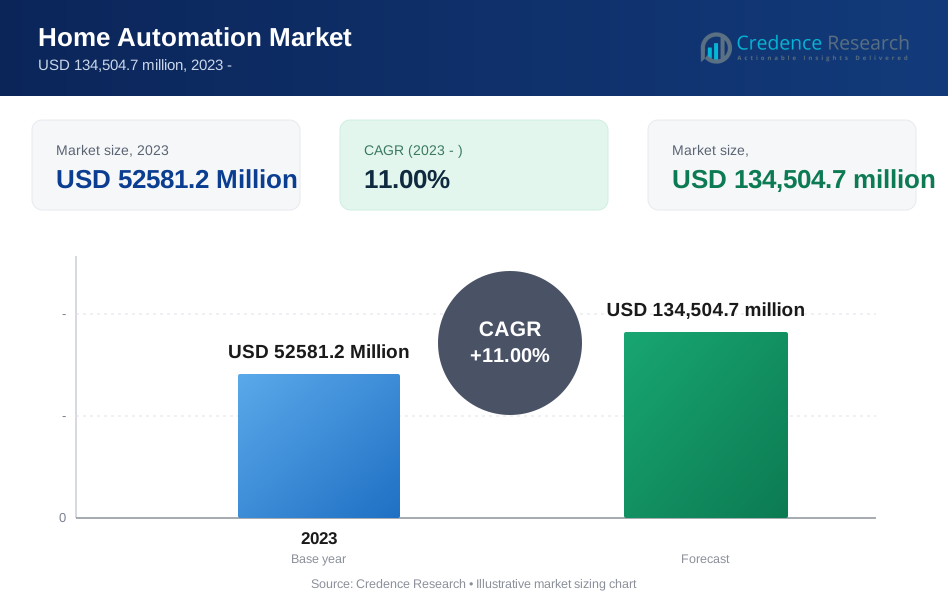
| Home Automation Market Size 2023 | USD 52581.2 million |
| Home Automation Market, CAGR | 11.00% |
| Home Automation Market Size 2032 | USD 134504.7 million |
Market Insights
- The Home Automation Market has demonstrated consistent expansion and is projected to maintain a robust CAGR of 11.00% from 2024 to 2032. Valued at USD 52581.2 million in 2023, this market is expected to reach USD 134504.7 million by 2032.
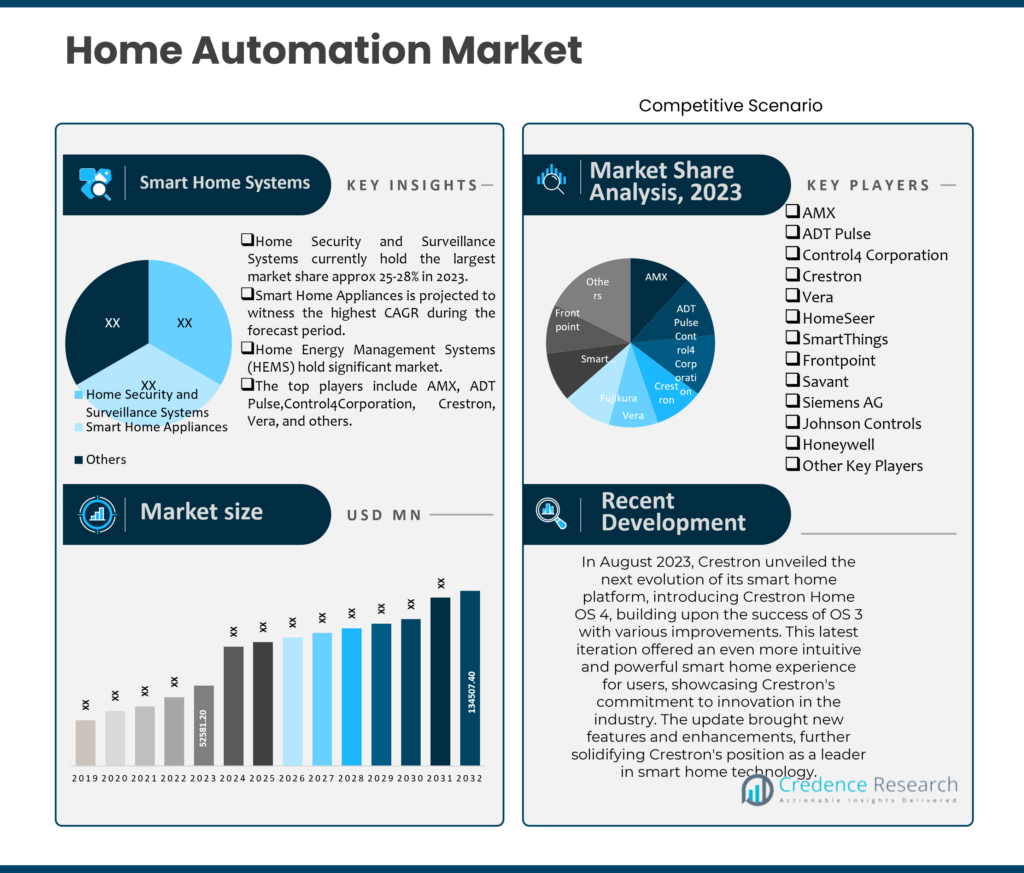
- Among the key segments, Home Security and Surveillance Systems led the market by type of system, capturing approximately 25-28% of the total market share in 2023. However, Smart Home Appliances are expected to experience the highest growth rate during the forecast period.
- Wi-Fi-based Systems currently hold the largest market share approx 25-30% in 2023. However, Thread Protocol is projected to witness the highest CAGR during the forecast period.
- Home Security and Safety dominate the market by application, holding around 27-32% of the market share in 2023, driven by the increasing demand for smart security solutions and remote access security solutions.
- North America held the largest share of the market in 2023, with a share of around 32-35%, followed by Asia Pacific and Europe, collectively accounting for just under 55% of the market share.
- The growth of the Home Automation Market is fueled by factors such as advancements in wireless technology, the rise of the Internet of Things (IoT), and increasing consumer demand for simplicity and energy efficiency in homes.
- Key opportunities in the market include the integration of AI and IoT technologies into everyday appliances, increased adoption across various smart home systems, and continuous advancements in communication protocols and connectivity options, fostering market expansion.
Executive Summary
Market Definition
The home automation market refers to the industry that develops, manufactures and distributes technologies and systems that enable homeowners to control and automate various aspects of their homes. It encompasses a wide range of products and solutions designed to make homes smarter, more efficient and more convenient that live in. Sensors and centralized control systems are used to enable remote control and management of lighting, heating, security, entertainment, and other related equipment. The home automation market has grown exponentially in recent years due to a number of factors including advancements in wireless technology, the rise of the Internet of Things (IoT), and increasing consumer demand for products for simplicity and energy efficiency. And voice assistants, are increasingly popular, and more and more homeowners are trying to integrate this technology into their daily lives.
Market Overview
The Home Automation Market has demonstrated consistent expansion and is projected to maintain a robust CAGR of 11.00% from 2024 to 2032. Valued at USD 52581.2 million in 2023, this market is expected to reach USD 134504.7 million by 2032.
Among the primary segments, Home Security and Surveillance Systems led the market by type of system, accounting for approximately 25-28% of the total market share in 2023. However, Smart Home Appliances are expected to witness the highest CAGR over the forecast period.
Wi-Fi-based Systems currently hold the largest market share approx 25-30% in 2023. However, thread protocol is projected to witness the highest CAGR during the forecast period.
Home Security and Safety emerged as the leading application segment in 2023, with a market share of about 27-32%, primarily due to the growing demand for smart security systems and remote access security solutions.
North America constituted the largest portion of the market in 2023, followed by Asia Pacific and Europe, collectively accounting for just under 55% of the market share.
The growth of the Home Automation Market is fueled by advancements in wireless technology, the rise of the Internet of Things (IoT), and increasing consumer demand for simplicity and energy efficiency in homes.
Continuous advancements in smart home technologies, including integration of AI and IoT technologies into everyday appliances, are further driving the demand for home automation solutions, especially in regions like North America and Asia Pacific..
Segmentation by Smart Home Systems
- Home Security and Surveillance Systems currently hold the largest market share approx 25-28% in 2023. The demand for smart security solutions such as motion sensors, surveillance cameras and remote monitoring systems have contributed significantly to the market share.
- Smart Home Appliances is projected to witness the highest CAGR during the forecast period. Increasing integration of AI and IoT technologies into everyday appliances such as refrigerators, washing machines and air conditioners is fueling the growth of the segment.
Segmentation by Communication Protocols and Connectivity
- Wi-Fi-based Systems currently hold the largest market share approx 25-30% in 2023. Wi-Fi connectivity is increasingly accepted for data transfer, remoteness, and compatibility with the vast ecosystem of smart home devices.
- Thread Protocol is projected to witness the highest CAGR during the forecast period. Thread is a low-power, connected system designed specifically for smart home systems. Its main advantages are reliability, security and simple device communication.
Segmentation by Application
- Home Security and Safety currently hold the largest market share approx 27-32% in 2023. Increased demand for smart security systems such as motion sensors, surveillance cameras and remote access security solutions has fueled the growth of this segment.
- Health and Wellness is projected to witness the highest CAGR during the forecast period. he rise of smart health and wellness solutions such as remote disease management, fitness tracking and connected health devices is driving the growth of this segment.
Segmentation by Region
- North America held significant share around 32-35% of the market in 2023. This dominance is primarily due to wide adoption of smart home technologies, strong leverage and presence of key market players have helped the industry dominate in terms of smart speakers, home environments and integrated security systems a early adoption has driven the market primarily in the United States.
- Asia Pacific and Europe collectively account for just under 55% share in 2023, with Europe holding over 20% share in the same year.
- The rest of the world, including Latin America, the Middle East, and Africa, supplies the remaining demand for Home Automation.
The increasing disposable income, rapid urbanization, and growing tech-savvy population contribute to the strong growth of the sector.
The North America region continues to dominate the Home Automations market. This dominance is due to several factors that have motivated the adoption and advancement of home automation technologies across the region. First, North America boasts a strong technology infrastructure, which provides a solid foundation for the integration and deployment of smart home systems. Advanced corporate connectivity, coupled with broadband high-speed internet connections and the proliferation of smart devices, facilitates seamless connections and connections between home appliances. For instance, in March 2024,the Communications Standards Agreement (CSA) announced the release of the Internet of Things (IoT) Device Security Specification 1.0, where the Product Security Verified Mark for IoT devices passes its requirements. The IoT Device Security Specification 1.0 Includes dozens of specific device security measures, such as unique specifications for each IoT device, no hard-coded default passwords, secure sensitive data on the device, security secure communications, secure software updates throughout the support period, secure development processes , including vulnerability management. Second, consumer awareness and acceptance of smart home technology is much higher in North America. Homeowners and businesses are increasingly recognizing the convenience, security and efficiency that automated systems offer. Growing demand for energy-efficient solutions, advanced security features and personalized home experiences is driving the adoption of home appliances in residential and commercial home appliances. Furthermore, the presence of key industry players, innovative startups, and robust investment in research and development contribute to the region's leadership in the Home Automation market.
The Asia Pacific region has emerged as the prominent region in the home automation market, reflecting a dynamic environment characterized by rapid technological development, increasing urbanization and growing consumer demand for lifestyle solutions a wisely expressed. The main reason for the company’s prominent share in the home automation market is the growing middle class with increasing disposable income. As living standards improve and urbanization accelerates, there is a growing trend in Asia Pacific countries to adopt modern home technology that offers comfort, safety and energy efficiency. Furthermore, the region’s strong infrastructure and widespread internet facilitate a proliferation of smart home systems. Advanced connectivity and ubiquitous high-speed internet services enable smart devices to be connected and connected seamlessly, enhancing the connected smart home ecosystem. Moreover, there is a growing awareness of the benefits of home automation, as well as aggressive marketing strategies by industry players and the rise of smart city initiatives and sustainable living practices across Asia Pacific increasing consumer interest and adoption drives the demand for smart home solutions to continue to grow. contribute to conservation and environmental sustainability. For instance, in June 2022, China's first-tier cities lead the way in smart city technology with innovations such as 3D spatial planning, digital twins, smart pipes for resource conservation, and early warning rail and subway monitoring systems. Chinese start-ups are at the forefront of these developments, working to create efficient and sustainable urban environments.
Key Highlights of the Report
The Home Automation Market is segmented by Smart Home Systems, Communication Protocols and Connectivity, Application, and Region. The growth of the market is propelled by advancements in wireless technology, the rise of the Internet of Things (IoT), and increasing consumer demand for simplicity and energy efficiency in homes.
Home Security and Surveillance Systems dominate the segment, serving essential functions in providing security and peace of mind to homeowners. Smart Home Appliances lead the product segment, offering innovative solutions for everyday household tasks and energy management.
Wi-Fi-based Systems currently hold the largest market share in the appliocation segment, with homeowners integrating smart devices and systems to enhance their living spaces' convenience and security. The Home Security and Safety application segment is witnessing rapid growth, driven by the increasing demand for smart security systems and remote access security solutions.
North America held the largest share of the Home Automation market, supported by a strong technology infrastructure and the presence of key players such as Google, Amazon, and Apple. These players focus on product innovation and strategic collaborations to maintain their market position and competitiveness in the rapidly evolving smart home industry.
What Are The Main Drivers Of The Global Home Automation Market?
Global Home Automation Market is primarily driven by growing consumer demand for convenience, comfort and energy efficiency in homes. Technological advances, such as the internet of things (IoT) and artificial intelligence, enable home systems to be connected and operated seamlessly. Rising urbanization, increasing middle class, and the expanding internet connectivity provides smart home technologies for home security, safety.
What Are The Major Challenges Faced By The Global Home Automation Market?
The global Home Automation market faces challenges include high initial installation and integration costs, which may hinder widespread adoption among consumers, connectivity issues between smart devices and systems from different manufacturers networks can complicate integration and prevent weak communication. Concerns about data privacy and security in connected homes make consumers nervous about potential vulnerabilities. Also, lack of awareness and understanding of smart home technologies among a large segment of the population may retard the growth of the market. Regulatory complexities and standards in various industries are also barriers to market expansion.
What Are The Growth Opportunities In The Global Home Automation Market?
The global Home Automation market presents growth opportunities driven by driven by several factors. First, the increasing adoption of the Internet of Things (IoT) and smart home technologies is creating a greater need for connected devices and systems that can be controlled remotely Second, energy consumption efficiency and cost savings are increasingly important to consumers, providing smart lighting, smart thermostats. The combination of voice assistants and AI technology makes home automation more accessible and user-friendly, driving market growth. Furthermore, strategic partnerships and collaboration among Home Automation suppliers, manufacturers and retailers can facilitate the growth opportunities.
Market Drivers
Increasing Demand Of Home Appliances
Growing demand for smart home appliances is a major factor driving the growth of the home automation market. Smart appliances, such as refrigerators, washing machines, and internet-connected dishwashers, allow for remote control, monitoring and automation. Consumers are interested in the features and services offered by these devices, such as energy cost savings through energy efficiency and the ability to remotely control and manage devices. Furthermore, voice assistants and AI the integration further enhances the user experience, making it hands-free control. Various companies, including tech giants and start-ups, have introduced smart home systems to meet the growing market demand for home automation. For instance, in January 2023, Boscch announced plans to introduce Matter compatibility into its ecosystem, allowing integration with other Matter-enabled systems. This move aimed to reduce complexity and meet consumer demands for a seamless and interoperable smart home experience, with Matter end devices expected to launch in 2023.
Market Restraints
High Initial Installation And Integration Costs
High initial installation and integration costs can be a major restriction in the growth of the home appliance market, especially for cost-conscious or low-income customers. The installation of home automation systems often requires specialized technicians and can involve complex processes, especially when retrofitting existing homes. lThe cost of purchasing and installing compatible equipment, as well as hiring staff for programming and programming, can deter potential customers. Additionally, maintenance and fees for advanced products or cloud services that continue to be maintained and ordered increase the overall cost of ownership. As a result, many consumers may opt for traditional home solutions instead of investing in a smart home, leading to a potentially slow growth of the market.
Opportunities
Adoption Of Various Strategies Among Market Players
Adoption of various strategies among market players create significant opportunity. The major companies serving the global Home Automation Market are AMX, ADT Pulse, Control4 Corporation, Crestron, Vera, HomeSeer, SmartThings, among others. The market players are considerably contributing to the market growth by the adoption of various strategies including mergers & acquisitions, collaborations, funding, and new product launches, to stay competitive in the market. For instance, in March 2023, ADT and Google launched a new DIY smart home security system, marking the first fully integrated offering from their partnership. The system, called ADT Self Setup, integrates Google Nest smart home products with ADT's security and life safety technology. It also introduced the ADT+ app, offering convenient control and ADT SMART Monitoring for a comprehensive DIY security solution.
Competitive Landscape
Key Players
The global Home Automation market is highly competitive, with several key players. Some of the major players in the market and their market share are as follows:
- AMX
- ADT Pulse
- Control4 Corporation
- Crestron
- Vera
- HomeSeer
- SmartThings
- Frontpoint
- Savant
- Siemens AG
- Johnson Controls
- Honeywell
- Others
These organizations prioritize product innovation, distribution channel expansion, and mergers and acquisitions to stay competitive.
The global Home Automation market's key players continually seek to stay ahead by offering new products and developments.
In August 2023, Crestron unveiled the next evolution of its smart home platform, introducing Crestron Home OS 4, building upon the success of OS 3 with various improvements. This latest iteration offered an even more intuitive and powerful smart home experience for users, showcasing Crestron's commitment to innovation in the industry. The update brought new features and enhancements, further solidifying Crestron's position as a leader in smart home technology.
In January 2024, BSH Home Appliances, a leading home appliance manufacturer, unveiled a new brand identity for its Siemens brand in Bengaluru. The company introduced software updates, including the significant launch of Crestron Home OS 4, expected to impress customers and dealers with its intuitive and powerful features.
Summary of Key Findings
- Market segmentation within the Home Automation Market encompasses various factors including smart home systems, communication protocols and connectivity, application, and region, reflecting the diverse uses and applications of home automation technologies.
- Home Security and Surveillance Systems emerge as the dominant segment, holding the majority market share due to the increasing emphasis on home security and peace of mind. Other segments such as Smart Home Appliances and Home Lighting Control Systems also contribute significantly to the market, catering to different household needs.
- CWi-Fi-based Systems currently dominant segment, holding the majority market share due to increasingly accepted for data transfer, remoteness, and compatibility with the vast ecosystem of smart home devices.
- Geographically, North America holds the largest market share, supported by a strong technology infrastructure and the presence of key industry players like Google, Amazon, and Apple. Asia Pacific and Europe collectively account for a substantial share of the market, with Asia Pacific witnessing growth due to increasing urbanization and consumer demand for lifestyle solutions.
Future Outlook
- The future outlook for the Home Automation Market indicates promising growth opportunities, particularly within sectors such as smart home appliances, energy management, and security solutions, driven by the increasing integration of AI and IoT technologies. However, anticipated challenges include interoperability issues, data privacy concerns, and the need for standardization across devices and platforms.
- To maintain competitiveness in the Home Automation Market, industry players should adopt various strategies such as continuous product innovation, strategic collaborations, securing funding for research and development, and expanding market presence. It is crucial for companies to prioritize addressing consumer preferences, improving product quality, and exploring untapped opportunities in emerging markets to ensure sustained growth amidst the evolving market landscape.
How CXOs Can Benefit from the Credence Research Home Automation Market Report
The Credence Research Home Automation Market Report provides CXOs with a comprehensive overview of the market, including:
- Market size and growth forecast:The report provides detailed estimates of the global Home Automation market size, segmented by smart home systems, communication protocols and connectivity, application, and region. It also includes forecasts for the market through 2032, based on key trends and drivers.
- Market segmentation:The report segments the Home Automation market by smart home systems, communication protocols and connectivity, application, and region. The increasing demand for advanced solutions is driven. This segmentation provides CXOs with a granular understanding of the market and the opportunities in each segment.
- Competitive landscape:The report profiles the key players in the Home Automation market and provides insights into their strategies, product offerings, and financial performance. This information can help CXOs to identify and assess their competition.
- Key trends and drivers:The report identifies and analyzes the key trends and drivers that are shaping the Home Automation market. This information can help CXOs to make informed decisions about their investments and strategies.
CXOs can use the insights from the Credence Research Home Automation Market Report to:
- Identify growth opportunities:The report can help CXOs to identify new growth opportunities in the Home Automation market. For example, the report identifies the growing demand for Home Automation from cloud computing providers and telecom companies as a key opportunity.
- Make informed investment decisions:The report can help CXOs to make informed investment decisions about Home Automation. For example, the report provides insights into the key factors to consider when evaluating Home Automation providers and selecting Home Automation solutions.
- Develop competitive strategies:The report can help CXOs to develop competitive strategies for their Home Automation businesses. For example, the report identifies the key strategies that Home Automation providers are using to differentiate themselves from their competitors.
- Track market developments:The report can help CXOs to track market developments and stay ahead of the curve. For example, the report provides insights into the latest trends and innovations in the Home Automation market.
Overall, the Credence Research Home Automation Market Report is a valuable resource for CXOs who are looking to gain a deeper understanding of the market and identify opportunities for growth.
Segmentation
-
By Smart Home Systems:
- Home Energy Management Systems (HEMS)
- Home Security and Surveillance Systems
- Home Lighting Control Systems
- Home Entertainment and Audio Systems
- Home Automation Hubs and Controllers
- Smart Home Appliances
- Smart Home Automation Software and Apps
-
By Communication Protocols and Connectivity:
- Wi-Fi-based Systems
- Bluetooth-based Systems
- Z-Wave and Zigbee-based Systems
- Thread Protocol
- Ethernet and Powerline Communication (PLC)
-
By Application:
- Home Security and Safety
- Energy Management and Conservation
- Comfort and Convenience
- Health and Wellness
- Entertainment and Multimedia
- Home Connectivity and IoT Integration
-
By Region
- North America
- US
- Canada
- Mexico
- Europe
- Germany
- France
- UK.
- Italy
- Spain
- Rest of Europe
- Asia Pacific
- China
- Japan
- India
- South Korea
- South-east Asia
- Rest of Asia Pacific
- Latin America
- Brazil
- Argentina
- Rest of Latin America
- Middle East & Africa
- GCC Countries
- South Africa
- Rest of Middle East and Africa
- North America
Adjacent Markets
In the Home Automation market, there are several adjacent markets which has high revenue growth opportunities. The key adjacent markets for Home Automation market -
Adjacent Markets |
||
| Smart Lighting Market | Smart Appliances Market | Smart Locks and Access Control Market |
| Home Security Systems Market | Energy Management Systems Market | HVAC (Heating, Ventilation, and Air Conditioning) Control Market |
| Smart Thermostat Market | Home Entertainment Systems Market | Smart Sensors and Detectors Market |
Request a Free Sample
Fill in your details and we'll send you a free sample report.
- Sample data tables & charts
- Research methodology
Need a Custom Version of This Report?
Tailor the scope, geography, or segments to your exact requirements.
- Custom geography or segment scope
- Direct access to our analyst team
Frequently Asked Questions
What is the current size of the global Home Automation market?
What is the expected growth rate of the Home Automation market between 2024 and 2032?
Which segment is leading the market share in terms of Smart Home Systems?
Which Communication Protocols and Connectivity Segments governs the demand for Home Automations in the world?
Which Thermal Spray Application Specific Home Automation segment is expected to post the highest CAGR during the forecast period?
Which region is fueling the growth of the Home Automation industry?
Who are the major players in the global Home Automation market?
What are the major market drivers of the Home Automation industry?
What are the major market restraints of the Home Automation industry?
What are the major market opportunities of the Home Automation industry?
Table of Content
Chapter 1. Report Introduction
- 1.1 Report Description & Purpose
- 1.1.1 Report Title & Market Definition
- 1.1.2 Unique Selling Propositions (USP) & Key Differentiators
- 1.1.3 Value Proposition for Stakeholders
- 1.2 Research Objectives
- 1.2.1 Market Sizing Objectives (Volume & Revenue)
- 1.2.2 Segmentation Objectives
- 1.2.3 Competitive Intelligence Objectives
- 1.2.4 Forecast & Scenario Objectives
- 1.3 Report Scope
- 1.3.1 Home Automation Scope – Types & Subtypes Covered
- 1.3.2 Geographic Scope – Regions & Countries Covered
- 1.3.3 Historical Period, Base Year & Forecast Period (2023; forecast to the forecast period)
- 1.3.4 Inclusions & Exclusions
- 1.4 HS Code & Classification Framework
- 1.5 Currency, Units & Pricing Basis
- 1.6 Target Stakeholders
- 1.7 Limitations & Assumptions
Chapter 2. Executive Summary
- 2.1 Global Home Automation Market Snapshot
- 2.1.1 Market Size – Historical (2023) & Forecast (the forecast period) (2023: USD 52581.2 Million → forecast year: USD 134,504.7 million)
- 2.1.2 Volume & Revenue – Global Totals
- 2.1.3 Key Market Highlights – Top Five Facts
- 2.2 Home Automation Market Segmentation Snapshot
- 2.2.1 Market Split by Region – 2023 vs.
- 2.3 Competitive Snapshot
- 2.3.1 Top 10 Players by Revenue Share – 2023
- 2.3.2 Top 10 Players by Volume Share – 2023
- 2.3.3 Recent Strategic Developments (18-Month Summary)
- 2.4 Key Investment Highlights & Strategic Conclusions
Chapter 3. Home Automation Market Dynamics & Industry Analysis
- 3.1 Market Overview & Context
- 3.1.1 Home Automation Market Position in the Broader Automotive Value Chain
- 3.1.2 OEM vs. Replacement Market Dynamics
- 3.1.3 Market Maturity & Development Stage by Region
- 3.2 Home Automation Market Drivers
- 3.3 Home Automation Market Restraints & Challenges
- 3.4 Home Automation Market Opportunities
- 3.5 Porter's Five Forces Analysis
- 3.5.1 Threat of New Entrants
- 3.5.2 Bargaining Power of Suppliers
- 3.5.3 Bargaining Power of Buyers
- 3.5.4 Threat of Substitutes
- 3.5.5 Competitive Rivalry – Intensity Assessment
- 3.6 Home Automation Value Chain Analysis
- 3.6.1 Upstream – Raw Material/Input Suppliers
- 3.6.1.1 Raw Material/Input 1
- 3.6.1.2 Raw Material/Input 2
- 3.6.1.3 Raw Material/Input 3
- 3.6.2 Midstream – Production/Manufacturing/Service Delivery
- 3.6.2.1 Production/Process Overview
- 3.6.2.2 Key Facility Locations & Capacity by Manufacturer
- 3.6.3 Downstream – Distribution & End Consumer
- 3.6.3.1 Primary Channel – B2B/OEM
- 3.6.3.2 Secondary Channels – Dealer, Retail, Online, Direct
- 3.6.4 Value Chain Profitability Analysis
- 3.6.1 Upstream – Raw Material/Input Suppliers
- 3.7 PESTEL Analysis
- 3.7.1 Political Factors
- 3.7.2 Economic Factors
- 3.7.3 Social Factors
- 3.7.4 Technological Factors
- 3.7.5 Environmental Factors
- 3.7.6 Legal Factors
- 3.8 Home Automation Supply Chain Analysis
- 3.8.1 Raw Material/Input Supply Risk Assessment
- 3.8.2 Manufacturing Concentration Risk (Geographic Exposure)
- 3.8.3 Trade Disruption Impact Analysis
- 3.9 Regulatory & Policy Landscape
Note: The regulatory and policy landscape section covers regulations based on their applicability to the market, Home Automation category, geography, and scope of the study. Only regulatory frameworks with a material impact on operations, compliance, trade, sustainability, or market access are analyzed in detail.
Chapter 4. Key Investment Pockets & Opportunity Analysis
- 4.1 Home Automation Market Attractiveness Analysis
- 4.1.1 By Region – Investment Attractiveness Matrix (Volume × CAGR)
- 4.2 Absolute Revenue Growth Opportunity
- 4.2.1 By Region – Absolute USD Growth Through the forecast period
- 4.3 Incremental Volume Opportunity
- 4.3.1 By Region – Incremental Volume Through the forecast period
- 4.3.2 Segment – Incremental Volume
- 4.4 Emerging Submarket Opportunity Deep Dive (Subject to Applicability)
- 4.5 Emerging Market Opportunity Scorecards
- 4.5.1 United States
- 4.5.2 Europe
- 4.5.3 Asia
- 4.5.4 Middle East & Africa
Note: Emerging Market Opportunity Scorecards will be included based on relevance and strategic importance. Regions listed are indicative and may vary depending on data availability and market dynamics.
Chapter 5. Home Automation Import-Export Analysis & Trade Flows
- 5.1 Global Trade Overview
- 5.1.1 Global Export Value by Country (2023)
- 5.1.2 Global Export Volume by Country (2023)
- 5.1.3 Global Import Value by Country (2023)
- 5.1.4 Global Import Volume by Country (2023)
- 5.1.5 Net Trade Balance by Country (2023)
- 5.2 Export Analysis – Segment
- 5.2.1 Type 1 (HS Code)
- 5.2.2 Type 2 (HS Code)
- 5.2.3 Type 3 (HS Code)
- 5.2.4 Type 4 (HS Code)
- 5.2.5 Type 5 (HS Code)
- 5.3 Import Analysis – Segment
- 5.3.1 Type 1 (HS Code)
- 5.3.2 Type 2 (HS Code)
- 5.3.3 Type 3 (HS Code)
- 5.3.4 Type 4 (HS Code)
- 5.3.5 Type 5 (HS Code)
- 5.4 Average Unit Trade Prices
- 5.4.1 Average Export Price – Segment & Country
- 5.4.2 Average Import Price – Segment & Source Country
- 5.4.3 Price Trends (2023)
- 5.5 Key Trade Route Analysis
- 5.5.1 Trade Route 1
- 5.5.2 Trade Route 2
- 5.5.3 Trade Route 3
- 5.5.4 Trade Route 4
- 5.5.5 Trade Route 5
- 5.6 Trade Policy Impact Assessment
- 5.6.1 US Anti-Dumping & Section 301 Tariffs
- 5.6.2 EU Customs Union Impact
- 5.6.3 Major Free Trade Agreements
- 5.6.4 USMCA Rules of Origin
Note: Trade policy analysis will be included only where relevant to the Home Automation market.
Chapter 6. Competitive Landscape & Company Benchmarking
- 6.1 Home Automation Market Concentration & Structure
- 6.1.1 Herfindahl-Hirschman Index (HHI) – vs. 2023
- 6.1.2 Tier 1, Tier 2 & Tier 3 Market Structure
- 6.1.3 Global, Regional & Local Player Dynamics
- 6.2 Home Automation Market Share Analysis – 2023
- 6.2.1 Global Revenue Share by Company
- 6.2.2 Global Volume Share by Company
- 6.2.3 Regional Revenue Share
- 6.2.4 Market Share Evolution ( vs. 2023)
- 6.2.5 OEM Segment Share by Company
- 6.2.6 Replacement Segment Share by Company
- 6.3 Production/Delivery Capacity & Facility Analysis
- 6.3.1 Global Installed Capacity
- 6.3.2 Capacity Utilization Rates
- 6.3.3 Production/Output Volume
- 6.3.4 Facility Locations & Capacity Map
- 6.3.5 Planned Capacity Additions
- 6.4 Home Automation Competitive Benchmarking Matrix
- 6.4.1 Revenue, Volume, CAGR & Profitability Comparison
- 6.4.2 Channel Revenue Mix
- 6.4.3 Geographic Revenue Exposure
- 6.4.4 R&D Intensity
- 6.4.5 Sustainability Maturity
- 6.5 Strategic Developments in Home Automation (Last 24 Months)
- 6.5.1 Mergers, Acquisitions & Divestments
- 6.5.2 New Home Automation Launches
- 6.5.3 Facility Expansions
- 6.5.4 Strategic Alliances, Joint Ventures & Partnerships
- 6.5.5 Distribution Expansion & Market Entry
- 6.5.6 Sustainability & ESG Initiatives
- 6.6 Competitive Strategy Mapping
- 6.6.1 Leader, Challenger, Follower & Niche Classification
- 6.6.2 Pricing Strategy Comparison
- 6.6.3 Channel Strategy Matrix
Note: Strategic developments are included based on their materiality and the availability of reliable information.
Chapter 7. Global Home Automation Market – By Distribution Channel
- 7.1 Segment Overview
- 7.1.1 Volume & Revenue Split by Channel (2023 & )
- 7.1.2 Channel Mix Evolution (the forecast period)
Chapter 8. Regional Market Analysis – Global Overview
- 8.1 Global Regional Overview
- 8.1.1 Regional Volume Share
- 8.1.2 Regional Revenue Share
- 8.1.3 Regional Volume by Region
- 8.1.4 Regional Revenue by Region
- 8.1.5 Regional Forecast Through the forecast period
- 8.2 Cross-Regional Segment Analysis
- 8.2.1 By Distribution Channel
- 8.2.2 By Brand/Price Tier
Chapter 9. North America Home Automation Market
- 9.1 United States
- 9.2 Canada
- 9.3 Mexico
Chapter 10. Europe Home Automation Market
- 10.1 Germany
- 10.2 France
- 10.3 Italy
- 10.4 United Kingdom
- 10.5 Spain
- 10.6 Poland
- 10.7 Russia
- 10.8 Netherlands
- 10.9 Belgium
- 10.10 Sweden
- 10.11 Denmark
- 10.12 Norway
- 10.13 Rest of Europe
Chapter 11. Asia Pacific Home Automation Market
- 11.1 China
- 11.2 India
- 11.3 Japan
- 11.4 South Korea
- 11.5 Thailand
- 11.6 Indonesia
- 11.7 Vietnam
- 11.8 Malaysia
- 11.9 Australia
- 11.10 Rest of Asia Pacific
Chapter 12. Latin America Home Automation Market
- 12.1 Brazil
- 12.2 Argentina
- 12.3 Colombia
- 12.4 Chile
- 12.5 Rest of Latin America
Chapter 13. Middle East Home Automation Market
- 13.1 Saudi Arabia
- 13.2 United Arab Emirates
- 13.3 Turkey
- 13.4 Israel
- 13.5 Iran
- 13.6 Rest of the Middle East
Chapter 14. Africa Home Automation Market
- 14.1 South Africa
- 14.2 Egypt
- 14.3 Nigeria
- 14.4 Morocco
- 14.5 Rest of Africa
Chapter 15. Home Automation Company Profiles
- 15.1 [Company 01]
- 15.1.1 Company Overview
- 15.1.2 Key Management Personnel
- 15.1.3 Products & Services Portfolio
- 15.1.4 Financial Performance
- 15.1.5 Key Market Focus & Geographic Presence
- 15.1.6 Recent Developments & Strategic Initiatives
Note: The company profile list is preliminary and may change based on research findings, market developments, data availability, and client requirements.
Chapter 16. Appendices
- Appendix A – List of Abbreviations & Acronyms
- Appendix B – Industry Classification Code Reference – Full Series
- Appendix C – Production & Capacity Data Tables
- Appendix D – End-Use & Demand Base Tables
- Appendix E – Consumption & Replacement Rate Assumptions
- Appendix F – ASP Reference Tables
- Appendix G – Manufacturing & Facility Database
- Appendix H – Import-Export Data Tables
- Appendix I – Regulatory Summary Tables
- Appendix J – Primary Research Participant List (Anonymized)
- Appendix K – Primary Research Questionnaire Framework
- Appendix L – Data Sources & Bibliography
- Appendix M – Market Size Divergence & Source Comparison
Chapter 17. Research Methodology
- 17.1 Research Framework & Philosophy
- 17.2 Secondary Research – Sources, Hierarchy & Data Extraction
- 17.3 Data Modeling – Bottom-Up & Top-Down Market Sizing
- 17.4 Primary Research – Stakeholder Framework, LOI & Sample Sizes
- 17.5 Forecast Methodology – Regression, Scenario & Sensitivity Analysis
- 17.6 Quality Control – Four-Layer Validation Framework
- 17.7 Limitations & Standard Assumptions
- 17.8 Disclaimer
