
| REPORT ATTRIBUTE | DETAILS |
|---|---|
| Historical Period | 2019-2022 |
| Base Year | 2023 |
| Forecast Period | 2024-2032 |
| Copper Oxychloride Market Size 2024 | USD 331.5 Million |
| Copper Oxychloride Market, CAGR | 5.00% |
| Copper Oxychloride Market Size 2032 | USD 331.5 Million |
Market Insights
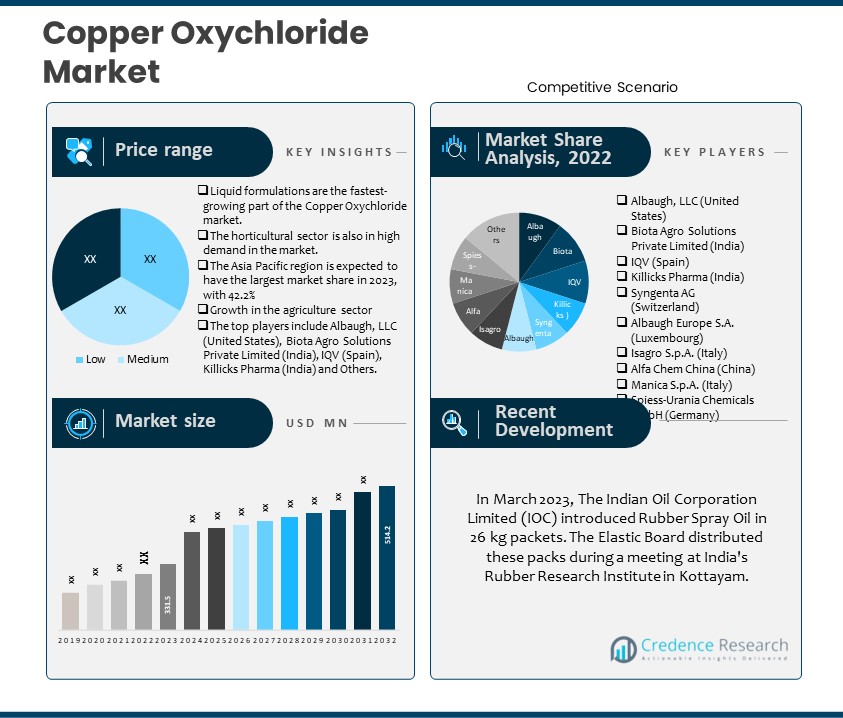
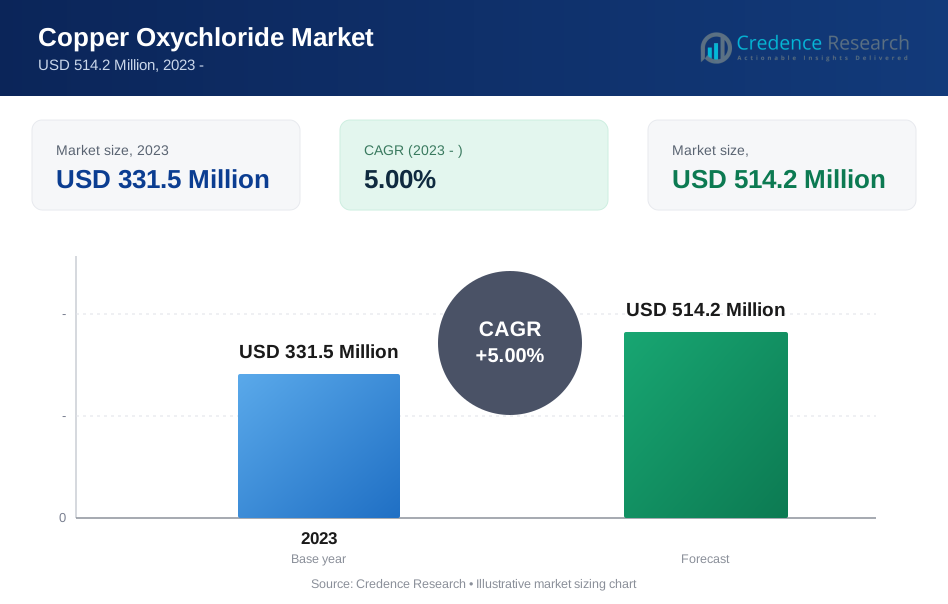
- The global demand for Copper Oxychloride was valued at USD 331.5 Million in 2023 and is expected to reach USD 514.2 Million in 2032, growing at a CAGR of 5.00% between 2024 and 2032.
- Fungicide is likely to be the main part of the worldwide copper oxychloride market, while the Bactericide segment is predicted to develop at a modest rate throughout the forecast period.
- Fruits and vegetables make up a significant section of the market, while cereals and grains are also popular.
- Liquid formulations are the fastest growing segment of the Copper Oxychloride market.
- The agricultural industry is predicted to lead the global copper oxychloride market. The horticultural sector is also in high demand in the market.
- The Asia Pacific area is expected to have the largest market share in 2023, accounting for 42.2%, while the North American region is expected to develop rapidly at a CAGR of 2023-2032.
- Growing demand in agriculture fuels market expansion.
- Copper toxicity and replacement availability limit market expansion.
Executive Summary
Market Definition
Copper oxychloride is a solid green, crystalline compound. The preparation methods comprise an oxidation catalyst for CU(I)Cl in brine solution and a micronutrient approach using cuprous oxide as a raw material. Copper oxychloride has numerous applications, including fungicides, colorants and pigments, feed additives, and others. Superoxide dismutase helps plants break down damaging oxygen molecules called free radicals. Furthermore, the copper oxychloride sector is being driven by increased demand as a fungicide for a variety of vegetable and fruit plants. The high demand for copper oxychloride in the agricultural sector for crop protection will drive significant expansion in the copper oxychloride market over the forecast period.
Market Overview
The global Copper Oxychloride Market has witnessed steady growth in recent years and is expected to grow at a CAGR of 5.00% between 2024 and 2032. The market was valued at USD 331.5 million in 2023 and is expected to reach USD 514.2 million in 2032.
The global copper oxychloride market is a booming segment of the agrochemical and chemical industries. Copper oxychloride, a copper, oxygen, and chlorine combination, is largely used as a fungicide and bactericide in agriculture to protect crops against fungal and bacterial diseases. The market's rise is related to its extensive use in a variety of crops, including fruits, vegetables, grains, and decorative plants. The growing demand for higher agricultural output to fulfill the demands of a growing worldwide population fuels the demand for effective disease control techniques, ultimately driving the market. Changes in climatic circumstances, which typically encourage the spread of plant diseases, as well as increased knowledge of sustainable agricultural practices, all contribute to the market's growth.
Copper oxychloride's efficacy, low toxicity to humans and animals when handled properly, and compatibility with other compounds all contribute to its widespread use. Furthermore, because consumers demand residue-free product, growers are more likely to use copper oxychloride because to its shorter pre-harvest period than other chemicals. However, environmental concerns about copper deposition in soil and water, as well as the possible influence on non-target creatures, remain a barrier. Regulatory organizations are imposing restrictions on copper oxychloride use, resulting in a shift toward more environmentally friendly alternatives and integrated disease control techniques.
Segmentation By Application
- Fungicide is expected to be the prominent section of the global copper oxychloride market. Copper oxychloride is a regularly used fungicide in agriculture to prevent various fungal diseases in crops. Its commercial domination stems from its effectiveness, low cost, and broad applicability.
- The Bactericide segment is predicted to develop at a moderate rate throughout the projection period.
Segmentation By Crop Type
- Fruits and vegetables account for a large portion of the market due to the widespread use of copper oxychloride to protect them from numerous illnesses and pests.
- Cereals and grains are other popular segments, as copper oxychloride is used to protect these crops from fungal infections and other hazardous diseases, resulting in higher crop yields and quality.
Segmentation by Formulation Type
- Liquid Formulations are the fastest expanding section of the Copper Oxychloride Market. Liquid formulations are rapidly expanding due to their simplicity of application and efficacy in delivering copper oxychloride to crops.
Segmentation By End-User
- The agricultural sector is expected to dominate the worldwide copper oxychloride market. Copper oxychloride is commonly used in agriculture as a fungicide and bactericide to protect crops from different diseases and illnesses. It is helpful at preventing fungal diseases in crops, especially fruits, vegetables, and decorative plants. The agriculture sector's consistent requirement for disease management, as well as the increased emphasis on sustainable farming practices, contribute to this segment's dominant position.
- The Horticultural Sector are also in high demand in the market.
Segmentation by Region
- In 2023, the Asia Pacific region is predicted to have the biggest market share, with 42.2%.
- The North American region is predicted to grow significantly at a CAGR from 2023 to 2032.
- The rest of the world, including Latin America, the Middle East, and Africa, supplies the remaining demand for Copper Oxychloride.
The Asia-Pacific region is estimated to lead the Copper Oxychloride Market between 2023 and 2032. By 2032, the Asia Pacific region is predicted to have the biggest market share, with 42.2%. Asia-Pacific is the world's largest copper oxychloride market. Because of its extensive agricultural activity, this region is a major user of copper oxychloride, particularly in China and India. Copper oxychloride is commonly used in agriculture as a fungicide and bactericide to treat numerous crop diseases, which contributes to its high demand in the region.
Moreover, The North American region is predicted to grow significantly at a CAGR from 2023 to 2032. The rapid rise of the population has raised food security concerns. Underdeveloped and developing nations continue to lack the infrastructure required to store and transport food grains. The use of agrochemicals such as fungicides can considerably increase yield. As a result, it is projected that the North American Copper Oxychloride market will expand rapidly.
Key Highlights of the Report
Application, Crop Type, Formulation Type, End-User, and region segment of the global Copper Oxychloride Market. The demand for copper oxychloride is likely to be highest in the horticultural industry, although the agricultural sector is predicted to dominate the global market. Furthermore, liquid formulations are the category that is growing the fastest in the market, while fruits and vegetables make up a sizable share of it. Additionally, cereals and grains are another well-liked market area, with Asia Pacific driving its growth.
Growing demand for organic agricultural practices, increased emphasis on sustainable agriculture, and technological developments in crop protection products are the market's primary drivers. Additionally, environmental concerns about copper usage, regulatory restrictions on pesticide use, and competition from other crop protection products are important market restraints. Also, the market's significant opportunities include expanding into emerging areas, developing innovative formulations, and adopting integrated pest control strategies.
The Asia-Pacific region is expected to lead the Copper Oxychloride Market from 2023 to 2032. With a market share of 42.2%, Asia-Pacific has the world's largest copper oxychloride market. Furthermore, the North American region is expected to increase rapidly at a CAGR between 2023 and 2032. The rapid growth of the population has caused food security problems.
What Are The Main Drivers Of The Global Copper Oxychloride Market?
Several factors promote growth in the Copper Oxychloride Market. The increased demand for organic farming practices is a major motivator, as customers value ecologically friendly alternatives. Furthermore, the growing emphasis on sustainable agriculture methods, as well as ongoing technological improvements in crop protection products, are important drivers of the market.
What Are The Major Challenges Faced By The Global Copper Oxychloride Market?
On the other hand, the market faces a number of impediments to its growth. Environmental concerns about the use of copper-based products pose barriers to market growth. Furthermore, governmental constraints on pesticide use may limit the market's potential expansion. In addition, the industry faces competition from alternative crop protection solutions, which may affect its market share and growth trajectory.
What Are The Growth Opportunities In The Global Copper Oxychloride Market?
Despite these challenges, the Copper Oxychloride Market provides numerous potential for growth and innovation. Expanding into emerging markets is a promising opportunity for market expansion. Furthermore, the development of innovative formulations and the implementation of integrated pest control strategies give chances to improve product offerings and meet changing consumer demands.
Market Drivers
Several factors drive the global Copper Oxychloride Market. The following are the key drivers of the global Copper Oxychloride Market:
Growing Demand In The Agriculture Sector
Rising agricultural and crop cultivation are driving high demand and growth prospects in the worldwide copper oxychloride market. Copper oxychloride has numerous applications, including fungicides in the food and agriculture sectors. Growing eating trends and expanded farming have fueled demand for copper oxychloride, which aids in crop protection and disease prevention in a variety of plants such as citrus, grapes, celery, tea, tomato, and others. The copper oxychloride fungicide acts by destroying pathogen cells. However, copper toxicity must be reduced because it can also harm plants. Superoxide dismutase helps to reduce oxidative stress and free radical damage in plants.
Furthermore, the government's goal to increase global agricultural production is driving demand for the copper oxychloride industry. For example, the Indian government created the Production Linked Incentive (PLI) in 2020 to stimulate local agrochemical manufacturing. According to the Organization for Economic Cooperation and Development (OECD), worldwide agricultural production is expected to increase by about 1.5% every year. Thus, with increasing agricultural production and the food industry around the world, the copper oxychloride market will expand and witness significant growth during the forecast period.
Market Restraints
The global Copper Oxychloride Market faces some challenges that may hinder its growth. These include the following:
Copper Toxicity And Replacement Availability
Copper oxychloride is in high demand for crop protection and disease prevention in the agricultural industry. However, copper toxicity caused by excessive use in soils can provide significant commercial issues since it has an environmental impact. Because copper oxychloride fungicide is not easily degradable, it might cause soil pollution, reducing demand for copper oxychloride. Furthermore, the availability of new biofungicides and less hazardous alternatives is a significant issue for the copper oxychloride business. For instance, copper hydroxide, Nordox, and others are preferable alternatives for copper oxychloride since they have a low copper concentration and are highly effective at controlling fungal illnesses.
Opportunities
The global Copper Oxychloride Market offers significant growth opportunities. These include the following:
Increasing Demand For Fungicides
Copper oxychloride and other copper-based protective fungicides are commonly used in plants to defend against infections, rust, and other issues. The increased need to control and prevent fungal diseases is driving demand for copper oxychloride, which is widely used in fungicides, feed additives, and other applications. Advancements in farming operations, high crop yields, and food security trends have all contributed to an increase in demand for fungicides to combat dangerous pathogens, fungal infections, and other issues. According to the National Horticulture Database, which the National Horticulture Board issued, India produced around 99.07 million metric tons of fruits and 191 million metric tons of vegetables in 2023–32.
Furthermore, the copper toxicity content of fungicides must be controlled in order to offer the correct protection spray content for fruits and vegetables while avoiding harm to them. As cereal, vegetable, and fruit output increases, demand for copper oxychloride fungicides will climb in the future years.
Competitive Landscape
Key Players
The global Copper Oxychloride Market is highly competitive, with several key players. Some of the major players in the market and their market share are as follows:
- Albaugh, LLC (United States)
- Biota Agro Solutions Private Limited (India)
- IQV (Spain)
- Killicks Pharma (India)
- Syngenta AG (Switzerland)
- Albaugh Europe S.A. (Luxembourg)
- Isagro S.p.A. (Italy)
- Alfa Chem China (China)
- Manica S.p.A. (Italy)
- Spiess-Urania Chemicals GmbH (Germany)
- Vimal Crop Care Pvt. Ltd. (India)
- Greenriver Industry Co., Ltd. (China)
- Hebei Jiheng Chemical Co., Ltd. (China)
- Tianjin Elong Co., Ltd. (China)
- Star Oxochem Pvt. Ltd. (India)
- GSP Crop Science Private Limited (India)
- KBI Kunj Chemicals (India)
- Groupe Roullier (France)
- Parikh Enterprises Private Limited (India)
- Green Agri Solution (India)
- Greenchem Biotech (India)
- Manica Fertilisantes (France)
- Avon Organics Limited (India)
- Bhaskar Agrochemicals Ltd. (India)
- Reflex Chemicals (China)
These organizations prioritize product innovation, Formulation Type expansion, and mergers and acquisitions to stay competitive.
The global Copper Oxychloride Market's key players continually seek to stay ahead by offering new products and developments.
In December 2020, Albaugh LLC, a major manufacturer of specialty products and crop protection, has acquired the prime source's assets from excelsior equity. This intended to combine the best customer service and production technology.
In October 2020, ADAMA Ltd. acquired a majority stake in FNV S.A., a crop protection distributor. This expanded the company's commercial and industrial footprint in the Latin American market.
In July 2023, Isagro July 2023, Isagro has announced the release of CuProtect, a new copper oxychloride fungicide. CuProtect is a water-soluble formulation of copper oxychloride intended for use in crops such as grapes, apples, and tomatoes.
Summary of Key Findings
- Increasing demand for fungicides.
- The market is segmented by Application, Crop Type, Formulation Type, End-User, and region.
- Fruits and vegetables make up a substantial section of the market
- Liquid formulations are the fastest developing segment of the Copper Oxychloride market.
- Asia-Pacific is leading in market growth; the market is highly competitive, with key players including Albaugh, LLC (United States), Biota Agro Solutions Private Limited (India), IQV (Spain), Killicks Pharma (India) and Others.
Future Outlook
- Growing demand for organic farming practices.
- Growth in the agriculture sector
- Technological developments in crop protection products
- Growing awareness of sustainable agricultural practices.
How CXOs Can Benefit from the Credence Research Copper Oxychloride Market Report
The Credence Research Copper Oxychloride Market Report provides CXOs with a comprehensive overview of the market, including:
- Market size and growth forecast: The report provides detailed estimates of the global Copper Oxychloride Market size, segmented By Application, Crop Type, Formulation Type, End-User and region. It also includes forecasts for the market through 2032 based on key trends and drivers.
- Market segmentation: The report segments the Copper Oxychloride Market By by Application, Crop Type, Formulation Type, End-User, and region. This segmentation provides CXOs with a granular understanding of the market and the opportunities in each segment.
- Competitive Landscape: The report profiles the key players in the Copper Oxychloride Market and provides insights into their strategies, product offerings, and financial performance. This information can help CXOs identify and assess their competition.
- Key trends and drivers: The report identifies and analyzes the key trends and drivers that are shaping the Copper Oxychloride Market. This information can help CXOs to make informed decisions about their investments and strategies.
CXOs can use the insights from the Credence Research Copper Oxychloride Market Report to:
- Identify growth opportunities: The report can help CXOs identify new growth opportunities in the Copper Oxychloride Market. By analyzing the data and trends in the report, they can make informed decisions about where to invest and expand their business.
- Make informed investment decisions: The report can help CXOs make informed investment decisions about Copper Oxychloride. For example, it may provide useful insights into market trends, customer preferences, the competitive landscape, and growth prospects in the Copper Oxychloride Market.
- Develop competitive strategies: The report can help CXOs develop competitive strategies for their Copper Oxychloride businesses. For example, by analyzing market trends, client preferences, and the competitive environment mentioned in the report, CXOs can fine-tune their strategies, differentiate their offers, and effectively position their firms in the marketplace.
- Track market developments: The report can help CXOs monitor market developments and stay ahead of the curve. For example, it provides insights into the latest trends and innovations in the Copper Oxychloride Market.
Overall, the Credence Research Copper Oxychloride Market Report is a valuable reCrop Type for CXOs who want to gain a deeper understanding of the market and identify opportunities for growth.
Segmentation
- By Application:
- Fungicide
- Bactericide
- By Crop Type:
- Fruits & Vegetables
- Cereals & Grains
- Ornamentals
- Others
- By Formulation Type:
- Liquid Formulations
- Solid Formulations
- By End-User:
- Agricultural Sector
- Horticultural Sector
- By Region
- North America
- The U.S.
- Canada
- Mexico
- Europe
- Germany
- France
- The U.K.
- Italy
- Spain
- Rest of Europe
- Asia Pacific
- China
- Japan
- India
- South Korea
- South-east Asia
- Rest of Asia Pacific
- Latin America
- Brazil
- Argentina
- Rest of Latin America
- Middle East & Africa
- GCC Countries
- South Africa
- Rest of the Middle East and Africa
- North America
Request a Free Sample
Fill in your details and we'll send you a free sample report.
- Sample data tables & charts
- Research methodology
Market Dynamics
Rising Demand for Crop Protection in Agriculture
The need to protect crops from fungal and bacterial diseases is driving the adoption of copper oxychloride, especially in regions with intensive fruit and vegetable cultivation.
Growth in Sustainable and Organic Farming Practices
Increasing consumer preference for residue-free and sustainable agricultural products is boosting the use of copper oxychloride, which is favored for its relatively low toxicity and shorter pre-harvest interval.
Expansion of Horticultural and High-Value Crop Production
The expansion of horticulture and cultivation of high-value crops such as grapes, apples, and tomatoes is increasing the demand for effective fungicides like copper oxychloride.
Technological Advancements in Formulations
The development and adoption of liquid formulations, which offer easier application and improved efficacy, are accelerating market growth and expanding usage among farmers.
Need a Custom Version of This Report?
Tailor the scope, geography, or segments to your exact requirements.
- Custom geography or segment scope
- Direct access to our analyst team
Frequently Asked Questions
What is the current size of the global Copper Oxychloride Market?
What is the expected growth rate of the Copper Oxychloride Market between 2024 and 2032?
Which segment is leading the market share in terms of End-User?
Which End-User segment governs the demand for Copper Oxychloride in the world?
Who are the major players in the global Copper Oxychloride Market?
Table of Content
Chapter 1 Market Segmentation
- 1.1 Segmentation Framework
- 1.1.1 Product and Service Classification
- 1.1.2 Application and End-Use Classification
- 1.1.3 Technology and Solution Classification
- 1.1.4 Customer and Distribution Channel Classification
- 1.1.5 Geographic Segmentation
- 1.1.6 Market Segment Definitions and Boundaries
- 1.2 By End-User
- 1.2.1 Agricultural Sector
- 1.2.2 Horticultural Sector
- 1.3 By Crop Type
- 1.3.1 Fruits & Vegetables
- 1.3.2 Cereals & Grains
- 1.3.3 Ornamentals
- 1.3.4 Others
- 1.4 By Application
- 1.4.1 Fungicide
- 1.4.2 Bactericide
- 1.5 By Formulation Type
- 1.5.1 Liquid Formulations
- 1.5.2 Solid Formulations
Chapter 2 Introduction
- 2.1 Report Objectives and Scope
- 2.2 Product Definition and Industry Terminology
- 2.3 Market Inclusions and Exclusions
- 2.4 Research Process
- 2.4.1 Primary Research and Expert Interviews
- 2.4.2 Secondary Research and Source Review
- 2.4.3 Top-Down and Bottom-Up Estimation
- 2.4.4 Data Triangulation and Verification
- 2.5 Market Size Measurement Basis
- 2.5.1 2023: USD 331.5 Million → 2032: USD 514.2 Million
- 2.6 Historical and Forecast Reference Periods
- 2.6.1 Base Year: 2023
- 2.6.2 Forecast Period: 2023-2032
- 2.7 Research Assumptions and Limitations
Chapter 3 Executive Summary
- 3.1 Market Snapshot and Key Findings
- 3.2 Base-Year Market Size, 2023
- 3.3 Forecast Market Size, 2032
- 3.4 Revenue and Volume Growth Outlook
- 3.5 Key Demand and Supply Indicators
- 3.6 Leading Market Segments
- 3.7 Fastest-Growing Market Opportunities
- 3.8 Regional Performance Highlights
- 3.9 Technology and Industry Transformation
- 3.10 Competitive Landscape Summary
- 3.11 Analyst View and Strategic Implications
Chapter 4 Global Copper Oxychloride Market Trends and Developments
- 4.1 Historical Industry Development
- 4.2 Recent Market Trends and Developments
- 4.3 Demand and Customer Behavior Trends
- 4.4 Technology and Product Innovation
- 4.5 Artificial Intelligence, Automation and Digitalization
- 4.6 Local Manufacturing and Supply Chain Realignment
- 4.7 Industry Partnerships, Mergers and Acquisitions
- 4.8 Sustainability and Circular Economy Developments
- 4.9 Government and Private Sector Investment Trends
- 4.10 Emerging Business Models and Commercialization
- 4.11 Industry Developments and Announcements
Chapter 5 Global Copper Oxychloride Market Production, Supply and Demand Analysis
- 5.1 Demand Trend and Consumption Analysis
- 5.2 Demand Forecast, 2023-2032
- 5.3 Production and Output Trend
- 5.4 Production and Output Forecast, 2023-2032
- 5.5 Installed Capacity and Capacity Utilization
- 5.6 Company-Wise Production Plants and Statistics
- 5.6.1 Installed Production Capacity
- 5.6.2 Actual Production
- 5.6.3 Planned Capacity and Expansion Targets
- 5.7 Supply Chain Structure and Procurement Trends
- 5.8 Supply-Demand Gap and Bottlenecks
- 5.9 Import Dependence and Sourcing Structure
- 5.10 Contract Manufacturing and Outsourcing
- 5.11 Regional Supply and Demand Concentration
Chapter 6 Global Copper Oxychloride Market Pricing Analysis
- 6.1 Pricing Structure and Measurement
- 6.2 Historical Pricing Trends
- 6.3 Pricing Outlook, 2023-2032
- 6.4 Average Selling Price and Unit Economics
- 6.5 Pricing by Product and Market Segment
- 6.6 Geographic Pricing Differences
- 6.7 Key Input, Energy, Labor and Logistics Costs
- 6.8 Contract Pricing and Purchasing Models
- 6.9 Pricing Sensitivity and Competitive Positioning
- 6.10 Price, Margin and Profitability Implications
Chapter 7 Global Copper Oxychloride Market Dynamics
- 7.1 Market Growth Drivers
- 7.1.1 Demand-Side Drivers
- 7.1.2 Technology and Innovation Drivers
- 7.1.3 Infrastructure and Investment Drivers
- 7.1.4 Regulatory and Policy Drivers
- 7.2 Market Restraints
- 7.2.1 Cost and Affordability Constraints
- 7.2.2 Technology and Adoption Barriers
- 7.2.3 Supply Chain and Operational Constraints
- 7.3 Market Challenges
- 7.3.1 Competitive Pressure and Margin Erosion
- 7.3.2 Skills, Infrastructure and Implementation Gaps
- 7.4 Emerging Market Opportunities
- 7.5 Market Dynamics Impact and Time-Horizon Assessment
Chapter 8 Global Copper Oxychloride Value Chain Analysis
- 8.1 Industry Value Chain Overview
- 8.2 Upstream Suppliers and Critical Inputs
- 8.3 Technology and Component Providers
- 8.4 Manufacturing or Service Delivery
- 8.5 Distribution, Channel Partners and Integrators
- 8.6 Downstream Applications and End Users
- 8.7 Value Addition and Profit Pools
- 8.8 Vertical Integration and Outsourcing
- 8.9 Supplier Concentration and Risk
- 8.10 Supply Chain Localization and Resilience
Chapter 9 Global Copper Oxychloride Market Regulations and Policies
- 9.1 Relevant Laws, Standards and Compliance Frameworks
- 9.2 Product, Service, Safety and Quality Requirements
- 9.3 Government Policies, Incentives and Subsidies
- 9.4 Imports, Exports and Trade Barriers
- 9.5 Public Procurement and Local Content Requirements
- 9.6 Environmental and Sustainability Compliance
- 9.7 Upcoming Policy Changes and Market Implications
Chapter 10 Global Copper Oxychloride Market Hotspots and Opportunities
- 10.1 Market Opportunity Mapping and Growth Hotspots
- 10.2 High-Growth Applications and Customer Groups
- 10.3 Underserved Markets and White-Space Opportunities
- 10.4 Emerging Technology and Product Opportunities
- 10.5 New Capacity and Investment Hotspots
- 10.6 Market Entry and Expansion Opportunities
- 10.7 Distribution and Partnership Opportunities
- 10.8 Near-Term and Long-Term Commercial Potential
- 10.9 Opportunity Attractiveness and Execution Risks
Chapter 11 Global Copper Oxychloride Market Outlook, 2023-2032
- 11.1 Market Size and Analysis
- 11.1.1 Revenue (Market Measurement: 2023: USD 331.5 Million → 2032: USD 514.2 Million)
- 11.1.2 Market Volume and Quantity Sold
- 11.1.3 Historical Market Size
- 11.1.4 Base-Year Market Size, 2023
- 11.2 Market Forecast, 2023-2032
- 11.2.1 Revenue Forecast to 2032
- 11.2.2 Volume Forecast to 2032
- 11.2.3 CAGR and Year-on-Year Growth
- 11.2.4 Incremental Revenue Opportunity
- 11.3 Forecast Assumptions and Scenario Analysis
- 11.3.1 Base-Case Forecast
- 11.3.2 Optimistic and Conservative Scenarios
- 11.3.3 Technology, Pricing and Policy Sensitivities
- 11.4 Market Attractiveness and Growth Outlook
Chapter 12 Global Copper Oxychloride Market Segmentation and Outlook
- 12.1 Segmentation Summary and Market Shares, 2023
- 12.2 Largest and Fastest-Growing Segments
- 12.3 By End-User - Market Size and Forecast, 2023-2032
- 12.3.1 Segment Definition and Scope
- 12.3.2 Historical Market Size
- 12.3.3 Revenue Forecast, 2023-2032
- 12.3.4 Volume Forecast, 2023-2032
- 12.3.5 Base-Year Market Share, 2023
- 12.3.6 Segment CAGR and Growth Drivers
- 12.3.7 Subsegment Market Size and Forecast
- 12.3.7.1 Agricultural Sector
- 12.3.7.2 Horticultural Sector
- 12.3.8 Subsegment Pricing and Adoption Trends
- 12.3.9 Leading Suppliers and Competition
- 12.3.10 Regional Demand and Opportunities
- 12.4 By Crop Type - Market Size and Forecast, 2023-2032
- 12.4.1 Segment Definition and Scope
- 12.4.2 Historical Market Size
- 12.4.3 Revenue Forecast, 2023-2032
- 12.4.4 Volume Forecast, 2023-2032
- 12.4.5 Base-Year Market Share, 2023
- 12.4.6 Segment CAGR and Growth Drivers
- 12.4.7 Subsegment Market Size and Forecast
- 12.4.7.1 Fruits & Vegetables
- 12.4.7.2 Cereals & Grains
- 12.4.7.3 Ornamentals
- 12.4.7.4 Others
- 12.4.8 Subsegment Pricing and Adoption Trends
- 12.4.9 Leading Suppliers and Competition
- 12.4.10 Regional Demand and Opportunities
- 12.5 By Application - Market Size and Forecast, 2023-2032
- 12.5.1 Segment Definition and Scope
- 12.5.2 Historical Market Size
- 12.5.3 Revenue Forecast, 2023-2032
- 12.5.4 Volume Forecast, 2023-2032
- 12.5.5 Base-Year Market Share, 2023
- 12.5.6 Segment CAGR and Growth Drivers
- 12.5.7 Subsegment Market Size and Forecast
- 12.5.7.1 Fungicide
- 12.5.7.2 Bactericide
- 12.5.8 Subsegment Pricing and Adoption Trends
- 12.5.9 Leading Suppliers and Competition
- 12.5.10 Regional Demand and Opportunities
- 12.6 By Formulation Type - Market Size and Forecast, 2023-2032
- 12.6.1 Segment Definition and Scope
- 12.6.2 Historical Market Size
- 12.6.3 Revenue Forecast, 2023-2032
- 12.6.4 Volume Forecast, 2023-2032
- 12.6.5 Base-Year Market Share, 2023
- 12.6.6 Segment CAGR and Growth Drivers
- 12.6.7 Subsegment Market Size and Forecast
- 12.6.7.1 Liquid Formulations
- 12.6.7.2 Solid Formulations
- 12.6.8 Subsegment Pricing and Adoption Trends
- 12.6.9 Leading Suppliers and Competition
- 12.6.10 Regional Demand and Opportunities
- 12.7 Segment Growth Comparison
- 12.8 Segment Attractiveness and Priority Matrix
Chapter 13 Global Copper Oxychloride End-Use and Application Market Outlook
- 13.1 End-Use Industry and Customer Demand Structure
- 13.2 Leading Applications and Customer Groups
- 13.3 End-Use Market Size, Share and Forecast
- 13.4 Major End-Use Industry Deep Dives
- 13.4.1 Customer Requirements and Use Cases
- 13.4.2 Demand and Replacement Cycles
- 13.4.3 Technical and Regulatory Considerations
- 13.4.4 Purchasing and Procurement Models
- 13.4.5 Leading Vendors and Distribution Channels
- 13.4.6 Forecast and Commercial Opportunities
- 13.5 Emerging Applications and Cross-Segment Demand
- 13.6 End-Use Industry Investment Priorities
Chapter 14 Global Copper Oxychloride Geographic Market Outlook, 2023-2032
- 14.1 Regional Market Size and Share, 2023
- 14.2 Regional Market Forecast, 2023-2032
- 14.3 Regional Pricing, Production and Demand Differences
- 14.4 North America
- 14.4.1 United States
- 14.4.2 Canada
- 14.4.3 Mexico
- 14.5 Europe
- 14.5.1 Germany
- 14.5.2 France
- 14.5.3 Italy
- 14.5.4 United Kingdom
- 14.5.5 Spain
- 14.5.6 Poland
- 14.5.7 Russia
- 14.5.8 Netherlands
- 14.5.9 Belgium
- 14.5.10 Sweden
- 14.5.11 Denmark
- 14.5.12 Norway
- 14.5.13 Rest of Europe
- 14.6 Asia Pacific
- 14.6.1 China
- 14.6.2 India
- 14.6.3 Japan
- 14.6.4 South Korea
- 14.6.5 Thailand
- 14.6.6 Indonesia
- 14.6.7 Vietnam
- 14.6.8 Malaysia
- 14.6.9 Australia
- 14.6.10 Rest of Asia Pacific
- 14.7 Latin America
- 14.7.1 Brazil
- 14.7.2 Argentina
- 14.7.3 Colombia
- 14.7.4 Chile
- 14.7.5 Rest of Latin America
- 14.8 Middle East
- 14.8.1 Saudi Arabia
- 14.8.2 United Arab Emirates
- 14.8.3 Turkey
- 14.8.4 Israel
- 14.8.5 Iran
- 14.8.6 Rest of the Middle East
- 14.9 Africa
- 14.9.1 South Africa
- 14.9.2 Egypt
- 14.9.3 Nigeria
- 14.9.4 Morocco
- 14.9.5 Rest of Africa
- 14.10 Regional Investment, Policy and Supply Chain Differences
- 14.11 Regional Competitive Landscape
- 14.12 Geographic Growth Hotspots
Chapter 15 Global Copper Oxychloride Technology, Innovation and Sustainability Outlook
- 15.1 Technology Landscape and Maturity
- 15.2 Product, Process and Service Innovation
- 15.3 AI, Automation and Digital Tools in the Industry
- 15.4 Technology Adoption and Performance Benchmarking
- 15.5 Innovation Pipeline and R&D Investment
- 15.6 Patent and Intellectual Property Trends
- 15.7 Energy Efficiency and Resource Management
- 15.8 Sustainability, Recycling and Circularity
- 15.9 Technology Roadmap, 2023-2032
- 15.10 Risks of Obsolescence and Technology Substitution
Chapter 16 Global Copper Oxychloride Market Key Strategic Imperatives
- 16.1 Growth and Market Entry Priorities
- 16.2 High-Return Products and Segments
- 16.3 Pricing, Profitability and Cost Optimization
- 16.4 Technology Investment and Product Differentiation
- 16.5 Supply Chain Localization and Resilience
- 16.6 Distribution and Customer Acquisition
- 16.7 Partnership, Acquisition and Capacity Strategy
- 16.8 Regional Expansion Priorities
- 16.9 Short-, Medium- and Long-Term Actions
Chapter 17 Competition Outlook
- 17.1 Industry Competition Characteristics
- 17.2 Market Structure and Concentration
- 17.3 Market Share and Competitive Positioning, 2023
- 17.4 Company-Wise Revenue and Product Benchmarking
- 17.5 Production and Service Capacity Benchmarking
- 17.6 Technology, Pricing and Differentiation
- 17.7 Regional Footprint and Distribution Strength
- 17.8 Mergers, Acquisitions and Strategic Alliances
- 17.9 New Entrants and Competitive Threats
- 17.10 Porter's Five Forces and Industry Attractiveness
- 17.11 Competitive Outlook, 2023-2032
Chapter 18 Company Profiles
- 18.1 Company Coverage and Selection Criteria
- 18.2 Albaugh, LLC
- 18.2.1 Business Description
- 18.2.2 Company Ownership and Geographic Presence
- 18.2.3 Product and Service Portfolio
- 18.2.4 Manufacturing and Operating Footprint
- 18.2.5 Production Capacity and Expansion Plans
- 18.2.6 Financial Performance and Investment
- 18.2.7 Market Share and Competitive Position
- 18.2.8 Technology and Innovation Capabilities
- 18.2.9 Strategic Alliances or Partnerships
- 18.2.10 Recent Developments
- 18.2.11 Growth Strategy and Outlook
- 18.3 Syngenta AG
- 18.4 Isagro S.p.A.
- 18.5 IQV
- 18.6 Biota Agro Solutions Private Limited
- 18.7 Killicks Pharma
- 18.8 Manica S.p.A.
- 18.9 Spiess-Urania Chemicals GmbH
- 18.10 Greenriver Industry Co., Ltd.
- 18.11 Vimal Crop Care Pvt. Ltd.
- 18.12 Other Relevant Market Participants
Note: Every listed company is profiled on the structure shown under the first company. The company list is preliminary and may change based on research findings, market developments, data availability and client requirements.
Chapter 19 Disclaimer
- 19.1 Research and Forecast Disclaimer
- 19.2 Data Source and Estimation Limitations
Note: The depth of individual sections depends on data availability for this market. Volume, capacity, trade and other unit-based metrics are included where applicable.

