
| REPORT ATTRIBUTE | DETAILS |
|---|---|
| Historical Period | 2019-2022 |
| Base Year | 2023 |
| Forecast Period | 2024-2032 |
| Cottonseed Oil Market Size 2023 | USD 5251.2 Million |
| Cottonseed Oil Market, CAGR | 4.00% |
| Cottonseed Oil Market Size 2032 | USD 7474.1 Million |
Market Insights
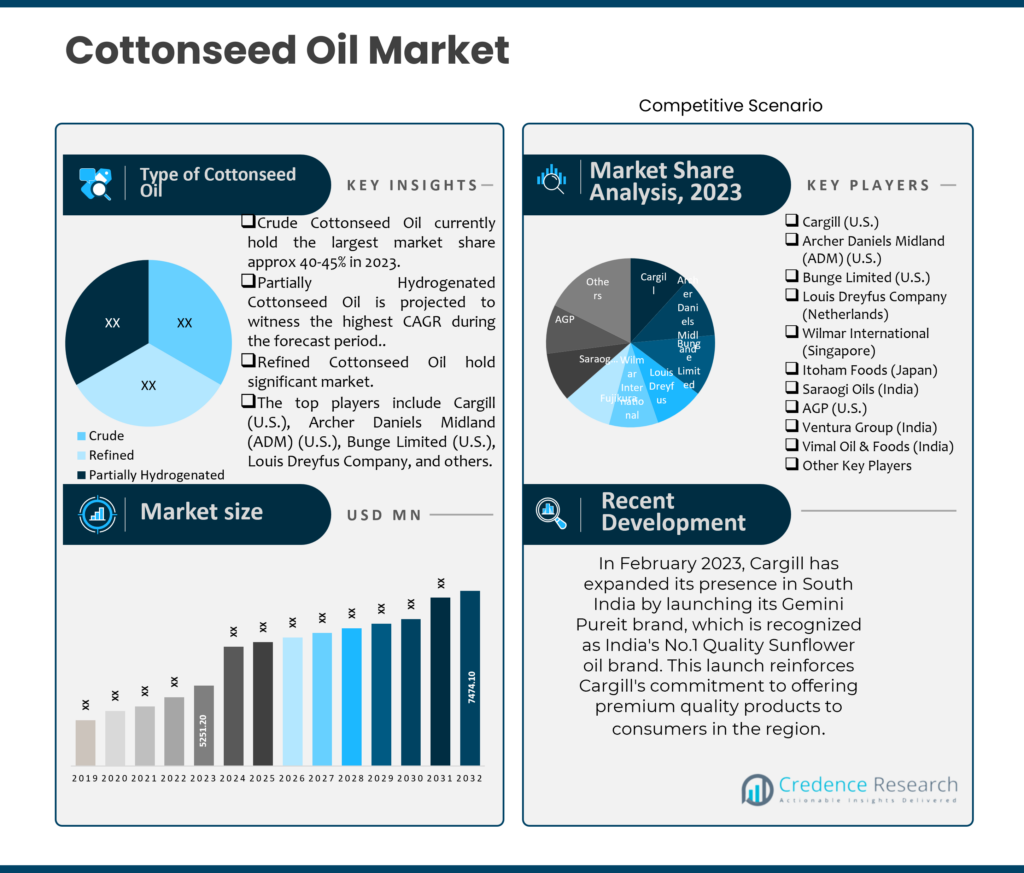
- The Cottonseed Oil Market attained a valuation of USD 5251.2 Million in 2023 and is anticipated to escalate to USD 7474.1 Million by 2032, exhibiting a robust CAGR of 4.00% during the forecast period from 2024 to 2032.
- Among the key segments, Crude Cottonseed Oil emerged as the dominant type, holding approximately 40-45% of the total market share in 2023. However, Partially Hydrogenated Cottonseed Oil is projected to witness the highest growth rate during the forecast period.
- Food grade cottonseed oil currently holds the largest market share approx 50-65% in 2023, while Industrial grade cottonseed oil is projected to witness the highest CAGR during the forecast period.
- Food and Beverage Industry holds the largest share of the market by end-user, accounting for approximately 50-55% in 2023, attributed to the widespread adoption of cottonseed oil in food processing.
- Asia Pacific holds the largest share of the market in 2023, followed by North America and Europe with a collective share of just under 55%.
- The rise in demand for cottonseed oil, driven by increasing consumer awareness of its health benefits and expanding applications in various industries, fuels the growth of the Cottonseed Oil Market.
- Key opportunities in the market include significant growth potential in biofuel production, increased adoption across various applications and end-users, and continuous advancements in extraction and refining technologies, fostering market expansion.
Executive Summary
Market Definition
The Cottonseed Oil market refers to the marketing and production of edible vegetable oils primarily derived from the seeds of the cotton plant. It involves the pressing or extraction of raw cotton seeds and other processes into oil, followed by refining processes to produce a light yellow, aromatic and nutritious oil suitable for human consumption. Cottonseed oil contains valuable compounds such as polyunsaturated fatty acids, vitamin E and phytosterols, contributing to its widespread use in foods its neutral flavor and high smoke point make it ideal for frying, baking and sautéing , while being firm under heat ensures consistent performance and extended shelf life. Also, cottonseed oil is a good base for salad dressings, sauces, marinades and spreads due to its emulsifying properties. In addition to its use in cooking oil, cottonseed oil finds applications in industrial applications such as cosmetics, soap manufacturing, textiles, and biofuel production It acts as a humidifier, stabilizer, and holding material a it works in skin care products, making the skin softer and smoother Soaps made using cottonseed oil because of its gentle cleansing properties. providing soft texture without stripping the skin of the natural oils Clothing manufacturers Manufacturers of this versatile oil It is also added to softening and healing fabrics to enhance and last longer. Finally, cottonseed oil represents a potential source of biodiesel, namely global initiatives aimed at reducing greenhouse gas emissions and reducing dependence on fossil fuels so the corresponds.
Market Overview
The Cottonseed Oil Market has exhibited steady growth and is anticipated to maintain a robust Compound Annual Growth Rate (CAGR) of 4.00% from 2024 to 2032. Valued at USD 5251.2 million in 2023, this market is forecasted to reach USD 7474.1 million by 2032.
Among the primary segments, Crude Cottonseed Oil dominated the market landscape by type, comprising approximately 40-45% of the total market share in 2023. However, Partially Hydrogenated Cottonseed Oil is anticipated to observe the highest CAGR over the forecast period.
Food grade cottonseed oil segment captured around 50-65% of the market share in 2023, driven by the extensive utilization of cottonseed oil in various food products such as cooking oils, salad dressings, and baked goods.
Food and beverages emerged as the leading application segment in 2023, with a market share of about 50-55%, primarily due to the increasing use of cottonseed oil as a versatile and healthy alternative in food products.
Asia Pacific constituted a significant portion of the market in 2023, followed by North America and Europe, collectively representing just under 55% of the market share.
The rise in demand for cottonseed oil is driven by factors such as increasing consumer awareness of its health benefits, expanding applications in various industries, and rising demand for sustainable alternatives to traditional cooking oils, particularly in regions like Asia Pacific and North America.
Continuous advancements in extraction and refining technologies, including improved processing methods, are further driving the demand for cottonseed oil, especially in industries requiring high-quality and standardized products.
Segmentation by Type of Cottonseed Oil
- Crude Cottonseed Oil currently hold the largest market share approx 40-45% in 2023. Due to its clear colour, mild taste and high oxidative stability, it is widely accepted and preferred in industries from foodservice to cosmetic manufacturing.
- Partially Hydrogenated Cottonseed Oil is projected to witness the highest CAGR during the forecast period. This oil provides trans fat, stabilizing the oil firmness, extends lifespan and increases corrosion resistance which making it ideally suited for applications requiring semi-solidity, such as short coatings, margarine, or confectionary coatings.
Segmentation by Grade of Cottonseed Oil
- Food grade cottonseed oil currently hold the largest market share approx 50-65% in 2023 owing to primary use as an ingredient in various culinary applications, including deep-frying, baking, and salad dressing preparation.
- Industrial grade cottonseed oil is projected to witness the highest CAGR during the forecast period. Industrial grade cottonseed oil caters mainly to non-food industries where purity requirements aren't as rigorous, such as lubricant production, leather tanning, and chemical synthesis.
Segmentation by End-Use Applications
- Food and Beverage Industry currently hold the largest market share approx 50-55% in 2023. A wide range of food products incorporate cottonseed oil, for its sensory attractiveness and affordability.
- Animal Feed and Livestock Nutrition is projected to witness the highest CAGR during the forecast period due to its strong focus on circular economic principles, resulting in an increased value proposition in terms of residual drive the market growth.
Segmentation by Region
- Asia Pacific held largest share around 38-42% of the market in 2023. The presence of advanced technologies, favorable government policies, and nfluenced by China's expansive agricultural capabilities, and with India’s high domestic consumption, other notable contributors include Indonesia, Vietnam, Thailand, and Malaysia.
- North America and Europe collectively account for just under 55% share in 2023, with North America holding over 20% share in the same year.
- The rest of the world, including Latin America, the Middle East, and Africa, supplies the remaining demand for Cottonseed Oil.
The growing awareness about the environmental benefits of Cottonseed Oil and the increasing availability of Cottonseed Oil-based products are also contributing to the market growth.
The Asia Pacific region holds the largest market share in the Cottonseed Oil market. This can be attributed to several factors including the high production and production of cotton in countries such as China, India and Pakistan which are major contributors to the local supply of cottonseed oil. China alone is one of the world’s leading producers of cotton and cottonseed oil, having been popularized by its abundant agricultural resources and favorable climate coupled with increased consumer awareness of the health benefits associated with cottonseed largest in the region. Also the growing food processing industry in developing countries like India and South East Asia has led to increased demand for edible oils including cottonseed oil and its versatility in in the kitchen, from baking and baking to salad dressings and marinades, making it popular among chefs and home cooks. For instance, according to Global Agricultural Information Network, in China, for the 2023/24 cotton production, the forecast is reduced to 5.9 million metric tons due to decreased planted area, while the 2022/23 estimate is revised upward to 6.68 million metric tons based on increased planted area and Xinjiang, China cotton volumes. Imports for 2023/24 are slightly raised to 1.9 million metric tons due to reduced yarn imports and China's issuance of an additional 750,000 metric tons in sliding-scale import quota. Furthermore, growing cosmetic and personal care industries in the region have also contributed to the growth of the cottonseed oil market. It is widely used in skin care products due to its smoothing and moisturizing properties and soothes dry skin.
Europe hold significant market share of the global Cottonseed Oil market, mainly due to the demand for high-quality cooking oil and ingredients in the regional food and beverage sector, followed by Germany, France, Italy. Spain and the United Kingdom are the main markets for this trend. The European Union (EU) has strict regulations on food safety and quality standards, and pays more attention to the use of high-quality cotton oil. Moreover, the EU Common Agricultural Policy supports and regulates farmers promote sustainable agricultural practices and help secure sources of local cottonseed oil. Furthermore, the European cosmetics and personal care industry contributes significantly to the regional cottonseed oil market. With consumers becoming more aware of their purchasing decisions and looking for natural, organic products, cottonseed oil has emerged as a desirable product due to its non-greasy and hypoallergenic properties.
Key Highlights of the Report
The Cottonseed Oil Market is segmented by Type of Cottonseed Oil, End-User Application, Grade of Cottonseed Oil, and Region. The growing demand for cottonseed oil is driven by factors such as increasing consumer awareness of its health benefits, expanding applications in various industries, and the need for sustainable alternatives across sectors including food and beverages, biofuels, and industrial applications.
Crude Cottonseed Oil dominates the segment, serving essential functions in various applications such as cooking oils, salad dressings, and baked goods due to its clear color, mild taste, and high oxidative stability.
Food grade cottonseed oil leads the grade segment, offering versatile options for culinary applications, including deep-frying, baking, and salad dressing preparation.
Food and Beverage Industry hold a significant market share in the end-user segment, utilizing cottonseed oil in various food products such as cooking oils, salad dressings, and baked goods.
Asia Pacific held the largest share of the Cottonseed Oil market, supported by advanced technologies and favorable government policies promoting sustainable products. Key players such as Cargill, Archer Daniels Midland (ADM), and Bunge Limited focus on product innovation and strategic collaborations to maintain their market position and competitiveness.
What Are The Main Drivers Of The Global Cottonseed Oil Market?
The global Cottonseed Oil market is driven by various factors such as increasing demand of edible oils owing to growing population and changing dietary habits, rising awareness about the health benefits of cottonseed oil, such as its low cholesterol content and high antioxidant properties further drive the cottonseed oil market.
What Are The Major Challenges Faced By The Global Cottonseed Oil Market?
The global Cottonseed Oil market is mainly challenged by fluctuating cottonseed prices, cotton production and weather conditions, competition from other edible oils such as soybean and sunflower oil which tend to cost less and more genetically modified cotton seeds. Challenges in the supply chain, trade regulations and changing consumer preferences for healthy oils also pose challenges to the growth of the market.
What Are The Growth Opportunities In The Global Cottonseed Oil Market?
The global Cottonseed Oil market presents numerous growth opportunities due to consumer awareness of the health benefits of cottonseed oil, such as its high antioxidant and cholesterol-reducing properties and innovations in a processes and products. Furthermore, the expanding market in emerging economies with growing population and increasing disposable income offers significant growth potential. Strategic partnerships, collaborations and investments in R&D can boost the market.
Market Drivers
Rising Awareness About The Health Benefits Of Cottonseed Oil
The global Cottonseed Oil market has significant growth, driven by the rising awareness about the health benefits of cottonseed oil. Cottonseed oil consumption which is rich in vitamin E, antioxidants and polyunsaturated fatty acids, cottonseed oil provides heart health benefits, reduces fat content and improves skin health. Additionally, it has a neutral flavor profile, making it suitable for a variety of cooking applications. Additionally, the high smoke quality of cottonseed oil makes it ideal for deep frying hot foods while retaining nutrients. Overall, growing awareness of these benefits has led to a significant increase in the demand for cottonseed oil worldwide.
Market Restraints
Fluctuating Cottonseed Prices
Fluctuating cottonseed prices restrained the demand Cottonseed Oil Market. Since the cotton seed is the main raw material for the production of cottonseed oil, the effect of the crop, agricultural support and factors such as by-products influence the value of the cough oil. Controversy arises for the buyer and the seller these changes may adversely affect the acceptability of the cottonseed oil, which may restrict market expansion in some areas. For instrance, in June 2022, according to the USDA Foreign Agricultural Service, between January to May 2022, cotton seed prices jumped 24 percent in Gujarat, India. Hence, managing cotton price risks is essential to achieve robust long-term growth in the cottonseed oil market.
Opportunities
Adoption Of Various Strategies Among Market Players
Adoption of various strategies among market players makes significant opportunity for the market. The major companies serving the global Cottonseed Oil Market are Cargill (U.S.), Archer Daniels Midland (ADM) (U.S.), Bunge Limited (U.S.), Louis Dreyfus Company (Netherlands), among others. The market players are considerably contributing to the market growth by the adoption of various strategies including mergers & acquisitions, collaborations, funding, and new product launches, to stay competitive in the market. For instance, in April 2023, Cargill, a global agribusiness company, is invested US$50M in Australia to expand and upgrade its oilseed crushing facilities in Newcastle, Narrabri, and Footscray. This investment aims to cater to rising demand for canola and cottonseed products and provide Australian growers with further access to global markets.
Competitive Landscape
Key Players
The global Cottonseed Oil market is highly competitive, with several key players. Some of the major players in the market and their market share are as follows:
- Cargill (U.S.)
- Archer Daniels Midland (ADM) (U.S.)
- Bunge Limited (U.S.)
- Louis Dreyfus Company (Netherlands)
- Wilmar International (Singapore)
- Itoham Foods (Japan)
- Saraogi Oils (India)
- AGP (U.S.)
- Ventura Group (India)
- Vimal Oil & Foods (India)
- Others
These organizations prioritize product innovation, distribution channel expansion, and mergers and acquisitions to stay competitive.
The global Cottonseed Oil market's key players continually seek to stay ahead by offering new products and developments.
In February 2023, Cargill has expanded its presence in South India by launching its Gemini Pureit brand, which is recognized as India's No.1 Quality Sunflower oil brand. This launch reinforces Cargill's commitment to offering premium quality products to consumers in the region.
In April 2023, Bunge, via its joint venture with IOI Corp., agreed to buy Fuji Oil's new Louisiana refinery, enhancing multi-oil processing capabilities, expanding customer reach, and strengthening its position in North American markets.
Summary of Key Findings
- The Cottonseed Oil Market is experiencing notable growth, propelled by the increasing demand for sustainable and renewable cooking oil sources across various industries including food, biofuels, and industrial applications. Key drivers fueling this growth include rising consumer awareness of the health benefits of cottonseed oil, its expanding applications, and the shift towards healthier cooking alternatives.
- Market segmentation within the Cottonseed Oil Market encompasses factors such as type of cottonseed oil, grade, end-user, and region, reflecting the diverse uses and applications of cottonseed oil.
- Crude Cottonseed Oil emerges as the dominant segment, holding the majority market share due to its clear color, mild taste, and high oxidative stability. Partially Hydrogenated Cottonseed Oil also contributes significantly to the market, particularly in industries like food processing and biofuels.
- Food and Beverage Industry emerge as the leading end-user segment, utilizing cottonseed oil in various food products such as cooking oils, salad dressings, and baked goods. Biofuels and industrial applications witness substantial growth, driven by the increasing focus on sustainable energy sources and industrial lubricants.
- Geographically, Asia Pacific holds the largest market share, supported by advanced technologies and favorable government policies promoting sustainable products. North America and Europe collectively account for a significant share of the market, with North America witnessing growth due to increasing demand for healthy cooking oil sources and sustainable practices.
Future Outlook
- The future outlook for the Cottonseed Oil Market indicates promising growth opportunities, particularly within sectors such as food and beverages, biofuels, and industrial applications, driven by the increasing demand for sustainable and healthier cooking oil sources. However, anticipated challenges include fluctuating cottonseed prices, competition from other edible oils, regulatory barriers, and changing consumer preferences.
- To maintain competitiveness in the Cottonseed Oil Market, industry players should adopt various strategies such as continuous technological innovation, strategic collaborations, securing investments for research and development, and expanding market reach. It is crucial for companies to prioritize addressing environmental concerns, improving extraction efficiency, and exploring new applications in emerging markets to ensure sustained growth amidst evolving industry dynamics.
How CXOs Can Benefit from the Credence Research Cottonseed Oil Market Report
The Credence Research Cottonseed Oil Market Report provides CXOs with a comprehensive overview of the market, including:
- Market size and growth forecast: The report provides detailed estimates of the global Cottonseed Oil market size, segmented by type of cottonseed oil, grade, end-user, and region. It also includes forecasts for the market through 2032, based on key trends and drivers.
- Market segmentation: The report segments the Cottonseed Oil market by type of cottonseed oil, grade, end-user, and region. The increasing demand for advanced solutions is driven. This segmentation provides CXOs with a granular understanding of the market and the opportunities in each segment.
- Competitive landscape: The report profiles the key players in the Cottonseed Oil market and provides insights into their strategies, product offerings, and financial performance. This information can help CXOs to identify and assess their competition.
- Key trends and drivers: The report identifies and analyzes the key trends and drivers that are shaping the Cottonseed Oil market. This information can help CXOs to make informed decisions about their investments and strategies.
CXOs can use the insights from the Credence Research Cottonseed Oil Market Report to:
- Identify growth opportunities: The report can help CXOs to identify new growth opportunities in the Cottonseed Oil market. For example, the report identifies the growing demand for Cottonseed Oil from cloud computing providers and telecom companies as a key opportunity.
- Make informed investment decisions: The report can help CXOs to make informed investment decisions about Cottonseed Oil. For example, the report provides insights into the key factors to consider when evaluating Cottonseed Oil providers and selecting Cottonseed Oil solutions.
- Develop competitive strategies: The report can help CXOs to develop competitive strategies for their Cottonseed Oil businesses. For example, the report identifies the key strategies that Cottonseed Oil providers are using to differentiate themselves from their competitors.
- Track market developments: The report can help CXOs to track market developments and stay ahead of the curve. For example, the report provides insights into the latest trends and innovations in the Cottonseed Oil market.
Overall, the Credence Research Cottonseed Oil Market Report is a valuable resource for CXOs who are looking to gain a deeper understanding of the market and identify opportunities for growth.
Segmentation
-
Type of Cottonseed Oil:
- Crude Cottonseed Oil
- Refined Cottonseed Oil
- Partially Hydrogenated Cottonseed Oil
-
Grade of Cottonseed Oil:
- Food Grade
- Industrial Grade
-
End-Use Applications:
- Food and Beverage Industry
- Restaurant and Foodservice Sector
- Food Processing and Manufacturing
- Biofuel Production
- Animal Feed and Livestock Nutrition
- Personal Care and Cosmetics
-
By Region
- North America
- US
- Canada
- Mexico
- Europe
- Germany
- France
- UK.
- Italy
- Spain
- Rest of Europe
- Asia Pacific
- China
- Japan
- India
- South Korea
- South-east Asia
- Rest of Asia Pacific
- Latin America
- Brazil
- Argentina
- Rest of Latin America
- Middle East & Africa
- GCC Countries
- South Africa
- North America
- Rest of Middle East and Africa
Adjacent Markets
In the Cottonseed Oil market, there are several adjacent markets which has high revenue growth opportunities. The key adjacent markets for Cottonseed Oil market -
Adjacent Markets |
||
| Edible Oils Market | Food Processing Industry | Industrial Oils Market |
| Health and Wellness Oils Market | Nutraceuticals and Dietary Supplements Market | Biofuel and Renewable Energy Market |
| Organic Oils Market | Cosmetic and Personal Care Oils Market | Agricultural Inputs and Farming Technology Market |

Request a Free Sample
Fill in your details and we'll send you a free sample report.
- Sample data tables & charts
- Research methodology
Market Dynamics
Rising Health Awareness
Increasing consumer awareness of the health benefits of cottonseed oil, such as its low cholesterol content, high vitamin E, and antioxidant properties, is driving its adoption as a preferred edible oil in both developed and emerging markets.
Expanding Applications Across Industries
Cottonseed oil's versatility in food processing, personal care, cosmetics, animal feed, and biofuel production is broadening its demand base, supporting market growth beyond traditional culinary uses.
Growth in Food Processing and Foodservice Sectors
The surge in processed food consumption and the expansion of the restaurant and foodservice industries, especially in Asia Pacific, are fueling demand for cottonseed oil due to its neutral flavor, high smoke point, and cost-effectiveness.
Technological Advancements in Extraction and Refining
Continuous improvements in extraction and refining technologies are enhancing oil quality and yield, making cottonseed oil more attractive for high-value applications and supporting its competitiveness against alternative edible oils.
Sustainability and Biofuel Initiatives
Global emphasis on sustainable and renewable resources is increasing the use of cottonseed oil in biofuel production, providing new growth avenues as governments and industries seek alternatives to fossil fuels.
Need a Custom Version of This Report?
Tailor the scope, geography, or segments to your exact requirements.
- Custom geography or segment scope
- Direct access to our analyst team
Frequently Asked Questions
What is the current size of the global Cottonseed Oil market?
What is the expected growth rate of the Cottonseed Oil market between 2024 and 2032?
Which segment is leading the market share in terms of Type of Cottonseed Oil?
Which Grade of Cottonseed Oil segments governs the demand for Cottonseed Oils in the world?
Which End-Use Applications segment is expected to post the highest CAGR during the forecast period?
Which region is fueling the growth of the Cottonseed Oil industry?
Who are the major players in the global Cottonseed Oil market?
What are the major market drivers of the Cottonseed Oil industry?
What are the major market restraints of the Cottonseed Oil industry?
What are the major market opportunities of the Cottonseed Oil industry?
Table of Content
Chapter 1 Market Segmentation
- 1.1 Segmentation Framework
- 1.1.1 Product and Service Classification
- 1.1.2 Application and End-Use Classification
- 1.1.3 Technology and Solution Classification
- 1.1.4 Customer and Distribution Channel Classification
- 1.1.5 Geographic Segmentation
- 1.1.6 Market Segment Definitions and Boundaries
- 1.2 By Grade
- 1.2.1 Food Grade
- 1.2.2 Industrial Grade
- 1.3 By End-Use Application
- 1.3.1 Food and Beverage Industry
- 1.3.2 Restaurant and Foodservice Sector
- 1.3.3 Food Processing and Manufacturing
- 1.3.4 Biofuel Production
- 1.3.5 Animal Feed and Livestock Nutrition
- 1.3.6 Personal Care and Cosmetics
- 1.4 By Type of Cottonseed Oil
- 1.4.1 Crude Cottonseed Oil
- 1.4.2 Refined Cottonseed Oil
- 1.4.3 Partially Hydrogenated Cottonseed Oil
Chapter 2 Introduction
- 2.1 Report Objectives and Scope
- 2.2 Product Definition and Industry Terminology
- 2.3 Market Inclusions and Exclusions
- 2.4 Research Process
- 2.4.1 Primary Research and Expert Interviews
- 2.4.2 Secondary Research and Source Review
- 2.4.3 Top-Down and Bottom-Up Estimation
- 2.4.4 Data Triangulation and Verification
- 2.5 Market Size Measurement Basis
- 2.5.1 2023: USD 5251.2 Million → 2032: USD 7,474.1 Million
- 2.6 Historical and Forecast Reference Periods
- 2.6.1 Base Year: 2023
- 2.6.2 Forecast Period: 2023-2032
- 2.7 Research Assumptions and Limitations
Chapter 3 Executive Summary
- 3.1 Market Snapshot and Key Findings
- 3.2 Base-Year Market Size, 2023
- 3.3 Forecast Market Size, 2032
- 3.4 Revenue and Volume Growth Outlook
- 3.5 Key Demand and Supply Indicators
- 3.6 Leading Market Segments
- 3.7 Fastest-Growing Market Opportunities
- 3.8 Regional Performance Highlights
- 3.9 Technology and Industry Transformation
- 3.10 Competitive Landscape Summary
- 3.11 Analyst View and Strategic Implications
Chapter 4 Global Cottonseed Oil Market Trends and Developments
- 4.1 Historical Industry Development
- 4.2 Recent Market Trends and Developments
- 4.3 Demand and Customer Behavior Trends
- 4.4 Technology and Product Innovation
- 4.5 Artificial Intelligence, Automation and Digitalization
- 4.6 Local Manufacturing and Supply Chain Realignment
- 4.7 Industry Partnerships, Mergers and Acquisitions
- 4.8 Sustainability and Circular Economy Developments
- 4.9 Government and Private Sector Investment Trends
- 4.10 Emerging Business Models and Commercialization
- 4.11 Industry Developments and Announcements
Chapter 5 Global Cottonseed Oil Market Production, Supply and Demand Analysis
- 5.1 Demand Trend and Consumption Analysis
- 5.2 Demand Forecast, 2023-2032
- 5.3 Production and Output Trend
- 5.4 Production and Output Forecast, 2023-2032
- 5.5 Installed Capacity and Capacity Utilization
- 5.6 Company-Wise Production Plants and Statistics
- 5.6.1 Installed Production Capacity
- 5.6.2 Actual Production
- 5.6.3 Planned Capacity and Expansion Targets
- 5.7 Supply Chain Structure and Procurement Trends
- 5.8 Supply-Demand Gap and Bottlenecks
- 5.9 Import Dependence and Sourcing Structure
- 5.10 Contract Manufacturing and Outsourcing
- 5.11 Regional Supply and Demand Concentration
Chapter 6 Global Cottonseed Oil Market Pricing Analysis
- 6.1 Pricing Structure and Measurement
- 6.2 Historical Pricing Trends
- 6.3 Pricing Outlook, 2023-2032
- 6.4 Average Selling Price and Unit Economics
- 6.5 Pricing by Product and Market Segment
- 6.6 Geographic Pricing Differences
- 6.7 Key Input, Energy, Labor and Logistics Costs
- 6.8 Contract Pricing and Purchasing Models
- 6.9 Pricing Sensitivity and Competitive Positioning
- 6.10 Price, Margin and Profitability Implications
Chapter 7 Global Cottonseed Oil Market Dynamics
- 7.1 Market Growth Drivers
- 7.1.1 Demand-Side Drivers
- 7.1.2 Technology and Innovation Drivers
- 7.1.3 Infrastructure and Investment Drivers
- 7.1.4 Regulatory and Policy Drivers
- 7.2 Market Restraints
- 7.2.1 Cost and Affordability Constraints
- 7.2.2 Technology and Adoption Barriers
- 7.2.3 Supply Chain and Operational Constraints
- 7.3 Market Challenges
- 7.3.1 Competitive Pressure and Margin Erosion
- 7.3.2 Skills, Infrastructure and Implementation Gaps
- 7.4 Emerging Market Opportunities
- 7.5 Market Dynamics Impact and Time-Horizon Assessment
Chapter 8 Global Cottonseed Oil Value Chain Analysis
- 8.1 Industry Value Chain Overview
- 8.2 Upstream Suppliers and Critical Inputs
- 8.3 Technology and Component Providers
- 8.4 Manufacturing or Service Delivery
- 8.5 Distribution, Channel Partners and Integrators
- 8.6 Downstream Applications and End Users
- 8.7 Value Addition and Profit Pools
- 8.8 Vertical Integration and Outsourcing
- 8.9 Supplier Concentration and Risk
- 8.10 Supply Chain Localization and Resilience
Chapter 9 Global Cottonseed Oil Market Regulations and Policies
- 9.1 Relevant Laws, Standards and Compliance Frameworks
- 9.2 Product, Service, Safety and Quality Requirements
- 9.3 Government Policies, Incentives and Subsidies
- 9.4 Imports, Exports and Trade Barriers
- 9.5 Public Procurement and Local Content Requirements
- 9.6 Environmental and Sustainability Compliance
- 9.7 Upcoming Policy Changes and Market Implications
Chapter 10 Global Cottonseed Oil Market Hotspots and Opportunities
- 10.1 Market Opportunity Mapping and Growth Hotspots
- 10.2 High-Growth Applications and Customer Groups
- 10.3 Underserved Markets and White-Space Opportunities
- 10.4 Emerging Technology and Product Opportunities
- 10.5 New Capacity and Investment Hotspots
- 10.6 Market Entry and Expansion Opportunities
- 10.7 Distribution and Partnership Opportunities
- 10.8 Near-Term and Long-Term Commercial Potential
- 10.9 Opportunity Attractiveness and Execution Risks
Chapter 11 Global Cottonseed Oil Market Outlook, 2023-2032
- 11.1 Market Size and Analysis
- 11.1.1 Revenue (Market Measurement: 2023: USD 5251.2 Million → 2032: USD 7,474.1 Million)
- 11.1.2 Market Volume and Quantity Sold
- 11.1.3 Historical Market Size
- 11.1.4 Base-Year Market Size, 2023
- 11.2 Market Forecast, 2023-2032
- 11.2.1 Revenue Forecast to 2032
- 11.2.2 Volume Forecast to 2032
- 11.2.3 CAGR and Year-on-Year Growth
- 11.2.4 Incremental Revenue Opportunity
- 11.3 Forecast Assumptions and Scenario Analysis
- 11.3.1 Base-Case Forecast
- 11.3.2 Optimistic and Conservative Scenarios
- 11.3.3 Technology, Pricing and Policy Sensitivities
- 11.4 Market Attractiveness and Growth Outlook
Chapter 12 Global Cottonseed Oil Market Segmentation and Outlook
- 12.1 Segmentation Summary and Market Shares, 2023
- 12.2 Largest and Fastest-Growing Segments
- 12.3 By Grade - Market Size and Forecast, 2023-2032
- 12.3.1 Segment Definition and Scope
- 12.3.2 Historical Market Size
- 12.3.3 Revenue Forecast, 2023-2032
- 12.3.4 Volume Forecast, 2023-2032
- 12.3.5 Base-Year Market Share, 2023
- 12.3.6 Segment CAGR and Growth Drivers
- 12.3.7 Subsegment Market Size and Forecast
- 12.3.7.1 Food Grade
- 12.3.7.2 Industrial Grade
- 12.3.8 Subsegment Pricing and Adoption Trends
- 12.3.9 Leading Suppliers and Competition
- 12.3.10 Regional Demand and Opportunities
- 12.4 By End-Use Application - Market Size and Forecast, 2023-2032
- 12.4.1 Segment Definition and Scope
- 12.4.2 Historical Market Size
- 12.4.3 Revenue Forecast, 2023-2032
- 12.4.4 Volume Forecast, 2023-2032
- 12.4.5 Base-Year Market Share, 2023
- 12.4.6 Segment CAGR and Growth Drivers
- 12.4.7 Subsegment Market Size and Forecast
- 12.4.7.1 Food and Beverage Industry
- 12.4.7.2 Restaurant and Foodservice Sector
- 12.4.7.3 Food Processing and Manufacturing
- 12.4.7.4 Biofuel Production
- 12.4.7.5 Animal Feed and Livestock Nutrition
- 12.4.7.6 Personal Care and Cosmetics
- 12.4.8 Subsegment Pricing and Adoption Trends
- 12.4.9 Leading Suppliers and Competition
- 12.4.10 Regional Demand and Opportunities
- 12.5 By Type of Cottonseed Oil - Market Size and Forecast, 2023-2032
- 12.5.1 Segment Definition and Scope
- 12.5.2 Historical Market Size
- 12.5.3 Revenue Forecast, 2023-2032
- 12.5.4 Volume Forecast, 2023-2032
- 12.5.5 Base-Year Market Share, 2023
- 12.5.6 Segment CAGR and Growth Drivers
- 12.5.7 Subsegment Market Size and Forecast
- 12.5.7.1 Crude Cottonseed Oil
- 12.5.7.2 Refined Cottonseed Oil
- 12.5.7.3 Partially Hydrogenated Cottonseed Oil
- 12.5.8 Subsegment Pricing and Adoption Trends
- 12.5.9 Leading Suppliers and Competition
- 12.5.10 Regional Demand and Opportunities
- 12.6 Segment Growth Comparison
- 12.7 Segment Attractiveness and Priority Matrix
Chapter 13 Global Cottonseed Oil End-Use and Application Market Outlook
- 13.1 End-Use Industry and Customer Demand Structure
- 13.2 Leading Applications and Customer Groups
- 13.3 End-Use Market Size, Share and Forecast
- 13.4 Major End-Use Industry Deep Dives
- 13.4.1 Customer Requirements and Use Cases
- 13.4.2 Demand and Replacement Cycles
- 13.4.3 Technical and Regulatory Considerations
- 13.4.4 Purchasing and Procurement Models
- 13.4.5 Leading Vendors and Distribution Channels
- 13.4.6 Forecast and Commercial Opportunities
- 13.5 Emerging Applications and Cross-Segment Demand
- 13.6 End-Use Industry Investment Priorities
Chapter 14 Global Cottonseed Oil Geographic Market Outlook, 2023-2032
- 14.1 Regional Market Size and Share, 2023
- 14.2 Regional Market Forecast, 2023-2032
- 14.3 Regional Pricing, Production and Demand Differences
- 14.4 North America
- 14.4.1 United States
- 14.4.2 Canada
- 14.4.3 Mexico
- 14.5 Europe
- 14.5.1 Germany
- 14.5.2 France
- 14.5.3 Italy
- 14.5.4 United Kingdom
- 14.5.5 Spain
- 14.5.6 Poland
- 14.5.7 Russia
- 14.5.8 Netherlands
- 14.5.9 Belgium
- 14.5.10 Sweden
- 14.5.11 Denmark
- 14.5.12 Norway
- 14.5.13 Rest of Europe
- 14.6 Asia Pacific
- 14.6.1 China
- 14.6.2 India
- 14.6.3 Japan
- 14.6.4 South Korea
- 14.6.5 Thailand
- 14.6.6 Indonesia
- 14.6.7 Vietnam
- 14.6.8 Malaysia
- 14.6.9 Australia
- 14.6.10 Rest of Asia Pacific
- 14.7 Latin America
- 14.7.1 Brazil
- 14.7.2 Argentina
- 14.7.3 Colombia
- 14.7.4 Chile
- 14.7.5 Rest of Latin America
- 14.8 Middle East
- 14.8.1 Saudi Arabia
- 14.8.2 United Arab Emirates
- 14.8.3 Turkey
- 14.8.4 Israel
- 14.8.5 Iran
- 14.8.6 Rest of the Middle East
- 14.9 Africa
- 14.9.1 South Africa
- 14.9.2 Egypt
- 14.9.3 Nigeria
- 14.9.4 Morocco
- 14.9.5 Rest of Africa
- 14.10 Regional Investment, Policy and Supply Chain Differences
- 14.11 Regional Competitive Landscape
- 14.12 Geographic Growth Hotspots
Chapter 15 Global Cottonseed Oil Technology, Innovation and Sustainability Outlook
- 15.1 Technology Landscape and Maturity
- 15.2 Product, Process and Service Innovation
- 15.3 AI, Automation and Digital Tools in the Industry
- 15.4 Technology Adoption and Performance Benchmarking
- 15.5 Innovation Pipeline and R&D Investment
- 15.6 Patent and Intellectual Property Trends
- 15.7 Energy Efficiency and Resource Management
- 15.8 Sustainability, Recycling and Circularity
- 15.9 Technology Roadmap, 2023-2032
- 15.10 Risks of Obsolescence and Technology Substitution
Chapter 16 Global Cottonseed Oil Market Key Strategic Imperatives
- 16.1 Growth and Market Entry Priorities
- 16.2 High-Return Products and Segments
- 16.3 Pricing, Profitability and Cost Optimization
- 16.4 Technology Investment and Product Differentiation
- 16.5 Supply Chain Localization and Resilience
- 16.6 Distribution and Customer Acquisition
- 16.7 Partnership, Acquisition and Capacity Strategy
- 16.8 Regional Expansion Priorities
- 16.9 Short-, Medium- and Long-Term Actions
Chapter 17 Competition Outlook
- 17.1 Industry Competition Characteristics
- 17.2 Market Structure and Concentration
- 17.3 Market Share and Competitive Positioning, 2023
- 17.4 Company-Wise Revenue and Product Benchmarking
- 17.5 Production and Service Capacity Benchmarking
- 17.6 Technology, Pricing and Differentiation
- 17.7 Regional Footprint and Distribution Strength
- 17.8 Mergers, Acquisitions and Strategic Alliances
- 17.9 New Entrants and Competitive Threats
- 17.10 Porter's Five Forces and Industry Attractiveness
- 17.11 Competitive Outlook, 2023-2032
Chapter 18 Company Profiles
- 18.1 Company Coverage and Selection Criteria
- 18.2 Cargill
- 18.2.1 Business Description
- 18.2.2 Company Ownership and Geographic Presence
- 18.2.3 Product and Service Portfolio
- 18.2.4 Manufacturing and Operating Footprint
- 18.2.5 Production Capacity and Expansion Plans
- 18.2.6 Financial Performance and Investment
- 18.2.7 Market Share and Competitive Position
- 18.2.8 Technology and Innovation Capabilities
- 18.2.9 Strategic Alliances or Partnerships
- 18.2.10 Recent Developments
- 18.2.11 Growth Strategy and Outlook
- 18.3 Archer Daniels Midland (ADM)
- 18.4 Bunge Limited
- 18.5 Louis Dreyfus Company
- 18.6 Wilmar International
- 18.7 Itoham Foods
- 18.8 Saraogi Oils
- 18.9 AGP
- 18.10 Ventura Group
- 18.11 Vimal Oil & Foods
- 18.12 Other Relevant Market Participants
Note: Every listed company is profiled on the structure shown under the first company. The company list is preliminary and may change based on research findings, market developments, data availability and client requirements.
Chapter 19 Disclaimer
- 19.1 Research and Forecast Disclaimer
- 19.2 Data Source and Estimation Limitations
Note: The depth of individual sections depends on data availability for this market. Volume, capacity, trade and other unit-based metrics are included where applicable.

