
| REPORT ATTRIBUTE | DETAILS |
|---|---|
| Historical Period | 2019-2022 |
| Base Year | 2023 |
| Forecast Period | 2024-2032 |
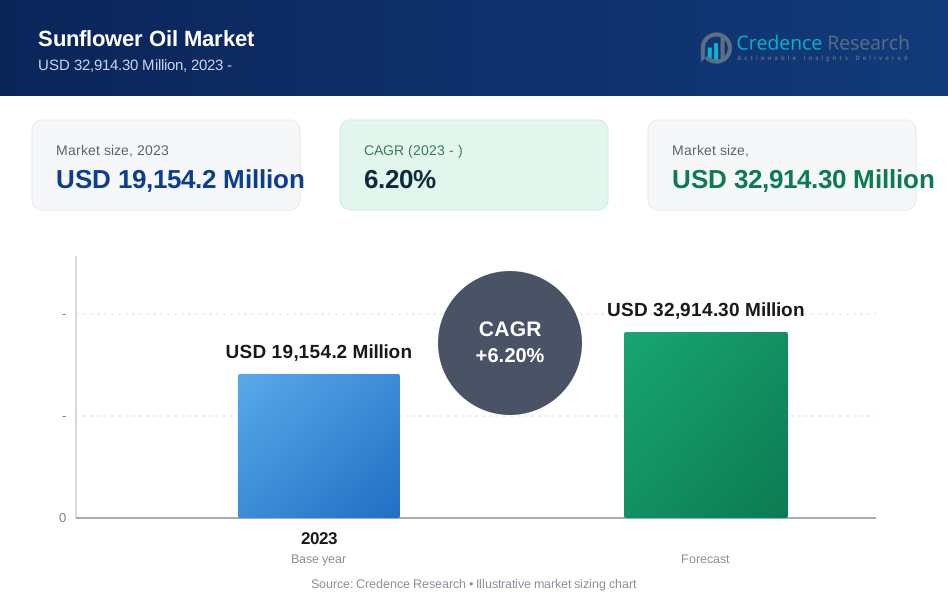
| Sunflower Oil Market 2023 | USD 19,154.2 Million |
| Sunflower Oil Market, CAGR | 6.20% |
| Sunflower Oil Market Size 2032 | USD 32,914.30 Million |
Market Insights
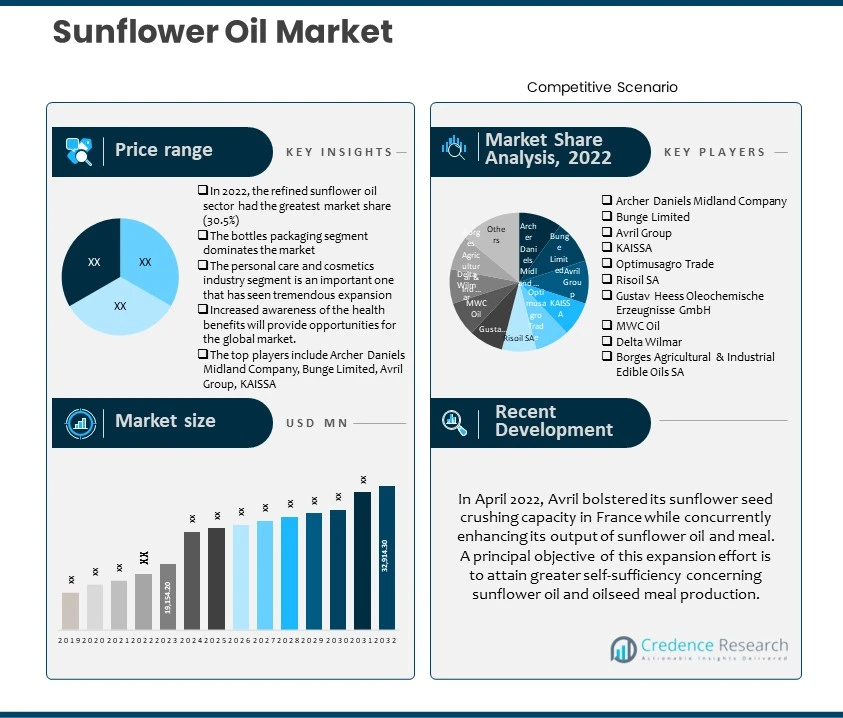
- The global demand for Sunflower Oil was valued at USD 19,154.2 Million in 2023 and is expected to reach USD 32,914.30 Million in 2032, growing at a CAGR of 6.20% between 2024 and 2032.
- The refined sunflower oil sector is the market leader by type of sunflower oil, accounting for more than 31% of total value in 2023, while the unrefined or cold-pressed sunflower oil segment is expected to grow rapidly throughout the forecast period.
- The bottles packaging type dominates the global need for Sunflower Oil, accounting for more than 20% in 2023 and cans is predicted to expand at a high CAGR.
- The personal care and cosmetics industry sector is predicted to grow fastest over the projection period, while the food industry segment will have a market share of more than 19% in 2023.
- Over the projection period, the foodservice providers category is expected to expand at the highest rate, while the supermarkets and hypermarkets category will dominate the market in 2023 with a 25% share.
- Europe is fueling the growth of the sunflower oil industry with over one-third share in 2023, while Asia Pacific and North America collectively account for just under 55% share in 2023. North America held over 20% share in 2023.
- Due to increased awareness of the health benefits associated with sunflower oil, such as its high levels of unsaturated fats, vitamin E, and antioxidants, is driving demand.
- The market's primary possibilities include the significant growth potential in Europe, growing concerns about heart health are prompting consumers to opt for healthier cooking oils like sunflower oil, which is low in saturated fats and cholesterol-free.
Executive Summary
Market Definition
Sunflower oil is a type of edible oil derived from sunflower seeds. It is commonly used in cooking and food processing due to its neutral flavor and versatile nature. This oil is known for its high levels of unsaturated fats, vitamin E, and antioxidants, making it a popular choice among health-conscious consumers. In simple terms, sunflower oil is a cooking oil made from sunflower seeds, widely used in kitchens and food production for its health benefits and culinary versatility.
Market Overview
The global Sunflower Oil market has witnessed steady growth in recent years and is expected to grow at a CAGR of 6.20% between 2024 and 2032. The market was valued at USD 19,154.2 million in 2023 and is expected to reach USD 32,914.30 million in 2032.
The key driver boosting the growth rate of the Sunflower Oil market is the technological advancements play a significant role in driving market expansion. Health conscious consumer trends, rising prevalence of cardiovascular diseases, and expanding food processing industry, particularly in developing regions, is boosting the demand for sunflower oil globally. Innovations in oil extraction technologies are improving the efficiency and quality of sunflower oil production, leading to higher yields and better product consistency.
Furthermore, the increased adoption of sunflower oil in foodservice sector is driving growth in the Sunflower Oil market. With Sunflower Oil, companies can easily customize products according to individual customer preferences, leading to enhanced customer satisfaction and loyalty. The growing popularity of vegetarian and vegan diets is driving the demand for plant-based cooking oils like sunflower oil as a healthier alternative to animal fats. Government-led campaigns promoting healthy eating habits and the consumption of nutritious foods are creating awareness about the benefits of sunflower oil, thus driving market growth.
Segmentation by Type of Sunflower Oil
- Refined sunflower oil is the leading segment by type of sunflower oil and held over 31% share in value in 2023, attributable to the continuous innovation and technological advancements in Sunflower Oil extraction technology.
- The unrefined or cold-pressed sunflower oil segment will likely exhibit a significant CAGR during the forecast period. Growing demand for sunflower oil in international markets, driven by its affordability, nutritional profile, and versatility, is providing opportunities for market expansion and revenue growth for producers and exporters.
- High Oleic Sunflower Oil, Mid Oleic Sunflower Oil, and Linoleic Sunflower Oil also contributes significantly to the market growth during the forecast period.
Segmentation by Packaging Type
- The bottles (e.g., plastic bottles, glass bottles) segment governs the demand for sunflower oil in the globally, holding a massive share of over 20% in 2023, and cans is also expected to grow at a rapid CAGR because increased awareness of the health benefits associated with sunflower oil, such as its high levels of unsaturated fats, vitamin E, and antioxidants, is driving demand.
- The drums, flexi tanks, bulk packaging (e.g., in tanker trucks) sectors segment contributes to the demand for Sunflower Oil.
Segmentation by End-Use Industry
- The Personal Care and Cosmetics Industry (Skincare Products, Haircare Products, Lip Balms and Lipsticks, Massage Oils, and Others) segment is expected to post the highest CAGR during the forecast period. This is primarily due to growing consumer preference for natural and organic ingredients is fueling the demand for organic sunflower oil, which is perceived as safer and more environmentally friendly.
- The food industry which includes cooking oil, salad dressings and marinades, bakery and confectionery products, processed foods (e.g., snacks, fried foods), ready-to-eat meals, and others segment is leading the market share with over 19% share in 2023.
Segmentation by Distribution Channel
- The foodservice providers (e.g., restaurants, cafes, hotels) segment is anticipated to register the highest CAGR during the projection period.
- With a market share of nearly 25% in 2023, the supermarkets and hypermarkets category is currently in the lead.
- The category of distribution channel segment includes convenience stores, specialty food stores, online retailers, industrial suppliers, and others.
Segmentation by Region
- Europe is fueling the growth of the Sunflower Oil industry with over one-third share in 2023 due to the growing concerns about heart health are prompting consumers to opt for healthier cooking oils like sunflower oil, which is low in saturated fats and cholesterol-free.
- Asia Pacific and North America collectively account for just under 55% share in 2023, with North America holding over 20% share in the same year.
- The rest of the world, including Latin America, the Middle East, and Africa, supplies the remaining demand for Sunflower Oil.
The market for Sunflower Oil is driven by government-led campaigns promoting healthy eating habits and the consumption of nutritious foods are creating awareness about the benefits of sunflower oil to promote the adoption of sunflower oil technology, thereby stimulating market growth.
Europe stands as a dominant force in the global sunflower oil market, boasting significant production and consumption levels. Countries within the region such as Ukraine, Russia, and France are renowned for their substantial contributions to sunflower oil production, securing Europe's prominent position in the industry. As per data from the US Department of Agriculture, the production of sunflower seed oil reached 5.82 million metric tons in the 2021-2022 period, marking an increase from the 5.12 million metric tons recorded in 2020-2021. This rise can be attributed to heightened demand from both the domestic processing sector and various regions in Europe. The widespread use of sunflower oil in European kitchens and food processing facilities underscores its importance in the culinary landscape.
One of the key drivers of sunflower oil demand in Europe is its versatility and health benefits. Consumers across the continent appreciate sunflower oil for its neutral flavor profile, making it suitable for various cooking applications. Additionally, its high content of unsaturated fats, vitamin E, and antioxidants aligns with the growing trend of health-conscious eating. As consumers increasingly prioritize healthier dietary choices, sunflower oil emerges as a preferred option over other cooking oils high in saturated fats. Moreover, Europe's robust infrastructure and well-established distribution networks facilitate the seamless supply of sunflower oil to domestic and international markets. With stringent quality standards and efficient production processes, European sunflower oil manufacturers maintain a competitive edge in the global market, further solidifying Europe's dominance in the sunflower oil industry.
The Asia Pacific is expected to be the fastest-growing region over the forecast period. Rapid industrialization, urbanization, and economic growth in countries like China, India, Japan, and South Korea are driving the adoption of Sunflower Oil across various sectors. Furthermore, the culinary versatility of sunflower oil makes it a favored choice in Asian cuisines, contributing to its widespread acceptance across the region. From stir-fries to deep-frying and salad dressings, sunflower oil's neutral taste and high smoke point make it suitable for various cooking methods. In April 2022, Bengaluru's Karnataka Cooperative Oilseeds Growers' Federation (KOF) introduced a fresh brand of Dhara sunflower oil. The National Dairy Development Board (NDDB) empowered the Fisheries, Animal Husbandry, and Dairy Minister to issue KOF a check worth INR 16.32 crore (USD 1.9 million) to support the procurement of oilseeds and edible oils.
The growing middle-class population and rising disposable incomes in Asia Pacific also play a significant role in driving sunflower oil consumption. As consumers seek higher-quality and healthier food options, the demand for sunflower oil is expected to continue its upward trajectory in the region. Additionally, government initiatives promoting healthier eating habits and the expansion of retail distribution channels further fuel market growth. With these factors combined, the Asia Pacific region is poised to maintain its position as a key growth driver in the global sunflower oil market
The primary factor driving the sunflower oil market's growth rate is the growing concerns about heart health are prompting consumers to opt for healthier cooking oils like sunflower oil, which is low in saturated fats and cholesterol-free, driving overall market growth.
Key Highlights of the Report
The global Sunflower Oil market is segmented by type of sunflower oil, packaging type, end-use industry, distribution channel, and region. Refined-based Sunflower Oil are the most popular, while unrefined or cold-pressed sunflower oil are the primary segments. In addition, bottles, and cans are the most commonly used categories. However, food industry, and supermarkets and hypermarkets dominate the market, with Europe leading the market growth.
One of the main factors propelling the global market for Sunflower Oil is continuous innovation and technological advancements in Sunflower Oil technologies. The growing demand for sunflower oil in international markets, driven by its affordability, nutritional profile, and versatility, is providing opportunities for market expansion and revenue growth for producers and exporters. The government-led campaigns promoting healthy eating habits and the consumption of nutritious foods are creating awareness about the benefits of sunflower oil, thus driving market growth.
Nonetheless, Europe is anticipated to have the greatest share of the worldwide Sunflower Oil market because of the countries within the region such as Ukraine, Russia, and France are renowned for their substantial contributions to sunflower oil production, securing Europe's prominent position in the industry. Furthermore, the market is anticipated to expand at the highest rate in the Asia-Pacific (APAC) region due to the consumers become more health-conscious, there is a growing preference for cooking oils that offer nutritional benefits.
What Are The Main Drivers Of The Global Sunflower Oil Market?
The main drivers of the global sunflower oil market include increasing health consciousness among consumers, driven by the perceived health benefits of sunflower oil such as its high levels of unsaturated fats, vitamin E, and antioxidants. Additionally, rising concerns about cardiovascular diseases have led to a preference for healthier cooking oils like sunflower oil, which is low in saturated fats.
What Are The Major Challenges Faced By The Global Sunflower Oil Market?
Major challenges faced by the global sunflower oil market include fluctuations in raw material prices and intense competition from other edible oils pose significant hurdles to market growth.
What Are The Growth Opportunities In The Global Sunflower Oil Market?
Growth opportunities in the global sunflower oil market include the expansion into new markets, particularly in emerging economies, offers growth prospects for sunflower oil producers. The increasing demand for organic and non-GMO products presents avenues for market expansion, as does the development of value-added products and functional foods fortified with sunflower oil. Technological advancements in oil extraction and processing enhance production efficiency, while collaboration and partnerships along the supply chain foster market expansion.
Market Drivers
The global Sunflower Oil market is driven by several factors. The following are the key drivers of the global Sunflower Oil market:
Growing Health Consciousness Among Consumers
The key driver of the global sunflower oil market is the increasing health consciousness among consumers. With rising awareness of the importance of healthy eating habits, more people are seeking cooking oils that offer nutritional benefits. Sunflower oil, with its high levels of unsaturated fats, vitamin E, and antioxidants, aligns well with these health trends. As consumers prioritize healthier options in their diets, the demand for sunflower oil is expected to continue growing.
Market Restraints
The global Sunflower Oil market faces some challenges that may hinder its growth. These include the following:
Fluctuations in Raw Material Prices
A significant restraint faced by the global sunflower oil market is the fluctuations in raw material prices. The prices of sunflower seeds, the primary raw material used in sunflower oil production, can be volatile due to various factors such as weather conditions, crop yields, and geopolitical events. These fluctuations can affect the profitability of sunflower oil producers and impact the overall stability of the market.
Opportunities
The global Sunflower Oil market offers significant growth opportunities. These include the following:
Expansion into Emerging Markets
The global sunflower oil market presents significant growth opportunities through its expansion into emerging markets. As populations grow and economies develop in regions such as Asia Pacific, Latin America, and Africa, there is an increasing demand for edible oils, including sunflower oil. Producers can capitalize on this opportunity by expanding their presence in these markets, tapping into new consumer segments, and establishing distribution networks to meet the growing demand.
Competitive Landscape
Key Players
The global Sunflower Oil market is highly competitive, with several key players. Some of the major players in the market and their market share are as follows:
- Archer Daniels Midland Company
- Bunge Limited
- Avril Group
- KAISSA
- Optimusagro Trade
- Risoil SA
- Gustav Heess Oleochemische Erzeugnisse GmbH
- MWC Oil
- Delta Wilmar
- Borges Agricultural & Industrial Edible Oils SA
- Spack BV
- Cargill Incorporated
- Others
These organizations prioritize product innovation, distribution channel expansion, and mergers and acquisitions to stay competitive.
The global Sunflower Oil market's key players continually seek to stay ahead by offering new products and developments.
In June 2022, Edible Oils Limited (EOL), a collaborative venture between Archer Daniels Midland (ADM) and Princes Limited, inaugurated a newly refurbished bottling facility at its Erith site, involving a hefty investment of GBP 24 million (USD 28.9 million). This initiative, as part of EOL's investment strategy for the Erith site, encompassed the installation of new bottling lines tailored for cooking oils and the overhaul of the oil tank farm to streamline the oil transfer process within the factory.
In April 2022, Avril bolstered its sunflower seed crushing capacity in France while concurrently enhancing its output of sunflower oil and meal. A principal objective of this expansion effort is to attain greater self-sufficiency concerning sunflower oil and oilseed meal production.
Summary of Key Findings
- The demand for sunflower oil is rising due to the health-conscious consumer trends, rising prevalence of cardiovascular diseases, growing population, and urbanization and changing lifestyles, which is boosting the growth of the sunflower oil market.
- Market segmented by type of sunflower oil, packaging type, end-use industry, distribution channel, and region.
- Refined-based Sunflower Oil are the most popular, while unrefined or cold-pressed sunflower oil are the primary segments. In addition, bottles, and cans are the most commonly used categories.
- However, food industry, and supermarkets and hypermarkets dominate the market.
- Europe is leading market growth; the market is highly competitive with key players including Archer Daniels Midland Company, Bunge Limited, Avril Group, KAISSA, Optimusagro Trade, Risoil SA, Gustav Heess Oleochemische Erzeugnisse GmbH, MWC Oil, Delta Wilmar, Borges Agricultural & Industrial Edible Oils SA, Spack BV, Cargill Incorporated, and Others.
Future Outlook
- Positive outlook for the global Sunflower Oil market with significant growth potential in the North American region
- One of the main factors promoting the market's expansion is the government and business sectors' current reliance on Sunflower Oil.
- During the forecast period, fluctuation in raw material prices is a significant factor projected to restrain the growth of the Sunflower Oil market.
- Key firms must focus on product innovation, growing market reach, and maintaining competitive pricing to keep ahead of the competition.
How CXOs Can Benefit from the Credence Research Sunflower Oil Market Report
The Credence Research Sunflower Oil Market Report provides CXOs with a comprehensive overview of the market, including:
- Market size and growth forecast: The report provides detailed estimates of the global Sunflower Oil market size, segmented by type of sunflower oil, packaging type, end-use industry, distribution channel, and region. It also includes forecasts for the market through 2032, based on key trends and drivers.
- Market segmentation: The report segments the Sunflower Oil market by type of sunflower oil, packaging type, end-use industry, distribution channel, and region. This segmentation provides CXOs with a granular understanding of the market and the opportunities in each segment.
- Competitive landscape: The report profiles the key players in the Sunflower Oil market and provides insights into their strategies, product offerings, and financial performance. This information can help CXOs to identify and assess their competition.
- Key trends and drivers: The report identifies and analyzes the key trends and drivers that are shaping the Sunflower Oil This information can help CXOs to make informed decisions about their investments and strategies.
CXOs can use the insights from the Credence Research Sunflower Oil Market Report to:
- Identify growth opportunities: The report can help CXOs to identify new growth opportunities in the Sunflower Oil For example, the report identifies the growing demand for Sunflower Oil from Sunflower Oil providers and manufacturing companies as a key opportunity.
- Make informed investment decisions: The report can help CXOs to make informed investment decisions about Sunflower Oil. For example, the report provides insights into the key factors to consider when evaluating Sunflower Oil providers and selecting Sunflower Oil
- Develop competitive strategies: The report can help CXOs to develop competitive strategies for their Sunflower Oil For example, the report identifies the key strategies that Sunflower Oil providers are using to differentiate themselves from their competitors.
- Track market developments: The report can help CXOs to track market developments and stay ahead of the curve. For example, the report provides insights into the latest trends and innovations in the Sunflower Oil
Overall, the Credence Research Sunflower Oil Market Report is a valuable resource for CXOs who are looking to gain a deeper understanding of the market and identify opportunities for growth.
Segmentation
- By Type of Sunflower Oil
- Refined Sunflower Oil
- Unrefined or Cold-Pressed Sunflower Oil
- High Oleic Sunflower Oil
- Mid Oleic Sunflower Oil
- Linoleic Sunflower Oil
- By Packaging Type
- Bottles (e.g., plastic bottles, glass bottles)
- Cans
- Drums
- Flexi Tanks
- Bulk Packaging (e.g., in tanker trucks)
- By End-User Industry
- Food Industry
- Cooking Oil
- Salad Dressings and Marinades
- Bakery and Confectionery Products
- Processed Foods (e.g., snacks, fried foods)
- Ready-to-Eat Meals
- Others
- Personal Care and Cosmetics Industry
- Skincare Products
- Haircare Products
- Lip Balms and Lipsticks
- Massage Oils
- Others
- Pharmaceuticals Industry
- Excipient in Medications
- Topical Formulations
- Nutraceuticals
- Others
- Industrial Applications
- Biofuel Production
- Lubricants and Hydraulic Fluids
- Paints and Coatings
- Adhesives and Sealants
- Others
- By Distribution Channel
- Supermarkets and Hypermarkets
- Convenience Stores
- Specialty Food Stores
- Online Retailers
- Foodservice Providers (e.g., restaurants, cafes, hotels)
- Industrial Suppliers
- Others
- By Region
- North America
- The U.S.
- Canada
- Mexico
- Europe
- Germany
- France
- The U.K.
- Italy
- Spain
- Rest of Europe
- Asia Pacific
- China
- Japan
- India
- South Korea
- South-east Asia
- Rest of Asia Pacific
- Latin America
- Brazil
- Argentina
- Rest of Latin America
- Middle East & Africa
- GCC Countries
- South Africa
- Rest of Middle East and Africa
- North America
- Food Industry
Request a Free Sample
Fill in your details and we'll send you a free sample report.
- Sample data tables & charts
- Research methodology
Need a Custom Version of This Report?
Tailor the scope, geography, or segments to your exact requirements.
- Custom geography or segment scope
- Direct access to our analyst team
Frequently Asked Questions
What is the current size of the global Sunflower Oil market?
What is the expected growth rate of the Sunflower Oil market between 2024 and 2032?
Which segment is leading the market share in terms of type of sunflower oil?
Which packaging type segment governs the demand for Sunflower Oil in the world?
Who are the major players in the global Sunflower Oil market?
Table of Content
Chapter 1. Report Introduction
- 1.1 Report Description & Purpose
- 1.1.1 Report Title & Market Definition
- 1.1.2 Unique Selling Propositions (USP) & Key Differentiators
- 1.1.3 Value Proposition for Stakeholders
- 1.2 Research Objectives
- 1.2.1 Market Sizing Objectives (Volume & Revenue) (Volume Where Applicable)
- 1.2.2 Segmentation Objectives
- 1.2.3 Competitive Intelligence Objectives
- 1.2.4 Forecast & Scenario Objectives
- 1.3 Report Scope
- 1.3.1 Sunflower Oil Scope – Segments & Subsegments Covered
- 1.3.2 Geographic Scope – Regions & Countries Covered
- 1.3.3 Historical Period, Base Year & Forecast Period (2023; forecast to the forecast period)
- 1.3.4 Inclusions & Exclusions
- 1.4 Industry Classification & Applicable Codes
- 1.5 Currency, Measurement Units & Valuation Basis
- 1.6 Target Stakeholders
- 1.7 Limitations & Assumptions
Chapter 2. Executive Summary
- 2.1 Global Sunflower Oil Market Snapshot
- 2.1.1 Market Size – Historical (2023) & Forecast (the forecast period) (2023: USD 19,154.2 Million → forecast year: USD 32,914.30 Million)
- 2.1.2 Volume & Revenue – Global Totals (Volume Where Applicable)
- 2.1.3 Key Market Highlights – Top Five Facts
- 2.2 Sunflower Oil Market Segmentation Snapshot
- 2.2.1 Market Split by Region – 2023 vs.
- 2.3 Competitive Snapshot
- 2.3.1 Top 10 Players by Revenue Share – 2023
- 2.3.2 Top 10 Players by Volume Share – 2023 (Volume Where Applicable)
- 2.3.3 Recent Strategic Developments (18-Month Summary)
- 2.4 Key Investment Highlights & Strategic Conclusions
Chapter 3. Sunflower Oil Market Dynamics & Industry Analysis
- 3.1 Market Overview & Context
- 3.1.1 Sunflower Oil Market Position in the Broader Industry Value Chain
- 3.1.2 Demand Structure & Purchasing Dynamics
- 3.1.3 Market Maturity & Development Stage by Region
- 3.2 Sunflower Oil Market Drivers
- 3.3 Sunflower Oil Market Restraints & Challenges
- 3.4 Sunflower Oil Market Opportunities
- 3.5 Porter's Five Forces Analysis
- 3.5.1 Threat of New Entrants
- 3.5.2 Bargaining Power of Suppliers
- 3.5.3 Bargaining Power of Buyers
- 3.5.4 Threat of Substitutes
- 3.5.5 Competitive Rivalry – Intensity Assessment
- 3.6 Sunflower Oil Value Chain Analysis
- 3.6.1 Upstream – Key Inputs, Resources & Suppliers
- 3.6.1.1 Key Input/Resource 1
- 3.6.1.2 Key Input/Resource 2
- 3.6.1.3 Key Input/Resource 3
- 3.6.2 Midstream – Core Operations & Value Creation
- 3.6.2.1 Operating Model & Process Overview
- 3.6.2.2 Key Operating Locations & Capabilities by Company
- 3.6.3 Downstream – Market Channels & End Users
- 3.6.3.1 Direct Sales & Customer Engagement Channels
- 3.6.3.2 Indirect Sales, Intermediaries & Partner Channels
- 3.6.4 Value Chain Profitability Analysis
- 3.6.1 Upstream – Key Inputs, Resources & Suppliers
- 3.7 PESTEL Analysis
- 3.7.1 Political Factors
- 3.7.2 Economic Factors
- 3.7.3 Social Factors
- 3.7.4 Technological Factors
- 3.7.5 Environmental Factors
- 3.7.6 Legal Factors
- 3.8 Sunflower Oil Supply Chain Analysis
- 3.8.1 Critical Input & Resource Availability Risk Assessment
- 3.8.2 Supplier & Operational Concentration Risk (Geographic Exposure)
- 3.8.3 Supply & Service Disruption Impact Analysis
- 3.9 Regulatory & Policy Landscape
Note: The regulatory and policy landscape section covers regulations based on their applicability to the market, Sunflower Oil category, geography, and scope of the study. Only regulatory frameworks with a material impact on operations, compliance, trade, sustainability, or market access are analyzed in detail.
Chapter 4. Key Investment Pockets & Opportunity Analysis
- 4.1 Sunflower Oil Market Attractiveness Analysis
- 4.1.1 By Region – Investment Attractiveness Matrix (Market Size × CAGR)
- 4.2 Absolute Revenue Growth Opportunity
- 4.2.1 By Region – Absolute Revenue Growth Through the forecast period
- 4.3 Incremental Demand Opportunity
- 4.3.1 By Region – Incremental Demand Through the forecast period
- 4.3.2 Segment – Incremental Demand
- 4.4 Emerging Submarket Opportunity Deep Dive (Subject to Applicability)
- 4.5 Priority Market Opportunity Scorecards
- 4.5.1 United States
- 4.5.2 Europe
- 4.5.3 Asia
- 4.5.4 Middle East & Africa
Note: Priority market opportunity scorecards reflect the geographic scope and strategic relevance of the study. Listed markets are indicative and may be adapted to the industry.
Chapter 5. Sunflower Oil Cross-Border Trade & Market Access Analysis
- 5.1 International Trade & Cross-Border Activity Overview
- 5.1.1 Global Export Value by Country (2023)
- 5.1.2 Global Export Volume by Country (2023) (Volume Where Applicable)
- 5.1.3 Global Import Value by Country (2023)
- 5.1.4 Global Import Volume by Country (2023) (Volume Where Applicable)
- 5.1.5 Net Trade Balance by Country (2023)
- 5.2 Export Analysis – Segment
- 5.2.1 Category 1 (Applicable Classification Code)
- 5.2.2 Category 2 (Applicable Classification Code)
- 5.2.3 Category 3 (Applicable Classification Code)
- 5.2.4 Category 4 (Applicable Classification Code)
- 5.2.5 Category 5 (Applicable Classification Code)
- 5.3 Import Analysis – Segment
- 5.3.1 Category 1 (Applicable Classification Code)
- 5.3.2 Category 2 (Applicable Classification Code)
- 5.3.3 Category 3 (Applicable Classification Code)
- 5.3.4 Category 4 (Applicable Classification Code)
- 5.3.5 Category 5 (Applicable Classification Code)
- 5.4 Cross-Border Pricing & Transaction Benchmarks
- 5.4.1 Export Pricing – Segment & Country
- 5.4.2 Import Pricing – Segment & Source Country
- 5.4.3 Price Trends (2023)
- 5.5 Key Cross-Border Trade & Delivery Routes
- 5.5.1 Cross-Border Trade/Delivery Route 1
- 5.5.2 Cross-Border Trade/Delivery Route 2
- 5.5.3 Cross-Border Trade/Delivery Route 3
- 5.5.4 Cross-Border Trade/Delivery Route 4
- 5.5.5 Cross-Border Trade/Delivery Route 5
- 5.6 Trade Policy & Market Access Impact Assessment
- 5.6.1 Tariff & Non-Tariff Barriers
- 5.6.2 Regional Trade & Economic Integration Frameworks
- 5.6.3 Bilateral & Multilateral Trade Agreements
- 5.6.4 Cross-Border Operating, Licensing & Localization Requirements
Note: This chapter applies where cross-border trade or delivery is relevant to Sunflower Oil. Goods, services, and digital offerings are assessed using applicable classifications and transaction measures. Import-export volumes, trade balances, and route analyses are included only where meaningful to the market.
Chapter 6. Competitive Landscape & Company Benchmarking
- 6.1 Sunflower Oil Market Concentration & Structure
- 6.1.1 Herfindahl-Hirschman Index (HHI) – vs. 2023
- 6.1.2 Leading, Mid-Sized & Emerging Player Structure
- 6.1.3 Global, Regional & Local Player Dynamics
- 6.2 Sunflower Oil Market Share Analysis – 2023
- 6.2.1 Global Revenue Share by Company
- 6.2.2 Global Volume Share by Company (Volume Where Applicable)
- 6.2.3 Regional Revenue Share
- 6.2.4 Market Share Evolution ( vs. 2023)
- 6.2.5 Company Market Share by Key Segment
- 6.2.6 Company Market Share by Customer Group
- 6.3 Operating Scale, Capacity & Infrastructure Analysis
- 6.3.1 Global Operating Scale & Supply Capacity
- 6.3.2 Resource Utilization & Operating Efficiency
- 6.3.3 Output, Service Delivery & Activity Metrics
- 6.3.4 Operating Footprint & Infrastructure Map
- 6.3.5 Planned Operational & Capacity Expansion
- 6.4 Sunflower Oil Competitive Benchmarking Matrix
- 6.4.1 Revenue, Growth, Profitability & Operating Metric Comparison
- 6.4.2 Channel Revenue Mix
- 6.4.3 Geographic Revenue Exposure
- 6.4.4 R&D Intensity
- 6.4.5 Sustainability Maturity
- 6.5 Strategic Developments in Sunflower Oil (Last 24 Months)
- 6.5.1 Mergers, Acquisitions & Divestments
- 6.5.2 New Products, Services & Solutions in Sunflower Oil
- 6.5.3 Operational & Infrastructure Expansions
- 6.5.4 Strategic Alliances, Joint Ventures & Partnerships
- 6.5.5 Distribution Expansion & Market Entry
- 6.5.6 Sustainability & ESG Initiatives
- 6.6 Competitive Strategy Mapping
- 6.6.1 Leader, Challenger, Follower & Niche Classification
- 6.6.2 Pricing Strategy Comparison
- 6.6.3 Channel Strategy Matrix
Note: Strategic developments are included based on their materiality and the availability of reliable information.
Chapter 7. Global Sunflower Oil Market – By Sales & Delivery Channel
- 7.1 Segment Overview
- 7.1.1 Volume & Revenue Split by Channel (2023 & ) (Volume Where Applicable)
- 7.1.2 Channel Mix Evolution (the forecast period)
Chapter 8. Regional Market Analysis – Global Overview
- 8.1 Global Regional Overview
- 8.1.1 Regional Volume Share (Volume Where Applicable)
- 8.1.2 Regional Revenue Share
- 8.1.3 Regional Volume by Region (Volume Where Applicable)
- 8.1.4 Regional Revenue by Region
- 8.1.5 Regional Forecast Through the forecast period
- 8.2 Cross-Regional Segment Analysis
- 8.2.1 By Sales & Delivery Channel
- 8.2.2 By Competitive Positioning & Price Tier
Chapter 9. North America Sunflower Oil Market
- 9.1 United States
- 9.2 Canada
- 9.3 Mexico
Chapter 10. Europe Sunflower Oil Market
- 10.1 Germany
- 10.2 France
- 10.3 Italy
- 10.4 United Kingdom
- 10.5 Spain
- 10.6 Poland
- 10.7 Russia
- 10.8 Netherlands
- 10.9 Belgium
- 10.10 Sweden
- 10.11 Denmark
- 10.12 Norway
- 10.13 Rest of Europe
Chapter 11. Asia Pacific Sunflower Oil Market
- 11.1 China
- 11.2 India
- 11.3 Japan
- 11.4 South Korea
- 11.5 Thailand
- 11.6 Indonesia
- 11.7 Vietnam
- 11.8 Malaysia
- 11.9 Australia
- 11.10 Rest of Asia Pacific
Chapter 12. Latin America Sunflower Oil Market
- 12.1 Brazil
- 12.2 Argentina
- 12.3 Colombia
- 12.4 Chile
- 12.5 Rest of Latin America
Chapter 13. Middle East Sunflower Oil Market
- 13.1 Saudi Arabia
- 13.2 United Arab Emirates
- 13.3 Turkey
- 13.4 Israel
- 13.5 Iran
- 13.6 Rest of the Middle East
Chapter 14. Africa Sunflower Oil Market
- 14.1 South Africa
- 14.2 Egypt
- 14.3 Nigeria
- 14.4 Morocco
- 14.5 Rest of Africa
Chapter 15. Sunflower Oil Company Profiles
- 15.1 [Company 01]
- 15.1.1 Company Overview
- 15.1.2 Key Management Personnel
- 15.1.3 Products & Services Portfolio
- 15.1.4 Financial Performance
- 15.1.5 Key Market Focus & Geographic Presence
- 15.1.6 Recent Developments & Strategic Initiatives
Note: The company profile list is preliminary and may change based on research findings, market developments, data availability, and client requirements.
Chapter 16. Appendices
- Appendix A – List of Abbreviations & Acronyms
- Appendix B – Industry Classification Code Reference – Full Series
- Appendix C – Supply, Output & Operating Capacity Data Tables
- Appendix D – End-Use & Demand Base Tables
- Appendix E – Demand, Adoption & Usage Assumptions
- Appendix F – Pricing & Revenue Metric Reference Tables
- Appendix G – Company Operations & Infrastructure Database
- Appendix H – Cross-Border Trade & Activity Data Tables (Where Applicable)
- Appendix I – Regulatory Summary Tables
- Appendix J – Primary Research Participant List (Anonymized)
- Appendix K – Primary Research Questionnaire Framework
- Appendix L – Data Sources & Bibliography
- Appendix M – Market Size Divergence & Source Comparison
Chapter 17. Research Methodology
- 17.1 Research Framework & Philosophy
- 17.2 Secondary Research – Sources, Hierarchy & Data Extraction
- 17.3 Data Modeling – Bottom-Up & Top-Down Market Sizing
- 17.4 Primary Research – Stakeholder Framework, LOI & Sample Sizes
- 17.5 Forecast Methodology – Regression, Scenario & Sensitivity Analysis
- 17.6 Quality Control – Four-Layer Validation Framework
- 17.7 Limitations & Standard Assumptions
- 17.8 Disclaimer
