
| REPORT ATTRIBUTE | DETAILS |
|---|---|
| Historical Period | 2019-2022 |
| Base Year | 2023 |
| Forecast Period | 2024-2032 |
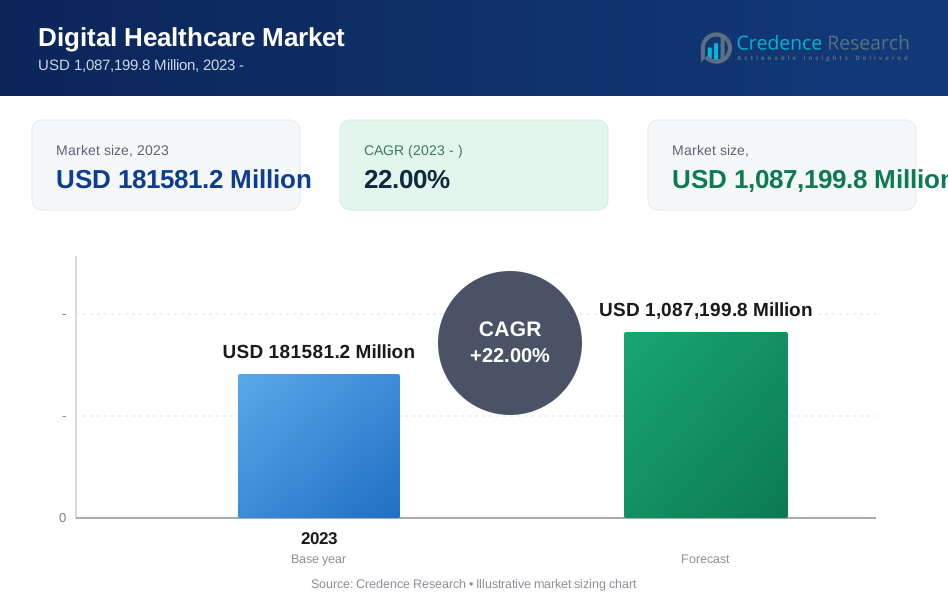
| Digital Healthcare Market Size 2023 | USD 181581.2 Million |
| Digital Healthcare Market, CAGR | 22.00% |
| Digital Healthcare Market Size 2032 | USD 1087199.8 Million |
Market Insights
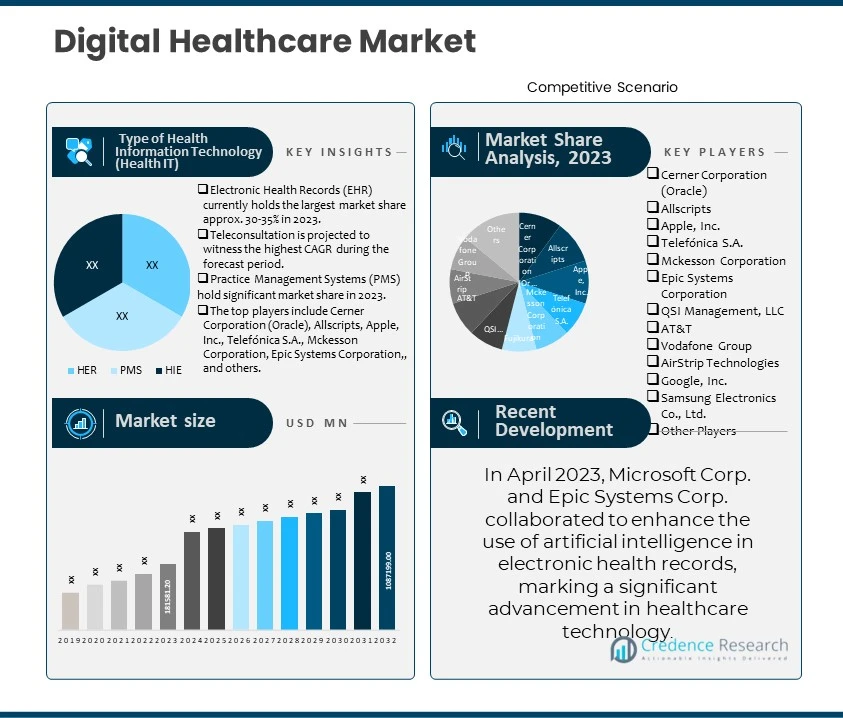
- The digital healthcare market attained a valuation of USD 181581.2 Million in 2023 and is anticipated to escalate to USD 1087199.8 Million by 2032, exhibiting a robust CAGR of 22.00% during the forecast period from 2024 to 2032.
- Among the key segments, Remote Patient Monitoring (RPM) holds the largest market share by Telemedicine and Telehealth segment, approximately 40-45% in 2023, driven by the rising prevalence of chronic diseases and growing awareness about its benefits. Teleconsultation is projected to witness the highest CAGR during the forecast period due to technological advancements and shifts in consumer preferences.
- Electronic Health Records (EHR) currently dominate the Health Information Technology (Health IT) segment, holding approximately 30-35% market share in 2023, owing to their efficiency in managing patient medical records. Practice Management Systems (PMS) are projected to witness the highest CAGR during the forecast period due to their benefits in handling billing processes and insurance claims.
- Health and Wellness Apps hold the largest market share by Mobile Health (mHealth) segment, approximately 30-40% in 2023, providing various lifestyle modification tools. Remote Monitoring Apps are projected to witness the highest CAGR during the forecast period due to advances in wearables and wireless communication.
- Chronic Disease Management currently holds the largest market share by Digital Therapeutics (DTx) segment, approximately 30-38% in 2023, driven by the increasing prevalence of chronic conditions. Prescription Digital Therapeutics (PDT) is projected to witness the highest CAGR during the forecast period due to growing evidence of clinical value.
- Clinical Decision Support (CDS) holds the largest market share by Healthcare Analytics and Artificial Intelligence (AI) segment, approximately 30-33% in 2023, owing to its capacity to streamline workflows. Predictive Analytics is projected to witness the highest CAGR during the forecast period due to accelerating AI advancements.
- Security Solutions currently dominate the Cybersecurity and Data Privacy segment, holding approximately 60-65% market share in 2023, safeguarding sensitive patient data. Compliance Tools are projected to witness the highest CAGR during the forecast period, driven by automated auditing and reporting.
- North America held the largest market share, around 38-42% in 2023, driven by a well-established healthcare system and rising healthcare costs. Asia Pacific and Europe collectively accounted for just under 55% share in 2023, with Europe holding over 20% share in the same year.
- Technological advancements, an increasing geriatric population, and government initiatives are primary drivers of market growth. Additionally, collaborations between technology companies and healthcare facilities contribute to market expansion.
Executive Summary
Market Definition
Digital Healthcare Market involves using technology to enhance healthcare delivery, focusing on areas like digital fitness & well-being and online doctor services. The digital healthcare market refers to the use of digital technologies, such as computers, mobile devices, and the internet, to improve healthcare services and outcomes. Digital healthcare initiatives include remote telemedicine, electronic health records (EHRs) for storing and managing patient data digitally, mobile health apps for monitoring health metrics, and wearable devices for real-time health monitoring. The market's evolution is driven by technological advancements, the rise of wearable devices, mobile health apps, and the integration of artificial intelligence in healthcare.
Market Overview
The Digital Healthcare Market has exhibited steady growth and is anticipated to maintain a robust Compound Annual Growth Rate (CAGR) of 22.00% from 2024 to 2032. Valued at USD 181581.2 million in 2023, this market is forecasted to reach USD 1087199.8 million by 2032.
The key driver boosting the growth rate of the Digital Healthcare Market is the increasing adoption of technology to enhance healthcare delivery and outcomes. Advancements in digital fitness, telemedicine, electronic health records, mobile health apps, and wearable devices are driving market expansion by improving healthcare services' efficiency and accessibility.
Furthermore, the expansion of the Digital Healthcare Market is actively driven by government initiatives promoting digital healthcare adoption and the rising prevalence of chronic diseases requiring continuous monitoring. The market is expected to grow significantly during the forecast period due to technological advancements and the growing demand for remote healthcare services.
In addition, the Digital Healthcare Market is poised for growth due to the adoption of various strategies among market players, including mergers & acquisitions, collaborations, and new product launches, to meet evolving healthcare needs and stay competitive in the market. These factors create numerous opportunities for the Digital Healthcare Market to expand during the forecast period.
Segmentation by Telemedicine and Telehealth
- Remote Patient Monitoring (RPM) currently holds the largest market share approx. 40-45% in 2023. The rising prevalence of chronic diseases and growing awareness about the benefits of RPM among both patients and healthcare providers drive the market growth.
- Teleconsultation is projected to witness the highest CAGR during the forecast period owing to technological advancements, competitive dynamics, and shifts in consumer preferences driving the market growth in the forecast period.
Segmentation by Health Information Technology (Health IT):
- Electronic Health Records (EHR) currently holds the largest market share approx. 30-35% in 2023 owing to various benefits such as improving clinical outcomes by enabling efficient management, sharing, and retrieval of patient medical records.
- Practice Management Systems (PMS) are projected to witness the highest CAGR during the forecast period owing to various benefits such as managing billing processes, handling insurance claims, and tracking patient payments.
Segmentation by Mobile Health (mHealth)
- Health and Wellness Apps currently hold the largest market share approx. 30-40% in 2023. The apps provide various benefits such as fitness guidance, nutrition advice, stress reduction techniques, sleep improvement tips, and other lifestyle modification tools.
- Remote Monitoring Apps are projected to witness the highest CAGR during the forecast period. Rapid advances in wearables, sensor technologies, and wireless communication facilitate real-time biometric data collection driving the market growth.
Segmentation by Digital Therapeutics (DTx)
- Chronic Disease Management currently holds the largest market share approx. 30-38% in 2023. increasing chronic conditions such as diabetes, asthma, COPD, mental disorders, and cardiovascular diseases driving the market growth.
- Prescription Digital Therapeutics (PDT) is projected to witness the highest CAGR during the forecast period due to growing evidence of clinical value, creating significant growth opportunities in this segment.
Segmentation by Healthcare Analytics and Artificial Intelligence (AI)
- Clinical Decision Support (CDS) currently holds the largest market share approx. 30-33% in 2023 owing to its capacity to streamline workflows, and minimize errors driving the market growth.
- Predictive Analytics is projected to witness the highest CAGR during the forecast period. Medical data coupled with accelerating AI advancements driving the market growth.
Segmentation by Cybersecurity and Data Privacy
- Security Solutions currently holds the largest market share approx. 60-65% in 2023. Safeguarding sensitive such as theft, loss, and misuse constitutes driving the market growth.
- Compliance Tools is projected to witness the highest CAGR during the forecast period. Automated auditing, reporting, policy enforcement, and staff training driving the market growth.
Segmentation by Region
- North America held the largest share around 38-42% of the market in 2023 due to a well-established healthcare system, rising healthcare costs, and the rise of advanced medical technology in the region.
- Asia Pacific and Europe collectively account for just under 55% share in 2023, with Europe holding over 20% share in the same year.
- The rest of the world, including Latin America, the Middle East, and Africa, supplies the remaining demand for digital health care.
Technological advancements in manufacturing digital healthcare systems/solutions, economic conditions, population demographics, and government initiatives drive the market.
The North American region holds the largest market share in the digital healthcare market. The region has a well-established healthcare system with advanced medical facilities, creating a huge demand for digital healthcare systems. The region has a large geriatric population, who are more prone to chronic diseases, thereby increasing the demand for chronic disease management. For instance, according to the National Library of Medicine, the number of people in the United States aged 50 years and older is projected to increase by 61.11% from 137.25 million in 2020 to 221.13 million in 2050 Of the population 50 years and older, the number with at least one chronic disease is estimated to increase by 99.5% from 71.522 million in 2020 to 142.66 million by 2050, and those with multimorbidity are projected to increase 91.16% from 7.8304 million in 2020 to 14.9 million in 2050. The presence of major market players like Cerner Corporation (Oracle), Allscripts, Apple, Inc., Telefónica S.A., Epic Systems Corporation, and others contributed to the market. Furthermore, high healthcare spending, allows hospitals and clinics to invest in advanced medical technology further boost the market growth. For instance, in August 2023, Quebec chose Wisconsin-based Epic Systems Corporation to build the infrastructure for its ambitious digital health record project. The first phase of the health network’s digital transition will be rolled out as a pilot project in two regions as early as 2024.
Asia Pacific region witnesses significant growth in the Digital Healthcare Market. One of the major factors is the increasing healthcare services in the region, especially in countries such as China, India, and Japan, with large populations and aging populations. For instance, according to the WHO, China's elderly population is rapidly growing, with those over 60 projected to make up 28% of the population by 2040. This is due to increases in life expectancy and decreases in fertility rates. This has led to an increase in the number of hospitals, clinics, and other healthcare facilities. Moreover, establishing a manufacturing factory by key market players in countries like India, China, and Singapore to cater to the demand for digital healthcare facilities also drives market growth. For instance, in June 2023, OMRON Healthcare is expanding its efforts to eliminate heart attacks and strokes through its "Going for Zero" vision by accelerating the use of blood pressure monitoring in India. They are establishing a manufacturing factory in Chennai, India, to produce blood pressure monitors starting in March 2025. This initiative aims to increase the availability and accessibility of blood pressure monitoring devices to support better heart health outcomes in India.
Key Highlights of the Report
The global Digital Healthcare Market is segmented by telemedicine and telehealth, health information technology (health IT), mobile health (mHealth), digital therapeutics (DTx), healthcare analytics and artificial intelligence (AI), cybersecurity and data privacy, and region. Remote Patient Monitoring (RPM) holds the largest market share by telemedicine and telehealth segment, particularly in chronic disease management, while Electronic Health Records (EHR) dominate in terms of health IT. Health and Wellness Apps are the most widely used segment in mobile health, and Clinical Decision Support (CDS) leads in healthcare analytics and AI. Security Solutions are predominant in cybersecurity and data privacy.
One of the main factors driving the global market for Digital Healthcare is the increasing adoption of technology to enhance healthcare delivery and outcomes. The demand for remote healthcare services, coupled with advancements in wearables, sensor technologies, and artificial intelligence, also contributes significantly to market expansion. Additionally, government initiatives promoting digital healthcare adoption and the rising prevalence of chronic diseases drive market growth.
Nonetheless, North America is expected to hold the largest share of the global Digital Healthcare Market due to its well-established healthcare system and high healthcare spending. Furthermore, the market is projected to witness the highest growth rate in the Asia Pacific (APAC) region, driven by increasing healthcare services, government initiatives, and collaborations between technology companies and healthcare facilities.
Key players such as Cerner Corporation (Oracle), Allscripts, Apple, Inc., Telefónica S.A., Epic Systems Corporation, and others focus on product innovation and strategic collaborations to maintain their market position and competitiveness in the Digital Healthcare industry.
What Are The Main Drivers Of The Global Digital Healthcare Market?
The global Digital Healthcare market is driven by various factors such as the rising prevalence of chronic diseases requiring continuous monitoring, technological advancements, and rising demand for remote healthcare services. Moreover, the rising aging population and growing awareness of preventive healthcare contribute to market growth. Along with, government initiatives promoting digital healthcare adoption further driving market expansion.
What Are The Major Challenges Faced By The Global Digital Healthcare Market?
The global Digital Healthcare market is mainly challenged by fierce competition among key players, rapid technological advancements high cost of implementation and maintenance, concerns regarding data security and patient privacy, and cyber security issues related to patient data and hospitals hindered the market expansion. Additionally, regulatory complexities and limited access to digital infrastructure in certain regions also challenge the market.
What Are The Growth Opportunities In The Global Digital Healthcare Market?
The global Digital Healthcare market presents numerous growth opportunities such as the adoption of advanced technology with the integration of artificial intelligence and machine learning for personalized healthcare delivery, increasing adoption of telemedicine and remote monitoring solutions, and investment in digital healthcare infrastructure. Moreover, population health management and software-based interventions further create opportunity for the market. In addition, the adoption of various strategies among market players creates significant opportunities for the market.
Market Drivers
The global Digital Healthcare market is driven by several factors. The following are the key drivers of the global Digital Healthcare market:
Increasing Geriatric Population
The global digital healthcare market is expected to grow significantly due to an increasing geriatric population, who are more prone to medical conditions that require stoma surgery, such as colorectal cancer, inflammatory bowel disease, and diverticulitis. According to the United Nations, the number of people aged 60 years or older is projected to reach nearly 2 billion by 2050, which will increases the demand for population health management solutions. Further, the aging population in North America, particularly in the United States, has been experiencing significant growth. According to the U.S. Census Bureau, the population aged 65 and older increased from 40.5 million in 2010 to 55.8 million in 2020, representing a 38% increase. It is projected to reach 94.7 million in 2060, with persons aged 65 and older expected to represent 22% of the population by 2040, up from 17% in 2020.
Market Restraints
The global Digital Healthcare market faces some challenges that may hinder its growth. These include the following:
Rapid Technological Advancements
The Digital Healthcare market is primarily constrained by rapid technological advancements, which require significant investment in R&D to be competitive. this need for constant product innovation may restrain the growth of the digital healthcare market. High R&D costs and short product life of digital healthcare solutions can make it difficult for companies to recoup their investments, potentially hampering market expansion. Moreover, rapid technological change means companies must continuously innovate their products, which can increase production costs and short product life cycles can be affected.
Opportunities
The global Digital Healthcare market offers significant growth opportunities. These include the following:
Adoption Of Various Strategies Among Market Players
The adoption of various strategies among market players creates significant opportunities for the market. The major companies serving the global Digital Healthcare Market are Allscripts, Apple, Inc., Telefónica S.A., Mckesson Corporation, Epic Systems Corporation, and AliveCor, among others. The market players are considerably contributing to the market growth by the adoption of various strategies including mergers & acquisitions, collaborations, funding, and new product launches, approvals to stay competitive in the market. For instance, in May 2022, AliveCor has launched KardiaComplete, an enterprise solution aimed at reducing the rising health and economic costs of heart disease. This comprehensive heart health program is designed to drive improved health outcomes and decrease the cost of cardiac care for individuals with atrial fibrillation and hypertension.
Competitive Landscape
Key Players
The global Digital Healthcare market is highly competitive, with several key players. Some of the major players in the market and their market share are as follows:
- Cerner Corporation (Oracle)
- Allscripts
- Apple, Inc.
- Telefónica S.A.
- Mckesson Corporation
- Epic Systems Corporation
- QSI Management, LLC
- AT&T
- Vodafone Group
- AirStrip Technologies
- Google, Inc.
- Samsung Electronics Co., Ltd.
- HiMS
- Orange
- Qualcomm Technologies, Inc.
- Softserve
- MQure
- Computer Programs and Systems, Inc.
- Vocera Communications
- IBM Corporation
- CISCO Systems, Inc.
- Others
These organizations prioritize product innovation, distribution channel expansion, and mergers and acquisitions to stay competitive.
The global Digital Healthcare market's key players continually seek to stay ahead by offering new products and developments.
In February 2023, King's College Hospital London - Dubai (KCH Dubai) selected Oracle Cerner and Oracle Cloud Infrastructure to provide electronic medical records (EMR) solutions, enhancing healthcare outcomes through innovative technology integration.
In April 2023, Microsoft Corp. and Epic Systems Corp. collaborated to enhance the use of artificial intelligence in electronic health records, marking a significant advancement in healthcare technology.
Summary of Key Findings
- The Digital Healthcare Market is experiencing significant growth, driven by the increasing adoption of technology to enhance healthcare delivery and outcomes. This growth is further fueled by government initiatives promoting digital healthcare adoption and the rising prevalence of chronic diseases requiring continuous monitoring.
- Market segmentation within the Digital Healthcare Market encompasses telemedicine and telehealth, health information technology (health IT), mobile health (mHealth), digital therapeutics (DTx), healthcare analytics and artificial intelligence (AI), cybersecurity and data privacy, and region, reflecting the diverse applications of digital healthcare solutions across various healthcare settings.
- Remote Patient Monitoring (RPM) emerges as the dominant segment in telemedicine and telehealth, driven by the rising prevalence of chronic diseases. Electronic Health Records (EHR) lead the health IT segment, offering efficient management of patient medical records.
- Health and Wellness Apps dominate the mobile health segment, providing various lifestyle modification tools. Clinical Decision Support (CDS) leads the healthcare analytics and AI segment, streamlining workflows and minimizing errors.
- Security Solutions hold the largest market share in cybersecurity and data privacy, safeguarding sensitive patient data. North America leads the market in terms of region, supported by a well-established healthcare system and high healthcare spending.
Future Outlook
- The future outlook for the Digital Healthcare Market indicates promising growth opportunities, particularly within telemedicine, remote monitoring, and digital therapeutics segments, driven by increasing healthcare expenditures and the demand for personalized healthcare delivery.
- Anticipated challenges include fierce competition among key players, rapid technological advancements, and concerns regarding data security and patient privacy. To maintain market competitiveness, industry players should focus on continuous innovation, strategic collaborations, and regulatory compliance.
- Companies need to prioritize research and development efforts to meet evolving healthcare needs and technological advancements. Additionally, exploring opportunities in emerging markets and leveraging advanced technologies, such as artificial intelligence and machine learning, will be crucial for sustained growth in the Digital Healthcare Market.
How CXOs Can Benefit from the Credence Research Digital Healthcare Market Report
The Credence Research Digital Healthcare Market Report provides CXOs with a comprehensive overview of the market, including:
- Market size and growth forecast:The report provides detailed estimates of the global Digital Healthcare market size, segmented by telemedicine and telehealth, health information technology (health IT), mobile health (mHealth), digital therapeutics (DTx), healthcare analytics and artificial intelligence (AI), cybersecurity and data privacy, and region. It also includes forecasts for the market through 2032, based on key trends and drivers.
- Market segmentation:The report segments the Digital Healthcare market by telemedicine and telehealth, health information technology (health IT), mobile health (mHealth), digital therapeutics (DTx), healthcare analytics and artificial intelligence (AI), cybersecurity and data privacy, and region. The increasing demand for advanced solutions is driven. This segmentation provides CXOs with a granular understanding of the market and the opportunities in each segment.
- Competitive landscape:The report profiles the key players in the Digital Healthcare market and provides insights into their strategies, product offerings, and financial performance. This information can help CXOs to identify and assess their competition.
- Key trends and drivers:The report identifies and analyzes the key trends and drivers that are shaping the Digital Healthcare market. This information can help CXOs to make informed decisions about their investments and strategies.
CXOs can use the insights from the Credence Research Digital Healthcare Market Report to:
- Identify growth opportunities:The report can help CXOs to identify new growth opportunities in the Digital Healthcare market. For example, the report identifies the growing demand for Digital Healthcare from cloud computing providers and telecom companies as a key opportunity.
- Make informed investment decisions:The report can help CXOs to make informed investment decisions about Digital Healthcare. For example, the report provides insights into the key factors to consider when evaluating Digital Healthcare providers and selecting Digital Healthcare solutions.
- Develop competitive strategies:The report can help CXOs to develop competitive strategies for their Digital Healthcare businesses. For example, the report identifies the key strategies that Digital Healthcare providers are using to differentiate themselves from their competitors.
- Track market developments:The report can help CXOs to track market developments and stay ahead of the curve. For example, the report provides insights into the latest trends and innovations in the Digital Healthcare market.
Overall, the Credence Research Digital Healthcare Market Report is a valuable resource for CXOs who are looking to gain a deeper understanding of the market and identify growth opportunities.
Segmentation
- Telemedicine and Telehealth:
- Teleconsultation
- Telemonitoring
- Telemedicine Platforms
- Remote Patient Monitoring (RPM)
- Health Information Technology (Health IT):
- Electronic Health Records (EHR)
- Practice Management Systems (PMS)
- Health Information Exchange (HIE)
- Mobile Health (mHealth):
- Health and Wellness Apps
- Medical Reference and Education Apps
- Remote Monitoring Apps
- Digital Therapeutics (DTx):
- Software-Based Interventions
- Chronic Disease Management
- Prescription Digital Therapeutics (PDT)
- Healthcare Analytics and Artificial Intelligence (AI):
- Predictive Analytics
- Clinical Decision Support (CDS)
- Population Health Management
- Cybersecurity and Data Privacy:
- Security Solutions
- Compliance Tools
- By Region
- North America
- The U.S.
- Canada
- Mexico
- Europe
- Germany
- France
- The U.K.
- Italy
- Spain
- Rest of Europe
- Asia Pacific
- China
- Japan
- India
- South Korea
- South-east Asia
- Rest of Asia Pacific
- Latin America
- Brazil
- Argentina
- Rest of Latin America
- Middle East & Africa
- GCC Countries
- South Africa
- Rest of Middle East and Africa
- North America
Adjacent Markets |
||
| Telemedicine Solutions Market | Remote Patient Monitoring Market | Health Information Exchange (HIE) Market |
| Wearable Health Devices Market | Electronic Health Records (EHR) Market | Virtual Reality (VR) in Healthcare Market |
| Healthcare Analytics Market | Mobile Health (mHealth) Apps Market | Artificial Intelligence (AI) in Healthcare Market |
Request a Free Sample
Fill in your details and we'll send you a free sample report.
- Sample data tables & charts
- Research methodology
Need a Custom Version of This Report?
Tailor the scope, geography, or segments to your exact requirements.
- Custom geography or segment scope
- Direct access to our analyst team
Frequently Asked Questions
What is the current size of the global Digital Healthcare market?
What is the expected growth rate of the Digital Healthcare market between 2024 and 2032?
Which segment is leading the market share in terms of Telemedicine and Telehealth?
Which Health Information Technology (Health IT) segments govern the demand for digital health care in the world?
Which Mobile Health (mHealth) segment is expected to post the highest CAGR during the forecast period?
Which region is fueling the growth of the Digital Healthcare industry?
Who are the major players in the global Digital Healthcare market?
What are the major market drivers of the Digital Healthcare industry?
What are the major market restraints of the Digital Healthcare industry?
What are the major market opportunities of the Digital Healthcare industry?
Table of Content
Chapter 1. Report Introduction
- 1.1 Report Description & Purpose
- 1.1.1 Report Title & Market Definition
- 1.1.2 Unique Selling Propositions (USP) & Key Differentiators
- 1.1.3 Value Proposition for Stakeholders
- 1.2 Research Objectives
- 1.2.1 Market Sizing Objectives (Volume & Revenue)
- 1.2.2 Segmentation Objectives
- 1.2.3 Competitive Intelligence Objectives
- 1.2.4 Forecast & Scenario Objectives
- 1.3 Report Scope
- 1.3.1 Digital Healthcare Scope – Types & Subtypes Covered
- 1.3.2 Geographic Scope – Regions & Countries Covered
- 1.3.3 Historical Period, Base Year & Forecast Period (2023; forecast to the forecast period)
- 1.3.4 Inclusions & Exclusions
- 1.4 HS Code & Classification Framework
- 1.5 Currency, Units & Pricing Basis
- 1.6 Target Stakeholders
- 1.7 Limitations & Assumptions
Chapter 2. Executive Summary
- 2.1 Global Digital Healthcare Market Snapshot
- 2.1.1 Market Size – Historical (2023) & Forecast (the forecast period) (2023: USD 181581.2 Million → forecast year: USD 1,087,199.8 Million)
- 2.1.2 Volume & Revenue – Global Totals
- 2.1.3 Key Market Highlights – Top Five Facts
- 2.2 Digital Healthcare Market Segmentation Snapshot
- 2.2.1 Market Split by Region – 2023 vs.
- 2.3 Competitive Snapshot
- 2.3.1 Top 10 Players by Revenue Share – 2023
- 2.3.2 Top 10 Players by Volume Share – 2023
- 2.3.3 Recent Strategic Developments (18-Month Summary)
- 2.4 Key Investment Highlights & Strategic Conclusions
Chapter 3. Digital Healthcare Market Dynamics & Industry Analysis
- 3.1 Market Overview & Context
- 3.1.1 Digital Healthcare Market Position in the Broader Automotive Value Chain
- 3.1.2 OEM vs. Replacement Market Dynamics
- 3.1.3 Market Maturity & Development Stage by Region
- 3.2 Digital Healthcare Market Drivers
- 3.3 Digital Healthcare Market Restraints & Challenges
- 3.4 Digital Healthcare Market Opportunities
- 3.5 Porter's Five Forces Analysis
- 3.5.1 Threat of New Entrants
- 3.5.2 Bargaining Power of Suppliers
- 3.5.3 Bargaining Power of Buyers
- 3.5.4 Threat of Substitutes
- 3.5.5 Competitive Rivalry – Intensity Assessment
- 3.6 Digital Healthcare Value Chain Analysis
- 3.6.1 Upstream – Raw Material/Input Suppliers
- 3.6.1.1 Raw Material/Input 1
- 3.6.1.2 Raw Material/Input 2
- 3.6.1.3 Raw Material/Input 3
- 3.6.2 Midstream – Production/Manufacturing/Service Delivery
- 3.6.2.1 Production/Process Overview
- 3.6.2.2 Key Facility Locations & Capacity by Manufacturer
- 3.6.3 Downstream – Distribution & End Consumer
- 3.6.3.1 Primary Channel – B2B/OEM
- 3.6.3.2 Secondary Channels – Dealer, Retail, Online, Direct
- 3.6.4 Value Chain Profitability Analysis
- 3.6.1 Upstream – Raw Material/Input Suppliers
- 3.7 PESTEL Analysis
- 3.7.1 Political Factors
- 3.7.2 Economic Factors
- 3.7.3 Social Factors
- 3.7.4 Technological Factors
- 3.7.5 Environmental Factors
- 3.7.6 Legal Factors
- 3.8 Digital Healthcare Supply Chain Analysis
- 3.8.1 Raw Material/Input Supply Risk Assessment
- 3.8.2 Manufacturing Concentration Risk (Geographic Exposure)
- 3.8.3 Trade Disruption Impact Analysis
- 3.9 Regulatory & Policy Landscape
Note: The regulatory and policy landscape section covers regulations based on their applicability to the market, Digital Healthcare category, geography, and scope of the study. Only regulatory frameworks with a material impact on operations, compliance, trade, sustainability, or market access are analyzed in detail.
Chapter 4. Key Investment Pockets & Opportunity Analysis
- 4.1 Digital Healthcare Market Attractiveness Analysis
- 4.1.1 By Region – Investment Attractiveness Matrix (Volume × CAGR)
- 4.2 Absolute Revenue Growth Opportunity
- 4.2.1 By Region – Absolute USD Growth Through the forecast period
- 4.3 Incremental Volume Opportunity
- 4.3.1 By Region – Incremental Volume Through the forecast period
- 4.3.2 Segment – Incremental Volume
- 4.4 Emerging Submarket Opportunity Deep Dive (Subject to Applicability)
- 4.5 Emerging Market Opportunity Scorecards
- 4.5.1 United States
- 4.5.2 Europe
- 4.5.3 Asia
- 4.5.4 Middle East & Africa
Note: Emerging Market Opportunity Scorecards will be included based on relevance and strategic importance. Regions listed are indicative and may vary depending on data availability and market dynamics.
Chapter 5. Digital Healthcare Import-Export Analysis & Trade Flows
- 5.1 Global Trade Overview
- 5.1.1 Global Export Value by Country (2023)
- 5.1.2 Global Export Volume by Country (2023)
- 5.1.3 Global Import Value by Country (2023)
- 5.1.4 Global Import Volume by Country (2023)
- 5.1.5 Net Trade Balance by Country (2023)
- 5.2 Export Analysis – Segment
- 5.2.1 Type 1 (HS Code)
- 5.2.2 Type 2 (HS Code)
- 5.2.3 Type 3 (HS Code)
- 5.2.4 Type 4 (HS Code)
- 5.2.5 Type 5 (HS Code)
- 5.3 Import Analysis – Segment
- 5.3.1 Type 1 (HS Code)
- 5.3.2 Type 2 (HS Code)
- 5.3.3 Type 3 (HS Code)
- 5.3.4 Type 4 (HS Code)
- 5.3.5 Type 5 (HS Code)
- 5.4 Average Unit Trade Prices
- 5.4.1 Average Export Price – Segment & Country
- 5.4.2 Average Import Price – Segment & Source Country
- 5.4.3 Price Trends (2023)
- 5.5 Key Trade Route Analysis
- 5.5.1 Trade Route 1
- 5.5.2 Trade Route 2
- 5.5.3 Trade Route 3
- 5.5.4 Trade Route 4
- 5.5.5 Trade Route 5
- 5.6 Trade Policy Impact Assessment
- 5.6.1 US Anti-Dumping & Section 301 Tariffs
- 5.6.2 EU Customs Union Impact
- 5.6.3 Major Free Trade Agreements
- 5.6.4 USMCA Rules of Origin
Note: Trade policy analysis will be included only where relevant to the Digital Healthcare market.
Chapter 6. Competitive Landscape & Company Benchmarking
- 6.1 Digital Healthcare Market Concentration & Structure
- 6.1.1 Herfindahl-Hirschman Index (HHI) – vs. 2023
- 6.1.2 Tier 1, Tier 2 & Tier 3 Market Structure
- 6.1.3 Global, Regional & Local Player Dynamics
- 6.2 Digital Healthcare Market Share Analysis – 2023
- 6.2.1 Global Revenue Share by Company
- 6.2.2 Global Volume Share by Company
- 6.2.3 Regional Revenue Share
- 6.2.4 Market Share Evolution ( vs. 2023)
- 6.2.5 OEM Segment Share by Company
- 6.2.6 Replacement Segment Share by Company
- 6.3 Production/Delivery Capacity & Facility Analysis
- 6.3.1 Global Installed Capacity
- 6.3.2 Capacity Utilization Rates
- 6.3.3 Production/Output Volume
- 6.3.4 Facility Locations & Capacity Map
- 6.3.5 Planned Capacity Additions
- 6.4 Digital Healthcare Competitive Benchmarking Matrix
- 6.4.1 Revenue, Volume, CAGR & Profitability Comparison
- 6.4.2 Channel Revenue Mix
- 6.4.3 Geographic Revenue Exposure
- 6.4.4 R&D Intensity
- 6.4.5 Sustainability Maturity
- 6.5 Strategic Developments in Digital Healthcare (Last 24 Months)
- 6.5.1 Mergers, Acquisitions & Divestments
- 6.5.2 New Digital Healthcare Launches
- 6.5.3 Facility Expansions
- 6.5.4 Strategic Alliances, Joint Ventures & Partnerships
- 6.5.5 Distribution Expansion & Market Entry
- 6.5.6 Sustainability & ESG Initiatives
- 6.6 Competitive Strategy Mapping
- 6.6.1 Leader, Challenger, Follower & Niche Classification
- 6.6.2 Pricing Strategy Comparison
- 6.6.3 Channel Strategy Matrix
Note: Strategic developments are included based on their materiality and the availability of reliable information.
Chapter 7. Global Digital Healthcare Market – By Distribution Channel
- 7.1 Segment Overview
- 7.1.1 Volume & Revenue Split by Channel (2023 & )
- 7.1.2 Channel Mix Evolution (the forecast period)
Chapter 8. Regional Market Analysis – Global Overview
- 8.1 Global Regional Overview
- 8.1.1 Regional Volume Share
- 8.1.2 Regional Revenue Share
- 8.1.3 Regional Volume by Region
- 8.1.4 Regional Revenue by Region
- 8.1.5 Regional Forecast Through the forecast period
- 8.2 Cross-Regional Segment Analysis
- 8.2.1 By Distribution Channel
- 8.2.2 By Brand/Price Tier
Chapter 9. North America Digital Healthcare Market
- 9.1 United States
- 9.2 Canada
- 9.3 Mexico
Chapter 10. Europe Digital Healthcare Market
- 10.1 Germany
- 10.2 France
- 10.3 Italy
- 10.4 United Kingdom
- 10.5 Spain
- 10.6 Poland
- 10.7 Russia
- 10.8 Netherlands
- 10.9 Belgium
- 10.10 Sweden
- 10.11 Denmark
- 10.12 Norway
- 10.13 Rest of Europe
Chapter 11. Asia Pacific Digital Healthcare Market
- 11.1 China
- 11.2 India
- 11.3 Japan
- 11.4 South Korea
- 11.5 Thailand
- 11.6 Indonesia
- 11.7 Vietnam
- 11.8 Malaysia
- 11.9 Australia
- 11.10 Rest of Asia Pacific
Chapter 12. Latin America Digital Healthcare Market
- 12.1 Brazil
- 12.2 Argentina
- 12.3 Colombia
- 12.4 Chile
- 12.5 Rest of Latin America
Chapter 13. Middle East Digital Healthcare Market
- 13.1 Saudi Arabia
- 13.2 United Arab Emirates
- 13.3 Turkey
- 13.4 Israel
- 13.5 Iran
- 13.6 Rest of the Middle East
Chapter 14. Africa Digital Healthcare Market
- 14.1 South Africa
- 14.2 Egypt
- 14.3 Nigeria
- 14.4 Morocco
- 14.5 Rest of Africa
Chapter 15. Digital Healthcare Company Profiles
- 15.1 [Company 01]
- 15.1.1 Company Overview
- 15.1.2 Key Management Personnel
- 15.1.3 Products & Services Portfolio
- 15.1.4 Financial Performance
- 15.1.5 Key Market Focus & Geographic Presence
- 15.1.6 Recent Developments & Strategic Initiatives
Note: The company profile list is preliminary and may change based on research findings, market developments, data availability, and client requirements.
Chapter 16. Appendices
- Appendix A – List of Abbreviations & Acronyms
- Appendix B – Industry Classification Code Reference – Full Series
- Appendix C – Production & Capacity Data Tables
- Appendix D – End-Use & Demand Base Tables
- Appendix E – Consumption & Replacement Rate Assumptions
- Appendix F – ASP Reference Tables
- Appendix G – Manufacturing & Facility Database
- Appendix H – Import-Export Data Tables
- Appendix I – Regulatory Summary Tables
- Appendix J – Primary Research Participant List (Anonymized)
- Appendix K – Primary Research Questionnaire Framework
- Appendix L – Data Sources & Bibliography
- Appendix M – Market Size Divergence & Source Comparison
Chapter 17. Research Methodology
- 17.1 Research Framework & Philosophy
- 17.2 Secondary Research – Sources, Hierarchy & Data Extraction
- 17.3 Data Modeling – Bottom-Up & Top-Down Market Sizing
- 17.4 Primary Research – Stakeholder Framework, LOI & Sample Sizes
- 17.5 Forecast Methodology – Regression, Scenario & Sensitivity Analysis
- 17.6 Quality Control – Four-Layer Validation Framework
- 17.7 Limitations & Standard Assumptions
- 17.8 Disclaimer
