
| REPORT ATTRIBUTE | DETAILS |
|---|---|
| Historical Period | 2019-2022 |
| Base Year | 2023 |
| Forecast Period | 2024-2032 |
| Flexible Displays Market Size 2023 | USD 15,743.29 Million |
| Flexible Displays Market, CAGR | 32.50% |
| Flexible Displays Market Size 2032 | USD 198,170.22 Million |
Market Overview
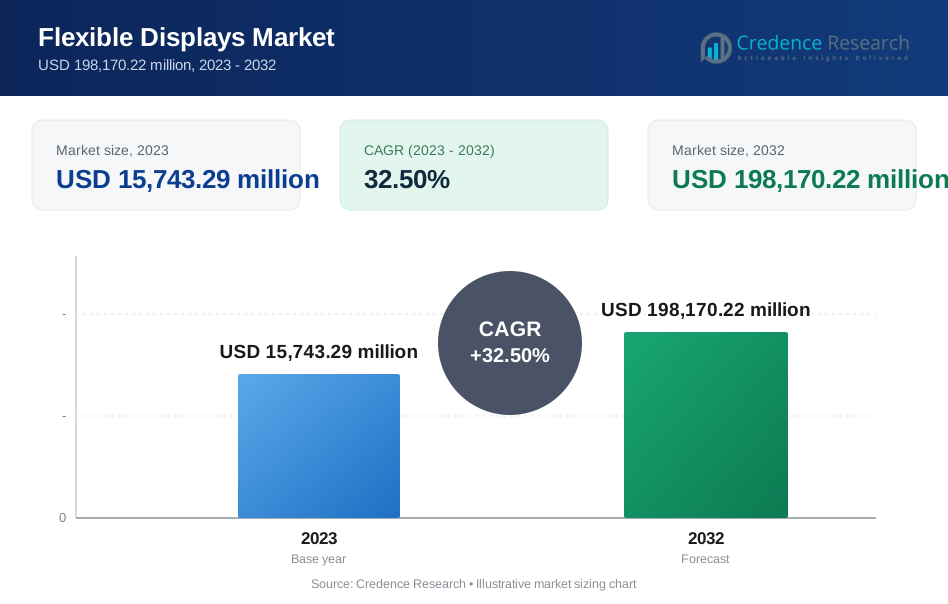
The Flexible Displays Market is projected to grow from USD 15,743.29 million in 2023 to an estimated USD 198,170.22 million by 2032, registering a compound annual growth rate (CAGR) of 32.50% from 2024 to 2032. This robust growth can be attributed to the rising demand for advanced display technologies across consumer electronics, automotive, and healthcare industries.
Key market drivers include the increasing consumer preference for foldable and flexible screens in smartphones and tablets, offering superior user experiences with enhanced viewing angles and portability. Additionally, the proliferation of IoT-connected devices and smart homes has driven demand for innovative display solutions, while technological advancements and R&D efforts accelerate the growth of this market. Trends such as growing investments in micro-LED and quantum-dot displays, as well as advancements in manufacturing processes, are creating new opportunities for flexible display adoption across various sectors.
Regionally, Asia-Pacific dominates the flexible displays market due to high demand from major markets such as China, South Korea, and Japan, where leading manufacturers and advanced technology integration prevail. North America follows, driven by strong consumer electronics penetration and innovation. Key players driving the market include Samsung Electronics, LG Display, BOE Technology Group, Royole Corporation, and Visionox, who are focusing on innovation, strategic partnerships, and expansion to maintain competitive edges.
Market Drivers
Increasing Demand for Consumer Electronics with Advanced Displays
The surge in demand for high-end consumer electronics, such as smartphones, tablets, smartwatches, and other wearable devices, has been a significant driver for the flexible displays market. For instance, Samsung reported shipping over 10 million foldable smartphones globally in 2022, representing a 300% increase from 2021. Modern consumers seek enhanced viewing experiences, portability, and multifunctional devices. Flexible displays meet these demands by providing lightweight, durable, and adaptable screen solutions capable of bending, folding, or even rolling. The rapid adoption of foldable smartphones, with major players such as Samsung, Huawei, and Motorola launching models with flexible displays, exemplifies how technological innovation and evolving consumer preferences are shaping market growth. With improved designs and declining production costs, more companies are entering the flexible display sector, further driving consumer awareness and adoption.
Technological Advancements and R&D Investments
Continuous advancements in display technologies, including Organic Light-Emitting Diodes (OLEDs), Active-Matrix Organic Light-Emitting Diodes (AMOLEDs), micro-LEDs, and quantum-dot displays, have been key drivers of the flexible displays market. OLED and AMOLED displays, in particular, offer superior image quality, vibrant colors, low power consumption, and flexibility that traditional display technologies cannot match. Companies are heavily investing in research and development to enhance these technologies, focusing on improving manufacturing efficiency, extending product lifespan, and reducing costs. For example, advancements in encapsulation technologies for flexible displays are enhancing their durability and performance, making them suitable for a wide range of applications in automotive, healthcare, and industrial sectors. This innovation-driven landscape continues to propel market expansion, as new breakthroughs lead to further adoption across industries.
Rising Adoption in Automotive and Industrial Applications
Flexible displays are increasingly gaining traction in automotive and industrial applications, driven by the need for smart, connected, and visually appealing interfaces. In the automotive sector, flexible displays are being incorporated into dashboard systems, infotainment displays, and control panels to provide drivers with intuitive, interactive, and multifunctional user interfaces. Automotive manufacturers prioritize enhanced user experience and connectivity, making flexible displays a compelling option. Similarly, in industrial settings, the demand for rugged, adaptable displays has grown due to their superior performance, resilience in harsh environments, and capability to deliver high-quality visuals. As industries continue to move towards smart solutions and automation, flexible displays are becoming integral to various systems, fostering their market penetration.
Growing Penetration of IoT Devices and Smart Home Ecosystems
The proliferation of Internet of Things (IoT) devices and the rapid expansion of smart home ecosystems have accelerated the adoption of flexible displays. These displays offer distinct advantages in creating innovative form factors, allowing for curved and flexible designs that blend seamlessly into different environments. Flexible display panels are being integrated into smart home hubs, digital signage, smart mirrors, and even foldable or rollable televisions, providing both aesthetic and functional benefits. As consumer lifestyles evolve with increasing connectivity needs, flexible displays help create more immersive and adaptable user experiences, supporting next-generation device designs. The increasing use of IoT and connected devices further strengthens demand, as flexible displays can fit unique form factors and design constraints that are difficult to address with conventional displays. This widespread adoption is further fueled by rising consumer awareness, technological improvements, and cost reductions, positioning flexible displays as a transformative component in modern electronic devices and applications.
Market Trends
Increased Adoption of Foldable and Rollable Devices
One of the most prominent trends in the flexible displays market is the surge in adoption of foldable and rollable devices, particularly in the consumer electronics segment. Major technology brands, including Samsung, Huawei, and Lenovo, are continuously launching foldable smartphones, tablets, and laptops, providing consumers with versatile and multi-functional devices.Samsung's latest foldable smartphone model can be folded over 200,000 times without compromising display quality or device functionality. These devices leverage flexible OLED and AMOLED display technologies, which offer high durability, vibrant visuals, and the ability to bend or roll without compromising performance. Rollable displays, seen in concept TVs and prototype devices, demonstrate the market's push toward compact and innovative designs.This trend highlights consumer demand for enhanced portability and user experience, driving manufacturers to prioritize display innovation. As competition intensifies and costs decrease, more affordable foldable and rollable devices are expected to reach the market, further driving their mainstream adoption.
Growing Integration of Flexible Displays in Emerging Applications
Beyond consumer electronics, flexible displays are rapidly penetrating various emerging applications, such as automotive displays, wearable devices, smart home systems, and healthcare solutions. In the automotive sector, some vehicles are now equipped with flexible OLED dashboards that offer customizable interfaces, enhancing both driver experience and vehicle aesthetics. Automotive manufacturers are increasingly incorporating flexible displays into curved dashboards, infotainment systems, and heads-up displays to offer an immersive, customizable user interface.In the healthcare industry, wearable medical devices are utilizing flexible displays to provide real-time health data in a comfortable and durable format. These flexible screens are being integrated into health monitoring devices, enhancing patient comfort and data accuracy. Similarly, flexible screens are becoming integral components of smart home devices, such as smart mirrors and smart displays, providing aesthetic appeal, space-saving designs, and superior functionality.This broadening scope of applications demonstrates the versatility of flexible displays and their potential to reshape the way technology is integrated into daily life across different sectors. As flexible displays continue to evolve, manufacturers are investing in research and development to improve durability, resolution, and cost efficiency, driving further innovation in this dynamic market.
Market Restraints and Challenges
High Manufacturing Costs and Complex Production Processes
One of the major challenges hindering the widespread adoption of flexible displays is their high manufacturing costs and complex production processes. Compared to traditional displays, flexible displays require sophisticated materials and advanced fabrication technologies, such as flexible substrates, encapsulation techniques, and high-precision machinery for bending and folding capabilities. This complexity not only drives up production costs but also poses challenges in achieving consistent quality and yield rates at scale. As a result, the high initial costs of flexible display devices, such as foldable smartphones, may limit their accessibility to a broad consumer base, making price reduction a critical goal for manufacturers. Moreover, integrating flexible displays into different form factors without compromising performance, durability, and user experience adds further layers of production difficulty. Industry players are continuously investing in research and development to streamline production and reduce costs, but overcoming these challenges remains an ongoing endeavor.
Durability Concerns and Limited Lifespan
While flexible displays offer unique advantages in terms of form factor and adaptability, concerns about their durability and lifespan pose a restraint to market growth. Flexible displays, particularly those using OLED or AMOLED technology, are prone to issues such as pixel degradation, color shifting, and vulnerability to mechanical stress caused by repeated folding or bending. Additionally, the protective coatings used on flexible displays may not offer the same level of scratch and impact resistance as conventional glass displays, making them susceptible to wear and damage over time. Consumer concerns about the long-term reliability of flexible devices can deter adoption, especially for products intended for daily use. Manufacturers are actively working on developing more robust encapsulation and protective technologies to improve display resilience. However, addressing these durability challenges is critical for building consumer confidence and unlocking the full potential of flexible displays across diverse applications.
Market Segmentation Analysis
By type
Flexible displays are categorized by type, including LCD (Liquid Crystal Display), which, while offering cost-effective and energy-efficient solutions, typically exhibits lower flexibility compared to OLEDs. OLED (Organic Light-Emitting Diode) technology dominates the market due to its superior flexibility, lightweight nature, vibrant colors, and high contrast ratios, driving demand in foldable smartphones, wearables, and automotive displays. EPD (Electronic Paper Display) is primarily used in e-readers and low-power applications, offering paper-like readability and energy efficiency, albeit with a smaller market presence. The "Others" category encompasses emerging technologies like micro-LEDs and quantum-dot displays, known for their advanced capabilities and high flexibility, fostering innovation across various applications.
By Application
Flexible displays are widely used across multiple applications, with the smartphone segment leading due to the popularity of foldable and curved screens that enhance user experiences and drive innovation in form factors. Smartwatches leverage flexible displays for sleeker, ergonomic designs that meet consumer demand for compact and durable wearables. Beyond smartwatches, flexible displays are used in other wearable devices, including fitness bands and medical devices, offering improved performance, comfort, and adaptable form factors. In the TV and monitor market, flexible displays are gaining traction through rollable and curved screen technologies, enhancing aesthetic appeal and viewing experiences. Additionally, flexible displays find integration in automotive displays, smart home devices, digital signage, and industrial interfaces, broadening their application scope and impact.
Segments
Based on Type
- LCD (Liquid Crystal Display)
- OLED (Organic Light-Emitting Diode)
- EPD (Electronic Paper Display)
- Others
Based on Application
- Smartphone
- Smartwatch
- Wearable Devices
- TVs and Monitors
- Others
Based on Panel Size
- Up to 6”
- 6-20”
- 20-50”
- Above 50”
Based on Material
- Glass
- Plastic
- Metal
Based on Region
- North America
- U.S.
- Canada
- Mexico
- Europe
- Germany
- France
- U.K.
- Italy
- Spain
- Rest of Europe
- Asia Pacific
- China
- Japan
- India
- South Korea
- South-east Asia
- Rest of Asia Pacific
- Latin America
- Brazil
- Argentina
- Rest of Latin America
- Middle East & Africa
- GCC Countries
- South Africa
- Rest of the Middle East and Africa
Regional Analysis
Asia-Pacific (40%):
Asia-Pacific dominates the flexible displays market, holding the largest market share at approximately 40%. This region’s leadership is driven by strong demand from countries like China, South Korea, and Japan, which serve as major hubs for display technology manufacturing and innovation. APAC is home to leading players such as Samsung Display, LG Display, and BOE Technology Group, who continue to invest in research and development, fostering advancements in flexible OLEDs, AMOLEDs, and next-generation display technologies. Consumer electronics demand, including smartphones, wearables, and foldable devices, is particularly strong, creating a fertile ground for flexible display adoption. Moreover, government initiatives supporting technology and innovation further strengthen the region’s position as a market leader.
North America (25%):
North America accounts for roughly 25% of the global flexible displays market share. The region's growth is primarily fueled by a high penetration of advanced consumer electronics, including smartphones, smartwatches, and tablets, which increasingly feature flexible display technologies. The United States, in particular, leads the regional market due to significant investments in research and development, technological advancements, and consumer demand for high-performance devices. Moreover, the automotive industry’s integration of flexible displays for infotainment and instrument clusters supports growth in this market. North America's strong focus on innovation and its vibrant tech ecosystem enable a continuous influx of advanced, consumer-centric display technologies.
Key players
- BOE Technology Group Co., Ltd.
- Corning Incorporated
- Innolux Corporation
- AUO Corporation
- Japan Display Inc
- LG Display Co., Ltd.
- Royole Corporation
- Samsung Electronics Co., Ltd.
- Sharp Corporation
- Visionox Company
Competitive Analysis
The flexible displays market is highly competitive, driven by innovation and rapid technological advancements. Leading players, including Samsung Electronics, BOE Technology Group, and LG Display, dominate with significant investments in research and development, focusing on OLED, AMOLED, and advanced flexible panel technologies. Companies such as Royole Corporation and Visionox have pioneered innovative designs, such as foldable and rollable displays, gaining market visibility. Corning Incorporated stands out with its development of flexible glass solutions, enhancing durability. Competition centers around product differentiation, technological innovation, and cost reduction to capture emerging opportunities across consumer electronics, automotive, and industrial applications. Strategic partnerships, acquisitions, and new product launches remain key strategies employed by market leaders to gain a competitive edge and meet evolving consumer demands for flexible displays.
Recent Developments
- In October 2024, BOE launched its new flexible AMOLED display, branded as Q10 AMOLED. This display enhances peak brightness by 12.5%, improves lifetime by 33%, and reduces power consumption by 10%. It debuted in smartphones like OnePlus 13, OPPO Find X8, and Vivo iQOO 13.
- In September 2023, Corning began mass production of ultra-thin bendable glass at its new facility in South Korea. This glass is used in foldable devices like the Samsung Galaxy Z Flip 5 and is part of a $1.5 billion investment plan over five years.
- In March 2024, Innolux announced plans to start mass production of LCD displays in India within 18-24 months, in collaboration with Vedanta. This venture is expected to cost between $3-4 billion.
- In January 2024, AUO debuted at CES 2024 with its new Micro LED applications for smart mobility, including advanced in-vehicle display solutions and human-machine interaction technologies.
- In January 2024, LG Display unveiled the world’s largest automotive display (57-inch Pillar-to-Pillar LCD) and the largest slidable OLED (32-inch) at CES 2024, showcasing its advancements in automotive display technologies.
- In September 2024, Samsung was reported to be developing a rollable smartphone with a 12.4-inch screen, expected to launch in the second half of 2025.
- In June 2024, Sharp announced it would cease all large-area LCD production by the end of 2024 as part of a shift towards focusing on smaller displays for automotive and VR sectors.
- In September 2024, Visionox produced a rollable AMOLED display for the Hongqi Guoya car, marking the first commercial use of such technology in automotive applications.
Market Concentration and Characteristics
The flexible displays market is characterized by moderate to high market concentration, with a few key players dominating a significant portion of the market share. Companies such as Samsung Electronics, BOE Technology Group, and LG Display lead the market through extensive R&D investments, innovative product offerings, and established supply chains. The market is marked by rapid technological advancements, particularly in OLED and AMOLED technologies, and intense competition to reduce production costs while improving performance and durability. Despite the presence of dominant players, the market remains dynamic, with smaller companies like Royole Corporation and Visionox carving niches through disruptive innovations such as foldable and rollable displays. Strategic collaborations, product diversification, and innovation in material science further define the market's competitive landscape, fostering growth and new application opportunities.
Report Coverage
The research report offers an in-depth analysis based on Type, Application, Panel Size, Material and Region. It details leading market players, providing an overview of their business, product offerings, investments, revenue streams, and key applications. Additionally, the report includes insights into the competitive environment, SWOT analysis, current market trends, as well as the primary drivers and constraints. Furthermore, it discusses various factors that have driven market expansion in recent years. The report also explores market dynamics, regulatory scenarios, and technological advancements that are shaping the industry. It assesses the impact of external factors and global economic changes on market growth. Lastly, it provides strategic recommendations for new entrants and established companies to navigate the complexities of the market.
Future Outlook
- Flexible displays will continue to gain traction in smartphones, tablets, and wearables, with more manufacturers launching foldable and rollable devices to enhance user experience and device versatility.
- Advancements in OLED, AMOLED, and emerging micro-LED technologies will further enhance display performance, reducing production costs and broadening their adoption across diverse applications.
- Automotive manufacturers will increasingly incorporate flexible displays in dashboards, infotainment systems, and control panels, providing customizable, intuitive interfaces to enhance user interaction.
- The healthcare sector will see higher adoption of flexible displays in wearable devices, offering enhanced patient comfort, real-time monitoring, and improved health data accuracy.
- Flexible displays will play a key role in smart home ecosystems, providing innovative, visually appealing, and multifunctional interfaces for devices like smart mirrors, smart hubs, and rollable televisions.
- Industry players will focus on reducing production costs and enhancing manufacturing processes, making flexible displays more accessible to mass markets and driving widespread adoption.
- Efforts to improve the durability and longevity of flexible displays will be critical, with innovations in encapsulation and protective coatings addressing consumer concerns and broadening their use cases.
- Flexible displays are expected to see increased adoption in digital signage and advertising, offering dynamic and visually appealing solutions for interactive and adaptive content displays.
- The development of flexible micro-LED displays will offer high resolution, brightness, and energy efficiency, creating new opportunities in various sectors such as automotive, wearables, and AR/VR devices.
- The market will witness regional expansion, particularly in emerging markets, as new entrants and investments drive innovation and bring cost-effective, advanced flexible display solutions to a broader audience.
Request a Free Sample
Fill in your details and we'll send you a free sample report.
- Sample data tables & charts
- Research methodology
Need a Custom Version of This Report?
Tailor the scope, geography, or segments to your exact requirements.
- Custom geography or segment scope
- Direct access to our analyst team
Frequently Asked Questions
What is the projected market size and growth rate of the flexible displays market?
What factors are driving the growth of the flexible displays market?
How are flexible displays used in consumer electronics?
Which region holds the largest share in the flexible displays market?
What role do technological advancements play in market growth?
Table of Content
Chapter 1. Report Introduction
- 1.1 Report Description & Purpose
- 1.1.1 Report Title & Market Definition
- 1.1.2 Unique Selling Propositions (USP) & Key Differentiators
- 1.1.3 Value Proposition for Stakeholders
- 1.2 Research Objectives
- 1.2.1 Market Sizing Objectives (Volume & Revenue)
- 1.2.2 Segmentation Objectives
- 1.2.3 Competitive Intelligence Objectives
- 1.2.4 Forecast & Scenario Objectives
- 1.3 Report Scope
- 1.3.1 Flexible Displays Scope – Types & Subtypes Covered
- 1.3.2 Geographic Scope – Regions & Countries Covered
- 1.3.3 Historical Period, Base Year & Forecast Period (2023; forecast to 2032)
- 1.3.4 Inclusions & Exclusions
- 1.4 HS Code & Classification Framework
- 1.5 Currency, Units & Pricing Basis
- 1.6 Target Stakeholders
- 1.7 Limitations & Assumptions
Chapter 2. Executive Summary
- 2.1 Global Flexible Displays Market Snapshot
- 2.1.1 Market Size – Historical (2023) & Forecast (2023-2032) (2023: USD 15,743.29 million → 2032: USD 198,170.22 million)
- 2.1.2 Volume & Revenue – Global Totals
- 2.1.3 Key Market Highlights – Top Five Facts
- 2.2 Flexible Displays Market Segmentation Snapshot
- 2.2.1 Market Split by Region – 2023 vs. 2032
- 2.3 Competitive Snapshot
- 2.3.1 Top 10 Players by Revenue Share – 2023
- 2.3.2 Top 10 Players by Volume Share – 2023
- 2.3.3 Recent Strategic Developments (18-Month Summary)
- 2.4 Key Investment Highlights & Strategic Conclusions
Chapter 3. Flexible Displays Market Dynamics & Industry Analysis
- 3.1 Market Overview & Context
- 3.1.1 Flexible Displays Market Position in the Broader Automotive Value Chain
- 3.1.2 OEM vs. Replacement Market Dynamics
- 3.1.3 Market Maturity & Development Stage by Region
- 3.2 Flexible Displays Market Drivers
- 3.3 Flexible Displays Market Restraints & Challenges
- 3.4 Flexible Displays Market Opportunities
- 3.5 Porter's Five Forces Analysis
- 3.5.1 Threat of New Entrants
- 3.5.2 Bargaining Power of Suppliers
- 3.5.3 Bargaining Power of Buyers
- 3.5.4 Threat of Substitutes
- 3.5.5 Competitive Rivalry – Intensity Assessment
- 3.6 Flexible Displays Value Chain Analysis
- 3.6.1 Upstream – Raw Material/Input Suppliers
- 3.6.1.1 Raw Material/Input 1
- 3.6.1.2 Raw Material/Input 2
- 3.6.1.3 Raw Material/Input 3
- 3.6.2 Midstream – Production/Manufacturing/Service Delivery
- 3.6.2.1 Production/Process Overview
- 3.6.2.2 Key Facility Locations & Capacity by Manufacturer
- 3.6.3 Downstream – Distribution & End Consumer
- 3.6.3.1 Primary Channel – B2B/OEM
- 3.6.3.2 Secondary Channels – Dealer, Retail, Online, Direct
- 3.6.4 Value Chain Profitability Analysis
- 3.6.1 Upstream – Raw Material/Input Suppliers
- 3.7 PESTEL Analysis
- 3.7.1 Political Factors
- 3.7.2 Economic Factors
- 3.7.3 Social Factors
- 3.7.4 Technological Factors
- 3.7.5 Environmental Factors
- 3.7.6 Legal Factors
- 3.8 Flexible Displays Supply Chain Analysis
- 3.8.1 Raw Material/Input Supply Risk Assessment
- 3.8.2 Manufacturing Concentration Risk (Geographic Exposure)
- 3.8.3 Trade Disruption Impact Analysis
- 3.9 Regulatory & Policy Landscape
Note: The regulatory and policy landscape section covers regulations based on their applicability to the market, Flexible Displays category, geography, and scope of the study. Only regulatory frameworks with a material impact on operations, compliance, trade, sustainability, or market access are analyzed in detail.
Chapter 4. Key Investment Pockets & Opportunity Analysis
- 4.1 Flexible Displays Market Attractiveness Analysis
- 4.1.1 By Region – Investment Attractiveness Matrix (Volume × CAGR)
- 4.2 Absolute Revenue Growth Opportunity
- 4.2.1 By Region – Absolute USD Growth Through 2032
- 4.3 Incremental Volume Opportunity
- 4.3.1 By Region – Incremental Volume Through 2032
- 4.3.2 Segment – Incremental Volume
- 4.4 Emerging Submarket Opportunity Deep Dive (Subject to Applicability)
- 4.5 Emerging Market Opportunity Scorecards
- 4.5.1 United States
- 4.5.2 Europe
- 4.5.3 Asia
- 4.5.4 Middle East & Africa
Note: Emerging Market Opportunity Scorecards will be included based on relevance and strategic importance. Regions listed are indicative and may vary depending on data availability and market dynamics.
Chapter 5. Flexible Displays Import-Export Analysis & Trade Flows
- 5.1 Global Trade Overview
- 5.1.1 Global Export Value by Country (2023)
- 5.1.2 Global Export Volume by Country (2023)
- 5.1.3 Global Import Value by Country (2023)
- 5.1.4 Global Import Volume by Country (2023)
- 5.1.5 Net Trade Balance by Country (2023)
- 5.2 Export Analysis – Segment
- 5.2.1 Type 1 (HS Code)
- 5.2.2 Type 2 (HS Code)
- 5.2.3 Type 3 (HS Code)
- 5.2.4 Type 4 (HS Code)
- 5.2.5 Type 5 (HS Code)
- 5.3 Import Analysis – Segment
- 5.3.1 Type 1 (HS Code)
- 5.3.2 Type 2 (HS Code)
- 5.3.3 Type 3 (HS Code)
- 5.3.4 Type 4 (HS Code)
- 5.3.5 Type 5 (HS Code)
- 5.4 Average Unit Trade Prices
- 5.4.1 Average Export Price – Segment & Country
- 5.4.2 Average Import Price – Segment & Source Country
- 5.4.3 Price Trends (2023)
- 5.5 Key Trade Route Analysis
- 5.5.1 Trade Route 1
- 5.5.2 Trade Route 2
- 5.5.3 Trade Route 3
- 5.5.4 Trade Route 4
- 5.5.5 Trade Route 5
- 5.6 Trade Policy Impact Assessment
- 5.6.1 US Anti-Dumping & Section 301 Tariffs
- 5.6.2 EU Customs Union Impact
- 5.6.3 Major Free Trade Agreements
- 5.6.4 USMCA Rules of Origin
Note: Trade policy analysis will be included only where relevant to the Flexible Displays market.
Chapter 6. Competitive Landscape & Company Benchmarking
- 6.1 Flexible Displays Market Concentration & Structure
- 6.1.1 Herfindahl-Hirschman Index (HHI) – vs. 2023
- 6.1.2 Tier 1, Tier 2 & Tier 3 Market Structure
- 6.1.3 Global, Regional & Local Player Dynamics
- 6.2 Flexible Displays Market Share Analysis – 2023
- 6.2.1 Global Revenue Share by Company
- 6.2.2 Global Volume Share by Company
- 6.2.3 Regional Revenue Share
- 6.2.4 Market Share Evolution ( vs. 2023)
- 6.2.5 OEM Segment Share by Company
- 6.2.6 Replacement Segment Share by Company
- 6.3 Production/Delivery Capacity & Facility Analysis
- 6.3.1 Global Installed Capacity
- 6.3.2 Capacity Utilization Rates
- 6.3.3 Production/Output Volume
- 6.3.4 Facility Locations & Capacity Map
- 6.3.5 Planned Capacity Additions
- 6.4 Flexible Displays Competitive Benchmarking Matrix
- 6.4.1 Revenue, Volume, CAGR & Profitability Comparison
- 6.4.2 Channel Revenue Mix
- 6.4.3 Geographic Revenue Exposure
- 6.4.4 R&D Intensity
- 6.4.5 Sustainability Maturity
- 6.5 Strategic Developments in Flexible Displays (Last 24 Months)
- 6.5.1 Mergers, Acquisitions & Divestments
- 6.5.2 New Flexible Displays Launches
- 6.5.3 Facility Expansions
- 6.5.4 Strategic Alliances, Joint Ventures & Partnerships
- 6.5.5 Distribution Expansion & Market Entry
- 6.5.6 Sustainability & ESG Initiatives
- 6.6 Competitive Strategy Mapping
- 6.6.1 Leader, Challenger, Follower & Niche Classification
- 6.6.2 Pricing Strategy Comparison
- 6.6.3 Channel Strategy Matrix
Note: Strategic developments are included based on their materiality and the availability of reliable information.
Chapter 7. Global Flexible Displays Market – By Distribution Channel
- 7.1 Segment Overview
- 7.1.1 Volume & Revenue Split by Channel (2023 & 2032)
- 7.1.2 Channel Mix Evolution (2023-2032)
Chapter 8. Regional Market Analysis – Global Overview
- 8.1 Global Regional Overview
- 8.1.1 Regional Volume Share
- 8.1.2 Regional Revenue Share
- 8.1.3 Regional Volume by Region
- 8.1.4 Regional Revenue by Region
- 8.1.5 Regional Forecast Through 2032
- 8.2 Cross-Regional Segment Analysis
- 8.2.1 By Distribution Channel
- 8.2.2 By Brand/Price Tier
Chapter 9. North America Flexible Displays Market
- 9.1 United States
- 9.2 Canada
- 9.3 Mexico
Chapter 10. Europe Flexible Displays Market
- 10.1 Germany
- 10.2 France
- 10.3 Italy
- 10.4 United Kingdom
- 10.5 Spain
- 10.6 Poland
- 10.7 Russia
- 10.8 Netherlands
- 10.9 Belgium
- 10.10 Sweden
- 10.11 Denmark
- 10.12 Norway
- 10.13 Rest of Europe
Chapter 11. Asia Pacific Flexible Displays Market
- 11.1 China
- 11.2 India
- 11.3 Japan
- 11.4 South Korea
- 11.5 Thailand
- 11.6 Indonesia
- 11.7 Vietnam
- 11.8 Malaysia
- 11.9 Australia
- 11.10 Rest of Asia Pacific
Chapter 12. Latin America Flexible Displays Market
- 12.1 Brazil
- 12.2 Argentina
- 12.3 Colombia
- 12.4 Chile
- 12.5 Rest of Latin America
Chapter 13. Middle East Flexible Displays Market
- 13.1 Saudi Arabia
- 13.2 United Arab Emirates
- 13.3 Turkey
- 13.4 Israel
- 13.5 Iran
- 13.6 Rest of the Middle East
Chapter 14. Africa Flexible Displays Market
- 14.1 South Africa
- 14.2 Egypt
- 14.3 Nigeria
- 14.4 Morocco
- 14.5 Rest of Africa
Chapter 15. Flexible Displays Company Profiles
- 15.1 [Company 01]
- 15.1.1 Company Overview
- 15.1.2 Key Management Personnel
- 15.1.3 Products & Services Portfolio
- 15.1.4 Financial Performance
- 15.1.5 Key Market Focus & Geographic Presence
- 15.1.6 Recent Developments & Strategic Initiatives
Note: The company profile list is preliminary and may change based on research findings, market developments, data availability, and client requirements.
Chapter 16. Appendices
- Appendix A – List of Abbreviations & Acronyms
- Appendix B – Industry Classification Code Reference – Full Series
- Appendix C – Production & Capacity Data Tables
- Appendix D – End-Use & Demand Base Tables
- Appendix E – Consumption & Replacement Rate Assumptions
- Appendix F – ASP Reference Tables
- Appendix G – Manufacturing & Facility Database
- Appendix H – Import-Export Data Tables
- Appendix I – Regulatory Summary Tables
- Appendix J – Primary Research Participant List (Anonymized)
- Appendix K – Primary Research Questionnaire Framework
- Appendix L – Data Sources & Bibliography
- Appendix M – Market Size Divergence & Source Comparison
Chapter 17. Research Methodology
- 17.1 Research Framework & Philosophy
- 17.2 Secondary Research – Sources, Hierarchy & Data Extraction
- 17.3 Data Modeling – Bottom-Up & Top-Down Market Sizing
- 17.4 Primary Research – Stakeholder Framework, LOI & Sample Sizes
- 17.5 Forecast Methodology – Regression, Scenario & Sensitivity Analysis
- 17.6 Quality Control – Four-Layer Validation Framework
- 17.7 Limitations & Standard Assumptions
- 17.8 Disclaimer
