
| REPORT ATTRIBUTE | DETAILS |
|---|---|
| Historical Period | 2019-2022 |
| Base Year | 2023 |
| Forecast Period | 2024-2032 |
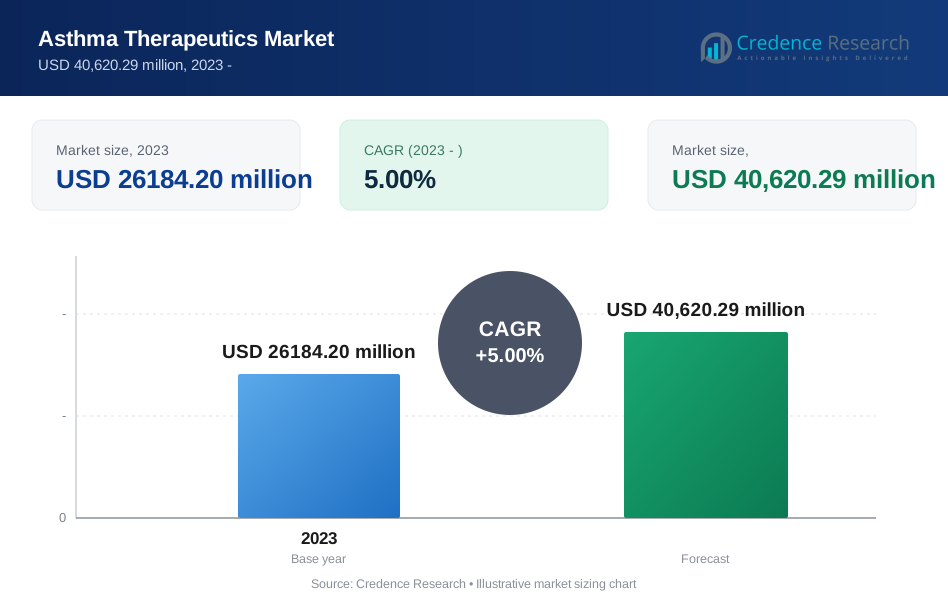
| Asthma Therapeutics Market Size 2023 | USD 26184.20 million |
| Asthma Therapeutics Market, CAGR | 5.00% |
| Asthma Therapeutics Market Size 2032 | USD 40620.29 million |
Market Insights
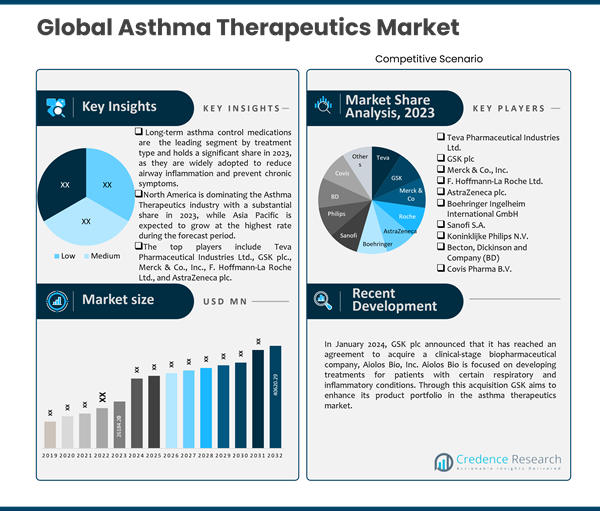
- The global demand for Asthma Therapeutics was valued at USD 26184.20 million in 2023 and is expected to reach USD 40620.29 million in 2032, growing at a CAGR of 5.00% between 2024 and 2032.
- The Inhaled Corticosteroids (ICS) segment was the market leader by Drug Class, accounting for the highest share in value in 2023, and the Combination Therapies (ICS/LABAs) segment is expected to grow rapidly throughout the forecast period.
- The Long-Term Asthma Control Medications segment was the market leader by Treatment Type, accounting for the highest share in value in 2023, and the Quick-Relief (Rescue) Medications segment is expected to grow rapidly throughout the forecast period.
- The Oral medications segment was the market leader by Route of Administration, accounting for the highest share in value in 2023, and the Injectables segment is expected to grow rapidly throughout the forecast period.
- The E-Commerce segment is predicted to grow fastest over the projection period, while Hospital Pharmacies had the largest share by Distribution Channel in 2023.
- North America is dominating the asthma therapeutics industry, with over one-third of the market in 2023.
- The market’s primary possibilities include the development of novel biologics, advancements in personalized medicine, increasing adoption of digital inhalers and smart devices, expansion of telehealth services for remote patient monitoring, and ongoing research and development activities aimed at improving drug efficacy and reducing side effects.
Executive Summary
Market Definition
Asthma therapeutics encompass a range of medications and treatment approaches aimed at managing and alleviating the symptoms of asthma, a chronic respiratory condition characterized by inflammation and narrowing of the airways. These therapeutics include inhaled corticosteroids (ICS), which reduce inflammation and prevent asthma attacks, and combination therapies (ICS/LABAs), which combine corticosteroids with long-acting beta-agonists to provide both anti-inflammatory and bronchodilator effects. Other treatments include leukotriene modifiers, mast cell stabilizers, and monoclonal antibodies targeting specific inflammatory pathways.
Asthma therapeutics work by relaxing the muscles around the airways, reducing inflammation, and preventing mucus buildup, which helps improve airflow and breathing. The advantages of asthma therapeutics include improved lung function, reduced frequency and severity of asthma attacks, enhanced quality of life for patients, and decreased need for emergency medical interventions.
Market Overview
The global asthma therapeutics market has witnessed steady growth in recent years and is expected to grow at a CAGR of 5.00% between 2024 and 2032. The market was valued at USD 26184.20 million in 2023 and is expected to reach USD 40620.29 million in 2032.
The increasing prevalence of asthma due to factors such as Urbanization, pollution, and changes in lifestyle necessitates the development and distribution of effective treatments, driving the growth of the asthma therapeutics market. Advancements in drug development are introducing novel therapies, including biologics and targeted treatments, which offer more personalized and effective options for patients. These innovations are crucial in addressing the diverse needs of the growing asthma patient population.
Moreover, heightened awareness and improved diagnostic tools are leading to earlier and more accurate diagnoses of asthma. This has expanded the patient pool seeking treatment and has driven the demand for advanced therapeutics. Additionally, the global aging population, which is more prone to respiratory conditions, is contributing to the rising demand for asthma therapeutics.
Government and healthcare initiatives also play a significant role in the market's expansion. Supportive policies, funding for research, and public health campaigns aimed at asthma control are increasing the availability and accessibility of asthma treatments. Furthermore, the emergence of combination therapies, which offer enhanced efficacy and convenience, is gaining traction in the market. These therapies are preferred by both patients and healthcare providers for their improved outcomes and ease of use.
Segmentation by Drug Class
- Inhaled Corticosteroids (ICS) are the leading segment by Drug Class and held the dominant share in value in 2023. ICS are widely prescribed due to their effectiveness in controlling and preventing asthma symptoms by reducing inflammation in the airways. Their long-standing use, proven efficacy, and role as a first-line treatment in asthma management contribute to their leading market share.
- The Combination Therapies (ICS/LABAs) segment is expected to exhibit the highest CAGR during the forecast period. The growth is driven by the enhanced therapeutic benefits of combining inhaled corticosteroids with long-acting beta-agonists (LABAs). These combination therapies improve symptom control and reduce the frequency of exacerbations, making them increasingly popular among patients and healthcare providers. Advances in inhaler technology and the development of new combination products further propel the growth of this segment.
- Long-acting beta agonists (LABAs), short-acting beta-agonists (SABAs), oral and intravenous corticosteroids, leukotriene modifiers other drug classes also contribute substantially to the market share.
Segmentation by Treatment Type
- Long-Term Asthma Control Medications is the leading segment by Treatment Type and holds a substantial share in 2023. These medications, including inhaled corticosteroids (ICS), long-acting beta agonists (LABAs), and combination therapies, are essential for the ongoing management of asthma. Their consistent use in preventing asthma symptoms and reducing the frequency and severity of exacerbations makes them the dominant segment.
- Quick-Relief (Rescue) Medications is the fastest-growing segment during the forecast period. The increasing incidence of asthma and the need for immediate relief during acute asthma attacks drive the demand for quick-relief medications, such as short-acting beta agonists (SABAs). Innovations in rescue inhalers and the introduction of new, more effective quick-relief options contribute to the rapid growth of this subsegment.
Segmentation by Route of Administration
- Oral medication is the leading segment by Route of Administration and holds a substantial share in 2023. Oral medications in asthma treatment primarily include oral corticosteroids and leukotriene modifiers. They are widely used for the long-term management of asthma, particularly in cases where inhaled treatments may not provide sufficient control or during exacerbations requiring systemic therapy.
- Injectables is the fastest-growing segment during the forecast period. Injectable medications in asthma therapy include biologics and systemic corticosteroids administered via injection or infusion. The growth in this segment is driven by the development of new biologic therapies targeting specific pathways in asthma pathogenesis, as well as the efficacy of systemic corticosteroids in severe asthma cases that are refractory to other treatments.
- The topical route of administration also contributes substantially to the market share.
Segmentation by Distribution Channel
- The Hospital Pharmacies held the largest market share by Distribution Channel in terms of value in 2023. Hospital pharmacies are a key distribution channel for asthma medications, especially for patients requiring immediate care or those hospitalized for severe asthma exacerbations. The direct availability of a wide range of asthma therapeutics and the trust associated with hospital pharmacies contribute to their dominant market share.
- E-commerce is expected to be the fastest-growing segment during the forecasted period. The convenience of online purchasing, the increasing use of digital health platforms, and the rising preference for home delivery of medications are driving the growth of the e-commerce channel. Additionally, the COVID-19 pandemic has accelerated the adoption of online pharmacies, further boosting this subsegment's growth.
- Brick and Mortar segment also contributes substantially to the market share.
Segmentation by End-Use
- The Hospitals & Clinics held the largest market share by End-Use in terms of value in 2023. These settings are primary points of care for asthma patients, providing comprehensive treatment, including emergency care, routine management, and follow-up consultations. The extensive use of asthma therapeutics in managing both acute and chronic cases in hospitals and clinics contributes to their dominant market share.
- Homecare Settings is expected to be the fastest-growing segment during the forecasted period. The growing trend towards home-based care, advancements in portable and user-friendly inhaler devices, and the increasing preference for managing chronic conditions at home drive the growth of this subsegment. The COVID-19 pandemic has also accelerated the shift towards homecare settings, further boosting this subsegment's growth.
- Ambulatory Surgical Centers contribute substantially to the market share.
Segmentation by Region
- North America holds the dominant share of the asthma therapeutics market, driven by advanced healthcare infrastructure, high prevalence of asthma, and robust research and development activities
- The Asia Pacific region is anticipated to be the fastest-growing market for asthma therapeutics during the forecast period, driven by the increasing prevalence of asthma, rising awareness, improving healthcare infrastructure, and a large aging population susceptible to respiratory conditions.
- The rest of the world, including Latin America, the Middle East, and Africa, supplies the remaining demand for retail inventory management software.
North America holds the dominant share of the asthma therapeutics market and is expected to maintain its dominance during the forecast period. This dominance is attributed to a well-established healthcare infrastructure. The region boasts a comprehensive network of healthcare facilities equipped with advanced medical technologies and highly trained healthcare professionals, ensuring timely and effective diagnosis and treatment of asthma. This robust infrastructure supports extensive research and development activities, facilitating the introduction of innovative therapeutics. Additionally, the widespread availability of specialized asthma care centers and the implementation of structured asthma management programs further enhance the accessibility and quality of care for patients, reinforcing North America's leading position in the asthma therapeutics market.
On the other hand, the Asia Pacific region is anticipated to be the fastest-growing market for asthma therapeutics during the forecast period. This rapid growth can be attributed to the increasing prevalence of asthma and improving healthcare infrastructure in emerging economies. The region's large and aging population is more susceptible to respiratory conditions, thereby increasing the demand for effective asthma therapeutics.
Key Highlights of the Report
The Global Asthma Therapeutics Market is segmented by Drug Class, Treatment Type, Route of Administration, Distribution Channel, End-Use, and region. The Inhaled Corticosteroids (ICS) segment dominated the market in 2023, holding the largest value share. However, Combination Therapies (ICS/LABAs) are expected to see the fastest growth, and Hospital Pharmacies remain the primary Distribution Channel, with North America leading the market share.
The increasing prevalence of asthma due to urbanization, pollution, and lifestyle changes drives the growth of the asthma therapeutics market. Additionally, the aging population, prone to respiratory conditions, boosts demand. Government initiatives, supportive policies, and public health campaigns enhance treatment accessibility. Moreover, improved awareness and diagnostic tools lead to earlier and more accurate diagnoses, expanding the patient pool and demand for advanced therapeutics.
Nonetheless, while North America led growth in the Asthma Therapeutics industry in 2023, driven by a well-established healthcare infrastructure and a comprehensive network of healthcare facilities equipped with advanced medical technologies. Additionally, the widespread availability of specialized asthma care centers and the implementation of structured asthma management programs further fuel market expansion in the region, Asia Pacific is set for the highest forecasted growth, driven by the increasing prevalence of asthma and improving healthcare infrastructure in emerging economies.
What Are The Main Drivers Of The Global Asthma Therapeutics Market?
The increasing prevalence of asthma due to urbanization, pollution, and lifestyle changes drives the growth of the asthma therapeutics market. Additionally, the aging population, prone to respiratory conditions, boosts demand. Government initiatives, supportive policies, and public health campaigns enhance treatment accessibility. Moreover, improved awareness and diagnostic tools lead to earlier and more accurate diagnoses, expanding the patient pool and demand for advanced therapeutics.
What are The Major Challenges Faced By The Global Asthma Therapeutics Market?
The high cost of advanced asthma therapies, such as biologics and targeted treatments, significantly restrains market growth. These treatments are often prohibitively expensive, limiting access for patients, especially in low and middle-income countries. Additionally, the availability of affordable generic versions further reduces the market share for branded drugs. While generics increase accessibility, they limit revenue growth for pharmaceutical companies, discouraging investment in innovative therapies.
What Are The Growth Opportunities In The Global Asthma Therapeutics Market?
Technological advancements, including smart inhalers and personalized medicine, present compelling opportunities for the asthma therapeutics market. These innovations have the potential to significantly improve patient care, drive treatment adherence, and pave the way for more effective and tailored asthma therapies, thereby fueling future growth and innovation in the market.
Market Drivers
Growing Incidence of Asthma Due to Increasing Urbanization and Pollution
The increasing prevalence of asthma is a significant factor driving the growth of the asthma therapeutics market. According to the Centers for Disease Control and Prevention (CDC), there are about 25 million asthma cases in the United States alone. Factors such as urbanization, pollution, and lifestyle changes are contributing to a rise in asthma cases, which necessitates the development and distribution of effective treatments. Currently, over 50% of the global population lives in urban areas, and this figure is projected by the World Bank to increase by 1.5 times to 6 billion by 2045. Urbanization increases the chances of acquiring asthma due to higher exposure to pollutants and allergens common in densely populated environments.
Moreover, the World Health Organization (WHO) reports that almost the entire global population (99%) breathes air that exceeds WHO air quality limits, posing severe health threats. Despite a record number of over 6000 cities in 117 countries monitoring air quality, residents are still exposed to unhealthy levels of fine particulate matter and nitrogen dioxide. People in low and middle-income countries suffer the highest exposures. Air pollution is a major risk factor for developing asthma and can worsen symptoms in those already affected, underscoring the urgent need for advanced asthma therapeutics to address this growing health challenge.
Market Restraints
High Cost of Treatment and Availability of Generic Drugs
The high cost of treatment is a significant factor restraining the growth of the asthma therapeutics market. Advanced asthma therapies, particularly biologics and targeted treatments, are often expensive. These high costs can limit patient access, especially in low and middle-income countries where healthcare budgets are constrained and patients may not afford the most effective treatments. Consequently, many patients in these regions may have to rely on older, less expensive, and potentially less effective medications, hindering the widespread adoption of advanced therapies.
Moreover, the availability of generic versions of asthma medications poses another challenge. Generics are more affordable, making them a preferred choice for both patients and healthcare providers, especially in cost-sensitive markets. While this increases accessibility to essential medications, it can reduce the market share for branded drugs. The lower revenue potential from generic competition can disincentivize pharmaceutical companies from investing heavily in the research and development of innovative therapies, further constraining the market growth for advanced asthma treatments.
Opportunities
Advancements in Technology
Technological advancements represent a pivotal opportunity for the future growth of the asthma therapeutics market. Innovations in drug delivery systems, particularly smart inhalers, are poised to revolutionize asthma management. Smart inhalers provide real-time monitoring of medication usage and offer personalized feedback to patients, promoting better treatment adherence and more effective disease management. This also reduces healthcare costs associated with poorly controlled asthma.
Furthermore, advances in genomics and biotechnology hold immense opportunities for personalized asthma treatments. By tailoring therapies to individual genetic profiles, healthcare providers can optimize treatment efficacy while minimizing adverse effects. Personalized medicine approaches in asthma care have the potential to transform the treatment landscape, offering more targeted and precise interventions tailored to each patient's unique genetic makeup. This opens up new avenues for innovation and market expansion in the realm of asthma therapeutics.
Competitive Landscape
Key Players
The global asthma therapeutics market is highly competitive, with several key players. Some of the major players in the market:
- Teva Pharmaceutical Industries Ltd.
- GSK plc
- Merck & Co., Inc.
- F. Hoffmann-La Roche Ltd.
- AstraZeneca plc
- Boehringer Ingelheim International GmbH
- Sanofi S.A.
- Koninklijke Philips N.V.
- Becton, Dickinson and Company (BD)
- Covis Pharma B.V.
These organizations prioritize business expansions, partnerships, and collaborations to stay competitive.
The key players in the global asthma therapeutics market continually seek to stay ahead through acquisitions and partnerships.
In January 2024, GSK plc announced the acquisition of Aiolos Bio, Inc., a clinical-stage biopharmaceutical company. Aiolos Bio is focused on developing treatments for patients with certain respiratory and inflammatory conditions. Through this acquisition, GSK aims to enhance its product portfolio in the asthma therapeutics market.
In March 2023, Teva Pharmaceuticals partnered with Rimidi to launch a respiratory patient monitoring program at Desert Oasis Healthcare in California, utilizing data from Teva's Digihaler System. This smart inhaler system provides objective data to enhance asthma management.
In January 2023, AstraZeneca’s Tezspire received approval for Medicinal Products for Human Use (CHMP) by the European Medicine Agency’s Committee. This development allows for its use in a convenient pre-filled, single-use pen for self-administration by patients aged 12 years and older who are dealing with severe asthma.
How are Companies Performing in the Asthma Therapeutics Market?
The global asthma therapeutics market is highly competitive, with several key players.
Startups are actively contributing to the asthma therapeutics industry by introducing novel approaches and technologies to address the challenges faced by patients and healthcare providers. These startups bring fresh perspectives and innovative solutions to the table, driving growth and advancement in the field.
The development of digital health platforms tailored specifically for asthma management is contributing to the industry significantly. For example, Propeller Health develops platforms that often leverage mobile apps and connected devices to track medication adherence, monitor symptoms, and provide personalized insights to patients and healthcare professionals. By harnessing the power of data analytics and real-time monitoring, these startups are empowering patients to take a more proactive role in managing their asthma and enabling healthcare providers to deliver more personalized and effective care.
Additionally, startups are exploring new therapeutic modalities and treatment approaches for asthma. This includes the development of novel drug delivery systems, such as inhalers with built-in sensors or smart nebulizers, to improve medication efficacy and patient adherence. Other startups are focusing on biotechnology and precision medicine to develop targeted therapies that address the underlying mechanisms of asthma and provide more tailored treatment options for patients.
Furthermore, startups are leveraging telemedicine and remote monitoring technologies to expand access to asthma care, particularly in underserved or remote areas. By offering virtual consultations and remote monitoring services, these startups are breaking down geographical barriers and improving access to specialized asthma care for patients around the world. Their entrepreneurial spirit and willingness to explore new ideas and technologies are shaping the future of asthma management and paving the way for improved outcomes for patients globally.
Summary of Key Findings
- The increasing prevalence of asthma due to urbanization, pollution, and lifestyle changes drives the growth of the asthma therapeutics market. Additionally, the aging population, prone to respiratory conditions, boosts demand. Government initiatives, supportive policies, and public health campaigns enhance treatment accessibility. Moreover, improved awareness and diagnostic tools lead to earlier and more accurate diagnoses, expanding the patient pool and demand for advanced therapeutics.
- Market segmented by drug class, treatment type, route of administration, distribution channel, end-use and region.
- Inhaled Corticosteroids (ICS) are the most popular, with Hospital Pharmacies remaining the primary Distribution Channel segment.
- North America is leading the market share; the market is highly competitive, with key players including Teva Pharmaceutical Industries Ltd., GSK plc, Merck & Co., Inc., F. Hoffmann-La Roche Ltd., AstraZeneca plc, Boehringer Ingelheim International GmbH, Sanofi S.A., Koninklijke Philips N.V., Becton, Dickinson and Company (BD), and Covis Pharma B.V.
Future Outlook
- Positive outlook for the global asthma therapeutics market with significant growth potential in the North American region.
- The key drivers accelerating the growth of the asthma therapeutics market include the increasing prevalence of asthma due to urbanization, pollution, and lifestyle changes.
- During the forecast period, the high cost of advanced treatment is expected to restrain the market growth.
- Key firms must focus on product innovation, growing market reach, and maintaining competitive pricing to keep ahead of the competition.
How CXOs Can Benefit from the Credence Research Asthma Therapeutics Market Report
The Credence Research Asthma Therapeutics Market Report provides CXOs with a comprehensive overview of the market, including:
- Market size and growth forecast:The report provides detailed estimates of the global asthma therapeutics market size, segmented by drug class, treatment type, route of administration, distribution channel, end-use, and region. It also includes forecasts for the market through 2032 based on key trends and drivers.
- Market segmentation:The report segments the asthma therapeutics market by drug class, treatment type, route of administration, distribution channel, end-use, and region. This segmentation provides CXOs with a granular understanding of the market and the opportunities in each segment.
- Competitive Landscape:The report profiles the key players in the asthma therapeutics market and provides insights into their strategies, product offerings, and financial performance. This information can help CXOs to identify and assess their competition.
- Key trends and drivers:The report identifies and analyzes the key trends and drivers shaping the Asthma Therapeutics Market. This information can help CXOs make informed decisions about their investments and strategies.
CXOs can use the insights from the Credence Research Asthma Therapeutics Market Report to:
- Identify growth opportunities:The report can help CXOs identify new growth opportunities in the Asthma Therapeutics Market. For example, it identifies the increasing prevalence of asthma due to urbanization, pollution, and lifestyle changes.
- Make informed investment decisions:The report can help CXOs make informed investment decisions about Asthma Therapeutics. For example, it provides insights into the key factors to consider when evaluating Asthma Therapeutics providers.
- Develop competitive strategies:The report can help CXOs develop competitive strategies for their Asthma Therapeutics businesses. For example, it identifies the key strategies that Asthma Therapeutics providers are using to differentiate themselves from their competitors.
- Track market developments:The report can help CXOs monitor market developments and stay ahead of the curve. For example, it provides insights into the latest trends and innovations in the Asthma Therapeutics Market.
The Credence Research Asthma Therapeutics Market Report is helpful for CXOs who want to learn more about the market and identify potential opportunities.
Segmentation
-
By Drug Class
- Inhaled Corticosteroids (ICS)
- Muscle Relaxants
- Combination Therapies (ICS/LABAs)
-
By Drug Class
- Combination Therapies (ICS/LABAs)
- Long-Acting Beta Agonists (LABAs)
- Short-Acting Beta Agonists (SABAs)
- Inhaled Corticosteroids (ICS)
- Oral And Intravenous Corticosteroids
- Leukotriene Modifiers
- Other Drug Classes
-
By Treatment Type
- Long-Term Asthma Control Drug Class
- Quick-Relief (Rescue) Drug Class
-
By Route of Administration
- Topical
- Oral
- Injectables
-
By Distribution Channel
- Brick & Mortar
- Hospital Pharmacies
- E-Commerce
-
By End-use
- Hospitals & Clinics
- Ambulatory Surgical Centers
- Homecare Settings
-
By Region
- North America
- US
- Canada
- Mexico
- Europe
- Germany
- France
- UK
- Italy
- Spain
- Rest of Europe
- Asia Pacific
- China
- Japan
- India
- South Korea
- South-east Asia
- Rest of Asia Pacific
- Latin America
- Brazil
- Argentina
- Rest of Latin America
- Middle East & Africa
- GCC Countries
- South Africa
- Rest of the Middle East and Africa
- North America
Adjacent Markets
In the Asthma Therapeutics Market, several adjacent markets have high revenue growth opportunities. The key adjacent markets for Asthma Therapeutics are-
Adjacent Markets |
||
| COPD Therapeutics Market | Allergy Immunotherapy Market | Pulmonary Drug Delivery Market |
| Biologics Market | Respiratory Devices Market | Cystic Fibrosis Therapeutics Market |
| Pediatric Respiratory Disease Treatment Market | Telehealth and Remote Patient Monitoring Market | Pharmacogenomics Market |
Request a Free Sample
Fill in your details and we'll send you a free sample report.
- Sample data tables & charts
- Research methodology
Need a Custom Version of This Report?
Tailor the scope, geography, or segments to your exact requirements.
- Custom geography or segment scope
- Direct access to our analyst team
Frequently Asked Questions
What is the current size of the global asthma therapeutics market?
What is the expected growth rate of the Asthma Therapeutics Market between 2024 and 2032?
Which segment is leading the market share in terms of Drug Class?
Which Distribution Channel governs the demand for Asthma Therapeutics globally?
Which Route of Administration is expected to post the highest CAGR during the forecast period?
Which region is fueling the growth of the asthma therapeutics industry?
Who are the major players in the global asthma therapeutics market?
What are the major market drivers of the asthma therapeutics industry?
What are the major market restraints of the asthma therapeutics industry?
What are the major market opportunities of the Asthma Therapeutics industry?
Table of Content
Chapter 1. Report Introduction
- 1.1 Report Description & Purpose
- 1.1.1 Report Title & Market Definition
- 1.1.2 Unique Selling Propositions (USP) & Key Differentiators
- 1.1.3 Value Proposition for Stakeholders
- 1.2 Research Objectives
- 1.2.1 Market Sizing Objectives (Volume & Revenue)
- 1.2.2 Segmentation Objectives
- 1.2.3 Competitive Intelligence Objectives
- 1.2.4 Forecast & Scenario Objectives
- 1.3 Report Scope
- 1.3.1 Asthma Therapeutics Scope – Types & Subtypes Covered
- 1.3.2 Geographic Scope – Regions & Countries Covered
- 1.3.3 Historical Period, Base Year & Forecast Period (2023; forecast to the forecast period)
- 1.3.4 Inclusions & Exclusions
- 1.4 HS Code & Classification Framework
- 1.5 Currency, Units & Pricing Basis
- 1.6 Target Stakeholders
- 1.7 Limitations & Assumptions
Chapter 2. Executive Summary
- 2.1 Global Asthma Therapeutics Market Snapshot
- 2.1.1 Market Size – Historical (2023) & Forecast (the forecast period) (2023: USD 26184.20 million → forecast year: USD 40,620.29 million)
- 2.1.2 Volume & Revenue – Global Totals
- 2.1.3 Key Market Highlights – Top Five Facts
- 2.2 Asthma Therapeutics Market Segmentation Snapshot
- 2.2.1 Market Split by Region – 2023 vs.
- 2.3 Competitive Snapshot
- 2.3.1 Top 10 Players by Revenue Share – 2023
- 2.3.2 Top 10 Players by Volume Share – 2023
- 2.3.3 Recent Strategic Developments (18-Month Summary)
- 2.4 Key Investment Highlights & Strategic Conclusions
Chapter 3. Asthma Therapeutics Market Dynamics & Industry Analysis
- 3.1 Market Overview & Context
- 3.1.1 Asthma Therapeutics Market Position in the Broader Automotive Value Chain
- 3.1.2 OEM vs. Replacement Market Dynamics
- 3.1.3 Market Maturity & Development Stage by Region
- 3.2 Asthma Therapeutics Market Drivers
- 3.3 Asthma Therapeutics Market Restraints & Challenges
- 3.4 Asthma Therapeutics Market Opportunities
- 3.5 Porter's Five Forces Analysis
- 3.5.1 Threat of New Entrants
- 3.5.2 Bargaining Power of Suppliers
- 3.5.3 Bargaining Power of Buyers
- 3.5.4 Threat of Substitutes
- 3.5.5 Competitive Rivalry – Intensity Assessment
- 3.6 Asthma Therapeutics Value Chain Analysis
- 3.6.1 Upstream – Raw Material/Input Suppliers
- 3.6.1.1 Raw Material/Input 1
- 3.6.1.2 Raw Material/Input 2
- 3.6.1.3 Raw Material/Input 3
- 3.6.2 Midstream – Production/Manufacturing/Service Delivery
- 3.6.2.1 Production/Process Overview
- 3.6.2.2 Key Facility Locations & Capacity by Manufacturer
- 3.6.3 Downstream – Distribution & End Consumer
- 3.6.3.1 Primary Channel – B2B/OEM
- 3.6.3.2 Secondary Channels – Dealer, Retail, Online, Direct
- 3.6.4 Value Chain Profitability Analysis
- 3.6.1 Upstream – Raw Material/Input Suppliers
- 3.7 PESTEL Analysis
- 3.7.1 Political Factors
- 3.7.2 Economic Factors
- 3.7.3 Social Factors
- 3.7.4 Technological Factors
- 3.7.5 Environmental Factors
- 3.7.6 Legal Factors
- 3.8 Asthma Therapeutics Supply Chain Analysis
- 3.8.1 Raw Material/Input Supply Risk Assessment
- 3.8.2 Manufacturing Concentration Risk (Geographic Exposure)
- 3.8.3 Trade Disruption Impact Analysis
- 3.9 Regulatory & Policy Landscape
Note: The regulatory and policy landscape section covers regulations based on their applicability to the market, Asthma Therapeutics category, geography, and scope of the study. Only regulatory frameworks with a material impact on operations, compliance, trade, sustainability, or market access are analyzed in detail.
Chapter 4. Key Investment Pockets & Opportunity Analysis
- 4.1 Asthma Therapeutics Market Attractiveness Analysis
- 4.1.1 By Region – Investment Attractiveness Matrix (Volume × CAGR)
- 4.2 Absolute Revenue Growth Opportunity
- 4.2.1 By Region – Absolute USD Growth Through the forecast period
- 4.3 Incremental Volume Opportunity
- 4.3.1 By Region – Incremental Volume Through the forecast period
- 4.3.2 Segment – Incremental Volume
- 4.4 Emerging Submarket Opportunity Deep Dive (Subject to Applicability)
- 4.5 Emerging Market Opportunity Scorecards
- 4.5.1 United States
- 4.5.2 Europe
- 4.5.3 Asia
- 4.5.4 Middle East & Africa
Note: Emerging Market Opportunity Scorecards will be included based on relevance and strategic importance. Regions listed are indicative and may vary depending on data availability and market dynamics.
Chapter 5. Asthma Therapeutics Import-Export Analysis & Trade Flows
- 5.1 Global Trade Overview
- 5.1.1 Global Export Value by Country (2023)
- 5.1.2 Global Export Volume by Country (2023)
- 5.1.3 Global Import Value by Country (2023)
- 5.1.4 Global Import Volume by Country (2023)
- 5.1.5 Net Trade Balance by Country (2023)
- 5.2 Export Analysis – Segment
- 5.2.1 Type 1 (HS Code)
- 5.2.2 Type 2 (HS Code)
- 5.2.3 Type 3 (HS Code)
- 5.2.4 Type 4 (HS Code)
- 5.2.5 Type 5 (HS Code)
- 5.3 Import Analysis – Segment
- 5.3.1 Type 1 (HS Code)
- 5.3.2 Type 2 (HS Code)
- 5.3.3 Type 3 (HS Code)
- 5.3.4 Type 4 (HS Code)
- 5.3.5 Type 5 (HS Code)
- 5.4 Average Unit Trade Prices
- 5.4.1 Average Export Price – Segment & Country
- 5.4.2 Average Import Price – Segment & Source Country
- 5.4.3 Price Trends (2023)
- 5.5 Key Trade Route Analysis
- 5.5.1 Trade Route 1
- 5.5.2 Trade Route 2
- 5.5.3 Trade Route 3
- 5.5.4 Trade Route 4
- 5.5.5 Trade Route 5
- 5.6 Trade Policy Impact Assessment
- 5.6.1 US Anti-Dumping & Section 301 Tariffs
- 5.6.2 EU Customs Union Impact
- 5.6.3 Major Free Trade Agreements
- 5.6.4 USMCA Rules of Origin
Note: Trade policy analysis will be included only where relevant to the Asthma Therapeutics market.
Chapter 6. Competitive Landscape & Company Benchmarking
- 6.1 Asthma Therapeutics Market Concentration & Structure
- 6.1.1 Herfindahl-Hirschman Index (HHI) – vs. 2023
- 6.1.2 Tier 1, Tier 2 & Tier 3 Market Structure
- 6.1.3 Global, Regional & Local Player Dynamics
- 6.2 Asthma Therapeutics Market Share Analysis – 2023
- 6.2.1 Global Revenue Share by Company
- 6.2.2 Global Volume Share by Company
- 6.2.3 Regional Revenue Share
- 6.2.4 Market Share Evolution ( vs. 2023)
- 6.2.5 OEM Segment Share by Company
- 6.2.6 Replacement Segment Share by Company
- 6.3 Production/Delivery Capacity & Facility Analysis
- 6.3.1 Global Installed Capacity
- 6.3.2 Capacity Utilization Rates
- 6.3.3 Production/Output Volume
- 6.3.4 Facility Locations & Capacity Map
- 6.3.5 Planned Capacity Additions
- 6.4 Asthma Therapeutics Competitive Benchmarking Matrix
- 6.4.1 Revenue, Volume, CAGR & Profitability Comparison
- 6.4.2 Channel Revenue Mix
- 6.4.3 Geographic Revenue Exposure
- 6.4.4 R&D Intensity
- 6.4.5 Sustainability Maturity
- 6.5 Strategic Developments in Asthma Therapeutics (Last 24 Months)
- 6.5.1 Mergers, Acquisitions & Divestments
- 6.5.2 New Asthma Therapeutics Launches
- 6.5.3 Facility Expansions
- 6.5.4 Strategic Alliances, Joint Ventures & Partnerships
- 6.5.5 Distribution Expansion & Market Entry
- 6.5.6 Sustainability & ESG Initiatives
- 6.6 Competitive Strategy Mapping
- 6.6.1 Leader, Challenger, Follower & Niche Classification
- 6.6.2 Pricing Strategy Comparison
- 6.6.3 Channel Strategy Matrix
Note: Strategic developments are included based on their materiality and the availability of reliable information.
Chapter 7. Global Asthma Therapeutics Market – By Distribution Channel
- 7.1 Segment Overview
- 7.1.1 Volume & Revenue Split by Channel (2023 & )
- 7.1.2 Channel Mix Evolution (the forecast period)
Chapter 8. Regional Market Analysis – Global Overview
- 8.1 Global Regional Overview
- 8.1.1 Regional Volume Share
- 8.1.2 Regional Revenue Share
- 8.1.3 Regional Volume by Region
- 8.1.4 Regional Revenue by Region
- 8.1.5 Regional Forecast Through the forecast period
- 8.2 Cross-Regional Segment Analysis
- 8.2.1 By Distribution Channel
- 8.2.2 By Brand/Price Tier
Chapter 9. North America Asthma Therapeutics Market
- 9.1 United States
- 9.2 Canada
- 9.3 Mexico
Chapter 10. Europe Asthma Therapeutics Market
- 10.1 Germany
- 10.2 France
- 10.3 Italy
- 10.4 United Kingdom
- 10.5 Spain
- 10.6 Poland
- 10.7 Russia
- 10.8 Netherlands
- 10.9 Belgium
- 10.10 Sweden
- 10.11 Denmark
- 10.12 Norway
- 10.13 Rest of Europe
Chapter 11. Asia Pacific Asthma Therapeutics Market
- 11.1 China
- 11.2 India
- 11.3 Japan
- 11.4 South Korea
- 11.5 Thailand
- 11.6 Indonesia
- 11.7 Vietnam
- 11.8 Malaysia
- 11.9 Australia
- 11.10 Rest of Asia Pacific
Chapter 12. Latin America Asthma Therapeutics Market
- 12.1 Brazil
- 12.2 Argentina
- 12.3 Colombia
- 12.4 Chile
- 12.5 Rest of Latin America
Chapter 13. Middle East Asthma Therapeutics Market
- 13.1 Saudi Arabia
- 13.2 United Arab Emirates
- 13.3 Turkey
- 13.4 Israel
- 13.5 Iran
- 13.6 Rest of the Middle East
Chapter 14. Africa Asthma Therapeutics Market
- 14.1 South Africa
- 14.2 Egypt
- 14.3 Nigeria
- 14.4 Morocco
- 14.5 Rest of Africa
Chapter 15. Asthma Therapeutics Company Profiles
- 15.1 [Company 01]
- 15.1.1 Company Overview
- 15.1.2 Key Management Personnel
- 15.1.3 Products & Services Portfolio
- 15.1.4 Financial Performance
- 15.1.5 Key Market Focus & Geographic Presence
- 15.1.6 Recent Developments & Strategic Initiatives
Note: The company profile list is preliminary and may change based on research findings, market developments, data availability, and client requirements.
Chapter 16. Appendices
- Appendix A – List of Abbreviations & Acronyms
- Appendix B – Industry Classification Code Reference – Full Series
- Appendix C – Production & Capacity Data Tables
- Appendix D – End-Use & Demand Base Tables
- Appendix E – Consumption & Replacement Rate Assumptions
- Appendix F – ASP Reference Tables
- Appendix G – Manufacturing & Facility Database
- Appendix H – Import-Export Data Tables
- Appendix I – Regulatory Summary Tables
- Appendix J – Primary Research Participant List (Anonymized)
- Appendix K – Primary Research Questionnaire Framework
- Appendix L – Data Sources & Bibliography
- Appendix M – Market Size Divergence & Source Comparison
Chapter 17. Research Methodology
- 17.1 Research Framework & Philosophy
- 17.2 Secondary Research – Sources, Hierarchy & Data Extraction
- 17.3 Data Modeling – Bottom-Up & Top-Down Market Sizing
- 17.4 Primary Research – Stakeholder Framework, LOI & Sample Sizes
- 17.5 Forecast Methodology – Regression, Scenario & Sensitivity Analysis
- 17.6 Quality Control – Four-Layer Validation Framework
- 17.7 Limitations & Standard Assumptions
- 17.8 Disclaimer
