
| REPORT ATTRIBUTE | DETAILS |
|---|---|
| Historical Period | 2019-2022 |
| Base Year | 2023 |
| Forecast Period | 2024-2032 |
| Harmonic Filters Market Size 2024 | USD 1,092.37 million |
| Harmonic Filters Market, CAGR | 9.20% |
| Harmonic Filters Market Size 2032 | USD 2,411.98 million |
Market Insights
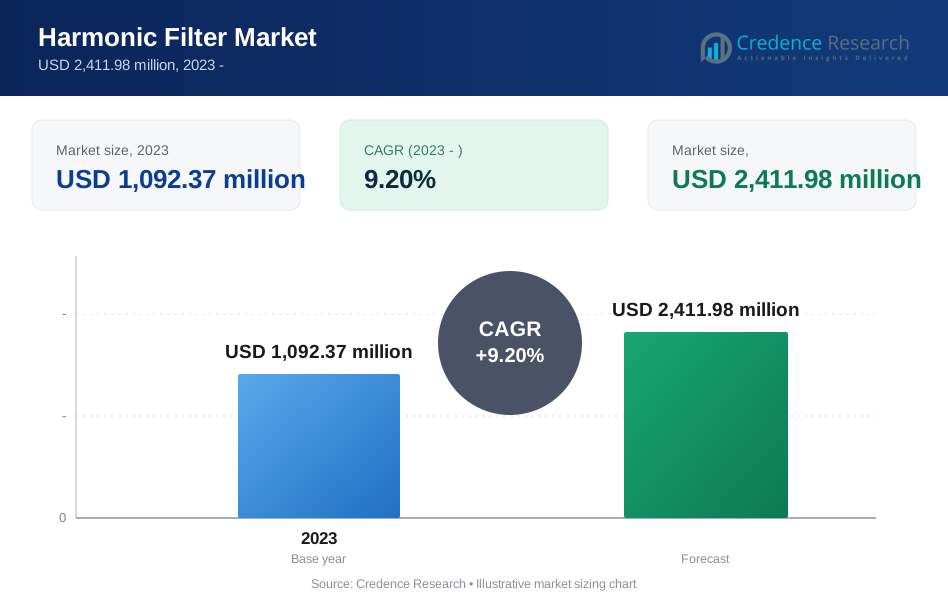
- The global demand for Harmonic Filters was valued at USD 1,092.37 million in 2023 and is expected to reach USD 2,411.98 million in 2032, growing at a CAGR of 9.20% % between 2024 and 2032.
- Over the forecast period, passive harmonic filters are predicted to remain the most common filter type in the market, while active harmonic filters are expected to be the fastest-growing filter type sector.
- The low voltage category led the global harmonic filter market in 2023.
- Three-phase harmonic filters are projected to maintain their market dominance over the next five years.
- Throughout the forecast period, the manufacturing segment is predicted to remain the most popular end-user type. The industrial sector is the largest manufacturer of variable speed drives (VSDs).
- Wind Power is the fastest-growing sector in the Harmonic Filter Market, and Variable Frequency Drives (VFDs) are another key segment.
- The nonlinear load category is the most prevalent in the harmonic filter sector.
- Capacitors are the most popular category in the harmonic filters market, while inductors are another important component. Inductors
- Above 2000 VAr is the most popular sector in the harmonic filter market.
- In 2023, North America dominated the global harmonic filter market, accounting for 25.3% of revenue, while Europe also played an important role, accounting for 22.3% of sales.
- Favorable government regulations promote market expansion.
- High cost and availability of substitutes limit market expansion.
Executive Summary
Market Definition
The Harmonic Filter Market includes devices and equipment used to attenuate or minimize harmonic distortion in electrical systems. Non-linear loads, such as electronic devices and variable speed drives, create harmonic distortion, which can result in power quality concerns and equipment malfunction. Harmonic filters are intended to remove these harmonics and maintain the smooth operation of electrical systems. They are commonly employed in industries, commercial buildings, and power distribution networks to ensure power quality, reduce energy losses, and meet regulatory requirements. The Harmonic Filter Market is driven by rising need for dependable and efficient power distribution, particularly in industrial, data centers, and renewable energy.
Market Overview
The global Harmonic Filter Market has witnessed steady growth in recent years and is expected to grow at a CAGR of 6.50% between 2024 and 2032. The market was valued at USD 1254.2 million in 2023 and is expected to reach USD 2210.6 million in 2032.
The Harmonic Filter Market is expanding rapidly due to rising demand for power quality and increased awareness of the negative impacts of harmonic distortion on electrical systems. Factors driving the market include rapid industrialization, increased use of non-linear loads, and the implementation of severe power quality rules. Harmonic filters are widely used in a variety of industries, including manufacturing, data centers, healthcare, and renewable energy, to reduce harmonic distortion and maintain the smooth and efficient operation of electrical systems. The market is likely to expand more as the demand for clean and steady power grows..
Segmentation by Type
- Passive harmonic filters are expected to remain the most popular filter type in the market over the projected period. Passive filters are ideal for continuous loads because they eliminate or bypass lower order fixed harmonics of current or voltage by tuning them at the resonance frequency.
- However, active harmonic filters are expected to be the fastest-growing filter type sector of the market, owing to their better harmonic elimination factor, which prevents them from being easily overloaded even when they approach their limits.
Segmentation by Voltage Level
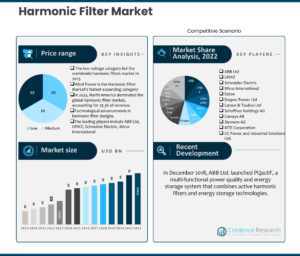
- The low voltage category led the worldwide harmonic filters market in 2023. The sector is expected to account for more than 75.0% of total market revenue by 2032. Low-voltage harmonic filters are utilized in a variety of applications, including power plants, industry, harbor cranes, and data centers.
- High voltage product types are utilized in heavy power transmission and distribution equipment to reduce resonance and harmonic distortion.
Segmentation by Phase Type
- Three-phase harmonic filters are expected to maintain their market dominance over the next five years. The segment is also expected to increase at a rapid pace in the market during the same period because of its diverse use in high-end industrial applications such as manufacturing and metal processing, as well as commercial applications such as data and IT centers, malls, and airports.
Segmentation by End-User
- Throughout the projection period, the manufacturing segment is expected to remain the market's most prevalent end-user type. The manufacturing sector is mostly comprised of cement, pharmaceutical, power plants, steel, foundry, and chemical industries.
- The industrial sector is the largest producer of variable speed drives (VSDs), with manufacturing playing a significant role. In industrial power distribution, VSDs introduce harmonics and cause a problem with power quality.
Segmentation by Application
- Wind Power is the Harmonic Filter Market's fastest expanding category. As wind energy becomes more widely used as a clean and renewable energy source, the demand for harmonic filters in wind power systems has increased.
- Another significant area of the Harmonic Filter Market is Variable Frequency Drives (VFDs). VFDs are commonly used in industrial applications to control the speed and torque of electric motors.
Segmentation by Voltage Source
- The non-linear load category is the most popular in the harmonic filter industry. Non-linear loads are devices or equipment that do not receive a sinusoidal current waveform from the power supply, resulting in harmonics. Non-linear loads include computers, variable frequency drives, and LED lighting.
Segmentation by Component
- Capacitors are the highest-demand category in the harmonic filters market. Capacitors serve an important part in harmonic filtering because they absorb and reduce harmonic currents. They are frequently used in combination with other components in harmonic filter designs.
- Inductors are another key segment in the harmonic filters industry. Inductors, also known as reactors, are used to control the flow of harmonic currents and give resistance to the electrical system's high-frequency components. They are necessary components in harmonic filter circuits.
Segmentation by Power Rating
- Above 2000 VAr is the most popular segment in the harmonic filters market. This division includes harmonic filters with reactive power ratings more than 2000 VAr (Volt-Ampere Reactive). The strong demand for harmonic filters in this market is due to the fact that larger industrial and commercial applications frequently necessitate greater power ratings to effectively minimize harmonics.
Segmentation by Region
- In 2023, North America dominated the global harmonic filter market, accounting for 25.3% of revenue.
- Europe also played a significant role, accounting for 22.3% of sales.
- The rest of the world, including Latin America, the Middle East, and Africa, supplies the remaining demand for Harmonic Filter.
North America dominated the global harmonic filter market in 2023. This can be linked to the region's significant production of consumer electronics and large population base. The harmonic filter market in the US has grown significantly due to increased non-linear loads in industrial and commercial sectors. Leading industries in the United States are using harmonic filters to assure operational stability and meet power quality standards. IEEE 519-2022 regulations emphasize the importance of adequate harmonic reduction.
Europe has emerged as a major participant in the harmonic filter industry. Governments in some nations, including the United Kingdom, Germany, and France, have made major expenditures in renewable energy schemes, contributing to this increase. Europe has set a goal of having 27% renewable energy in its entire energy composition by 2030. The integration of various renewable energy sources into the grid causes voltage oscillations, which account for around 20% of power loss in electrical systems. The upsurge in the alternative energy industry is considerably driving the harmonic filters market.
Key Highlights of the Report
Type, Voltage Level, Phase Type, End-User, Type, Voltage Source, Component, Power Rating and region segment of the global Harmonic Filter Market. The low voltage category dominated the global harmonic filters market in 2023, and the manufacturing segment is predicted to remain the industry's most common end-user. In addition, Wind Power is the Harmonic Filter Market's fastest growing segment, with Capacitors being the most in-demand. Also, the non-linear load category is the most prevalent, with North America leading the market growth.
The market is being driven by increased demand for power quality and reliable electrical systems, stringent rules and standards for harmonics mitigation, and the growing adoption of non-linear loads in industries and commercial sectors. Furthermore, high installation and maintenance costs of harmonic filters, lack of knowledge and understanding about harmonic distortion and its impact, and difficulties in retrofitting harmonic filters in existing electrical systems are the significant limitations of the market.
Nonetheless, North America dominated the worldwide harmonic filter market in 2023. This can be attributed to the region's high output of consumer electronics and huge population. Furthermore, Europe has emerged as a significant player in the harmonic filter market. Governments in several countries, like the United Kingdom, Germany, and France, have made significant investments in renewable energy projects, contributing to this increase.
What Are The Main Drivers Of The Global Harmonic Filter Market?
One of the key drivers of the Harmonic Filter Market is the increasing demand for power quality and reliable electrical systems. As industries and commercial sectors become more dependent on sensitive electronic equipment, the need to mitigate harmonic distortion and ensure clean power becomes crucial. Additionally, stringent regulations and standards for harmonics mitigation are driving the adoption of harmonic filters. Compliance with these regulations is essential for industries to maintain optimal power quality and prevent equipment malfunction.
What Are The Major Challenges Faced By The Global Harmonic Filter Market?
While the Harmonic Filter Market is experiencing growth, some restraints need to be considered. One such restraint is the high installation and maintenance costs associated with harmonic filters. The initial investment required for installing harmonic filters can be significant, especially for large-scale applications. Additionally, ongoing maintenance and monitoring of these filters add to the overall costs. Another restraint is the lack of awareness and understanding about harmonic distortion and its impact. Many industries and individuals may not be fully aware of the detrimental effects of harmonics on electrical systems, which can lead to a slower adoption rate of harmonic filters.
What Are The Growth Opportunities In The Global Harmonic Filter Market?
The Harmonic Filter Market presents several opportunities for growth and innovation. Technological advancements in harmonic filter designs and efficiency are opening up new possibilities for improved performance and cost-effectiveness. Manufacturers are continuously developing innovative solutions that offer better harmonic mitigation capabilities while reducing the footprint and energy consumption of the filters. Additionally, the growing focus on renewable energy integration and smart grid technologies provides opportunities for harmonic filter adoption. As the use of renewable energy sources like solar and wind power increases, the need for effective harmonic mitigation becomes crucial to ensure the stability of the grid.
Market Drivers
Favorable Government Regulations
Power quality and harmonics standards are motivating businesses to invest in improved harmonic filter technologies. Compliance with these regulations ensures that activities function smoothly while also avoiding penalties and reputational damage. Companies and governments are making investments that are increasing demand for harmonic filters in the market.
Regulatory standards and rules have been established in several nations. Aside from worldwide norms and regulations, the majority of regions and countries have their own regulating agencies that set harmonic distortion limits.
The International Electrotechnical Commission (IEC) and the Institute of Electrical and Electronics Engineers (IEEE) establish global standards for harmonic distortion. These standards are present in most locations, but their required execution has yet to be implemented.
Governments have created many rules and imposed penalties on sectors that do not comply with power quality standards, hence pushing the harmonic filter industry.
Market Restraints
High Cost and Availability of Substitutes
Price is a key element in limiting market expansion, especially in developing nations with price-sensitive consumers. Harmonic filters are expensive, thus their usage is confined to specific industries. Harmonic filters are widely used in industries like information technology, textiles, automotive, and paper and pulp. Harmonic filters, on the other hand, are underutilized in small businesses due to the availability of low-cost alternatives.
Transformers, reactors, and low-cost filters are examples of economical harmonic mitigation solutions used by small businesses. These replacements do not accomplish complete harmonic filtering, yet they are chosen by low-income customers and businesses in developing countries. As a result, the availability of low-cost replacements impedes the expansion of the harmonic filter industry.
Opportunities
Increasing Demand for IT and Data Centers
The proliferation of data centers and their dependency on high-quality power supplies are likely to offer opportunities for the use of harmonic filters to assure continuous operations and protect sensitive IT equipment. The growing demand for power inverters and static converters in commercial applications such as data centers and cloud computing is projected to drive the harmonic filter market forward.
The growing requirement to ensure power quality has led to the increased use of harmonic filters in high-end devices, UPS, routers, servers, and HVAC systems. The growing number of data centers is driving up demand for harmonic filters in the market. According to CloudScene data6, around 8,000 data centers were operational globally as of January 2021.
The majority of data centers are located in six countries: the United States (33% of total), the United Kingdom (5.7%), Germany (5.5%), China (5.2%), Canada (3.3%), and the Netherlands (3.4%). These characteristics provide chances for players in the harmonic filter market to grow their businesses and meet the growing demand from IT and data centers.
Competitive Landscape
Key Players
The global Harmonic Filter Market is highly competitive, with several key players. Some of the major players in the market and their market share are as follows:
- ABB Ltd
- LPINZ
- Schneider Electric
- Mirus International
- Eaton
- Enspec Power Ltd
- Larsen & Toubro Ltd
- Schaffner Holdings AG
- Comsys AB
- Siemens AG
- MTE Corporation
- CC Power and Industrial Solutions Ltd.
- AVX Corporation
- TDK Corporation
- Arteche, and others.
These organizations prioritize product innovation, Phase Type expansion, and mergers and acquisitions to stay competitive.
The global Harmonic Filter Market's key players continually seek to stay ahead by offering new products and developments.
In January 2019, Mesta Electronics, Inc. introduced a new third-generation DPM active harmonic filter for high-frequency current sensors to monitor load current constantly.
In June 2021, HPS introduced the HPS Centurion P Passive Harmonic Filter. This novel filter effectively reduces harmonic currents caused by non-linear loads. With initial options ranging from 5 to 500 horsepower, it improves power quality by reducing harmonics and increasing true power factor. This integration provides dependable and rapid resolution.
Summary of Key Findings
- Increasing need for IT and data centers.
- The market is segmented by type, voltage level, phase type, end-user, type, voltage source, component, power rating, and region.
- Wind Power is the Harmonic Filter Market's fastest-growing sector
- Passive harmonic filters are predicted to remain the most common filter type in the market over the projected period
- North America is leading market growth; the market is highly competitive with key players including ABB Ltd, LPINZ, Schneider Electric, Mirus International, Eaton, Enspec Power Ltd and Others.
Future Outlook
- Growing demand for power quality and efficient electrical systems.
- Increasing adoption of renewable energy sources.
- Stringent regulations and standards for power quality.
- Rising awareness about the harmful effects of harmonic distortion.
- Technological advancements in harmonic filter designs.
- Expansion of industrial and manufacturing sectors.
- Integration of smart grid technologies.
How CXOs Can Benefit from the Credence Research Harmonic Filter Market Report
The Credence Research Harmonic Filter Market Report provides CXOs with a comprehensive overview of the market, including:
- Market size and growth forecast:The report provides detailed estimates of the global Harmonic Filter Market size, segmented by type, voltage level, phase type, end-user, type, voltage source, component, power rating, and region. It also includes forecasts for the market through 2032 based on key trends and drivers.
- Market segmentation:The report segments the Harmonic Filter Market by type, voltage level, phase type, end-user, type, voltage source, component, power rating, and region. This segmentation provides CXOs with a granular understanding of the market and the opportunities in each segment.
- Competitive Landscape:The report profiles the key players in the Harmonic Filter Market and provides insights into their strategies, product offerings, and financial performance. This information can help CXOs to identify and assess their competition.
- Key trends and drivers:The report identifies and analyzes the key trends and drivers that are shaping the Harmonic Filter Market. This information can help CXOs to make informed decisions about their investments and strategies.
CXOs can use the insights from the Credence Research Harmonic Filter Market Report to:
- Identify growth opportunities:The report can help CXOs to identify new growth opportunities in the Harmonic Filter Market. For example, it can provide insights into emerging technologies, market trends, and key market players.
- Make informed investment decisions:The report can help CXOs to make informed investment decisions about Harmonic Filters. For example, it can provide insights into market trends, growth potential, competitive landscape, and key players in the industry.
- Develop competitive strategies:The report can help CXOs to develop competitive strategies for their Harmonic Filter businesses. For example, the report identifies the key strategies that dark fiber providers are using to differentiate themselves from their competitors.
- Track market developments:The report can help CXOs to track market developments and stay ahead of the curve. For example, the report provides insights into the latest trends and innovations in the Harmonic Filter Market.
Overall, the Credence Research Harmonic Filter Market Report is a valuable resource for CXOs who are looking to gain a deeper understanding of the market and identify opportunities for growth.
Segmentation
By Type:- Active Harmonic Filters (AHFs)
- Passive Harmonic Filters (PHFs)
- Hybrid Harmonic Filters
- Low Voltage Harmonic Filters
- Medium Voltage Harmonic Filters
- High Voltage Harmonic Filters
- Single Phase Harmonic Filters
- Three Phase Harmonic Filters
- Industrial
- Manufacturing
- Automotive
- Petrochemical
- Commercial
- Data Centers
- Telecommunication
- Residential
- Variable Frequency Drives (VFDs)
- UPS
- HVAC
- Water Treatment
- Wind Power
- Others
- Linear Load
- Non-Linear Load
- Capacitors
- Inductors
- Resistors
- Sensors
- Others
- Up to 500 VAr
- 501 VAr to 2000 VAr
- Above 2000 VAr
- North America
- US
- Canada
- Mexico
- Europe
- Germany
- France
- UK.
- Italy
- Spain
- Rest of Europe
- Asia Pacific
- China
- Japan
- India
- South Korea
- South-east Asia
- Rest of Asia Pacific
- Latin America
- Brazil
- Argentina
- Rest of Latin America
- Middle East & Africa
- GCC Countries
- South Africa
- Rest of Middle East and Africa
Adjacent Markets
In the Harmonic Filter Market, several adjacent markets have high revenue growth opportunities. The key adjacent markets for Harmonic Filter Market –
Adjacent Markets |
||
| Power Quality Monitoring Market | Surge Protection Devices Market | Voltage Regulator Market |
| Power Factor Correction Market | Uninterruptible Power Supply (UPS) Market | Active Power Filters Market |
| Energy Storage Systems Market | Smart Grid Market | Renewable Energy Market |
Request a Free Sample
Fill in your details and we'll send you a free sample report.
- Sample data tables & charts
- Research methodology
Need a Custom Version of This Report?
Tailor the scope, geography, or segments to your exact requirements.
- Custom geography or segment scope
- Direct access to our analyst team
Frequently Asked Questions
What is the size of Harmonic Filter Market?
What is the expected growth rate of the Harmonic Filter Market between 2024 and 2032?
Which segment is leading the market share in terms of Voltage Level?
Which Power Rating segment governs the demand for Harmonic Filter in the world?
Who are the major players in this market?
What are the major market drivers of the Harmonic Filter industry?
What are the major market restraints of the Harmonic Filter industry?
What are the major market opportunities of the Harmonic Filter industry?
Table of Content
Chapter 1. Report Introduction
- 1.1 Report Description & Purpose
- 1.1.1 Report Title & Market Definition
- 1.1.2 Unique Selling Propositions (USP) & Key Differentiators
- 1.1.3 Value Proposition for Stakeholders
- 1.2 Research Objectives
- 1.2.1 Market Sizing Objectives (Volume & Revenue)
- 1.2.2 Segmentation Objectives
- 1.2.3 Competitive Intelligence Objectives
- 1.2.4 Forecast & Scenario Objectives
- 1.3 Report Scope
- 1.3.1 Harmonic Filter Scope – Types & Subtypes Covered
- 1.3.2 Geographic Scope – Regions & Countries Covered
- 1.3.3 Historical Period, Base Year & Forecast Period (2023; forecast to the forecast period)
- 1.3.4 Inclusions & Exclusions
- 1.4 HS Code & Classification Framework
- 1.5 Currency, Units & Pricing Basis
- 1.6 Target Stakeholders
- 1.7 Limitations & Assumptions
Chapter 2. Executive Summary
- 2.1 Global Harmonic Filter Market Snapshot
- 2.1.1 Market Size – Historical (2023) & Forecast (the forecast period) (2023: USD 1,092.37 million → forecast year: USD 2,411.98 million)
- 2.1.2 Volume & Revenue – Global Totals
- 2.1.3 Key Market Highlights – Top Five Facts
- 2.2 Harmonic Filter Market Segmentation Snapshot
- 2.2.1 Market Split by Region – 2023 vs.
- 2.3 Competitive Snapshot
- 2.3.1 Top 10 Players by Revenue Share – 2023
- 2.3.2 Top 10 Players by Volume Share – 2023
- 2.3.3 Recent Strategic Developments (18-Month Summary)
- 2.4 Key Investment Highlights & Strategic Conclusions
Chapter 3. Harmonic Filter Market Dynamics & Industry Analysis
- 3.1 Market Overview & Context
- 3.1.1 Harmonic Filter Market Position in the Broader Automotive Value Chain
- 3.1.2 OEM vs. Replacement Market Dynamics
- 3.1.3 Market Maturity & Development Stage by Region
- 3.2 Harmonic Filter Market Drivers
- 3.3 Harmonic Filter Market Restraints & Challenges
- 3.4 Harmonic Filter Market Opportunities
- 3.5 Porter's Five Forces Analysis
- 3.5.1 Threat of New Entrants
- 3.5.2 Bargaining Power of Suppliers
- 3.5.3 Bargaining Power of Buyers
- 3.5.4 Threat of Substitutes
- 3.5.5 Competitive Rivalry – Intensity Assessment
- 3.6 Harmonic Filter Value Chain Analysis
- 3.6.1 Upstream – Raw Material/Input Suppliers
- 3.6.1.1 Raw Material/Input 1
- 3.6.1.2 Raw Material/Input 2
- 3.6.1.3 Raw Material/Input 3
- 3.6.2 Midstream – Production/Manufacturing/Service Delivery
- 3.6.2.1 Production/Process Overview
- 3.6.2.2 Key Facility Locations & Capacity by Manufacturer
- 3.6.3 Downstream – Distribution & End Consumer
- 3.6.3.1 Primary Channel – B2B/OEM
- 3.6.3.2 Secondary Channels – Dealer, Retail, Online, Direct
- 3.6.4 Value Chain Profitability Analysis
- 3.6.1 Upstream – Raw Material/Input Suppliers
- 3.7 PESTEL Analysis
- 3.7.1 Political Factors
- 3.7.2 Economic Factors
- 3.7.3 Social Factors
- 3.7.4 Technological Factors
- 3.7.5 Environmental Factors
- 3.7.6 Legal Factors
- 3.8 Harmonic Filter Supply Chain Analysis
- 3.8.1 Raw Material/Input Supply Risk Assessment
- 3.8.2 Manufacturing Concentration Risk (Geographic Exposure)
- 3.8.3 Trade Disruption Impact Analysis
- 3.9 Regulatory & Policy Landscape
Note: The regulatory and policy landscape section covers regulations based on their applicability to the market, Harmonic Filter category, geography, and scope of the study. Only regulatory frameworks with a material impact on operations, compliance, trade, sustainability, or market access are analyzed in detail.
Chapter 4. Key Investment Pockets & Opportunity Analysis
- 4.1 Harmonic Filter Market Attractiveness Analysis
- 4.1.1 By Region – Investment Attractiveness Matrix (Volume × CAGR)
- 4.2 Absolute Revenue Growth Opportunity
- 4.2.1 By Region – Absolute USD Growth Through the forecast period
- 4.3 Incremental Volume Opportunity
- 4.3.1 By Region – Incremental Volume Through the forecast period
- 4.3.2 Segment – Incremental Volume
- 4.4 Emerging Submarket Opportunity Deep Dive (Subject to Applicability)
- 4.5 Emerging Market Opportunity Scorecards
- 4.5.1 United States
- 4.5.2 Europe
- 4.5.3 Asia
- 4.5.4 Middle East & Africa
Note: Emerging Market Opportunity Scorecards will be included based on relevance and strategic importance. Regions listed are indicative and may vary depending on data availability and market dynamics.
Chapter 5. Harmonic Filter Import-Export Analysis & Trade Flows
- 5.1 Global Trade Overview
- 5.1.1 Global Export Value by Country (2023)
- 5.1.2 Global Export Volume by Country (2023)
- 5.1.3 Global Import Value by Country (2023)
- 5.1.4 Global Import Volume by Country (2023)
- 5.1.5 Net Trade Balance by Country (2023)
- 5.2 Export Analysis – Segment
- 5.2.1 Type 1 (HS Code)
- 5.2.2 Type 2 (HS Code)
- 5.2.3 Type 3 (HS Code)
- 5.2.4 Type 4 (HS Code)
- 5.2.5 Type 5 (HS Code)
- 5.3 Import Analysis – Segment
- 5.3.1 Type 1 (HS Code)
- 5.3.2 Type 2 (HS Code)
- 5.3.3 Type 3 (HS Code)
- 5.3.4 Type 4 (HS Code)
- 5.3.5 Type 5 (HS Code)
- 5.4 Average Unit Trade Prices
- 5.4.1 Average Export Price – Segment & Country
- 5.4.2 Average Import Price – Segment & Source Country
- 5.4.3 Price Trends (2023)
- 5.5 Key Trade Route Analysis
- 5.5.1 Trade Route 1
- 5.5.2 Trade Route 2
- 5.5.3 Trade Route 3
- 5.5.4 Trade Route 4
- 5.5.5 Trade Route 5
- 5.6 Trade Policy Impact Assessment
- 5.6.1 US Anti-Dumping & Section 301 Tariffs
- 5.6.2 EU Customs Union Impact
- 5.6.3 Major Free Trade Agreements
- 5.6.4 USMCA Rules of Origin
Note: Trade policy analysis will be included only where relevant to the Harmonic Filter market.
Chapter 6. Competitive Landscape & Company Benchmarking
- 6.1 Harmonic Filter Market Concentration & Structure
- 6.1.1 Herfindahl-Hirschman Index (HHI) – vs. 2023
- 6.1.2 Tier 1, Tier 2 & Tier 3 Market Structure
- 6.1.3 Global, Regional & Local Player Dynamics
- 6.2 Harmonic Filter Market Share Analysis – 2023
- 6.2.1 Global Revenue Share by Company
- 6.2.2 Global Volume Share by Company
- 6.2.3 Regional Revenue Share
- 6.2.4 Market Share Evolution ( vs. 2023)
- 6.2.5 OEM Segment Share by Company
- 6.2.6 Replacement Segment Share by Company
- 6.3 Production/Delivery Capacity & Facility Analysis
- 6.3.1 Global Installed Capacity
- 6.3.2 Capacity Utilization Rates
- 6.3.3 Production/Output Volume
- 6.3.4 Facility Locations & Capacity Map
- 6.3.5 Planned Capacity Additions
- 6.4 Harmonic Filter Competitive Benchmarking Matrix
- 6.4.1 Revenue, Volume, CAGR & Profitability Comparison
- 6.4.2 Channel Revenue Mix
- 6.4.3 Geographic Revenue Exposure
- 6.4.4 R&D Intensity
- 6.4.5 Sustainability Maturity
- 6.5 Strategic Developments in Harmonic Filter (Last 24 Months)
- 6.5.1 Mergers, Acquisitions & Divestments
- 6.5.2 New Harmonic Filter Launches
- 6.5.3 Facility Expansions
- 6.5.4 Strategic Alliances, Joint Ventures & Partnerships
- 6.5.5 Distribution Expansion & Market Entry
- 6.5.6 Sustainability & ESG Initiatives
- 6.6 Competitive Strategy Mapping
- 6.6.1 Leader, Challenger, Follower & Niche Classification
- 6.6.2 Pricing Strategy Comparison
- 6.6.3 Channel Strategy Matrix
Note: Strategic developments are included based on their materiality and the availability of reliable information.
Chapter 7. Global Harmonic Filter Market – By Distribution Channel
- 7.1 Segment Overview
- 7.1.1 Volume & Revenue Split by Channel (2023 & )
- 7.1.2 Channel Mix Evolution (the forecast period)
Chapter 8. Regional Market Analysis – Global Overview
- 8.1 Global Regional Overview
- 8.1.1 Regional Volume Share
- 8.1.2 Regional Revenue Share
- 8.1.3 Regional Volume by Region
- 8.1.4 Regional Revenue by Region
- 8.1.5 Regional Forecast Through the forecast period
- 8.2 Cross-Regional Segment Analysis
- 8.2.1 By Distribution Channel
- 8.2.2 By Brand/Price Tier
Chapter 9. North America Harmonic Filter Market
- 9.1 United States
- 9.2 Canada
- 9.3 Mexico
Chapter 10. Europe Harmonic Filter Market
- 10.1 Germany
- 10.2 France
- 10.3 Italy
- 10.4 United Kingdom
- 10.5 Spain
- 10.6 Poland
- 10.7 Russia
- 10.8 Netherlands
- 10.9 Belgium
- 10.10 Sweden
- 10.11 Denmark
- 10.12 Norway
- 10.13 Rest of Europe
Chapter 11. Asia Pacific Harmonic Filter Market
- 11.1 China
- 11.2 India
- 11.3 Japan
- 11.4 South Korea
- 11.5 Thailand
- 11.6 Indonesia
- 11.7 Vietnam
- 11.8 Malaysia
- 11.9 Australia
- 11.10 Rest of Asia Pacific
Chapter 12. Latin America Harmonic Filter Market
- 12.1 Brazil
- 12.2 Argentina
- 12.3 Colombia
- 12.4 Chile
- 12.5 Rest of Latin America
Chapter 13. Middle East Harmonic Filter Market
- 13.1 Saudi Arabia
- 13.2 United Arab Emirates
- 13.3 Turkey
- 13.4 Israel
- 13.5 Iran
- 13.6 Rest of the Middle East
Chapter 14. Africa Harmonic Filter Market
- 14.1 South Africa
- 14.2 Egypt
- 14.3 Nigeria
- 14.4 Morocco
- 14.5 Rest of Africa
Chapter 15. Harmonic Filter Company Profiles
- 15.1 [Company 01]
- 15.1.1 Company Overview
- 15.1.2 Key Management Personnel
- 15.1.3 Products & Services Portfolio
- 15.1.4 Financial Performance
- 15.1.5 Key Market Focus & Geographic Presence
- 15.1.6 Recent Developments & Strategic Initiatives
Note: The company profile list is preliminary and may change based on research findings, market developments, data availability, and client requirements.
Chapter 16. Appendices
- Appendix A – List of Abbreviations & Acronyms
- Appendix B – Industry Classification Code Reference – Full Series
- Appendix C – Production & Capacity Data Tables
- Appendix D – End-Use & Demand Base Tables
- Appendix E – Consumption & Replacement Rate Assumptions
- Appendix F – ASP Reference Tables
- Appendix G – Manufacturing & Facility Database
- Appendix H – Import-Export Data Tables
- Appendix I – Regulatory Summary Tables
- Appendix J – Primary Research Participant List (Anonymized)
- Appendix K – Primary Research Questionnaire Framework
- Appendix L – Data Sources & Bibliography
- Appendix M – Market Size Divergence & Source Comparison
Chapter 17. Research Methodology
- 17.1 Research Framework & Philosophy
- 17.2 Secondary Research – Sources, Hierarchy & Data Extraction
- 17.3 Data Modeling – Bottom-Up & Top-Down Market Sizing
- 17.4 Primary Research – Stakeholder Framework, LOI & Sample Sizes
- 17.5 Forecast Methodology – Regression, Scenario & Sensitivity Analysis
- 17.6 Quality Control – Four-Layer Validation Framework
- 17.7 Limitations & Standard Assumptions
- 17.8 Disclaimer
