
Market Overview:
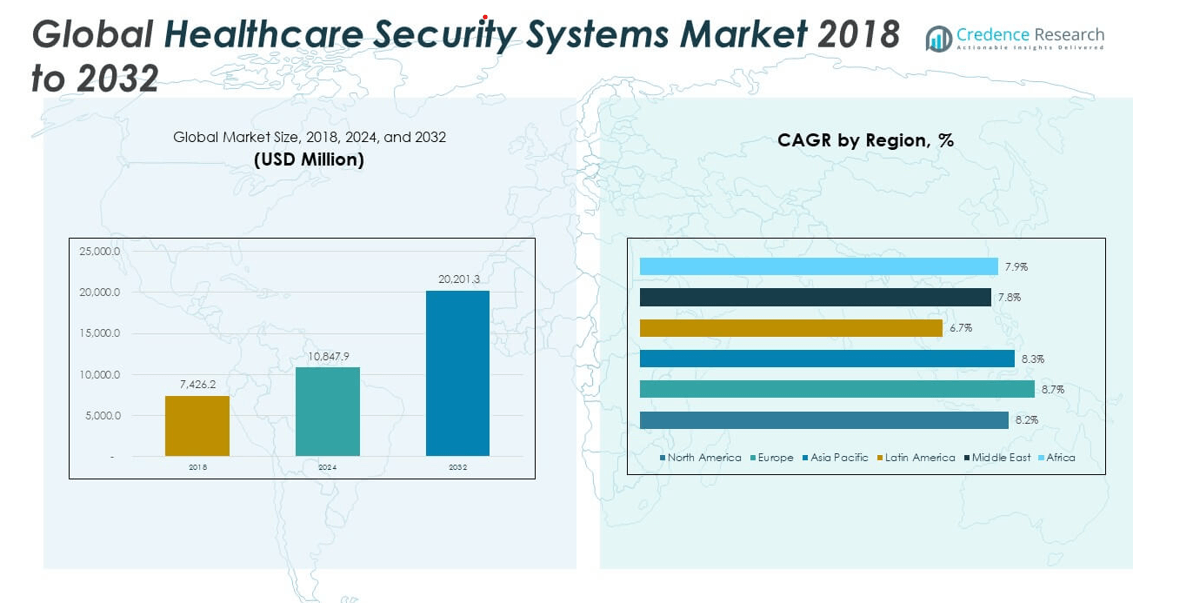
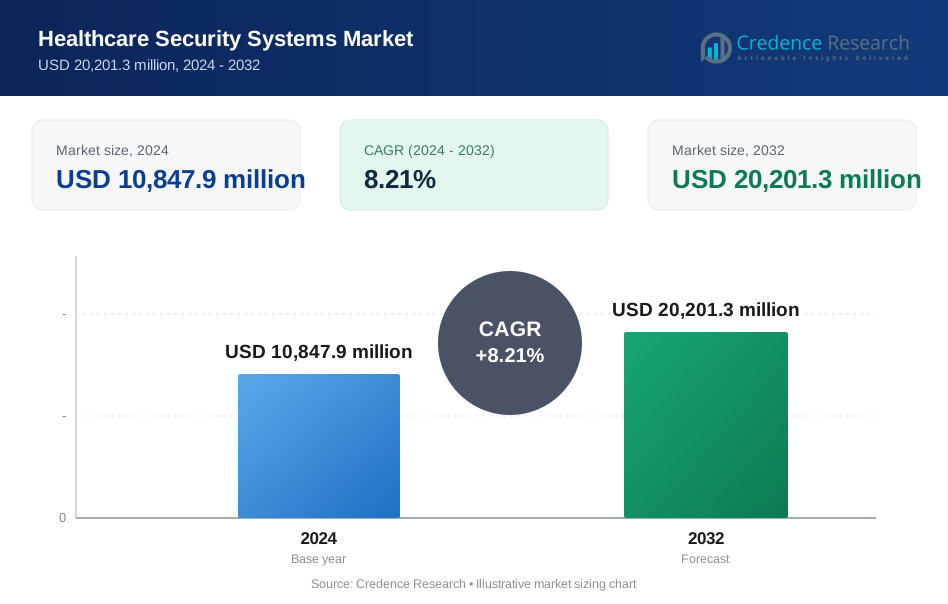
The Healthcare Security Systems Market size was valued at USD 7,426.2 million in 2018 to USD 10,847.9 million in 2024 and is anticipated to reach USD 20,201.3 million by 2032, at a CAGR of 8.21% during the forecast period.
| REPORT ATTRIBUTE | DETAILS |
|---|---|
| Historical Period | 2020-2023 |
| Base Year | 2024 |
| Forecast Period | 2025-2032 |
| Healthcare Security Systems Market Size 2024 | USD 10,847.9 million |
| Healthcare Security Systems Market, CAGR | 8.21% |
| Healthcare Security Systems Market Size 2032 | USD 20,201.3 million |
The growth of the healthcare security systems market is primarily driven by the increasing need to safeguard sensitive patient data, ensure physical safety within healthcare facilities, and comply with stringent data protection regulations. As healthcare institutions adopt digital solutions and IoT-connected medical devices, the risk of cyber threats and data breaches escalates. This has compelled hospitals, clinics, and other providers to invest in advanced surveillance, access control, and cybersecurity systems. Furthermore, rising healthcare infrastructure investments and growing awareness of security vulnerabilities continue to reinforce the demand for integrated security solutions.
North America leads the healthcare security systems market due to its mature healthcare infrastructure, higher adoption of digital technologies, and strong regulatory mandates on patient data protection. Europe follows closely with similar regulatory frameworks and increasing investment in hospital modernization. Meanwhile, Asia-Pacific is emerging as the fastest-growing region, driven by rapid healthcare expansion in countries like China and India, alongside increasing focus on improving hospital security. The Middle East and Latin America are also showing growth potential as healthcare facilities modernize and prioritize security enhancements across their operations.
Market Insights:
- The Healthcare Security Systems Market was valued at USD 10,847.9 million in 2024 and is expected to reach USD 20,201.3 million by 2032, growing at a CAGR of 8.21%.
- Rising cyber threats and increasing adoption of connected medical devices are driving demand for integrated physical and digital security solutions.
- Regulatory compliance requirements such as HIPAA and GDPR continue to push healthcare providers toward investing in advanced security infrastructure.
- High initial costs and budget constraints in smaller healthcare facilities limit widespread adoption of next-generation security systems.
- North America led the Healthcare Security Systems Market in 2024, capturing 32.02% of the global share, supported by strong digital infrastructure.
- Asia Pacific is emerging as the fastest-growing region, fueled by healthcare digitization initiatives in China, India, and Southeast Asia.
- Hospitals remain the largest end-user segment due to their complex security needs and higher exposure to physical and cyber threats.
Market Drivers:
Stringent Regulatory Mandates are Accelerating Demand for Comprehensive Healthcare Security Systems
Government regulations such as HIPAA, GDPR, and other patient data protection laws are driving the integration of robust security infrastructure in healthcare facilities. Organizations must meet strict compliance standards to avoid penalties and legal consequences. Healthcare providers now prioritize secure data storage and transmission across all endpoints. Security systems that offer real-time monitoring, encryption, and breach detection have become essential. The Healthcare Security Systems Market is expanding due to this rising need for compliance-driven solutions. It benefits vendors offering tools that align with regulatory frameworks. Failure to meet these legal standards can severely impact operational continuity. Healthcare institutions recognize security as an operational necessity rather than a discretionary expense.
- For example, TechMagic developed a HIPAA-compliant digital platform for a U.S.-based healthcare provider with over 60 specialty care locations. The solution enabled secure data storage, billing workflows, and strict access controls aligned with regulatory standards.
Increasing Incidences of Cybersecurity Threats in Healthcare Environments
Cyberattacks targeting healthcare institutions have become more frequent and sophisticated. Ransomware, phishing, and data exfiltration attacks jeopardize patient safety and data integrity. Hospitals and clinics handle vast amounts of sensitive information, making them high-value targets. The Healthcare Security Systems Market continues to grow as cybersecurity threats escalate globally. It supports adoption of firewalls, multi-factor authentication, and endpoint detection systems. Decision-makers now invest in proactive and layered cybersecurity approaches. Real-time threat intelligence and zero-trust architectures gain momentum across institutions. These evolving threats push healthcare organizations to overhaul outdated IT and security systems.
Expansion of Telehealth and Remote Patient Monitoring Solutions
The proliferation of remote healthcare services raises new concerns about data transmission and endpoint security. Telehealth platforms require encrypted communication channels and authenticated access to maintain confidentiality. Hospitals must safeguard not only internal systems but also patient devices connecting to networks. The Healthcare Security Systems Market responds to these new vulnerabilities with advanced telehealth-compatible solutions. It enables secure virtual consultations, remote diagnostics, and real-time monitoring without compromising privacy. Healthcare providers now embed security at the design stage of digital health solutions. Rising demand for home-based care further amplifies the need for secure data environments. Organizations also train staff and patients in best practices to minimize risks.
Rising Physical Security Threats Within Healthcare Infrastructure
Physical threats, including theft, unauthorized access, and violence in hospitals, highlight the need for advanced surveillance and control systems. Emergency rooms, pharmacies, and data centers are particularly vulnerable areas. The Healthcare Security Systems Market gains momentum by providing integrated video surveillance, smart ID systems, and visitor management tools. It enables administrators to monitor staff, patients, and third-party contractors in real time. With increasing foot traffic in healthcare environments, manual security becomes ineffective. Organizations adopt AI-powered surveillance and biometric access control to address security loopholes. These systems also support post-incident analysis and forensic investigations. Investment in physical security solutions remains essential to maintain operational safety and regulatory compliance.
- For instance, Northwell Health expanded AI-powered physical security, integrating Motorola Solutions’ analytics across its 26 hospitals and 1,000 care sites. The system’s smart video, radio integration, and automated threat detection supports real-time alerts for incidents like unauthorized entry, unattended items, and fall risks.
Market Trends
Integration of AI and Predictive Analytics into Healthcare Security Systems
AI-powered tools help healthcare institutions detect anomalies, automate responses, and reduce reliance on manual monitoring. Predictive analytics identifies potential threats by analyzing behavioral and usage patterns across systems. The Healthcare Security Systems Market sees strong traction in solutions offering AI-driven threat detection and prevention. It supports smarter surveillance, incident response, and risk management. AI also improves false-positive rates, reducing the workload on security teams. Machine learning models continuously refine threat recognition capabilities based on historical data. Hospitals now rely on AI to secure both digital and physical environments. This trend continues to redefine security management strategies across the healthcare sector.
Adoption of IoT Security Protocols to Safeguard Connected Medical Devices
The proliferation of IoT-enabled medical devices increases the complexity of securing healthcare networks. Connected systems such as infusion pumps, wearables, and diagnostic devices introduce new attack surfaces. The Healthcare Security Systems Market adapts by embedding security protocols at the device level. It enhances authentication, encryption, and remote device management capabilities. Healthcare institutions now demand security-by-design principles for all connected technologies. Vendors develop security solutions tailored for medical IoT ecosystems. Device-specific firewalls, endpoint isolation, and firmware protection play critical roles. Organizations also segment networks to minimize risk exposure from compromised devices. This trend reinforces the importance of end-to-end device security.
- For instance, a security assessment of over 200,000 infusion pumps across various hospitals using IoT Security from Palo Alto Networks revealed that 75% of devices had at least one known vulnerability.
Growth in Cloud-Based Healthcare Security Platforms and Services
Healthcare institutions are migrating to cloud environments to improve scalability and access. This transition requires security solutions capable of managing hybrid and multi-cloud infrastructures. The Healthcare Security Systems Market expands to support cloud-native security tools and SaaS-based monitoring platforms. It offers centralized dashboards, automated threat alerts, and policy enforcement across distributed systems. Hospitals now prefer security models that adapt to evolving cloud architectures. Cloud-based systems enable faster response times and easier updates. Vendors are integrating compliance checks and audit trails into cloud security offerings. This trend enhances both efficiency and transparency for security teams.
- For example, Censinet RiskOps™ enabled healthcare organizations to automate third‑party risk assessments and maintain real‑time monitoring, achieving an average Mean Time to Contain (MTTC) of just 2 hours in cloud-based environments. It automates vendor evaluation, reduces manual processes, and continuously updates risk profiles to accelerate incident containment and strengthen cybersecurity resilience
Focus on Identity and Access Management to Prevent Unauthorized Data Access
Ensuring that only authorized personnel can access sensitive data is critical to healthcare operations. Organizations implement identity and access management (IAM) frameworks to manage users, roles, and privileges. The Healthcare Security Systems Market supports IAM through biometric authentication, smart cards, and role-based controls. It limits exposure to insider threats and unintentional data leaks. IAM tools also streamline audit processes and user provisioning. With growing workforce mobility, healthcare institutions need secure access across locations and devices. Vendors offer integrated IAM solutions that work across cloud, on-premise, and mobile platforms. This trend addresses both compliance and operational efficiency requirements.
Market Challenges Analysis
High Costs of Advanced Security Infrastructure and Limited IT Budgets in Smaller Facilities
Implementing modern security systems often involves significant upfront investments in hardware, software, and skilled personnel. Smaller clinics and regional hospitals struggle to allocate sufficient funds for such infrastructure. The Healthcare Security Systems Market must address the affordability gap that persists among low- and mid-tier institutions. It often excludes smaller providers from adopting comprehensive solutions. Budget constraints limit integration of AI, biometrics, and advanced access control technologies. Subscription-based models help mitigate costs but may still be unsustainable in some geographies. Organizations face trade-offs between immediate operational needs and long-term security goals. Lack of financial flexibility delays modernization efforts and exposes these facilities to avoidable risks.
Shortage of Cybersecurity Expertise and Operational Knowledge in Healthcare Settings
Healthcare providers face difficulty hiring and retaining skilled cybersecurity professionals who understand both IT systems and clinical operations. The shortage of talent leads to inadequate monitoring, delayed incident responses, and misconfigured systems. The Healthcare Security Systems Market continues to suffer from a lack of in-house expertise, especially in public sector healthcare. It increases dependence on third-party vendors and managed security services, which may not always align with the organization’s internal workflows. Training programs remain limited or outdated, resulting in operational inefficiencies and increased vulnerabilities. Constant technology upgrades demand continuous skill development, which most healthcare institutions find hard to sustain.
Market Opportunities
Growing Demand for Integrated Solutions Across Physical and Digital Security Domains
Healthcare providers increasingly seek unified platforms that consolidate physical surveillance, access control, and cybersecurity functions. The Healthcare Security Systems Market sees rising demand for integrated systems that offer centralized management and interoperability. It allows administrators to oversee facility-wide security from a single interface. Vendors offering flexible, scalable solutions tailored to hospital workflows are well-positioned. Demand also grows for modular platforms that support phased implementation across departments. This integration enhances efficiency while minimizing complexity.
Emergence of Regional Healthcare Infrastructure Projects in Developing Nations
Government-led healthcare expansion projects in Asia-Pacific, Latin America, and parts of Africa create new opportunities for security vendors. The Healthcare Security Systems Market stands to benefit from hospital construction, telehealth rollout, and digital health records programs. It enables vendors to introduce cost-effective, cloud-based, and mobile-compatible solutions in emerging economies. Rising focus on patient safety and compliance further accelerates procurement of advanced security tools. Vendors that adapt solutions to local regulations and resource constraints can gain early mover advantage.
Market Segmentation Analysis:
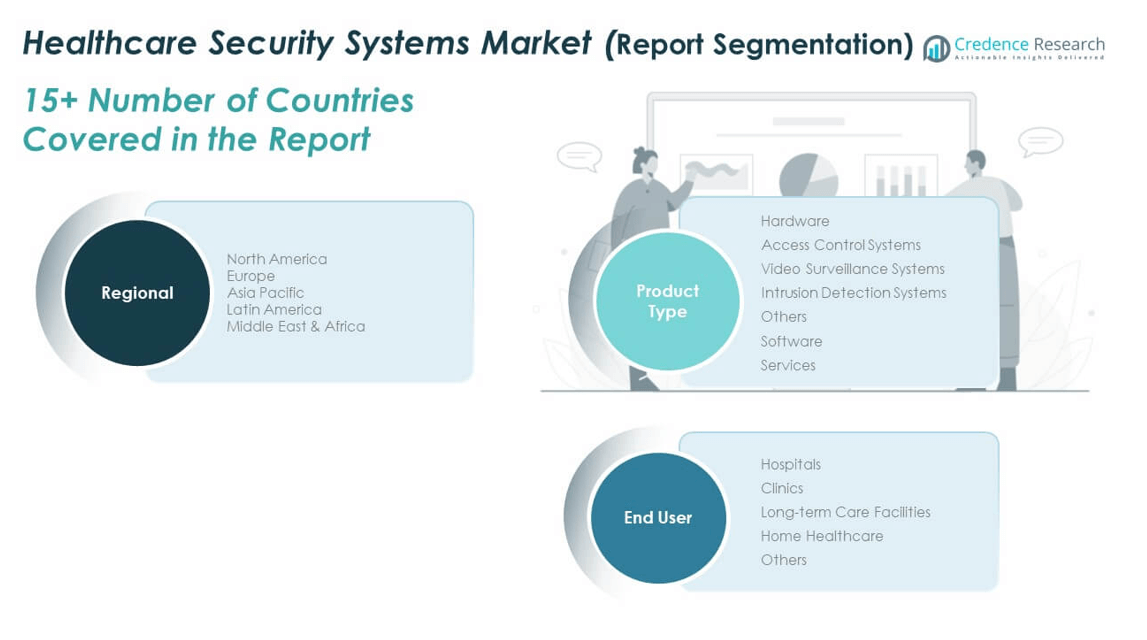
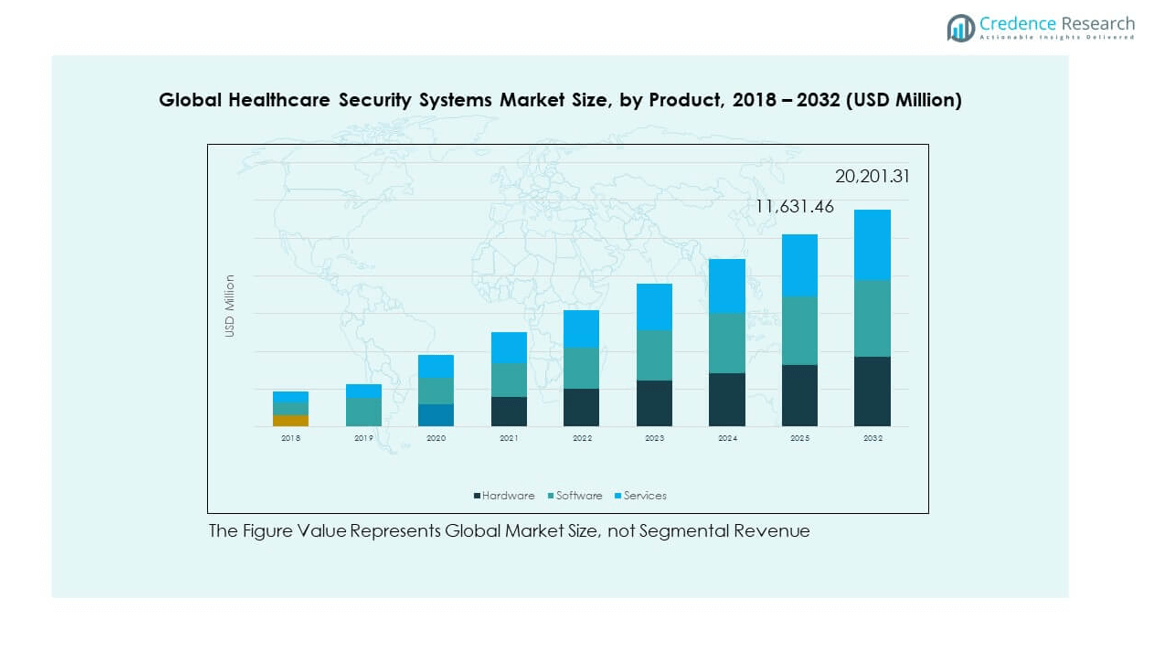
The Healthcare Security Systems Market is segmented by product into hardware, software, and services.
By product type, hardware solutions, access control systems hold a dominant share due to their critical role in restricting unauthorized physical entry to sensitive areas. Video surveillance systems are widely deployed for real-time monitoring, especially in emergency departments, pharmacies, and data centers. Intrusion detection systems gain traction in hospitals and clinics with growing security awareness. The hardware segment leads in terms of revenue, driven by mandatory compliance and infrastructure upgrades. Software solutions provide network security, real-time alerts, and integration with hospital management systems. Demand for cloud-based platforms and cybersecurity software continues to increase. The services segment includes installation, maintenance, and monitoring, which support long-term functionality and optimization of security systems.
- For instance, many hospitals implement RFID access cards, smart locks, and biometric readers. ASSA ABLOY, a leading global provider, delivers physical hardware such as RFID cards, controllers, and readers that enable secure access to restricted areas like pharmacies, data centers, and patient records rooms.
By end user, hospitals represent the largest segment owing to their expansive infrastructure and higher security risks. Clinics and long-term care facilities show steady adoption of basic surveillance and access systems. Home healthcare drives emerging demand for mobile-compatible security tools. The market adapts to each segment's operational scale and specific security priorities. It continues to expand with tailored offerings for varied healthcare environments.
- For instance, the rise in home healthcare has increased demand for mobile-compatible security platforms. Vendors now provide mobile threat prevention, endpoint protection, and secure remote access tools tailored to support virtual care delivery and mobile healthcare workforce operations.
Segmentation:
By Product:
- Hardware
- Access Control Systems
- Video Surveillance Systems
- Intrusion Detection Systems
- Others
- Software
- Services
By End User:
- Hospitals
- Clinics
- Long-term Care Facilities
- Home Healthcare
- Others
By Region:
- North America
- U.S.
- Canada
- Mexico
- Europe
- Germany
- France
- U.K.
- Italy
- Spain
- Rest of Europe
- Asia Pacific
- China
- Japan
- India
- South Korea
- South-east Asia
- Rest of Asia Pacific
- Latin America
- Brazil
- Argentina
- Rest of Latin America
- Middle East & Africa
- GCC Countries
- South Africa
- Rest of the Middle East and Africa
Regional Analysis:
North America
The North America Healthcare Security Systems Market size was valued at USD 2,384.56 million in 2018 to USD 3,473.02 million in 2024 and is anticipated to reach USD 6,442.20 million by 2032, at a CAGR of 8.2% during the forecast period. North America accounted for 32.02% of the global market in 2024. The region leads the market due to widespread implementation of digital health infrastructure and strict data protection regulations. It benefits from early adoption of technologies such as AI-driven surveillance and zero-trust cybersecurity models. Hospitals and health systems in the U.S. and Canada prioritize cybersecurity investment in response to rising ransomware threats. Strong public and private sector collaboration fosters rapid deployment of security upgrades. The presence of major security solution vendors accelerates innovation and adoption. Cloud-based security platforms are widely used across healthcare networks in the region. North America maintains leadership due to its technology maturity and compliance-driven culture.
Europe
The Europe Healthcare Security Systems Market size was valued at USD 1,988.74 million in 2018 to USD 2,992.93 million in 2024 and is anticipated to reach USD 5,791.72 million by 2032, at a CAGR of 8.7% during the forecast period. Europe held 27.60% of the global market share in 2024. Healthcare organizations in the region adopt integrated security solutions to comply with GDPR and other national regulations. It shows high demand for identity and access management systems, video analytics, and threat intelligence platforms. Countries like Germany, France, and the UK drive market expansion through investments in smart hospitals and eHealth. The market is supported by consistent funding from national health systems. Vendors benefit from strong procurement frameworks and centralized security planning. The region’s aging population increases healthcare service demand, further emphasizing secure digital transformation. Europe continues to grow due to its emphasis on patient privacy and operational resilience.
Asia Pacific
The Asia Pacific Healthcare Security Systems Market size was valued at USD 1,757.79 million in 2018 to USD 2,577.92 million in 2024 and is anticipated to reach USD 4,826.09 million by 2032, at a CAGR of 8.3% during the forecast period. Asia Pacific contributed 23.76% to the global market in 2024. The region shows rapid growth due to increasing investments in healthcare digitization and infrastructure development. Countries such as China, India, Japan, and South Korea deploy modern surveillance and cybersecurity systems across hospital networks. Rising adoption of telemedicine and connected medical devices prompts demand for robust endpoint protection. Government initiatives in smart healthcare accelerate market expansion. Security vendors tailor offerings to suit localized needs and regulatory environments. Language-specific interfaces and scalable cloud models gain traction across public and private hospitals. Asia Pacific is positioned as a high-growth region due to its large population base and fast digital adoption.
Latin America
The Latin America Healthcare Security Systems Market size was valued at USD 627.52 million in 2018 to USD 849.23 million in 2024 and is anticipated to reach USD 1,414.09 million by 2032, at a CAGR of 6.7% during the forecast period. Latin America accounted for 7.83% of the global market in 2024. The region witnesses growing adoption of security systems amid rising threats to healthcare infrastructure. Countries such as Brazil, Mexico, and Chile invest in surveillance and data protection tools to enhance hospital safety. Budget constraints remain a key challenge, leading to phased implementation of solutions. The private healthcare sector leads in integrating digital security systems. Public hospitals focus on upgrading legacy systems through pilot programs and international partnerships. Cloud-based platforms and mobile-accessible security tools gain popularity. Vendors offer cost-effective packages that align with local compliance norms. Latin America shows moderate growth driven by urban healthcare development and regulatory evolution.
Middle East
The Middle East Healthcare Security Systems Market size was valued at USD 478.99 million in 2018 to USD 683.42 million in 2024 and is anticipated to reach USD 1,232.28 million by 2032, at a CAGR of 7.8% during the forecast period. The Middle East contributed 6.30% of the global market in 2024. The region advances in healthcare security through high investment in hospital infrastructure and smart city initiatives. Gulf countries such as UAE and Saudi Arabia deploy biometric access controls, smart ID systems, and cloud-native cybersecurity platforms. Rising medical tourism and international accreditation requirements enhance demand for advanced security protocols. Hospitals integrate surveillance with building automation and IoT platforms. Cross-border collaborations and foreign technology adoption accelerate deployment. The region focuses on security as part of healthcare modernization. It maintains growth momentum due to strategic health sector reforms and rising patient volume.
Africa
The Africa Healthcare Security Systems Market size was valued at USD 188.63 million in 2018 to USD 271.35 million in 2024 and is anticipated to reach USD 494.93 million by 2032, at a CAGR of 7.9% during the forecast period. Africa held 2.50% of the global market in 2024. The region remains in an early phase of healthcare security implementation. Public health systems prioritize basic infrastructure development, with gradual integration of surveillance and data security. Countries such as South Africa, Nigeria, and Kenya drive demand through private sector healthcare growth. International aid programs and NGO support aid digitization efforts in rural hospitals. Security adoption focuses on theft prevention, patient monitoring, and electronic health record protection. Vendors entering the African market tailor offerings for low-bandwidth and mobile-first environments. The market exhibits steady progress due to rising awareness and incremental investments in health tech.
Key Player Analysis:
- Siemens AG
- Bosch Security Systems
- Tyco Integrated Security
- Honeywell International, Inc.
- Schneider Electric
- Cisco Systems, Inc.
- Avigilon Corporation
- Nedap Security Management
- Stanley Security Solutions
- Genetec Inc.
- Other Key Players
Competitive Analysis:
The Healthcare Security Systems Market features a mix of global technology leaders, specialized security firms, and regional solution providers. Key players include Siemens Healthineers, Johnson Controls, Honeywell, GE HealthCare, and Bosch Security Systems. These companies compete on innovation, scalability, and compliance-oriented solutions. The market favors vendors that offer integrated physical and cybersecurity systems tailored for healthcare workflows. It continues to evolve with increasing partnerships between health IT providers and security technology firms. Strategic acquisitions and product launches strengthen competitive positioning. Companies focus on AI integration, cloud capabilities, and zero-trust architecture to differentiate offerings. It shows a trend toward end-to-end platforms that reduce complexity and enhance operational efficiency.
Recent Developments:
- In July 2025, Axonius, a global leader in cyber asset intelligence, announced its acquisition of Cynerio, a pioneer in medical device security, for over $100 million. This acquisition aims to tackle the significant security risks associated with the proliferation of connected medical devices in healthcare settings, which have often gone unprotected and invisible to traditional security tools.
- In June 2025, Genetec launched Security Center SaaS, a cloud-based security platform developed to allow healthcare organizations to deploy both cloud and on-premises systems for enhanced flexibility and protection. This new solution enables healthcare entities to scale their security systems efficiently and maintain robust defenses for their facilities and sensitive data.
- In January 2025, Siemens AGlaunched an Apple Wallet-integrated mobile access solution for its Building X Security Manager. This innovation enables secure building entry for healthcare staff and patients using Apple devices, streamlining secure access and enhancing convenience within healthcare facilities.
Market Concentration & Characteristics:
The Healthcare Security Systems Market demonstrates moderate concentration, with a few large players holding significant market share across high-value regions such as North America and Europe. It is characterized by rapid innovation, high regulatory alignment, and a growing demand for customized, interoperable solutions. Tier-1 companies dominate enterprise-level hospital networks, while regional players address smaller facilities with localized offerings. It supports both hardware-intensive and cloud-based models, driven by the evolving nature of healthcare delivery and digital threats. Competitive dynamics emphasize technological adaptability, compliance, and service integration. The market remains sensitive to healthcare reforms and funding cycles across regions.
Report Coverage:
The research report offers an in-depth analysis based on product and end-user It details leading market players, providing an overview of their business, product offerings, investments, revenue streams, and key applications. Additionally, the report includes insights into the competitive environment, SWOT analysis, current market trends, as well as the primary drivers and constraints. Furthermore, it discusses various factors that have driven market expansion in recent years. The report also explores market dynamics, regulatory scenarios, and technological advancements that are shaping the industry. It assesses the impact of external factors and global economic changes on market growth. Lastly, it provides strategic recommendations for new entrants and established companies to navigate the complexities of the market.
Future Outlook:
- Rising adoption of AI and machine learning will enhance threat detection and automate incident response in healthcare settings.
- Cloud-based security platforms will see greater implementation due to scalability and lower maintenance costs.
- Integration of physical and cybersecurity systems will become standard in modern healthcare infrastructure.
- Growing demand for remote healthcare services will increase the need for secure telehe
- alth and mobile access solutions.
- Regulatory pressure will drive investment in identity management and compliance-focused security frameworks.
- Emerging markets will accelerate adoption through government-backed healthcare digitization programs.
- Biometric authentication and real-time monitoring tools will become more prevalent in high-risk hospital zones.
- Partnerships between healthcare providers and cybersecurity firms will intensify to address evolving threat landscapes.
- Vendors will focus on modular and interoperable systems to support diverse healthcare facility needs.
- Continued innovation in IoT device security will protect connected medical equipment from cyber intrusions.
Request a Free Sample
Fill in your details and we'll send you a free sample report.
- Sample data tables & charts
- Research methodology
Need a Custom Version of This Report?
Tailor the scope, geography, or segments to your exact requirements.
- Custom geography or segment scope
- Direct access to our analyst team
Frequently Asked Questions
What is the current market size for Healthcare Security Systems Market, and what is its projected size in 2032?
Which Healthcare Security Systems Market segment held the largest share in 2024?
Who are the leading companies in the Healthcare Security Systems Market?
Who are the major players in this market?
Table of Content
Chapter 1. Report Introduction
- 1.1 Report Description & Purpose
- 1.1.1 Report Title & Market Definition
- 1.1.2 Unique Selling Propositions (USP) & Key Differentiators
- 1.1.3 Value Proposition for Stakeholders
- 1.2 Research Objectives
- 1.2.1 Market Sizing Objectives (Volume & Revenue) (Volume Where Applicable)
- 1.2.2 Segmentation Objectives
- 1.2.3 Competitive Intelligence Objectives
- 1.2.4 Forecast & Scenario Objectives
- 1.3 Report Scope
- 1.3.1 Healthcare Security Systems Scope – Segments & Subsegments Covered
- 1.3.2 Geographic Scope – Regions & Countries Covered
- 1.3.3 Historical Period, Base Year & Forecast Period (2024; forecast to 2032)
- 1.3.4 Inclusions & Exclusions
- 1.4 Industry Classification & Applicable Codes
- 1.5 Currency, Measurement Units & Valuation Basis
- 1.6 Target Stakeholders
- 1.7 Limitations & Assumptions
Chapter 2. Executive Summary
- 2.1 Global Healthcare Security Systems Market Snapshot
- 2.1.1 Market Size – Historical (2024) & Forecast (2024-2032) (2024: USD 10,847.9 million → 2032: USD 20,201.3 million)
- 2.1.2 Volume & Revenue – Global Totals (Volume Where Applicable)
- 2.1.3 Key Market Highlights – Top Five Facts
- 2.2 Healthcare Security Systems Market Segmentation Snapshot
- 2.2.1 Market Split by Region – 2024 vs. 2032
- 2.3 Competitive Snapshot
- 2.3.1 Top 10 Players by Revenue Share – 2024
- 2.3.2 Top 10 Players by Volume Share – 2024 (Volume Where Applicable)
- 2.3.3 Recent Strategic Developments (18-Month Summary)
- 2.4 Key Investment Highlights & Strategic Conclusions
Chapter 3. Healthcare Security Systems Market Dynamics & Industry Analysis
- 3.1 Market Overview & Context
- 3.1.1 Healthcare Security Systems Market Position in the Broader Industry Value Chain
- 3.1.2 Demand Structure & Purchasing Dynamics
- 3.1.3 Market Maturity & Development Stage by Region
- 3.2 Healthcare Security Systems Market Drivers
- 3.3 Healthcare Security Systems Market Restraints & Challenges
- 3.4 Healthcare Security Systems Market Opportunities
- 3.5 Porter's Five Forces Analysis
- 3.5.1 Threat of New Entrants
- 3.5.2 Bargaining Power of Suppliers
- 3.5.3 Bargaining Power of Buyers
- 3.5.4 Threat of Substitutes
- 3.5.5 Competitive Rivalry – Intensity Assessment
- 3.6 Healthcare Security Systems Value Chain Analysis
- 3.6.1 Upstream – Key Inputs, Resources & Suppliers
- 3.6.1.1 Key Input/Resource 1
- 3.6.1.2 Key Input/Resource 2
- 3.6.1.3 Key Input/Resource 3
- 3.6.2 Midstream – Core Operations & Value Creation
- 3.6.2.1 Operating Model & Process Overview
- 3.6.2.2 Key Operating Locations & Capabilities by Company
- 3.6.3 Downstream – Market Channels & End Users
- 3.6.3.1 Direct Sales & Customer Engagement Channels
- 3.6.3.2 Indirect Sales, Intermediaries & Partner Channels
- 3.6.4 Value Chain Profitability Analysis
- 3.6.1 Upstream – Key Inputs, Resources & Suppliers
- 3.7 PESTEL Analysis
- 3.7.1 Political Factors
- 3.7.2 Economic Factors
- 3.7.3 Social Factors
- 3.7.4 Technological Factors
- 3.7.5 Environmental Factors
- 3.7.6 Legal Factors
- 3.8 Healthcare Security Systems Supply Chain Analysis
- 3.8.1 Critical Input & Resource Availability Risk Assessment
- 3.8.2 Supplier & Operational Concentration Risk (Geographic Exposure)
- 3.8.3 Supply & Service Disruption Impact Analysis
- 3.9 Regulatory & Policy Landscape
Note: The regulatory and policy landscape section covers regulations based on their applicability to the market, Healthcare Security Systems category, geography, and scope of the study. Only regulatory frameworks with a material impact on operations, compliance, trade, sustainability, or market access are analyzed in detail.
Chapter 4. Key Investment Pockets & Opportunity Analysis
- 4.1 Healthcare Security Systems Market Attractiveness Analysis
- 4.1.1 By Region – Investment Attractiveness Matrix (Market Size × CAGR)
- 4.2 Absolute Revenue Growth Opportunity
- 4.2.1 By Region – Absolute Revenue Growth Through 2032
- 4.3 Incremental Demand Opportunity
- 4.3.1 By Region – Incremental Demand Through 2032
- 4.3.2 Segment – Incremental Demand
- 4.4 Emerging Submarket Opportunity Deep Dive (Subject to Applicability)
- 4.5 Priority Market Opportunity Scorecards
- 4.5.1 United States
- 4.5.2 Europe
- 4.5.3 Asia
- 4.5.4 Middle East & Africa
Note: Priority market opportunity scorecards reflect the geographic scope and strategic relevance of the study. Listed markets are indicative and may be adapted to the industry.
Chapter 5. Healthcare Security Systems Cross-Border Trade & Market Access Analysis
- 5.1 International Trade & Cross-Border Activity Overview
- 5.1.1 Global Export Value by Country (2024)
- 5.1.2 Global Export Volume by Country (2024) (Volume Where Applicable)
- 5.1.3 Global Import Value by Country (2024)
- 5.1.4 Global Import Volume by Country (2024) (Volume Where Applicable)
- 5.1.5 Net Trade Balance by Country (2024)
- 5.2 Export Analysis – Segment
- 5.2.1 Category 1 (Applicable Classification Code)
- 5.2.2 Category 2 (Applicable Classification Code)
- 5.2.3 Category 3 (Applicable Classification Code)
- 5.2.4 Category 4 (Applicable Classification Code)
- 5.2.5 Category 5 (Applicable Classification Code)
- 5.3 Import Analysis – Segment
- 5.3.1 Category 1 (Applicable Classification Code)
- 5.3.2 Category 2 (Applicable Classification Code)
- 5.3.3 Category 3 (Applicable Classification Code)
- 5.3.4 Category 4 (Applicable Classification Code)
- 5.3.5 Category 5 (Applicable Classification Code)
- 5.4 Cross-Border Pricing & Transaction Benchmarks
- 5.4.1 Export Pricing – Segment & Country
- 5.4.2 Import Pricing – Segment & Source Country
- 5.4.3 Price Trends (2024)
- 5.5 Key Cross-Border Trade & Delivery Routes
- 5.5.1 Cross-Border Trade/Delivery Route 1
- 5.5.2 Cross-Border Trade/Delivery Route 2
- 5.5.3 Cross-Border Trade/Delivery Route 3
- 5.5.4 Cross-Border Trade/Delivery Route 4
- 5.5.5 Cross-Border Trade/Delivery Route 5
- 5.6 Trade Policy & Market Access Impact Assessment
- 5.6.1 Tariff & Non-Tariff Barriers
- 5.6.2 Regional Trade & Economic Integration Frameworks
- 5.6.3 Bilateral & Multilateral Trade Agreements
- 5.6.4 Cross-Border Operating, Licensing & Localization Requirements
Note: This chapter applies where cross-border trade or delivery is relevant to Healthcare Security Systems. Goods, services, and digital offerings are assessed using applicable classifications and transaction measures. Import-export volumes, trade balances, and route analyses are included only where meaningful to the market.
Chapter 6. Competitive Landscape & Company Benchmarking
- 6.1 Healthcare Security Systems Market Concentration & Structure
- 6.1.1 Herfindahl-Hirschman Index (HHI) – vs. 2024
- 6.1.2 Leading, Mid-Sized & Emerging Player Structure
- 6.1.3 Global, Regional & Local Player Dynamics
- 6.2 Healthcare Security Systems Market Share Analysis – 2024
- 6.2.1 Global Revenue Share by Company
- 6.2.2 Global Volume Share by Company (Volume Where Applicable)
- 6.2.3 Regional Revenue Share
- 6.2.4 Market Share Evolution ( vs. 2024)
- 6.2.5 Company Market Share by Key Segment
- 6.2.6 Company Market Share by Customer Group
- 6.3 Operating Scale, Capacity & Infrastructure Analysis
- 6.3.1 Global Operating Scale & Supply Capacity
- 6.3.2 Resource Utilization & Operating Efficiency
- 6.3.3 Output, Service Delivery & Activity Metrics
- 6.3.4 Operating Footprint & Infrastructure Map
- 6.3.5 Planned Operational & Capacity Expansion
- 6.4 Healthcare Security Systems Competitive Benchmarking Matrix
- 6.4.1 Revenue, Growth, Profitability & Operating Metric Comparison
- 6.4.2 Channel Revenue Mix
- 6.4.3 Geographic Revenue Exposure
- 6.4.4 R&D Intensity
- 6.4.5 Sustainability Maturity
- 6.5 Strategic Developments in Healthcare Security Systems (Last 24 Months)
- 6.5.1 Mergers, Acquisitions & Divestments
- 6.5.2 New Products, Services & Solutions in Healthcare Security Systems
- 6.5.3 Operational & Infrastructure Expansions
- 6.5.4 Strategic Alliances, Joint Ventures & Partnerships
- 6.5.5 Distribution Expansion & Market Entry
- 6.5.6 Sustainability & ESG Initiatives
- 6.6 Competitive Strategy Mapping
- 6.6.1 Leader, Challenger, Follower & Niche Classification
- 6.6.2 Pricing Strategy Comparison
- 6.6.3 Channel Strategy Matrix
Note: Strategic developments are included based on their materiality and the availability of reliable information.
Chapter 7. Global Healthcare Security Systems Market – By Sales & Delivery Channel
- 7.1 Segment Overview
- 7.1.1 Volume & Revenue Split by Channel (2024 & 2032) (Volume Where Applicable)
- 7.1.2 Channel Mix Evolution (2024-2032)
Chapter 8. Regional Market Analysis – Global Overview
- 8.1 Global Regional Overview
- 8.1.1 Regional Volume Share (Volume Where Applicable)
- 8.1.2 Regional Revenue Share
- 8.1.3 Regional Volume by Region (Volume Where Applicable)
- 8.1.4 Regional Revenue by Region
- 8.1.5 Regional Forecast Through 2032
- 8.2 Cross-Regional Segment Analysis
- 8.2.1 By Sales & Delivery Channel
- 8.2.2 By Competitive Positioning & Price Tier
Chapter 9. North America Healthcare Security Systems Market
- 9.1 United States
- 9.2 Canada
- 9.3 Mexico
Chapter 10. Europe Healthcare Security Systems Market
- 10.1 Germany
- 10.2 France
- 10.3 Italy
- 10.4 United Kingdom
- 10.5 Spain
- 10.6 Poland
- 10.7 Russia
- 10.8 Netherlands
- 10.9 Belgium
- 10.10 Sweden
- 10.11 Denmark
- 10.12 Norway
- 10.13 Rest of Europe
Chapter 11. Asia Pacific Healthcare Security Systems Market
- 11.1 China
- 11.2 India
- 11.3 Japan
- 11.4 South Korea
- 11.5 Thailand
- 11.6 Indonesia
- 11.7 Vietnam
- 11.8 Malaysia
- 11.9 Australia
- 11.10 Rest of Asia Pacific
Chapter 12. Latin America Healthcare Security Systems Market
- 12.1 Brazil
- 12.2 Argentina
- 12.3 Colombia
- 12.4 Chile
- 12.5 Rest of Latin America
Chapter 13. Middle East Healthcare Security Systems Market
- 13.1 Saudi Arabia
- 13.2 United Arab Emirates
- 13.3 Turkey
- 13.4 Israel
- 13.5 Iran
- 13.6 Rest of the Middle East
Chapter 14. Africa Healthcare Security Systems Market
- 14.1 South Africa
- 14.2 Egypt
- 14.3 Nigeria
- 14.4 Morocco
- 14.5 Rest of Africa
Chapter 15. Healthcare Security Systems Company Profiles
- 15.1 [Company 01]
- 15.1.1 Company Overview
- 15.1.2 Key Management Personnel
- 15.1.3 Products & Services Portfolio
- 15.1.4 Financial Performance
- 15.1.5 Key Market Focus & Geographic Presence
- 15.1.6 Recent Developments & Strategic Initiatives
Note: The company profile list is preliminary and may change based on research findings, market developments, data availability, and client requirements.
Chapter 16. Appendices
- Appendix A – List of Abbreviations & Acronyms
- Appendix B – Industry Classification Code Reference – Full Series
- Appendix C – Supply, Output & Operating Capacity Data Tables
- Appendix D – End-Use & Demand Base Tables
- Appendix E – Demand, Adoption & Usage Assumptions
- Appendix F – Pricing & Revenue Metric Reference Tables
- Appendix G – Company Operations & Infrastructure Database
- Appendix H – Cross-Border Trade & Activity Data Tables (Where Applicable)
- Appendix I – Regulatory Summary Tables
- Appendix J – Primary Research Participant List (Anonymized)
- Appendix K – Primary Research Questionnaire Framework
- Appendix L – Data Sources & Bibliography
- Appendix M – Market Size Divergence & Source Comparison
Chapter 17. Research Methodology
- 17.1 Research Framework & Philosophy
- 17.2 Secondary Research – Sources, Hierarchy & Data Extraction
- 17.3 Data Modeling – Bottom-Up & Top-Down Market Sizing
- 17.4 Primary Research – Stakeholder Framework, LOI & Sample Sizes
- 17.5 Forecast Methodology – Regression, Scenario & Sensitivity Analysis
- 17.6 Quality Control – Four-Layer Validation Framework
- 17.7 Limitations & Standard Assumptions
- 17.8 Disclaimer
