
| REPORT ATTRIBUTE | DETAILS |
|---|---|
| Historical Period | 2019-2022 |
| Base Year | 2023 |
| Forecast Period | 2024-2032 |
| Healthcare Tele-Consultation Services Market Size 2023 | USD 3181.20 Million |
| Healthcare Tele-Consultation Services Market CAGR | 2430% |
| Healthcare Tele-Consultation Services Market Size 2032 | USD 22533.63 Million |
Market Insights
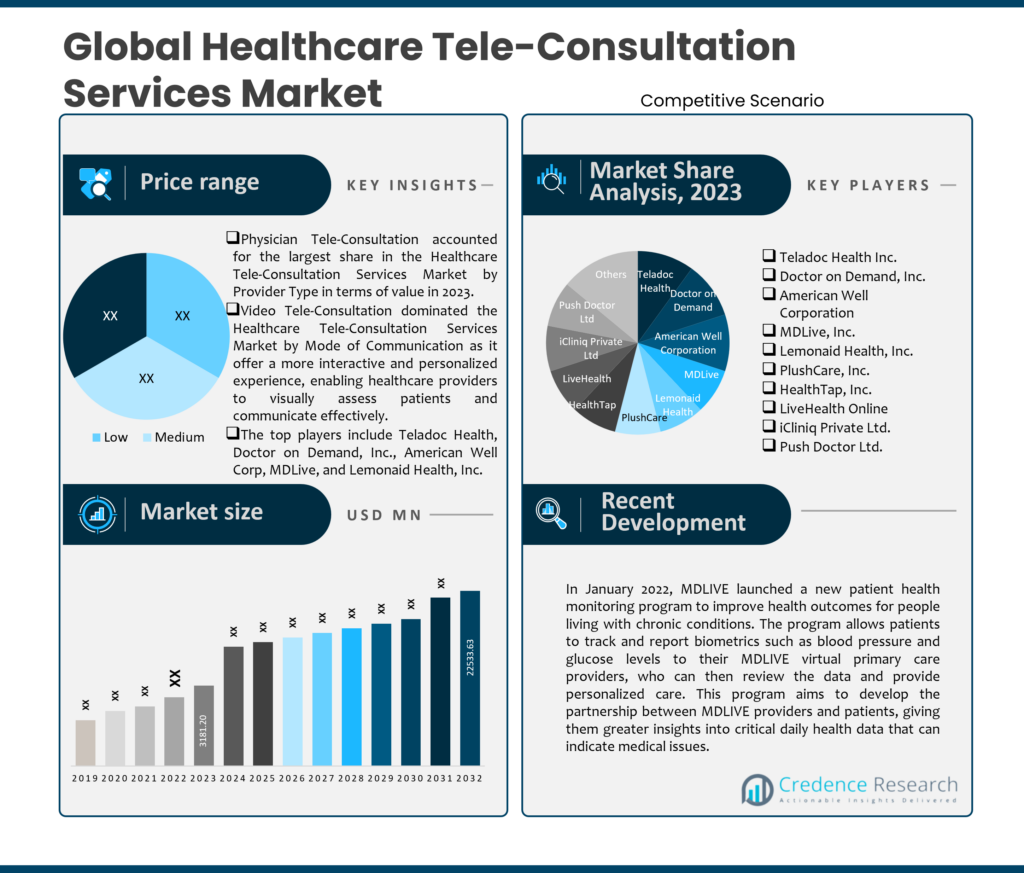
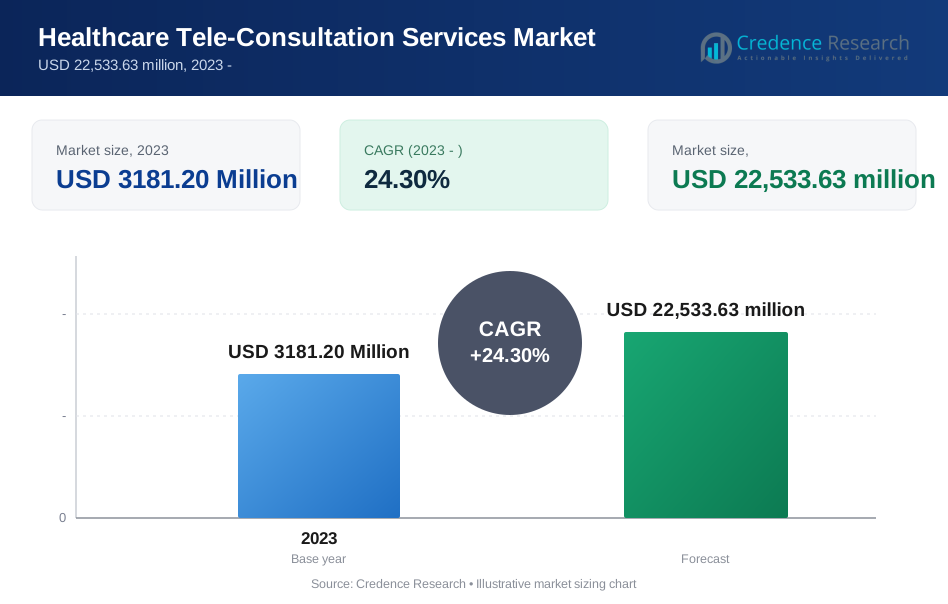
- The global demand for Healthcare Tele-Consultation Services was valued at USD 3181.20 Million in 2023 and is expected to reach USD 22533.63 Million in 2032, growing at a CAGR of 24.30% between 2024 and 2032.
- The physician tele-consultation is the market leader by provider type, accounting for a significant portion of total value is 2023, while the mental health tele-consultation segment is expected to grow rapidly throughout the forecast period.
- The video tele-consultation segment dominates the global need by mode of communication for healthcare tele-consultation, accounting for a significant portion in 2023. The chat/text tele-consultation segment is predicted to expand at a high CAGR.
- Over the projection period, geriatric tele-consultation is expected to expand at the highest rate, while adult tele-consultation will dominate the market in 2023 with a substantial share.
- The primary care tele-consultation segment will have the dominant portion, with a substantial market share in 2023, while the chronic disease tele-consultation segment is expected to grow at the highest rate.
- North America is dominating the healthcare tele-consultation services industry with a substantial share in 2023, while Asia Pacific is expected to grow at the highest rate during the forecast period.
- The market's primary possibilities include advancements in AI, ML, and data analytics technology, along with the integration of chatbots for instant patient support and assistance.
Executive Summary
Market Definition
Healthcare Tele-Consultation Services refer to the remote provision of medical advice, diagnosis, treatment planning, and follow-up care through telecommunications technology. This service allows patients to consult with healthcare professionals, such as doctors, specialists, or therapists, without the need for in-person visits. Utilizing audio, video, and digital communication platforms, tele-consultations enable individuals to discuss their health concerns, receive expert guidance, and obtain prescriptions or referrals as necessary. Tele-consultation services play a crucial role in modern healthcare delivery, allowing continuity of care, improving patient outcomes, and expanding access to medical expertise.
Market Overview
The global Healthcare Tele-Consultation Services Market has witnessed steady growth in recent years and is expected to grow at a CAGR of 24.30% between 2024 and 2032. The market was valued at USD 3181.20 million in 2023 and is expected to reach USD 22533.63 million in 2032.
The key driver accelerating the growth rate of the healthcare tele-consultation services market is the continuous advancements in telecommunications technology, including high-speed internet, mobile devices, and telehealth platforms, that have made tele-consultation services more accessible and user-friendly. This increased accessibility has been instrumental in broadening the reach of tele-consultation services, enabling individuals to connect with healthcare professionals, regardless of their location, easily.
Moreover, the COVID-19 pandemic has accelerated the recognition of telehealth as a vital component of modern healthcare delivery, leading to greater acceptance and utilization of remote consultation services among patients and healthcare providers. Additionally, by minimizing travel expenses, decreasing hospital admissions, and optimizing resource utilization, tele-consultations offer a cost-effective alternative to traditional in-person visits. This cost-effectiveness has contributed to the growing adoption of tele-consultation services, particularly among individuals seeking affordable and accessible healthcare options.
Furthermore, the increasing prevalence of chronic conditions such as diabetes, hypertension, and heart disease globally has further fueled the demand for tele-consultation services. These conditions require ongoing monitoring and management, which tele-consultations facilitate by offering convenient and regular access to healthcare professionals. Also, the integration of tele-consultation platforms with electronic health record systems has streamlined data sharing and ensured continuity of patient information between healthcare providers.
Segmentation by Provider Type
- Physician tele-consultation is the leading segment by provider type and will hold a substantial share in 2023, owing to physicians' extensive medical expertise and regulatory compliance mandating licensed professionals for diagnosis and treatment.
- The mental health tele-consultation segment is expected to exhibit a significant CAGR during the forecast period owing to rising awareness and efforts to reduce the stigma associated with mental health issues, and the convenience and accessibility offered by tele-consultation platforms.
- The nurse tele-consultation and specialist tele-consultation significantly contribute to the market growth.
Segmentation by Mode of Communication
- The video tele-consultation segment boasts the dominating position in the healthcare tele-consultation services industry, holding a massive share in 2023. This is due to the provision of visual assessments, allowing healthcare providers to observe physical symptoms and gestures, which are crucial for accurate diagnosis and treatment planning.
- The chat/text tele-consultation segment is expected to grow with the highest CAGR during the projected period due to technological advancements, such as AI-powered chatbots and natural language processing algorithms, which have enhanced the capabilities of Chat/Text Tele-Consultation platforms.
- The Phone Tele-Consultation segment further contributes to the growth of the market.
Segmentation by Patient Demographics
- The adult tele-consultation boasts the dominating position in the healthcare tele-consultation services industry, holding a massive share in 2023. Adults often have complex healthcare needs and may require regular consultations for chronic conditions, preventive care, and general health maintenance.
- Geriatric tele-consultation is expected to grow at the highest rate due to the challenges faced by older adults accessing traditional healthcare services due to mobility issues, transportation limitations, and health conditions that make it difficult for them to visit healthcare facilities in person.
- The pediatric tele-consultation sector also significantly contributes to the growth of the market.
Segmentation by Specialty Focus
- The Chronic disease tele-consultation is expected to post the highest CAGR during the forecast period. This is primarily due to the rising prevalence of chronic diseases such as diabetes, hypertension, cardiovascular diseases, and respiratory conditions globally.
- The primary care tele-consultation is leading the market share with a significant share in 2023. This is attributed to the high demand for primary care services, including consultations for routine health issues, preventive care, chronic disease management, and minor acute illnesses.
Segmentation by Region
- North America is fueling the growth of the healthcare tele-consultation services industry, with a massive share in 2023 due to the region's higher prevalence of chronic diseases and large elderly population.
- The Asia Pacific market is expected to grow at the highest rate during the forecasted period.
- The rest of the world, including Latin America, the Middle East, and Africa, supplies the remaining demand for the Healthcare Tele-Consultation Services industry.
In North America, the growth of the healthcare tele-consultation services market is being driven by the region's higher prevalence of chronic diseases and a large elderly population. With chronic diseases on the rise, there is a growing demand for accessible healthcare services, especially among older adults with mobility issues or difficulty accessing traditional healthcare facilities. This demographic trend is prompting healthcare providers to adopt tele-consultation services to meet the evolving needs of their patient population. For instance, the Harvard Health Letter article highlights the significant rise of remote patient monitoring devices in the United States, with approximately 50 million people currently using such devices. Moreover, the MSI International survey indicates strong public support for remote patient monitoring, with 80% of Americans in favor of its use and nearly half expressing a very favorable attitude toward its incorporation into medical care.
Furthermore, North America's dedication to innovation, particularly in the healthcare sector, has fueled the market growth of tele-consultation services. The AHA’s Leadership Summit serves as a platform for introducing innovative approaches to healthcare delivery and patient monitoring. For instance, the Henry Ford Health System, based in Detroit, has successfully expanded behavioral health integration through 100% virtual care, leading to positive patient satisfaction, high rates of depression & anxiety remission, and reductions in physician burnout and administrative burden. Similarly, Northern Light Health in Maine has leveraged technology to enhance the care experience by implementing patient self-scheduling, on-demand telehealth, and e-consults to improve access to subspecialists. As healthcare providers continue to prioritize patient-centered care and leverage advancements in technology, the healthcare tele-consultation services market in the region is expected to witness sustained growth and expansion, catering to the diverse healthcare needs of the population.
On the other hand, the Asia Pacific region is experiencing rapid urbanization and population growth, leading to increased demand for healthcare services. Tele-consultation services offer a convenient and efficient way to manage this growing demand by reducing wait times, optimizing resource allocation, and improving overall healthcare efficiency. Additionally, with the high penetration of internet and smartphone users and the rapidly growing population of mobile subscribers, the Asia Pacific region presents a vast market opportunity for telehealth providers. According to GSMA Intelligence, the number of mobile subscribers in Asia Pacific totaled 1.7 billion in 2022, and this figure is projected to rise to 2.1 billion by 2030. This exponential growth in mobile connectivity enables individuals to utilize tele-consultation services for their healthcare needs.
Moreover, the penetration of smartphone connections in Asia Pacific was 76% in 2022, and it is predicted to reach 94% by 2030. The widespread availability and adoption of smartphones contribute to the accessibility and convenience of tele-consultation services in the Asia Pacific region. Furthermore, virtual care, which includes tele-consulting, telepathology, teleradiology, and e-pharmacy, is experiencing significant growth in countries such as India. For instance, by September 21, 2021, the Health Ministry's eSanjeevani telehealth service crossed 12 million teleconsultations since its launch. This service enables patient-to-doctor consultations from the confines of their homes, as well as doctor-to-doctor consultations, illustrating the increasing adoption and acceptance of telehealth solutions in the region.
Key Highlights of the Report
The global healthcare tele-consultation services market is segmented by provider type, mode of communication, patient demographics, specialty focus, and region. Physician Tele-Consultation is the most popular provider, while Video Tele-Consultation is the primary segment in the mode of communication. In addition, primary care tele-consultation is the most demanding service, with the North American region leading the market growth.
The main factors propelling the global market for healthcare tele-consultation services are the continuous advancements in telecommunications technology and the rising prevalence of chronic conditions worldwide. The cost-effectiveness and convenience offered by tele-consultation services have also significantly contributed to their growing popularity among both patients and healthcare providers.
Nonetheless, North America is anticipated to have the greatest share of the worldwide healthcare tele-consultation services market due to the region's higher prevalence of chronic diseases and a large elderly population. Furthermore, the market is anticipated to expand at the highest rate in the Asia-Pacific region due to the high penetration of internet and smartphone users, and the rapidly growing population of mobile subscribers.
What Are the Main Drivers of the Global Healthcare Tele-Consultation Services Market?
The healthcare tele-consultation services market is propelled by ongoing advancements in telecommunications technology, coupled with the increasing prevalence of chronic conditions worldwide. Moreover, the cost-effectiveness and convenience provided by tele-consultation services have played a significant role in their rising appeal to both patients and healthcare providers. Additionally, the industry is also anticipated to benefit from the integration of tele-consultation platforms with electronic health record (EHR) systems, facilitating seamless data sharing and ensuring continuity of patient information.
What Are the Major Challenges Faced by the Global Healthcare Tele-Consultation Services Market?
Privacy and security concerns present a significant challenge to the widespread adoption of healthcare tele-consultation services. Fraudulent individuals posing as licensed healthcare professionals are a growing threat, potentially exploiting unsuspecting patients seeking remote medical assistance. These concerns undermine patients' confidence in remote healthcare platforms and impede the market's expansion.
What Are the Growth Opportunities in the Global Healthcare Tele-Consultation Services Market?
The integration of AI, ML, and data analytics poses a major opportunity for healthcare tele-consultation services in the future. With AI chatbots providing instant patient support and IoT devices aiding in remote monitoring and data analysis, tele-consultation can offer highly personalized care and efficiency. This advancement is poised to revolutionize healthcare delivery, improving patient outcomes and solidifying tele-consultation's role in the future of healthcare.
Market Drivers
Advancements in Telecommunications Technology
Continuous advancements in telecommunications technology, encompassing high-speed internet, mobile devices, and telehealth platforms, play a pivotal role in driving the growth of the healthcare tele-consultation services market. These advancements have significantly enhanced the accessibility and user-friendliness of tele-consultation services, facilitating broader outreach to individuals irrespective of their geographical location. According to the Gitnux Organization, the global proliferation of mobile phones is forecasted to reach nearly 8.06 billion by 2022, with approximately 53% of all mobile connections projected to operate on 5G networks by the end of 2025. Moreover, with telecommunication companies investing approximately $1.8 trillion in infrastructure between 2010 and 2020, the foundation for seamless connectivity and tele-consultation services has been robustly established on a global scale
Furthermore, the introduction of the next-generation 5G network service by the Indian government has ushered in faster network capabilities, enhancing the tele-consultation experience for patients and driving demand. Telehealth platforms continue to evolve with advancements in mobile phone technology and telecommunications services. Notably, in June 2021, the Digital Medicine Society launched the Digital Health Measurement Collaborative Community (DATAcc), fostering collaborations to develop best practices for measuring health through telehealth platforms. Such collaborative efforts with telecom service providers are anticipated to strengthen healthcare infrastructure, fostering widespread adoption of telehealth consultation services.
Market Restraints
Privacy and Security Concerns
Privacy and security concerns present significant barriers to the widespread adoption of healthcare tele-consultation services, hindering the market's growth. The presence of fraudulent individuals posing as licensed healthcare professionals is a crucial threat, potentially exploiting unsuspecting patients seeking remote medical assistance. These impostors, with fabricated credentials, hamper trust in tele-consultation platforms, deterring patients from engaging in online consultations.
Moreover, the digital nature of tele-consultation services heightens concerns regarding data privacy. These concerns undermine confidence in remote healthcare platforms and impede the market's expansion, highlighting the urgent need for robust privacy measures and security protocols to foster trust and encourage adoption.
Opportunities
Integration of Cutting Edge Technologies in Healthcare
The integration of cutting-edge technologies such as artificial intelligence, machine learning, and data analytics presents a significant opportunity for the future expansion and enhancement of healthcare tele-consultation services. With AI-powered chatbots poised to provide real-time assistance to patients, remote monitoring tools, and Internet of Things (IoT) devices enabling seamless data collection and analysis, there is great potential for personalized, efficient, and accessible healthcare delivery.
By harnessing these technologies, tele-consultation platforms can offer tailored solutions that address individual patient needs while empowering healthcare providers with valuable insights derived from comprehensive patient data. This not only fosters improved patient outcomes but also opens up new avenues for innovation and growth in the telehealth sector, positioning it as a cornerstone of future healthcare delivery models.
Competitive Landscape
Key Players
The global healthcare tele-consultation services market is highly competitive, with several key players. Some of the major players in the market and their market share are as follows:
- Teladoc Health Inc.
- Doctor on Demand, Inc.
- American Well Corporation
- MDLive, Inc.
- Lemonaid Health, Inc.
- PlushCare, Inc.
- HealthTap, Inc.
- LiveHealth Online
- iCliniq Private Limited
- Push Doctor Limited
- K Health, Inc.
- Maple Corporation
- Babylon Health plc
- SteadyMD, Inc.
- 98point6, Inc.
- Heal, Inc.
- Sherpaa Health, Inc.
- Medici Technologies, LLC
- Virtuwell
- Zocdoc, Inc.
- Others
These organizations prioritize product innovation to stay competitive.
The global healthcare tele-consultation services market's key players continually seek to stay ahead by offering new products and developments.
In October 2023, HealthTap, a prominent virtual healthcare provider offering accessible primary care services throughout the U.S., collaborated with Health Gorilla, a privacy-focused health information network and interoperability solution provider. This collaboration is intended to enable physicians to access patient medical records seamlessly from any organization within Health Gorilla's network during HealthTap's virtual doctor visits. Additionally, individuals who register for a free HealthTap account will have the ability to access their medical records.
In July 2023, Teladoc Health announced its partnership with Microsoft to incorporate Microsoft Azure OpenAI Service, Azure Cognitive Services, and the Nuance Dragon Ambient eXperience (DAX) into the Teladoc Health Solo platform. These combined solutions aim to streamline the generation of clinical documentation during virtual examinations, alleviating the workload on healthcare professionals while enhancing the quality of shared medical data and the care it facilitates.
In January 2022, MDLive Inc. launched a new patient health monitoring program to improve health outcomes for people living with chronic conditions. The program allows patients to track and report biometrics such as blood pressure and glucose levels to their MDLIVE virtual primary care providers, who can then review the data and provide personalized care. This program aims to develop the partnership between MDLIVE providers and patients, giving them greater insights into critical daily health data that can indicate medical issues.
How Companies are Performing in the Healthcare Tele-Consultation Services Market?
The global healthcare tele-consultation services market is highly competitive, with several key players.
Startups are playing a significant role in revolutionizing the healthcare tele-consultation services market by introducing innovative solutions to address evolving patient needs, improve access to care, and enhance the overall telehealth experience. The startups are developing user-friendly tele-consultation platforms and mobile applications that offer intuitive interfaces, seamless appointment scheduling, secure video conferencing capabilities, and integrated electronic health record (EHR) systems. Startups such as Teladoc Health, Doctor on Demand, and Amwell are pioneering in this space, offering comprehensive tele-consultation solutions that cater to diverse patient populations.
Additionally, startups are leveraging emerging technologies such as artificial intelligence (AI), machine learning (ML), and natural language processing (NLP) to enhance tele-consultation services. Companies, including Babylon Health and Infermedica, are at the forefront of AI-driven telehealth innovation, developing intelligent systems that augment the capabilities of healthcare providers and enhance the patient experience. Moreover, startups such as Ginger, Talkspace, and BetterHelp are supporting the mental health tele-consultation space by offering on-demand therapy sessions, mental wellness programs, and peer support networks.
Summary of Key Findings
- The demand for healthcare tele-consultation services is increasing due to continuous advancements in telecommunications technology and the rising prevalence of chronic conditions globally. The cost-effectiveness and convenience offered by tele-consultation services have also significantly contributed to their growing popularity among both patients and healthcare providers.
- Market segmented by provider type, mode of communication, patient demographics, specialty focus, and region.
- Physician tele-consultation is the leading segment by provider type and will hold a substantial share in 2023, owing to physicians' extensive medical expertise and regulatory compliance mandating licensed professionals for diagnosis and treatment.
- The video tele-consultation segment boasts the dominating position in the market due to the convenience of visual assessments. These assessments allow healthcare providers to observe physical symptoms and gestures, which are crucial for accurate diagnosis and treatment planning.
- North America is leading market growth; the market is highly competitive with key players including Teladoc Health Inc., Doctor on Demand, Inc., American Well Corporation, MDLive, Inc., Lemonaid Health, Inc., PlushCare, Inc., HealthTap, Inc., LiveHealth Online, iCliniq Private Limited, Push Doctor Limited, K Health, Inc., Maple Corporation, Babylon Health plc, SteadyMD, Inc., 98point6, Inc., Heal, Inc., Sherpaa Health, Inc., Medici Technologies, LLC, Virtuwell and Zocdoc, Inc., and Others.
Future Outlook
- Positive outlook for the global Healthcare Tele-Consultation Services Market with significant growth potential in the Asia Pacific region.
- One of the main factors promoting the market's expansion is growing advancements in telecommunications.
- During the forecast period, the presence of fraudulent individuals posing as licensed healthcare professionals, alongside the concerns related to privacy and security of data, are expected to act as significant factors restraining the growth of the healthcare tele-consultation services market
- To stay competitive, key firms in the healthcare tele-consultation services market should prioritize advancements and cutting-edge technological developments in telecommunication.
How CXOs Can Benefit from the Credence Research Healthcare Tele-Consultation Services Market Report
The Credence Research Healthcare Tele-Consultation Services Market Report provides CXOs with a comprehensive overview of the market, including:
- Market size and growth forecast:The report provides detailed estimates of the global Healthcare Tele-Consultation Services Market size, segmented by provider type, mode of communication, patient demographics, specialty focus, and region. It also includes forecasts for the market through 2032 based on key trends and drivers.
- Market segmentation:The report segments the Healthcare Tele-Consultation Services Market by provider type, mode of communication, patient demographics, specialty focus, and region. This segmentation provides CXOs with a granular understanding of the market and the opportunities in each segment.
- Competitive Landscape:The report profiles the key players in the Healthcare Tele-Consultation Services Market and provides insights into their strategies, product offerings, and financial performance. This information can help CXOs to identify and assess their competition.
- Key trends and drivers:The report identifies and analyses the key trends and drivers shaping the Healthcare Tele-Consultation Services Market. This information can help CXOs make informed decisions about their investments and strategies.
CXOs can use the insights from the Credence Research Healthcare Tele-Consultation Services Market Report to:
- Identify growth opportunities:The report can help CXOs identify new growth opportunities in the healthcare tele-consultation services market. For example, it identifies the growing demand for healthcare tele-consultation services from emerging markets such as Asia-Pacific, where increasing internet penetration and smartphone adoption are driving the need for remote healthcare services.
- Make informed investment decisions:The report can help CXOs make informed investment decisions about healthcare tele-consultation services. For example, it provides insights into the key factors to consider when evaluating and selecting healthcare tele-consultation service providers.
- Develop competitive strategies:The report can help CXOs develop competitive strategies for their healthcare tele-consultation service businesses. For example, the report identifies the key strategies that healthcare tele-consultation service providers are using to differentiate themselves from their competitors.
- Track market developments:The report can help CXOs monitor market developments and stay ahead of the curve. For example, it provides insights into the latest trends and innovations in the Healthcare Tele-Consultation Services Market.
Overall, the Credence Research Healthcare Tele-Consultation Services Market Report is a valuable resource for CXOs who are looking to gain a deeper understanding of the market and identify opportunities for growth.
Segmentation
-
By Provider Type
- Physician Tele-Consultation
- Nurse Tele-Consultation
- Mental Health Tele-Consultation
- Specialist Tele-Consultation
-
By Mode of Communication
- Video Tele-Consultation
- Phone Tele-Consultation
- Chat/Text Tele-Consultation
-
By Patient Demographics
- Adult Tele-Consultation
- Paediatric Tele-Consultation
- Geriatric Tele-Consultation
-
By Specialty Focus
- Primary Care Tele-Consultation
- Chronic Disease Tele-Consultation
- Urgent Care Tele-Consultation
- Specialty Care Tele-Consultation
-
By Region
- North America
- US
- Canada
- Mexico
- Europe
- Germany
- France
- UK.
- Italy
- Spain
- Rest of Europe
- Asia Pacific
- China
- Japan
- India
- South Korea
- South-east Asia
- Rest of Asia Pacific
- Latin America
- Brazil
- Argentina
- Rest of Latin America
- Middle East & Africa
- GCC Countries
- South Africa
- Rest of the Middle East and Africa
- North America
Request a Free Sample
Fill in your details and we'll send you a free sample report.
- Sample data tables & charts
- Research methodology
Need a Custom Version of This Report?
Tailor the scope, geography, or segments to your exact requirements.
- Custom geography or segment scope
- Direct access to our analyst team
Frequently Asked Questions
What is the current size of the global Healthcare Tele-Consultation Services Market?
What is the expected growth rate of the Healthcare Tele-Consultation Services Market between 2024 and 2032?
Which segment is leading the market share in terms of provider type?
Which segment is leading the market share in terms of Mode of Communication?
Which segment is expected to post the highest CAGR during the forecast period in terms of patient demographics?
Which region is fueling the growth of the Healthcare Tele-Consultation Services Market?
Who are the major players in the global Healthcare Tele-Consultation Services Market?
What are the major market drivers of the global Healthcare Tele-Consultation Services Market?
What are the major market restraints of the Healthcare Tele-Consultation Services Market?
What are the major market opportunities of the global Healthcare Tele-Consultation Services Market?
Table of Content
Chapter 1. Report Introduction
- 1.1 Report Description & Purpose
- 1.1.1 Report Title & Market Definition
- 1.1.2 Unique Selling Propositions (USP) & Key Differentiators
- 1.1.3 Value Proposition for Stakeholders
- 1.2 Research Objectives
- 1.2.1 Market Sizing Objectives (Volume & Revenue)
- 1.2.2 Segmentation Objectives
- 1.2.3 Competitive Intelligence Objectives
- 1.2.4 Forecast & Scenario Objectives
- 1.3 Report Scope
- 1.3.1 Healthcare Tele-Consultation Services Scope – Types & Subtypes Covered
- 1.3.2 Geographic Scope – Regions & Countries Covered
- 1.3.3 Historical Period, Base Year & Forecast Period (2023; forecast to the forecast period)
- 1.3.4 Inclusions & Exclusions
- 1.4 HS Code & Classification Framework
- 1.5 Currency, Units & Pricing Basis
- 1.6 Target Stakeholders
- 1.7 Limitations & Assumptions
Chapter 2. Executive Summary
- 2.1 Global Healthcare Tele-Consultation Services Market Snapshot
- 2.1.1 Market Size – Historical (2023) & Forecast (the forecast period) (2023: USD 3181.20 Million → forecast year: USD 22,533.63 million)
- 2.1.2 Volume & Revenue – Global Totals
- 2.1.3 Key Market Highlights – Top Five Facts
- 2.2 Healthcare Tele-Consultation Services Market Segmentation Snapshot
- 2.2.1 Market Split by Region – 2023 vs.
- 2.3 Competitive Snapshot
- 2.3.1 Top 10 Players by Revenue Share – 2023
- 2.3.2 Top 10 Players by Volume Share – 2023
- 2.3.3 Recent Strategic Developments (18-Month Summary)
- 2.4 Key Investment Highlights & Strategic Conclusions
Chapter 3. Healthcare Tele-Consultation Services Market Dynamics & Industry Analysis
- 3.1 Market Overview & Context
- 3.1.1 Healthcare Tele-Consultation Services Market Position in the Broader Automotive Value Chain
- 3.1.2 OEM vs. Replacement Market Dynamics
- 3.1.3 Market Maturity & Development Stage by Region
- 3.2 Healthcare Tele-Consultation Services Market Drivers
- 3.3 Healthcare Tele-Consultation Services Market Restraints & Challenges
- 3.4 Healthcare Tele-Consultation Services Market Opportunities
- 3.5 Porter's Five Forces Analysis
- 3.5.1 Threat of New Entrants
- 3.5.2 Bargaining Power of Suppliers
- 3.5.3 Bargaining Power of Buyers
- 3.5.4 Threat of Substitutes
- 3.5.5 Competitive Rivalry – Intensity Assessment
- 3.6 Healthcare Tele-Consultation Services Value Chain Analysis
- 3.6.1 Upstream – Raw Material/Input Suppliers
- 3.6.1.1 Raw Material/Input 1
- 3.6.1.2 Raw Material/Input 2
- 3.6.1.3 Raw Material/Input 3
- 3.6.2 Midstream – Production/Manufacturing/Service Delivery
- 3.6.2.1 Production/Process Overview
- 3.6.2.2 Key Facility Locations & Capacity by Manufacturer
- 3.6.3 Downstream – Distribution & End Consumer
- 3.6.3.1 Primary Channel – B2B/OEM
- 3.6.3.2 Secondary Channels – Dealer, Retail, Online, Direct
- 3.6.4 Value Chain Profitability Analysis
- 3.6.1 Upstream – Raw Material/Input Suppliers
- 3.7 PESTEL Analysis
- 3.7.1 Political Factors
- 3.7.2 Economic Factors
- 3.7.3 Social Factors
- 3.7.4 Technological Factors
- 3.7.5 Environmental Factors
- 3.7.6 Legal Factors
- 3.8 Healthcare Tele-Consultation Services Supply Chain Analysis
- 3.8.1 Raw Material/Input Supply Risk Assessment
- 3.8.2 Manufacturing Concentration Risk (Geographic Exposure)
- 3.8.3 Trade Disruption Impact Analysis
- 3.9 Regulatory & Policy Landscape
Note: The regulatory and policy landscape section covers regulations based on their applicability to the market, Healthcare Tele-Consultation Services category, geography, and scope of the study. Only regulatory frameworks with a material impact on operations, compliance, trade, sustainability, or market access are analyzed in detail.
Chapter 4. Key Investment Pockets & Opportunity Analysis
- 4.1 Healthcare Tele-Consultation Services Market Attractiveness Analysis
- 4.1.1 By Region – Investment Attractiveness Matrix (Volume × CAGR)
- 4.2 Absolute Revenue Growth Opportunity
- 4.2.1 By Region – Absolute USD Growth Through the forecast period
- 4.3 Incremental Volume Opportunity
- 4.3.1 By Region – Incremental Volume Through the forecast period
- 4.3.2 Segment – Incremental Volume
- 4.4 Emerging Submarket Opportunity Deep Dive (Subject to Applicability)
- 4.5 Emerging Market Opportunity Scorecards
- 4.5.1 United States
- 4.5.2 Europe
- 4.5.3 Asia
- 4.5.4 Middle East & Africa
Note: Emerging Market Opportunity Scorecards will be included based on relevance and strategic importance. Regions listed are indicative and may vary depending on data availability and market dynamics.
Chapter 5. Healthcare Tele-Consultation Services Import-Export Analysis & Trade Flows
- 5.1 Global Trade Overview
- 5.1.1 Global Export Value by Country (2023)
- 5.1.2 Global Export Volume by Country (2023)
- 5.1.3 Global Import Value by Country (2023)
- 5.1.4 Global Import Volume by Country (2023)
- 5.1.5 Net Trade Balance by Country (2023)
- 5.2 Export Analysis – Segment
- 5.2.1 Type 1 (HS Code)
- 5.2.2 Type 2 (HS Code)
- 5.2.3 Type 3 (HS Code)
- 5.2.4 Type 4 (HS Code)
- 5.2.5 Type 5 (HS Code)
- 5.3 Import Analysis – Segment
- 5.3.1 Type 1 (HS Code)
- 5.3.2 Type 2 (HS Code)
- 5.3.3 Type 3 (HS Code)
- 5.3.4 Type 4 (HS Code)
- 5.3.5 Type 5 (HS Code)
- 5.4 Average Unit Trade Prices
- 5.4.1 Average Export Price – Segment & Country
- 5.4.2 Average Import Price – Segment & Source Country
- 5.4.3 Price Trends (2023)
- 5.5 Key Trade Route Analysis
- 5.5.1 Trade Route 1
- 5.5.2 Trade Route 2
- 5.5.3 Trade Route 3
- 5.5.4 Trade Route 4
- 5.5.5 Trade Route 5
- 5.6 Trade Policy Impact Assessment
- 5.6.1 US Anti-Dumping & Section 301 Tariffs
- 5.6.2 EU Customs Union Impact
- 5.6.3 Major Free Trade Agreements
- 5.6.4 USMCA Rules of Origin
Note: Trade policy analysis will be included only where relevant to the Healthcare Tele-Consultation Services market.
Chapter 6. Competitive Landscape & Company Benchmarking
- 6.1 Healthcare Tele-Consultation Services Market Concentration & Structure
- 6.1.1 Herfindahl-Hirschman Index (HHI) – vs. 2023
- 6.1.2 Tier 1, Tier 2 & Tier 3 Market Structure
- 6.1.3 Global, Regional & Local Player Dynamics
- 6.2 Healthcare Tele-Consultation Services Market Share Analysis – 2023
- 6.2.1 Global Revenue Share by Company
- 6.2.2 Global Volume Share by Company
- 6.2.3 Regional Revenue Share
- 6.2.4 Market Share Evolution ( vs. 2023)
- 6.2.5 OEM Segment Share by Company
- 6.2.6 Replacement Segment Share by Company
- 6.3 Production/Delivery Capacity & Facility Analysis
- 6.3.1 Global Installed Capacity
- 6.3.2 Capacity Utilization Rates
- 6.3.3 Production/Output Volume
- 6.3.4 Facility Locations & Capacity Map
- 6.3.5 Planned Capacity Additions
- 6.4 Healthcare Tele-Consultation Services Competitive Benchmarking Matrix
- 6.4.1 Revenue, Volume, CAGR & Profitability Comparison
- 6.4.2 Channel Revenue Mix
- 6.4.3 Geographic Revenue Exposure
- 6.4.4 R&D Intensity
- 6.4.5 Sustainability Maturity
- 6.5 Strategic Developments in Healthcare Tele-Consultation Services (Last 24 Months)
- 6.5.1 Mergers, Acquisitions & Divestments
- 6.5.2 New Healthcare Tele-Consultation Services Launches
- 6.5.3 Facility Expansions
- 6.5.4 Strategic Alliances, Joint Ventures & Partnerships
- 6.5.5 Distribution Expansion & Market Entry
- 6.5.6 Sustainability & ESG Initiatives
- 6.6 Competitive Strategy Mapping
- 6.6.1 Leader, Challenger, Follower & Niche Classification
- 6.6.2 Pricing Strategy Comparison
- 6.6.3 Channel Strategy Matrix
Note: Strategic developments are included based on their materiality and the availability of reliable information.
Chapter 7. Global Healthcare Tele-Consultation Services Market – By Distribution Channel
- 7.1 Segment Overview
- 7.1.1 Volume & Revenue Split by Channel (2023 & )
- 7.1.2 Channel Mix Evolution (the forecast period)
Chapter 8. Regional Market Analysis – Global Overview
- 8.1 Global Regional Overview
- 8.1.1 Regional Volume Share
- 8.1.2 Regional Revenue Share
- 8.1.3 Regional Volume by Region
- 8.1.4 Regional Revenue by Region
- 8.1.5 Regional Forecast Through the forecast period
- 8.2 Cross-Regional Segment Analysis
- 8.2.1 By Distribution Channel
- 8.2.2 By Brand/Price Tier
Chapter 9. North America Healthcare Tele-Consultation Services Market
- 9.1 United States
- 9.2 Canada
- 9.3 Mexico
Chapter 10. Europe Healthcare Tele-Consultation Services Market
- 10.1 Germany
- 10.2 France
- 10.3 Italy
- 10.4 United Kingdom
- 10.5 Spain
- 10.6 Poland
- 10.7 Russia
- 10.8 Netherlands
- 10.9 Belgium
- 10.10 Sweden
- 10.11 Denmark
- 10.12 Norway
- 10.13 Rest of Europe
Chapter 11. Asia Pacific Healthcare Tele-Consultation Services Market
- 11.1 China
- 11.2 India
- 11.3 Japan
- 11.4 South Korea
- 11.5 Thailand
- 11.6 Indonesia
- 11.7 Vietnam
- 11.8 Malaysia
- 11.9 Australia
- 11.10 Rest of Asia Pacific
Chapter 12. Latin America Healthcare Tele-Consultation Services Market
- 12.1 Brazil
- 12.2 Argentina
- 12.3 Colombia
- 12.4 Chile
- 12.5 Rest of Latin America
Chapter 13. Middle East Healthcare Tele-Consultation Services Market
- 13.1 Saudi Arabia
- 13.2 United Arab Emirates
- 13.3 Turkey
- 13.4 Israel
- 13.5 Iran
- 13.6 Rest of the Middle East
Chapter 14. Africa Healthcare Tele-Consultation Services Market
- 14.1 South Africa
- 14.2 Egypt
- 14.3 Nigeria
- 14.4 Morocco
- 14.5 Rest of Africa
Chapter 15. Healthcare Tele-Consultation Services Company Profiles
- 15.1 [Company 01]
- 15.1.1 Company Overview
- 15.1.2 Key Management Personnel
- 15.1.3 Products & Services Portfolio
- 15.1.4 Financial Performance
- 15.1.5 Key Market Focus & Geographic Presence
- 15.1.6 Recent Developments & Strategic Initiatives
Note: The company profile list is preliminary and may change based on research findings, market developments, data availability, and client requirements.
Chapter 16. Appendices
- Appendix A – List of Abbreviations & Acronyms
- Appendix B – Industry Classification Code Reference – Full Series
- Appendix C – Production & Capacity Data Tables
- Appendix D – End-Use & Demand Base Tables
- Appendix E – Consumption & Replacement Rate Assumptions
- Appendix F – ASP Reference Tables
- Appendix G – Manufacturing & Facility Database
- Appendix H – Import-Export Data Tables
- Appendix I – Regulatory Summary Tables
- Appendix J – Primary Research Participant List (Anonymized)
- Appendix K – Primary Research Questionnaire Framework
- Appendix L – Data Sources & Bibliography
- Appendix M – Market Size Divergence & Source Comparison
Chapter 17. Research Methodology
- 17.1 Research Framework & Philosophy
- 17.2 Secondary Research – Sources, Hierarchy & Data Extraction
- 17.3 Data Modeling – Bottom-Up & Top-Down Market Sizing
- 17.4 Primary Research – Stakeholder Framework, LOI & Sample Sizes
- 17.5 Forecast Methodology – Regression, Scenario & Sensitivity Analysis
- 17.6 Quality Control – Four-Layer Validation Framework
- 17.7 Limitations & Standard Assumptions
- 17.8 Disclaimer
