
High Content Screening Market Size and Outlook
How big is the High Content Screening market?
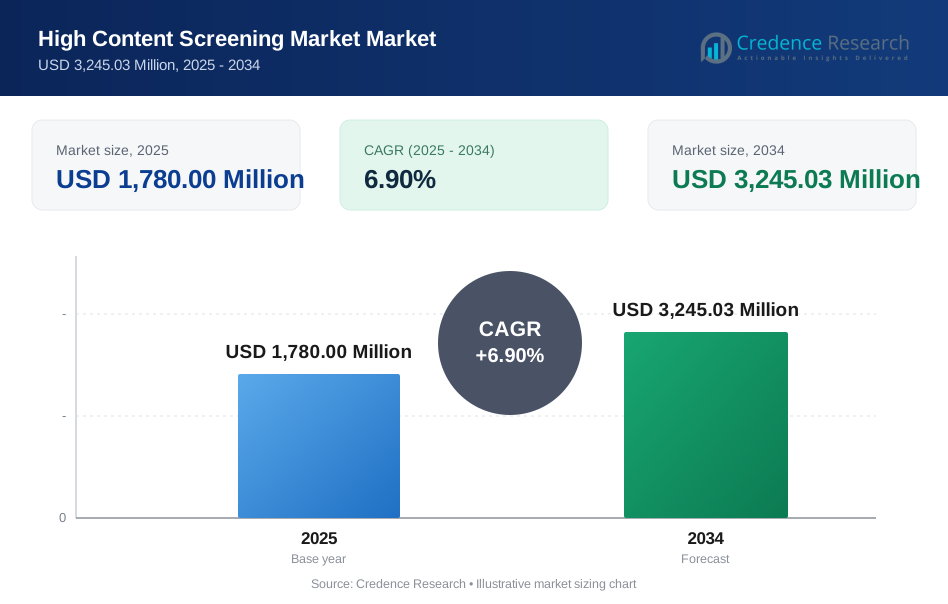
The High Content Screening market reached USD 1,780 million in 2025 and is projected to grow to USD 3,245.03 million by 2034, registering a CAGR of 6.90%. North America holds the leading regional share, accounting for 41.5% of the global market.
The market has expanded significantly from its historical base, driven by the increasing adoption of automated imaging and analysis technologies in drug discovery and life sciences research. The need for high-throughput, multiparametric screening solutions has accelerated demand, especially as pharmaceutical and biotechnology companies seek to streamline early-stage drug development.
Technological advancements, such as improved imaging platforms and sophisticated data analytics, have transformed customer expectations and procurement strategies. Buyers now prioritize integrated systems that offer scalability, automation, and robust data management, leading to higher average selling prices and recurring revenue from software and consumables.
Geographically, North America and Europe dominate due to strong research infrastructure, established pharmaceutical industries, and favorable funding environments. The competitive landscape features global leaders and specialized players, with differentiation based on technology innovation, service integration, and customer support.
What this report answers.
This report provides actionable insights for market entry, portfolio planning, pricing strategy, geographic expansion, and competitive benchmarking. It enables stakeholders to assess growth opportunities, understand evolving customer needs, and anticipate shifts in procurement and technology adoption across regions and segments.
Report Attributes
| Attribute | Detail |
|---|---|
| Historical period | 2018 |
| Base year | 2025 |
| Forecast period | 2025-2034 |
| Base-year market size | USD 1,780 Million |
| Forecast-year market size | USD 3,245.03 Million |
| Revenue CAGR | 6.90% |
| Segments covered | Product & Service, Instrument Type, Consumables & Accessories, Application, Drug Discovery & Development Application, Basic Research Application, End User |
| Geographic scope | Global |
Eight Findings That Shape the Forecast
- The market will nearly double in value from 2025 to 2034, driven by a 6.90% CAGR.
- North America leads with a 41.5% share, reflecting strong research and pharma activity.
- Europe holds the second-largest share at 28.0%, supported by robust funding and infrastructure.
- Regional demand in North America is propelled by advanced drug discovery pipelines and high R&D investment.
- Integrated product and service offerings are increasingly favored by buyers seeking end-to-end solutions.
- Automation and AI-driven analytics are reshaping procurement and operational models.
- Pharmaceutical and biotechnology companies remain the primary end users, driving recurring demand.
- Emerging markets present new opportunities as research capacity and funding improve.
Market Size and Growth Outlook From 2025 to 2034
What is the High Content Screening market forecast for 2034
The High Content Screening market is forecast to reach USD 3,245.03 million by 2034, up from USD 1,780 million in 2025, reflecting a CAGR of 6.90% over the forecast period.
| Metric | Base year | Forecast year | CAGR |
|---|---|---|---|
| Revenue | USD 1,780 Million | USD 3,245.03 Million | 6.90% |
Growth is supported by increased adoption in drug discovery, higher replacement demand for advanced systems, and recurring purchases of consumables and software licenses.
What the High Content Screening Market Covers
The High Content Screening market includes automated imaging systems, analysis software, consumables, and related services used for high-throughput, multiparametric cellular analysis in drug discovery, toxicology, and basic research. It excludes adjacent markets such as general laboratory imaging, standalone microscopy, and unrelated analytical instrumentation. Customers include pharmaceutical, biotechnology, academic, and contract research organizations, with value captured across hardware, software, consumables, and services.
Imaging Instruments
Imaging instruments form the core of High Content Screening, providing automated, high-resolution image capture for cellular assays. These systems are essential for high-throughput screening and are typically sold as capital equipment, with revenue generated through initial sales and ongoing service contracts.
Analysis Software
Analysis software enables advanced image processing, data management, and interpretation of complex cellular data. Vendors generate revenue through software licensing, updates, and integration services, with demand driven by the need for scalable, user-friendly analytics platforms.
Consumables and Reagents
Consumables and reagents, including assay plates, dyes, and buffers, are critical for recurring revenue. These products support ongoing assay workflows and are purchased regularly by laboratories, making them a stable and growing revenue stream.
Services and Support
Services and support encompass installation, training, maintenance, and technical assistance. Providers differentiate through rapid response, application expertise, and tailored support packages, often bundled with equipment sales or offered as standalone contracts.
Integrated Solutions
Integrated solutions combine instruments, software, consumables, and services into unified platforms. These offerings address customer demand for streamlined procurement, interoperability, and simplified workflows, supporting higher average deal values and long-term customer retention.
High Content Screening Market Segmentation
The High Content Screening market is segmented by Product & Service, Instrument Type, Consumables & Accessories, Application, Drug Discovery & Development Application, Basic Research Application, and End User. Each dimension reflects distinct customer needs, procurement criteria, and revenue models, shaping the competitive landscape and growth opportunities.
By Product & Service
This dimension covers imaging instruments, analysis software, consumables, and services. Imaging instruments represent significant capital investment and are central to laboratory automation. Analysis software is increasingly valued for its ability to handle large, complex datasets, driving recurring licensing revenue. Consumables and reagents provide stable, repeatable sales, while services and support differentiate vendors through technical expertise and customer engagement.
| Segment | Revenue model | Growth profile |
|---|---|---|
| Imaging Instruments | Capital sales, service contracts | Steady replacement and upgrade demand |
| Analysis Software | Licensing, updates, integration | Growing with data complexity |
| Consumables & Reagents | Recurring purchases | Stable, volume-driven |
| Services & Support | Contracts, bundled offerings | Value-added, retention-focused |
By Instrument Type
Instrument type segmentation distinguishes between standalone imaging platforms, integrated systems, and modular components. Standalone platforms appeal to established labs seeking high-throughput capacity, while integrated systems attract buyers prioritizing workflow automation and interoperability. Modular components allow customization but may require higher technical expertise for integration.
By Consumables & Accessories
Consumables and accessories include assay plates, dyes, buffers, and specialized reagents. These products are essential for daily operations and drive recurring revenue. Procurement decisions are influenced by compatibility, quality, and supplier reliability, with laboratories often standardizing on preferred brands to ensure consistency and performance.
By Application
Applications span drug discovery, toxicology, and basic research. Drug discovery remains the largest segment, leveraging High Content Screening for target identification, lead optimization, and safety profiling. Toxicology applications benefit from rapid, multiparametric analysis, while basic research uses these platforms for cellular pathway studies and functional genomics.
By Drug Discovery & Development Application
Within drug discovery, High Content Screening supports hit identification, lead validation, and mechanism-of-action studies. Pharmaceutical and biotechnology companies rely on these systems to accelerate timelines and reduce attrition rates, making this segment a key driver of market growth.
By Basic Research Application
Academic and government research institutions use High Content Screening for fundamental studies in cell biology, genetics, and disease modeling. Funding cycles and grant availability influence purchasing patterns, with demand rising as research priorities shift toward complex, multiparametric assays.
By End User
End users include pharmaceutical companies, biotechnology firms, academic institutions, and contract research organizations. Pharmaceutical and biotech companies account for the largest share, driven by high-throughput screening needs and regulatory requirements. Academic users prioritize flexibility and cost-effectiveness, while CROs focus on scalability and rapid turnaround.
Detailed Segmentation Coverage
- By Product & Service: Imaging Instruments, Analysis Software, Consumables & Reagents, Services & Support, Integrated Solutions
- By Instrument Type: Standalone Platforms, Integrated Systems, Modular Components
- By Consumables & Accessories: Assay Plates, Dyes, Buffers, Specialized Reagents
- By Application: Drug Discovery, Toxicology, Basic Research
- By Drug Discovery & Development Application: Hit Identification, Lead Validation, Mechanism-of-Action Studies
- By Basic Research Application: Cell Biology, Genetics, Disease Modeling
- By End User: Pharmaceutical Companies, Biotechnology Firms, Academic Institutions, Contract Research Organizations
Request a Free Sample
Fill in your details and we'll send you a free sample report.
- Sample data tables & charts
- Research methodology
Global Trade Context
Global High Content Screening Trade Segment Summary and Context for 2025
High Content Screening systems are primarily manufactured in North America, Europe, and parts of Asia Pacific, with cross-border trade driven by demand from pharmaceutical and biotechnology hubs. The market is characterized by high-value, low-volume shipments, with leading vendors exporting advanced systems and software to research centers worldwide.
What Is Driving High Content Screening Demand
Growth in the High Content Screening market is driven by rising demand for high-throughput drug discovery, technological advancements in imaging and analytics, expanding applications in basic research, and increasing investment in life sciences infrastructure.
Rising demand for high-throughput drug discovery
The pharmaceutical industry faces mounting pressure to accelerate drug development and reduce attrition rates. High Content Screening enables rapid, multiparametric analysis of cellular responses, supporting efficient hit identification and lead optimization. This capability appeals to pharmaceutical and biotechnology companies seeking to streamline early-stage R&D. Demand is further amplified by the need for predictive toxicology and safety profiling. However, adoption may be constrained by high initial capital costs for advanced systems.
Technological advancements in imaging and analytics
Continuous innovation in imaging hardware, automation, and data analytics has transformed High Content Screening platforms. Enhanced resolution, throughput, and integration with artificial intelligence allow for more complex assays and deeper insights. These advancements attract both new and existing users, driving replacement demand and expanding the addressable market. The complexity of integrating new technologies with legacy systems can slow adoption for some organizations.
Evidence. In 2023, several leading vendors introduced AI-powered image analysis modules, enabling automated phenotypic screening and reducing manual interpretation time, as reported by industry publications.
Expanding applications in basic research
Academic and government research institutions increasingly use High Content Screening for studies in cell biology, genetics, and disease modeling. The ability to conduct large-scale, multiparametric assays supports fundamental discoveries and translational research. Funding from public and private sources underpins this trend, though budget cycles and grant availability can introduce volatility in purchasing patterns.
Increasing investment in life sciences infrastructure
Governments and private investors are boosting funding for life sciences research, particularly in emerging markets. This investment supports the establishment of new laboratories, technology upgrades, and workforce development, expanding the customer base for High Content Screening. The pace of infrastructure development varies by region, with regulatory and procurement hurdles affecting market access in some countries.
Driver Impact Summary
| Driver | Expected Market Effect | Geographic Relevance | Impact Timeline |
|---|---|---|---|
| Rising demand for high-throughput drug discovery | Faster adoption, increased recurring usage, higher replacement demand | North America, Europe, Asia Pacific | Short to medium term |
| Technological advancements in imaging and analytics | Expanded addressable market, higher average selling prices, increased differentiation | Global | Medium to long term |
| Expanding applications in basic research | Broader customer base, increased procurement from academic and government sectors | North America, Europe, Asia Pacific | Medium term |
| Increasing investment in life sciences infrastructure | Market expansion into new geographies, higher equipment and consumables sales | Asia Pacific, Latin America, Middle East | Long term |
High Content Screening Market Trends to 2034
The High Content Screening market is shaped by automation, AI-driven analytics, integrated platforms, and expanding applications in translational research. Vendors are focusing on interoperability, cloud-based data management, and user-friendly interfaces to meet evolving customer needs and regulatory requirements.
Automation and workflow integration
Laboratories are increasingly adopting automated High Content Screening platforms to boost throughput and reduce manual intervention. Integration with liquid handling, robotics, and laboratory information management systems streamlines workflows and minimizes errors. This trend supports higher productivity and consistency, but requires significant upfront investment and process redesign for full realization of benefits.
AI-driven analytics and image interpretation
Artificial intelligence and machine learning are transforming image analysis, enabling automated phenotypic screening and complex pattern recognition. These technologies reduce analysis time, improve reproducibility, and support more sophisticated assays. Vendors are embedding AI modules into their platforms, creating new differentiation opportunities and raising the bar for data quality and regulatory compliance.
Cloud-based data management and collaboration
The shift toward cloud-based platforms allows laboratories to store, share, and analyze large datasets securely and efficiently. Cloud solutions facilitate remote collaboration, multi-site studies, and integration with external databases. This trend enhances scalability and data accessibility, but introduces new challenges around cybersecurity and data governance.
Expansion into translational and personalized medicine
High Content Screening is increasingly used in translational research and personalized medicine, supporting patient-derived cell assays and biomarker discovery. This expansion opens new revenue streams and partnerships with clinical research organizations and healthcare providers. The complexity of clinical integration and regulatory oversight presents new hurdles for vendors and users alike.
Where the Unserved Demand Sits
The largest opportunities in the High Content Screening market lie in emerging geographies, underserved research segments, and applications requiring tailored solutions. Addressing these gaps requires product adaptation, pricing innovation, and targeted distribution strategies to convert latent demand into sustainable revenue.
Emerging markets with expanding research capacity
Countries in Asia Pacific, Latin America, and the Middle East are investing in life sciences infrastructure and workforce development. Local research institutions and biotech startups require affordable, scalable High Content Screening solutions. Vendors must adapt pricing models and offer localized support to overcome procurement and training barriers. Execution risk centers on navigating regulatory complexity and building effective distribution networks.
Academic and translational research institutions
Many academic and translational research centers lack access to advanced High Content Screening platforms due to budget constraints and limited technical expertise. Solutions tailored for smaller-scale, flexible use cases, combined with grant-friendly pricing and training, can unlock new demand. The main risk is ensuring ongoing support and system utilization in resource-constrained environments.
Applications in rare disease and personalized medicine
There is growing interest in using High Content Screening for rare disease modeling and personalized therapy development. These applications require customized assay development, data analytics, and regulatory support. Vendors that can provide end-to-end solutions and collaborate with clinical researchers stand to gain, but must manage the complexity and cost of bespoke projects.
Integration with digital health and real-world data
Opportunities exist to link High Content Screening data with digital health platforms and real-world evidence sources. This integration can enhance drug development, safety monitoring, and patient stratification. Realizing this potential requires interoperability standards, data privacy safeguards, and partnerships with healthcare IT providers. The principal risk is aligning incentives and technical standards across diverse stakeholders.
High Content Screening Market Barriers
The main barriers to adoption in the High Content Screening market include high capital and operating costs, integration complexity with existing laboratory systems, and the need for specialized technical expertise. These constraints affect procurement decisions, slow market penetration, and limit access for smaller organizations and emerging markets.
High capital and operating costs
Acquiring advanced High Content Screening platforms requires significant upfront investment, often exceeding the budgets of smaller laboratories and academic institutions. Ongoing costs for maintenance, software updates, and consumables further strain resources. This barrier disproportionately affects organizations in emerging markets and those with limited funding, restricting market access and slowing adoption rates.
Integration complexity and workflow disruption
Integrating new High Content Screening systems with existing laboratory infrastructure can be technically challenging and disruptive to established workflows. Compatibility issues with legacy equipment, data management systems, and laboratory protocols require careful planning and customization. These complexities increase implementation timelines and costs, deterring some potential buyers from upgrading or adopting new platforms.
Shortage of specialized technical expertise
Effective operation and maintenance of High Content Screening platforms demand specialized skills in imaging, data analysis, and assay development. Many laboratories, especially in emerging markets and smaller institutions, lack access to trained personnel. This skills gap limits the ability to fully utilize advanced features, reduces return on investment, and can lead to underutilization or operational errors. Vendors must invest in training and support to address this persistent challenge.
Regional Market Structure and Growth Outlook
North America leads the High Content Screening market, accounting for 41.5% of global revenue, followed by Europe at 28.0%. These regions benefit from advanced research infrastructure, strong pharmaceutical industries, and robust funding environments. Asia Pacific, Latin America, the Middle East, and Africa present emerging opportunities as research capacity and investment increase.
North America
With a 41.5% share, North America is the largest regional market for High Content Screening. The United States dominates due to its concentration of pharmaceutical and biotechnology companies, world-class research universities, and significant government and private R&D funding. Procurement is driven by demand for high-throughput screening in drug discovery and toxicology, with buyers prioritizing integrated, automated solutions. Local and international vendors compete on technology, service, and support, while regulatory standards and data security requirements shape product offerings. The region's established distribution networks and high installed base support recurring revenue from consumables and software. Strategic implications include the need for continuous innovation and strong customer relationships to maintain market leadership.
Europe
Europe holds a 28.0% share, supported by a robust life sciences sector, collaborative research networks, and favorable public funding. Major contributors include Germany, the United Kingdom, and France, where pharmaceutical and academic research drive demand. Procurement is influenced by grant cycles, regulatory harmonization, and a focus on translational research. European buyers value interoperability, data privacy, and compliance with evolving standards. Competition is intense, with both global and regional players offering differentiated solutions. Strategic opportunities lie in expanding partnerships with academic consortia and leveraging EU funding for technology adoption.
Asia Pacific
Asia Pacific is an emerging growth region, fueled by rising investment in life sciences infrastructure, expanding pharmaceutical manufacturing, and increasing government support for research. China, Japan, South Korea, and India are key markets, each with distinct regulatory and procurement environments. Demand is strongest in urban research hubs and among rapidly growing biotech startups. Price sensitivity and the need for localized support shape vendor strategies. The region's fragmented distribution landscape and varying technical standards present challenges, but also opportunities for tailored solutions and market entry partnerships.
Latin America
Latin America is experiencing gradual growth in High Content Screening adoption, led by Brazil, Mexico, and Argentina. Investment in research infrastructure and public health initiatives is increasing, though budget constraints and procurement complexity remain barriers. Local distributors play a critical role in market access, and buyers often seek cost-effective, scalable solutions. Opportunities exist for vendors that can provide training, support, and flexible financing to address resource limitations.
Middle East and Africa
The Middle East and Africa represent nascent but promising markets for High Content Screening. Growth is concentrated in countries investing in healthcare and research, such as the United Arab Emirates, Saudi Arabia, and South Africa. Adoption is driven by government initiatives, partnerships with international research organizations, and the establishment of new research centers. Challenges include limited technical expertise, infrastructure gaps, and regulatory hurdles. Vendors must focus on education, capacity building, and long-term partnerships to unlock potential in these regions.
Recent Developments and Strategic Implications
In January 2025, Molecular Devices launched the ImageXpress HCS.ai High-Content Screening System, a fifth-generation platform that combines faster image acquisition, AI-driven analysis and a modular design for complex cell models. This is material for the market because buyers are increasingly prioritizing higher-throughput systems that can support both routine phenotypic assays and more demanding 3D workflows from the same installed base. Strategically, the launch increases pressure on competitors to pair strong optics with deeper AI workflow integration and upgrade paths.
In April 2025, ZEISS globally launched Axioscan 7 spatial biology, a high-throughput slide scanner and workflow portfolio for multiplex immunofluorescence in clinical research that can automatically scan up to 100 samples in a single run. This matters because high-content screening is expanding beyond plate-based cell assays into tissue-scale spatial analysis, where automation, reproducibility and AI-enabled image handling are becoming central purchasing criteria. Strategically, the move positions ZEISS to compete for translational research and CRO budgets that increasingly overlap with advanced imaging and screening spend.
In July 2025, Sartorius launched the Incucyte CX3 Live-Cell Analysis System, adding confocal fluorescence imaging for 3D cell culture and real-time analysis of up to six microplates in parallel. This is important because organoid and spheroid assays are moving further into mainstream discovery screening, raising demand for platforms that keep cells in a controlled incubator environment while improving throughput and reducing phototoxic stress. Strategically, the CX3 strengthens Sartorius’ position in live-cell imaging and suggests rising competition around in-incubator analysis for advanced cell models.
In July 2025, Sartorius completed its acquisition of MatTek, including Visikol, after receiving regulatory approval and satisfying other customary closing conditions. The completed transaction matters because MatTek’s human cell-based microtissues and 3D models broaden Sartorius’ upstream assay model portfolio and create tighter links with its existing cell analysis instruments, reagents and AI tools, which can improve the biological relevance of high-content readouts. Strategically, the deal suggests that ownership of advanced cell models is becoming a more important competitive lever alongside instrument performance.
In February 2026, Revvity announced the launch of the Opera Phenix OptIQ high-content screening system at SLAS2026, positioning it for quantitative imaging across complex models such as 3D organoids and organ-on-chip systems while adding higher camera sensitivity, expanded AI classification and improved autofocus. This matters because customers are demanding better data quality and easier analysis in advanced phenotypic screening without accepting slower workflows. Strategically, the release reinforces Revvity’s standing in premium high-content screening and raises the competitive bar for legacy confocal imaging platforms.
In April 2026, Agilent announced the launch of the BioTek Cytation 9 cell imaging multimode reader, combining multimode microplate reading with high-content cell imaging in one platform for cell-based and biochemical assays. This is significant because many laboratories want hybrid instruments that consolidate screening steps, broaden assay coverage and improve imaging speed without committing to a full premium HCS stack. Strategically, Cytation 9 sharpens Agilent’s appeal to midmarket and multiuse labs and could intensify pricing and feature competition in the compact imaging segment.
Need a Custom Version of This Report?
Tailor the scope, geography, or segments to your exact requirements.
- Custom geography or segment scope
- Direct access to our analyst team
Competitive Landscape
Leading companies in the High Content Screening market include Thermo Fisher Scientific Inc., Danaher Corporation, Revvity Inc., Merck KGaA, Becton, Dickinson and Company, Sartorius AG, Yokogawa Electric Corporation, Agilent Technologies Inc., Bio-Rad Laboratories Inc., Bruker Corporation, Tecan Group Ltd., Corning Incorporated, Evident Corporation, Nikon Corporation, Carl Zeiss AG, and Molecular Devices LLC. These firms compete globally, offering comprehensive portfolios that span imaging instruments, software, consumables, and services.
The market is characterized by a mix of established multinational corporations and specialized technology providers. Differentiation is achieved through innovation in imaging resolution, automation, AI-driven analytics, and integrated workflow solutions. Companies leverage installed-base advantages, extensive distribution networks, and strong customer support to retain clients and drive recurring revenue from consumables and software. Pricing strategies reflect the high value and technical complexity of these systems, with bundled offerings and service contracts common among leading vendors.
Strategic activity includes partnerships with research institutions, acquisitions to expand technology capabilities, and investments in cloud-based and AI-enabled platforms. Switching costs are significant due to integration requirements and user training, reinforcing vendor lock-in. New entrants face high barriers related to regulatory compliance, technical expertise, and brand recognition, but may find opportunities in niche applications or emerging markets.
Key Companies
- Thermo Fisher Scientific Inc.
- Danaher Corporation
- Revvity Inc.
- Merck KGaA
- Becton, Dickinson and Company
- Sartorius AG
- Yokogawa Electric Corporation
- Agilent Technologies Inc.
- Bio-Rad Laboratories Inc.
- Bruker Corporation
- Tecan Group Ltd.
- Corning Incorporated
- Evident Corporation
- Nikon Corporation
- Carl Zeiss AG
- Molecular Devices LLC
Frequently Asked Questions
What is the High Content Screening market size in 2025?
What is its forecast value by 2034?
What is the expected CAGR?
Which product or service segment leads the market?
Which region leads the market?
What drives demand in this market?
Who are the major companies in this market?
What are the main challenges and opportunities in this market?
Table of Content
Chapter 1 Market Segmentation
- 1.1 Segmentation Framework
- 1.1.1 Product and Service Classification
- 1.1.2 Application and End-Use Classification
- 1.1.3 Technology and Solution Classification
- 1.1.4 Customer and Distribution Channel Classification
- 1.1.5 Geographic Segmentation
- 1.1.6 Market Segment Definitions and Boundaries
- 1.2 Product & Service
- 1.2.1 Imaging Instruments
- 1.2.2 Analysis Software
- 1.2.3 Consumables & Reagents
- 1.2.4 Services & Support
- 1.2.5 Integrated Solutions
- 1.3 Instrument Type
- 1.3.1 Standalone Platforms
- 1.3.2 Integrated Systems
- 1.3.3 Modular Components
- 1.4 Consumables & Accessories
- 1.4.1 Assay Plates
- 1.4.2 Dyes
- 1.4.3 Buffers
- 1.4.4 Specialized Reagents
- 1.5 Application
- 1.5.1 Drug Discovery
- 1.5.2 Toxicology
- 1.5.3 Basic Research
- 1.6 Drug Discovery & Development Application
- 1.6.1 Hit Identification
- 1.6.2 Lead Validation
- 1.6.3 Mechanism-of-Action Studies
- 1.7 Basic Research Application
- 1.7.1 Cell Biology
- 1.7.2 Genetics
- 1.7.3 Disease Modeling
- 1.8 End User
- 1.8.1 Pharmaceutical Companies
- 1.8.2 Biotechnology Firms
- 1.8.3 Academic Institutions
- 1.8.4 Contract Research Organizations
Chapter 2 Introduction
- 2.1 Report Objectives and Scope
- 2.2 Product Definition and Industry Terminology
- 2.3 Market Inclusions and Exclusions
- 2.4 Research Process
- 2.4.1 Primary Research and Expert Interviews
- 2.4.2 Secondary Research and Source Review
- 2.4.3 Top-Down and Bottom-Up Estimation
- 2.4.4 Data Triangulation and Verification
- 2.5 Market Size Measurement Basis
- 2.5.1 2025: USD 1,780.00 Million → 2034: USD 3,245.03 Million
- 2.6 Historical and Forecast Reference Periods
- 2.6.1 Historical Period: 2018-2025
- 2.6.2 Base Year: 2025
- 2.6.3 Forecast Period: 2025-2034
- 2.7 Research Assumptions and Limitations
Chapter 3 Executive Summary
- 3.1 Market Snapshot and Key Findings
- 3.2 Base-Year Market Size, 2025
- 3.3 Forecast Market Size, 2034
- 3.4 Revenue and Volume Growth Outlook
- 3.5 Key Demand and Supply Indicators
- 3.6 Leading Market Segments
- 3.7 Fastest-Growing Market Opportunities
- 3.8 Regional Performance Highlights
- 3.9 Technology and Industry Transformation
- 3.10 Competitive Landscape Summary
- 3.11 Analyst View and Strategic Implications
Chapter 4 Global High Content Screening Market Size, Share and Forecast 2034 Market Trends and Developments
- 4.1 Historical Industry Development, 2018-2025
- 4.2 Recent Market Trends and Developments
- 4.3 Demand and Customer Behavior Trends
- 4.4 Technology and Product Innovation
- 4.5 Artificial Intelligence, Automation and Digitalization
- 4.6 Local Manufacturing and Supply Chain Realignment
- 4.7 Industry Partnerships, Mergers and Acquisitions
- 4.8 Sustainability and Circular Economy Developments
- 4.9 Government and Private Sector Investment Trends
- 4.10 Emerging Business Models and Commercialization
- 4.11 Industry Developments and Announcements
Chapter 5 Global High Content Screening Market Size, Share and Forecast 2034 Market Production, Supply and Demand Analysis
- 5.1 Demand Trend and Consumption Analysis, 2018-2025
- 5.2 Demand Forecast, 2025-2034
- 5.3 Production and Output Trend, 2018-2025
- 5.4 Production and Output Forecast, 2025-2034
- 5.5 Installed Capacity and Capacity Utilization
- 5.6 Company-Wise Production Plants and Statistics
- 5.6.1 Installed Production Capacity
- 5.6.2 Actual Production
- 5.6.3 Planned Capacity and Expansion Targets
- 5.7 Supply Chain Structure and Procurement Trends
- 5.8 Supply-Demand Gap and Bottlenecks
- 5.9 Import Dependence and Sourcing Structure
- 5.10 Contract Manufacturing and Outsourcing
- 5.11 Regional Supply and Demand Concentration
Chapter 6 Global High Content Screening Market Size, Share and Forecast 2034 Market Pricing Analysis
- 6.1 Pricing Structure and Measurement
- 6.2 Historical Pricing Trends, 2018-2025
- 6.3 Pricing Outlook, 2025-2034
- 6.4 Average Selling Price and Unit Economics
- 6.5 Pricing by Product and Market Segment
- 6.6 Geographic Pricing Differences
- 6.7 Key Input, Energy, Labor and Logistics Costs
- 6.8 Contract Pricing and Purchasing Models
- 6.9 Pricing Sensitivity and Competitive Positioning
- 6.10 Price, Margin and Profitability Implications
Chapter 7 Global High Content Screening Market Size, Share and Forecast 2034 Market Dynamics
- 7.1 Market Growth Drivers
- 7.1.1 Demand-Side Drivers
- 7.1.2 Technology and Innovation Drivers
- 7.1.3 Infrastructure and Investment Drivers
- 7.1.4 Regulatory and Policy Drivers
- 7.2 Market Restraints
- 7.2.1 Cost and Affordability Constraints
- 7.2.2 Technology and Adoption Barriers
- 7.2.3 Supply Chain and Operational Constraints
- 7.3 Market Challenges
- 7.3.1 Competitive Pressure and Margin Erosion
- 7.3.2 Skills, Infrastructure and Implementation Gaps
- 7.4 Emerging Market Opportunities
- 7.5 Market Dynamics Impact and Time-Horizon Assessment
Chapter 8 Global High Content Screening Market Size, Share and Forecast 2034 Value Chain Analysis
- 8.1 Industry Value Chain Overview
- 8.2 Upstream Suppliers and Critical Inputs
- 8.3 Technology and Component Providers
- 8.4 Manufacturing or Service Delivery
- 8.5 Distribution, Channel Partners and Integrators
- 8.6 Downstream Applications and End Users
- 8.7 Value Addition and Profit Pools
- 8.8 Vertical Integration and Outsourcing
- 8.9 Supplier Concentration and Risk
- 8.10 Supply Chain Localization and Resilience
Chapter 9 Global High Content Screening Market Size, Share and Forecast 2034 Market Regulations and Policies
- 9.1 Relevant Laws, Standards and Compliance Frameworks
- 9.2 Product, Service, Safety and Quality Requirements
- 9.3 Government Policies, Incentives and Subsidies
- 9.4 Imports, Exports and Trade Barriers
- 9.5 Public Procurement and Local Content Requirements
- 9.6 Environmental and Sustainability Compliance
- 9.7 Upcoming Policy Changes and Market Implications
Chapter 10 Global High Content Screening Market Size, Share and Forecast 2034 Market Hotspots and Opportunities
- 10.1 Market Opportunity Mapping and Growth Hotspots
- 10.2 High-Growth Applications and Customer Groups
- 10.3 Underserved Markets and White-Space Opportunities
- 10.4 Emerging Technology and Product Opportunities
- 10.5 New Capacity and Investment Hotspots
- 10.6 Market Entry and Expansion Opportunities
- 10.7 Distribution and Partnership Opportunities
- 10.8 Near-Term and Long-Term Commercial Potential
- 10.9 Opportunity Attractiveness and Execution Risks
Chapter 11 Global High Content Screening Market Size, Share and Forecast 2034 Market Outlook, 2025-2034
- 11.1 Market Size and Analysis
- 11.1.1 Revenue (Market Measurement: 2025: USD 1,780.00 Million → 2034: USD 3,245.03 Million)
- 11.1.2 Market Volume and Quantity Sold
- 11.1.3 Historical Market Size, 2018-2025
- 11.1.4 Base-Year Market Size, 2025
- 11.2 Market Forecast, 2025-2034
- 11.2.1 Revenue Forecast to 2034
- 11.2.2 Volume Forecast to 2034
- 11.2.3 CAGR and Year-on-Year Growth
- 11.2.4 Incremental Revenue Opportunity
- 11.3 Forecast Assumptions and Scenario Analysis
- 11.3.1 Base-Case Forecast
- 11.3.2 Optimistic and Conservative Scenarios
- 11.3.3 Technology, Pricing and Policy Sensitivities
- 11.4 Market Attractiveness and Growth Outlook
Chapter 12 Global High Content Screening Market Size, Share and Forecast 2034 Market Segmentation and Outlook
- 12.1 Segmentation Summary and Market Shares, 2025
- 12.2 Largest and Fastest-Growing Segments
- 12.3 Product & Service - Market Size and Forecast, 2025-2034
- 12.3.1 Segment Definition and Scope
- 12.3.2 Historical Market Size, 2018-2025
- 12.3.3 Revenue Forecast, 2025-2034
- 12.3.4 Volume Forecast, 2025-2034
- 12.3.5 Base-Year Market Share, 2025
- 12.3.6 Segment CAGR and Growth Drivers
- 12.3.7 Subsegment Market Size and Forecast
- 12.3.7.1 Imaging Instruments
- 12.3.7.2 Analysis Software
- 12.3.7.3 Consumables & Reagents
- 12.3.7.4 Services & Support
- 12.3.7.5 Integrated Solutions
- 12.3.8 Subsegment Pricing and Adoption Trends
- 12.3.9 Leading Suppliers and Competition
- 12.3.10 Regional Demand and Opportunities
- 12.4 Instrument Type - Market Size and Forecast, 2025-2034
- 12.4.1 Segment Definition and Scope
- 12.4.2 Historical Market Size, 2018-2025
- 12.4.3 Revenue Forecast, 2025-2034
- 12.4.4 Volume Forecast, 2025-2034
- 12.4.5 Base-Year Market Share, 2025
- 12.4.6 Segment CAGR and Growth Drivers
- 12.4.7 Subsegment Market Size and Forecast
- 12.4.7.1 Standalone Platforms
- 12.4.7.2 Integrated Systems
- 12.4.7.3 Modular Components
- 12.4.8 Subsegment Pricing and Adoption Trends
- 12.4.9 Leading Suppliers and Competition
- 12.4.10 Regional Demand and Opportunities
- 12.5 Consumables & Accessories - Market Size and Forecast, 2025-2034
- 12.5.1 Segment Definition and Scope
- 12.5.2 Historical Market Size, 2018-2025
- 12.5.3 Revenue Forecast, 2025-2034
- 12.5.4 Volume Forecast, 2025-2034
- 12.5.5 Base-Year Market Share, 2025
- 12.5.6 Segment CAGR and Growth Drivers
- 12.5.7 Subsegment Market Size and Forecast
- 12.5.7.1 Assay Plates
- 12.5.7.2 Dyes
- 12.5.7.3 Buffers
- 12.5.7.4 Specialized Reagents
- 12.5.8 Subsegment Pricing and Adoption Trends
- 12.5.9 Leading Suppliers and Competition
- 12.5.10 Regional Demand and Opportunities
- 12.6 Application - Market Size and Forecast, 2025-2034
- 12.6.1 Segment Definition and Scope
- 12.6.2 Historical Market Size, 2018-2025
- 12.6.3 Revenue Forecast, 2025-2034
- 12.6.4 Volume Forecast, 2025-2034
- 12.6.5 Base-Year Market Share, 2025
- 12.6.6 Segment CAGR and Growth Drivers
- 12.6.7 Subsegment Market Size and Forecast
- 12.6.7.1 Drug Discovery
- 12.6.7.2 Toxicology
- 12.6.7.3 Basic Research
- 12.6.8 Subsegment Pricing and Adoption Trends
- 12.6.9 Leading Suppliers and Competition
- 12.6.10 Regional Demand and Opportunities
- 12.7 Drug Discovery & Development Application - Market Size and Forecast, 2025-2034
- 12.7.1 Segment Definition and Scope
- 12.7.2 Historical Market Size, 2018-2025
- 12.7.3 Revenue Forecast, 2025-2034
- 12.7.4 Volume Forecast, 2025-2034
- 12.7.5 Base-Year Market Share, 2025
- 12.7.6 Segment CAGR and Growth Drivers
- 12.7.7 Subsegment Market Size and Forecast
- 12.7.7.1 Hit Identification
- 12.7.7.2 Lead Validation
- 12.7.7.3 Mechanism-of-Action Studies
- 12.7.8 Subsegment Pricing and Adoption Trends
- 12.7.9 Leading Suppliers and Competition
- 12.7.10 Regional Demand and Opportunities
- 12.8 Basic Research Application - Market Size and Forecast, 2025-2034
- 12.8.1 Segment Definition and Scope
- 12.8.2 Historical Market Size, 2018-2025
- 12.8.3 Revenue Forecast, 2025-2034
- 12.8.4 Volume Forecast, 2025-2034
- 12.8.5 Base-Year Market Share, 2025
- 12.8.6 Segment CAGR and Growth Drivers
- 12.8.7 Subsegment Market Size and Forecast
- 12.8.7.1 Cell Biology
- 12.8.7.2 Genetics
- 12.8.7.3 Disease Modeling
- 12.8.8 Subsegment Pricing and Adoption Trends
- 12.8.9 Leading Suppliers and Competition
- 12.8.10 Regional Demand and Opportunities
- 12.9 End User - Market Size and Forecast, 2025-2034
- 12.9.1 Segment Definition and Scope
- 12.9.2 Historical Market Size, 2018-2025
- 12.9.3 Revenue Forecast, 2025-2034
- 12.9.4 Volume Forecast, 2025-2034
- 12.9.5 Base-Year Market Share, 2025
- 12.9.6 Segment CAGR and Growth Drivers
- 12.9.7 Subsegment Market Size and Forecast
- 12.9.7.1 Pharmaceutical Companies
- 12.9.7.2 Biotechnology Firms
- 12.9.7.3 Academic Institutions
- 12.9.7.4 Contract Research Organizations
- 12.9.8 Subsegment Pricing and Adoption Trends
- 12.9.9 Leading Suppliers and Competition
- 12.9.10 Regional Demand and Opportunities
- 12.10 Segment Growth Comparison
- 12.11 Segment Attractiveness and Priority Matrix
Chapter 13 Global High Content Screening Market Size, Share and Forecast 2034 End-Use and Application Market Outlook
- 13.1 End-Use Industry and Customer Demand Structure
- 13.2 Leading Applications and Customer Groups
- 13.3 End-Use Market Size, Share and Forecast
- 13.4 Major End-Use Industry Deep Dives
- 13.4.1 Customer Requirements and Use Cases
- 13.4.2 Demand and Replacement Cycles
- 13.4.3 Technical and Regulatory Considerations
- 13.4.4 Purchasing and Procurement Models
- 13.4.5 Leading Vendors and Distribution Channels
- 13.4.6 Forecast and Commercial Opportunities
- 13.5 Emerging Applications and Cross-Segment Demand
- 13.6 End-Use Industry Investment Priorities
Chapter 14 Global High Content Screening Market Size, Share and Forecast 2034 Geographic Market Outlook, 2025-2034
- 14.1 Regional Market Size and Share, 2025
- 14.2 Regional Market Forecast, 2025-2034
- 14.3 Regional Pricing, Production and Demand Differences
- 14.4 North America
- 14.4.1 United States
- 14.4.2 Canada
- 14.4.3 Mexico
- 14.5 Europe
- 14.5.1 Germany
- 14.5.2 France
- 14.5.3 Italy
- 14.5.4 United Kingdom
- 14.5.5 Spain
- 14.5.6 Poland
- 14.5.7 Russia
- 14.5.8 Netherlands
- 14.5.9 Belgium
- 14.5.10 Sweden
- 14.5.11 Denmark
- 14.5.12 Norway
- 14.5.13 Rest of Europe
- 14.6 Asia Pacific
- 14.6.1 China
- 14.6.2 India
- 14.6.3 Japan
- 14.6.4 South Korea
- 14.6.5 Thailand
- 14.6.6 Indonesia
- 14.6.7 Vietnam
- 14.6.8 Malaysia
- 14.6.9 Australia
- 14.6.10 Rest of Asia Pacific
- 14.7 Latin America
- 14.7.1 Brazil
- 14.7.2 Argentina
- 14.7.3 Colombia
- 14.7.4 Chile
- 14.7.5 Rest of Latin America
- 14.8 Middle East
- 14.8.1 Saudi Arabia
- 14.8.2 United Arab Emirates
- 14.8.3 Turkey
- 14.8.4 Israel
- 14.8.5 Iran
- 14.8.6 Rest of the Middle East
- 14.9 Africa
- 14.9.1 South Africa
- 14.9.2 Egypt
- 14.9.3 Nigeria
- 14.9.4 Morocco
- 14.9.5 Rest of Africa
- 14.10 Regional Investment, Policy and Supply Chain Differences
- 14.11 Regional Competitive Landscape
- 14.12 Geographic Growth Hotspots
Chapter 15 Global High Content Screening Market Size, Share and Forecast 2034 Technology, Innovation and Sustainability Outlook
- 15.1 Technology Landscape and Maturity
- 15.2 Product, Process and Service Innovation
- 15.3 AI, Automation and Digital Tools in the Industry
- 15.4 Technology Adoption and Performance Benchmarking
- 15.5 Innovation Pipeline and R&D Investment
- 15.6 Patent and Intellectual Property Trends
- 15.7 Energy Efficiency and Resource Management
- 15.8 Sustainability, Recycling and Circularity
- 15.9 Technology Roadmap, 2025-2034
- 15.10 Risks of Obsolescence and Technology Substitution
Chapter 16 Global High Content Screening Market Size, Share and Forecast 2034 Market Key Strategic Imperatives
- 16.1 Growth and Market Entry Priorities
- 16.2 High-Return Products and Segments
- 16.3 Pricing, Profitability and Cost Optimization
- 16.4 Technology Investment and Product Differentiation
- 16.5 Supply Chain Localization and Resilience
- 16.6 Distribution and Customer Acquisition
- 16.7 Partnership, Acquisition and Capacity Strategy
- 16.8 Regional Expansion Priorities
- 16.9 Short-, Medium- and Long-Term Actions
Chapter 17 Competition Outlook
- 17.1 Industry Competition Characteristics
- 17.2 Market Structure and Concentration
- 17.3 Market Share and Competitive Positioning, 2025
- 17.4 Company-Wise Revenue and Product Benchmarking
- 17.5 Production and Service Capacity Benchmarking
- 17.6 Technology, Pricing and Differentiation
- 17.7 Regional Footprint and Distribution Strength
- 17.8 Mergers, Acquisitions and Strategic Alliances
- 17.9 New Entrants and Competitive Threats
- 17.10 Porter's Five Forces and Industry Attractiveness
- 17.11 Competitive Outlook, 2025-2034
Chapter 18 Company Profiles
- 18.1 Company Coverage and Selection Criteria
- 18.2 Thermo Fisher Scientific Inc.
- 18.2.1 Business Description
- 18.2.2 Company Ownership and Geographic Presence
- 18.2.3 Product and Service Portfolio
- 18.2.4 Manufacturing and Operating Footprint
- 18.2.5 Production Capacity and Expansion Plans
- 18.2.6 Financial Performance and Investment
- 18.2.7 Market Share and Competitive Position
- 18.2.8 Technology and Innovation Capabilities
- 18.2.9 Strategic Alliances or Partnerships
- 18.2.10 Recent Developments
- 18.2.11 Growth Strategy and Outlook
- 18.3 Danaher Corporation
- 18.4 Revvity Inc.
- 18.5 Merck KGaA
- 18.6 Becton, Dickinson and Company
- 18.7 Sartorius AG
- 18.8 Yokogawa Electric Corporation
- 18.9 Agilent Technologies Inc.
- 18.10 Bio-Rad Laboratories Inc.
- 18.11 Bruker Corporation
- 18.12 Tecan Group Ltd.
- 18.13 Corning Incorporated
- 18.14 Evident Corporation
- 18.15 Nikon Corporation
- 18.16 Carl Zeiss AG
- 18.17 Molecular Devices LLC
- 18.18 Other Relevant Market Participants
Note: Every listed company is profiled on the structure shown under the first company. The company list is preliminary and may change based on research findings, market developments, data availability and client requirements.
Chapter 19 Disclaimer
- 19.1 Research and Forecast Disclaimer
- 19.2 Data Source and Estimation Limitations
Note: The depth of individual sections depends on data availability for this market. Volume, capacity, trade and other unit-based metrics are included where applicable.

