
| REPORT ATTRIBUTE | DETAILS |
|---|---|
| Historical Period | 2020-2023 |
| Base Year | 2024 |
| Forecast Period | 2025-2032 |
| Agricultural Equipment Market Size 2024 | USD 1,52,719.19 million |
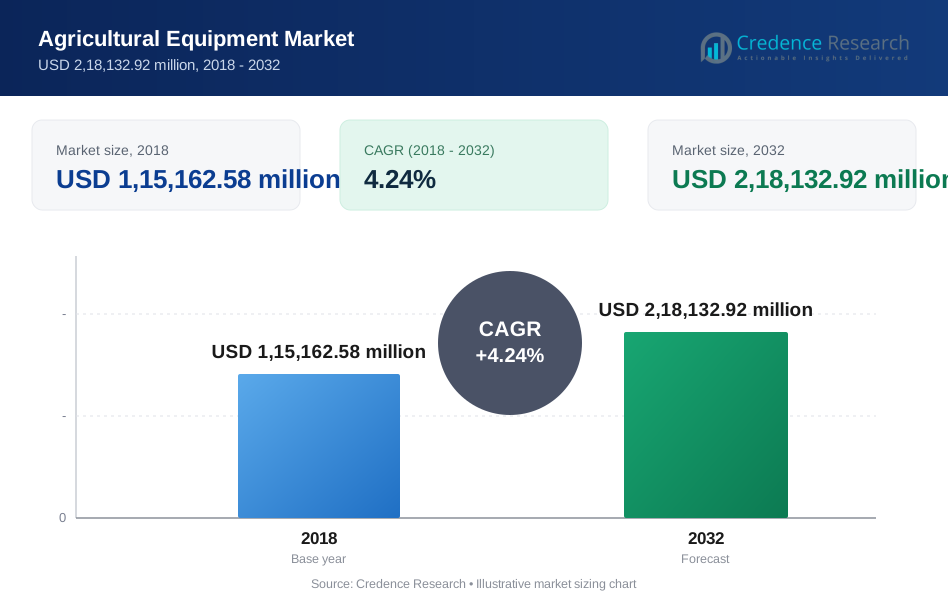
| Agricultural Equipment Market, CAGR | 4.24% |
| Agricultural Equipment Market Size 2032 | USD 2,18,132.92 million |
Market Overview:
The Global Agricultural Equipment Market size was valued at USD 1,15,162.58 million in 2018 to USD 1,52,719.19 million in 2024 and is anticipated to reach USD 2,18,132.92 million by 2032, at a CAGR of 4.24% during the forecast period.
The primary drivers behind this market's expansion include the global push for higher agricultural productivity amid a growing population and limited arable land. Farmers are adopting precision farming equipment and advanced Equipment that allow for efficient seeding, fertilizing, harvesting, and crop monitoring with minimal input and labor. Government support through subsidies, farm mechanization schemes, and rural credit programs has significantly boosted equipment adoption, particularly in developing economies. Furthermore, the industry is witnessing a shift towards sustainability, with electric and hybrid Equipment gaining traction due to stricter emission regulations and growing environmental awareness. The integration of data-driven solutions, such as GPS-guided tractors and sensor-based monitoring systems, is helping farmers make informed decisions, reduce waste, and enhance yields, thus fueling overall market growth.
Regionally, Asia-Pacific dominates the global agricultural Equipment market in terms of both revenue and growth rate. Countries such as China and India are leading this trend due to their large agricultural sectors and increasing investments in modernizing farming infrastructure. Government initiatives promoting mechanization and improving rural credit access are playing a pivotal role in this region. North America follows, driven by the early adoption of advanced technologies and the presence of key industry players. However, the region has faced temporary headwinds from declining commodity prices and high interest rates, affecting Equipment sales in recent years. Europe holds a mature market position, with consistent demand supported by sustainability goals and adoption of smart farming practices. Meanwhile, Latin America and the Middle East & Africa are emerging markets, showing steady growth backed by agricultural expansion, increased foreign investment, and a gradual shift toward mechanized farming methods in countries like Brazil, Argentina, and South Africa.
Market Insights:
- The Global Agricultural Equipment Market reached USD 152,719.19 million in 2024 and is forecast to grow to USD 218,132.92 million by 2032, expanding at a CAGR of 4.24%.
- Mechanization is accelerating due to labor shortages and the need to improve productivity, with tractors, harvesters, and planters replacing manual labor in key regions.
- Government subsidies and rural credit schemes in developing economies are enabling small and mid-sized farmers to access advanced Equipment.
- Precision farming technologies-such as GPS, drones, and AI-driven tools-are transforming farm operations through data-driven decision-making and optimized resource use.
- Growing environmental concerns are pushing manufacturers toward electrified Equipment, with electric and hybrid models gaining traction in line with emission regulations.
- High capital costs and lack of financing continue to limit adoption among smallholder farmers, while after-sales service gaps hinder reliability in emerging markets.
- Asia-Pacific leads the market in both revenue and growth, followed by North America and Europe; Latin America and Africa are witnessing steady progress in mechanized farming.
Market Drivers:
Rising Demand for Mechanization to Address Labor Shortages and Increase Productivity
One of the core factors driving the Global Agricultural Equipment Market is the growing labor shortage in the agricultural sector. Many rural regions are witnessing migration to urban areas, reducing the availability of farm labor. Farmers are increasingly turning to machines such as tractors, harvesters, and planters to maintain productivity levels and meet crop demands. Mechanization enables faster operations, minimizes human error, and ensures timely planting and harvesting. It also reduces dependency on seasonal labor and optimizes resource utilization. The Global Agricultural Equipment Market is benefiting from this structural shift in farming practices, where equipment is replacing manual processes to ensure efficiency and profitability.
- For example, John Deere’s autonomous tractors use AI-driven navigation and real-time crop analysis to perform field operations with minimal human intervention, directly addressing workforce gaps and enabling 24/7 operation.
Government Incentives and Subsidies Supporting Equipment Acquisition Across Developing Regions
Governments across various countries are offering financial incentives, subsidies, and favorable credit schemes to promote the adoption of agricultural Equipment. These initiatives are especially impactful in developing economies, where the initial cost of Equipment often hinders small and mid-sized farmers from upgrading. By lowering entry barriers, government support accelerates the purchase of tractors, threshers, and irrigation systems. Policies that encourage rural development and modernization of agriculture are enhancing market penetration. In India, for instance, schemes like the Sub-Mission on Agricultural Mechanization (SMAM) have directly influenced Equipment adoption rates. Such initiatives ensure consistent demand and provide long-term stability for manufacturers and distributors.
- For instance, according to the Ministry of Agriculture & Farmers’ Welfare, the Indian government allocated approximately ₹3,606.72 crores (about $480 million at 2020 exchange rates) for agricultural mechanization subsidies between 2014–15 and 2020–21 under the Sub-Mission on Agricultural Mechanization (SMAM). This funding has enabled small and marginal farmers across India to access modern equipment, supporting increased productivity and efficiency in the agricultural sector.
Technological Advancements Transforming Equipment Capabilities and Farming Efficiency
Technological innovation is reshaping the capabilities of agricultural Equipment and redefining productivity standards in the sector. Integration of GPS, drones, artificial intelligence, and IoT sensors is enabling data-driven precision farming. These tools help monitor soil conditions, optimize inputs, and reduce operational costs, which is crucial for large-scale farms. Smart Equipment also facilitates predictive maintenance and real-time field performance tracking. It is contributing to sustainable practices by minimizing overuse of fertilizers and pesticides. The market is witnessing continuous R&D investments aimed at improving automation, energy efficiency, and user experience across Equipment types.
Growing Emphasis on Sustainable Agriculture and Electrification of Equipment
Environmental concerns and stricter emission regulations are pushing manufacturers to develop electric and hybrid agricultural Equipment. These alternatives reduce greenhouse gas emissions and lower fuel dependency, addressing key environmental challenges in the farming sector. The market is gradually transitioning from traditional diesel-powered equipment to more sustainable solutions. Manufacturers are expanding their electric Equipment portfolios and investing in battery technology to support longer field operations. Consumers are increasingly prioritizing eco-friendly products that align with global sustainability goals. This shift is creating new growth avenues and reshaping long-term market strategies.
Market Trends:
Integration of Fleet Management and Telematics Solutions to Enhance Operational Visibility
A growing trend in the Global Agricultural Equipment Market is the adoption of telematics and fleet management systems to monitor Equipment performance in real-time. These systems provide data on equipment location, fuel usage, operating hours, and maintenance schedules. Large-scale farms and agribusinesses are increasingly using telematics to streamline equipment utilization and reduce downtime. It helps operators make informed decisions about fleet deployment and maintenance planning. Remote diagnostics and over-the-air software updates are becoming standard features in modern agricultural Equipment. This trend reflects the industry's movement toward connected farming ecosystems and centralized farm management platforms.
- TYM’s S.A.M. (Smart Agricultural Management) system, for example, enables real-time monitoring and control of tractors, providing remote management of multiple vehicles, detailed operation statistics, and automated maintenance alerts. Their D.A.V.E. (Digital Automated Vehicular Experience) system, featured in the T130 utility tractor, enables the creation and storage of precise straight-line work paths, further optimizing field efficiency and remote oversight.
Rise of Subscription-Based and Equipment-as-a-Service Models Across the Industry
Manufacturers and service providers are shifting toward offering Equipment through leasing, rental, or subscription models. This approach helps reduce the financial burden on small and mid-size farmers who cannot afford outright purchases of high-cost Equipment. The Global Agricultural Equipment Market is witnessing growing interest in equipment-as-a-service, where farmers pay based on usage or output instead of owning Equipment. It creates flexibility for users and opens recurring revenue streams for OEMs and dealers. Technology-driven platforms are facilitating on-demand access to tractors, harvesters, and drones. This trend is redefining equipment ownership models and expanding access to advanced Equipment in cost-sensitive markets.
Customization and Crop-Specific Equipment Development to Meet Regional Needs
Manufacturers are focusing on developing customized Equipment tailored to specific crops, soil types, and regional farming practices. The demand for crop-specific solutions, such as sugarcane harvesters, rice transplanters, and cotton pickers, is increasing in key agricultural regions. It is helping improve productivity and reduce post-harvest losses by ensuring equipment matches local requirements. This approach also supports efficient mechanization in diverse geographies with varying topography and weather conditions. The Global Agricultural Equipment Market is evolving beyond one-size-fits-all solutions to a more targeted product development strategy. It supports inclusive growth by catering to niche farming communities and enhancing adaptability.
- For example, John Deere’s CH570 Sugar Cane Harvester, equipped with the Harvest Monitor™ and SmartClean™ systems, uses integrated sensors to automatically adjust cleaning fan speeds, minimizing cane losses and optimizing residue management. This system provides live agronomic feedback via the JDLink™ dashboard, supporting in-field decision-making.
Growing Influence of Startups and Agri-Tech Collaborations in Product Innovation
Startups and agri-tech companies are playing a larger role in introducing disruptive technologies to the agricultural Equipment sector. Many are partnering with established OEMs to co-develop intelligent systems, sensor modules, and autonomous features. This collaborative innovation model accelerates product development and shortens time-to-market for next-generation Equipment. It is also enabling greater experimentation with AI, computer vision, and machine learning in farm equipment. The Global Agricultural Equipment Market is benefiting from this influx of entrepreneurial activity, which is bringing fresh perspectives and digital expertise to a traditionally hardware-driven industry. These collaborations are shaping the next wave of smart and scalable farming tools.
Market Challenges Analysis:
High Capital Investment Requirements and Cost Sensitivity Among Small and Marginal Farmers
One of the major challenges in the Global Agricultural Equipment Market is the high upfront cost associated with modern equipment. Tractors, combine harvesters, and precision farming tools require substantial investment, making them inaccessible to small-scale and marginal farmers in many developing countries. Financing options are limited or unaffordable in rural areas where credit risk remains high. The market faces slow adoption in price-sensitive regions where farmers rely on low-cost alternatives or second-hand Equipment. It must address affordability through innovative pricing models, cooperative ownership schemes, and stronger institutional support. The cost barrier continues to limit inclusive growth and restricts the full penetration of advanced technologies.
Lack of After-Sales Support Infrastructure and Skilled Operators in Emerging Markets
Another significant challenge lies in the inadequate after-sales service infrastructure, particularly in remote and underdeveloped regions. Timely maintenance, availability of spare parts, and technical support are critical to maximizing Equipment uptime and efficiency. Many users in emerging markets struggle with limited access to trained technicians or authorized service centers. The Global Agricultural Equipment Market faces operational inefficiencies when Equipment remains idle due to repair delays or lack of spare parts. It must invest in expanding dealer networks, digital service platforms, and localized training programs to bridge this gap. Building a skilled operator base and robust service ecosystem is essential for sustained growth across diverse geographies.
Market Opportunities:
Expansion of Smart Farming and Data-Driven Agriculture in Emerging Economies
The rising adoption of digital technologies in agriculture presents a strong opportunity for the Global Agricultural Equipment Market. Emerging economies are investing in smart farming tools, supported by mobile connectivity and cloud-based platforms. Precision equipment integrated with sensors, GPS, and analytics can improve resource management and increase crop yields. Governments and agri-tech startups are promoting digital literacy and technology transfer in rural areas. The market can leverage this momentum by offering affordable, scalable, and user-friendly smart Equipment. It is well-positioned to support data-driven farming models across large and small holdings.
Surge in Demand for Climate-Resilient and Region-Specific Equipment Solutions
Climate variability and soil degradation are prompting demand for Equipment that can operate efficiently under changing environmental conditions. Manufacturers have the opportunity to design equipment tailored to local soil types, rainfall patterns, and topographic constraints. The Global Agricultural Equipment Market can tap into this demand by introducing climate-resilient Equipment with adaptive features. Customized implements and modular designs can enhance performance and reduce crop losses. It can drive growth by aligning product portfolios with region-specific challenges and sustainability goals. This focus on localized innovation can unlock new customer segments and strengthen market penetration.
Market Segmentation Analysis:
The Global Agricultural Equipment Market is segmented by equipment type, application, and ownership.
By equipment types, tractors hold the largest market share due to their central role in field operations and versatility. Harvesters follow, supported by mechanized harvesting across major crop-producing regions. Planting and fertilizing equipment is gaining traction with the rise of precision agriculture. Sprayers and irrigation systems show growing demand in regions with erratic rainfall, while the “others” category includes tillers, balers, and loaders, catering to diverse farm needs.
- For example, Case IH’s Axial-Flow Combine Harvesters are widely used for mechanized harvesting of cereals and grains in major crop-producing regions such as the US and Europe, leveraging advanced threshing and separation technology for high efficiency.
By application, cereals and grains dominate market demand, reflecting their global cultivation scale and food security relevance. Equipment used for oilseeds and pulses ranks next, driven by expanding acreage and export-oriented production. Fruits and vegetables require specialized Equipment, particularly in high-value horticulture. The others category includes Equipment used for plantation crops, forage, and niche produce.
- For example, Mahindra & Mahindra supplies specialized planters and harvesters for oilseeds and pulses, supporting expanding acreage and export-oriented production in India.
By ownership, individual farmers form the largest user segment, especially in Asia-Pacific and Africa. Cooperatives are emerging as a key ownership model, enabling Equipment access for smallholders. Large agribusinesses invest heavily in high-capacity, data-driven Equipment. The others segment includes government agencies, research farms, and rental operators contributing to Equipment deployment.
Segmentation:
By Equipment Type
- Tractors
- Harvesters
- Planting and Fertilizing Equipment
- Sprayers and Irrigation Systems
- Others
By Application
- Cereals and Grains
- Oilseeds and Pulses
- Fruits and Vegetables
- Others
By Ownership
- Individual Farmers
- Cooperatives
- Large Agribusinesses
- Others
By Region
- North America
- Europe
- Asia Pacific
- Latin America
- Middle East
- Africa
Regional Analysis:
The North America Agricultural Equipment Market size was valued at USD 35,842.05 million in 2018 to USD 46,838.21 million in 2024 and is anticipated to reach USD 67,162.04 million by 2032, at a CAGR of 4.3% during the forecast period. North America holds a 23% share of the Global Agricultural Equipment Market, driven by the early adoption of advanced technologies and large-scale commercial farming practices. The United States and Canada are key contributors, with strong demand for high-horsepower tractors, harvesters, and precision equipment. It benefits from robust R&D investment, extensive dealer networks, and favorable farm credit systems. Market activity is supported by the integration of telematics, automation, and smart sensors to optimize farm operations. However, fluctuations in commodity prices and rising interest rates have posed short-term challenges. It continues to grow due to high replacement rates and increasing adoption of climate-resilient equipment.
The Europe Agricultural Equipment Market size was valued at USD 22,969.18 million in 2018 to USD 28,897.93 million in 2024 and is anticipated to reach USD 37,785.56 million by 2032, at a CAGR of 3.1% during the forecast period. Europe accounts for 14% of the Global Agricultural Equipment Market and maintains a mature yet steadily expanding position. Countries such as Germany, France, and Italy lead demand with their advanced agricultural infrastructure and strong emphasis on sustainability. It is shaped by stringent emission standards and digital farming regulations under the EU’s Common Agricultural Policy. Manufacturers focus on compact, fuel-efficient, and smart equipment tailored to fragmented landholdings. Growth is supported by rising demand for electric Equipment and data-driven precision tools. It continues to prioritize eco-friendly farming and precision land management.
The Asia Pacific Agricultural Equipment Market size was valued at USD 47,831.63 million in 2018 to USD 65,894.51 million in 2024 and is anticipated to reach USD 100,148.10 million by 2032, at a CAGR of 5.1% during the forecast period. Asia Pacific holds the largest share of the Global Agricultural Equipment Market at 43% and remains the fastest-growing region. China and India lead adoption due to strong government initiatives and mechanization subsidies. It benefits from rising rural incomes, expanding agricultural exports, and modernization of traditional farming methods. Rapid urbanization and labor shortages are further driving demand for Equipment across various segments. Japan, South Korea, and ASEAN countries are also investing in automation and robotics. It offers significant growth potential through both volume sales and technological upgrades.
The Latin America Agricultural Equipment Market size was valued at USD 4,185.58 million in 2018 to USD 5,460.90 million in 2024 and is anticipated to reach USD 6,630.76 million by 2032, at a CAGR of 2.1% during the forecast period. Latin America holds 4% of the Global Agricultural Equipment Market, with Brazil and Argentina being major contributors. Mechanization is increasing in soybean, sugarcane, and corn production, especially on large plantations. It is supported by foreign investment, trade partnerships, and technology transfer initiatives. Seasonal demand fluctuations and financing limitations affect smaller operators, but large agribusinesses are driving market growth. Expansion of export-oriented agriculture continues to stimulate equipment sales. It shows steady progress, particularly in high-capacity tractors and harvesters.
The Middle East Agricultural Equipment Market size was valued at USD 2,701.25 million in 2018 to USD 3,214.66 million in 2024 and is anticipated to reach USD 3,719.06 million by 2032, at a CAGR of 1.5% during the forecast period. The Middle East holds 2% of the Global Agricultural Equipment Market, with key demand centers in Saudi Arabia, UAE, and Egypt. Water scarcity and arid conditions shape demand for irrigation Equipment and soil preparation tools. It is gradually modernizing agricultural systems through government-backed food security and land development programs. Import reliance and high capital costs remain barriers in some areas. Sustainable agriculture practices and greenhouse farming are creating demand for specialized Equipment. It is expanding slowly, with niche growth in targeted Equipment segments.
The Africa Agricultural Equipment Market size was valued at USD 1,632.89 million in 2018 to USD 2,412.97 million in 2024 and is anticipated to reach USD 2,687.41 million by 2032, at a CAGR of 1.0% during the forecast period. Africa accounts for 1% of the Global Agricultural Equipment Market and represents an emerging growth frontier. Mechanization levels remain low, but development efforts are gaining momentum across countries like Nigeria, Kenya, and South Africa. It faces challenges from limited infrastructure, small landholdings, and financing gaps. Governments and NGOs are promoting shared equipment programs and rural mechanization initiatives. The rise of agro-processing and regional integration is supporting gradual market development. It holds long-term potential through targeted investment and policy support.
Key Player Analysis:
- John Deere
- CNH Industrial
- AGCO Corporation
- Kubota Corporation
- Claas Group
- SDF Group
- Mahindra & Mahindra
- JCB Agriculture
- Caterpillar
- MTZ
Competitive Analysis:
The Global Agricultural Equipment Market is moderately consolidated, with leading players commanding significant market share through extensive product portfolios, global distribution networks, and strong brand equity. Key companies such as Deere & Company, CNH Industrial, AGCO Corporation, Kubota Corporation, and CLAAS KGaA are actively investing in innovation, automation, and smart farming technologies to maintain competitiveness. It is witnessing strategic collaborations, mergers, and acquisitions aimed at expanding geographic presence and product offerings. Regional players are also gaining traction by offering cost-effective Equipment tailored to local needs. Companies are increasingly focusing on sustainability, electrification, and digital integration to align with regulatory requirements and evolving customer preferences. The market remains competitive, with firms leveraging technology, after-sales service, and localized manufacturing to strengthen market positioning. Continuous investment in R&D and aftermarket solutions is essential for maintaining long-term growth and customer loyalty across diverse global farming landscapes.
Recent Developments:
- In January 2025, John Deere unveiled its 2025 equipment lineup, featuring the advanced S7 Series combines, updated 6M and 6R tractors, and the powerful 9RX Series tractors, all designed to maximize productivity and efficiency for modern farming operations. The company also introduced the 2025 Gator XUV models and the 2025R Compact Tractor, targeting both large-scale and small property owners
- In February 2025, AGCO, a global leader in agricultural Equipment, entered a new partnership with Italian tractor specialist SDF to strengthen their global position in the low- to mid-horsepower tractor segment. Beginning mid-year 2025, SDF will produce proprietary tractors with up to 85 horsepower for most global markets under this agreement.
Market Concentration & Characteristics:
The Global Agricultural Equipment Market exhibits moderate to high market concentration, with a few multinational corporations holding a dominant share across key regions. It is characterized by strong brand loyalty, high capital intensity, and a growing emphasis on technology integration. Product innovation, reliability, and efficient after-sales support are key differentiators among competitors. The market is cyclical, influenced by commodity prices, weather patterns, and government policies. It shows strong demand for customized Equipment suited to diverse crops, terrains, and farming practices. Entry barriers remain high due to the need for advanced manufacturing capabilities, regulatory compliance, and dealer networks. The shift toward smart, sustainable, and service-oriented solutions is reshaping market dynamics.
Report Coverage:
The research report offers an in-depth analysis based on equipment type, application, and ownership. It details leading market players, providing an overview of their business, product offerings, investments, revenue streams, and key applications. Additionally, the report includes insights into the competitive environment, SWOT analysis, current market trends, as well as the primary drivers and constraints. Furthermore, it discusses various factors that have driven market expansion in recent years. The report also explores market dynamics, regulatory scenarios, and technological advancements that are shaping the industry. It assesses the impact of external factors and global economic changes on market growth. Lastly, it provides strategic recommendations for new entrants and established companies to navigate the complexities of the market.
Future Outlook:
- The Global Agricultural Equipment Market exhibits moderate to high market concentration, with a few multinational corporations holding a dominant share across key regions.
- It is characterized by strong brand loyalty, high capital intensity, and a growing emphasis on technology integration.
- Product innovation, reliability, and efficient after-sales support are key differentiators among competitors.
- The market is cyclical, influenced by commodity prices, weather patterns, and government policies.
- It shows strong demand for customized Equipment suited to diverse crops, terrains, and farming practices.
- Entry barriers remain high due to the need for advanced manufacturing capabilities, regulatory compliance, and dealer networks.
- The shift toward smart, sustainable, and service-oriented solutions is reshaping market dynamics.
Request a Free Sample
Fill in your details and we'll send you a free sample report.
- Sample data tables & charts
- Research methodology
Need a Custom Version of This Report?
Tailor the scope, geography, or segments to your exact requirements.
- Custom geography or segment scope
- Direct access to our analyst team
Frequently Asked Questions
What is the current size of the Agricultural Equipment Market?
Which is the leading region of the market for Agricultural Equipment?
What are the key drivers for the growth of the Agricultural Equipment market?
Which is the major segment in the Agricultural Equipment market by application?
Table of Content
Chapter 1. Report Introduction
- 1.1 Report Description & Purpose
- 1.1.1 Report Title & Market Definition
- 1.1.2 Unique Selling Propositions (USP) & Key Differentiators
- 1.1.3 Value Proposition for Stakeholders
- 1.2 Research Objectives
- 1.2.1 Market Sizing Objectives (Volume & Revenue) (Volume Where Applicable)
- 1.2.2 Segmentation Objectives
- 1.2.3 Competitive Intelligence Objectives
- 1.2.4 Forecast & Scenario Objectives
- 1.3 Report Scope
- 1.3.1 Agricultural Equipment Scope – Segments & Subsegments Covered
- 1.3.2 Geographic Scope – Regions & Countries Covered
- 1.3.3 Historical Period, Base Year & Forecast Period (2018; forecast to 2032)
- 1.3.4 Inclusions & Exclusions
- 1.4 Industry Classification & Applicable Codes
- 1.5 Currency, Measurement Units & Valuation Basis
- 1.6 Target Stakeholders
- 1.7 Limitations & Assumptions
Chapter 2. Executive Summary
- 2.1 Global Agricultural Equipment Market Snapshot
- 2.1.1 Market Size – Historical (2018) & Forecast (2018-2032) (2018: USD 1,15,162.58 million → 2032: USD 2,18,132.92 million)
- 2.1.2 Volume & Revenue – Global Totals (Volume Where Applicable)
- 2.1.3 Key Market Highlights – Top Five Facts
- 2.2 Agricultural Equipment Market Segmentation Snapshot
- 2.2.1 Market Split by Region – 2018 vs. 2032
- 2.3 Competitive Snapshot
- 2.3.1 Top 10 Players by Revenue Share – 2018
- 2.3.2 Top 10 Players by Volume Share – 2018 (Volume Where Applicable)
- 2.3.3 Recent Strategic Developments (18-Month Summary)
- 2.4 Key Investment Highlights & Strategic Conclusions
Chapter 3. Agricultural Equipment Market Dynamics & Industry Analysis
- 3.1 Market Overview & Context
- 3.1.1 Agricultural Equipment Market Position in the Broader Industry Value Chain
- 3.1.2 Demand Structure & Purchasing Dynamics
- 3.1.3 Market Maturity & Development Stage by Region
- 3.2 Agricultural Equipment Market Drivers
- 3.3 Agricultural Equipment Market Restraints & Challenges
- 3.4 Agricultural Equipment Market Opportunities
- 3.5 Porter's Five Forces Analysis
- 3.5.1 Threat of New Entrants
- 3.5.2 Bargaining Power of Suppliers
- 3.5.3 Bargaining Power of Buyers
- 3.5.4 Threat of Substitutes
- 3.5.5 Competitive Rivalry – Intensity Assessment
- 3.6 Agricultural Equipment Value Chain Analysis
- 3.6.1 Upstream – Key Inputs, Resources & Suppliers
- 3.6.1.1 Key Input/Resource 1
- 3.6.1.2 Key Input/Resource 2
- 3.6.1.3 Key Input/Resource 3
- 3.6.2 Midstream – Core Operations & Value Creation
- 3.6.2.1 Operating Model & Process Overview
- 3.6.2.2 Key Operating Locations & Capabilities by Company
- 3.6.3 Downstream – Market Channels & End Users
- 3.6.3.1 Direct Sales & Customer Engagement Channels
- 3.6.3.2 Indirect Sales, Intermediaries & Partner Channels
- 3.6.4 Value Chain Profitability Analysis
- 3.6.1 Upstream – Key Inputs, Resources & Suppliers
- 3.7 PESTEL Analysis
- 3.7.1 Political Factors
- 3.7.2 Economic Factors
- 3.7.3 Social Factors
- 3.7.4 Technological Factors
- 3.7.5 Environmental Factors
- 3.7.6 Legal Factors
- 3.8 Agricultural Equipment Supply Chain Analysis
- 3.8.1 Critical Input & Resource Availability Risk Assessment
- 3.8.2 Supplier & Operational Concentration Risk (Geographic Exposure)
- 3.8.3 Supply & Service Disruption Impact Analysis
- 3.9 Regulatory & Policy Landscape
Note: The regulatory and policy landscape section covers regulations based on their applicability to the market, Agricultural Equipment category, geography, and scope of the study. Only regulatory frameworks with a material impact on operations, compliance, trade, sustainability, or market access are analyzed in detail.
Chapter 4. Key Investment Pockets & Opportunity Analysis
- 4.1 Agricultural Equipment Market Attractiveness Analysis
- 4.1.1 By Region – Investment Attractiveness Matrix (Market Size × CAGR)
- 4.2 Absolute Revenue Growth Opportunity
- 4.2.1 By Region – Absolute Revenue Growth Through 2032
- 4.3 Incremental Demand Opportunity
- 4.3.1 By Region – Incremental Demand Through 2032
- 4.3.2 Segment – Incremental Demand
- 4.4 Emerging Submarket Opportunity Deep Dive (Subject to Applicability)
- 4.5 Priority Market Opportunity Scorecards
- 4.5.1 United States
- 4.5.2 Europe
- 4.5.3 Asia
- 4.5.4 Middle East & Africa
Note: Priority market opportunity scorecards reflect the geographic scope and strategic relevance of the study. Listed markets are indicative and may be adapted to the industry.
Chapter 5. Agricultural Equipment Cross-Border Trade & Market Access Analysis
- 5.1 International Trade & Cross-Border Activity Overview
- 5.1.1 Global Export Value by Country (2018)
- 5.1.2 Global Export Volume by Country (2018) (Volume Where Applicable)
- 5.1.3 Global Import Value by Country (2018)
- 5.1.4 Global Import Volume by Country (2018) (Volume Where Applicable)
- 5.1.5 Net Trade Balance by Country (2018)
- 5.2 Export Analysis – Segment
- 5.2.1 Category 1 (Applicable Classification Code)
- 5.2.2 Category 2 (Applicable Classification Code)
- 5.2.3 Category 3 (Applicable Classification Code)
- 5.2.4 Category 4 (Applicable Classification Code)
- 5.2.5 Category 5 (Applicable Classification Code)
- 5.3 Import Analysis – Segment
- 5.3.1 Category 1 (Applicable Classification Code)
- 5.3.2 Category 2 (Applicable Classification Code)
- 5.3.3 Category 3 (Applicable Classification Code)
- 5.3.4 Category 4 (Applicable Classification Code)
- 5.3.5 Category 5 (Applicable Classification Code)
- 5.4 Cross-Border Pricing & Transaction Benchmarks
- 5.4.1 Export Pricing – Segment & Country
- 5.4.2 Import Pricing – Segment & Source Country
- 5.4.3 Price Trends (2018)
- 5.5 Key Cross-Border Trade & Delivery Routes
- 5.5.1 Cross-Border Trade/Delivery Route 1
- 5.5.2 Cross-Border Trade/Delivery Route 2
- 5.5.3 Cross-Border Trade/Delivery Route 3
- 5.5.4 Cross-Border Trade/Delivery Route 4
- 5.5.5 Cross-Border Trade/Delivery Route 5
- 5.6 Trade Policy & Market Access Impact Assessment
- 5.6.1 Tariff & Non-Tariff Barriers
- 5.6.2 Regional Trade & Economic Integration Frameworks
- 5.6.3 Bilateral & Multilateral Trade Agreements
- 5.6.4 Cross-Border Operating, Licensing & Localization Requirements
Note: This chapter applies where cross-border trade or delivery is relevant to Agricultural Equipment. Goods, services, and digital offerings are assessed using applicable classifications and transaction measures. Import-export volumes, trade balances, and route analyses are included only where meaningful to the market.
Chapter 6. Competitive Landscape & Company Benchmarking
- 6.1 Agricultural Equipment Market Concentration & Structure
- 6.1.1 Herfindahl-Hirschman Index (HHI) – vs. 2018
- 6.1.2 Leading, Mid-Sized & Emerging Player Structure
- 6.1.3 Global, Regional & Local Player Dynamics
- 6.2 Agricultural Equipment Market Share Analysis – 2018
- 6.2.1 Global Revenue Share by Company
- 6.2.2 Global Volume Share by Company (Volume Where Applicable)
- 6.2.3 Regional Revenue Share
- 6.2.4 Market Share Evolution ( vs. 2018)
- 6.2.5 Company Market Share by Key Segment
- 6.2.6 Company Market Share by Customer Group
- 6.3 Operating Scale, Capacity & Infrastructure Analysis
- 6.3.1 Global Operating Scale & Supply Capacity
- 6.3.2 Resource Utilization & Operating Efficiency
- 6.3.3 Output, Service Delivery & Activity Metrics
- 6.3.4 Operating Footprint & Infrastructure Map
- 6.3.5 Planned Operational & Capacity Expansion
- 6.4 Agricultural Equipment Competitive Benchmarking Matrix
- 6.4.1 Revenue, Growth, Profitability & Operating Metric Comparison
- 6.4.2 Channel Revenue Mix
- 6.4.3 Geographic Revenue Exposure
- 6.4.4 R&D Intensity
- 6.4.5 Sustainability Maturity
- 6.5 Strategic Developments in Agricultural Equipment (Last 24 Months)
- 6.5.1 Mergers, Acquisitions & Divestments
- 6.5.2 New Products, Services & Solutions in Agricultural Equipment
- 6.5.3 Operational & Infrastructure Expansions
- 6.5.4 Strategic Alliances, Joint Ventures & Partnerships
- 6.5.5 Distribution Expansion & Market Entry
- 6.5.6 Sustainability & ESG Initiatives
- 6.6 Competitive Strategy Mapping
- 6.6.1 Leader, Challenger, Follower & Niche Classification
- 6.6.2 Pricing Strategy Comparison
- 6.6.3 Channel Strategy Matrix
Note: Strategic developments are included based on their materiality and the availability of reliable information.
Chapter 7. Global Agricultural Equipment Market – By Sales & Delivery Channel
- 7.1 Segment Overview
- 7.1.1 Volume & Revenue Split by Channel (2018 & 2032) (Volume Where Applicable)
- 7.1.2 Channel Mix Evolution (2018-2032)
Chapter 8. Regional Market Analysis – Global Overview
- 8.1 Global Regional Overview
- 8.1.1 Regional Volume Share (Volume Where Applicable)
- 8.1.2 Regional Revenue Share
- 8.1.3 Regional Volume by Region (Volume Where Applicable)
- 8.1.4 Regional Revenue by Region
- 8.1.5 Regional Forecast Through 2032
- 8.2 Cross-Regional Segment Analysis
- 8.2.1 By Sales & Delivery Channel
- 8.2.2 By Competitive Positioning & Price Tier
Chapter 9. North America Agricultural Equipment Market
- 9.1 United States
- 9.2 Canada
- 9.3 Mexico
Chapter 10. Europe Agricultural Equipment Market
- 10.1 Germany
- 10.2 France
- 10.3 Italy
- 10.4 United Kingdom
- 10.5 Spain
- 10.6 Poland
- 10.7 Russia
- 10.8 Netherlands
- 10.9 Belgium
- 10.10 Sweden
- 10.11 Denmark
- 10.12 Norway
- 10.13 Rest of Europe
Chapter 11. Asia Pacific Agricultural Equipment Market
- 11.1 China
- 11.2 India
- 11.3 Japan
- 11.4 South Korea
- 11.5 Thailand
- 11.6 Indonesia
- 11.7 Vietnam
- 11.8 Malaysia
- 11.9 Australia
- 11.10 Rest of Asia Pacific
Chapter 12. Latin America Agricultural Equipment Market
- 12.1 Brazil
- 12.2 Argentina
- 12.3 Colombia
- 12.4 Chile
- 12.5 Rest of Latin America
Chapter 13. Middle East Agricultural Equipment Market
- 13.1 Saudi Arabia
- 13.2 United Arab Emirates
- 13.3 Turkey
- 13.4 Israel
- 13.5 Iran
- 13.6 Rest of the Middle East
Chapter 14. Africa Agricultural Equipment Market
- 14.1 South Africa
- 14.2 Egypt
- 14.3 Nigeria
- 14.4 Morocco
- 14.5 Rest of Africa
Chapter 15. Agricultural Equipment Company Profiles
- 15.1 [Company 01]
- 15.1.1 Company Overview
- 15.1.2 Key Management Personnel
- 15.1.3 Products & Services Portfolio
- 15.1.4 Financial Performance
- 15.1.5 Key Market Focus & Geographic Presence
- 15.1.6 Recent Developments & Strategic Initiatives
Note: The company profile list is preliminary and may change based on research findings, market developments, data availability, and client requirements.
Chapter 16. Appendices
- Appendix A – List of Abbreviations & Acronyms
- Appendix B – Industry Classification Code Reference – Full Series
- Appendix C – Supply, Output & Operating Capacity Data Tables
- Appendix D – End-Use & Demand Base Tables
- Appendix E – Demand, Adoption & Usage Assumptions
- Appendix F – Pricing & Revenue Metric Reference Tables
- Appendix G – Company Operations & Infrastructure Database
- Appendix H – Cross-Border Trade & Activity Data Tables (Where Applicable)
- Appendix I – Regulatory Summary Tables
- Appendix J – Primary Research Participant List (Anonymized)
- Appendix K – Primary Research Questionnaire Framework
- Appendix L – Data Sources & Bibliography
- Appendix M – Market Size Divergence & Source Comparison
Chapter 17. Research Methodology
- 17.1 Research Framework & Philosophy
- 17.2 Secondary Research – Sources, Hierarchy & Data Extraction
- 17.3 Data Modeling – Bottom-Up & Top-Down Market Sizing
- 17.4 Primary Research – Stakeholder Framework, LOI & Sample Sizes
- 17.5 Forecast Methodology – Regression, Scenario & Sensitivity Analysis
- 17.6 Quality Control – Four-Layer Validation Framework
- 17.7 Limitations & Standard Assumptions
- 17.8 Disclaimer
