| REPORT ATTRIBUTE | DETAILS |
|---|---|
| Historical Period | 2019-2022 |
| Base Year | 2023 |
| Forecast Period | 2024-2032 |
| Inkjet Coders Market Size 2023 | USD 1951.2 Million |
| Inkjet Coders Market, CAGR | 8% |
| Inkjet Coders Market Size 2032 | USD 3900.5 Million |
Market Insights
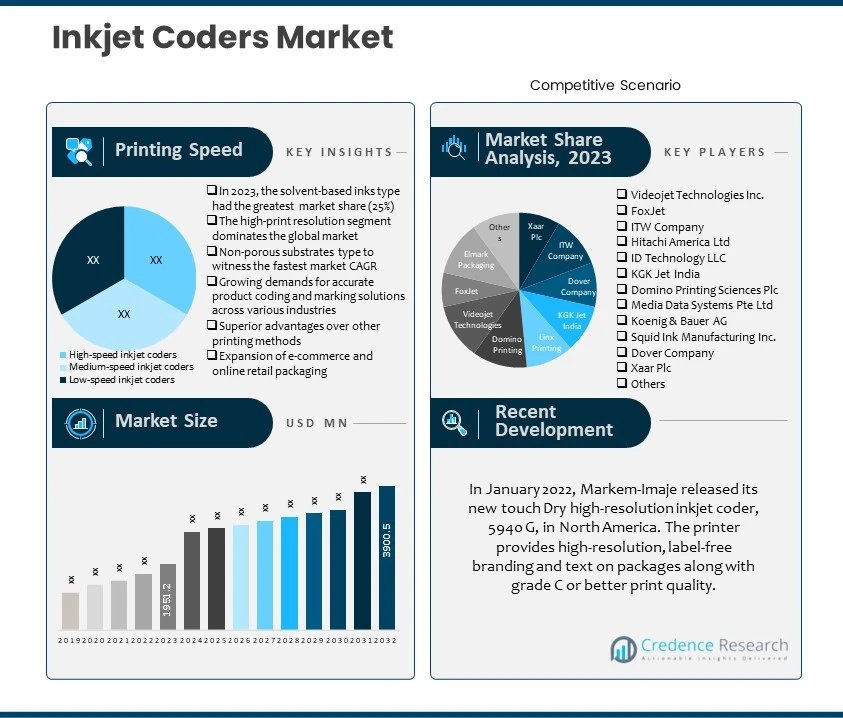
- The global demand for inkjet coders was valued at USD 1951.2 Million in 2023 and is expected to reach USD 3900.5 Million in 2032, growing at a CAGR of 8% between 2024 and 2032.
- Continuous inkjet (CIJ) printers are the market leader in technology type, accounting for more than 30% of total value in 2023, while the drop-on-demand (DOD) inkjet printers are predicted to increase at a substantial CAGR over the projected time frame.
- The product expiration dates application segment dominates the global market for inkjet coders, accounting for more than 24% of the market in 2023.
- Over the projection period, the medium-speed inkjet coders are expected to expand at the highest rate, while the high-speed inkjet coders category dominated the market in 2023 with a 40% share.
- Solvent-based inks dominated the market, with 25% of the total revenue share by ink type category. In contrast, UV-curable inks will expand fastest during the projected period.
- With an impressive market share of more than 58% by 2023 and estimates for considerable CAGR growth, the high-print resolution category will likely continue to lead the market.
- North America is leading the continued growth of the inkjet coders sector, accounting for more than one-third of the market in 2023, while Europe and Asia Pacific together account for just under 56%. Europe controlled more than 22.5% of the market in 2023.
- The market is witnessing a trend towards digital inkjet printing technologies due to their versatility, precision, and ability to print variable data such as barcodes, QR codes, expiration dates, and batch numbers on products and packaging.
Executive Summary
Market Definition
Inkjet coders, which are also known as inkjet printers or labeling systems, are non-contact printing machines that employ inkjet technology to generate high-quality, detailed, and legible codes on a wide range of surfaces. These printers use small nozzles to propel ink droplets onto the surface, creating characters, numbers, symbols, and pictures. Inkjet coders are widely used in the food and beverage, pharmaceutical, cosmetic, automotive, electronics, and packaging industries to assure accurate product traceability, identification, and compliance with regulations.
Market Overview
The global inkjet coders market has witnessed consistent growth over recent years and is set to grow at a CAGR of 8% between 2024 and 2032. The market was valued at USD 1951.2 million in 2023 and is anticipated to reach USD 3900.5 million in 2032.
Inkjet coders are widely used in many different types of industries for product marking and tagging, such as printing batch numbers, expiration dates, barcodes, and other variable information on objects and packaging. Inkjet coding technologies are classified into three types: Continuous Inkjet (CIJ), Thermal Inkjet (TIJ), and Drop-on-Demand (DOD), each having its own set of properties and applications. Growing consumer awareness of product traceability and safety, tight laws controlling product labeling and coding, and the need for reliable and efficient coding solutions are some of the primary factors supporting the inkjet coder growth. The market is further propelled by the expansion of industries, including pharmaceuticals, manufacturing, cosmetics, and food & beverages, all of which require effective coding solutions for quality control and supply chain management.
Inkjet coders, on the other hand, require regular maintenance to function at optimal efficiency. Printhead maintenance, cleaning, and replacing worn-out components are certain examples of heavy maintenance duties. If inkjet coders are not properly maintained, they might cause downtime, which can disrupt production schedules and productivity. While inkjet coders are fast and dependable, they have printing resolution limitations when compared to other printing technologies, such as laser coders. This limitation can be problematic for some applications that need high-resolution printing, such as small and complex product labeling or the printing of intricate images.
Inkjet coding technology is constantly evolving, resulting in the development of increasingly complex and dependable inkjet coders. Recent innovations in print head designs, ink formulations, and software integration have increased printing speed, quality, precision, and maintenance. These technological improvements attract organizations seeking effective and affordable coding solutions, further propelling the inkjet coder market forward. The growing online retail, e-commerce, and consumer packaged goods sectors have led to an expansion in the packaging business, which in turn contributed to the growth of the inkjet coder market. As businesses aim for visually appealing designs as well as efficient product identification, inkjet coders serve as a necessary technique for adding variable information to packaging materials, maintaining brand visibility, and increasing customer engagement.
Segmentation by Technology Type
- Continuous inkjet (CIJ) printers dominate the technology type category, capturing over 30% of the market share in 2023. CIJ printers are favored for their versatility, high-speed printing capabilities, and suitability for a wide range of substrates and applications.
- Drop-on-demand (DOD) inkjet printers are expected to witness significant market growth due to the latest advancements in print head technology, improved print quality, and enhanced flexibility in printing variable data and graphics.
Segmentation by Ink Type
- Solvent-based ink type emerged as the primary choice in the inkjet coders market, accounting for over 25% of total revenue in 2023. Solvent-based inks offer fast drying times, excellent adhesion, and durability on various substrates, which makes them ideal for industrial coding and marking applications.
- UV-curable and oil-based inks cater to specific niche market applications within inkjet coders. These include UV-curable inks for high-resolution printing on non-porous substrates and oil-based inks for specialized industrial applications.
Segmentation by Substrate Type
- Non-porous substrates, including plastics, metals, and glass, are projected to experience notable CAGR growth due to increased demand for coding and marking on packaging materials, automotive parts, and electronics.
- The porous substrates segment, encompassing materials like paper and cardboard, leads the market share with over 38% in 2023, owing to their extensive use in the printing of labels, packaging, and promotional items.
Segmentation by End-User Industry
- The cosmetics and personal care category is predicted to expand rapidly, attributed to the increased demands for product labeling, batch coding, and customization in the beauty and grooming sectors.
- Pharmaceuticals and healthcare remain the dominant end-user industry category, commanding a market share of nearly 22% in 2023 due to stringent serialization and track-and-trace requirements for medical products.
Segmentation by Application
- The product expiration dates category dominates the inkjet coders market, with a share of more than 24% in 2023. This demonstrates the importance of inkjet coders in printing batch codes, expiration dates, and regulatory information on packed products.
- Logo and branding applications contribute to the diverse market range of inkjet coders applications, supporting brand identification, marketing initiatives, and product differentiation in various industries.
Segmentation by Print Resolution
- High resolution emerges as the leading category in terms of print resolution, commanding a massive share of 58% in 2023. High-resolution inkjet coders are primarily favored for their ability to produce sharp, detailed prints suitable for small text, graphics, and barcodes.
- The standard resolution category demonstrates the largest market CAGR. It mainly offers cost-effective printing solutions for applications requiring moderate print quality and readability.
Segmentation by Printing Speed
- High-speed inkjet coders lead the printing speed category, capturing a substantial market share of 40% in 2023. High-speed printers are in demand for industries requiring rapid production rates and high-volume printing capabilities.
- Medium-speed inkjet coders are the fastest-growing segment, providing a balance of print speed and quality for applications with moderate to high throughput rates.
Segmentation by Region
- North America leads the growth of the inkjet coders industry, accounting for over one-third of the global market in 2023, owing to modernization of technology, a strong manufacturing base, and continuous demand from key end-user industries.
- Europe and Asia Pacific collectively contributed nearly 56% of the market share in 2023, with Europe holding a dominant position of over 23% due to the presence of major players, stringent quality standards, and higher adoption of advanced printing technologies.
- The rest of the world, including Latin America, the Middle East, and Africa, has untapped market opportunities for the adoption of inkjet coders.
In 2023, North America overtook other regions as the largest global market for inkjet coders. This growth can be ascribed to the increased adoption of inkjet coding technologies across the food and beverages industry within the region. The United States currently controls the majority market in North America. These coders have been widely adopted in the food, packaging, and pharmaceutical sectors throughout the United States. North America is home to a large number of coding manufacturers and solution providers owing to its early adoption of inkjet coding and printing technology.
Europe had the second-largest market share in 2023. This region has a major pharmaceutical manufacturing hub, with nations such as the United Kingdom, Germany, and Belgium playing key roles. Pharmaceutical companies demand precise and accurate inkjet coding techniques for product identification, serialization, and track-and-trace purposes. Europe is also at the forefront of implementing Industry 4.0 standards and technology in manufacturing. Inkjet coders are used in smart factories, networked manufacturing lines, and centralized control systems.
Asia Pacific is anticipated to provide substantial growth opportunities in the inkjet coders market in the forecast time frame. Many Asia-Pacific countries are rapidly industrializing and expanding their manufacturing industries. China is a major manufacturer in the market due to the low capital requirements, technological developments, and changing industry trends and player requirements in the country. In addition, governments throughout the region have implemented legal standards in an effort to curb the ever-rising acts of piracy and counterfeiting.
Key Highlights of the Report
The global inkjet coders market is segmented by technology type, ink type, substrate type, end-user industry, application, print resolution, printing speed, and region. Continuous inkjet (CIJ) printers lead the technology type category, offering versatility and reliability for various coding and marking applications. Solvent-based ink types emerge as the primary choice, catering to fast-drying and durable printing needs across different substrates. Porous substrates, such as paper and cardboard, lead in market share due to their widespread usage in packaging and labeling applications. High-resolution and high-speed inkjet coders dominate their respective categories, meeting industry demands for clear, high-quality prints at efficient production speeds.
Inkjet coders are among the most innovative breakthroughs in dot-matrix format printers. These devices consist of numerous ink guns that drop ink onto the relevant substrate to print the necessary information. This technology can be used to mark either flat or curved surfaces. Plus, inkjet coders can print on almost any sort of material. High-resolution inkjet coders are becoming increasingly popular in industries that require excellent quality and accurate printing, especially packaging and branding. The demand for more precise barcodes, short QR codes, and product details contributes to this market trend. The increasing growth of e-commerce and online retail channels worldwide has also resulted in higher market demands for efficient and fast inkjet coders for labeling and shipping applications.
One of the key market limitations is the higher upfront cost of inkjet coding equipment, especially for high-speed and high-resolution devices, which may be a barrier to adoption for smaller enterprises. Some inkjet coders also require costly consumables, such as ink and maintenance parts, which results in continual running costs for organizations to consider.
What Are The Main Drivers Of The Global Inkjet Coders Market?
Inkjet coders are in high demand due to increasingly severe regulations, notably in the food, pharmaceutical, and packaging industries, which require accurate and compliant product labeling. The demand for improved product traceability to track and verify the origin and validity of items, particularly in the food & pharmaceutical industries, promotes the adoption of inkjet coders for serialization and track-and-trace. Product safety and traceability are becoming increasingly important to consumers. Inkjet coders help to ensure accurate and visible coding, which provides consumers with important details about the products they buy, such as the origin, production date, and ingredients. The norm for traceability and transparency fuels the consistent growth of the inkjet coders market.
What Are The Major Challenges Faced By The Global Inkjet Coders Market?
The initial cost of purchasing and installing inkjet coders, particularly models with complex capabilities, can be substantial. This limits small enterprises or those with limited resources from implementing this technology. Inkjet printers require routine maintenance and buying of consumables such as ink and solvents. The ongoing running costs connected with inkjet coders can accumulate over time. Food and pharmaceutical industries have strict guidelines in place for the safety and composition of inks used in packaging and labeling. It can also be challenging for inkjet printer manufacturers to meet these amenableness standards.
What Are The Growth Opportunities In The Global Inkjet Coders Market?
With the growing trend of industrial automation, businesses are implementing innovative coding and marking solutions to optimize their manufacturing operations. The real-time coding capabilities and high-speed printing of inkjet printer coders make them an ideal solution for automated production lines. They help to decrease manual errors, increase productivity, and improve overall operational efficiency. Inkjet coders serve applications in a broad spectrum of business sectors, including pharmaceuticals, food and beverage, beauty products, automobile manufacturing, electronic goods, and others. Inkjet coders are suitable for a wide range of product forms and packaging materials due to their ability to print on many kinds of substrates, such as plastic, metal, paper, glass, and flexible packaging. This extensive application scope is anticipated to increase global market demand opportunities for inkjet coders in the coming years.
Market Drivers
Several factors contribute to the growth of the global inkjet coders market. The primary factors propelling the global inkjet coders market are as follows:
Increased Need for Label Printing in the Pharmaceutical Sector
The pharmaceutical sector is subject to stringent laws that govern product traceability, identity, and safety. Inkjet coders help meet these regulatory standards by generating clear and legible codes such as batch numbers, dates of expiration, barcodes, serial codes, and other dynamic information. The address and name of the manufacturer, packer, or distributor must be on the label. It must also have suitable usage directions that define the setting and objectives, dosage, timing, and mode of administration for the medicine. Compliance with standards like Good Manufacturing Practices (GMP) and serialization regulations increases the market demand for high-quality inkjet coding solutions. High-quality printing is required in the pharmaceutical business to maintain code readability throughout a product's life cycle.
The growing number of pharmacy stores is further driving up the market need for these coders. These inkjet printers are utilized in pharmacies to mark blister packs, cartons, and packaging for prescription drugs and other pharmacy products. This prevents the sale of fake drugs and allows for the traceability necessary to comply with legal requirements. In general, the expiration date of the drug must be displayed on both the outer packaging and the internal container. Label statements should be displayed boldly and explicitly. The manufacturing lot number, often referred to as the batch number on the packaging or tag, should provide a complete production history for the item. This increased usage of label printing in pharmaceuticals boosts market expansion.
Market Restraints
The global inkjet coders market confronts multiple challenges that may impede its expansion. These consist of the following:
Requires Extensive Maintenance and Higher Costs of Ink Refills
Inkjet coders require frequent maintenance due to the necessity to clean the printheads on a regular basis. The frequency of printhead cleaning depends on how often the printer is used. However, even if the printer is used infrequently, it still needs to have its printheads cleaned approximately every three months. Thus, employing an inkjet coder can be more costly, especially if the company requires a lot of printing on a regular schedule. Reloading inkjet coders also incurs costs. Inkjet cartridges can be quite expensive, with adequate cartridges for a decent printer costing nearly as much as the equipment. As a result, these issues are likely to slow the market growth for inkjet coders in the coming years.
Opportunities
The inkjet coders market presents substantial growth opportunities on a global scale. These consist of the following:
Advancements in Printing Technology
Inkjet printer technology has made substantial developments that enable high-resolution (HR), high-speed coding on a wide range of substrates. Continuous inkjet (CIJ) technology is gaining market prominence due to its ability to print at higher speeds for variable data applications. It has extensive applications in the food & beverage, medicinal products, and packaging businesses. The piezoelectric and thermal inkjet printheads are recent developments that have increased print quality and efficiency. The integration of digital abilities further facilitates customization and variable data printing, which meets the various requirements of many businesses.
The technological innovations in these inkjet coders, such as software programs that regulate and track automatic flush systems and ink viscosity, are expected to create enormous growth opportunities for the industry during the forecast period. Inkjet programmers are now widely incorporated into smart manufacturing processes, which facilitate real-time monitoring, remote testing, and predictive maintenance. This enhances operational efficacy and minimizes downtime.
Competitive Landscape
Key Players
The global inkjet coders market is highly competitive, with major firms consistently inventing and increasing their product offerings to fulfill the needs of diverse industries. The following are a few of the most prominent market players and their market shares:
- Videojet Technologies Inc.
- FoxJet
- ITW Company
- Shanghai Rottweil Handyware Printing Technology Co. Ltd
- Hitachi America Ltd
- ID Technology LLC
- KGK Jet India
- Linx Printing Technologies
- Domino Printing Sciences Plc
- Media Data Systems Pte Ltd
- Elmark Packaging
- Koenig & Bauer AG
- Squid Ink Manufacturing Inc.
- Markem-Imaje
- Dover Company
- Xaar Plc
- Others
These leading players continuously invest in R&D projects to enhance their product offerings, improve print quality, increase printing speeds, and expand application capabilities across various end-use industries. They also focus on providing comprehensive aftermarket services, including maintenance, technical support, training, and spare parts availability, to ensure customer satisfaction and loyalty.
Partnerships, collaborations, mergers, and acquisitions are common strategies employed by companies to strengthen their market position, broaden their customer base, and tap into new growth opportunities.
In October 2023, Domino Printing Sciences (Domino) officially announced the launch of a new subsidiary, Domino Printing Indonesia, which will provide complete closed-end inkjet coding solutions to the Indonesian archipelago.
In November 2022, Xaar Plc introduced a new printhead called Xaar Aquinox. This device is part of Xaar's ImagineX platform. It is built on aQ power technology, which allows it to work with a wider variety of pH values when employing water-based materials. In addition, the device has a longer nozzle open time, is more energy efficient, and produces higher-quality prints.
In October 2022, Videojet Technologies Inc., a manufacturer of marking, coding, and printing devices, released six new inks for bigger inkjet printers, introducing recent developments in the coding solution.
In April 2022, Markem-Imaje (MI) launched the 9750+ continuous inkjet (CIJ) hybrid coder. This new solution would benefit consumers by reducing their ink and pigment inventory requirements while also lowering costs. It allows for the delivery of high legibility and permanence color contrasted codes using pigments and dyes in addition to typical dark ones.
In March 2022, Xaar Plc acquired Megnajet, an entity that designs and manufactures industrial ink management and supply solutions for digital inkjets. This acquisition would give Xaar clients, especially user developer integrators (UDIs), additional integration across inkjet technologies and a more accessible printing environment, reducing their time to market and development time.
Summary of Key Findings
- The increasing demand for product traceability, stringent government regulations regarding packaging and labeling, and the growing need for efficient coding and marking solutions in various industries are major drivers fueling the growth of the inkjet coders market.
- The market is segmented by technology type, ink type, substrate type, end-user industry, application, print resolution, printing speed, and region.
- Non-contact inkjet coding technologies, such as thermal inkjet (TIJ) and piezoelectric inkjet, are gaining market traction due to their ability to print on irregular surfaces, sensitive materials, and high-speed production lines while minimizing maintenance requirements and downtime.
- However, challenges such as high initial investment costs, maintenance requirements, and competition from alternative coding technologies like laser and thermal inkjet are impacting market dynamics.
- The market for inkjet coders is highly competitive, with key players such as Domino Printing Sciences, Markem-Imaje (Dover Company), Videojet Technologies Inc. (Danaher Corporation), and Hitachi Industrial Equipment Systems Co. Ltd actively participating in product innovations and market expansion strategies.
Future Outlook
- The Asia-Pacific region is witnessing the fastest market growth in inkjet coder adoption, which can be attributed to expanding manufacturing activities, increasing government regulations regarding product labeling, and the presence of major manufacturing hubs in countries like China, India, and Japan.
- The industry is experiencing an emergence of advanced coding software that incorporates features such as dynamic data printing, serialization, batch management, and remote monitoring, thereby broadening the capabilities and flexibility of inkjet coding systems.
How CXOs Can Benefit from the Credence Research Inkjet Coders Market Report
The Credence Research Inkjet Coders Market Report provides CXOs with a comprehensive overview of the market, including:
- Market Size and Growth Forecast: The report provides detailed estimates of the global inkjet coders market size, segmented by technology type, ink type, substrate type, end-user industry, application, print resolution, printing speed, and region. It also includes forecasts for the market through 2032 based on key trends and drivers.
- Market Segmentation: The report segments the inkjet coders market by technology type, ink type, substrate type, end-user industry, application, print resolution, printing speed, and region. This segmentation helps CXOs gain a deeper understanding of market dynamics and identify growth opportunities in specific segments.
- Competitive Landscape: The report profiles leading players in the inkjet coders market, offering insights into their strategies, product offerings, and financial performance. This information assists CXOs in assessing competition and formulating effective business strategies.
- Key Trends and Drivers: The report identifies and analyzes the key trends and drivers shaping the inkjet coders market. This information enables CXOs to make informed decisions regarding investments, product development, and market positioning.
CXOs can use the insights from the Credence Research Inkjet Coders Market Report to:
- Identify Growth Opportunities: The report helps CXOs identify growth opportunities in the inkjet coders market, such as the increasing demand for high-resolution inkjet coders in the pharmaceutical and cosmetics industries.
- Make Informed Investment Decisions: CXOs can make informed investment decisions regarding inkjet coder technologies and solutions by understanding key factors highlighted in the report, such as print resolution, printing speed, and substrate compatibility.
- Develop Competitive Strategies: The report assists CXOs in developing competitive strategies for their inkjet coders businesses, such as identifying market niches or differentiating offerings based on print quality, application versatility, and industry-specific requirements.
- Track Market Developments: The report enables CXOs to track market developments and stay ahead of the curve by providing key insights into the latest trends and innovations in the inkjet coders market.
Overall, the Credence Research Inkjet Coders Market Report is a valuable resource for CXOs looking to gain a deeper understanding of the market and identify growth opportunities.
Segmentation
- By Technology Type
- Continuous inkjet (CIJ) printers
- Drop-on-demand (DOD) inkjet printers
- Thermal DOD inkjet printers
- Piezoelectric DOD inkjet printers
- By Ink Type
- Solvent-based inks
- Water-based inks
- UV-curable inks
- Oil-based inks
- Specialty inks (e.g., food-grade, pigmented)
- By Substrate Type
- Porous substrates (e.g., paper, cardboard)
- Non-porous substrates (e.g., plastics, metals, glass)
- Flexible packaging materials
- Rigid packaging materials
- By End-User Industry
- Food and beverage
- Pharmaceuticals and healthcare
- Cosmetics and personal care
- Electronics
- Automotive
- Building materials
- Chemicals and industrial products
- Others
- By Application
- Product expiration dates
- Lot/batch numbers
- Barcodes and QR codes
- Serial numbers
- Logo and branding
- Regulatory information (e.g., FDA compliance)
- By Print Resolution
- Standard resolution
- High resolution
- By Printing Speed
- High-speed inkjet coders
- Medium-speed inkjet coders
- Low-speed inkjet coders
- By Region
- North America
- The U.S.
- Canada
- Mexico
- Europe
- Germany
- France
- The U.K.
- Italy
- Spain
- Rest of Europe
- Asia Pacific
- China
- Japan
- India
- South Korea
- South-east Asia
- Rest of Asia Pacific
- Latin America
- Brazil
- Argentina
- Rest of Latin America
- Middle East & Africa
- GCC Countries
- South Africa
- Rest of the Middle East and Africa
- North America

Request a Free Sample
Fill in your details and we'll send you a free sample report.
- Sample data tables & charts
- Research methodology
Market Dynamics
Stringent Regulatory Requirements for Product Labeling
Industries such as food, pharmaceuticals, and cosmetics face strict regulations mandating clear, traceable, and compliant product labeling. Inkjet coders are essential for meeting these requirements, driving adoption across regulated sectors.
Growth in Packaging and Manufacturing Sectors
The expansion of global packaging, e-commerce, and manufacturing industries increases the need for efficient, high-speed, and flexible coding solutions, making inkjet coders vital for product identification and traceability.
Advancements in Inkjet Technology
Continuous improvements in printhead design, ink formulations, and integration with digital systems have enhanced print quality, speed, and reliability, encouraging more industries to adopt inkjet coders for diverse applications.
Rising Demand for Product Traceability and Anti-Counterfeiting
With growing concerns over product authenticity and supply chain transparency, especially in pharmaceuticals and food, inkjet coders enable serialization, batch coding, and real-time tracking, supporting anti-counterfeiting efforts.
Need a Custom Version of This Report?
Tailor the scope, geography, or segments to your exact requirements.
- Custom geography or segment scope
- Direct access to our analyst team
Frequently Asked Questions
What is the current size of the global inkjet coders market?
What is the expected growth rate of the inkjet coders market between 2024 and 2032?
Which segment is leading the market revenue share in terms of technology type?
Which end-user industry governs the market demand for inkjet coders globally?
Who are the major players in the global inkjet coders market?
Table of Content
Chapter 1 Market Segmentation
- 1.1 Segmentation Framework
- 1.1.1 Product and Service Classification
- 1.1.2 Application and End-Use Classification
- 1.1.3 Technology and Solution Classification
- 1.1.4 Customer and Distribution Channel Classification
- 1.1.5 Geographic Segmentation
- 1.1.6 Market Segment Definitions and Boundaries
- 1.2 By Ink Type
- 1.2.1 Solvent-based inks
- 1.2.2 Water-based inks
- 1.2.3 UV-curable inks
- 1.2.4 Oil-based inks
- 1.2.5 Specialty inks
- 1.3 By Application
- 1.3.1 Product expiration dates
- 1.3.2 Lot/batch numbers
- 1.3.3 Barcodes and QR codes
- 1.3.4 Logo and branding
- 1.3.5 Regulatory information
- 1.4 By Technology Type
- 1.4.1 Continuous inkjet (CIJ) printers
- 1.4.2 Drop-on-demand (DOD) inkjet printers
- 1.4.3 Thermal DOD inkjet printers
- 1.4.4 Piezoelectric DOD inkjet printers
- 1.5 By End-User Industry
- 1.5.1 Food and beverage
- 1.5.2 Pharmaceuticals and healthcare
- 1.5.3 Cosmetics and personal care
- 1.5.4 Electronics
- 1.5.5 Automotive
Chapter 2 Introduction
- 2.1 Report Objectives and Scope
- 2.2 Product Definition and Industry Terminology
- 2.3 Market Inclusions and Exclusions
- 2.4 Research Process
- 2.4.1 Primary Research and Expert Interviews
- 2.4.2 Secondary Research and Source Review
- 2.4.3 Top-Down and Bottom-Up Estimation
- 2.4.4 Data Triangulation and Verification
- 2.5 Market Size Measurement Basis
- 2.5.1 2023: USD 1951.2 million → 2032: USD 3,900.5 Million
- 2.6 Historical and Forecast Reference Periods
- 2.6.1 Base Year: 2023
- 2.6.2 Forecast Period: 2023-2032
- 2.7 Research Assumptions and Limitations
Chapter 3 Executive Summary
- 3.1 Market Snapshot and Key Findings
- 3.2 Base-Year Market Size, 2023
- 3.3 Forecast Market Size, 2032
- 3.4 Revenue and Volume Growth Outlook
- 3.5 Key Demand and Supply Indicators
- 3.6 Leading Market Segments
- 3.7 Fastest-Growing Market Opportunities
- 3.8 Regional Performance Highlights
- 3.9 Technology and Industry Transformation
- 3.10 Competitive Landscape Summary
- 3.11 Analyst View and Strategic Implications
Chapter 4 Global Inkjet Coders Market Trends and Developments
- 4.1 Historical Industry Development
- 4.2 Recent Market Trends and Developments
- 4.3 Demand and Customer Behavior Trends
- 4.4 Technology and Product Innovation
- 4.5 Artificial Intelligence, Automation and Digitalization
- 4.6 Local Manufacturing and Supply Chain Realignment
- 4.7 Industry Partnerships, Mergers and Acquisitions
- 4.8 Sustainability and Circular Economy Developments
- 4.9 Government and Private Sector Investment Trends
- 4.10 Emerging Business Models and Commercialization
- 4.11 Industry Developments and Announcements
Chapter 5 Global Inkjet Coders Market Production, Supply and Demand Analysis
- 5.1 Demand Trend and Consumption Analysis
- 5.2 Demand Forecast, 2023-2032
- 5.3 Production and Output Trend
- 5.4 Production and Output Forecast, 2023-2032
- 5.5 Installed Capacity and Capacity Utilization
- 5.6 Company-Wise Production Plants and Statistics
- 5.6.1 Installed Production Capacity
- 5.6.2 Actual Production
- 5.6.3 Planned Capacity and Expansion Targets
- 5.7 Supply Chain Structure and Procurement Trends
- 5.8 Supply-Demand Gap and Bottlenecks
- 5.9 Import Dependence and Sourcing Structure
- 5.10 Contract Manufacturing and Outsourcing
- 5.11 Regional Supply and Demand Concentration
Chapter 6 Global Inkjet Coders Market Pricing Analysis
- 6.1 Pricing Structure and Measurement
- 6.2 Historical Pricing Trends
- 6.3 Pricing Outlook, 2023-2032
- 6.4 Average Selling Price and Unit Economics
- 6.5 Pricing by Product and Market Segment
- 6.6 Geographic Pricing Differences
- 6.7 Key Input, Energy, Labor and Logistics Costs
- 6.8 Contract Pricing and Purchasing Models
- 6.9 Pricing Sensitivity and Competitive Positioning
- 6.10 Price, Margin and Profitability Implications
Chapter 7 Global Inkjet Coders Market Dynamics
- 7.1 Market Growth Drivers
- 7.1.1 Demand-Side Drivers
- 7.1.2 Technology and Innovation Drivers
- 7.1.3 Infrastructure and Investment Drivers
- 7.1.4 Regulatory and Policy Drivers
- 7.2 Market Restraints
- 7.2.1 Cost and Affordability Constraints
- 7.2.2 Technology and Adoption Barriers
- 7.2.3 Supply Chain and Operational Constraints
- 7.3 Market Challenges
- 7.3.1 Competitive Pressure and Margin Erosion
- 7.3.2 Skills, Infrastructure and Implementation Gaps
- 7.4 Emerging Market Opportunities
- 7.5 Market Dynamics Impact and Time-Horizon Assessment
Chapter 8 Global Inkjet Coders Value Chain Analysis
- 8.1 Industry Value Chain Overview
- 8.2 Upstream Suppliers and Critical Inputs
- 8.3 Technology and Component Providers
- 8.4 Manufacturing or Service Delivery
- 8.5 Distribution, Channel Partners and Integrators
- 8.6 Downstream Applications and End Users
- 8.7 Value Addition and Profit Pools
- 8.8 Vertical Integration and Outsourcing
- 8.9 Supplier Concentration and Risk
- 8.10 Supply Chain Localization and Resilience
Chapter 9 Global Inkjet Coders Market Regulations and Policies
- 9.1 Relevant Laws, Standards and Compliance Frameworks
- 9.2 Product, Service, Safety and Quality Requirements
- 9.3 Government Policies, Incentives and Subsidies
- 9.4 Imports, Exports and Trade Barriers
- 9.5 Public Procurement and Local Content Requirements
- 9.6 Environmental and Sustainability Compliance
- 9.7 Data Protection, AI and Cybersecurity Compliance
- 9.8 Upcoming Policy Changes and Market Implications
Chapter 10 Global Inkjet Coders Market Hotspots and Opportunities
- 10.1 Market Opportunity Mapping and Growth Hotspots
- 10.2 High-Growth Applications and Customer Groups
- 10.3 Underserved Markets and White-Space Opportunities
- 10.4 Emerging Technology and Product Opportunities
- 10.5 New Capacity and Investment Hotspots
- 10.6 Market Entry and Expansion Opportunities
- 10.7 Distribution and Partnership Opportunities
- 10.8 Near-Term and Long-Term Commercial Potential
- 10.9 Opportunity Attractiveness and Execution Risks
Chapter 11 Global Inkjet Coders Market Outlook, 2023-2032
- 11.1 Market Size and Analysis
- 11.1.1 Revenue (Market Measurement: 2023: USD 1951.2 million → 2032: USD 3,900.5 Million)
- 11.1.2 Market Volume and Quantity Sold
- 11.1.3 Historical Market Size
- 11.1.4 Base-Year Market Size, 2023
- 11.2 Market Forecast, 2023-2032
- 11.2.1 Revenue Forecast to 2032
- 11.2.2 Volume Forecast to 2032
- 11.2.3 CAGR and Year-on-Year Growth
- 11.2.4 Incremental Revenue Opportunity
- 11.3 Forecast Assumptions and Scenario Analysis
- 11.3.1 Base-Case Forecast
- 11.3.2 Optimistic and Conservative Scenarios
- 11.3.3 Technology, Pricing and Policy Sensitivities
- 11.4 Market Attractiveness and Growth Outlook
Chapter 12 Global Inkjet Coders Market Segmentation and Outlook
- 12.1 Segmentation Summary and Market Shares, 2023
- 12.2 Largest and Fastest-Growing Segments
- 12.3 By Ink Type - Market Size and Forecast, 2023-2032
- 12.3.1 Segment Definition and Scope
- 12.3.2 Historical Market Size
- 12.3.3 Revenue Forecast, 2023-2032
- 12.3.4 Volume Forecast, 2023-2032
- 12.3.5 Base-Year Market Share, 2023
- 12.3.6 Segment CAGR and Growth Drivers
- 12.3.7 Subsegment Market Size and Forecast
- 12.3.7.1 Solvent-based inks
- 12.3.7.2 Water-based inks
- 12.3.7.3 UV-curable inks
- 12.3.7.4 Oil-based inks
- 12.3.7.5 Specialty inks
- 12.3.8 Subsegment Pricing and Adoption Trends
- 12.3.9 Leading Suppliers and Competition
- 12.3.10 Regional Demand and Opportunities
- 12.4 By Application - Market Size and Forecast, 2023-2032
- 12.4.1 Segment Definition and Scope
- 12.4.2 Historical Market Size
- 12.4.3 Revenue Forecast, 2023-2032
- 12.4.4 Volume Forecast, 2023-2032
- 12.4.5 Base-Year Market Share, 2023
- 12.4.6 Segment CAGR and Growth Drivers
- 12.4.7 Subsegment Market Size and Forecast
- 12.4.7.1 Product expiration dates
- 12.4.7.2 Lot/batch numbers
- 12.4.7.3 Barcodes and QR codes
- 12.4.7.4 Logo and branding
- 12.4.7.5 Regulatory information
- 12.4.8 Subsegment Pricing and Adoption Trends
- 12.4.9 Leading Suppliers and Competition
- 12.4.10 Regional Demand and Opportunities
- 12.5 By Technology Type - Market Size and Forecast, 2023-2032
- 12.5.1 Segment Definition and Scope
- 12.5.2 Historical Market Size
- 12.5.3 Revenue Forecast, 2023-2032
- 12.5.4 Volume Forecast, 2023-2032
- 12.5.5 Base-Year Market Share, 2023
- 12.5.6 Segment CAGR and Growth Drivers
- 12.5.7 Subsegment Market Size and Forecast
- 12.5.7.1 Continuous inkjet (CIJ) printers
- 12.5.7.2 Drop-on-demand (DOD) inkjet printers
- 12.5.7.3 Thermal DOD inkjet printers
- 12.5.7.4 Piezoelectric DOD inkjet printers
- 12.5.8 Subsegment Pricing and Adoption Trends
- 12.5.9 Leading Suppliers and Competition
- 12.5.10 Regional Demand and Opportunities
- 12.6 By End-User Industry - Market Size and Forecast, 2023-2032
- 12.6.1 Segment Definition and Scope
- 12.6.2 Historical Market Size
- 12.6.3 Revenue Forecast, 2023-2032
- 12.6.4 Volume Forecast, 2023-2032
- 12.6.5 Base-Year Market Share, 2023
- 12.6.6 Segment CAGR and Growth Drivers
- 12.6.7 Subsegment Market Size and Forecast
- 12.6.7.1 Food and beverage
- 12.6.7.2 Pharmaceuticals and healthcare
- 12.6.7.3 Cosmetics and personal care
- 12.6.7.4 Electronics
- 12.6.7.5 Automotive
- 12.6.8 Subsegment Pricing and Adoption Trends
- 12.6.9 Leading Suppliers and Competition
- 12.6.10 Regional Demand and Opportunities
- 12.7 Segment Growth Comparison
- 12.8 Segment Attractiveness and Priority Matrix
Chapter 13 Global Inkjet Coders End-Use and Application Market Outlook
- 13.1 End-Use Industry and Customer Demand Structure
- 13.2 Leading Applications and Customer Groups
- 13.3 End-Use Market Size, Share and Forecast
- 13.4 Major End-Use Industry Deep Dives
- 13.4.1 Customer Requirements and Use Cases
- 13.4.2 Demand and Replacement Cycles
- 13.4.3 Technical and Regulatory Considerations
- 13.4.4 Purchasing and Procurement Models
- 13.4.5 Leading Vendors and Distribution Channels
- 13.4.6 Forecast and Commercial Opportunities
- 13.5 Emerging Applications and Cross-Segment Demand
- 13.6 End-Use Industry Investment Priorities
Chapter 14 Global Inkjet Coders Geographic Market Outlook, 2023-2032
- 14.1 Regional Market Size and Share, 2023
- 14.2 Regional Market Forecast, 2023-2032
- 14.3 Regional Pricing, Production and Demand Differences
- 14.4 North America
- 14.4.1 United States
- 14.4.2 Canada
- 14.4.3 Mexico
- 14.5 Europe
- 14.5.1 Germany
- 14.5.2 France
- 14.5.3 Italy
- 14.5.4 United Kingdom
- 14.5.5 Spain
- 14.5.6 Poland
- 14.5.7 Russia
- 14.5.8 Netherlands
- 14.5.9 Belgium
- 14.5.10 Sweden
- 14.5.11 Denmark
- 14.5.12 Norway
- 14.5.13 Rest of Europe
- 14.6 Asia Pacific
- 14.6.1 China
- 14.6.2 India
- 14.6.3 Japan
- 14.6.4 South Korea
- 14.6.5 Thailand
- 14.6.6 Indonesia
- 14.6.7 Vietnam
- 14.6.8 Malaysia
- 14.6.9 Australia
- 14.6.10 Rest of Asia Pacific
- 14.7 Latin America
- 14.7.1 Brazil
- 14.7.2 Argentina
- 14.7.3 Colombia
- 14.7.4 Chile
- 14.7.5 Rest of Latin America
- 14.8 Middle East
- 14.8.1 Saudi Arabia
- 14.8.2 United Arab Emirates
- 14.8.3 Turkey
- 14.8.4 Israel
- 14.8.5 Iran
- 14.8.6 Rest of the Middle East
- 14.9 Africa
- 14.9.1 South Africa
- 14.9.2 Egypt
- 14.9.3 Nigeria
- 14.9.4 Morocco
- 14.9.5 Rest of Africa
- 14.10 Regional Investment, Policy and Supply Chain Differences
- 14.11 Regional Competitive Landscape
- 14.12 Geographic Growth Hotspots
Chapter 15 Global Inkjet Coders Technology, Innovation and Sustainability Outlook
- 15.1 Technology Landscape and Maturity
- 15.2 Product, Process and Service Innovation
- 15.3 AI, Automation and Digital Tools in the Industry
- 15.4 Technology Adoption and Performance Benchmarking
- 15.5 Innovation Pipeline and R&D Investment
- 15.6 Patent and Intellectual Property Trends
- 15.7 Energy Efficiency and Resource Management
- 15.8 Sustainability, Recycling and Circularity
- 15.9 Technology Roadmap, 2023-2032
- 15.10 Risks of Obsolescence and Technology Substitution
Chapter 16 Global Inkjet Coders Market Key Strategic Imperatives
- 16.1 Growth and Market Entry Priorities
- 16.2 High-Return Products and Segments
- 16.3 Pricing, Profitability and Cost Optimization
- 16.4 Technology Investment and Product Differentiation
- 16.5 Supply Chain Localization and Resilience
- 16.6 Distribution and Customer Acquisition
- 16.7 Partnership, Acquisition and Capacity Strategy
- 16.8 Regional Expansion Priorities
- 16.9 Short-, Medium- and Long-Term Actions
Chapter 17 Competition Outlook
- 17.1 Industry Competition Characteristics
- 17.2 Market Structure and Concentration
- 17.3 Market Share and Competitive Positioning, 2023
- 17.4 Company-Wise Revenue and Product Benchmarking
- 17.5 Production and Service Capacity Benchmarking
- 17.6 Technology, Pricing and Differentiation
- 17.7 Regional Footprint and Distribution Strength
- 17.8 Mergers, Acquisitions and Strategic Alliances
- 17.9 New Entrants and Competitive Threats
- 17.10 Porter's Five Forces and Industry Attractiveness
- 17.11 Competitive Outlook, 2023-2032
Chapter 18 Company Profiles
- 18.1 Company Coverage and Selection Criteria
- 18.2 Videojet Technologies Inc.
- 18.2.1 Business Description
- 18.2.2 Company Ownership and Geographic Presence
- 18.2.3 Product and Service Portfolio
- 18.2.4 Manufacturing and Operating Footprint
- 18.2.5 Production Capacity and Expansion Plans
- 18.2.6 Financial Performance and Investment
- 18.2.7 Market Share and Competitive Position
- 18.2.8 Technology and Innovation Capabilities
- 18.2.9 Strategic Alliances or Partnerships
- 18.2.10 Recent Developments
- 18.2.11 Growth Strategy and Outlook
- 18.3 Domino Printing Sciences Plc
- 18.4 Markem-Imaje
- 18.5 Hitachi America Ltd
- 18.6 Linx Printing Technologies
- 18.7 FoxJet
- 18.8 KGK Jet India
- 18.9 Xaar Plc
- 18.10 Squid Ink Manufacturing Inc.
- 18.11 Koenig & Bauer AG
- 18.12 Other Relevant Market Participants
Note: Every listed company is profiled on the structure shown under the first company. The company list is preliminary and may change based on research findings, market developments, data availability and client requirements.
Chapter 19 Disclaimer
- 19.1 Research and Forecast Disclaimer
- 19.2 Data Source and Estimation Limitations
Note: The depth of individual sections depends on data availability for this market. Volume, capacity, trade and other unit-based metrics are included where applicable.