
About this report
The Global Military Drones Market report explores the critical analysis of the Military Drones industry using key parameters. The report consists of investment strategies, the need for investments in the Military Drones industry, and the multiple benefits for the investors. Importantly, this report sets out major changes in the global technical regulations for the Military Drones industry, as well as how economic and non-economic barriers are helping the Military Drones market. Moreover, the report analyses the global, regional, and country-level historic and forecasted market size. The report also provides a comprehensive analysis of key investment propositions, demand and supply gap, competitors positioning, STAR analysis, SRC analysis, and Tornado analysis. Key technological developments and other analyses such as porter's five forces analysis, PESTEL analysis, value chain analysis, etc.
Key Highlights of the report
How are the major segments performing in the Military Drones Market?
In 2021, Intelligence, Surveillance, Reconnaissance, and Target Acquisition (ISRT) will be the leading segment based on the application. Instead of combat operations, UAVs' use in the defense sector is thought to be the reason for the segment's expansion.
In 2021, the fixed-wing segment will lead the market. Fixed-wing aerial aircraft can frequently deliver heavier payloads over greater distances and for longer periods while using less power than VTOL (Vertical Take-off and Landing) UAVs.
In 2021, the Extended Visual Line of Sight (EVLOS) segment will lead the market because EVLOS UAVs are widely used in effective combat management, electronic warfare, and long-range missions to gather crucial information.
In 2021, the Fuel Cell segment will lead the market due to the defense industry's growing need for high-endurance UAVs for surveillance and reconnaissance missions.
In 2021, the >6 Hours segment will lead the market due to various advancements.
In 2021, the Vertical Take-off segment will lead the market because Vertical Take-off launch technology eliminates the need for a runway. All that is needed is a helipad or an open area.
In 2021, the >150 Kilograms segment will lead the market. The market for military drones will rise as more drones with large payload capacities are used to assist vital missions, including traffic monitoring, surveillance, and search and rescue operations.
Which region dominated the Military Drones Market?
In 2021, North America was one of the major contributors to the global military drone market due to the widespread use of military drones that have resulted from growing safety and security worries and a shortage of experienced pilots. The market share of U.S. military drones is growing quickly due to regular technological advancements that enable manufacturers to create various models in various weights, forms, and sizes.
What is the competitive environment of the Military Drones Market?
Many companies use various methods, including alliances, mergers, and collaboration, to strengthen their positions in the international market. The manufacturers are concentrating largely on producing new and innovative military drones to broaden their client base in the fiercely competitive market in light of the surging wartime scenario across various countries and the growing demand. For instance, in March 2022, Gambit will be an autonomous collaborative platform (ACP) created through digital engineering to reduce acquisition costs and hasten time to market. The jet-powered platform will significantly rely on autonomous systems and artificial intelligence developments designed for air superiority. Similarly, in December 2020, the creation of nano bug drones by BAE Systems and UAVTEK was disclosed. The Bug drones can operate in severe winds and have a low visible profile, allowing them to patrol hostile areas covertly.
Executive Summary
How has the introduction of A.I. in military drones affected the expansion of the market?
Military drones are unmanned aircraft that carry out a variety of tasks, such as target monitoring, surveillance, remote sensing, and combat. Drone pilots are the people who operate these machines remotely. Due to ongoing R&D and innovation-boosting capabilities, drone technology has seen significant progress over the past few years. Modern sensors, LiDAR, GNSS, cutting-edge cameras, thermal imaging systems, and infrared imaging systems are all included in the numerous drones. The most sophisticated drones are outfitted with various sensor systems, including air-to-air missiles, a worldwide system for mobile communication, and communication intelligence sensors (GSM). Modern unmanned aerial vehicles have internal weapons bays and huge sensors that accommodate many payloads. Commercial applications of artificial intelligence (A.I.) are being used for high-altitude military UAVs' autonomous flight systems. This is anticipated to be a reliable indicator of the expansion of the military drone market globally in the ensuing years.
Which are the key investments by the players in the Military Drones Industry Market?
Military drones are receiving more government money to make military operations more effective. The demand for military drones will rise, increasing their manufacturing. A report from the Bard College Center for the Study of the Drone claims that compared to 2018, the U.S. Navy's funding for unmanned systems climbed by USD 1 billion (38%) and the U.S. Army's funding increased by USD 719 million (73%) in 2019. Department of Defense (DOD) of the U.S. also requested roughly USD 9.39 billion for drones and related technology in 2019, a considerable increase of 26% over the budgeted amount for drones in 2018.
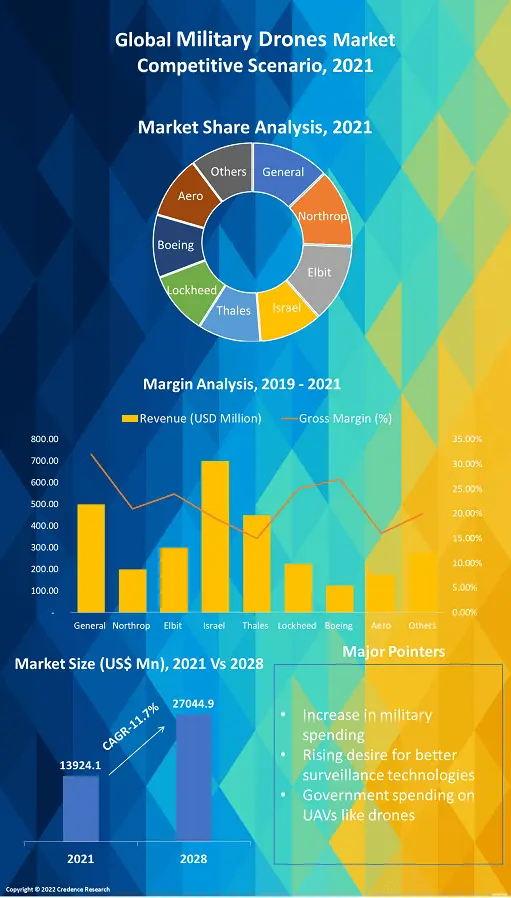
Some of the major players in the market are General Atomics Aeronautical Systems, Inc. (GA-ASI) (U.S.), Northrop Grumman Corporation (U.S.), Elbit Systems Ltd. (Israel), Israel Aerospace Industries Ltd. (Israel), AeroVironment, Inc. (the U.S.), Lockheed Martin Corporation (U.S.), Thales Group (France), and Boeing (U.S.), among others.
What are the Major Driving Factors for the Military Drones Market?
The increase in military spending and the rising desire for better surveillance technologies have fueled the expansion of the global market for military drones. Government spending on UAVs like drones has surged due to the rising terrorism threat and a global rise in security concerns. Defense modernization is another element that is anticipated to present growth prospects over the projection period. Drones are being used by several brand-new international military organizations more frequently for combat operations, law enforcement, and particularly border protection. Due to rising costs, increasing venture capital investments, and the enormous need for drone-generated data, UAVs are widely used in military drones.
What are the Major Risks for the Military Drones Market?
A key obstacle to the widespread use of military drones is their perceived lack of safety and security and social problems like privacy invasion. In light of the weaker demand, the lack of technical expertise required to operate these drones could provide a significant obstacle for players. But the expensive price of UAV solutions is impeding the market's expansion.
Which is the Key Application in the Military Drones Market?
The military drone market is segmented based on type: fixed-wing, rotary-wing, and hybrid/transitional. In 2021, the fixed-wing category dominated the market. While requiring less power than VTOL (vertical take-off and landing) UAVs, fixed-wing aerial vehicles can often transport heavier payloads over larger distances and longer periods. This makes them perfect for long-distance missions like mapping, surveillance, and defense, in which long endurance is crucial. They are widely used by various armed forces worldwide in the defense sector. These elements are expected to fuel the segment's expansion through the forecast period.
How is the Military Drones Market performing in regions?
In 2021, the global military drone market was dominated by North America due to rising defense spending, growing safety and security concerns, and expanding investment in unmanned aircraft system research and development. Leading drone producers like Northrop Grumman and Lockheed Martin Corporation are also present in the area, which is anticipated to assist market expansion. The U.S. is home to several OEMs, including General Atomics Aeronautical Systems, Inc., Northrop Grumman Corporation, and others, which is why this huge share exists. Drone technology has advanced due to important developments involving the American army and increased investment by significant key regional companies. Since the United States is one of the top exporters of military UAVs globally, the region is anticipated to grow quickly.
Besides, the Asia Pacific is expected to grow significantly over the forecast period due to growing financial support for cutting-edge drone technologies for espionage, surveillance, and reconnaissance uses. Additionally, the region's market is experiencing strong revenue development due to rising military spending by nations like China and India. Drones have been used in Asia-Pacific nations to protect the security of national borders due to political unrest. This is among the most important aspects of promoting and expanding the market in this area. China is creating cutting-edge technologies to produce drones at affordable prices.
What is the regulatory landscape for the Military Drones Market?
The industry is expanding due to changes in government regulations and an increase in the number of exceptions given to companies for the use of UAV drones for commercial purposes. Drones are being used for law enforcement purposes by the Federal Bureau of Investigation (FBI), Department of Homeland Security, and U.S. border protection to monitor the border between the United States and Mexico.
What is the Market Size of Military Drones regarding value?
The Military Drones Market is anticipated to grow at a substantial CAGR of 11.70% in the upcoming years. The Global Military Drones industry was estimated to be worth USD 13924.1 million in 2021 and was expected to be worth USD 27044.95 million by 2028.
What effect does COVID-19 have on the market for Military Drones?
The global market for military drones has been adversely affected by the COVID-19 pandemic's propagation. Due to a lack of market confidence, fewer military drone business contracts have been made to procure defense equipment and related services. Additionally, it has been noted that numerous nations, including the United States, India, France, and Israel, have reduced their defense spending. For instance, the U.S. defense budget dropped from $712 billion in 2020 to $705 billion in 2021. Regulation and policy changes, labor dependency, working capital management, liquidity and solvency management, and regulatory and policy changes are the main risk considerations for market participants in military drones.
Segmentation of Global Military Drones Market-
Global Military Drones Market – By Application
- Intelligence, Surveillance, Reconnaissance, and Target Acquisition (ISRT)
- Delivery and Transportation
- Combat Operations
- Battle Damage Management
Global Military Drones Market – By Type
- Fixed-wing
- Rotary-wing
- Hybrid/Transitional
Global Military Drones Market – By Range
- Visual Line of Sight (VLOS)
- Extended Visual Line of Sight (EVLOS)
- Beyond Line of Sight (BLOS)
Global Military Drones Market – By Propulsion Type
- Battery Powered
- Fuel Cell
- Hybrid Cell
Global Military Drones Market – By Endurance
- <1–2 Hours
- 2–6 Hours
- >6 Hours
Global Military Drones Market – By Launching Mode
- Vertical Take-off
- Automatic Take-off and Landing
- Catapult Launcher
- Hand Launched
Global Military Drones Market – By MTOW
- 25–150 Kilograms
- >150 Kilograms
Global Military Drones Market – By Region
- North America
- S.
- Canada
- Europe
- Germany
- France
- K.
- Italy
- Spain
- Rest of Europe
- Asia Pacific
- China
- Japan
- India
- South Korea
- South-east Asia
- Rest of Asia Pacific
- Latin America
- Brazil
- Mexico
- Rest of Latin America
- Middle East & Africa
- GCC Countries
- South Africa
- Rest of Middle East and Africa
Request a Free Sample
Fill in your details and we'll send you a free sample report.
- Sample data tables & charts
- Research methodology
Need a Custom Version of This Report?
Tailor the scope, geography, or segments to your exact requirements.
- Custom geography or segment scope
- Direct access to our analyst team
Frequently Asked Questions
How does COVID-19 Impact the global Military Drones market?
Which is the leading market for Military Drones?
What are the key drivers for the growth of the Military Drones market?
Which major type segment in the Military Drones Market?
Which major MTOW segment in the Military Drones Market?
Table of Content
Chapter 1. Report Introduction
- 1.1 Report Description & Purpose
- 1.1.1 Report Title & Market Definition
- 1.1.2 Unique Selling Propositions (USP) & Key Differentiators
- 1.1.3 Value Proposition for Stakeholders
- 1.2 Research Objectives
- 1.2.1 Market Sizing Objectives (Volume & Revenue)
- 1.2.2 Segmentation Objectives
- 1.2.3 Competitive Intelligence Objectives
- 1.2.4 Forecast & Scenario Objectives
- 1.3 Report Scope
- 1.3.1 Military Drones Scope – Types & Subtypes Covered
- 1.3.2 Geographic Scope – Regions & Countries Covered
- 1.3.3 Historical Period, Base Year & Forecast Period (the historical period; forecast to the forecast period)
- 1.3.4 Inclusions & Exclusions
- 1.4 HS Code & Classification Framework
- 1.5 Currency, Units & Pricing Basis
- 1.6 Target Stakeholders
- 1.7 Limitations & Assumptions
Chapter 2. Executive Summary
- 2.1 Global Military Drones Market Snapshot
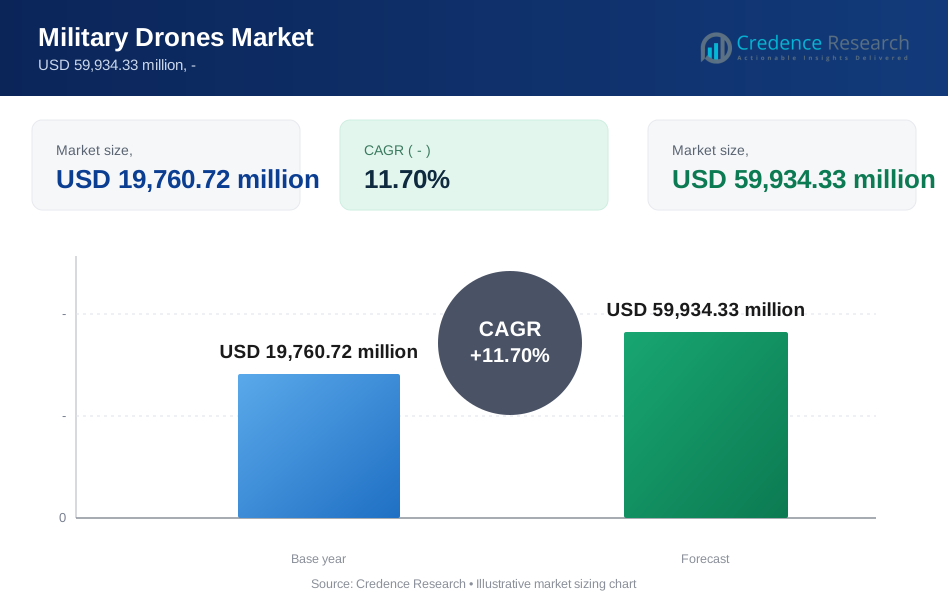
- 2.1.1 Market Size – Historical (the historical period) & Forecast (the forecast period) (base year: USD 19,760.72 million → forecast year: USD 59,934.33 million)
- 2.1.2 Volume & Revenue – Global Totals
- 2.1.3 Key Market Highlights – Top Five Facts
- 2.2 Military Drones Market Segmentation Snapshot
- 2.2.1 Market Split by Region – vs.
- 2.3 Competitive Snapshot
- 2.3.1 Top 10 Players by Revenue Share –
- 2.3.2 Top 10 Players by Volume Share –
- 2.3.3 Recent Strategic Developments (18-Month Summary)
- 2.4 Key Investment Highlights & Strategic Conclusions
Chapter 3. Military Drones Market Dynamics & Industry Analysis
- 3.1 Market Overview & Context
- 3.1.1 Military Drones Market Position in the Broader Automotive Value Chain
- 3.1.2 OEM vs. Replacement Market Dynamics
- 3.1.3 Market Maturity & Development Stage by Region
- 3.2 Military Drones Market Drivers
- 3.3 Military Drones Market Restraints & Challenges
- 3.4 Military Drones Market Opportunities
- 3.5 Porter's Five Forces Analysis
- 3.5.1 Threat of New Entrants
- 3.5.2 Bargaining Power of Suppliers
- 3.5.3 Bargaining Power of Buyers
- 3.5.4 Threat of Substitutes
- 3.5.5 Competitive Rivalry – Intensity Assessment
- 3.6 Military Drones Value Chain Analysis
- 3.6.1 Upstream – Raw Material/Input Suppliers
- 3.6.1.1 Raw Material/Input 1
- 3.6.1.2 Raw Material/Input 2
- 3.6.1.3 Raw Material/Input 3
- 3.6.2 Midstream – Production/Manufacturing/Service Delivery
- 3.6.2.1 Production/Process Overview
- 3.6.2.2 Key Facility Locations & Capacity by Manufacturer
- 3.6.3 Downstream – Distribution & End Consumer
- 3.6.3.1 Primary Channel – B2B/OEM
- 3.6.3.2 Secondary Channels – Dealer, Retail, Online, Direct
- 3.6.4 Value Chain Profitability Analysis
- 3.6.1 Upstream – Raw Material/Input Suppliers
- 3.7 PESTEL Analysis
- 3.7.1 Political Factors
- 3.7.2 Economic Factors
- 3.7.3 Social Factors
- 3.7.4 Technological Factors
- 3.7.5 Environmental Factors
- 3.7.6 Legal Factors
- 3.8 Military Drones Supply Chain Analysis
- 3.8.1 Raw Material/Input Supply Risk Assessment
- 3.8.2 Manufacturing Concentration Risk (Geographic Exposure)
- 3.8.3 Trade Disruption Impact Analysis
- 3.9 Regulatory & Policy Landscape
Note: The regulatory and policy landscape section covers regulations based on their applicability to the market, Military Drones category, geography, and scope of the study. Only regulatory frameworks with a material impact on operations, compliance, trade, sustainability, or market access are analyzed in detail.
Chapter 4. Key Investment Pockets & Opportunity Analysis
- 4.1 Military Drones Market Attractiveness Analysis
- 4.1.1 By Region – Investment Attractiveness Matrix (Volume × CAGR)
- 4.2 Absolute Revenue Growth Opportunity
- 4.2.1 By Region – Absolute USD Growth Through the forecast period
- 4.3 Incremental Volume Opportunity
- 4.3.1 By Region – Incremental Volume Through the forecast period
- 4.3.2 Segment – Incremental Volume
- 4.4 Emerging Submarket Opportunity Deep Dive (Subject to Applicability)
- 4.5 Emerging Market Opportunity Scorecards
- 4.5.1 United States
- 4.5.2 Europe
- 4.5.3 Asia
- 4.5.4 Middle East & Africa
Note: Emerging Market Opportunity Scorecards will be included based on relevance and strategic importance. Regions listed are indicative and may vary depending on data availability and market dynamics.
Chapter 5. Military Drones Import-Export Analysis & Trade Flows
- 5.1 Global Trade Overview
- 5.1.1 Global Export Value by Country (the historical period)
- 5.1.2 Global Export Volume by Country (the historical period)
- 5.1.3 Global Import Value by Country (the historical period)
- 5.1.4 Global Import Volume by Country (the historical period)
- 5.1.5 Net Trade Balance by Country (the historical period)
- 5.2 Export Analysis – Segment
- 5.2.1 Type 1 (HS Code)
- 5.2.2 Type 2 (HS Code)
- 5.2.3 Type 3 (HS Code)
- 5.2.4 Type 4 (HS Code)
- 5.2.5 Type 5 (HS Code)
- 5.3 Import Analysis – Segment
- 5.3.1 Type 1 (HS Code)
- 5.3.2 Type 2 (HS Code)
- 5.3.3 Type 3 (HS Code)
- 5.3.4 Type 4 (HS Code)
- 5.3.5 Type 5 (HS Code)
- 5.4 Average Unit Trade Prices
- 5.4.1 Average Export Price – Segment & Country
- 5.4.2 Average Import Price – Segment & Source Country
- 5.4.3 Price Trends (the historical period)
- 5.5 Key Trade Route Analysis
- 5.5.1 Trade Route 1
- 5.5.2 Trade Route 2
- 5.5.3 Trade Route 3
- 5.5.4 Trade Route 4
- 5.5.5 Trade Route 5
- 5.6 Trade Policy Impact Assessment
- 5.6.1 US Anti-Dumping & Section 301 Tariffs
- 5.6.2 EU Customs Union Impact
- 5.6.3 Major Free Trade Agreements
- 5.6.4 USMCA Rules of Origin
Note: Trade policy analysis will be included only where relevant to the Military Drones market.
Chapter 6. Competitive Landscape & Company Benchmarking
- 6.1 Military Drones Market Concentration & Structure
- 6.1.1 Herfindahl-Hirschman Index (HHI) – vs.
- 6.1.2 Tier 1, Tier 2 & Tier 3 Market Structure
- 6.1.3 Global, Regional & Local Player Dynamics
- 6.2 Military Drones Market Share Analysis –
- 6.2.1 Global Revenue Share by Company
- 6.2.2 Global Volume Share by Company
- 6.2.3 Regional Revenue Share
- 6.2.4 Market Share Evolution ( vs. )
- 6.2.5 OEM Segment Share by Company
- 6.2.6 Replacement Segment Share by Company
- 6.3 Production/Delivery Capacity & Facility Analysis
- 6.3.1 Global Installed Capacity
- 6.3.2 Capacity Utilization Rates
- 6.3.3 Production/Output Volume
- 6.3.4 Facility Locations & Capacity Map
- 6.3.5 Planned Capacity Additions
- 6.4 Military Drones Competitive Benchmarking Matrix
- 6.4.1 Revenue, Volume, CAGR & Profitability Comparison
- 6.4.2 Channel Revenue Mix
- 6.4.3 Geographic Revenue Exposure
- 6.4.4 R&D Intensity
- 6.4.5 Sustainability Maturity
- 6.5 Strategic Developments in Military Drones (Last 24 Months)
- 6.5.1 Mergers, Acquisitions & Divestments
- 6.5.2 New Military Drones Launches
- 6.5.3 Facility Expansions
- 6.5.4 Strategic Alliances, Joint Ventures & Partnerships
- 6.5.5 Distribution Expansion & Market Entry
- 6.5.6 Sustainability & ESG Initiatives
- 6.6 Competitive Strategy Mapping
- 6.6.1 Leader, Challenger, Follower & Niche Classification
- 6.6.2 Pricing Strategy Comparison
- 6.6.3 Channel Strategy Matrix
Note: Strategic developments are included based on their materiality and the availability of reliable information.
Chapter 7. Global Military Drones Market – By Distribution Channel
- 7.1 Segment Overview
- 7.1.1 Volume & Revenue Split by Channel ( & )
- 7.1.2 Channel Mix Evolution (the forecast period)
Chapter 8. Regional Market Analysis – Global Overview
- 8.1 Global Regional Overview
- 8.1.1 Regional Volume Share
- 8.1.2 Regional Revenue Share
- 8.1.3 Regional Volume by Region
- 8.1.4 Regional Revenue by Region
- 8.1.5 Regional Forecast Through the forecast period
- 8.2 Cross-Regional Segment Analysis
- 8.2.1 By Distribution Channel
- 8.2.2 By Brand/Price Tier
Chapter 9. North America Military Drones Market
- 9.1 United States
- 9.2 Canada
- 9.3 Mexico
Chapter 10. Europe Military Drones Market
- 10.1 Germany
- 10.2 France
- 10.3 Italy
- 10.4 United Kingdom
- 10.5 Spain
- 10.6 Poland
- 10.7 Russia
- 10.8 Netherlands
- 10.9 Belgium
- 10.10 Sweden
- 10.11 Denmark
- 10.12 Norway
- 10.13 Rest of Europe
Chapter 11. Asia Pacific Military Drones Market
- 11.1 China
- 11.2 India
- 11.3 Japan
- 11.4 South Korea
- 11.5 Thailand
- 11.6 Indonesia
- 11.7 Vietnam
- 11.8 Malaysia
- 11.9 Australia
- 11.10 Rest of Asia Pacific
Chapter 12. Latin America Military Drones Market
- 12.1 Brazil
- 12.2 Argentina
- 12.3 Colombia
- 12.4 Chile
- 12.5 Rest of Latin America
Chapter 13. Middle East Military Drones Market
- 13.1 Saudi Arabia
- 13.2 United Arab Emirates
- 13.3 Turkey
- 13.4 Israel
- 13.5 Iran
- 13.6 Rest of the Middle East
Chapter 14. Africa Military Drones Market
- 14.1 South Africa
- 14.2 Egypt
- 14.3 Nigeria
- 14.4 Morocco
- 14.5 Rest of Africa
Chapter 15. Military Drones Company Profiles
- 15.1 [Company 01]
- 15.1.1 Company Overview
- 15.1.2 Key Management Personnel
- 15.1.3 Products & Services Portfolio
- 15.1.4 Financial Performance
- 15.1.5 Key Market Focus & Geographic Presence
- 15.1.6 Recent Developments & Strategic Initiatives
Note: The company profile list is preliminary and may change based on research findings, market developments, data availability, and client requirements.
Chapter 16. Appendices
- Appendix A – List of Abbreviations & Acronyms
- Appendix B – Industry Classification Code Reference – Full Series
- Appendix C – Production & Capacity Data Tables
- Appendix D – End-Use & Demand Base Tables
- Appendix E – Consumption & Replacement Rate Assumptions
- Appendix F – ASP Reference Tables
- Appendix G – Manufacturing & Facility Database
- Appendix H – Import-Export Data Tables
- Appendix I – Regulatory Summary Tables
- Appendix J – Primary Research Participant List (Anonymized)
- Appendix K – Primary Research Questionnaire Framework
- Appendix L – Data Sources & Bibliography
- Appendix M – Market Size Divergence & Source Comparison
Chapter 17. Research Methodology
- 17.1 Research Framework & Philosophy
- 17.2 Secondary Research – Sources, Hierarchy & Data Extraction
- 17.3 Data Modeling – Bottom-Up & Top-Down Market Sizing
- 17.4 Primary Research – Stakeholder Framework, LOI & Sample Sizes
- 17.5 Forecast Methodology – Regression, Scenario & Sensitivity Analysis
- 17.6 Quality Control – Four-Layer Validation Framework
- 17.7 Limitations & Standard Assumptions
- 17.8 Disclaimer
