
| REPORT ATTRIBUTE | DETAILS |
|---|---|
| Historical Period | 2020-2023 |
| Base Year | 2024 |
| Forecast Period | 2025-2032 |
| Laser Cutting Machines Market Size 2024 | USD 6,432.47 Million |
| Laser Cutting Machines Market, CAGR | 9.41% |
| Laser Cutting Machines Market Size 2032 | USD 13,207.9 Million |
Market Overview:
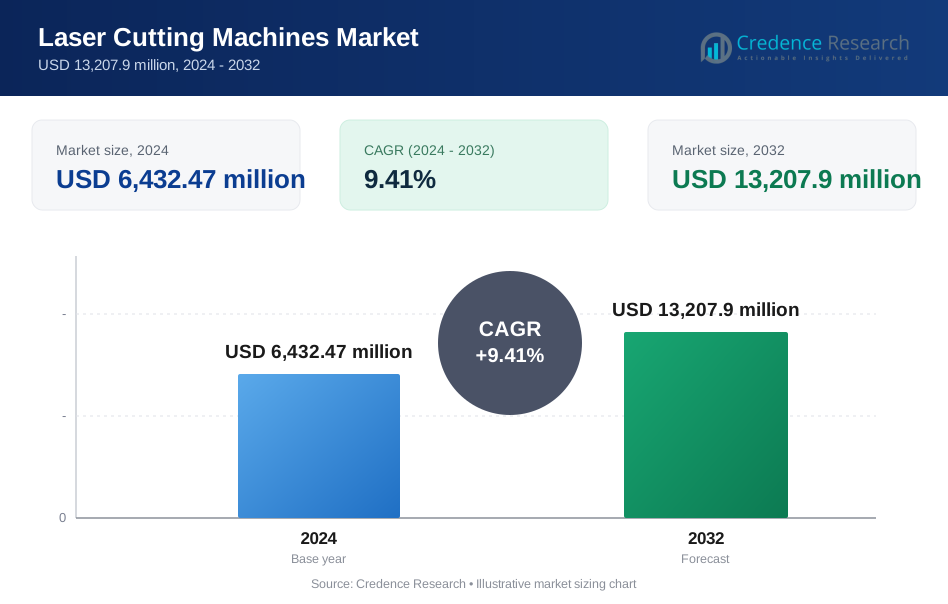
The Laser Cutting Machines Market is projected to grow from USD 6,432.47 million in 2024 to USD 13,207.9 million by 2032, at a compound annual growth rate (CAGR) of 9.41%.
The laser cutting machines market is driven by increasing demand across industries such as automotive, aerospace, electronics, and construction, where precision and high-quality cutting are critical. The shift toward automation and the growing adoption of advanced manufacturing technologies further fuel market growth. Advancements in fiber laser technology, offering higher energy efficiency and lower operating costs, are enhancing the capabilities of laser cutting machines, driving their widespread use. The rise in demand for electric vehicles and renewable energy sectors, particularly for manufacturing electric motor components and hydrogen fuel cells, also propels market expansion. Additionally, the integration of artificial intelligence (AI) and 3D vision systems in laser cutting machines improves accuracy, efficiency, and operational flexibility, aligning with industry trends toward smart manufacturing. Increasing investment in research and development for faster, more efficient laser systems and the expansion of applications in medical device manufacturing and consumer electronics also contribute to market growth.
The laser cutting machines market exhibits strong geographical distribution, with key regions including North America, Europe, Asia-Pacific, and the Rest of the World (RoW). Asia-Pacific dominates the market, holding around 35% of the global share in 2024, driven by industrialization in China, Japan, and South Korea. North America, with a 28% market share, benefits from its advanced manufacturing base and growing electric vehicle production. Europe, holding 25%, is fueled by its automotive and aerospace sectors, particularly in Germany and France. The Rest of the World, including Latin America, the Middle East, and Africa, holds a smaller 12% share, showing growth through infrastructure and renewable energy projects. Leading players, such as Alpha Laser GMBH, Amada, Bystronic, and IPG Photonics, continue to shape these regional markets.
Market Insights:
- The laser cutting machines market is projected to grow from USD 6,432.47 million in 2024 to USD 13,207.9 million by 2032, at a CAGR of 9.41%.
- Growing demand for precision manufacturing in automotive, aerospace, electronics, and construction industries is driving market expansion.
- Technological advancements in fiber laser technology, offering higher energy efficiency and lower operating costs, are enhancing laser cutting machine capabilities.
- Increasing adoption of automation and smart manufacturing, with AI and 3D vision systems, is improving operational efficiency and precision.
- Rising demand for electric vehicles and renewable energy sectors fuels the need for laser cutting machines in producing critical components.
- Research and development investments in faster, more efficient laser systems and expansion into new applications, like medical devices, are boosting market growth.
- Asia-Pacific holds 35% of the market share in 2024, followed by North America at 28%, Europe at 25%, and the Rest of the World with 12%.
Market Drivers:
Growing Demand for Precision Manufacturing:
One of the key drivers of the laser cutting machines market is the rising demand for precision manufacturing in industries such as automotive, aerospace, and electronics. As these industries require high-quality, accurate, and intricate cutting of materials, laser cutting machines have become essential for ensuring efficiency and precision. For instance, Boeing uses laser cutting for titanium parts in their aircraft, ensuring components meet strict tolerances and performance standards. This demand is further propelled by the need for lightweight materials in automotive and aerospace sectors, which rely heavily on precise laser cutting to meet design and performance standards.
Advancements in Fiber Laser Technology:
Technological advancements, particularly in fiber laser technology, play a significant role in driving the market growth. Fiber lasers offer numerous advantages, including higher energy efficiency, lower operational costs, and improved cutting speeds. These benefits have made fiber laser cutting machines more appealing to manufacturers, especially those looking to optimize production processes and reduce energy consumption. The development of high-power fiber lasers has also expanded their application in cutting thicker materials, increasing their versatility across different industries.
Rising Adoption of Automation and Smart Manufacturing:
The global shift towards automation and smart manufacturing is another significant factor fueling the growth of the laser cutting machines market. With industries increasingly adopting automated solutions to enhance productivity and reduce human error, laser cutting machines equipped with artificial intelligence (AI), machine learning, and 3D vision systems are gaining traction. These technologies improve operational efficiency, increase precision, and enable faster production cycles, aligning with the trends of Industry 4.0 and smart factories.
Expansion of Renewable Energy and Electric Vehicle Sectors:
The growing renewable energy and electric vehicle sectors also drive demand for laser cutting machines. These industries require advanced manufacturing technologies to produce critical components, such as electric motors, hydrogen fuel cells, and battery systems. For instance, SLTL Group's fiber laser cutting technology is used to manufacture intricate shapes for EV battery cases and inverter components, ensuring tight tolerances and high reliability. Laser cutting machines provide the precision, speed, and flexibility needed for the production of these components, contributing to the market's growth as the transition to cleaner energy sources and electric vehicles accelerates globally.
Market Trends:
Increased Adoption of Fiber Lasers:
One of the prominent trends in the laser cutting machines market is the increased adoption of fiber lasers. Fiber lasers offer higher efficiency, precision, and faster processing speeds compared to traditional CO2 lasers, making them ideal for various industrial applications. The shift towards fiber laser technology is driven by its ability to cut a wide range of materials, including metals, with lower operational costs and reduced maintenance requirements. As industries look for cost-effective and high-performance solutions, the demand for fiber laser cutting machines continues to rise.
Integration of Automation and AI:
The integration of automation and artificial intelligence (AI) in laser cutting machines is reshaping the manufacturing landscape. AI-powered laser systems can optimize cutting paths, reduce waste, and enhance accuracy, resulting in improved production efficiency. Automated laser cutting machines, equipped with robotics and advanced control systems, enable continuous operation with minimal human intervention. For instance, Scansonic MI GmbH's use of AI in inline monitoring for laser welding and soldering. This trend aligns with the global push toward smart manufacturing, where data-driven systems and AI help manufacturers achieve higher productivity and precision.
Growth in Electric Vehicle Manufacturing:
The rapid growth of the electric vehicle (EV) industry is driving demand for laser cutting machines. As the automotive sector shifts towards electrification, manufacturers require advanced cutting technologies to produce key components like battery modules, electric motor parts, and lightweight materials. For instance, Tesla's 4680 tabless battery production relies on high-speed galvanometer-based laser cutting systems to achieve precise cuts in battery foils, enhancing productivity and reducing material waste. Laser cutting machines provide the precision and flexibility needed to meet the design and performance requirements of EV components. This trend is expected to continue as the EV market expands globally.
Sustainability and Green Manufacturing Initiatives:
Sustainability and green manufacturing are emerging trends influencing the laser cutting machines market. Manufacturers are increasingly adopting energy-efficient laser systems to reduce their environmental footprint. Fiber lasers, known for their lower energy consumption, are being preferred over traditional laser technologies. Additionally, the demand for renewable energy applications, such as solar panels and hydrogen fuel cells, is boosting the need for laser cutting machines that contribute to sustainable manufacturing practices.
Market Challenges Analysis:
High Initial Investment and Operational Costs:
One of the major challenges in the laser cutting machines market is the high initial investment and operational costs associated with these machines. While laser cutting technology offers precision, speed, and efficiency, the upfront cost of purchasing advanced laser cutting machines, especially those equipped with fiber lasers or AI-powered automation, can be prohibitive for small and medium-sized enterprises (SMEs). For instance, Trumpf, a leading German manufacturer, launched the TruLaser Center 7030 in March 2024, a fully automated laser cutting machine designed for high-speed production. The high capital expenditure required for procurement, installation, and training adds to the financial burden on companies with limited resources. Additionally, the ongoing operational costs, including maintenance, power consumption, and replacement of laser components, further escalate the total cost of ownership. For industries operating on tight margins, these expenses can be a significant deterrent to adopting laser cutting machines, slowing down the market's growth potential.
Skill Shortage and Technological Complexity:
Another key challenge facing the laser cutting machines market is the shortage of skilled labor and the complexity of operating advanced laser systems. As laser cutting technology becomes more sophisticated with the integration of AI, automation, and 3D vision systems, there is a growing need for highly skilled operators who can manage and maintain these machines effectively. However, there is a noticeable gap in the availability of trained professionals who possess the technical knowledge required to handle complex laser cutting equipment. This skill shortage not only increases the likelihood of operational inefficiencies but also raises the risk of machine downtime due to improper handling. Furthermore, the rapid pace of technological advancements means that operators need continuous training to stay updated with the latest systems and software upgrades. The lack of skilled labor and the need for regular training pose significant challenges, particularly for companies that want to maximize the benefits of their laser cutting investments but face limitations in workforce expertise and training infrastructure.
Market Opportunities:
The laser cutting machines market presents significant opportunities, particularly with the growing demand for advanced manufacturing in emerging industries. As sectors such as electric vehicles (EVs), renewable energy, and aerospace continue to expand, there is a rising need for precision cutting technologies to manufacture critical components. The production of electric motor parts, battery modules, and hydrogen fuel cells requires the accuracy and efficiency that laser cutting machines provide, creating a vast opportunity for manufacturers to capitalize on these expanding markets. The increasing shift towards lightweight materials, especially in automotive and aerospace applications, further enhances the demand for laser cutting technologies that can handle intricate designs and offer higher productivity.
Moreover, the global trend toward automation and smart manufacturing opens doors for integrating AI and machine learning into laser cutting systems. Companies that invest in developing automated, AI-powered laser cutting solutions can meet the growing demand for faster, more precise, and highly efficient manufacturing processes. Emerging markets in Asia-Pacific and Latin America, driven by industrialization and infrastructure development, offer significant growth potential for laser cutting machine providers. As manufacturers seek cost-effective, high-performance solutions to improve their production capabilities, the market has opportunities to grow through technological innovations and expanding its reach to new geographical regions.
Market Segmentation Analysis:
By Type
The laser cutting machines market is segmented by type, primarily into fiber lasers, CO2 lasers, and solid-state lasers. Fiber lasers hold a significant market share due to their energy efficiency, high precision, and ability to cut various materials, including metals. CO2 lasers remain popular for non-metal cutting applications, particularly in industries requiring versatility.
By End User
End-user industries driving the laser cutting machines market include automotive, aerospace, electronics, and manufacturing. The automotive and aerospace sectors demand high-precision cutting for lightweight materials and complex components. Meanwhile, the electronics industry leverages laser technology for delicate and intricate cutting requirements, making these sectors key contributors to market growth.
By Application
Applications of laser cutting machines span across metal cutting, non-metal cutting, engraving, and drilling. Metal cutting leads the application segment, particularly in industries like automotive and construction, where precision and speed are crucial. Engraving and non-metal cutting applications are growing due to their role in packaging, textiles, and consumer electronics production.
Segments:
Based on Type
- Solid State Lasers
- Gas Lasers
- Semiconductor Lasers
Based on End User
- Automotive
- Consumer Electronics
- Defense & Aerospace
- Industrial
- Others
Based on Application
- Fusion Cutting
- Flame Cutting
- Sublimation Cutting
Based on the Geography:
- North America
- U.S.
- Canada
- Mexico
- Europe
- Germany
- France
- U.K.
- Italy
- Spain
- Rest of Europe
- Asia Pacific
- China
- Japan
- India
- South Korea
- South-east Asia
- Rest of Asia Pacific
- Latin America
- Brazil
- Argentina
- Rest of Latin America
- Middle East & Africa
- GCC Countries
- South Africa
- Rest of the Middle East and Africa
Regional Analysis:
North America
North America is expected to hold a significant share of the laser cutting machines market, accounting for 28% of the global market in 2024. The region’s well-established manufacturing base, particularly in industries such as automotive, aerospace, and electronics, drives the demand for advanced laser cutting technologies. In the United States, the focus on automation and smart manufacturing is accelerating the adoption of fiber lasers and AI-powered laser cutting systems. Furthermore, the growing trend toward electric vehicle (EV) manufacturing and renewable energy projects, such as solar panels and wind turbines, is boosting the demand for precision laser cutting machines in the region. Canada also contributes to the market with its expanding industrial sector and investment in advanced manufacturing technologies.
Europe
Europe is projected to hold 25% of the laser cutting machines market share in 2024. The region’s strong focus on industrial automation and sustainable manufacturing practices drives market growth. Countries like Germany, Italy, and France are leading adopters of laser cutting technology due to their robust automotive and aerospace industries. Germany, in particular, with its advanced engineering capabilities, is a key market for high-precision fiber laser cutting machines. The European Union’s commitment to reducing carbon emissions and transitioning to electric vehicles and renewable energy is further propelling the demand for laser cutting machines in the production of components for electric motors, batteries, and hydrogen fuel cells. The region's increasing focus on green manufacturing practices also contributes to the adoption of energy-efficient laser technologies.
Asia-Pacific
Asia-Pacific is anticipated to dominate the global laser cutting machines market, holding 35% of the market share in 2024. Rapid industrialization, infrastructure development, and the growth of key industries such as automotive, electronics, and construction are driving demand in countries like China, Japan, and South Korea. China, being the largest manufacturing hub, is a key contributor to the market’s growth, particularly in metal cutting and heavy machinery applications. The region’s increasing focus on automation and smart manufacturing, along with government initiatives supporting industrial modernization, is encouraging the adoption of advanced laser cutting technologies. Additionally, the rising demand for consumer electronics and electric vehicles in the region creates a lucrative market for precision laser cutting machines.
Rest of the World (RoW)
The Rest of the World, comprising Latin America, the Middle East, and Africa, is expected to hold a smaller but steadily growing market share of 12% in 2024. The market in Latin America is driven by the expansion of manufacturing sectors in countries like Brazil and Mexico, particularly in automotive and electronics. In the Middle East and Africa, industrial growth, infrastructure projects, and the adoption of renewable energy sources are boosting the demand for laser cutting machines, especially in construction and energy-related applications.
Key Player Analysis:
- Jenoptik
- Fanuc
- Epilog Lasers
- Bystronic
- Trumpf
- Alpha Laser GMBH
- DPSS Laser
- xTool
- Kern Lasers System
- Coherent
- IPG Photonics
- Amada
Competitive Analysis:
The laser cutting machines market is highly competitive, with leading players such as Alpha Laser GMBH, Amada, Bystronic, Coherent, DPSS Laser, Epilog Lasers, Fanuc, IPG Photonics, Jenoptik, and Kern Lasers System dominating the landscape. These companies focus on innovation, advanced technology integration, and expanding product portfolios to maintain their market positions. Fiber laser technology has been a key area of competition, with companies like IPG Photonics and Bystronic offering cutting-edge solutions that deliver superior precision and efficiency. Automation and AI integration are also central to the competitive strategies, as players like Fanuc and Coherent enhance their laser cutting machines with robotics and smart manufacturing capabilities. Additionally, acquisitions and partnerships, such as Jenoptik’s acquisition of Kromek, enable these companies to diversify their offerings and enter new market segments. Regional expansion, particularly in emerging markets like Asia-Pacific, further intensifies competition as leading players vie for larger market shares globally.
Recent Developments:
- In February 2023, xTool introduced a powerful and precise 40W laser module, designed for cutting and engraving delicate parts with advanced precision.
- In February 2023, Kern Laser Systems launched the KT300 and KT500 CO2 laser cutting machines, which offer faster cutting speeds and higher output power than their previous models.
- In June 2023, Trumpf Laser developed a versatile fiber laser, available in power ranges from 500 to 2000 watts, capable of manufacturing core components for electric motors and hydrogen cells.
- In June 2023, Fanuc launched the iRVision 3D, a 3D vision system designed to enhance the accuracy and efficiency of laser cutting machines.
Market Concentration & Characteristics:
The laser cutting machines market is moderately concentrated, with a few key players dominating the industry. Companies such as IPG Photonics, Bystronic, Amada, and Coherent hold significant market shares due to their focus on technological advancements, product innovation, and strong global distribution networks. The market is characterized by intense competition among these leading players, who continuously invest in research and development to introduce high-performance, energy-efficient machines that cater to evolving industrial needs. Smaller companies and regional players also contribute to market diversity, offering specialized solutions for niche applications. The growing demand for automated and smart laser cutting systems has led to increased adoption of fiber lasers, AI integration, and 3D vision systems, further shaping the competitive landscape. Market entry barriers remain high due to the capital-intensive nature of the industry and the technological expertise required, but ongoing innovations are driving continuous market growth.
Report Coverage:
The research report offers an in-depth analysis based on Type, End-User, Application and Geography. It details leading market players, providing an overview of their business, product offerings, investments, revenue streams, and key applications. Additionally, the report includes insights into the competitive environment, SWOT analysis, current market trends, as well as the primary drivers and constraints. Furthermore, it discusses various factors that have driven market expansion in recent years. The report also explores market dynamics, regulatory scenarios, and technological advancements that are shaping the industry. It assesses the impact of external factors and global economic changes on market growth. Lastly, it provides strategic recommendations for new entrants and established companies to navigate the complexities of the market.
Future Outlook:
- The laser cutting machines market will see increased demand from industries such as automotive, aerospace, and electronics due to the need for precision cutting.
- Technological advancements in fiber lasers will continue to drive efficiency, offering faster cutting speeds and lower operational costs.
- The growing adoption of electric vehicles will boost the demand for laser cutting machines to manufacture electric motor components and battery systems.
- Automation and smart manufacturing will be central, with AI and 3D vision systems improving precision and production efficiency.
- Expansion into renewable energy sectors, including hydrogen fuel cells and solar panels, will increase the need for advanced laser cutting technologies.
- Investment in research and development will lead to the introduction of more energy-efficient and versatile laser cutting systems.
- Increased use of laser cutting in medical device manufacturing and consumer electronics will create new growth avenues.
- Emerging markets, particularly in Asia-Pacific, will continue to dominate the industry due to rapid industrialization.
- Green manufacturing practices will push demand for energy-efficient laser cutting technologies in Europe.
- Competition among key players will intensify as companies invest in expanding their product portfolios and technological capabilities.
Request a Free Sample
Fill in your details and we'll send you a free sample report.
- Sample data tables & charts
- Research methodology
Need a Custom Version of This Report?
Tailor the scope, geography, or segments to your exact requirements.
- Custom geography or segment scope
- Direct access to our analyst team
Frequently Asked Questions
What is the current size of the Laser Cutting Machines Market?
What factors are driving the growth of the Laser Cutting Machines Market?
What are the key segments within the Laser Cutting Machines Market?
What are some challenges faced by the Laser Cutting Machines Market?
Who are the major players in the Laser Cutting Machines Market?
Table of Content
Chapter 1. Report Introduction
- 1.1 Report Description & Purpose
- 1.1.1 Report Title & Market Definition
- 1.1.2 Unique Selling Propositions (USP) & Key Differentiators
- 1.1.3 Value Proposition for Stakeholders
- 1.2 Research Objectives
- 1.2.1 Market Sizing Objectives (Volume & Revenue)
- 1.2.2 Segmentation Objectives
- 1.2.3 Competitive Intelligence Objectives
- 1.2.4 Forecast & Scenario Objectives
- 1.3 Report Scope
- 1.3.1 Laser Cutting Machines Scope – Types & Subtypes Covered
- 1.3.2 Geographic Scope – Regions & Countries Covered
- 1.3.3 Historical Period, Base Year & Forecast Period (2024; forecast to 2032)
- 1.3.4 Inclusions & Exclusions
- 1.4 HS Code & Classification Framework
- 1.5 Currency, Units & Pricing Basis
- 1.6 Target Stakeholders
- 1.7 Limitations & Assumptions
Chapter 2. Executive Summary
- 2.1 Global Laser Cutting Machines Market Snapshot
- 2.1.1 Market Size – Historical (2024) & Forecast (2024-2032) (2024: USD 6,432.47 million → 2032: USD 13,207.9 million)
- 2.1.2 Volume & Revenue – Global Totals
- 2.1.3 Key Market Highlights – Top Five Facts
- 2.2 Laser Cutting Machines Market Segmentation Snapshot
- 2.2.1 Market Split by Region – 2024 vs. 2032
- 2.3 Competitive Snapshot
- 2.3.1 Top 10 Players by Revenue Share – 2024
- 2.3.2 Top 10 Players by Volume Share – 2024
- 2.3.3 Recent Strategic Developments (18-Month Summary)
- 2.4 Key Investment Highlights & Strategic Conclusions
Chapter 3. Laser Cutting Machines Market Dynamics & Industry Analysis
- 3.1 Market Overview & Context
- 3.1.1 Laser Cutting Machines Market Position in the Broader Automotive Value Chain
- 3.1.2 OEM vs. Replacement Market Dynamics
- 3.1.3 Market Maturity & Development Stage by Region
- 3.2 Laser Cutting Machines Market Drivers
- 3.3 Laser Cutting Machines Market Restraints & Challenges
- 3.4 Laser Cutting Machines Market Opportunities
- 3.5 Porter's Five Forces Analysis
- 3.5.1 Threat of New Entrants
- 3.5.2 Bargaining Power of Suppliers
- 3.5.3 Bargaining Power of Buyers
- 3.5.4 Threat of Substitutes
- 3.5.5 Competitive Rivalry – Intensity Assessment
- 3.6 Laser Cutting Machines Value Chain Analysis
- 3.6.1 Upstream – Raw Material/Input Suppliers
- 3.6.1.1 Raw Material/Input 1
- 3.6.1.2 Raw Material/Input 2
- 3.6.1.3 Raw Material/Input 3
- 3.6.2 Midstream – Production/Manufacturing/Service Delivery
- 3.6.2.1 Production/Process Overview
- 3.6.2.2 Key Facility Locations & Capacity by Manufacturer
- 3.6.3 Downstream – Distribution & End Consumer
- 3.6.3.1 Primary Channel – B2B/OEM
- 3.6.3.2 Secondary Channels – Dealer, Retail, Online, Direct
- 3.6.4 Value Chain Profitability Analysis
- 3.6.1 Upstream – Raw Material/Input Suppliers
- 3.7 PESTEL Analysis
- 3.7.1 Political Factors
- 3.7.2 Economic Factors
- 3.7.3 Social Factors
- 3.7.4 Technological Factors
- 3.7.5 Environmental Factors
- 3.7.6 Legal Factors
- 3.8 Laser Cutting Machines Supply Chain Analysis
- 3.8.1 Raw Material/Input Supply Risk Assessment
- 3.8.2 Manufacturing Concentration Risk (Geographic Exposure)
- 3.8.3 Trade Disruption Impact Analysis
- 3.9 Regulatory & Policy Landscape
Note: The regulatory and policy landscape section covers regulations based on their applicability to the market, Laser Cutting Machines category, geography, and scope of the study. Only regulatory frameworks with a material impact on operations, compliance, trade, sustainability, or market access are analyzed in detail.
Chapter 4. Key Investment Pockets & Opportunity Analysis
- 4.1 Laser Cutting Machines Market Attractiveness Analysis
- 4.1.1 By Region – Investment Attractiveness Matrix (Volume × CAGR)
- 4.2 Absolute Revenue Growth Opportunity
- 4.2.1 By Region – Absolute USD Growth Through 2032
- 4.3 Incremental Volume Opportunity
- 4.3.1 By Region – Incremental Volume Through 2032
- 4.3.2 Segment – Incremental Volume
- 4.4 Emerging Submarket Opportunity Deep Dive (Subject to Applicability)
- 4.5 Emerging Market Opportunity Scorecards
- 4.5.1 United States
- 4.5.2 Europe
- 4.5.3 Asia
- 4.5.4 Middle East & Africa
Note: Emerging Market Opportunity Scorecards will be included based on relevance and strategic importance. Regions listed are indicative and may vary depending on data availability and market dynamics.
Chapter 5. Laser Cutting Machines Import-Export Analysis & Trade Flows
- 5.1 Global Trade Overview
- 5.1.1 Global Export Value by Country (2024)
- 5.1.2 Global Export Volume by Country (2024)
- 5.1.3 Global Import Value by Country (2024)
- 5.1.4 Global Import Volume by Country (2024)
- 5.1.5 Net Trade Balance by Country (2024)
- 5.2 Export Analysis – Segment
- 5.2.1 Type 1 (HS Code)
- 5.2.2 Type 2 (HS Code)
- 5.2.3 Type 3 (HS Code)
- 5.2.4 Type 4 (HS Code)
- 5.2.5 Type 5 (HS Code)
- 5.3 Import Analysis – Segment
- 5.3.1 Type 1 (HS Code)
- 5.3.2 Type 2 (HS Code)
- 5.3.3 Type 3 (HS Code)
- 5.3.4 Type 4 (HS Code)
- 5.3.5 Type 5 (HS Code)
- 5.4 Average Unit Trade Prices
- 5.4.1 Average Export Price – Segment & Country
- 5.4.2 Average Import Price – Segment & Source Country
- 5.4.3 Price Trends (2024)
- 5.5 Key Trade Route Analysis
- 5.5.1 Trade Route 1
- 5.5.2 Trade Route 2
- 5.5.3 Trade Route 3
- 5.5.4 Trade Route 4
- 5.5.5 Trade Route 5
- 5.6 Trade Policy Impact Assessment
- 5.6.1 US Anti-Dumping & Section 301 Tariffs
- 5.6.2 EU Customs Union Impact
- 5.6.3 Major Free Trade Agreements
- 5.6.4 USMCA Rules of Origin
Note: Trade policy analysis will be included only where relevant to the Laser Cutting Machines market.
Chapter 6. Competitive Landscape & Company Benchmarking
- 6.1 Laser Cutting Machines Market Concentration & Structure
- 6.1.1 Herfindahl-Hirschman Index (HHI) – vs. 2024
- 6.1.2 Tier 1, Tier 2 & Tier 3 Market Structure
- 6.1.3 Global, Regional & Local Player Dynamics
- 6.2 Laser Cutting Machines Market Share Analysis – 2024
- 6.2.1 Global Revenue Share by Company
- 6.2.2 Global Volume Share by Company
- 6.2.3 Regional Revenue Share
- 6.2.4 Market Share Evolution ( vs. 2024)
- 6.2.5 OEM Segment Share by Company
- 6.2.6 Replacement Segment Share by Company
- 6.3 Production/Delivery Capacity & Facility Analysis
- 6.3.1 Global Installed Capacity
- 6.3.2 Capacity Utilization Rates
- 6.3.3 Production/Output Volume
- 6.3.4 Facility Locations & Capacity Map
- 6.3.5 Planned Capacity Additions
- 6.4 Laser Cutting Machines Competitive Benchmarking Matrix
- 6.4.1 Revenue, Volume, CAGR & Profitability Comparison
- 6.4.2 Channel Revenue Mix
- 6.4.3 Geographic Revenue Exposure
- 6.4.4 R&D Intensity
- 6.4.5 Sustainability Maturity
- 6.5 Strategic Developments in Laser Cutting Machines (Last 24 Months)
- 6.5.1 Mergers, Acquisitions & Divestments
- 6.5.2 New Laser Cutting Machines Launches
- 6.5.3 Facility Expansions
- 6.5.4 Strategic Alliances, Joint Ventures & Partnerships
- 6.5.5 Distribution Expansion & Market Entry
- 6.5.6 Sustainability & ESG Initiatives
- 6.6 Competitive Strategy Mapping
- 6.6.1 Leader, Challenger, Follower & Niche Classification
- 6.6.2 Pricing Strategy Comparison
- 6.6.3 Channel Strategy Matrix
Note: Strategic developments are included based on their materiality and the availability of reliable information.
Chapter 7. Global Laser Cutting Machines Market – By Distribution Channel
- 7.1 Segment Overview
- 7.1.1 Volume & Revenue Split by Channel (2024 & 2032)
- 7.1.2 Channel Mix Evolution (2024-2032)
Chapter 8. Regional Market Analysis – Global Overview
- 8.1 Global Regional Overview
- 8.1.1 Regional Volume Share
- 8.1.2 Regional Revenue Share
- 8.1.3 Regional Volume by Region
- 8.1.4 Regional Revenue by Region
- 8.1.5 Regional Forecast Through 2032
- 8.2 Cross-Regional Segment Analysis
- 8.2.1 By Distribution Channel
- 8.2.2 By Brand/Price Tier
Chapter 9. North America Laser Cutting Machines Market
- 9.1 United States
- 9.2 Canada
- 9.3 Mexico
Chapter 10. Europe Laser Cutting Machines Market
- 10.1 Germany
- 10.2 France
- 10.3 Italy
- 10.4 United Kingdom
- 10.5 Spain
- 10.6 Poland
- 10.7 Russia
- 10.8 Netherlands
- 10.9 Belgium
- 10.10 Sweden
- 10.11 Denmark
- 10.12 Norway
- 10.13 Rest of Europe
Chapter 11. Asia Pacific Laser Cutting Machines Market
- 11.1 China
- 11.2 India
- 11.3 Japan
- 11.4 South Korea
- 11.5 Thailand
- 11.6 Indonesia
- 11.7 Vietnam
- 11.8 Malaysia
- 11.9 Australia
- 11.10 Rest of Asia Pacific
Chapter 12. Latin America Laser Cutting Machines Market
- 12.1 Brazil
- 12.2 Argentina
- 12.3 Colombia
- 12.4 Chile
- 12.5 Rest of Latin America
Chapter 13. Middle East Laser Cutting Machines Market
- 13.1 Saudi Arabia
- 13.2 United Arab Emirates
- 13.3 Turkey
- 13.4 Israel
- 13.5 Iran
- 13.6 Rest of the Middle East
Chapter 14. Africa Laser Cutting Machines Market
- 14.1 South Africa
- 14.2 Egypt
- 14.3 Nigeria
- 14.4 Morocco
- 14.5 Rest of Africa
Chapter 15. Laser Cutting Machines Company Profiles
- 15.1 [Company 01]
- 15.1.1 Company Overview
- 15.1.2 Key Management Personnel
- 15.1.3 Products & Services Portfolio
- 15.1.4 Financial Performance
- 15.1.5 Key Market Focus & Geographic Presence
- 15.1.6 Recent Developments & Strategic Initiatives
Note: The company profile list is preliminary and may change based on research findings, market developments, data availability, and client requirements.
Chapter 16. Appendices
- Appendix A – List of Abbreviations & Acronyms
- Appendix B – Industry Classification Code Reference – Full Series
- Appendix C – Production & Capacity Data Tables
- Appendix D – End-Use & Demand Base Tables
- Appendix E – Consumption & Replacement Rate Assumptions
- Appendix F – ASP Reference Tables
- Appendix G – Manufacturing & Facility Database
- Appendix H – Import-Export Data Tables
- Appendix I – Regulatory Summary Tables
- Appendix J – Primary Research Participant List (Anonymized)
- Appendix K – Primary Research Questionnaire Framework
- Appendix L – Data Sources & Bibliography
- Appendix M – Market Size Divergence & Source Comparison
Chapter 17. Research Methodology
- 17.1 Research Framework & Philosophy
- 17.2 Secondary Research – Sources, Hierarchy & Data Extraction
- 17.3 Data Modeling – Bottom-Up & Top-Down Market Sizing
- 17.4 Primary Research – Stakeholder Framework, LOI & Sample Sizes
- 17.5 Forecast Methodology – Regression, Scenario & Sensitivity Analysis
- 17.6 Quality Control – Four-Layer Validation Framework
- 17.7 Limitations & Standard Assumptions
- 17.8 Disclaimer
