
| REPORT ATTRIBUTE | DETAILS |
|---|---|
| Historical Period | 2019-2022 |
| Base Year | 2023 |
| Forecast Period | 2024-2032 |
| Lignite Coal Market Size 2023 | USD 3684.2 million |
| Lignite Coal Market, CAGR | 4.30% |
| Lignite Coal Market Size 2032 | USD 5381.48 million |
Market Insights
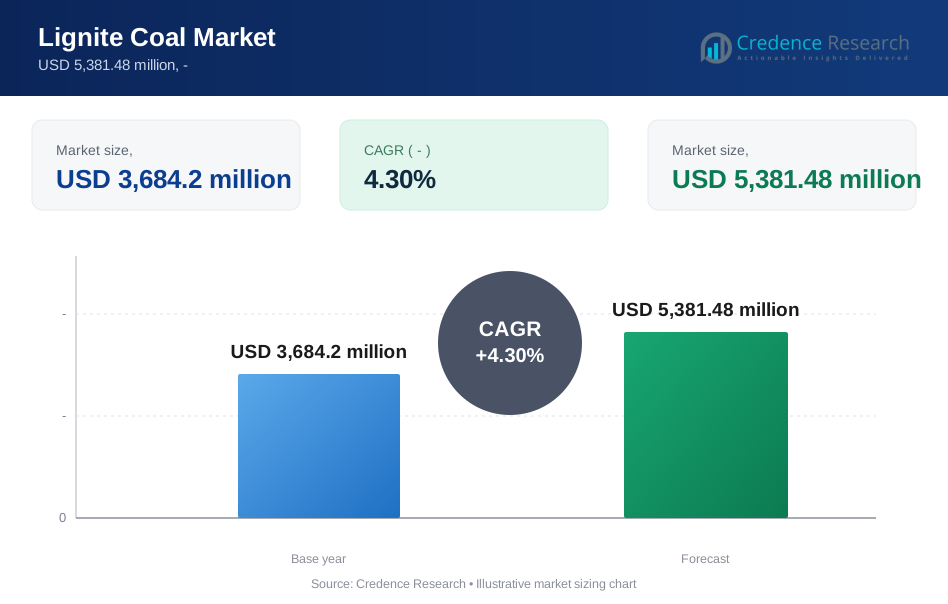
- The global market for lignite coal is projected to expand at a compound annual growth rate (CAGR) of 4.30% between 2024 and 2032, from an estimated USD 3684.2 million in 2023 to USD 5381.48 million in 2032.
- The largest category is power generation. Synthetic natural gas production, on the other hand, is expected to grow at a strong CAGR.
- The raw lignite category will expand at a rapid rate of growth.
- Throughout the projected period, the CAGR for the utilities is anticipated to be the highest.
- Asia Pacific controlled the lignite coal market.
- Regarding the market share of lignite coal, Europe is expected to come second.
- North America is expected to experience the fastest growth in the lignite coal industry.
- A number of factors, including the expanding use of lignite coal in regions with unreliable grids, lignite plants' ability to offer emergency power generation, and an aging population in some developed countries, might prioritize reliable energy over environmental concerns, temporarily impacting demand.
- The market for lignite coal may benefit from developments that drive opportunities to export lignite to other nations with high demand. This can drive production and market expansion, and supporting educational and training initiatives to develop a qualified workforce for the lignite industry can promote its growth and modernization.
Executive Summary
Market Definition
The lignite coal market describes the international trade and industry pertaining to the extraction, preparation, and distribution of lignite, a type of coal that is higher in moisture content and has a lower carbon content than other coal varieties. Its main applications are in the production of electricity and in sectors of the economy that need cheap energy. Environmental laws, energy policy, and regional demand are a few examples of the variables that affect market dynamics.
Market Overview
It is predicted that the Lignite Coal industry will continue its upward trajectory between 2024 and 2032, growing at a compound annual growth rate (CAGR) of 4.30%. From its projected USD 3684.2 million in 2023 to USD 5381.48 million in 2032, the market will continue to grow.
The market for lignite coal is expanding mostly due to industrial demand. Chemical, steel, and cement industries, among others, mostly depend on lignite as a cheap raw material and energy source. It is a favored option for industrial processes requiring significant energy input due to its wide availability and inexpensive cost. In addition, the need for lignite to sustain the growing industrial sectors of emerging economies is fueled by their expansion. The need for lignite coal is growing as enterprises look for cost-effective and dependable energy sources to stay competitive, driving market expansion in spite of legal and environmental obstacles. Investments in cleaner technology and efficient combustion methods further enhance the appeal of lignite in the industrial sector.
Furthermore, the dependable baseload power provided by lignite coal is essential for market expansion. It is a desirable alternative for power generation due to its availability and affordability, guaranteeing a steady and continuous supply of electricity. In contrast to variable renewable energy sources, lignite-fired power plants have a stable operating capacity that satisfies the energy needs of families and enterprises. Energy security depends on this dependability, especially in areas where access to other energy sources is restricted. The need for consistent and reasonably priced power is growing as developing economies expand, making lignite a vital energy resource. Investments in cleaner combustion technologies balance the economic and environmental aspects of lignite's viability.
Segmentation by Application
- Power generation is the market leader in terms of application. The environmental performance of lignite-fired power plants has improved due to advancements in combustion technologies and efficiency improvements, which have reduced emissions of pollutants such as nitrogen oxides and sulfur dioxide.
- The synthetic natural gas production category will exhibit a sizable CAGR during the projected period. Gasification is the process of heating lignite coal under regulated conditions using a mixture of steam and oxygen. As a result, a gas mixture known as syngas, or synthesis gas, is created, which is mostly made up of carbon monoxide (CO) and hydrogen (H2).
- Other applications, including fertilizer and chemical production, domestic heating, and industrial applications, also support the need for a lignite coal market.
Segmentation by Form
- The raw lignite category is projected to develop at a greater CAGR over the forecast period. Raw lignite is used as a fuel or energy source in manufacturing operations in industries such as paper mills, cement, and brick kilns. In certain areas, people choose it because of its local availability and cost.
- The processed lignite category will likely register a significant CAGR during forecasting. Activated carbon is derived from lignite and is used in air filtration, water purification, and industrial operations that call for adsorption capabilities. In addition, pellets or briquettes, which have a more consistent size and density, can be made from lignite. These forms are appropriate for both industrial and residential heating applications because they are simpler to handle, transport, and store.
Segmentation by End User
- The utilities are projected to grow faster over the projection period. Utilities can enhance their energy security by including lignite coal in their fuel mix. It guarantees a consistent supply of energy and reduces dependency on imported fuels like natural gas, especially in regions with abundant lignite reserves.
- Other end users, including the industrial, residential, and agricultural sectors, also influence the need for lignite coal.
Segmentation by Region
- Asia Pacific leads the lignite coal industry. This is due to the rising demand for lignite coal from Asia Pacific countries such as China, India, Australia, and other countries.
- Europe is estimated to rank second in the lignite coal market.
- It is anticipated that the lignite coal market in North America will grow quickly.
- The remaining demand for lignite coal is met by regions such as Africa, the Middle East, and Latin America.
The market for lignite coal is growing because of greenhouse gas emission laws, which force improvements in carbon capture and better combustion technology. Efficiency in lignite utilization is becoming increasingly expensive as power plants and industries try to meet more stringent environmental regulations. This desire for innovation improves lignite's market viability by reducing its environmental impact while maintaining its economic benefits.
The lignite coal market in the Asia Pacific is predicted to grow to be the largest in the globe. The Asia Pacific region is projected to stimulate the growth of the lignite coal market because of escalating industrial activity and energy demands. Over 60% of the world's lignite usage in 2023 came from this region. Leading contributors are China and India, each of which consumes around 960 million metric tons and 120 million metric tons yearly, respectively. The main forces are rapid infrastructure development and urbanization. Due to federal investments in coal-based power projects, which further strengthen the market, Asia Pacific is an essential location for prospective expansion in the lignite coal market.
It is projected that the lignite coal market will develop at the fastest rate in the North American region. The market for lignite coal is expected to develop in North America because of its substantial deposits and the region's continuous need for dependable, affordable energy. Because it has large lignite resources, the United States uses this resource to generate electricity, maintain energy security, and promote industrial activity. By increasing investments in cutting-edge clean coal technologies and carbon capture and storage (CCS) systems, lignite becomes a more attractive option by reducing environmental issues. Furthermore, regional policies that support economic stability and energy diversification improve the market prospects for lignite. Lignite coal continues to be an essential part of the energy mix as long as North America prioritizes energy affordability and dependability.
Key Highlights of the Report
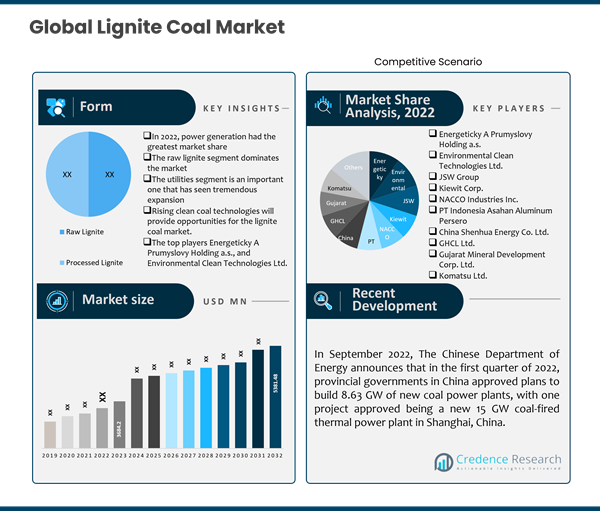
The global lignite coal market is segmented by application, form, end user, and region. Power generation is the market spearhead in terms of the application. Raw lignite is the top-form category. Throughout the forecast period, the utilities category is expected to grow at the greatest CAGR. Asia Pacific is seeing the most growth in the lignite coal market.
Technological developments largely drive the market expansion for lignite coal. Advances in clean coal technology and carbon capture and storage significantly reduce emissions, making lignite use more environmentally sustainable. Lignite is becoming a more appealing energy source due to its increased energy output and decreased prices brought about by improved mining processes and efficient combustion technologies. Furthermore, lignite's applications go beyond power generation due to developments in gasification and liquefaction technologies, which broadens its market potential. Lignite's commercial viability increases as more businesses and power plants use these technologies to increase efficiency and comply with more stringent environmental requirements. Lignite is still a cost-effective and environmentally friendly energy source in the changing energy market because of ongoing research and development.
It is anticipated that Asia Pacific will hold the most significant global market share for lignite coal. The usage of lignite coal is more environmentally friendly and efficient because of developments in environmental management, mining, and processing technology. Regional geopolitical dynamics and strategic considerations influence the development and trade of lignite coal in Asia Pacific. Trade and investment in lignite coal resources are made easier by a growing level of integration between the regional and international energy markets. In addition, it is projected that the market in North America will grow at the quickest rate. Lignite coal is essential to the generation of electricity in regions of North America where coal-fired power plants are still prevalent despite a shift to cleaner energy sources. The ongoing infrastructure and economic development projects in the United States have increased demand for energy, which lignite coal can help to meet in part.
Which Key Factors Are Driving The Global Lignite Coal Market?
The market for lignite coal is expanding due to economic development and industrialization in emerging economies, which increase the demand for lignite as an energy source. Government subsidies and incentives for coal production and use can also boost the lignite coal market.
What Are The Main Challenges Confronting The Global Lignite Coal Market?
The primary obstacles confronting the lignite coal sector are the increasing utilization and diminishing expenses of sustainable energy sources such as wind and solar power, which diminish the need for lignite coal. Additionally, the adverse health consequences of air pollution resulting from lignite combustion, which encompasses respiratory and cardiovascular ailments, prompt opposition from society and regulatory bodies.
What Market Opportunities Exist For Lignite Coal Globally?
Opportunities in the lignite coal market are being created, among other things, by utilizing lignite combustion by-products, such as fly ash and slag, in construction and other industries can create additional revenue streams and invest in R&D to discover new uses and improve the efficiency of lignite can open up new markets and applications.
Market Drivers
Increasing Energy Demand
The market for lignite coal is expanding due to rising energy demand worldwide, particularly in developing nations. The need for dependable and reasonably priced power generation is increasing as economies and populations rise. The demand for energy is successfully met by lignite coal due to its plentiful deposits and relatively low cost when compared to other sources. The growth of infrastructure and industrialization, particularly in developing nations, depends on lignite. Lignonite's place in the energy mix is maintained despite environmental concerns due to the need for baseload power and energy security. A further factor in lignite's attraction in the face of expanding global energy consumption is investments in cleaner technologies and environmental practices.
Market Restraints
Climate Change Concerns and Carbon Emissions
The market for lignite coal is significantly constrained by worries about climate change and the carbon emissions that go along with it. For every unit of energy produced, the combustion of lignite emits more CO2 into the atmosphere than other fossil fuels, which adds to greenhouse gas emissions and global warming. Lignite producers and users face challenges from strict environmental restrictions and worldwide agreements to minimize carbon footprints. Further limiting lignite coal's social acceptability and market expansion are growing public knowledge of and activity against fossil fuels in general. These elements force the lignite coal sector to make investments in carbon capture and storage and cleaner technology in order to reduce emissions and ensure that it complies with changing environmental regulations while remaining relevant in the market.
Opportunities
Rising Clean Coal Technologies
The market for lignite coal is expected to develop as a result of clean coal technologies (CCTs), which enhance efficiency and environmental performance. Carbon capture and storage (CCS), integrated gasification combined cycle (IGCC), and advanced combustion techniques are just a few of the technologies that are included in CCTs. Lowering the emissions of pollutants, including sulfur dioxide, nitrogen oxides, and particulate matter, alleviates environmental issues related to the burning of lignite. Furthermore, CCTs improve energy efficiency by making the best use of lignite resources and lowering power plant operating expenses. Investments in CCTs become essential for lignite producers to guarantee compliance with strict environmental criteria while retaining competitiveness in the energy market as global energy demands rise and regulatory constraints intensify. By improving sustainability and market acceptability, ongoing research and development in CCTs will propel the expansion of the lignite coal market even further.
Competitive Landscape
Key Players
A number of significant players dominate the highly competitive global market for lignite coal. A handful of the top market players are shown below, together with their respective market shares:
- Energeticky A Prumyslovy Holding a.s.
- Environmental Clean Technologies Ltd.
- JSW Group
- Kiewit Corp.
- NACCO Industries Inc.
- PT Indonesia Asahan Aluminum Persero
- China Shenhua Energy Co. Ltd.
- GHCL Ltd.
- Gujarat Mineral Development Corp. Ltd.
- Komatsu Ltd.
- Lanna Resources Public Co. Ltd.
- Mechel PAO
- NLC India Ltd.
- Rajasthan State Mines and Minerals Ltd.
- RWE AG
- Others
In order to stay competitive, these organizations give priority to product innovation, expansion of their distribution channels, and mergers and acquisitions.
By creating cutting-edge ideas and goods, the foremost manufacturers in the global market for lignite coal consistently strive to stay one step ahead of the competition.
In November 2022, China's government urged power utilities to obtain more of their needs through long-term thermal coal supply contracts, which it extended to all coal mines for 2023. The goal of these contracts is to secure market supply and stabilize prices. The long-term agreement will cover all coal-fired power and heating plants as well as coal-mining enterprises.
In February 2022, Zhejiang, a coastal province in eastern China, approved the USD 840 million construction of a coal-fired power plant. The Zhejiang Energy Group claims that the Liuheng Power Plant's Phase 2 Project will help balance the province's energy supply and demand.
How are Companies Performing in the Lignite Coal Market?
Leading companies in the lignite coal industry, like RWE AG, Luminant (a Vistra Corp. affiliate), and CEZ Group, are performing well because of technological developments and strategic initiatives. Leading German utility RWE AG is still making investments to switch from lignite to renewable energy sources. RWE has maintained notable operational performance by integrating renewable energy projects and investing in gas-fired capacity that is ready for hydrogen, even though the company has plans to phase out lignite by 2030. Another significant player is Luminant, a division of Vistra Corp. that mostly conducts business in the US. In addition to diversifying its energy portfolio to include large investments in renewable energy, the company has maintained profitability through effective lignite mining operations, guaranteeing long-term stability despite the industry's general move away from coal.
To obtain a competitive edge in the market, leading companies in the lignite coal industry are putting more emphasis on implementing digital twin applications. By combining data from sensors and other sources to create a virtual version of a physical product, system, or process, digital twin technology allows for real-time monitoring, analysis, and improvement. For instance, the Finnish machine industry company Metso Outotec introduced Metso Outotec Geminex, a science-based digital twin designed to manage unpredictability and optimize resources, in March 2022. By merging operational data from internal and external data sources, the novel solution simulates and optimizes smooth, sustainable operations in the hydrometallurgical, pyrometallurgical, and mineral processing industries. It offers the metallurgical and lignite mining industries unmatched advantages. The cutting-edge Geminex digital twin helps clients create and modify their processes quickly.
One of Central Europe's largest companies of lignite coal is still the Czech-based CEZ Group. In addition to aggressively pursuing cleaner energy sources, CEZ is balancing its lignite coal operations. The business has been modernizing its facilities to uphold strong financial performance while increasing efficiency and lowering emissions in compliance with environmental regulations from the European Union. To ensure sustainable performance in the midst of the global energy transition, these companies are, overall, managing the difficult landscape by investing in cleaner technology, streamlining lignite coal operations, and complying with regulatory frameworks.
Summary of Key Findings
- Lignite coal is becoming increasingly necessary due to the availability and competitiveness of alternative energy sources like natural gas, renewables, and nuclear power impact lignite demand.
- The market is segmented by application, form, end user, and region.
- In the market, the most prevalent application is the power generation.
- Raw lignite is the foremost form category.
- The utilities category is expected to grow the fastest in terms of CAGR during the forecast period.
- In terms of market development, Asia Pacific is a leader; the market is highly competitive with key players including Energeticky A Prumyslovy Holding a.s., Environmental Clean Technologies Ltd., JSW Group, Kiewit Corp., NACCO Industries Inc., PT Indonesia Asahan Aluminum Persero, China Shenhua Energy Co. Ltd., GHCL Ltd., Gujarat Mineral Development Corp. Ltd., Komatsu Ltd., Lanna Resources Public Co. Ltd., Mechel PAO, NLC India Ltd., Rajasthan State Mines and Minerals Ltd., RWE AG, and Others.
Future Outlook
- The lignite coal industry is expected to increase significantly in Asia Pacific, and its outlook is positive worldwide.
- The market will continue to expand due to several factors, including the expansion of urban populations, which will increase energy demands and potentially drive lignite coal use in developing countries.
- The main factor preventing the industry's growth in the lignite coal sector is the high moisture content of lignite, which reduces its energy efficiency and increases transportation and handling costs.
- Developing new products, reaching a wider market, and maintaining competitive prices are all necessary for major businesses to stay ahead of the competition.
How the Credence Research Lignite Coal Market Report Can Help CXOs
The Credence Research Lignite Coal Market Report provides CXOs with an extensive market overview and comprises the following:
- Market size and growth forecast: The study offers comprehensive market estimations for lignite coal globally, broken down by application, form, end user, and region. Furthermore, the report includes market forecasts through 2032, derived from key drivers and trends.
- Market segmentation: The research report divides the lignite coal market into segments by application, form, end user, and region. This segmentation helps CXOs understand the market and the opportunities inside each area in great depth.
- Competitive landscape: The study report provides a thorough analysis of the leading businesses in the lignite coal sector, together with details on their revenue streams, product lines, and business strategies. With this information, CXOs can assess and identify their competitors.
- Key trends and drivers: The study report analyzes and highlights the key developments and elements driving the market for lignite coal. CXOs can utilize this information to make well-informed choices regarding their plans and investments.
The Credence Research Lignite Coal Market Report provides CXOs with insights that they may utilize to:
- Identify growth opportunities: This analysis is likely to help CXOs find fresh growth prospects in the lignite coal sector. For example, the research recognizes the industrial sector's increasing requirement for lignite coal as a crucial opportunity.
- Make informed investment decisions: The study aids CXOs in making informed decisions about lignite coal. For example, it delivers information on the key variables to consider while picking solutions and evaluating suppliers.
- Develop competitive strategies: CXOs can utilize the research report to establish competitive strategies for their lignite coal firms. The study paper explores the primary tactics employed by lignite coal providers to set themselves apart from their rivals.
- Track market developments: By tracking market advancements, this research report could assist CXOs in remaining ahead of the curve. For example, it provides information about the latest advancements and patterns in the lignite coal industry.
The Credence Research Lignite Coal Market Report is helpful for CXOs who want to learn more about the market and identify potential opportunities.
Segmentation
-
By Application
- Power Generation
- Synthetic Natural Gas Production
- Fertilizer and Chemical Production
- Domestic Heating
- Industrial Applications
-
By Form
- Raw Lignite
- Processed Lignite
-
By End User
- Utilities
- Industrial Sector
- Residential Sector
- Agricultural Sector
-
By Region
- North America
- U.S
- Canada
- Mexico
- Europe
- Germany
- France
- UK
- Italy
- Spain
- Rest of Europe
- Asia Pacific
- China
- Japan
- India
- South Korea
- South-east Asia
- Rest of Asia Pacific
- Latin America
- Brazil
- Argentina
- Rest of Latin America
- Middle East & Africa
- GCC Countries
- South Africa
- The Rest of the Middle East and Africa
- North America
Adjacent Markets
Several adjacent markets in the lignite coal market have high revenue growth opportunities. The key adjacent markets for the lignite coal market -
Adjacent Markets |
||
| Electricity Generation | Industrial Chemicals | Steel Production |
| Coal Mining Equipment | Renewable Energy | Chemical Industry |
| Environmental Technologies | Natural Gas | Construction Materials |
Request a Free Sample
Fill in your details and we'll send you a free sample report.
- Sample data tables & charts
- Research methodology
Need a Custom Version of This Report?
Tailor the scope, geography, or segments to your exact requirements.
- Custom geography or segment scope
- Direct access to our analyst team
Frequently Asked Questions
How much does the global market currently hold for lignite coal?
What is the lignite coal market's projected growth rate between 2024 and 2032?
In terms of the application, which market category is leading?
Regarding the form, which market category is in the lead?
Which end-user segment is estimated to have the highest CAGR throughout the forecast period?
In which region is the market for lignite coal expanding?
Who are the main players in the global lignite coal industry?
Which market factors are the primary drivers of the lignite coal industry?
What main market challenges prevent the growth of the lignite coal sector?
What are the main market opportunities for the lignite coal sector?
Table of Content
Chapter 1. Report Introduction
- 1.1 Report Description & Purpose
- 1.1.1 Report Title & Market Definition
- 1.1.2 Unique Selling Propositions (USP) & Key Differentiators
- 1.1.3 Value Proposition for Stakeholders
- 1.2 Research Objectives
- 1.2.1 Market Sizing Objectives (Volume & Revenue)
- 1.2.2 Segmentation Objectives
- 1.2.3 Competitive Intelligence Objectives
- 1.2.4 Forecast & Scenario Objectives
- 1.3 Report Scope
- 1.3.1 Lignite Coal Scope – Types & Subtypes Covered
- 1.3.2 Geographic Scope – Regions & Countries Covered
- 1.3.3 Historical Period, Base Year & Forecast Period (the historical period; forecast to the forecast period)
- 1.3.4 Inclusions & Exclusions
- 1.4 HS Code & Classification Framework
- 1.5 Currency, Units & Pricing Basis
- 1.6 Target Stakeholders
- 1.7 Limitations & Assumptions
Chapter 2. Executive Summary
- 2.1 Global Lignite Coal Market Snapshot
- 2.1.1 Market Size – Historical (the historical period) & Forecast (the forecast period) (base year: USD 3,684.2 million → forecast year: USD 5,381.48 million)
- 2.1.2 Volume & Revenue – Global Totals
- 2.1.3 Key Market Highlights – Top Five Facts
- 2.2 Lignite Coal Market Segmentation Snapshot
- 2.2.1 Market Split by Region – vs.
- 2.3 Competitive Snapshot
- 2.3.1 Top 10 Players by Revenue Share –
- 2.3.2 Top 10 Players by Volume Share –
- 2.3.3 Recent Strategic Developments (18-Month Summary)
- 2.4 Key Investment Highlights & Strategic Conclusions
Chapter 3. Lignite Coal Market Dynamics & Industry Analysis
- 3.1 Market Overview & Context
- 3.1.1 Lignite Coal Market Position in the Broader Automotive Value Chain
- 3.1.2 OEM vs. Replacement Market Dynamics
- 3.1.3 Market Maturity & Development Stage by Region
- 3.2 Lignite Coal Market Drivers
- 3.3 Lignite Coal Market Restraints & Challenges
- 3.4 Lignite Coal Market Opportunities
- 3.5 Porter's Five Forces Analysis
- 3.5.1 Threat of New Entrants
- 3.5.2 Bargaining Power of Suppliers
- 3.5.3 Bargaining Power of Buyers
- 3.5.4 Threat of Substitutes
- 3.5.5 Competitive Rivalry – Intensity Assessment
- 3.6 Lignite Coal Value Chain Analysis
- 3.6.1 Upstream – Raw Material/Input Suppliers
- 3.6.1.1 Raw Material/Input 1
- 3.6.1.2 Raw Material/Input 2
- 3.6.1.3 Raw Material/Input 3
- 3.6.2 Midstream – Production/Manufacturing/Service Delivery
- 3.6.2.1 Production/Process Overview
- 3.6.2.2 Key Facility Locations & Capacity by Manufacturer
- 3.6.3 Downstream – Distribution & End Consumer
- 3.6.3.1 Primary Channel – B2B/OEM
- 3.6.3.2 Secondary Channels – Dealer, Retail, Online, Direct
- 3.6.4 Value Chain Profitability Analysis
- 3.6.1 Upstream – Raw Material/Input Suppliers
- 3.7 PESTEL Analysis
- 3.7.1 Political Factors
- 3.7.2 Economic Factors
- 3.7.3 Social Factors
- 3.7.4 Technological Factors
- 3.7.5 Environmental Factors
- 3.7.6 Legal Factors
- 3.8 Lignite Coal Supply Chain Analysis
- 3.8.1 Raw Material/Input Supply Risk Assessment
- 3.8.2 Manufacturing Concentration Risk (Geographic Exposure)
- 3.8.3 Trade Disruption Impact Analysis
- 3.9 Regulatory & Policy Landscape
Note: The regulatory and policy landscape section covers regulations based on their applicability to the market, Lignite Coal category, geography, and scope of the study. Only regulatory frameworks with a material impact on operations, compliance, trade, sustainability, or market access are analyzed in detail.
Chapter 4. Key Investment Pockets & Opportunity Analysis
- 4.1 Lignite Coal Market Attractiveness Analysis
- 4.1.1 By Region – Investment Attractiveness Matrix (Volume × CAGR)
- 4.2 Absolute Revenue Growth Opportunity
- 4.2.1 By Region – Absolute USD Growth Through the forecast period
- 4.3 Incremental Volume Opportunity
- 4.3.1 By Region – Incremental Volume Through the forecast period
- 4.3.2 Segment – Incremental Volume
- 4.4 Emerging Submarket Opportunity Deep Dive (Subject to Applicability)
- 4.5 Emerging Market Opportunity Scorecards
- 4.5.1 United States
- 4.5.2 Europe
- 4.5.3 Asia
- 4.5.4 Middle East & Africa
Note: Emerging Market Opportunity Scorecards will be included based on relevance and strategic importance. Regions listed are indicative and may vary depending on data availability and market dynamics.
Chapter 5. Lignite Coal Import-Export Analysis & Trade Flows
- 5.1 Global Trade Overview
- 5.1.1 Global Export Value by Country (the historical period)
- 5.1.2 Global Export Volume by Country (the historical period)
- 5.1.3 Global Import Value by Country (the historical period)
- 5.1.4 Global Import Volume by Country (the historical period)
- 5.1.5 Net Trade Balance by Country (the historical period)
- 5.2 Export Analysis – Segment
- 5.2.1 Type 1 (HS Code)
- 5.2.2 Type 2 (HS Code)
- 5.2.3 Type 3 (HS Code)
- 5.2.4 Type 4 (HS Code)
- 5.2.5 Type 5 (HS Code)
- 5.3 Import Analysis – Segment
- 5.3.1 Type 1 (HS Code)
- 5.3.2 Type 2 (HS Code)
- 5.3.3 Type 3 (HS Code)
- 5.3.4 Type 4 (HS Code)
- 5.3.5 Type 5 (HS Code)
- 5.4 Average Unit Trade Prices
- 5.4.1 Average Export Price – Segment & Country
- 5.4.2 Average Import Price – Segment & Source Country
- 5.4.3 Price Trends (the historical period)
- 5.5 Key Trade Route Analysis
- 5.5.1 Trade Route 1
- 5.5.2 Trade Route 2
- 5.5.3 Trade Route 3
- 5.5.4 Trade Route 4
- 5.5.5 Trade Route 5
- 5.6 Trade Policy Impact Assessment
- 5.6.1 US Anti-Dumping & Section 301 Tariffs
- 5.6.2 EU Customs Union Impact
- 5.6.3 Major Free Trade Agreements
- 5.6.4 USMCA Rules of Origin
Note: Trade policy analysis will be included only where relevant to the Lignite Coal market.
Chapter 6. Competitive Landscape & Company Benchmarking
- 6.1 Lignite Coal Market Concentration & Structure
- 6.1.1 Herfindahl-Hirschman Index (HHI) – vs.
- 6.1.2 Tier 1, Tier 2 & Tier 3 Market Structure
- 6.1.3 Global, Regional & Local Player Dynamics
- 6.2 Lignite Coal Market Share Analysis –
- 6.2.1 Global Revenue Share by Company
- 6.2.2 Global Volume Share by Company
- 6.2.3 Regional Revenue Share
- 6.2.4 Market Share Evolution ( vs. )
- 6.2.5 OEM Segment Share by Company
- 6.2.6 Replacement Segment Share by Company
- 6.3 Production/Delivery Capacity & Facility Analysis
- 6.3.1 Global Installed Capacity
- 6.3.2 Capacity Utilization Rates
- 6.3.3 Production/Output Volume
- 6.3.4 Facility Locations & Capacity Map
- 6.3.5 Planned Capacity Additions
- 6.4 Lignite Coal Competitive Benchmarking Matrix
- 6.4.1 Revenue, Volume, CAGR & Profitability Comparison
- 6.4.2 Channel Revenue Mix
- 6.4.3 Geographic Revenue Exposure
- 6.4.4 R&D Intensity
- 6.4.5 Sustainability Maturity
- 6.5 Strategic Developments in Lignite Coal (Last 24 Months)
- 6.5.1 Mergers, Acquisitions & Divestments
- 6.5.2 New Lignite Coal Launches
- 6.5.3 Facility Expansions
- 6.5.4 Strategic Alliances, Joint Ventures & Partnerships
- 6.5.5 Distribution Expansion & Market Entry
- 6.5.6 Sustainability & ESG Initiatives
- 6.6 Competitive Strategy Mapping
- 6.6.1 Leader, Challenger, Follower & Niche Classification
- 6.6.2 Pricing Strategy Comparison
- 6.6.3 Channel Strategy Matrix
Note: Strategic developments are included based on their materiality and the availability of reliable information.
Chapter 7. Global Lignite Coal Market – By Distribution Channel
- 7.1 Segment Overview
- 7.1.1 Volume & Revenue Split by Channel ( & )
- 7.1.2 Channel Mix Evolution (the forecast period)
Chapter 8. Regional Market Analysis – Global Overview
- 8.1 Global Regional Overview
- 8.1.1 Regional Volume Share
- 8.1.2 Regional Revenue Share
- 8.1.3 Regional Volume by Region
- 8.1.4 Regional Revenue by Region
- 8.1.5 Regional Forecast Through the forecast period
- 8.2 Cross-Regional Segment Analysis
- 8.2.1 By Distribution Channel
- 8.2.2 By Brand/Price Tier
Chapter 9. North America Lignite Coal Market
- 9.1 United States
- 9.2 Canada
- 9.3 Mexico
Chapter 10. Europe Lignite Coal Market
- 10.1 Germany
- 10.2 France
- 10.3 Italy
- 10.4 United Kingdom
- 10.5 Spain
- 10.6 Poland
- 10.7 Russia
- 10.8 Netherlands
- 10.9 Belgium
- 10.10 Sweden
- 10.11 Denmark
- 10.12 Norway
- 10.13 Rest of Europe
Chapter 11. Asia Pacific Lignite Coal Market
- 11.1 China
- 11.2 India
- 11.3 Japan
- 11.4 South Korea
- 11.5 Thailand
- 11.6 Indonesia
- 11.7 Vietnam
- 11.8 Malaysia
- 11.9 Australia
- 11.10 Rest of Asia Pacific
Chapter 12. Latin America Lignite Coal Market
- 12.1 Brazil
- 12.2 Argentina
- 12.3 Colombia
- 12.4 Chile
- 12.5 Rest of Latin America
Chapter 13. Middle East Lignite Coal Market
- 13.1 Saudi Arabia
- 13.2 United Arab Emirates
- 13.3 Turkey
- 13.4 Israel
- 13.5 Iran
- 13.6 Rest of the Middle East
Chapter 14. Africa Lignite Coal Market
- 14.1 South Africa
- 14.2 Egypt
- 14.3 Nigeria
- 14.4 Morocco
- 14.5 Rest of Africa
Chapter 15. Lignite Coal Company Profiles
- 15.1 [Company 01]
- 15.1.1 Company Overview
- 15.1.2 Key Management Personnel
- 15.1.3 Products & Services Portfolio
- 15.1.4 Financial Performance
- 15.1.5 Key Market Focus & Geographic Presence
- 15.1.6 Recent Developments & Strategic Initiatives
Note: The company profile list is preliminary and may change based on research findings, market developments, data availability, and client requirements.
Chapter 16. Appendices
- Appendix A – List of Abbreviations & Acronyms
- Appendix B – Industry Classification Code Reference – Full Series
- Appendix C – Production & Capacity Data Tables
- Appendix D – End-Use & Demand Base Tables
- Appendix E – Consumption & Replacement Rate Assumptions
- Appendix F – ASP Reference Tables
- Appendix G – Manufacturing & Facility Database
- Appendix H – Import-Export Data Tables
- Appendix I – Regulatory Summary Tables
- Appendix J – Primary Research Participant List (Anonymized)
- Appendix K – Primary Research Questionnaire Framework
- Appendix L – Data Sources & Bibliography
- Appendix M – Market Size Divergence & Source Comparison
Chapter 17. Research Methodology
- 17.1 Research Framework & Philosophy
- 17.2 Secondary Research – Sources, Hierarchy & Data Extraction
- 17.3 Data Modeling – Bottom-Up & Top-Down Market Sizing
- 17.4 Primary Research – Stakeholder Framework, LOI & Sample Sizes
- 17.5 Forecast Methodology – Regression, Scenario & Sensitivity Analysis
- 17.6 Quality Control – Four-Layer Validation Framework
- 17.7 Limitations & Standard Assumptions
- 17.8 Disclaimer
