
Market Overview
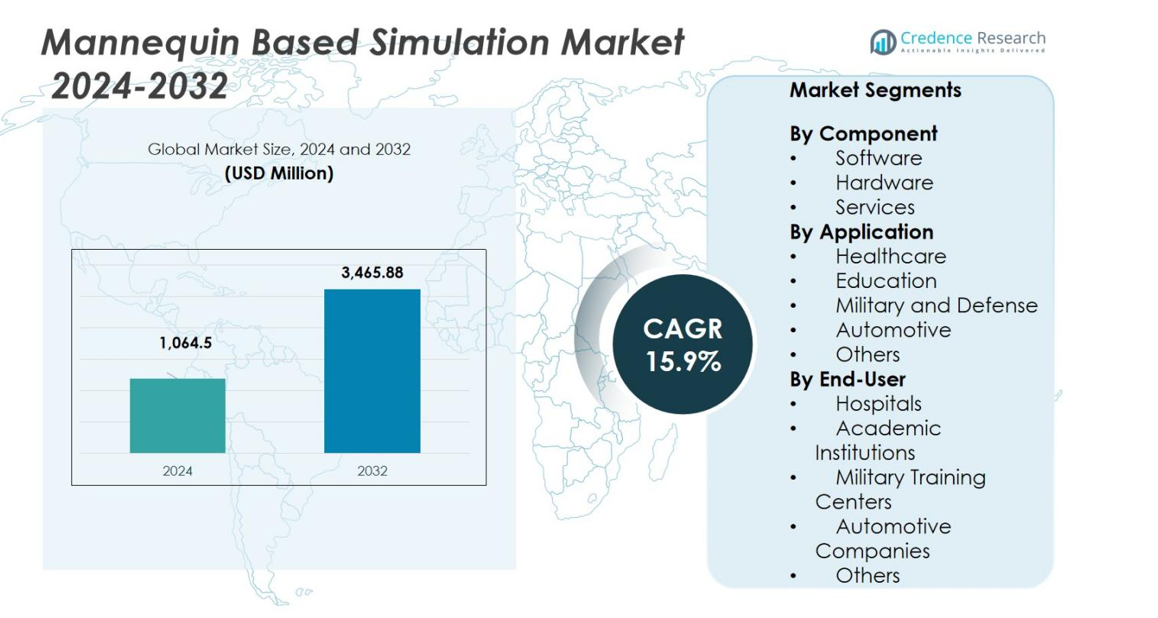
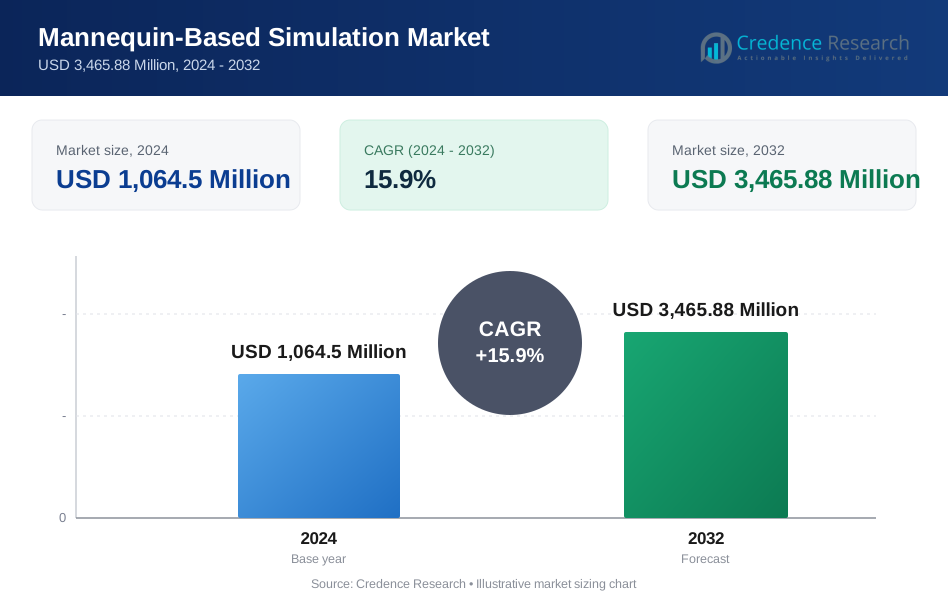
The Mannequin Based Simulation Market size was valued at USD 1,064.5 Million in 2024 and is anticipated to reach USD 3,465.88 Million by 2032, at a CAGR of 15.9% during the forecast period.
| REPORT ATTRIBUTE | DETAILS |
|---|---|
| Historical Period | 2020-2023 |
| Base Year | 2024 |
| Forecast Period | 2025-2032 |
| Mannequin Based Simulation Market Size 2024 | USD 1,064.5 Million |
| Mannequin Based Simulation Market, CAGR | 15.9% |
| Mannequin Based Simulation Market Size 2032 | USD 3,465.88 Million |
The Mannequin Based Simulation Market features leading players such as Laerdal Medical, CAE Healthcare, Gaumard Scientific, Limbs & Things, 3B Scientific, Simulaids, Kyoto Kagaku, Mentice AB, Surgical Science Sweden AB and Operative Experience Inc.. These companies invest heavily in R&D to deliver high‑fidelity mannequins, integrated simulation software and comprehensive service offerings. The market is geographically led by the North America region, which held 35% market share in 2024 due to advanced healthcare infrastructure and strong training ecosystem. Urban centres across this region continue to adopt and scale simulation‑based training, reinforcing industry lead and providing a launch pad for global expansion.
Market Insights
- The Mannequin Based Simulation Market was valued at USD 1,064.5 Million in 2024 and is anticipated to reach USD 3,465.88 Million by 2032, registering a CAGR of 15.9 % during the forecast period.
- The Hardware segment held a dominant share of 55 % in 2024, supported by strong demand for high‑fidelity mannequins in healthcare and training settings.
- Integration of artificial intelligence and virtual reality into mannequin‑based systems is emerging as a key trend, creating enhanced training experiences across healthcare, military, and education verticals.
- Market growth faces restraints such as high initial investment costs and complexities in integrating advanced simulation systems into existing training infrastructures.
- Regionally, North America led the market with a 35 % share in 2024, followed by Europe at 25 % and Asia Pacific at 20 %, driven by advanced healthcare systems and robust defense training programs.
Market Segmentation Analysis:
By Component
In the Mannequin-Based Simulation Market, the Hardware segment holds the dominant share, accounting for 55% in 2024. Hardware-based simulators, including mannequins and associated equipment, are the primary focus of this market segment, driven by the increasing demand for realistic training environments across various sectors. The high adoption rates in healthcare training, where lifelike simulation is crucial, fuel the growth of the hardware segment. The Software segment follows closely with significant growth potential due to the increasing demand for advanced simulation software that enhances realism and user experience in various training applications.
- For instance, the Software segment is gaining traction with innovations like CAE Healthcare’s AI-powered simulation software developed to elevate training interactivity and adaptiveness, complementing the hardware with enhanced user experience and realism.
By Application
The Healthcare application segment is the largest, commanding a share of 45% in the Mannequin-Based Simulation Market in 2024. The increasing focus on medical training, patient safety, and the rising need for skill development in healthcare professionals, particularly for critical care and emergency procedures, are key growth drivers. Education follows with a growing share, as academic institutions adopt mannequin-based simulations to improve hands-on learning experiences. The Military and Defense segment is also gaining traction due to the rising use of simulation technologies for tactical and emergency training, contributing to the segment’s growth.
- For instance, MedVision’s manikins like Leonardo enable healthcare professionals to practice routine and emergency medical procedures, enhancing their skills in a risk-free environment.
By End-User
The Hospitals segment is the dominant end-user category in the mannequin-based simulation market, representing 38% of the market share in 2024. This is driven by the need for hospitals to ensure that healthcare professionals receive high-quality, hands-on training to handle real-world emergencies. The Academic Institutions segment also holds a significant share of about 32%, driven by the increasing adoption of simulation-based learning in medical and engineering courses. Military Training Centers follow with a growing share due to the rising demand for tactical training solutions that enhance combat readiness through realistic simulation technologies.
Key Growth Drivers
Rising Demand for Healthcare Training
The growing need for advanced healthcare training is a major driver for the mannequin-based simulation market. As medical professionals increasingly rely on simulation technology to hone their skills without risk to patients, the demand for high-quality, realistic mannequins continues to rise. This is particularly crucial for emergency medicine, surgery, and other high-stakes environments. Healthcare institutions are incorporating mannequins into their training programs to enhance skill development, reduce medical errors, and improve patient outcomes, contributing significantly to the market’s expansion.
- For instance, Laerdal Medical’s SimMan 3G PLUS offers immersive emergency care training with realistic patient handling, interchangeable face skins, and the ability to practice with real clinical devices, enhancing decision-making and teamwork skills in high-stress scenarios.
Technological Advancements in Simulation
Advancements in simulation technology, such as AI, VR, and haptic feedback, are propelling the growth of the mannequin-based simulation market. These technologies enhance realism and interaction, making training experiences more immersive and effective. The integration of software that mimics real-world scenarios allows trainees to engage in realistic, high-pressure situations. This innovation improves learning outcomes and drives the adoption of advanced simulation systems across sectors like healthcare, military, and automotive, further accelerating market growth.
- For instance, 3D Systems has introduced the Touch and Touch X haptic devices, delivering force-feedback technology that allows users to feel virtual objects, enhancing tactile realism for surgical training and design workflows.
Increasing Adoption in Military and Defense
The mannequin-based simulation market is witnessing robust growth in the military and defense sectors. Realistic training environments using mannequins enable military personnel to practice in scenarios that simulate combat situations, disaster response, and tactical operations. As governments and defense organizations focus on enhancing training quality and reducing operational risks, the demand for mannequin-based simulation systems in military and defense applications continues to rise. This adoption is bolstered by the need for cost-effective and safe training solutions for personnel in critical roles.
Key Trends & Opportunities
Integration of Artificial Intelligence and Virtual Reality
The integration of artificial intelligence (AI) and virtual reality (VR) in mannequin-based simulation systems is a key trend that offers significant opportunities for the market. AI enables adaptive learning systems that tailor scenarios based on individual performance, enhancing the training experience. Virtual reality further immerses trainees, allowing them to interact with their environment in a virtual space. These technologies improve the realism and efficiency of training, creating opportunities for manufacturers to innovate and provide advanced solutions that cater to various industries like healthcare, military, and education.
- For instance, Boeing has utilized AR-assisted assembly instructions in manufacturing training that reduced production time by 25% and error rates by 40%, highlighting AI and VR’s role in industrial skills training by providing personalized, interactive guidance and feedback.
Growth in Emerging Markets
Emerging markets, particularly in Asia-Pacific, are presenting lucrative opportunities for the mannequin-based simulation market. The growing demand for advanced training solutions in developing economies, coupled with increasing investments in education and healthcare infrastructure, drives market expansion in these regions. As these markets witness improvements in medical training and defense capabilities, there is a surge in the adoption of simulation systems. The expansion of global healthcare standards and military modernization further supports the uptake of mannequin-based simulation technologies in these regions.
- For instance, Laerdal Medical A/S has reported rising adoption of their patient simulators in developing countries to enhance medical training and patient safety.
Key Challenges
High Initial Investment Costs
A key challenge faced by the mannequin-based simulation market is the high initial investment required for advanced simulation systems. The cost of acquiring high-quality mannequins, along with the integration of sophisticated software and hardware, can be prohibitive for some institutions, particularly in developing regions. This financial barrier limits the adoption of mannequin-based training solutions, especially among smaller organizations or those with constrained budgets, hindering the market's potential growth.
Complexity in System Integration
The complexity involved in integrating mannequin-based simulation systems with existing training programs presents a significant challenge. Many organizations struggle to seamlessly incorporate new technology into their established training processes, particularly in healthcare and military settings. Ensuring compatibility between simulation equipment, software, and existing training infrastructure requires substantial technical expertise and resources, which can slow the pace of adoption. This challenge necessitates ongoing research and development to streamline system integration and reduce implementation barriers.
Regional Analysis
North America
The North America region held a market share of 35% in the mannequin‑based simulation market in 2024. The adoption is strong due to its advanced healthcare infrastructure, established training centres, and significant defence spending that require high‑fidelity simulation systems. The presence of major players and continuous innovations in simulation hardware and software further bolster this dominance. Hospitals and academic institutions in the US and Canada increasingly incorporate mannequin‑based systems to improve clinical competency and patient safety. With rising demand for minimally invasive procedures and high‑stakes training environments, the North America region continues to drive market growth.
Europe
Europe accounted for a market share of 25% in the mannequin‑based simulation market in 2024. Countries such as Germany, the UK and France show significant uptake of training simulations in both healthcare and military sectors. The region benefits from well‑regulated medical education frameworks and strong investments in simulation training technologies. European institutions prioritise patient safety and surgical skill development, which strengthens the demand for high‑fidelity mannequins and accompanying systems. Emerging regulatory mandates and partnerships between simulation vendors and academic/training centres are further advancing market penetration across Europe.
Asia Pacific
The Asia Pacific region represented 20% of the mannequin‑based simulation market in 2024. Rapid expansion of healthcare infrastructures, rising training standards and growing defence budgets in countries such as China, India and Japan are key growth drivers. The region is witnessing accelerated adoption of simulation solutions to enhance clinical training and operational readiness in military and emergency response settings. Furthermore, lower cost of labour and increasing number of training centres are enabling broader use of mannequin‑based systems across both public and private sectors, positioning Asia Pacific as a fast‑growing region in the forecast period.
Latin America
Latin America held an estimated share of 10% of the mannequin‑based simulation market in 2024. While adoption levels are lower compared with developed regions, increasing investments in healthcare education, simulation training programmes within military units, and the expansion of private sector training centres are beginning to contribute to growth. Economic constraints and budget challenges remain barriers, yet governments in Brazil and Mexico are gradually prioritising training infrastructures to reduce clinical error rates and improve patient outcomes, which supports future market opportunities in Latin America.
Middle East & Africa
The Middle East & Africa (MEA) region accounted for the remaining 10% of the global mannequin‑based simulation market in 2024. Growth is driven by increasing military and defence training expenditures, the development of simulation‑based healthcare education in GCC countries, and the rising presence of international medical training providers. Despite the growth potential, challenges such as limited local manufacturing capacity, infrastructure gaps and budgetary constraints restrict faster uptake. However, initiatives focusing on building simulation centres and enhancing training quality for healthcare and defence personnel point to improved prospects for MEA over the forecast period.
Market Segmentations:
By Component
- Software
- Hardware
- Services
By Application
- Healthcare
- Education
- Military and Defense
- Automotive
- Others
By End-User
- Hospitals
- Academic Institutions
- Military Training Centers
- Automotive Companies
- Others
By Region
- North America
- U.S.
- Canada
- Mexico
- Europe
- Germany
- France
- U.K.
- Italy
- Spain
- Rest of Europe
- Asia Pacific
- China
- Japan
- India
- South Korea
- South-east Asia
- Rest of Asia Pacific
- Latin America
- Brazil
- Argentina
- Rest of Latin America
- Middle East & Africa
- GCC Countries
- South Africa
- Rest of the Middle East and Africa
Competitive Landscape
The competitive landscape in the mannequin‑based simulation market features major key players such as Laerdal Medical, CAE Healthcare, Gaumard Scientific, Limbs & Things, 3B Scientific, Simulaids, Kyoto Kagaku, Mentice AB, Surgical Science Sweden AB and Operative Experience Inc.. These firms actively pursue differentiation through product innovation, partnerships, and geographic expansion to capture market share. They deploy extensive R&D to enhance fidelity in hardware and simulation software, leveraging digital integration such as AI and VR. Many also form strategic alliances with healthcare institutions and defense organizations to broaden training solutions. Market consolidation and mergers add further intensity, raising barriers for smaller entrants. As a result, competitive rivalry remains moderate‑to‑high, with companies striving to maintain leadership by expanding application scopes and improving service offerings.
Key Player Analysis
- Mentice AB
- Gaumard Scientific
- Limbs & Things
- Surgical Science Sweden AB
- 3B Scientific
- Operative Experience Inc.
- Kyoto Kagaku
- CAE Healthcare
- Laerdal Medical
- Simulaids
Recent Developments
- In January 2024, Laerdal also unveiled its new obstetric simulator, “MamaAnne™”, developed in collaboration with Limms & Things, designed to train maternal‑health teams on labour, delivery, and emergency scenarios.
- In March 2024, IngMar Medical launched Aurora, a medical simulation manikin used to train clinicians in all forms of ventilation, featuring an innovative Internal Simulated Lung (ISL) based on IngMar's ASL 5000 Breathing Simulator technology with tetherless, internal system integration.
- In December 2024, Fujifilm India launched the innovative Mikoto Colon Model, a cutting-edge endoscopy simulation technology combining advanced sensor technology with artificial intelligence, featuring four difficulty levels for self-paced learning among practitioners of varying expertise.
Report Coverage
The research report offers an in-depth analysis based on Component, Application, End User and Region. It details leading market players, providing an overview of their business, product offerings, investments, revenue streams, and key applications. Additionally, the report includes insights into the competitive environment, SWOT analysis, current market trends, as well as the primary drivers and constraints. Furthermore, it discusses various factors that have driven market expansion in recent years. The report also explores market dynamics, regulatory scenarios, and technological advancements that are shaping the industry. It assesses the impact of external factors and global economic changes on market growth. Lastly, it provides strategic recommendations for new entrants and established companies to navigate the complexities of the market.
Future Outlook
- The market will expand as more training programmes embed high‑fidelity mannequins into standard curricula across healthcare and defence sectors.
- Artificial intelligence and virtual‑reality integration will enable personalised simulation scenarios, boosting training effectiveness and driving demand.
- Emerging economies will account for increasing volume growth as government policies support simulation‑based education and defence training infrastructure builds out.
- The shift toward competency‑based education will elevate demand for mannequins that simulate complex clinical events, enhancing experiential learning outcomes.
- Cross‑industry adoption, including automotive and industrial safety training, will open new vertical applications beyond healthcare and military.
- Service‑and‑maintenance models will expand, enabling vendors to offer full‑lifecycle support and recurring revenue streams tied to simulation hardware.
- Modular and scalable mannequin systems will gain traction as institutions seek cost‑effective upgrades rather than full‑system replacements.
- Partnerships between simulation vendors and academic/clinical centres will accelerate product validation and generate site‑specific use‑cases driving uptake.
- Standardisation and certification requirements for simulation training by regulatory bodies will elevate baseline demand for certified mannequin‑based solutions.
- Consolidation through mergers and acquisitions will accelerate, with larger players acquiring niche specialists to broaden functionality and strengthen global distribution.
Request a Free Sample
Fill in your details and we'll send you a free sample report.
- Sample data tables & charts
- Research methodology
Need a Custom Version of This Report?
Tailor the scope, geography, or segments to your exact requirements.
- Custom geography or segment scope
- Direct access to our analyst team
Frequently Asked Questions
What is the current market size for Mannequin Based Simulation Market, and what is its projected size in 2032?
At what Compound Annual Growth Rate is the Mannequin Based Simulation Market projected to grow between 2025 and 2032?
Which is the leading region of the market for Mannequin-Based Simulation?
What are the key drivers for the growth of the Mannequin-Based Simulation market?
Which is the major segment in the Mannequin-Based Simulation market by application?
Who are the leading companies in the Mannequin Based Simulation Market?
Table of Content
Chapter 1. Report Introduction
- 1.1 Report Description & Purpose
- 1.1.1 Report Title & Market Definition
- 1.1.2 Unique Selling Propositions (USP) & Key Differentiators
- 1.1.3 Value Proposition for Stakeholders
- 1.2 Research Objectives
- 1.2.1 Market Sizing Objectives (Volume & Revenue)
- 1.2.2 Segmentation Objectives
- 1.2.3 Competitive Intelligence Objectives
- 1.2.4 Forecast & Scenario Objectives
- 1.3 Report Scope
- 1.3.1 Mannequin-Based Simulation Scope – Types & Subtypes Covered
- 1.3.2 Geographic Scope – Regions & Countries Covered
- 1.3.3 Historical Period, Base Year & Forecast Period (2024; forecast to 2032)
- 1.3.4 Inclusions & Exclusions
- 1.4 HS Code & Classification Framework
- 1.5 Currency, Units & Pricing Basis
- 1.6 Target Stakeholders
- 1.7 Limitations & Assumptions
Chapter 2. Executive Summary
- 2.1 Global Mannequin-Based Simulation Market Snapshot
- 2.1.1 Market Size – Historical (2024) & Forecast (2024-2032) (2024: USD 1,064.5 Million → 2032: USD 3,465.88 Million)
- 2.1.2 Volume & Revenue – Global Totals
- 2.1.3 Key Market Highlights – Top Five Facts
- 2.2 Mannequin-Based Simulation Market Segmentation Snapshot
- 2.2.1 Market Split by Region – 2024 vs. 2032
- 2.3 Competitive Snapshot
- 2.3.1 Top 10 Players by Revenue Share – 2024
- 2.3.2 Top 10 Players by Volume Share – 2024
- 2.3.3 Recent Strategic Developments (18-Month Summary)
- 2.4 Key Investment Highlights & Strategic Conclusions
Chapter 3. Mannequin-Based Simulation Market Dynamics & Industry Analysis
- 3.1 Market Overview & Context
- 3.1.1 Mannequin-Based Simulation Market Position in the Broader Automotive Value Chain
- 3.1.2 OEM vs. Replacement Market Dynamics
- 3.1.3 Market Maturity & Development Stage by Region
- 3.2 Mannequin-Based Simulation Market Drivers
- 3.3 Mannequin-Based Simulation Market Restraints & Challenges
- 3.4 Mannequin-Based Simulation Market Opportunities
- 3.5 Porter's Five Forces Analysis
- 3.5.1 Threat of New Entrants
- 3.5.2 Bargaining Power of Suppliers
- 3.5.3 Bargaining Power of Buyers
- 3.5.4 Threat of Substitutes
- 3.5.5 Competitive Rivalry – Intensity Assessment
- 3.6 Mannequin-Based Simulation Value Chain Analysis
- 3.6.1 Upstream – Raw Material/Input Suppliers
- 3.6.1.1 Raw Material/Input 1
- 3.6.1.2 Raw Material/Input 2
- 3.6.1.3 Raw Material/Input 3
- 3.6.2 Midstream – Production/Manufacturing/Service Delivery
- 3.6.2.1 Production/Process Overview
- 3.6.2.2 Key Facility Locations & Capacity by Manufacturer
- 3.6.3 Downstream – Distribution & End Consumer
- 3.6.3.1 Primary Channel – B2B/OEM
- 3.6.3.2 Secondary Channels – Dealer, Retail, Online, Direct
- 3.6.4 Value Chain Profitability Analysis
- 3.6.1 Upstream – Raw Material/Input Suppliers
- 3.7 PESTEL Analysis
- 3.7.1 Political Factors
- 3.7.2 Economic Factors
- 3.7.3 Social Factors
- 3.7.4 Technological Factors
- 3.7.5 Environmental Factors
- 3.7.6 Legal Factors
- 3.8 Mannequin-Based Simulation Supply Chain Analysis
- 3.8.1 Raw Material/Input Supply Risk Assessment
- 3.8.2 Manufacturing Concentration Risk (Geographic Exposure)
- 3.8.3 Trade Disruption Impact Analysis
- 3.9 Regulatory & Policy Landscape
Note: The regulatory and policy landscape section covers regulations based on their applicability to the market, Mannequin-Based Simulation category, geography, and scope of the study. Only regulatory frameworks with a material impact on operations, compliance, trade, sustainability, or market access are analyzed in detail.
Chapter 4. Key Investment Pockets & Opportunity Analysis
- 4.1 Mannequin-Based Simulation Market Attractiveness Analysis
- 4.1.1 By Region – Investment Attractiveness Matrix (Volume × CAGR)
- 4.2 Absolute Revenue Growth Opportunity
- 4.2.1 By Region – Absolute USD Growth Through 2032
- 4.3 Incremental Volume Opportunity
- 4.3.1 By Region – Incremental Volume Through 2032
- 4.3.2 Segment – Incremental Volume
- 4.4 Emerging Submarket Opportunity Deep Dive (Subject to Applicability)
- 4.5 Emerging Market Opportunity Scorecards
- 4.5.1 United States
- 4.5.2 Europe
- 4.5.3 Asia
- 4.5.4 Middle East & Africa
Note: Emerging Market Opportunity Scorecards will be included based on relevance and strategic importance. Regions listed are indicative and may vary depending on data availability and market dynamics.
Chapter 5. Mannequin-Based Simulation Import-Export Analysis & Trade Flows
- 5.1 Global Trade Overview
- 5.1.1 Global Export Value by Country (2024)
- 5.1.2 Global Export Volume by Country (2024)
- 5.1.3 Global Import Value by Country (2024)
- 5.1.4 Global Import Volume by Country (2024)
- 5.1.5 Net Trade Balance by Country (2024)
- 5.2 Export Analysis – Segment
- 5.2.1 Type 1 (HS Code)
- 5.2.2 Type 2 (HS Code)
- 5.2.3 Type 3 (HS Code)
- 5.2.4 Type 4 (HS Code)
- 5.2.5 Type 5 (HS Code)
- 5.3 Import Analysis – Segment
- 5.3.1 Type 1 (HS Code)
- 5.3.2 Type 2 (HS Code)
- 5.3.3 Type 3 (HS Code)
- 5.3.4 Type 4 (HS Code)
- 5.3.5 Type 5 (HS Code)
- 5.4 Average Unit Trade Prices
- 5.4.1 Average Export Price – Segment & Country
- 5.4.2 Average Import Price – Segment & Source Country
- 5.4.3 Price Trends (2024)
- 5.5 Key Trade Route Analysis
- 5.5.1 Trade Route 1
- 5.5.2 Trade Route 2
- 5.5.3 Trade Route 3
- 5.5.4 Trade Route 4
- 5.5.5 Trade Route 5
- 5.6 Trade Policy Impact Assessment
- 5.6.1 US Anti-Dumping & Section 301 Tariffs
- 5.6.2 EU Customs Union Impact
- 5.6.3 Major Free Trade Agreements
- 5.6.4 USMCA Rules of Origin
Note: Trade policy analysis will be included only where relevant to the Mannequin-Based Simulation market.
Chapter 6. Competitive Landscape & Company Benchmarking
- 6.1 Mannequin-Based Simulation Market Concentration & Structure
- 6.1.1 Herfindahl-Hirschman Index (HHI) – vs. 2024
- 6.1.2 Tier 1, Tier 2 & Tier 3 Market Structure
- 6.1.3 Global, Regional & Local Player Dynamics
- 6.2 Mannequin-Based Simulation Market Share Analysis – 2024
- 6.2.1 Global Revenue Share by Company
- 6.2.2 Global Volume Share by Company
- 6.2.3 Regional Revenue Share
- 6.2.4 Market Share Evolution ( vs. 2024)
- 6.2.5 OEM Segment Share by Company
- 6.2.6 Replacement Segment Share by Company
- 6.3 Production/Delivery Capacity & Facility Analysis
- 6.3.1 Global Installed Capacity
- 6.3.2 Capacity Utilization Rates
- 6.3.3 Production/Output Volume
- 6.3.4 Facility Locations & Capacity Map
- 6.3.5 Planned Capacity Additions
- 6.4 Mannequin-Based Simulation Competitive Benchmarking Matrix
- 6.4.1 Revenue, Volume, CAGR & Profitability Comparison
- 6.4.2 Channel Revenue Mix
- 6.4.3 Geographic Revenue Exposure
- 6.4.4 R&D Intensity
- 6.4.5 Sustainability Maturity
- 6.5 Strategic Developments in Mannequin-Based Simulation (Last 24 Months)
- 6.5.1 Mergers, Acquisitions & Divestments
- 6.5.2 New Mannequin-Based Simulation Launches
- 6.5.3 Facility Expansions
- 6.5.4 Strategic Alliances, Joint Ventures & Partnerships
- 6.5.5 Distribution Expansion & Market Entry
- 6.5.6 Sustainability & ESG Initiatives
- 6.6 Competitive Strategy Mapping
- 6.6.1 Leader, Challenger, Follower & Niche Classification
- 6.6.2 Pricing Strategy Comparison
- 6.6.3 Channel Strategy Matrix
Note: Strategic developments are included based on their materiality and the availability of reliable information.
Chapter 7. Global Mannequin-Based Simulation Market – By Distribution Channel
- 7.1 Segment Overview
- 7.1.1 Volume & Revenue Split by Channel (2024 & 2032)
- 7.1.2 Channel Mix Evolution (2024-2032)
Chapter 8. Regional Market Analysis – Global Overview
- 8.1 Global Regional Overview
- 8.1.1 Regional Volume Share
- 8.1.2 Regional Revenue Share
- 8.1.3 Regional Volume by Region
- 8.1.4 Regional Revenue by Region
- 8.1.5 Regional Forecast Through 2032
- 8.2 Cross-Regional Segment Analysis
- 8.2.1 By Distribution Channel
- 8.2.2 By Brand/Price Tier
Chapter 9. North America Mannequin-Based Simulation Market
- 9.1 United States
- 9.2 Canada
- 9.3 Mexico
Chapter 10. Europe Mannequin-Based Simulation Market
- 10.1 Germany
- 10.2 France
- 10.3 Italy
- 10.4 United Kingdom
- 10.5 Spain
- 10.6 Poland
- 10.7 Russia
- 10.8 Netherlands
- 10.9 Belgium
- 10.10 Sweden
- 10.11 Denmark
- 10.12 Norway
- 10.13 Rest of Europe
Chapter 11. Asia Pacific Mannequin-Based Simulation Market
- 11.1 China
- 11.2 India
- 11.3 Japan
- 11.4 South Korea
- 11.5 Thailand
- 11.6 Indonesia
- 11.7 Vietnam
- 11.8 Malaysia
- 11.9 Australia
- 11.10 Rest of Asia Pacific
Chapter 12. Latin America Mannequin-Based Simulation Market
- 12.1 Brazil
- 12.2 Argentina
- 12.3 Colombia
- 12.4 Chile
- 12.5 Rest of Latin America
Chapter 13. Middle East Mannequin-Based Simulation Market
- 13.1 Saudi Arabia
- 13.2 United Arab Emirates
- 13.3 Turkey
- 13.4 Israel
- 13.5 Iran
- 13.6 Rest of the Middle East
Chapter 14. Africa Mannequin-Based Simulation Market
- 14.1 South Africa
- 14.2 Egypt
- 14.3 Nigeria
- 14.4 Morocco
- 14.5 Rest of Africa
Chapter 15. Mannequin-Based Simulation Company Profiles
- 15.1 [Company 01]
- 15.1.1 Company Overview
- 15.1.2 Key Management Personnel
- 15.1.3 Products & Services Portfolio
- 15.1.4 Financial Performance
- 15.1.5 Key Market Focus & Geographic Presence
- 15.1.6 Recent Developments & Strategic Initiatives
Note: The company profile list is preliminary and may change based on research findings, market developments, data availability, and client requirements.
Chapter 16. Appendices
- Appendix A – List of Abbreviations & Acronyms
- Appendix B – Industry Classification Code Reference – Full Series
- Appendix C – Production & Capacity Data Tables
- Appendix D – End-Use & Demand Base Tables
- Appendix E – Consumption & Replacement Rate Assumptions
- Appendix F – ASP Reference Tables
- Appendix G – Manufacturing & Facility Database
- Appendix H – Import-Export Data Tables
- Appendix I – Regulatory Summary Tables
- Appendix J – Primary Research Participant List (Anonymized)
- Appendix K – Primary Research Questionnaire Framework
- Appendix L – Data Sources & Bibliography
- Appendix M – Market Size Divergence & Source Comparison
Chapter 17. Research Methodology
- 17.1 Research Framework & Philosophy
- 17.2 Secondary Research – Sources, Hierarchy & Data Extraction
- 17.3 Data Modeling – Bottom-Up & Top-Down Market Sizing
- 17.4 Primary Research – Stakeholder Framework, LOI & Sample Sizes
- 17.5 Forecast Methodology – Regression, Scenario & Sensitivity Analysis
- 17.6 Quality Control – Four-Layer Validation Framework
- 17.7 Limitations & Standard Assumptions
- 17.8 Disclaimer
